The line element approach for the geometry of Poincar´
e disk
Jong Ryul Kim
AbstractThe geometry of Poincar´e disk itself is interpreted without any mapping to different spaces. Our approach might be one of the shortest and is intended for educational contribution.
Mathematics Subject Classification (2010) 53A35, 53C22 97-02
Keywords: Poincar´e disk; inner product; cross ratio; holomorphic function; angle; line element
Email: [email protected]
Address: Department of Mathematics, Kunsan National University, Kunsan, 573-701, Republic of Korea
1. Introduction
For vectors vp = (v1, v2) and wp = (w1, w2) in 2-dimensional Euclidean space
R2, the norm of a vector |vp| =
√
vp·vp = p
v2
1+v22 which is the Pythagorean theorem is defined by the dot product
vp·wp=v1w1+v2w2
and the angle θformed by two vector v, w∈R2 is given by cosθ=|vv||·ww|. The arc length of a differentiable curveα(t) inR2 fromα(0) toα(1) is given by
Z 1
0
|α0(t)|dt=
Z 1
0
p
α0(t)·α0(t)dt
and the arc length of a piecewise differentiable curve is the sum of the arc length of differentiable parts. The distance from α(0) to α(1) is defined by the shortest arc length among all curves. We can easily show that the straight line from α(0) to α(1) is the shortest arc length when the dot product is given onR2. Thus by considering an inner productg(v, w) on a vector spaceV ⊂R2and defining the arc length of a curveα(t) by
Z 1
0
|α0(t)|dt=
Z 1
0
p
g(α0(t), α0(t))dt,
we can have a distance different from Euclidean geometry. A geometry where four Euclidean postulates except for the Parallel one hold is known as absolute geometry ([6]). A non-Euclidean geometry with an inner product g on Poincar´e
1
disk DP ={(x, y)∈R2|x2+y2<1}satisfying the following three observations is going to be determined.
• First, ifg(vp, wp) =f(p)(vp·wp), then the angle defined by an inner product is
equal to the angle defined by the dot product
cosθ = p g(vp, wp) g(vp, vp)
p
g(wp, wp)
= p f(p)(vp·wp) f(p)(vp·vp)
p
f(p)(wp·wp)
= vp·wp |vp||wp|
= cosθ .
• Second, the geometry of Poincar´e disk DP is assumed to be rotationally
sym-metric, that is, the geometry of a neighborhood at p is isometric to that of a neighborhood at any point qrelated to pby rotation of any angle. It means that a function f(r, θ) = f(x, y) ing(vp, wp) =f(p)(vp·wp) depends only onrfor the
polar coordinates p= (x, y) = (rcosθ, rsinθ)∈DP.
• Third, the Euclidean norm of a vector vp = (v1, v2) at p= (p1, p2) ∈DP with
(p1+v1, p2+v2)∈DP must be scaled to infinity aspgoes to the boundary ofDP,
since the boundary is considered to be a circle of radius∞.
Under these three assumptions, one of the simplest candidates for an inner prod-uctg on Poincar´e diskDP could be
g(vp, wp) =
2(vp·wp)
1−(x2+y2)
for all points p = (x, y) ∈ DP and scaling constant 2. The line element ds2 of
Poincar´e disk is
ds2= 4(dx
2+dy2)
(1−(x2+y2))2.
Let α(t) = (x(t), y(t)) be a differentiable curve from α(0) to α(1) in DP. The
arc length ofα(t) fromα(0) = toα(1) is
Z 1
0
p
g(α0(t), α0(t))dt=
Z 1
0
2|α0(t)| 1− |α(t)|2dt,
where|α0(t)|=p
α0(t)·α0(t) and|α(t)|2=x(t)2+y(t)2. The distanced(α(0), α(1)) is the shortest arc length among all curve from α(0) to α(1)
d(α(0), α(1)) = infα Z 1
0
2|α0(t)| 1− |α(t)|2dt .
We are going to find a shortest path between any two points in Poincar´e disk by using a distance-preserving biholomorphic mapping on Poincar´e disk or a linear fractional transformation which preserves the cross ratio and the distance. We also show that Poincar´e Disk is isometric to one connected component of two-sheeted hyperboloid −x2+y2+z2 =−1 in 3-dimensional Minkowski space-time and the sum of the interior angles of a triangle, a Saccheri quadrilateral on Poincar´e disk is less than π, 2π, respectively.
There are plenty lecture notes, papers([1],[5], [7]) and books ([2] [3],[4], [6]) on the hyperbolic geometry. The picture of the hyperbolic geometry is well-known. Here we suggest intuitive and direct approaches for the effective understanding of the hyperbolic geometry.
A function f :DP −→DP ⊂Cis said to be holomorphic iff(x, y) =u(x, y) +
iv(x, y) satisfies the Cauchy Riemann equations
∂u ∂x =
∂v ∂y,
∂v ∂x =−
∂u ∂y.
A biholomorphic function is a holomorphic functionf which is bijective and whose inverse f−1 is also holomorphic. Let α(t) =x(t) +iy(t) be a differentiable curve from α(0) =z1 toα(1) =z2in DP. Forf(z1) = (f◦α)(0) andf(z2) = (f◦α)(1), the distanced(f(z1), f(z2)) is
d(f(z1), f(z2)) = inff(α)
Z 1
0
2|(f ◦α)0(t)| 1− |(f◦α)(t)|2dt .
We show that iff is a holomorphic function onDP, thend(f(z1), f(z2))≤d(z1, z2).
Schwarz-Pick Theorem For a holomorphic function f : DP −→ DP, it holds
that
|f0(z)| 1− |f(z)|2 ≤
1 1− |z|2 .
Proof. Define
g(z) = z1−z 1−z1z
, h(z) = f(z1)−z
1−f(z1)z z1∈DP.
Sinceg−1(0) =z1, we havehf(g−1(0))= 0. Using the Schwarz Lemma, we get
h
f(g−1(z)) ≤ |z|.
Hence
h
f(z)
= h
f(g−1(g(z)))
≤ |g(z)|
f(z1)−f(z)
1−f(z1)f(z)
≤
z1−z 1−z1z
lim
z→z1
f(z1)−f(z) z1−z
1−f(z1)f(z)
≤zlim→z1
1 1−z1z
.
So we have
|f0(z)| 1− |f(z)|2 ≤
1 1− |z|2 .
Forz1=α(0), z2=α(1) andf(z1) = (f◦α)(0),f(z2) = (f◦α)(1), we get
inff(α)
Z 1
0
2|f0(α(t))||α0(t)|
1− |f(α(t))|2 dt≤infα
Z 1
0
2|α0(t)|
1− |α(t)|2dt=d(z1, z2)
by Schwarz-Pick Theorem. So we get ([5])
d(f(z1), f(z2))≤d(z1, z2). (1)
Iff−1is a holomorphic function on DP, then we have
d(z1, z2) =d(f−1(f(z1)), f−1(f(z2)))≤d(f(z1), f(z2))
by applying the above (1). Hence we obtain
d(f(z1), f(z2)) =d(z1, z2) (2)
3. A shortest path between any two points in Poincar´e disk
We show that a straight line connecting the origin and an arbitrary point p∈
DP is a shortest path. Let α(t) = (x(t), y(t)) = (r(t) cosθ(t), r(t) sinθ(t)) be a
differentiable curve from α(0) = (0,0) to α(1) = (x(1), y(1)) = p for the polar coordinates. Calculations show that
α0(t) = (r0(t) cosθ(t)−r(t) sinθ(t)θ0(t), r0(t) sinθ(t) +r(t) cosθ(t)θ0(t))
Z 1
0
p
g(α0(t), α0(t))dt =
Z 1
0
2p(r0(t))2+ (r(t))2(θ0(t))2 1−r(t)2 dt
≥
Z 1
0
2p(r0(t))2 1−r(t)2 dt
=
Z 1
0
2|r0(t)| 1−r(t)2dt,
where we use the inequality
p
(r0(t))2+ (r(t))2(θ0(t))2≥p(r0(t))2.
It means that the length of an arbitrary curve connecting the origin and an arbitrary pointp∈DP is greater than equal to the length of a straight line which is the case
of a constant θ0=θ(t) connecting the origin and an arbitrary point p∈DP. Fix
two constants cosθ(t) =a and sinθ(t) =b. Let α(t) = (at, bt) be a straight line from α(0) = (0,0) toα(1) = (a, b) forc=√a2+b2<1. Then we have
Z 1
0
p
g(α0(t), α0(t))dt =
Z 1
0
2√a2+b2 1−(a2+b2)t2dt
=
Z 1
0 2c 1−c2t2dt
=
Z 1
0 c 1 +ct−
−c 1−ctdt
= ln1 +c 1−c.
Also letα(t) = (0, ct) be a straight line fromα(0) = (0,0) toα(1) = (0, c) forc <1. Then we have
Z 1
0
p
g(α0(t), α0(t))dt =
Z 1
0 2c 1−c2t2dt
=
Z 1
0 c 1 +ct−
−c 1−ctdt
= ln1 +c 1−c .
A functionf :C−→Cof the form
f(z) = az+b
cz+d (ad−bc6= 0)
is called a linear fractional transformation. Note that a M¨obius transformationf
f(z) = z+a ¯
az+ 1 (3)
for|a|2=aa <¯ 1 anda∈
Cis a linear fractional transformation which is a bijective mapping on DP, since
𝑥
𝑦
𝑎 1
𝑧
𝐷𝑃
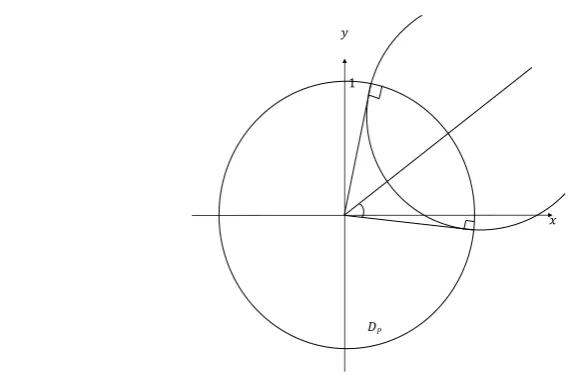
0
r
Figure 1. A shortest path through a point (a,0) on Poincar´e disk
and f(0) =a. It is clear that
f(z) = z+a ¯
az+ 1 = 1 ¯ a+
a−1 ¯
a
¯ az+ 1
is biholomorphic, sincef(z) =az+b fora, b∈Candf(z) =1z are holomorhic.
LetCbe a circle with centerz0= (x0, y0) and radiusron the complex planeC, that is,
(z−z0)(z−z0) =r2
zz¯−z¯0z−z0z¯+z0z¯0−r2= 0. (4)
We show that a part of C in DP which meets orthogonally at two points of the
boundary of Poincar´e disk is a shortest path. Rewrite (4) as
zz¯+δz+ ¯δz¯+γ= 0 forδ=−z0 and|z0|2−r2=γ . (5)
LetLbe a line through the origin on the complex planeC
L={(x, y)|cx+dy= 0}. (6)
Rewrite (6) as
βz+ ¯βz¯= 0 forβ= c−id
2 andz=x+iy . (7)
We find the image of y−axis (that is, ¯β =β by (7)) inDP by a biholomorphic
function
f(z) = z+a
az+ 1 for a reala∈DP.
Recall that d(f(z1), f(z2)) = d(z1, z2) (2). ¯β = β implies d = 0. So we get x= 0. Putw=azz++1a. Then we getz= −waw−+1a . From the equation (7)
β w−a
−aw+ 1 +β
w−a
−aw+ 1
= 0,
we get a circle equation (5)
𝑥
𝑦
1
𝐷𝑃
Figure 2. A rotation on Poincar´e disk
𝑥
𝑦
1
𝐷𝑃
𝐴
Figure 3. Two parallels to y-axis through a pointAon Poincar´e disk
ww¯−1 2
a+1
a
w−1 2
a+1
a
¯
w+ 1 = 0
with
−δ=z0=z0= 1 2
a+1
a
> r
a1
a = 1 (8)
and
|z0|2−r2=γ= 1. (9)
Two circles meet at two points withx=z01, since
x2+y2= 1, (x−z0)2+y2=r2
1−x2=r2−(x−z0)2=r2−x2+ 2z0x−z20=−1−x 2+ 2z
or
x2+y2= 1, (x−z0)2+y2=z20−1
1−x2=z02−1−(x−z0)2, 2 = 2z0x.
Asagoes to 0, z01 goes to 0 by (8). The equations (8) and (9) imply that the center and radius of a circle depending onaare on the hyperbola|z0|2−r2= 1. Asagoes to 1, z1
0 goes to 1 and the norm of radius of a circle goes to zero by|z0|
2−r2= 1.
Two circles meet orthogonally at two points by the following two facts. The equation |z0|2 = r2 + 1 implies that the triangle consisting of three points (the origin, z0 and one of the two meeting points) is a right triangle. Note that the position vector from the origin to a point p of the boundary of Poincar´e disk is always orthogonal to the tangent vector at a pointp(Fig. 1).
Finally, a rotation f(z) = eiθz on D
P is also holomorphic, it preserves the
distance by (2) (Fig. 2).
4. The cross ratio and the distance between two points on Poincar´e disk Letα(t) = (t,0)⊂DP be a differentiable curve fromα(0) = (0,0) toα(x). The
shortest arc length of α(t) fromα(0) to α(x) is
Z x
0
p
g(α0(t), α0(t))dt =
Z x
0 2 1−t2dt
=
Z x
0 1 1 +t −
−1 1−tdt
= ln1 +x
1−x. (10)
The cross ratio [z0, z1, w1, w0] for four pointsz0, z1, w1, w0∈Cis defined by
[z0, z1, w1, w0] =
(z0−w1)(z1−w0) (z1−w1)(z0−w0) .
Put
T(z) = [z, z1, w1, w0] =
(z−w1)(z1−w0) (z1−w1)(z−w0) .
Then we see
T(z1) = 1, T(w1) = 0, T(w0) =∞.
For a real number 0< x <1, we have
T(x) = [x,0,1,−1] = (x−1)(0−(−1)) (0−1)(x+ 1) =
1−x
1 +x (11)
T(0) = 1, T(1) = 0, T(−1) =∞. (12)
From (10), (11) and (12), we can define the distance from xto the originO ofDP
by
d(x, O) = ln
1−x 1 +x .
For 0< iy < i, we have
T(iy) = [iy,0, i,−i] = (iy−i)(0−(−i)) (0−i)(iy+i) =
1−y 1 +y
So we get
d(iy, O) = ln
1−y 1 +y .
We find the image ofy−axis by a linear fractional transformation
for a realawith|a|<1. We get the same results as in section 3. A linear fractional transformationf preserves the cross ratio
[f(z0), f(z1), f(w1), f(w0)] = [z0, z1, w1, w0].
So we can define the distance by
d(z1, z2) =d(f(z1), f(z2)) =
ln[z1, z2, w1, w0] ,
where w1, w0∈∂D. It is easy to check that
d(z1, z2) =d(z2, z1), d(z1, z2) +d(z2, z3)≥d(z1, z3)
d(z1, z2)≥0 and d(z1, z2) = 0 if and only if z1=z2 for allz1, z2, z3∈DP.
Remark. Let us denote by H the Poincar´e upper half plane. Take a bijective mapping h:H→DP
h(z) = z−i iz−1
with the inverse g(w) = 1−i−iww. Then we haveg0(w) = (1−−2iw)2 and the imaginary
part of g(w) is
Im(g(w)) = 1− |w| 2
|1−iw|2.
Since |w2|2 = www¯w¯ = www¯ w¯ = |w|4, we have |w2| = |w|2. So we obtain the following relation
Z 1
0
2|α0(t)| 1− |α(t)|2dt=
Z 1
0
|(1−−2iα(t))2||α0(t)|
1−|α(t)|2
|1−iα(t)|2
dt=
Z 1
0
|(g◦α)0(t)| Im(g(α(t)))dt.
Therefore we can define a inner product onHas
g(vp, wp) =
1
y(vp·wp) for allp∈H.
5. The line element
Let S be a regular surface in 3-dimensional Euclidean space R3. The first fun-damental form
Ip:TpS×TpS−→R, Ip(v, w) =v·w
is the inner product on the tangent space TpS atp∈S of a surfaceS induced by
the dot product of R3. LetX : U ⊆R2 −→ S ⊂R3 be a coordinate chart of a surface S, that is,
X(u, v) = (x(u, v), y(u, v), z(u, v)). Letα: [t0, t1] =I−→S ⊂R3 be a curve inS such that
α(t) =X(u(t), v(t))
for a curvec(t) = (u(t), v(t)⊂U ⊆R2. The length of the curve fromα(t0) toα(t) is
s(t) =
Z t
t0
|α0(r)|dr=
Z t
t0 q
Iα(r) α0(r), α0(r)
dr.
Since
α0(r) =Xu du dr +Xv
dv dr
Iα(r) α0(r), α0(r)
=Iα(r)
Xu du dr+Xv
dv dr, Xu
du dr+Xv
=Xu·Xu
du
dr 2
+ 2Xu·Xv
du
dr
dv
dr
+Xv·Xv
dv
dr 2
=Edu dr
2
+ 2Fdu dr
dv
dr
+Gdv dr
2 ,
where we putE=Xu·Xu,F =Xu·Xv andG=Xv·Xv, we get ds
dt = r
Edu dt
2
+ 2Fdu dt
dv
dt
+Gdv dr
2 .
Therefore we have the so-called line element
ds2=Edu2+ 2F dudv+Gdv2.
Note that the line element ds2 of 2-dimensional Euclidean space
R2 with the dot product is
ds2=dx2+dy2. For a vector v= (v1, v2)∈R2, the notations
ds2(v) =|v|2, dx2(v) =dx(v)dx(v) =v
1v1=v12, dy2(v) =dy(v)dy(v) =v2v2=v22
imply the Pythagorean Theorem. Using the polar coordinates, we get
ds2=dx2+dy2=dr2+r2dθ ,
since
(x, y) = (rcosθ, rsinθ)
(dx, dy) = (drcosθ−rsinθdθ, drsinθ+rcosθdθ). The line element ds2 of Poincar´e upper half plane, Poincar´e disk is
ds2=dx 2+dy2
y2 , ds
2= 4(dx2+dy2) (1−(x2+y2))2,
respectively. Let us find the line element ds2 of Poincar´e disk with respect to the polar coordinates. By (10), we can put for real 0≤r <1
¯
r= ln1 +r 1−r. Then we have
sinh ¯r= e ¯
r−e−¯r
2 =
1+r
1−r−
1−r
1+r
2 =
2r 1−r2.
ds2= 4(dx
2+dy2)
(1−r2)2 =
4(dr2+r2dθ2) (1−r2)2 =
2
1−r2
2
dr2+ 2r 1−r2
2 dθ2
It follows from ¯r(r) = ln1+1−rr that
dr¯= 2 1−r2dr. So we get
ds2=d¯r2+ 2r 1−r2
2
dθ2=dr¯2+ sinh2rdθ¯ 2.
A rotationf(z) =eiθz onD
P preserves the isometry. Rewrite it onDP
ds2=dr2+ sinh2rdθ2.
So
E= 1, F= 0, G= sinh2r. Then we get Gaussian curvature K=−1
K= −1
2√EG ∂ ∂θ ∂E ∂θ √ EG + ∂ ∂r ∂G ∂r √ EG
=−1.
By the Gauss-Bonnet theorem, the sum of the interior angles of a triangle onDP is
𝑦
𝑧
𝑥 x = z
x = -z
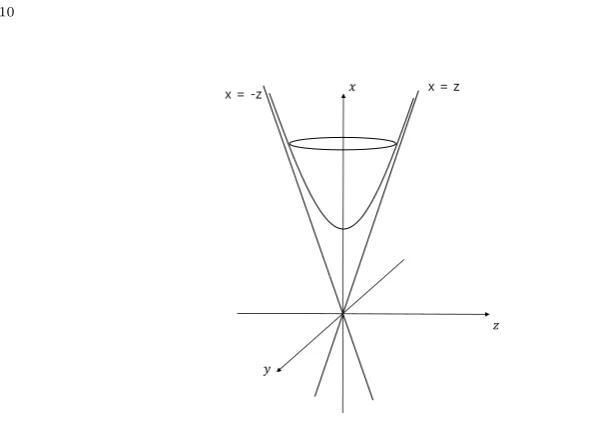
Figure 4. One connected component of two-sheeted hyperboloid
and two congruent sides AD ∼= BC without assuming the Parallel postulate is called a Saccheri quadrilateral. ABis called the base of the quadrilateral. Consider a Saccheri quadrilateral Y OXP with the baseOX on Poincar´e disk DP, where X,Y is a point inx-axis,y-axis, respectively. Since we have two triangles4Y OX and4XY P, the sum of the interior angles of a Saccheri quadrilateral on Poincar´e disk is less than 2π.
5-1. The line element of a surface of revolution LetR31 be Minkowski space-time with metric
g(v, w) =−v1w1+v2w2+v3w3.
Consider the surface of revolution of a curveα(r) = (coshr,0,sinhr) of the hyper-bolax2−z2= 1 in the xz-plane with a coordinate chart
X(r, θ) = (coshr,sinhrcosθ,sinhrsinθ)⊂R3 1,
which is−x2+y2+z2=−1 (Fig. 4). So we have
Xr= (sinhr,coshrcosθ,coshrsinθ), Xθ= (0,−sinhrsinθ,sinhrcosθ) E=g(Xr,Xr) =−sinh2r+ cosh2r= 1
F =g(Xr,Xθ) = 0, G=g(Xθ,Xθ) = sinh2r.
Hence we get
ds2=dr2+ sinh2rdθ2.
So Poincar´e Disk is isometric to the above surface of revolution of a curve α(r) = (coshr,0,sinhr) of the hyperbolax2−z2= 1 in thexz-plane in Minkowski space-time R3
References
[1] G. S. Birman and A. A. Ungar, The hyperbolic derivative in the Poincar´e ball model of hyperbolic geometry, J. Math. Anal. Appl. 254 (2001) 321–333
[2] N. V. Efimov, Higher geometry, Mir Publishers, 1980
[3] John McCleary, Geometry from a Differentiable Viewpoint, Cambrige university press, 1994 [4] Barrett O’ Neill, Elementary Differential Geometry 2nd edition, Academic press, 1997 [5] G. Popescu, Hyperbolic geometry on noncommutative polyballs, J. Math. Anal. Appl. 456
(2017) 576–607
[6] James R. Smart, Modern geometries 5th edition, Brooks/Cole Publishing Company, 1998 [7] A. A. Ungar, Hyperbolic trigonometry and its application in the Poincar´e ball model of