Karen J. Mickle, Peter Caputi, Jan M. Potter, Julie R. Steele
PII: S0268-0033(16)30155-3
DOI: doi:10.1016/j.clinbiomech.2016.10.005
Reference: JCLB 4227
To appear in: Clinical Biomechanics
Received date: 18 April 2016 Accepted date: 5 October 2016
Please cite this article as: Mickle, Karen J., Caputi, Peter, Potter, Jan M., Steele, Julie R., Efficacy of a progressive resistance exercise program to increase toe flexor strength in older people,Clinical Biomechanics(2016), doi:10.1016/j.clinbiomech.2016.10.005
ACCEPTED MANUSCRIPT
Efficacy of a Progressive Resistance Exercise Program to Increase Toe Flexor Strength in Older People
Karen J. Micklea1, Peter Caputi b, Jan M. Potter c, Julie R. Steele a
a
Biomechanics Research Laboratory, University of Wollongong, Northfields Ave, Wollongong, NSW 2522, Australia
b
School of Psychology, University of Wollongong, Northfields Ave, Wollongong, NSW 2522, Australia
c
Division of Aged Care, Illawarra Shoalhaven Local Health District, Wollongong Hospital, Wollongong, NSW 2500, Australia
1
Permanent address: Institute of Sport Exercise and Active Living, Victoria
University, Melbourne, VIC 8001, Australia
Correspondence and reprints:
Dr Karen J. Mickle
Institute of Sport Exercise and Active Living
Victoria University
PO Box 14428
Melbourne, VIC, 8001
Australia
Email: [email protected]
Running page head:
Restoring toe strength in older people.
ACCEPTED MANUSCRIPT
Abstract
Background: Reduced toe flexor strength is an independent predictor of falls in older people. However it is unknown whether strengthening programs can restore toe flexor
strength in older individuals. The aim of this study was to investigate whether a
progressive resistance training program, focused specifically on the foot muscles,
could improve toe flexor strength in community-dwelling older people.
Methods: After baseline testing, 85 men and women (age range 60-90 years) were randomized to either a supervised, progressive resistance training(n=43) or a
home-based exercise (n=42) group for 12 weeks. A further 32 participants were recruited
for a control group. The primary outcome measures were hallux and lesser toe flexor
strength pre- and post-intervention. Secondary outcome measures were exercise
compliance, components of the Foot Health Status Questionnaire and single-leg
balance time.
Findings: Average class attendance was 89% with 68 participants from the two intervention groups (80%) completing the follow-up assessments. Participants in the
supervised, progressive resistance training group significantly increased their toe
strength (up to 36%; P < 0.02), whereas there was no change in toe strength in either the home-based or control groups. This increased toe strength was accompanied by a
significant improvement in perceived general foot health and single-leg balance time
compared to the other groups (P < 0.05).
Interpretation: Progressive resistance exercises are a viable intervention to increase toe flexor strength in older adults. A clinical trial is now required to determine
whether this intervention can reduce the number of falls suffered by older adults.
ACCEPTED MANUSCRIPT
1. Introduction
A decline in muscle strength is typically regarded as an inevitable consequence of
ageing, and age-related loss of muscle mass is one of the main determinants of frailty.
Muscle atrophy in older adults has been associated with an annual decline in lower
leg strength of approximately 3%.1 This muscle atrophy and strength loss can arise
from muscle disuse and are inversely associated with changes in physical activity. 2
Although under researched compared to other lower limb muscles, it appears that
muscles within the feet also suffer from atrophy and an associated loss of strength
with ageing. For example, older adults have 27-36% less toe flexor muscle strength
than their younger counterparts. 3, 4 This reduction in toe flexor strength is likely to
have a profound effect on the ability of older adults to walk safely. An individual’s
toes are in contact with the ground for 75% of the stance phase when walking5 and
the long toe flexor muscles help control forward progression of the leg over the foot.6
This could be critical when attempting to take corrective steps to maintain balance in
a near-fall situation. Of concern, a prospective study of over 300 older people found
that fallers had a reduction of more than 20% in their hallux and lesser toe strength
compared to non-fallers. 7 Hallux strength was also found to be a stronger predictor
of falls than other more commonly measured falls risk factors, such as age, gender,
falls risk score and quadriceps strength. In fact, each unit (% body weight) increase
in hallux strength decreased the odds of sustaining a fall by 7%. 7
Strengthening the toe flexor muscles should improve the ability of the toes to
perform their specific roles in balance and walking. Supporting this theory,
Kokkonen et al.8 monitored athletes while they completed toe resistance training for 12 weeks. Compared to an age- and gender-matched control group, toe flexor
ACCEPTED MANUSCRIPT
in vertical jump performance. Similarly,Unger et al. 9 employed a within-subject design whereby 15 men and women (aged 21-62 years) completed toe strengthening
exercises (Archxerciser™) on one foot over 6 weeks. Compared to the “untrained”
(control) foot, toe flexor strength improved almost four-fold after 6 weeks.
Importantly, these unilateral strength gains were accompanied by significant
improvements in single limb horizontal and vertical jump performance. The most
impressive toe strength gains have been reported in 14 males who performed high
resistance toe training, which resulted in a 60-70% increase in toe flexor strength.10
These results suggest that increasing toe strength can lead to improved motor task
performance in young adults.
There is emerging evidence that toe-strengthening exercises may be effective
for older adults or people with foot pathologies. For example, individuals with pes planus (flat feet) exhibited significant increases in hallux flexor strength following a
2-month intervention program that incorporated the Short Foot strengthening
exercise.11 Other research has associated toe exercises with improved motor task
performance in older adults. Nine nursing home residents undertook training three
times a week using their toes to gather a weighted towel and pass beanbags from one
place to another.12 After 8 weeks the toe-grasp training was found to significantly
improve the participants’ spontaneous sway performance with both their eyes open
and closed by 16% and 26%, respectively. In contrast, no change, or poorer balance
was displayed by an age-matched control group, who participated in a group exercise
program. Unfortunately, although balance performance improved after toe-grasp
training, toe strength was not measured in this study. Therefore, it is unknown
whether the training lead to toe strength gains or whether improvements in balance
ACCEPTED MANUSCRIPT
included in a multifaceted podiatry intervention study involving older adults with foot
pain and who were identified as being at an increased risk of falling.13 This
intervention (foot orthoses, advice on footwear, footwear subsidy, a home-based
program of foot and ankle exercises, a falls prevention education and routine podiatry
care) resulted in a 36% reduction in falls incidence compared to the control group
who received routine podiatry care for 12 months. The toe-strengthening portion of
the program consisted of participants completing exercises on an Archxerciser™ and
picking up stones with their toes, three times a week for 6 months. At the 12 month
conclusion of the intervention, a non-significant 9% increase in toe flexion strength
was reported. This program, however, was non-progressive (resistance did not
increase as strength improved) and did not target the intrinsic foot muscles.13
Consequently, the objective of the current study was to address the limitations in
previous studies, by investigating whether a progressive resistance training program,
focused specifically on the foot muscles, could improve toe flexor strength in
community-dwelling older people. We hypothesised that older people who
participated in the structured 12-week progressive resistance training program would
increase their toe flexor strength more than older people who performed home-based
ACCEPTED MANUSCRIPT
2. Methods
2.1 Design Overview
This study was a longitudinal study with parallel and randomized allocation of two
exercise interventions to determine the effectiveness and adherence of each program.
A control group, who were unavailable to participate in the exercise program due to
other commitments, were assessed to allow comparison of the outcome variables to
the exercise groups. Due to logistics associated with implementing the interventions (i.e. the intervention needed to be completed before a summer holiday break), the control group was recruited after the other groups. As there was no further follow-up or clinical outcomes measured (e.g. number of falls), the study was not deemed to be a full RCT.
2.2 Setting and Participants
Volunteers were recruited from the Illawarra region of New South Wales, Australia
between September 2013 and June 2014. Potential participants responded to either
an advertisement placed on the university staff email list or in the local newspaper,
and were screened according to the participant selection criteria. Male and female
participants were included in the study if they were aged over 60 years, living
independently in the community, able to ambulate for at least 10 m without an aid,
free from known neurological disorders, and were willing and able to attend 12 weeks
of group-based exercise classes. Eighty-five individuals were eligible to participate
in the exercise intervention (19 men and 66 women; mean age 69.7 (SD 5.8) years,
range = 60-90 years). A further 32 participants were recruited for the control group,
the majority from the initial recruitment call whom were unable to commit to the
exercise program (7 men and 25 women; mean age 68.3 (SD 5.3) years, range =
ACCEPTED MANUSCRIPT
participant information package before any testing procedures began. The University
of Wollongong Human Research Ethics Committee (HE13/282) approved all
recruiting and testing procedures. All data were collected in the Biomechanics
Research Laboratory, University of Wollongong, Australia.
2.3 Randomization and Interventions
Baseline testing for the intervention groups was performed over 3 weeks, with up to
30 participants enrolled each week (week 1 = 30, week 2 = 29, week 3 = 26). After
the participants completed the baseline assessment and questionnaires, they
self-selected a sealed envelope that revealed their group allocation, with 15 supervised,
group training and 15 home-exercise places available each week. To ensure
allocation concealment, a research assistant who was not involved with the
recruitment or follow-up assessments performed the group randomization.
Participants in the supervised, progressive resistance training group (Toe
Training group) attended three 45-minute group-exercise classes each week, for 12
weeks, with class sizes typically ranging from 5-10 participants. During each class,
an Accredited Exercise Physiologist (not associated with the study), led the
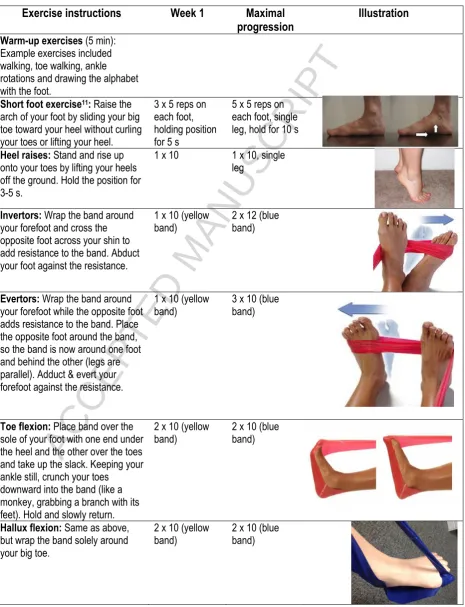
participants through a warm-up, followed by a series of eight exercises that were
developed by the Chief Investigator [K.J.M] to strengthen the foot muscles (see Table
1). Most exercises were performed using exercise bands (66fit latex, Physio
Supplies, Spalding, UK), with the resistance level starting from light (yellow) and
progressing through to x-heavy (blue). The level of exercise difficulty progressively
increased throughout the 12-week program, by increasing either the strength of the
resistance bands or the number of repetitions (1-3 sets; 10-15 reps)14.
The home-exercise group (Home group) received a booklet containing a series
ACCEPTED MANUSCRIPT
amount of resistance. The warm-up consisted of ankle rotations, calf raises and toe
raises, and the cool down consisted of rolling a golf ball underneath each foot for 2
minutes. They then performed a prescribed number of repetitions of toe squeezes, toe
pulls, marble pickups and towel pulls as suggested by Frey 15 and the Short Foot
exercise 11, three times per week.
The instructor recorded class attendance at the group strength-training
sessions; whereas participants in the home-based exercise group were asked to record
the exercise sessions they performed in a training diary. Participants were asked to
report any adverse effects of the exercise program and reasons for program dropouts
were recorded.
Participants recruited for the Control group completed the assessments at
baseline and again after 12 weeks, but were not given any exercises. They were
asked to maintain their normal activities. It was not possible to blind participants to
their group assignment because they actively participated in their randomly assigned
training program. However, no information was provided to the participants about
which program was hypothesized to be more beneficial.
2.4 Outcomes and Follow-up
All measurements were collected before and after the intervention period, 12 weeks
later, by study personnel who were unaware of the randomization assignments. Toe
flexor strength was the primary outcome, and was quantified using our previously
developed, reliable (ICC > 0.92) protocol.7, 16 Each participant stood with their feet
placed hip-width apart, with the test foot centred on an emed AT-4 pressure platform
(Novel gmbh; Munich, Germany), and were instructed to push down on the platform
as hard as possible under two conditions: (i) using their hallux and lesser toes, or (ii)
ACCEPTED MANUSCRIPT
each condition, with the centre of pressure inspected to exclude trials in which
participants displayed excessive body sway. The data were then analysed using
Novel Projects software, whereby the hallux and lesser toes were masked on the peak
pressure picture. Peak force (N) was then determined for the mask of interest under
each condition and normalised to body weight to represent maximum hallux flexor
strength and lesser toe flexor strength (% BW) for each foot.
Health-related quality of life with respect to foot health, was a secondary
outcome measure of the trial and was assessed using the Foot Health Status
Questionnaire (FHSQ).17 The FHSQ uses 19 items to assess the domains of foot
pain, foot function, footwear, general foot health, general health, physical activity,
social capacity and vigour. Each domain was scored from 0-100 whereby a higher
score indicates better function.
Single-leg balance time was used as a reliable (ICC >0.75)18 clinical measure
of balance to characterise the functional capacity of the participants in the trial. The
participants stood with their weight evenly distributed across both feet, with their
eyes open and focused on a point on the wall/floor. Keeping their arms by their
sides, each participant was asked to lift the non-test foot off the floor and try to
maintain their balance as long as possible. The test (and timer) was stopped after 60 s
or when the lifted foot was placed on the floor19. Participants were given two
attempts on each leg unless they were able to complete 60 s on their first attempt. If a
participant was able to complete at least 10 s on the eyes-open component, the task
was progressed to performing the test with their eyes closed. The single-limb balance
task is a challenging balance task and the eyes-closed component was used to
discriminate small improvements, particularly if the cohorts displayed few functional
ACCEPTED MANUSCRIPT
2.5 Statistical Analysis
Participant characteristics including age, BMI and balance were compared between
the three groups at baseline using a one-way ANOVA. The purpose of this analysis
was to ensure the three groups were appropriately matched on factors that could
influence their performance of the exercise programs. For variables where both feet
were tested (one-leg balance, toe strength),only data from the left foot were used to
satisfy the statistical assumption of data independence. A two-way repeated
measures analysis of variance design, with one between factor (group: Toe-Training
class, home-exercises and control) and one within factor (test session: pre and post),
was then conducted to test whether the foot strengthening exercises affected toe
strength and balance over time. For variables that differed between groups at
baseline (lesser toe strength),an analysis of covariance was conducted to test
differences between the three groups at post-intervention, using baseline strength as a
covariate. Scores from the Foot Health Status Questionnaire were not normally
distributed, so the between-group difference was determined by comparing the
change in score between baseline and follow-up using a Kruskal-Wallis test. An
alpha of P < 0.05 was established for all statistical analyses, which were conducted using SPSS software (IBM SPSS Statistics 22).
Results
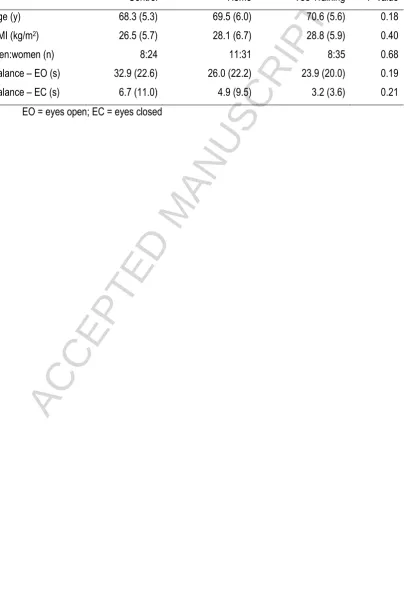
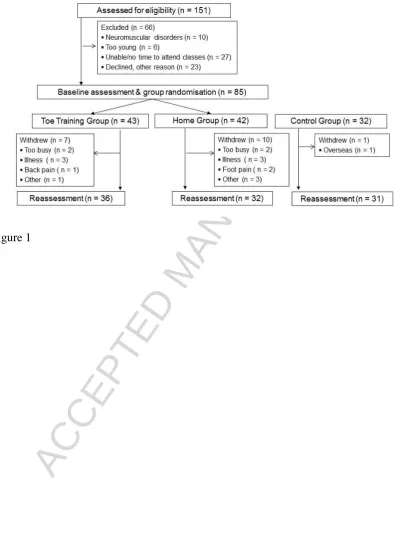
Figure 1 shows the flow of participants through the study. Participants in the three
groups had very similar characteristics at baseline (see Table 2).
ACCEPTED MANUSCRIPT
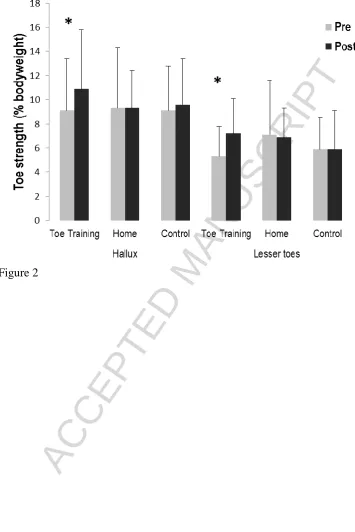
Significant time x group interaction effects were found for hallux strength (F[2,93] =
3.57; P = 0.03; ηp2 = 0.07) and lesser toe strength (F[2,93] = 10.57, P < 0.001; ηp2 = 0.18 see Figure 2). For hallux strength, although there was no change across time for
either the Control group (Mdiff = 0.33 %BW, P = 0.50), or Home groups (Mdiff = 0.05 %BW, P = 0.92), there was a significant increase in hallux strength from pre- to post-intervention testing for the Toe Training group (Mdiff = 1.7 %BW, P < 0.001). In addition to the significant time x group interaction for lesser toe strength, when using
baseline strength as a covariate, we found a significant increase in the adjusted means
(95% CI) of the Toe Training (7.7 (7.1-8.4) % BW) compared to the Control (5.9
(5.2-6.6) % BW) and Home (6.3 (5.6-6.9) % BW) groups after the intervention (F[2,95]
= 8.3, P <0.001). Foot health
Scores obtained for the Home, Toe Training and Control participants at baseline and
post-intervention for each domain of the Foot Health Status Questionnaire are
displayed in Table 3. A significant improvement for the General Foot Health domain
was found in the Toe Training group (mean change (95% CI) = 12.6 (6.0 – 19.1)
points) compared to the Home and Control groups (P ≤ 0.05). None of the other domains showed any significant change following the 12 week follow-up period for
any participant group.
Balance
Significant time x group interaction effects were found for single leg balance with
eyes open (F[2,96] = 4.49; P = 0.01; ηp2 = 0.09) whereby there was no change across time for either the Control group (Mdiff = -5.1 s, P = 0.06), or Home groups (Mdiff = 4.2 s, P = 0.12), but there was a significant increase in time from pre- to
ACCEPTED MANUSCRIPT
significant effect of time was found for single-leg balance with eyes closed (F[2,96] =
10.7; P ≤ 0.001; ηp2 = 0.1) whereby pairwise comparisons revealed no change across time for the Control group (Mdiff = 0.9 s, P = 0.43), but there was a significant increase in time from pre- to post-intervention testing for the Home (Mdiff = 2.7 s, P = 0.03) and the Toe Training groups (Mdiff = 3.0 s, P = 0.01).
Compliance
Thirty-six of the 43 participants (84%) completed the supervised Toe Training
exercise program. Average class attendance was 89% (range 37-100%). Thirty
participants (81%) attended at least 75% of their scheduled classes with eight
participants (22%) attending all 36 classes. Thirty-two of the 42 participants (76%)
in the Home group returned for the follow-up assessment. Average compliance to the
home-based exercise program was 83% (range 0-100%). Twenty-four participants
(80%) completed at least 75% of their programmed exercises with 13 participants
(43%) completing 100% of the exercise program. The reasons for participant
dropouts are included in Figure 1. No serious adverse events were reported during
the classes; although one participant experienced an exacerbation of existing lower
back pain during the first week of the program and withdrew from the study.
Discussion
The aim of this study was to determine whether a progressive resistance training
program, focused specifically on the foot muscles, could strengthen the toe flexor
muscles in community-dwelling older people in comparison to home-based general
foot exercises and controls. The findings indicate that older people can significantly
increase both their hallux and lesser toe flexor strength by participating in a
structured, progressive group exercise class within a 12-week program. The
ACCEPTED MANUSCRIPT
Similar to previous research, 13 the non-progressive general foot exercises
completed by the home-based exercise group, failed to elicit a significant change in
toe strength. In fact, despite performing foot exercises such as picking up marbles
with their toes, the home-based exercise group displayed a 1% reduction in lesser toe
strength. The programs performed by the home-based exercise group and
participants in previous research,13 were ineffective as they were non-progressive,
that is, the resistance did not increase as the strength of the participants improved
over time. Conversely, the supervised training group in this study performed foot
exercises using exercise bands, which gradually progressed in resistance, as the
participants became stronger. This program resulted in an increase in lesser toe
strength of 1.9% BW, representing a 36% increase in strength from baseline. Both
foot exercise groups appeared to have small improvements in their balance after
completing their respective programs. Only the Toe Training group showed a
significant improvement in the balance time with their eyes open, but both groups
improved the length of time they could balance on one-leg with their eyes closed.
The only exercises that were replicated in both exercise programs were the short foot
exercise and heel raises. These were also the only exercises that were weight bearing
and progressed to being performed on a single leg, which may explain why both
groups improved their single-leg balance time. Further research is required to
determine the contribution of toe strength to balance, however, it worth noting that
the Toe Training resulted in improved balance.
The significant increase in toe strength displayed by the supervised training
group was accompanied by a significant improvement in perceived general foot
health. Anecdotally, many of the participants in the supervised training intervention
ACCEPTED MANUSCRIPT
that a forefoot callus that had been present for 19 years had “disappeared” during the
program. Other participants made positive statements such as: “I walk out of the
class and feel like I’m walking on clouds”, “I have the bounce back in my steps”, and
“I can see muscles and joints in my feet that I’ve never seen before”.
Adherence to the supervised, progressive resistance training intervention was
very high, with more than 80% of the participants attending at least 75% of the
exercise classes over the 12 weeks. Compliance to the home-based exercises was
also high (80% completing >75% of the exercise sessions), although trial dropout was
greater in the home-based exercise group compared to the supervised group (24% vs
16%). Adherence to this home-based program was higher than that reported by Spink
et al.,13 who had 66% self-reported completed exercise sessions, with 52% of the participants completing 75% or more of the requested three exercise sessions per
week. However, their exercise program lasted for 24 weeks, twice as long as the
current intervention. Participants in the supervised training were offered 16 class
times per week, with the small classes supervised by the same instructor. This led to
the participants developing a strong rapport with the instructor and fellow trial
participants, which is likely to have contributed to the high exercise class compliance.
The strengths of this study are the high compliance rates in both progressive
training and home exercise groups, small losses to follow-up and the inclusion of an
active home-based exercise group who still did a form of simple foot exercises. This
will allow us to make a more accurate sample size calculation to adequately power a
clinical trial. However, the findings of the current study need to be interpreted in the
context of the following limitations. Firstly, owing to the nature of the intervention,
it was not possible to blind participants to their group allocation. Secondly, the
ACCEPTED MANUSCRIPT
commitment to the intervention. Twenty-seven people who initially expressed interest
declined participation, primarily due to reluctance to commit to the study for a
3-month period. Finally, care needs to be taken in generalising these findings, as all
participants were living independently in the community and there was an over
representation of female participants. Whether the intervention is effective in
residential care settings or in older people who have specific foot problems associated
with muscle weakness, such as hallux valgus, lesser toe deformities and pes planus,
requires investigation. The foot exercises, however, have the advantage of being
performed in a seated position, allowing individuals with stability problems or poor
cardiovascular health to participate in the program.
We have previously identified that reduced strength of the muscles that flex
the toes is one of the strongest independent contributors to falls in older people. 7 In
fact, each unit (% body weight) increase in hallux strength decreased the odds of
sustaining a fall by 7%. Results of this study provide evidence that a 12-week
progressive resistance training intervention can significantly increase strength of the
toe flexor muscles in community-dwelling older people. Based on the current study,
the 1.7 %BW average increase in hallux flexor muscle strength associated with the
progressive resistance training program has the potential to result in a 12% reduction
in falls incidence. A prospective clinical trial, following participants after they have
completed a Toe Training intervention and monitoring their future falls is required to
confirm or refute this notion.
As falls are the leading cause of injury, disability, hospitalisation and death
for older adults, effective evidence-based interventions are urgently required to
reduce the risk of falling in older adults. This innovative study has been designed to
ACCEPTED MANUSCRIPT
training intervention can increase the strength of the toe flexor muscles in older
people. As minimal negative effects of the intervention can be foreseen and the
intervention can be readily translated into community practice, the potential benefits
associated with this toe strengthening training program for older adults are
substantial. A clinical trial that determines whether this intervention can reduce the
risk of falling is now recommended.
Acknowledgements
The authors wish to acknowledge all of the participants in the trial. The authors
would like to thank the Clinical Trials Unit staff at the Illawarra Health and Medical
Research Institute for assistance with the group exercise classes.
Funding: This work was supported by the Illawarra Health and Medical Research Institute and completed while Dr Mickle held an Australian National Health and
Medical Research Council Post-doctoral Fellowship (Overseas Clinical Training
Fellowship, ID 1016521). The funding agencies did not have a role in the design,
conduct, or reporting of the study or in the decision to submit the article for
ACCEPTED MANUSCRIPT
References
1. Goodpaster, B.H., et al., The loss of skeletal muscle strength, mass, and quality in older adults: The health, aging and body composition study. The Journals of Gerontology Series A: Biological Sciences and Medical Sciences, 2006. 61(10): p. 1059-1064.
2. Kent-Braun, J.A., A.V. Ng, and K. Young, Skeletal muscle contractile and noncontractile components in young and older women and men. Journal of Applied Physiology, 2000. 88(2): p. 662-668.
3. Endo, M., J. Ashton-Miller, and N. Alexander, Effects of age and gender on toe flexor muscle strength. Journals of Gerontology. Series A, Biological Sciences and Medical Sciences, 2002. 57A(6): p. M392-397.
4. Menz, H.B., et al., Plantarflexion strength of the toes: age and gender differences and evaluation of a clinical screening test. Foot & Ankle International, 2006. 27(12): p. 1103-8. 5. Hughes, J., P. Clark, and L. Klenerman, The importance of the toes in walking. J Bone Joint
Surg Br, 1990. 72-B(2): p. 245-251.
6. Hamel, A.J., S.W. Donahue, and N.A. Sharkey, Contributions of active and passive toe flexion to forefoot loading. Clinical Orthopaedics & Related Research, 2001(393): p. 326-34. 7. Mickle, K.J., et al., ISB Clinical Biomechanics Award 2009: Toe weakness and deformity
increase the risk of falls in older people. Clinical Biomechanics, 2009. 24: p. 787-791. 8. Kokkonen, J., et al., Improved performance though digit strength gains. Research Quarterly
for Exercise and Sport, 1988. 59(1): p. 57-63.
9. Unger, C.L. and M.J. Wooden, Effect of foot intrinsic muscle strength training on jump performance. Journal of Strength and Conditioning Research, 2000. 14(4): p. 373-378. 10. Goldmann, J.-P., et al., The potential of toe flexor muscles to enhance performance. Journal
of Sports Sciences, 2013. 31(4): p. 424-433.
11. Jung, D.-Y., E.-K. Koh, and O.-Y. Kwon, Effect of foot orthoses and short-foot exercise on the cross-sectional area of the abductor hallucis muscle in subjects with pes planus: a randomized controlled trial. Journal of Back & Musculoskeletal Rehabilitation, 2011. 24(4): p. 225-31.
12. Kobayashi, R., et al., Effects of toe grasp training for the aged on spontaneous postural sway. Journal of Physical Therapy Science, 1999. 11(1): p. 31-34.
13. Spink, M.J., et al., Effectiveness of a multifaceted podiatry intervention to prevent falls in community dwelling older people with disabling foot pain: randomised controlled trial. BMJ, 2011. 342: p. d3411.
14. Balady, G.J., et al., ACSM's Guidelines for Exercise Testing and Prescription. Sixth ed, ed. B.A. Franklin. 2000, USA: Lippincott Williams & Wilkins.
15. Frey, C., Foot health and shoewear for women. Clinical Orthopaedics & Related Research, 2000. 372: p. 32-44.
16. Mickle, K.J., et al. A novel and reliable method to measure toe flexor strength. in Proceedings of the 10th Emed Scientific Meeting. 2006. Spitzingsee, Germany.
17. Bennett, P.J., et al., Development and validation of a questionnaire designed to measure foot-health status. Journal of the American Podiatric Medical Association, 1998. 88(9): p. 419-28. 18. Sherrington, C. and S.R. Lord, Reliability of simple portable tests of physical performance in
older people after hip fracture. Clinical Rehabilitation, 2005. 19(5): p. 496-504.
ACCEPTED MANUSCRIPT
Table 1: The progressive Toe Training exercise program.
Exercise instructions Week 1 Maximal
progression Illustration
Warm-up exercises (5 min): Example exercises included walking, toe walking, ankle rotations and drawing the alphabet with the foot.
Short foot exercise11: Raise the
arch of your foot by sliding your big toe toward your heel without curling your toes or lifting your heel.
3 x 5 reps on each foot, holding position for 5 s
5 x 5 reps on each foot, single leg, hold for 10 s
Heel raises: Stand and rise up onto your toes by lifting your heels off the ground. Hold the position for 3-5 s.
1 x 10 1 x 10, single leg
Invertors: Wrap the band around your forefoot and cross the opposite foot across your shin to add resistance to the band. Abduct your foot against the resistance.
1 x 10 (yellow
band) 2 x 12 (blue band)
Evertors: Wrap the band around your forefoot while the opposite foot adds resistance to the band. Place the opposite foot around the band, so the band is now around one foot and behind the other (legs are parallel). Adduct & evert your forefoot against the resistance.
1 x 10 (yellow
band) 3 x 10 (blue band)
Toe flexion: Place band over the sole of your foot with one end under the heel and the other over the toes and take up the slack. Keeping your ankle still, crunch your toes
downward into the band (like a monkey, grabbing a branch with its feet). Hold and slowly return.
2 x 10 (yellow
band) 2 x 10 (blue band)
Hallux flexion: Same as above, but wrap the band solely around your big toe.
2 x 10 (yellow
ACCEPTED MANUSCRIPT
Ankle dorsiflexion: Wrap the middle of the band around the foot you are exercising. Place the ends of the band under the opposite foot to stabilize the band. Grasp the ends of the band at your opposite knee. Lift your foot upward against the band. Hold and slowly return.
1 x 10 (yellow
band) 1 x 10 (blue band)
Big toe pulls: Place the band around your big toes and hold the end of the bands in opposite hands. Leaving your heels on the ground, pull your big toes away from each other and towards your little toes. Hold for 5 seconds.
1 x 10 (yellow
band) 2 x 10 (blue band
ACCEPTED MANUSCRIPT
Table 2: Descriptive characteristics and single-leg balance time of the Control (n = 32), Home (n = 42) and Toe Training (n = 43) groups at baseline. Values given are mean (SD), unless indicated.
Control Home Toe Training P-value Age (y) 68.3 (5.3) 69.5 (6.0) 70.6 (5.6) 0.18 BMI (kg/m2) 26.5 (5.7) 28.1 (6.7) 28.8 (5.9) 0.40
Men:women (n) 8:24 11:31 8:35 0.68 Balance – EO (s) 32.9 (22.6) 26.0 (22.2) 23.9 (20.0) 0.19 Balance – EC (s) 6.7 (11.0) 4.9 (9.5) 3.2 (3.6) 0.21
ACCEPTED MANUSCRIPT
Table 3: Foot related quality of life scores (out of 100), obtained for each domain of the Foot Health Status Questionnaire for the three groups, at baseline and completion of the intervention period.
a = significant change in score for the Toe Training group from baseline to post-intervention compared to the Control and Home groups
Variable Control Home Toe Training
Baseline Post-intervention Baseline Post-intervention Baseline Post-intervention Foot Health mean (95% CI) mean (95% CI) mean (95% CI) mean (95% CI) mean (95% CI) mean (95% CI)
Foot pain 78.9 (71.6 – 86.2) 82.2 (74.8 – 89.6) 79.3 (70.7 – 87.9) 81.2 (75.0 – 87.5) 82.9 (75.0 – 90.8) 85.3 (78.0 – 92.6) Foot function 85.9 (78.9 – 92.9) 88.5 (80.6 – 96.4) 85.5 (77.1 – 93.8) 87.3 (81.4 – 93.2) 91.8 (85.7 – 97.9) 92.9 (87.6 – 98.2) Shoes 53.2 (41.7 – 64.8) 54.3 (41.4 – 67.2) 44.9 (32.8 – 57.0) 46.8 (36.1 – 57.4) 48.1 (37.2 – 59.0) 48.1 (37.3 – 59.0) General foot health 56.3 (45.1 – 67.5) 58.9 (47.8 – 70.0) 64.4 (53.6 – 75.1) 68.2 (58.3 – 78.0) 54.0 (44.2 – 63.8) 66.6 (58.3 – 74.9)a
ACCEPTED MANUSCRIPT
Fig 1: The flow of participants through the trial.
ACCEPTED MANUSCRIPT
ACCEPTED MANUSCRIPT
ACCEPTED MANUSCRIPT
Highlights
We compared a progressive strengthening program to a simple home-based foot exercise program
Adherence to supervised, group exercise classes focussed on the feet was very high
12 week progressive resistance training increases toe strength in older people
General foot exercises (e.g. picking up marbles) do not increase toe strength