Physica 116B (1983) 101-105 Paper presented at ICDS-12
North-Holland Publishing Company Amsterdam, August 31 - September 3, 1982
INTERSTITIAL MUONS AND HYDROGEN IN CRYSTALLINE SILICON
A.
MAINWOOD* and A.M. STONEHAM**
* Physics Department, King's College, Strand, London WC2R 2LS, U.K.
** Theoretical Physics Division, AERE Harwell, Didcot, Oxon OXl l ORA, U.K.
+ o
We have calculated self-consistent total energy surfaces for H , H and H_ present
• • z
interstitially in crystalline Si. We conclude molecular hydrogen is the stabSe form& consistent with the lack of observed electrical and optical activity. Both H and H- have complex surfaces, with some features sensitive to lattice distortion. The local minima are too small to give localised states when zero-point energy is included. We discuss our results in relation to earlier theories and to experiments on "normal" and "anomalous" muonium [ ~+e-].
I. INTRODUCTION
Experimental data on hydrogen in silicon are reasonably abundant, apparently mutually incom- patible, and unexplained by current theories. One would ~xpect hydrogen, deuterium, and muonium (~ e) to behave in similar ways since they are chemically identical and only differ in mass, but the most important experiments show instead:
(i) Hydrogen is electrically and optically inactive.
+
(ii) Muonium [I] (~ e, the analogue of hydrogen) appears to be present in two forms - normal muonium, Mu, with a compact s-like wavefunction on a site with te~rahedral symmetry, and anomalous muonium, Mu*, with <IIi> axis p-like anisotropic hyperfine structure. There appear to be transitions between the two states with a peculiar temperature dependence. It is possible that an excited or complex state, for example [H e eh] is involved.
(iii) Implanted deuterium appears [2] to be dis- placed off the tetrahedral site towards a <iii> back bond direction (although it may be associa- ted with a defect).
Experiments on diamond and germanium complicate the matter further. Hydrogen is extremely abundant and very mobile in diamond [3]. Pion experiments in germanium [4]+show a change of site at abou t 60°K for the z from an off centre position (T ~ 6OK) to a central tetrahedral position. However, few defect properties have proved to be similar through the group IV crystals, so these observations may not have parallels in silicon. We shall describe else- where some similar work on diamond to which the reader is referred for a fuller discussion.
Current theories [5] do not account for these observations, and in most cases the reason is that they concentrate on the one-electron energy levels of the hydrogen constrained at the tetra- hedral site. It is surely necessary to use a
self-consistent procedure to calculate total energy surfaces, and from them attempt to explain the observed features.
2. THEORETICAL METHOD
The main ingredients of our approach are a self- consistent, though semi-empirical method, and a finite cluster approximation.
The CNDO (Complete Neglect of Differential Overlap) method.
We use a self-consistent, semi-empirical molecu- lar orbital method, called CNDO [6]. It was devised for use on organic molecules, but can easily be parameterised and modified for use on solids, retaining the physical and chemical ideas The following approximations are made to the Hartree-Fock-Roothaan equations:
(i) Valence electrons alone are treated;
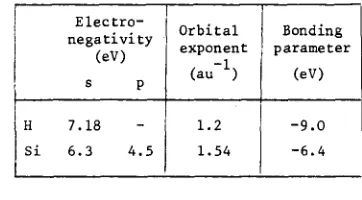
(ii) Matrix elements are approximated systema- tically using three types of parameter: electro- negativity, orbital exponents and bonding para- meters. The silicon parameters were obtained by Harker and Larkins [7], to fit the cohesive energy, lattice parameter and valence band width of a periodic cluster of silicon. The hydrogen parameters are those of Pople and Beveridge.
Electro- negativity
(eV)
s p
H 7 . 1 8 -
S i 6.3 4.5
Orbital exponent
(au -I)
1.2 1.54
Bonding parameter
(eV)
-9.0 -6.4
The code (here the Harwell MOSES [8] code)pre- dicts the total energy for any chosen geometry, the one electron levels and wavefunctions, and other properties such as charge densities and matrix elements.
The method has been used successfully on vacancies [9], self-interstitials [I0] and impurities [Ii] in diamond, to mention only related applications.
Clusters
We have taken clusters of silicon atoms of the correct lattice structure, with the dangling bonds at the3surface of the clusters saturated by single sp hybrids of silicon (Si*) at the correct positions to represent the next shell
of neighbours. The (30 Si 40 Si *) cluster, used predominantly, is centred on a tetra- hedral site, and includes seven shells of atoms.
Further calculations using a (29 Si 30 Si*) cluster showed that the effects of the hydrogen interacting with the cluster surface were not significant.
Total Energy surfaces for hydrogen in silicon.
By doing repeated calculations with hydrogen moved within the silicon cluster, with total charge zero, it is possible to build up the energy surface for hydrogen (or muonium) in silicon. If we put a net charge of +i on+the cluster we obtain the energy surface for H (or
~+).
,,....
A. Mainwood, A.M. Stoneham / Interstitial muons and hydrogen in crystalline Si 103
3. RESULTS H°(~+e) in Silicon
The hydrogen has an almost spherical potential well centred on the tetrahedral site, with nar- row low energy channels via hexagonal sites to the next tetrahedral sites. The energy barrier is only .052 eV. However, if neighbouring sili- con atoms are allowed to relax by only 1% of a lattice spacing the energy barrier is completely removed.
0.5
0'4
>
~
0.3 n- LU Z LU .J 0"2F-- O F-
0'1
TOTAL ENERGY MOTION NORMAL TO (111>
~ < 1 1 ' > ~ < 1 1 ' >
l/,,o>
TETRAGONAL HEXAGONAL {T)SITE (H)SITE
__ H SITE ON RELAXATION
T H T
(111) INTERSTITIAL SITES
2 3 5 ~
H + (~+) in Silicon ~ i
A <iiO> plane is used to show this energy surface
.~. - - - m --Tu - - ~
""... H "".%
O ~OM IN PLANE • ATOM NOT IN PLANE
This energy surface is completely different from neutral hydrogen. The tetrahedral and hexa- gonal sites are high in energy with the minima along <OO1> directions about 1.6A from a silicon atom. There is a saddle point between these sites along the back bond direction, but a direct route out of the <IIO> plane between minima associated with different tetrahedral
T TETRAHEDRAL SITES H HEXAGONAL SITES
BONDS ... 'BACK' BONDS
T : +039 H : - 1,48 X : -3-23
0 -I
J
.lj /
H+(p+)IN Si <110> P L A N E Molecular hydrogen (H 2) in silicon
Here we took the hydrogen molecule with its free spacing and placed it in the cluster at the tet- rahedral site with [O01], [IIO] and Jill]orien- tations, and also straddling the hexagonal site along a [Iii] axis. Of these the tetrahedral [OO1] orientation was most stable, and further calculations showed that the free spacing was also correct. The barrier to rotation via a [ii0] axis is only 0.093 eV and the barrier to migration is .95 eV, although both these figures will be reduced substantially by lattice relaxa- tion. The experimental activation energy for hydrogen diffusion is .5 eV to .6 eV.
Molecular hydrogen is more stable than atomic hydrogen by about 2 eV/atom in silicon, which is consistent with the complete lack of optical, infra-red and electrical activity of hydrogen in crystalline silicon.
4. DISCUSSION
Our calculations show how complex the energy surfaces of hydrogen or muonium in silicon are. It is clearly completely misleading to presume that the muon is trapped at a tetrahedral site and to base predictions on that assumption. The wells are so shallow that there are apparently no localised states for muonium, [p el, and probably not for hydrogen. The muonium could be in a tunnelling state between a small number of sites, possibly with some self-trapping by the crystal, or loosely associated with a defect.
The energy surfaces are strongly dependent on charge state. We would not expect them to be quite so strongly affected by additional weakly- bound carriers in diffuse orbits around the hydrogen. For example a trapped exciton state like [p e eh] ~ay have a similar energy surface to that for [~- e]. However, the fine struc- + ture and the radical differences between the and [p+e] surfaces demands reservation in d e t a i l Since the lifetime of the muon is only 2 Dsec, it is quite possible the observed Mu and Mu* species correspond to transient or metastable states, possibly involving bound excitons. Finally, there are four remaining questions arising from the experimental muon spin rotation work, which these energy surfaces may help us to answer:
(a) Does the same model apply to diamond, Si and Ge? The hyperfine constants do not change monotonically along the sequence, which should make one suspicious of premature assumptions.
(b) Are impurities or defects involved? It is becoming accepted that simple donors and acceptors have only secondary influence [12,13], but transient defects caused by the muon may be involved during the muon's short lifetime, [14,15], even though the crystal may recover rapidly.
A. Mainwood, A.M. Stoneham
/
Interstitial muons and hydrogen in crystalline Si 105and conclusions must be based on a detailed model.
(d) Are transient states involved? SuggEstions include excited states $ike [~ e ] or [~- e], bound exciton states [~ e eh] [14] and locali- sation in minima which are not the lowest [18].
REFERENCES:
[i] Estle, T.L. Hyp. Int. ~ (1981) 365.
[2] Picraux, S. and Vook, F.L., Phys. Rev. BIB (1978) 2066.
[3] Sellsahop, J.P.F., "Diamond Research" p.24 (1979).
Sellschop, J.P.F., Madiba, C.C.P. and Annegarn, H.J., Abstracts of Cambridge Diamond Conference (unpublished) p.43 (1979).
[4] Maier, K., Proc. Int. Conf. "Electronic Structure of Hydrogen in Metals" (Plenum Press ed. Jena, P. and Satterthwaite, C.) in press (1982).
[5] Wang, J.S. and Kittel, C., Phys. Rev. B7 (1973) 713.
Herbert, D.C. and Inkson, J., J. Phys. CIO (1977) L695.
Altarelli, M. and Hsu, W.Y., Phys. Rev. Lett. 43 (1979) 1346.
Singh, V.A., Weigel, C., Corbett, J.W. and Roth, L.M. Phys. Star. Sol. 81b (1977) 637.
Singh, V.A., Corbett, J.W., Weigel, C. and Roth, L.M., Phys. Lett. 65A (1978) 261.
[ 6]
[7]
[8]
[91
[10]
[11]
[12]
[13]
[14]
[15]
[16]
[17]
[18]
Pople, J.A. and Beveridge, D.L., "Approxi- mate Molecular Orbital Theory" (McGraw Hill 1970).
Harker, A.H. and Larkins, F.P., J. Phys. C12 (1979) 2487.
Harker, A.H. and Lyon, S.B., Harwell Report AERE R8598 (1979).
Mainwood, Alison, J. Phys. CII (1978) 2703.
Mainwood, Alison, Stoneham, A.M. and Larkins, F.P., Sol. St. Electr. 21 (1978)
1431.
Mainwood, Alison, J. Phys. C12 (1979) 2543.
Clawson, C.W., Crowe, K.M., Rosenblum, S.S. and Brewer, J.H., Hyp. Int. 8 (1981) 397.
Boekema, C., Holzschuh, E., KUndig, W., Meier, P.F., Patterson, B.D., Reichart, W. and RHegg, K., Hyp. Int. 8 (1981) 401.
Stoneham, A.M., Hyp. Int. 6 (1979) 211.
Bucci, C., de Renzi, R., Guidi, G., Podini,P., Tedeschi, R. and Norlin, L.O., Hyp. Int. 8
(1981) 385.
Stoneham, A.M., Berichte der Bunsenges 76 (1972) 816; J. Nuc. Mat. 69/70 (1977) 109.
Haller, E.E. Hyp. Int. 8 (1981) 401.