Original Research Article
Correction with oral hydration improves maternal and perinatal
outcome in women with third trimester isolated oligohydramnios
Pragati Aggarwal*, Sharda Patra
INTRODUCTION
Oligohydramnios is defined quantitatively as an amniotic fluid volume <500ml, and semi- quantitatively as amniotic fluid index <5cm or single deepest pocket <2cm on ultrasound.1 The overall prevalence of
Oligohydramnios is 3-5%.2 It is more common in 3rd
trimester. In 2-3% of women with oligohydramnios no cause (like fetal disorders, maternal disorders, rupture of membranes) is attribute, which is termed as isolated oligohydramnios. Isolated oligohydramnios at times
could be due to maternal dehydration preferably due to inadequate oral intake, maternal fever, diarrhoea etc. Multiple therapeutic options have been suggested for restoring the amniotic fluid index in women with isolated oligohydramnios especially remote from term aiming to prolong pregnancy till term and optimise perinatal outcome. The treatment modalities are serial transabdominal or transcervical amnioinfusion, intravenous hydration, desmopressin (dDAVP) and amniotic membrane sealing techniques in rupture of membranes cases. All these mechanisms have been tried
ABSTRACT
Background: Oligohydramnios is related to serious maternal and fetal complications. In case of isolated oligohydramnios in third trimester maternal oral hydration has shown promising results in improving maternal and perinatal outcome.
Methods: This study was conducted on 50 pregnant women complicated by idiopathic oligohydramnios (AFI<5) in third trimester. Their pre hydration daily fluid intake was noted and they were advised to take oral fluids more than their usual intake (according to their convenience). The daily fluid intake and AFI was measured on day1, day2, day3 then weekly till delivery. At delivery maternal and fetal outcome were measured.
Results: The mean AFI of the study population at the time of enrolment was 4.25±1.01 and daily mean fluid intake was 1.46±0.41. The post hydration fluid intake per day was significantly high as compared to pre hydration fluid intake (4.40±0.51 litres vs 1.46±0.41 litres, p<0.001). A significant difference in the amniotic fluid index was seen post hydration. The mean AFI on day 1, day 2, day 3 was 6.19±0.93, 7.33±1.13, 8.0±1.07 as compared to pre hydration AFI 4.25±1.01 (p<0.001). The amniotic fluid index post hydration normalized (AFI>8) in 6%, 30%, 61% and 100% of women on day1, day2, day3 and after a week. The perinatal outcome was favourable in all the women with 100% live births and a mean birth weight of 2.77±0.29 kg.
Conclusions: A simple correction of maternal dehydration by an adequate and sustained daily oral fluid intake in pregnancies complicated by isolated third oligohydramnios in third trimester significantly improves amniotic fluid index, maternal outcome and perinatal outcome.
Keywords: Amniotic fluid index, Isolated oligohydramnios, Oral hydration, Perinatal outcome Department of Obstetrics and Gynecology, Lady Hardinge Medical College, New Delhi, India
Received: 13 December 2017
Accepted: 08 January 2018
*Correspondence:
Dr.Pragati Aggarwal,
E-mail: [email protected]
Copyright: © the author(s), publisher and licensee Medip Academy. This is an open-access article distributed under the terms of the Creative Commons Attribution Non-Commercial License, which permits unrestricted non-commercial use, distribution, and reproduction in any medium, provided the original work is properly cited.
to increase amniotic fluid index. But these are invasive method and there clinical utility is still debated.4
Maternal hydration, for restoring the amniotic fluid volume in pregnant women with oligohydramnios is a newer method which in recent studies has shown promising results. Maternal hydration being non invasive, is a simple, safe, cheap and easy method for treating isolated oligohydramnios without conferring any risks to the mother and fetus.4
Regarding the amount and duration of fluid therapy, many investigators have tried a fixed dose for a short duration (orally 2litres/hour) or a forced hydration and have reported convincing results, though for a short period. However as regards the long term effects are concerned, the results are still grim. Thus, there is no consensus on how much fluid and for how long maternal hydration therapy should be administered in pregnancy complicated by oligohydramnios for an optimum outcome.
The present study was undertaken to define an appropriate volume and correct way of administration of fluid as oral hydration therapy in women with isolated oligohydramnios and to evaluate its effect on amniotic fluid volume and perinatal outcome.
METHODS
This was an observational study done in department of obstetrics and gynaecology at Lady hardinge medical college, Delhi over a period of one year. Ethical clearance was taken from institutional ethical committee. Fifty women with isolated oligohydramnios (AFI<5) in third trimester of pregnancy were included in the study after a written informed consent. Women attending the routine antenatal clinic or presenting in emergency in third trimester of pregnancy with oligohydramnios were admitted for a complete maternal –fetal evaluation. These women were subjected to thorough history followed by detailed physical examination and obstetric examination. This was followed by non stress test, and baseline investigations. These women were asked about their daily intake of fluids at home, which was noted. An ultrasound examination was done for confirmation and to rule out other causes of oligohydramnios like PROM, FGR and any fetal anomalies. A colour doppler and AFI was done. Those with normal doppler flows and an amniotic fluid index <5 were included in the study.
Management protocol
These women were asked to drink plenty of water more than their usual intake (according to their convenience) in 24 hours. Intake - output charting was done. Fetal monitoring was done with FHS charting, DFMC chart and a baseline NST. The next day (after 24 hours) on day 1, the total amount of fluid taken by the women in 24 hours was calculated and the AFI was measured on day 1.
Women were asked to continue to take plenty of oral fluid according to their convenience. Ultrasound was done daily during the fluid therapy consecutively for three days and weekly thereafter till delivery. The deepest, unobstructed and clear pockets of amniotic fluid without limb buds or cord structures were visualized and the vertical pocket was measured in each quadrant. All the four measurements of the largest vertical pocket were summed up to calculate amniotic fluid index. The fetal monitoring with FHS, DFMC and daily NST continued till AFI normalised (more than 8). Those who attained a normal AFI after hydration therapy were discharged and were followed up weekly in the antenatal clinic till delivery. At delivery the maternal and fetal outcomes were measured.
Statistical analysis
The statistical analysis was done by using latest version of Statistical Package for the social sciences (SPSS) software. The results were expressed as mean±standard deviation. Comparison was done using student’s t-test and ANOVA test.
RESULTS
[image:2.595.312.543.485.754.2]In the present study, mean age of the women was 25.98±3.96 years ranging from 20-37 years. Out of the studied population 62% were booked. The mean gestational age at presentation was 34.1±2.1 weeks ranging from 28.6 to 37.4 weeks. Majority of women (44%) were between 34-36 weeks of gestation.
Table 1: Demographic and clinical profile of pregnant women with isolated oligohydramnios.
Variables No. %
Age (In years)
20-24 23 46
25-30 15 30
>30 12 24
Mean±SD (in years) 25.98±3.96
Range (in years) 20-37
ANC registration
Booked 31 62
Unbooked 19 38
Presentation during admission
USG based diagnosis of oligohydramnios 24 48
Preterm labour pains 16 32
Perception of decrease fetal movements 10 20
POG at admission (in weeks)
28-30 2 4
30-32 5 10
32-34 13 26
34-36 22 44
36-38 8 16
Mean±SD (in weeks) 34.1±2.1
Maximum women (48%) presented with ultrasound showing oligohydramnios and 20% with decreased perception of fetal movements (Table 1).
Table 2: Distribution of pregnant women according to their amniotic fluid index (AFI) on ultrasound at the
time of admission (<5).
AFI at
admission (<5) (in cm)
Number of pregnant woman (N=50)
Percentage
<2 2 4
2-4 11 22
>4 37 74
Mean amniotic fluid index 4.25±1.01cm
Amniotic fluid index in study population was less than 5 cm with a mean amniotic fluid index of 4.25+1.01cm (Table 2). Prior to treatment, average daily fluid intake in the study population was 1.46+0.4 litres ranging between 500 ml to 2 litres (Table 3).
Table 3: Distribution of pregnant women according to their daily fluid intake prior to hydration therapy at
the time of admission.
Daily fluid Intake (in Litres)
Number of pregnant women (N=50)
Percentage
0.5-1 19 38
1-1.5 16 32
1.5-2 15 30
Mean±SD 1.46±0.4 Range (Litres) 0.5-2
After increasing the fluid intake, the overall mean fluid intake per day was significantly more during the oral
hydration therapy compared to the fluid intake prior to therapy (4.40+0.51 litres vs 1.46±0.41 litres, p<0.001). However, the difference in the mean daily fluid intake from day 1 (4.07+0.76 litres) to week 4 (5.0+0.66 litres) during the hydration therapy was statistically not significant (p=0.024) (Table 4).
Table 4: Comparison of pre hydration and post hydration daily mean oral fluid intake.
Fluid intake Mean±SD (In litres) P-value
Prehydration
Day 0 1.46±0.41
<0.001 Post
hydration
Mean±SD (In litres)
Mean±SD (In litres) Day1 4.07±0.76
4.40 +0.51 Day2 4.38±0.62
Day3 4.45±0.60 Week1 4.70±0.52 Week 2 4.62±0.53 Week 3 4.67±0.60 Week 4 5.0±0.66
On day 0 (at enrolment) all women (n=50, 100%) had AFI<5 cm with mean AFI of 4.25±1.01. On day1 of oral hydration the AFI was between 5-8 cm in 45 (90%) and more than 8 in 3 women (6%). There remained only 2 women with an AFI <5.
[image:3.595.314.542.186.330.2]However, on day 2 and day 3 of oral hydration the AFI in 30% and 60% of women was more than 8 respectively. There was only one woman out of 50 with an AFI <5 on day 3. At the end of first week all of the women had AFI >8cm which continued to be in the same level (>8) till fourth week (Table 5).
Table 5: Distribution of pregnant women according to pattern of AFI from day 0 (pre hydration) to week 4 (post hydration).
AFI (cm) Day 0
n (%)
Day 1 n (%)
Day 2 n (%)
Day 3 n (%)
Week1 n (%)
Week 2 n (%)
Week 3 n (%)
Week 4 n (%)
<5 50 (100) 2 (4) 1 (2) 1 (2) 0 0 0 0
5-8 0 45 (90) 34 (68) 18 (37) 0 0 0
>8 0 3 (6) 15 (30) 30 (61) 46 (100) 36 (100) 18 (100) 9 (100)
Total (no. of
pregnant women) 50 50 50 49* 46* 36* 18* 9*
*rest of the women delivered during the study
The mean AFI on day 1, day 2, day 3 and first week during the oral hydration therapy was significantly more compared to the pre hydration AFI (6.19±0.93 vs 4.25±1.01, 7.33±1.13 vs 4.25±1.01, 8±1.07 vs 4.25±1.01 and 9.3±0.98 respectively, p<0.001). The AFI was consistently in the normal level (9.64+0.94) from first
week to fourth week and the difference with the pre hydration AFI was highly significant (Table 6).
[image:3.595.58.544.562.647.2]Table 6: Comparison of pre hydration and post hydration mean AFI from enrolment to 4 weeks.
Mean±SD (in cm) p-value
At enrolment 4.25±1.01 <0.001
Day1 6.19±0.93 <0.001
Day2 7.33±1.13 <0.001
Day3 8.0±1.07 <0.001
Week1 9.3±0.98 <0.001
Week2 9.79±0.96 <0.001
Week3 9.64±0.94 <0.001
[image:4.595.53.285.258.345.2]Week4 9.31±0.63 <0.001
Table 7: Mean AFI at the time of delivery with respect to gestational age at delivery.
Gestational age at delivery (in weeks)
Mean AFI at the time of delivery (in cm)
36-37 (N=14) 9.6
37-38 (N=21) 9.9
38-39 (N=12) 9.4
39-40 (N=3) 10.4
Mean±SD 9.8±0.43
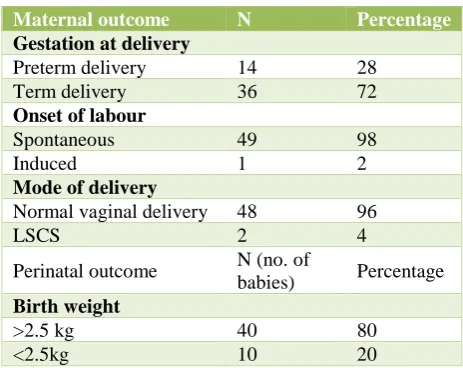
Out of all the enrolled women, 72% delivered at term, 49 women went into spontaneous labour and 1 woman was induced, out of which 48 had vaginal delivery and 2 had caesarean section which was done for oblique lie with CPD and failed induction. All women had 100% live birth with no NICU admission and all having APGAR 8,9,9. Majority had birth weight >2.5kg with mean of 2.77+0.29 kg (Table 8).
Table 8: Maternal and perinatal outcome.
Maternal outcome N Percentage
Gestation at delivery
Preterm delivery 14 28
Term delivery 36 72
Onset of labour
Spontaneous 49 98
Induced 1 2
Mode of delivery
Normal vaginal delivery 48 96
LSCS 2 4
Perinatal outcome N (no. of
babies) Percentage
Birth weight
>2.5 kg 40 80
<2.5kg 10 20
DISCUSSION
The purpose of present study was to evaluate whether simple maternal oral hydration is able to normalize the amniotic fluid index in women with isolated oligohydramnios in the third trimester. Also, we wanted to define the appropriate volume and the correct way of administration of daily water intake to reach this aim.
The results of the present study indicated that the age of the studied women ranged between 20 and 37 years with a mean age of 25.98±3.96 years. Majority of the women (76%) were in the age group of 20-30 years (Table 1). Magnan et al, Patrelli et al and Shikha et al have quoted a similar age between 24-26 years.3-5 In the present study,
maximum number of women were literate (80%) (table 1). The result was in accordance to Shikha et al showing 77% of study population to be literate.3
The mean gestational age at the time of presentation was 34.1±2.1 weeks ranging from 28.6 to 37.4 weeks. Majority of women (44%) were between 34-36 weeks of gestation (Table 1). Mean gestational age was comparable to studies by Magnan et al, and Patrelli et al in which it was ranging between 31 to 36 weeks.4,5
Present study included women who had isolated oligohydramnios in third trimester with an amniotic fluid index of less than 5cm and with normal doppler flows. The mean amniotic fluid index at the time of admission was 4.25±1.01 cm which ranged from 0 to 5 cm (Table 2). There are numerous studies which have shown the beneficial effect of oral hydration on initial AFI in women with isolated oligohydramnios. The amniotic fluid index in most of the studies varied from less than 5cm to between 5-8 cm. The pre-hydration AFI in the studies by Umber et al, Patrelli et al and Shehzad et al was less than 5.5-7
The average daily fluid intake in the study population was 1.46±0.4 litres ranging between 500 ml to 2 litres (Table 3). Nearly forty percent of the women’s daily fluid intake prior to pre hydration therapy was less than one litre per day. Montgomery et al, recommended 8-10 glasses of water each day during pregnancy, which is around 2-2.5 litres per day.8 Similarly, European food
authority, reported that water intake in pregnant women to be around 2700 ml per day.9 This clearly shows that in
present study fluid intake (1.46±0.4 litres) of women was below the recommended amount and could be the cause of maternal dehydration leading to oligohydramnios.
The present study aimed to define the appropriate volume and the correct way of administration of daily water intake in women with isolated oligohydramnios in third trimester and to evaluate whether a continuous prolonged hydrotherapy instead of a fixed and shorter therapy can normalize the AFI and the AFI remains sustained, particularly till the time of delivery. Thus in the present study, with continuous and sustained oral intake of fluids, the average daily fluid intake of women was 4.07±0.76 litres (table 4) with more than two third took between 4-6 litres. A method similar to ours was followed by Patrelli et al and Shikha et al.3,5
[image:4.595.51.283.477.661.2]and 4.25 cm to 9.3cm respectively) (Table 6). The AFI in 90% of the women increased to between 5-8cm on day1 of an adequate intake of oral fluids. It was more than 8cm in 100% of the women at the end of first week with continued oral hydration therapy (Table 5). The difference in the AFI after first week during oral hydration therapy was highly significant (p value<0.001). This is clear that women were dehydrated before the therapy and after taking adequate fluids orally their dehydration got corrected leading to increase in amniotic fluid volume in them. Our results are consistent with that of the study by Patrelli et al who reported that by giving oral hydration therapy of 2.5 litres per day plus routine intake of water, significantly improves the quantity of amniotic fluid, resulting in a normal AFI at birth.5 In fact,
they noted that an increased AFI at birth was significant in the group who took 2500 mL of water daily (AFI increased from 7.7 to 11.2 cm at birth, ΔAFI = 3.5cm) compared to the group who took 1500 mL daily (AFI increased from 7.5 at to 8.6 cm, ΔAFI =1). Similarly, Shikha et al demonstrated that sustained fluid intake i.e. two litres of fluid over one hour daily, have significant increment in the mean post hydration AFI, 6.09±1.65 cm at 3 hour, 7.41±1.46 cm at 24 hours (p <0.001) and 8.06±1.55 cm at 48 hours (p <0.001) from a baseline of 5.75±1.59 cm.3 Abbasalizadeh et al also showed a
significant rise in AFI from a baseline of 5.75 to 8.06 cm at 48 hour, 5.25 to 6.40 at week1 and 7.14 at week 2 respectively when the oral hydration was sustained at 20 ml/kg/day.10 This suggests that duration is more
important than the dose of fluid intake.
In contrast, Nada et al, reported that the duration of the increase in AFI after oral maternal hydration remained till one week post hydration when oral hydration was given at 2 litres in 2 hours and the AFI was measured at 2hours, 2nd day, 4th day and 9th day.11 Number of women with
AFI > 6 was 100% at 2 hours, 35% on day 2, 11% on day 4 and 0.05% on day 9. Thus, they reported that most of the pregnant women’s (99.5%) AFI returned to the pre-treatment levels by the end of first week post hydration. The maximum duration of the increase in AFI after hydration was about one week. This could be because the fluid intake was not sustained.
Simply by allowing the study population to drink adequate fluids daily as per their convenience (mean intake being 4.40 +0.51 litres during hydration compared to 1.46±0.41 litres pre-hydration) which has to be continued till delivery, we were able to suggest that the correct daily and sustained oral fluid intake helps in maintaining adequate AFI till delivery.
All of the women achieved normal amniotic fluid index at first week of oral hydration therapy. At the time of delivery all had normal amniotic fluid index. Out of 50 women enrolled in present study 2% were induced in view of postdated pregnancy, 98% went into spontaneous labour. Hina et al reported induction rate was 63% in women with isolated oligohydramnios as compared to
14% in control group.12 The reported rate of caesarean
was very low (4%) in present study. Anna et al, studied that 15.2% caesarean section delivery among 341 oligohydramnios patients.13 Oligohydramnios is
associated with increased maternal and foetal morbidities. Maternal morbidity is due to increased rates of induction of labour and caesarean deliveries. Perinatal morbidity and mortality is due to umbilical cord compression leading to fetal distress, low APGAR scores and meconium aspiration syndrome. This clearly states that restoration of normal amniotic fluid at delivery decreases rate of induction of labour and caesarean section. Intra-partum distress is the commonest problem with oligohydramnios cases and presents as abnormal contraction stress test, fetal bradycardia, or passage of meconium, leading to poor fetal outcome. In present study, all women had normal AFI at the time of delivery with no perinatal complications. All women had live babies with normal APGAR score and none had NICU admission. Shikha et al found meconium stained liqour in 54.5% of cases, 18% being thick and 36.4% thin meconium stained during labour.3 It has to be noted that
in above study most of the women with thick MSL had AFI between 5-7 cm and thin MSL was seen in women with AFI 7-9 cm during labour. At birth 96% of babies had APGAR < 7 in severe oligohydramnios group (AFI <5) while only 32% in cases with decreased liquor group (AFI 6-8). Shikha et al showed that the cases in which AFI improved to 7 and above after oral hydration had higher vaginal delivery rate, better APGAR score and lesser NICU admission which was in agreement with present study.3 In present study, 80% of babies had birth
weight above 2.5kg and 20% had low birth weight babies with overall mean birth weight of 2.77 kg (Table 7), this result could be explained due to normal AFI of pregnant women at the time of delivery. In consensus with present study, Bachhav et al, reported 33 % neonates in the control group and 64 % in the study group (having AFI <5 cm) had birth weight <2.5 kg.14
Thus, present study favours a positive role of oral hydration therapy with an adequate amount of fluid intake, extended over a long duration (till delivery) in women with third trimester oligohydramnios. Thus, a simple correction of maternal dehydration in women with isolated oligohydramnios by taking adequate and sustained daily oral fluids normalizes amniotic fluid index thereby improving maternal and perinatal outcome.
ACKNOWLEDGMENTS
Author wish to express heartily thanks and gratitude with full respect to Dr. Sharda Patra, Professor, Dept of Obstetrics and Gynaecology, Lady Hardinge Medical College, New Delhi. Her support, encouragement, guidance and great personal interest was a constant driving inertia to finish this work.
Ethical approval: The study was approved by the Institutional Ethics Committee
REFERENCES
1. Phelen JP, Smith CV, Broussard P, Small M. Amniotic fluid volume assessment with four quadrant technique at 36-42 weeks gestation. J Reprod Med. 1987;32:540-2.
2. James, Steer, Weiner, Gonik, Crowther, Robson. Abnormalities of amniotic fluid volume. High risk Pregnancy. 4th ed. Elsevier Saunders;2011:197-202.
3. Seth S, Mishra P, Kanti V, Shukla SK. Effect of oral hydration therapy on isolated oligohydramnios cases and perinatal outcome. J Women’s Health Issues Care. 2014;3(2):1-4.
4. Magann EF, Doherty DA, Chauhan SP, Barrilleaux SP, Verity LA, Martin JN. Effect of maternal hydration on amniotic fluid volume. Am J Obstetric Gynecol 2003;101(6):1261-4.
5. Patrelli TS, Gizzo S, Cosmi E, Carpano MG, Gangi SD, Pedrazzi G et al. Maternal hydration therapy improves the quantity of amniotic fluid and the pregnancy outcome in third-trimester isolated oligohydramnios. J Ultrasound Med. 2012;31:239-44.
6. Umber A. Intravenous versus oral maternal hydration therapy for increasing amniotic fluid volume. Annals. 2010;16(1):14-6.
7. Lorzadeh N, Kazemirad S, Lorzadeh M, Najafi S. Comparison of effect of oral and intravenous fluid
therapy on women with oligohydramnios. Res J Obstet Gynecol. 2008;1(1):25-9.
8. Montgomery KS. An Update on Water Needs during Pregnancy and Beyond. J Perinat Edu. 2002;11(3):40-2.
9. EFSA Panel on Dietetic Products, Nutrition, and Allergies (NDA); Scientific Opinion on Dietary reference values for water. EFSA J. 2010;8(3):1-48. 10. Abbasalizadeh S, Abbasalizadeh F, Azar ZF. Effect
of Desmopressin on increase of amniotic fluid volume in pregnancies with oligohydramnios. Int J Curr Res Academic Rev. 2015;3(9):227-30.
11. Nada Z. Oral and intravenous maternal hydration in third trimester idiopathic oligohydramnios: Effects and duration. J Nursing Health Sci. 2015;4(5):22-25. 12. Ahmad H, Munim S. Isolated Oligohydramnios is
not an indicator for adverse perinatal outcome. JPMA. 2009;59(10):691-4.
13. Locateli A, vergani P, Pezzullo JC, Toso L, Verderio M. Perinatal outcome associated with oligohydramnios in uncomplicated pregnancies. Am J Obstet Gynecol. 2004;269:130-3.
14. Bachhav AA, Waikar M. Low amniotic fluid index at term as a predictor of adverse perinatal outcome. J Obstet Gynaecol India. 2014;64:120-3.