! "!" # $ $"
% & ''' (
Blind Multi-Agent System for Department Teaching Schedule
Abdur Rashid Khan*
Institute of Computing & Information Technology (ICIT), Gomal University,
Dera Ismail Khan, Pakistan
Sheikh Muhammad Saqib
Institute of Computing and Information Technology (ICIT), Gomal University,
Dera Ismail Khan, Pakistan [email protected]
Abstract: This research paper represents a multi-agent system, which have four Agents named as Knowledge Acquisition Agent, Attendance Agent, Decision Making Agent and Communication Agent that works together to that automatically gets inputs, manipulates the data, prepares timetable as well as keeps the record of students’ attendance and makes communication with its environment in an automatic fashion through sensors. All the agents work like human agents, which is one of the basic aims of computer technology. This work depicts an idea to integrate the Human Expertise, Information as well as the Biometric Technologies to solve real world problems. Feedback may be used as a learning element in the processing of the Multi-agent system. Snapshots (i.e., time table preparation, Attendance records, decision about absenteeism etc) depict how the various results are being provided by this multi-agent system to help human. This system can easily be implemented through adaptation of Biometric Technology and may also be used for employees’ attendance record as well as for security purposes, in future research.
Keywords:Agent, multi-agent system, biometrics technology and sensors
I. INTRODUCTION
Students’ absenteeism is a major concern for educators at institutions of higher learning. We observed that absences are just like a termite for students, which can demolish him from his education. Biometric is the most secure and convenient authentication tool. It can not be borrowed, stolen, or forgotten and forging one is practically impossible. Biometrics measures individual's unique physical or behavioral characteristics to recognize or authenticate their identity. Common physical biometrics includes fingerprints, hand or palm geometry, retina, iris, and facial characteristics. Behavioral characters characteristics include signature, voice, keystroke pattern, and gait. Of this class of biometrics, technologies for signature and voice are the most developed [1]. Absenteeism disturbs the dynamic teaching-learning environment and adversely affects the overall well-being of classes [2]. In a survey of the impact of attendance on student classroom success made by Robert M. Schmidt, the author measured the impact of time commitments by students to various course activities on the students' performance in the given class [3]. Education system is mainly based upon keeping strict control over the presence of the students. While, right information at the right time is only possible through real time computer processing. Such software is required which may provide facilities both for feedback as well as feed forward controlling strategies. Mostly, a teacher teaches many classes daily, where there are more than 40 students in each class. Hence it is very difficult for a teacher to manage attendance of each class individually and prepare a time table for numerous subjects and a large number of teachers as well. This research paper presents a multi-agent system to give a concept of making an agent device which can automatically
acquire knowledge about courses, teachers’ specialties, evaluate attendance of each student and prepare a time table for allocation of subjects. This works aims to develop a multi-agent system that can automatically acquire knowledge from its environment, process data, produces results and communicate back with its environment. The summarized form of objectives of this work is: -
• To develop a multi-agent system that may work like a human’s team.
• To prepare a guideline to utilize both Computer and Biometric technologies in a useful form.
• To provide a pedagogical device to help students and researchers to use the useful techniques and technologies in research and development.
• To provide a way of further research to expand this work for security and staff management.
Information is acquired from external environment through these sub-agents, are processed and communicated back to the users automatically. This work is presently limited just to a conceptual acquisition and processing of information, which will be enhanced in the future through implementation of biometric devices along with inclusion of methodology how to learn from its experience through using suitable technique(s) of learning.
II.CONCEPTUALDESIGN
Decision Making Agent, Knowledge Base and Communication Agent. The Knowledge Acquisition Agent acquires knowledge from the users directly and/or through biometric technologies, prepares time table and allocation of courses for the session. This agent learns from its feed back or experience and utilizes this knowledge effectively. The Attendance Agent keeps the record of students’ attendance, gives details about absentees of the students and announcement of the class timings. The
Decision Making Agent is responsible for making decisions about the rules implementations and punishment/warnings. Knowledge Base (KB) stores knowledge about all the functions of this system. The Communication Agent works as a liaison agent between the main system and the system users, like; Students, Teachers, Academic Section, Exam Section, Administration etc.
Figure.1 Main Components of the Multi-Agent System
III.RESULTS&DISCUSSIONS
As mentioned previously, the proposed Multi Agent environment consists of three agents, which has a mechanism of acquiring knowledge from its environment and learns from its experience as well. The logical as well as working activities of all these agents are being described in the following paragraphs.
A. Knowledge Acquisition Agent
This Sub-Agent acquires knowledge and has the learning capabilities from its environment. It prepares time table for all classes and also allocate courses with the help of its past experience through using its learning mechanism. This agent gets knowledge from its environment; local and foreign education institutions, all the sections of the institute, and other users. Fig 2 depicts the internal working and communication of this agent with the other coordinating agents.
Human User,
Attendance Agent Study Plan
Maintains records warning, struck off, fines, re-admissions, pay bills
Inputs include; information about programs, courses, students, teachers etc along with the
feedback of the
system is acquired through Keyboard for the time being. Processing of this agent includes; preparing the time table and courses allocation to various teachers according to their specialties and expertise. Control Mechanism is to distribute the courses using specified criteria without confliction in time table. Objectives are to produce and communicate the time table, and courses allocation. While, its Environment consists of; department, students, teachers, input devices, knowledge base and other co-partner agents of the Multi-agent System. See the pseudo code for this agent shown through Table 2.Table.1Pseudo Code for Knowledge Acquisition Agent
i) Input From Environment.
If AlreadyExistStudentRecord() then Return
Stop
Else: Insert in to data base
ii) Input for Courses:
Get(Courses for all Programs)
iii)Processing:
SettingTimeTable()
iv) Generate reports.
TimeTableNoticeBoard()
TechersAllocatedCourses()
Data Entries/Input Forms: Following snapshots are the input entries of this agent, which are based upon the knowledge about programs, courses, students, teachers, and its feedback. Following layouts will be used for inputs about Students, Teachers and Course information. Fig 3 depicts the inputs, which shows the code, designation, remuneration details etc.
Figure.3 Teachers’ Remuneration
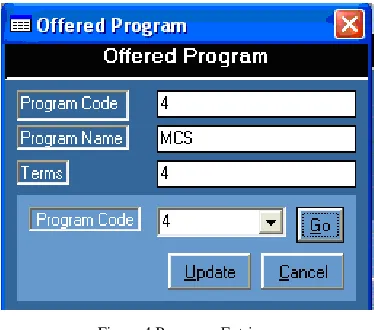
Fig 4 shows how entries can be made about the programs offered, their codes, and relevant terms.
Figure.4 Programs Entries
Fig 5 gives details about courses being offered in a specific program in the relevant term.
Figure.5 Courses Entries
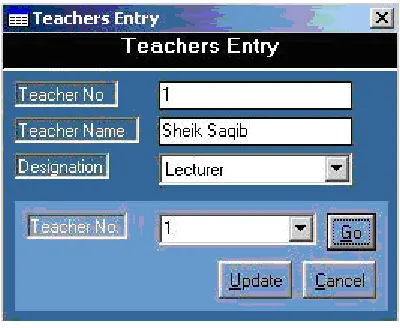
Students’ and teachers’ information entries are being shown through Fig 6 and Fig 7 respectively, as given below.
Figure.6 Students’ Profile
Figure.8 Teachers’ Profile
Outputs of this agent include: Courses Allocation and Time Table as shown through Fig 8 and Fig 9 below.
Figure.9 Courses Allocation
Time table being produced by the Knowledge Acquisition Agent is shown through Fig 9 as below.
Figure.10 Time Table
B. Attendance Agent
This agent has communication with Knowledge base, Knowledge Acquisition and Decision making Agents. It announces class timings, keeps record of attendance. This agent is responsible for class timings, along with informing students about their absentees.
Table.2 Pseudo Code for Attendance Agent
i) Input from 1st Agent.
Get Inputs about_time_ table and
teachers_with-courses
ii) Processing:
ClassAnnouncement()
CapturingTime()
TakingAttendence()
iii) Irregularity Report
Apply rules_of_attendance and
Generate_the_report
Else: Return Stop
iv) Out Put:
Generate Attendance_Report
Fig 10 represents the daily attendance report being produced by the Attendance Agent.
Figure.11 Daily Attendance Report
C. Decision Making Agent
This agent takes output of Attendance Agent as input and used to generate the monthly report for each student. It takes care for the rules and regulations about attendance and acts accordingly. Checking their attendance either he will be worn, struck off or cancel the admission of a student. At the end of semester this agent generates the teachers’ bill if the classes are evening or self finance based.
i) Input
Get(students_ attendance from Attendance_agent)
ii) Warning Report
If(Month=1)
If(attendance<50%)
Generate Warning_report
iii) Struck Off Report
If(Month=2)
If(attendance<60%)
Generate Struck_off_Report
iv) Cancel Admission Report
If(Month=3)
If(attendance<75%)
Generate Cancel_admission_report
v) Generate Teacher Bills
If(Classes_Self_Finance or Evening_Schedule)
Then
Generate Report_For_Bill.
Sample consolidated struck off report, individual students’ report and struck off information letter to students’ parents can be seen through Fig 11, Fig 12 and Fig 13 as given below.
Figure.11 Consolidated Struck off Report for Notice Board
Figure.12 All students Struck off Report
Figure.13 Student’s Parent Letter
Similarly, teachers; bill of payment being verified by the internal committee is shown in the Fig 13 as below.
Figure.14 Teachers’ Bill of Payment D. Communication Agent
This agent makes communication with the students, their parents and various sections of the university, like; Academic section, Exam Section, Pay Section, and Administration. The output information (i.e. warning, struck off, fines, termination, etc) are displayed over the notice board, university website and through letters. These results become a feedback to the Knowledge Management Agent to learn from the working experience of this multi-agent system.
IV.CONCLUSION
attendance, time table preparation and course allocation and replaces dedicated staff. It is educational version, so it can be used by teachers and institutions free of cost.
V.REFERENCES
[1]. http://www.peterindia.net/BiometricsView.html
[2].Foltz, John. Evaluation of factors influencing student class attendance and performance, American Journal of Agricultural Economics, 1996
http://www.allbusiness.com/north-america/united-states/590295-1.html
[3]. A Study in Student Time Allocation ", AMERICAN ECONOMIC REVIEW, May, 1983, pp. 23-28).