!
"
#"#
$ % %#
&
'
((( )
Enhancement of Aodv Protocol Performance by reducing the delay
R. Thandeeswaran*
School of Information Technology and Engineering VIT University
Vellore, India [email protected]
Vinithra J and N Hima Bindu
School of Information Technology and Engineering VIT University
Vellore, India [email protected]
Abstract:MANETs are infrastructure less and wireless networks in which there are several nodes which are free to move arbitrarily and perform management of routes. Different types of MANET protocols are available such as AODV, DSR, and DSDV out of which AODV outperforms. AODV and other on demand routing protocols use route request (RREQ) and route reply (RREP) for the process of route discovery and route maintenance. In AODV each node sends the RREQ to all it neighbouring nodes and thus there is a chance that a single node may get a RREQ more than once; same for the case of RREP also. This increases the average delay of the protocol and is considered to be as one of the disadvantage of the protocol. To avoid this problem, we proposed a enhanced AODV which avoid the sending of redundant RREQ and RREP among the process of route discovery. It obtains better performance than the existing AODV and other protocols .The same is implemented using NS-2 tool and simulation results show that the enhanced AODV provides high packet delivery rate and low communication delay than the existing AODV..
Keywords: MANET, AODV, DSR, DSDV, packet delivery rate, delay
I. INTRODUCTION
A. Mobile Adhoc Networks
Ad-hoc networking is a concept in computer communications, which means that the users wanting to communicate with each other forms a temporary network, without any form of centralized administration.
Network’s wireless topology may change rapidly and unpredictably [1]. Such networks may operate in a standalone fashion, or may be connected to the larger Internet operating as a hybrid fixed/Ad-Hoc networks. In a MANETs, no such infrastructure exists and the networks topology may dynamically change in an unpredictable manner since nodes are free to move as shown in figure 1.
Figure: 1 Dynamic Topology in Ad-Hoc Networks
B. Mechanisms Required In The Manet
[a] Multihop operation requires a routing mechanism designed for mobile nodes.
[b] Internet access mechanisms.
[c] Self configuring networks require an address allocation mechanism.
The main purpose of IETF MANET working group is to standardize IP routing in Mobile Ad hoc Networks [1, 14]. Three routing protocols accepted as experimental RFCs, and a fourth one coming up. These protocols all into two categories: Reactive Protocols, Proactive Protocols
Figure: 2 Classification of Adhoc routing protocols
C. The Destination Sequence Distance Vector (Dsdv) Routing Protocol
The Destination Sequence Distance Vector (DSDV) is a proactive uncast mobile ad hoc network routing protocol. Routing performance in mobile ad hoc networks are quite different [6]. In routing tables of DSDV, an entry stores the next hop towards a destination, the cost metric for the routing path to the destination and a destination sequence number that is created by the destination. Sequence numbers are used in DSDV to distinguish stale routes from fresh ones and avoid formation of route loops.
One is "full dump” update type and the full routing table is included inside the update. An incremental update contains only those entries that with metric have been changed since the last update is sent. Additionally, the incremental update fits in one packet.
D. The Dynamic Source Routing (Dsr) Protocol
The Dynamic Source Routing (DSR) is a reactive uncast routing protocol that utilizes source routing algorithm. In source routing algorithm, each data packet contains complete routing information to reach its dissemination. Additionally, in DSR each node uses caching technology to maintain route information that it has learnt. There are two major phases in DSR, the route discovery phase and the route maintenance phase [1, 5]. When a source node wants to send a packet, it firstly consults its route cache. If the required route is available, the source node includes the routing information inside the data packet before sending it. Otherwise, the source node initiates a route discovery operation by broadcasting route request packets. A route request packet contains addresses of both the source and the destination and a unique number to identify the request. Receiving a route request packet, a node checks its route cache. If the node doesn’t have routing information for the requested destination, it appends its own address to the route record field of the route request packet. Then, the request packet is forwarded to its neighbors. If the route request packet reaches the destination or an intermediate node has routing information to the destination, a route reply packet is generated. When the route reply packet is generated by the destination, it comprises addresses of nodes that have been traversed by the route request packet. Otherwise, the route reply packet comprises the addresses of nodes. The route request packet has traversed concatenated with the route in the intermediate node’s route cache.
E. The Ad Hoc On-Demand Distance Vector Routing (Aodv) Protocol
The Ad Hoc On-demand Distance Vector Routing (AODV) protocol is a reactive unicast routing protocol for mobile ad hoc networks. As a reactive routing protocol, AODV only needs to maintain the routing information about the active paths. In AODV, routing information is maintained in routing tables at nodes [4, 10]. Every mobile node keeps a next-hop routing table, which contains the destinations to which it currently has a route. A routing table entry expires if it has not been used or reactivated for a pre-specified expiration time. Moreover, AODV adopts the destination sequence number technique used by DSDV in an on-demand way. In AODV, when a source node wants to send packets to the destination but no route is available, it initiates a route discovery operation. In the route discovery operation, the source broadcasts route request (RREQ) packets [4]. A RREQ includes addresses of the source and the destination, the broadcast ID, which is used as its identifier, the last seen sequence number of the destination as well as the source node’s sequence number. Sequence numbers are important to ensure loop-free and up-to-date routes. To reduce the flooding overhead, a node discards RREQs that it has seen before and the expanding ring search algorithm is used in route discovery operation.
II.NS-2SIMULATOR
Generally speaking, network simulators try to model the real world networks. The principal idea is that if a system can be modeled, then features of the model can be changed and the corresponding results can be analyzed. As the process of model modification is relatively cheap than the complete real implementation, a wide variety of scenarios can be analyzed at low cost.
However, network simulators are not perfect. They cannot perfectly model all the details of the networks. However, if well modeled, they will be close enough so as to give the researcher a meaningful insight into the network under test, and how changes will affect its operation.
A. Wireless Simulation In Ns-2 Software Structure And Mechanism Of Ns-2
The key to get to know ns-2 is it is a discrete event network simulator. In ns-2 network physical activities are translated to events, events are queued and processed in the order of their scheduled occurrences. And the simulation time progresses with the events processed. And also the simulation “time” may not be the real life time as we “inputted”. But, why is ns-2 that useful, what kind of work can be done by ns-2, it can model essential network components, traffic models and applications. Typically, it can configure transport layer protocols, routing protocols, interface queues, and also link layer mechanisms. We can easily see that this software tool in fact could provide us a whole view of the network construction, meanwhile, it also maintain the flexibility for us to decide. Thus, just this one software can help us simulate nearly all parts of the network [2, 10]. This definitely will save us great amount of cost invested on network constructing. The following Figure 2.1 shows a layered structure which ns-2 can simulate for us.
Figure: 3 NS-2 simulate layered structure of networks
Figure: 4 Data flow for one time simulation
As Figure 4 shows, for the data flow of one time simulation in ns-2, the user input an OTcl source file, the OTcl script do the work of initiates an event scheduler, sets up the network topology using the network objects and the plumbing functions in the library, and tells traffic sources when to start and stop transmitting packets through the event scheduler. And then, this OTcl script file will be passed to ns-2, in this view, we can treat ns-2 as Object-oriented Tcl (OTcl) script interpreter that has a simulation event scheduler and network component object libraries, and network setup module libraries. And then the detail network construction and traffic simulation will be actually done in ns-2. After a simulation is finished, NS produces one or more text-based output files that contain detailed simulation data, and the data can be used for simulation analysis [2, 10].
From the NS-2 developer view, Figure 3 shows the layered architecture of ns. The event schedulers and most of the network components are implemented in C++ and available to Tcl Script, thus the lowest level of NS-2 is implemented by C++, and the Tcl script level is on top of it to make simulation stuffs much easier to be conducted [2, 10].
Figure: 5 Layered structure from the ns-2 developer view
Then, upon the Tcl level, we see the overview of the network. That is the simulation scenario. These all things combined as so called ns-2 software.
III. PERFORMANCEEVALUATIONOFROUTING
PROTOCOL
To prove that AODV outperforms [11][12], comparison between the various protocols like AODV,DSR and DSDV is done based on packet delivery rate, End to End delay.
A. Packet delivery rate:
The ratio of number of packets reached the destination to the total number sent from the source.
Table1: Various parameters chosen for simulation in ns- 2
PARAMETERS VALUES
Simulation time 30 sec
Number of nodes 120
Pause time 10, 20, 30, 40 and 50msec
Terrene size 2000 X 1000
Traffic Type Constant Bit Rate(CBR)
Maximum Speed 10m/s
Network Load 4 pkts/sec
Mobility Model Random Waypoint Model
B. Comparison Graph
Figure: 6 xgraph that shows the packet delivery rate of AODV,DSR,DSDV protocols
DELAY: The time interval in which the packets stay in the network.
Average delay comparison of AODV,DSR,DSDV
IV. PROPOSEDMODEL
A. ENHANCED ADHOC ON-DEMAND DISTANCE
VECTORPROTOCOL
Analyzing previous protocols, we can say that most of on-demand routing protocols, has two main phases: 1. Route Discovery and 2. Route Maintenance. This route discovery is done by sending RREQ and RREP. As a result of the comparative study in various on-demand protocols, we found that each node in the network will get same RREQ and RREP more than once[13], and this increases the communication delay. Specifically, the proposed Enhanced AODV protocol discovers routes on- demand using a modified route discovery procedure. During the process of route discovery in the proposed AODV we assign an id to each node and a broadcast id to each RREQ. When first time the RREQ is received by the intermediate node the broadcast id of the RREQ is assigned to the id of the node. After that each time when the node receives a RREQ it checks the id value and if it is equals to the existing value the node will not accept it and this indicates that it already receives this RREQ and forward to its neighbor. Same in the case of the RREP also. When first time the RREP is received by the intermediate node the broadcast id of the RREP is assigned to the id of the node. After that each time when the node receives a RREP it checks the id value and if it is equals to the existing value the node will not accept it and this indicates that it already receives this RREP and forward to its neighbor. Thus by using this mechanism we are able to avoid the sending or forwarding of redundant RREQ and RREP to a node and thus reduces the communication delay and increases the performance of the protocol.
B. Mechanism Of Sending Route Request In Aodv
Figure: 8
In this node A is the source node and node B is the destination node. The various intermediate nodes between the source and the destination are node 1, 2, 3, 4, 5, 6, 7 and 8. Each node gets the RREQ for the route discovery process; it forwards the RREQ to all of its neighboring nodes. Thus from the diagram its is clear that, node 2 is the neighboring node for both node 1 and node 3. Thus it gets the RREQ from both 1 and 3. But both are same request only. Same in the case of node 5 also, it gets the request from node 4 and node 2. This is the reason for high delay in the protocol. Our proposed AODV find this as disadvantage.
C. Mechanism Of Sending Route Request In Proposed Aodv In proposed AODV, we assign an id to each node. When first time the node receives a request that nodes broadcast id is assigned to that node’s id. Then every a request came to this node it checks the id with the broadcast id of the request. If both the broadcast id and id of the node are the same, then the request is being rejected by the node since it already has that particular request.
Figure: 9 Mechanism of sending Route Request(RREQ) in AODV
D. Mechanism Of Sending Route Reply In Aodv
Figure: 10 Mechanism of sending Route Reply(RREP) in AODV
protocol. Our proposed AODV finds this also as a disadvantage.
E. Mechanism Of Sending Route Reply In Proposed Aodv
[image:5.612.340.567.79.357.2]
Figure: 11 Mechanism of sending Route Reply(RREP) in AODV
In proposed AODV , we assign an id to each node. When first time the node receives a reply that nodes broadcast id is assigned to that node’s id. Then every a reply came to this node it checks the id with the broadcast id of the request. If both the broadcast id and id of the node are the same, then the request is being rejected by the node since it already has that particular request. This enhanced AODV is implemented using NS-2 tool and the performance evaluation is checked.
V.SIMULATIONRESULTS
Table 2: Parameters chosen for comparison of AODV and proposed AODV(MAODV)
PARAMETERS VALUES
Simulation time 30 sec
Number of nodes 120
Pause time 10, 20, 30, 40, 50 sec
Terrain size 2000 X 1000
Traffic Type Constant Bit Rate
(CBR)
Maximum Speed 10m/s
Network Load 4 pkts/sec
Mobility Model Random Waypoint
Model
A. Packet Delivery Rate Comparison Ofaodv And Proposed Aodv(Maodv)
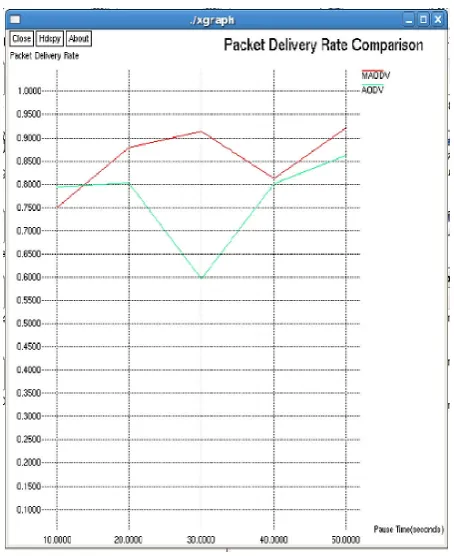
The MAODV outperforms AODV when the retransmission of Route Request (RREQ) and Route
Reply(RREP) is stopped.The performance is compared in terms of packet delivery rate as shown below
Figure: 12 xgraph that shows the performance of enhanced AODV(MAODV) better than AODV in terms of packet delivery rate.
B. Average Delay Comparison Of Aodv And Proposed Aodv(Maodv)
As defined earlier, the delay is the average time interval where the packets stay in the network. Our proposed AODV reduces the delay by stopping the retransmission of Route Request(RREQ) and Route Reply(RREP).The Comparison of delay in AODV and MAODV is shown below using xgraph
[image:5.612.47.250.105.246.2] [image:5.612.52.260.429.666.2] [image:5.612.328.564.500.678.2]VI. CONCLUSION
When pause time increases the performance of AODV gets affected little. To reduce delay, the retransmission of redundant route request and route reply to a node causes serious impairment on the routing performance and it will take time for route discovery process. In proposed AODV proposed AODV we implemented the idea of stopping the redundant route information to the neighboring nodes by comparing the id of the node with broadcast id to increase the overall performance and reduce the communication delay in the network. Our future scope of this project is to implement the same concept in other protocols also.
VII. REFERENCES:
[1] An Introduction to Mobile Ad Hoc Network, by Ming Yu Jiang at website http://kiki.ee.ntu.edu.tw/mmnet1/adhoc/ [2] The network simulator - ns-2. http:// www.
isi.edu/nsnam/ns/.
[3] Murthy, S. and J.J. Garcia-Luna-Aceves, An Efficient Routing Protocol for Wireless Networks, ACM Mobile Networks and App. J., Special Issue on Routing in Mobile Communication Networks, Oct. 1996, pp. 183-97 [4] C.E. Perkins and E.M. Royer. Ad hoc On demand
Distance Vector routing, mobile computing systems and applications, 1999.
[5] Proceedings. WMCSA ’99. Second IEEE workshop on, 1999, p90 – p100.
[6] D. Johnson, D. A. Maltz, Dynamic Source Routing (DSR) in ad hoc wireless networks, in Mobile Computing ( T.
Imielinski and H. Korth, eds.) , Kluwer Acad. Publ., 1996.
[7] C. E. Perkins and P. Bhagwat. Highly dynamic Destination Sequence Distance Vector Routing (DSDV) for mobile computers, ACM Computer communication review, Vol. 24, No.4, (ACM SIGCOMM’94) Oct. 1994, pp.234-244.
[8] G. Pei, M. Gerla and T.-W. Chen, Fisheye State Routing in Mobile ad hoc networks, in proceedings of the 2000 ICDCS Workshops, Taipei, Taiwan, Apr. 2000, pp.D71-D78.
[9] Navid Nikaein, Christian Bonnet and Neda Nikaein, HARP – Hybrid Ad hoc Routing Protocol, in proceeding of IST 2001: International Symposium on Telecommunications, Iran/Tehran 2001.
[10] C. C. Chiang, T. C. Tsai, W. Liu and M. Gerla, Routing in clustered Multihop, mobile wireless networks with fading channel, The Next Millennium, The IEEE SICON, 1997. [11] Mingliang Jiang, Jinyang Li and Y. C. Tay. Cluster Based
Routing Protocol (CBRP), Internet draft-ietf-manet-cbrp-spec-01.txt. Design Routing Protocol Performance comparison in NS-2: AODV compared to DSR as Example. Yinfei Pan,
[12] Department of Computer Science, SUNY Binghamton, Vestal Parkway East, Vestal. NY 10850.
[13] MD. Mohammad Hasam, “Modeling delay and packet trap in NCS using NS2” in IEEE conference on 2007 [14] Das, S.R., R. Castaeda and J. Yan, “Simulation-based
performance evaluation of routing protocols for mobile ad hoc networks.”, Mobile Networks and Applications, 2000, pp: 179-189.