Volume 2, No. 1, Jan-Feb 2011
International Journal of Advanced Research in Computer Science
RESEARCH PAPER
Available Online at www.ijarcs.info
An Ontology Aided Requirement Engineering Framework
Shilpa Sharma*
Sanghvi Inst. of Management &Science Indore, India
Maya Ingle
Indore Institute of Computer Applications Indore, India
Abstract: With the advent of knowledge intensive practices in requirement engineering, ontology has become a definitive choice. It will not only facilitate the confining of knowledge strenuous environment for requirement engineering but also enrich sharing of knowledge across various applications from different domains. Also, the ontology assists in defining information for the exchange of semantic software requirement specification data and lengthens the communication framework. In this paper, we present an Ontology Aided Requirements Engineering (OntoAidedRE) framework that endorses the categories of requirement to elicit, represent and analyze the diversity of factors associated with requirement engineering process. The OntoAidedRE framework represents a hierarchical structure accompaniment with harmonizing semantics in a coalescing ontological requirement engineering process. We also present examples from the practice of our framework that combine theoretical and practical aspects. This, conversely, necessitates divulging the benefits of implementing an OntoAidedRE in practicing the requirement engineering process.
Keywords: OntoPre Requirements, OntoInput Requirements, OntoSystem Requirements, OntoOutput Requirements and OntoAidedRE
I. INTRODUCTION
Requirements engineering is the branch of software engineering concerned with the real world goals for functions of and constrains on the software systems. It is also concerned with the relationship of these factors to precise specifications of software behavior and their evolution overtime and across software families. Therefore, the process involved in developing the system requirements is called Requirements Engineering [1] [3]. Requirements are often specified, validated and documented across different domains, disciplines and dislocation of the respective stakeholders and authors. Also, the requirements reuse and designing of solutions obtained in a hysterical way (without properly analysing before reusing) due to lack of knowledge intensive environment. Besides, members of the same domain may use different terminology, and often there is no common perceptive of the terms or concepts used and the problems faced within specific domains [5]. Therefore, many requirement engineers are facing numerous challenges when developing software requirement specifications for highly complex, long-lead projects and services of various domains.
Ontology is a formal, explicit specification of a shared conceptualization [4]. By adopting ontology approach, the requirements knowledge are represented as ontology concepts and therefore become more definite, complete, consistent and convenient to share and reuse [2]. Based on the above verdict, it appears potential to consider and evaluate elementary shift in the way requirement engineering is practiced. One way to do this is to investigate a possible orientation (building on the current process-driven approaches) towards more knowledge-driven requirements engineering in an attempt to address some of the identified shortcomings of current process-driven requirement engineering approaches. Additionally, the emphasis must be given to categorize the requirements depending on relevant changes of knowledge. The Ontology Aided Requirements Engineering (OntoAidedRE) framework followed a layered approach and intended to be a generic paradigm to enable
knowledge driven requirements engineering. It is not only supported by ontology but also driven by requirement type depending on relevant changes of knowledge.
Ontology technology is more and more applied to requirements engineering. Section 2 reveals the related work such as OntoREM Meta Model, Onto-ActRE framework and Multiple Ontology frameworks based on ontology. Ontology is legitimately scrupulous representation of cadaver of knowledge defining concepts that may use to elicit requirement types and the relationship that hold between them. The OntoAidedRE framework is introduced in Section 3. In Section 4, we present some case studies to elucidate the software requirement specification set from the practice of OntoAidedRE framework. Finally, we conclude with the benefits of an OntoAidedRE.
II. RELATED WORKS
In the current arena of requirement engineering, there are different requirement engineering models, frameworks and tools are available based on the ontology oriented approach. All these can conveniently establish software requirement specification set for a particular application by enriching every phase of traditional requirement engineering process such as Requirements elicitation, Requirements analysis and negotiation, Requirements documentation and validation and Requirements management. The typical work includes OntoREM’s Metamodel, Onto-ActRE framework and Multiple Ontology frameworks.
as the audited RE methodology including its associated process, methods, tools and deployment [7]. On the other hand the Onto- ActRE framework adopts a mixed-initiative approach to elicit, represent and analyze the diversity of factors associated with software-intensive systems. It combines various RE modeling techniques with complementary semantics in a unifying ontological engineering process. It provides means to understand and evaluate the effects of system functions and constraints in light of the concepts, properties their relationships that exist in the Universe of Discourse (UoD) from the perspectives of the real world goals, technology, organization, and business/mission requirements [8]. Alternatively, based on KADS knowledge modeling, a multiple ontology framework for requirements elicitation and reuse has been proposed. Besides encapsulating the ontology of domain knowledge, it also includes the top level ontology, task ontology and application ontology which are categorized according to the domain relevant degree. Top level ontology and domain ontology contain the static knowledge which is independent of problem solving. While task ontology captures the dynamic knowledge with regard to problem solving and application ontology expresses the knowledge specific to solving particular applications. The framework provides a more powerful knowledge base for requirements elicitation and definitely defines the responsibilities of all stakeholders [9].
III. ONTOAIDEDREFRAMEWORK
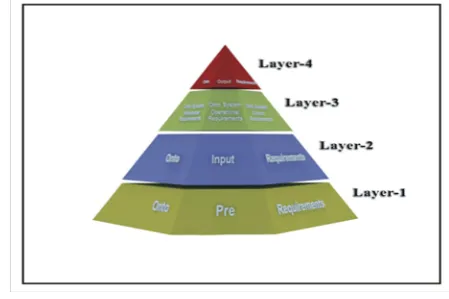
In order to accomplish the improved requirement engineering activities of conventional process driven requirement engineering model an OntoAidedRE framework has been proposed. The OntoAidedRE is intended to enable knowledge driven requirement engineering by encapsulating the ontology. Ontology is used to strengthen the generality of concepts. The layered structure has been designed taking into the account the inter relationships between different domains and multidisciplinary environment. The framework is comprised of four layers as shown in the Figure 1. This layered hierarchical structure can be extracted from the endeavor depending on the requirement type such as pre, input, system and output requirements. It is anticipated that the OntoAidedRE will enhance each requirement engineering activity such as requirements elicitation, requirements analysis and negotiation, requirements documentation and validation, requirements management, requirements change and configuration along with the integration of major goals such as better communication, change management and requirements reuse. Also, the product of applying the OntoAidedRE promotes the cohesiveness between the artifacts generated at every requirements engineering activity of different applications.
A. Layer 1: OntoPre Requirements
The layer is primarily responsible to facilitate the candidate system efficacy. The pre requisitions for the candidate system such as system activation method, system definition, system defined constraints and related protocols must be articulated at this level. All these provisions are established with the help of user verification or identification such as Login-Password or any security check services, and user registration facility etc.
B. Layer 2: OntoInput Requirements
This layer triggers the initial qualifying terms of the candidate system. In order to gain first insights into its usability and further evolve it to conceptualize the problem domain and its related business entities. The major emphasis is on accelerating the system by providing the initial inputs or the system required specifications such as system-defined or access details stacking of initial data values.
C. Layer 3: OntoSystem Requirements
Requirements usually capture ideas, perspectives and relationships at various levels of detail and they are interpreted differently from different standpoints. For simplicity in identifying such standpoints and to create a chain of command consisting of various stakeholders, services or concerns associated with the system and the environment, the layer 3 is divided into three sub layers.
• Sub layer 3 a: OntoSystem Operational Requirements: The sub layer covers all the system access procedures such as system modification and updating competencies which includes addition, deletion etc. The appropriate user responsive messages (if applicable) are also integrated within this sub layer task.
• Sub layer 3 b: OntoSystem Control Requirements: The sub layer is responsible for system control procedure provision. The advanced electronic Control provisions for accomplishment of system goals such as automation of variety of appliances and managing wide range of disparate technology from single point are abstracted in this sub layer. Also the pensiveness of knowledge engineering environment catalyzes the control procedures to an optimal extent.
• Sub layer 3 c: OntoSystem Parameter
Requirements: All the system parameterizing procedures are ascertained at this sub layer. It allows confining the system decision information as intelligent records such as conventional databases and data dictionaries.
D. Layer 4: OntoOutput Requirements
[image:2.595.322.547.619.768.2]© 2010, IJARCS All Rights Reserved 281 IV. CASE STUDIES
These studies are being conceded in order to produce the requirement specifications that include identification, modeling and validation of user requirements of different applications from various domains. The requirement engineering for various information systems from different domains such as Transaction processing System (TPS), Management Information System (MIS) and Office Automation System (OAS) are practiced using the layered OntoAidedRE framework. The framework integrates various requirement engineering activities with complementary semantics in a unifying ontological engineering process. Thus, the overarching requirement engineering process models the gathered information using a uniform representation scheme that promotes cohesiveness between the requirement specifications set generated from different applications and creates a shared understanding from multiple dimensions. Also, to enable participation from diverse stakeholders, this layered approach is supported with ontological engineering process that provides rich modeling constructs with easily understandable semantics.
A. Case 1: Online Examination System
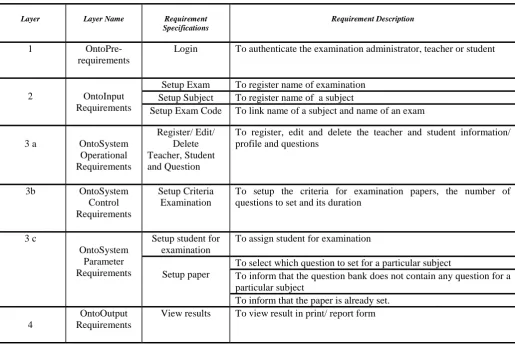
Based on creative and critical teaching and learning, an online examination system (an example of TPS), is planned that has been systematically invented in order to help students cope with the information age. It offers a dynamic elucidation which can save time to prepare the examination papers, evaluate the examination automatically and
paperless. The OntoAidedRE framework is used to establish the requirements set as shown in Table 1.
B. Case 2: Personal Investment Management System Personal Investment Management System (an example of MIS) is intended to help the user keep account of his/her money invested in institutions such as Banks and Share Market. This document is meant to delineate the features of Personal Investment Management System, so as to serve as a guide to Managing investment of a single user, which would include maintaining bookkeeping information about entities like Portfolio, Security, and Transaction, Computation of Net-Worth and Rate of Investment (ROI) of the Investor. Also, giving alerts to the user, if requests for one, downloading the current prices of shares from the web and User authentication. Table 2 provides the requirement set by implementing the OntoAidedRE.
C. Case 3: Hotel Automation System
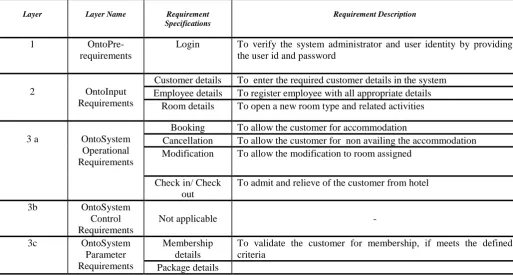
[image:3.595.41.557.426.771.2]The basic objective of Hotel Automation System is to generalize and simplify the monthly or day to day activities of Hotel like Room activities, check in of New Customer, check out of customer, assigning a room according to customer requirement, and finally compute the bill etc. which has to be performed repeatedly on regular basis. To provide efficient, fast, reliable and user-friendly system is the basic aphorism following this exercise. Table 3 illustrates the requirement set by practicing the OntoAidedRE.
Table I. Online Examination System using OntoAidedRE
Layer Layer Name Requirement
Specifications
Requirement Description
1
OntoPre-requirements
Login To authenticate the examination administrator, teacher or student
2 OntoInput
Requirements
Setup Exam To register name of examination Setup Subject To register name of a subject
Setup Exam Code To link name of a subject and name of an exam
3 a OntoSystem
Operational Requirements
Register/ Edit/ Delete Teacher, Student and Question
To register, edit and delete the teacher and student information/ profile and questions
3b OntoSystem
Control Requirements
Setup Criteria Examination
To setup the criteria for examination papers, the number of questions to set and its duration
3 c
OntoSystem Parameter Requirements
Setup student for examination
To assign student for examination
Setup paper
To select which question to set for a particular subject
To inform that the question bank does not contain any question for a particular subject
To inform that the paper is already set.
4
OntoOutput Requirements
Table II. Personal Investment Management System using OntoAidedRE
Layer Layer Name Requirement
Specifications
Requirement Description
1
OntoPre-requirements
Login Login into PIMS
2
OntoInput Requirements
Create/ Rename/ Delete portfolio
Creates a new portfolio/Rename an existing portfolio/Delete an existing portfolio
Create/ Rename/ Delete security
Creates a new security/Rename an existing portfolio/Delete an existing security
3 a
OntoSystem Operational Requirements
Add/ Edit/ Delete transaction
Add a transaction to a security/ Edit an existing transaction/ Delete an existing transaction
Add current share price/Edit share
price
Add the current share price/ Edit the price of a share already present in the list
3b
OntoSystem Control Requirements
Compute net-worth
Compute net-worth of investment /portfolio /security
Compute ROI Compute ROI of a given security
3 c
OntoSystem Parameter Requirements
Set alerts/ Show alerts/ Delete alerts
Set alert giving date and details/ Show all the pending alerts/ Delete an already set alert
4 OntoOutput
Requirements
Display investment Display information of the entire Investment
Display portfolio Display information about a given Portfolio Display security Display information about a given security
Table III. Hotel Automation System using OntoAidedRE
Layer Layer Name Requirement
Specifications
Requirement Description
1
OntoPre-requirements
Login To verify the system administrator and user identity by providing the user id and password
2 OntoInput
Requirements
Customer details To enter the required customer details in the system Employee details To register employee with all appropriate details
Room details To open a new room type and related activities
3 a OntoSystem
Operational Requirements
Booking To allow the customer for accommodation
Cancellation To allow the customer for non availing the accommodation Modification To allow the modification to room assigned
Check in/ Check out
To admit and relieve of the customer from hotel
3b OntoSystem
Control Requirements
Not applicable -
3c OntoSystem
Parameter Requirements
Membership details
To validate the customer for membership, if meets the defined criteria
[image:4.595.39.553.481.756.2]© 2010, IJARCS All Rights Reserved 283
4 OntoOutput
Requirements
Bill generation To view the final statement of customer in print/ report form before check out
V. RESULTS AND CONCLUSION
In this paper, we have presented Ontology Aided Requirements Engineering (OntoAidedRE) framework that enables the knowledge driven requirement engineering based on ontology. Also, the type of requirement such as OntoPre-requirement, OntoInput Requirement, OntoSystem Operational Requirement, OntoSystem Control Requirement, OntoSystem Parameter Requirement and OntoOutput Requirement, is emphasized to address the software requirement specifications. Although, various ontology based models and frameworks have been suggested that facilitates eliciting and capturing of requirements and specifications, modeling of system environments and domain knowledge. Also, that best fulfills the project-or department-specific needs. But, in the scope of convoluting all the aspects of requirement competencies such as managing software advancement, adaptability to change and reuse, supporting the process improvement through knowledge support, the OntoAidedRE has been proposed.
To foster the systematic practice of the OntoAidedRE framework many applications from various domains such as Transaction Processing, Management Information and Office Automation systems has been identified. Also, the requirement specifications for these systems are formally and well defined there by it can be one solution for many projects.
VI. REFERENCES
[1] M. Kossmann, M. Odeh, A. Gillies, R. Wong, From Process-Driven to Knowledge Driven Requirements Engineering Using Domain Ontology, to be published by INCOSE, 2008
[2] N.F. Noy, D.L. McGuinness, Ontology Development 101: A Guide to Creating Your First Ontology, Stanford University, 2000
[3] M. Kossmann, M. Odeh, A. Gillies, ‘Tour d’horizon’ in Requirements Engineering – Areas left for exploration, INCOSE, 2007
[4] T. R. Gruber, A translation approach to portable ontology specifications, Knowledge Acquisition, vol. 5, no. 2, pp. 199-220, 1992
[5] Evermann, J., Wand, Y., “Ontology based object oriented domain modeling: fundamental concepts,”
Requirements Engineering, Springer-Verlag London Ltd., 2005
[6] Breitman, K. K., and Leite, J. C. S. P., “Ontology as a Requirement Engineering Product,” In Proceedings of the 11th IEEE International Requirements Engineering Conference, Monterey Bay, California, USA, September 2003, pp. 309-319
[7] Seok Won Lee and Robin A. Gandhi, “Ontology-based Active Requirements Engineering Framework”, In the Proceedings of the 12th Asia-Pacific Software Engineering Conference (APSEC’05), 2005
[8] Mario Kossmann, Mohammed Odeh, Richard Wong, Andrew Gillies, “Ontology-driven Requirements Engineering: Building the OntoREM Meta Model”, [9] LI Zong-yong , WANG Zhi-xue, YANG Ying-ying, WU
Yue1 LIU Ying, “Towards a Multiple Ontology Framework for Requirements Elicitation and Reuse”, 31st Annual International Computer Software and Applications Conference(COMPSAC), 2007
[10] Z.Jin, "Ontology-Based Requirements Elicitation," Journal of Computers, vol. 23, No.5, pp. 486-492, 2000. [11] H. Kaiya and M. Saeki, "Using Domain Ontology as
Domain Knowledge for Requirements Elicitation," in Proceedings of 14th IEEE International Requirements Engineering Conference, pp. 186-195, 2006
[12] A. Sutcliffe and N. Maiden, "The domain theory for requirements engineering," IEEE Transactions on Software Engineering, vol. 24, No.3, pp. 174-196,1998. [13] A. Dardenne, A. van Lamsweerde and S. Fickas,
D,“Goal-directed requirements acquisition," Science of Computer Programming, vol. 20, pp. 3-50, 1993. [14] T. R. Gruber, "A translation approach to portable
ontology specifications," Knowledge Acquisition, vol. 5, pp. 199-220, 1993.
[15] H. Kaiya and M. Saeki, "Ontology Based Requirements Analysis: Lightweight Semantic Processing Approach," in Fifth International Conference on Quality Software, pp. 19-20, 2005.
[16] Shilpa Sharma, Maya Ingle, “Study of Object Oriented Software Engineering versus Ontology Engineering”, National Conference on Emerging Technologies in Electronics, Mechanical and Computer Engineering, IIST, Indore, 2010.