Volume 8, No. 5, May – June 2017
International Journal of Advanced Research in Computer Science REVIEW ARTICLE
Available Online at www.ijarcs.info
An Image Retrieval Framework: A Review
Mohd Aquib Ansari
Madhav Institute of Technology & Science Gwalior (M.P.), India
Manish Dixit
Madhav Institute of Technology & Science Gwalior (M.P.), India
Abstract: Content-Based Image Retrieval is a process to retrieve the similar images from the large set of image database corresponding to the query image. In CBIR low level or pixel level features such as color, texture and shape of the images are extracted and on the basis of similarity matching algorithm the required similar kind of images are retrieved from the image database. To understand the evaluation and evolution of CBIR system various research was studied and various research is going on this way also. In this paper, we have discussed some of the popular pixel level feature extraction techniques for Content-Based Image Retrieval and we also present here about the performance of each technique.
Keywords: Content Based Image Retrieval; Color; Texture; Shape; Feature Extraction; Similarity Measurement.
I. INTRODUCTION
The multimedia technology and network technology is growing day by day and the databases of digital images are also growing rapidly. Thus, we need an efficient, fast and accurate algorithm to retrieve the relevant images from a huge image repository. The goal of the image retrieval is to browse the large image databases and find out whether the image repository contains the query image pattern which is given by the user on the basis of similarity matrices. There are two approaches Text-Based Image Retrieval (TBIR) [1] and Content-Based Image Retrieval (CBIR). From 1970's to the present, Image retrieval technology was enhancing from text-based techniques to content-based techniques. In the Text-Based Image Retrieval Technique, firstly images were annotated with the text or number or keyword, and then images are searched on the basis of textual text or keyword. Although, Text based technique is fast and reliable but also it is over dependent on manually annotation on images and the size of the database. There are various limitations of text-based image retrieval such as manual annotation of images with the text or number or keyword which is extremely insufficient, laborious, and time-consuming and obsolete method. For the large databases, it is not an appropriate method.
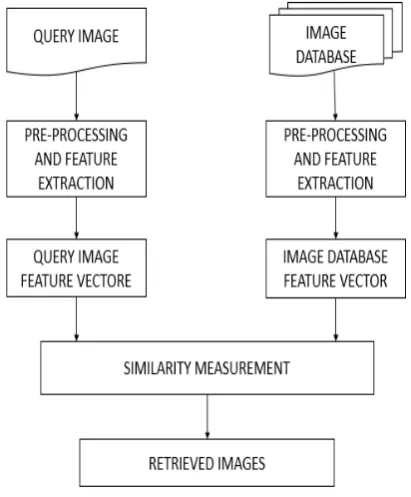
To overcome the limitations of TBIR, the concept Content Based Image Retrieval [2] came into the frame in 1990's which are efficiently used by peoples. CBIR is a kind of image retrieval technique of computer vision for retrieving the relevant images according to visual feature such as color, shape and texture of images from the large database based on some similarity measures. In a precise way, CBIR, a technique of image retrieval, that could frame out the images that are similar to querying images from the large image database. In CBIR, each image that is stored in the large database, its features are extracted and compared to the feature of the query image. At last, the relevant images can be displayed corresponding to query image. The CBIR figure is shown in figure 1.
The CBIR technology has been used in a several of applications such as fingerprint identification, digital libraries, crime prevention, medical diagnosis, historical research, architectural and engineering design, publishing
[image:1.595.335.541.327.576.2]and advertising, art, education, fashion and graphic design, geographical information and remote sensing systems etc.
Figure 1. Content Based Image Retrieval
It contains main two parts.
A. Feature extraction
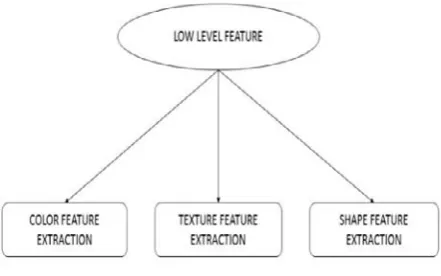
The word ‘feature’ which specify the quantifiable property of an object or in another way we can say that it describes the object. The features are extracted from the image like spatial based on pixels level features such ascolor, texture and shape. The features play the important role in CBIR. Good features describe the image efficiently and make good effects on accuracy. The classification of feature extraction technique is shown in figure 2.
B. Similarity measurement
© 2015-19, IJARCS All Rights Reserved 693 and the query image and according to distance, they are
[image:2.595.49.270.134.272.2]ranked in order to retrieve most similar image first. It also plays an important role in CBIR. A good similarity measurement technique proceeds good retrieval rate of images.
Figure 2. Classification of low-level features
There is some application of CBIR such as Trademark Registration, Medical Diagnosis, Crime Prevention, Web Searching, Surveillance, Remote Sensing, web-related application, Biomedical Applications etc.[3][4]..
II. FEATURE EXTRACTION TECHNIQUES
There are various feature extraction techniques to extract low-level features from the images.
A. Color
It is the sensitive, understandable, essential and widely used feature for image retrieval. The color is the property that is based on reflection of light and processing of that information in the brain. Before selecting the color descriptor, a color space must be chosen first because colors are defined in three-dimensional color space. The various types of color space, which are used widely, are RGB (Red, Green, Blue), HSV (Hue, Saturation, Value), opponent color space etc.
RGB is most widely used color space for displaying the images. It contains three color component which is red, green and blue which are called additive primaries. It is also be called additive color space. By mixing the components of RGB space, the desirable color can be produced. The RGB color space is device dependent and non-uniform color space [5].
HSV (Hue, Saturation, Value) is also widely used in computer graphics and it is the more intuitive way to represent the color, it is also be called HSL (Hue, Saturation, Lightness), or HSB (Hue, Saturation, Brightness) color space. It is most suitable for object retrieval because hue is invariant to changes in illumination and camera direction.
There is various type of type of color descriptors. 1) Color moment
Mean, Standard deviation and Skewness are effective color moments [6]. It is used to find out the distribution of colors in an image. The average color value in an image can be calculated by Mean (M). The square root of the variance of the distribution is calculated by Standard deviation (
σ
).
Skewness (S) can be defined as a measure of the degree ofasymmetry in the distribution. The moments are described as:
(1.1)
(1.2)
(1.3)
Pi,j= the value of the ith
2) Color histogram
color component of the image pixel j.
N = number of pixel in the image.
Three moments for each of the three color component are used to describe the color content of an image. Color moment works well in L*a*b color space in compare to H*s*v color space.
Color histogram [7] is an efficient way to calculate the essential features from the image. It is the way of representation of the color content of an image. Any pixel of an image can be framed by the three components in certain color space such as red blue and green color components are described for RGB color space and hue, saturation and value are described for HSV color space. The distribution of color in the image in color space can be described by the color histogram. It contains the number of bins which can be defined for each component. The histogram contains a large number of the bin will only increase the computational cost as well as inefficient indexing also for image databases. So, it needs to quantize the bins. So, quantization process takes place in histogram techniques. It helps to reduce the number of the bins in histogram by taking the color that is similar to each other and putting those color in the same bin. It Histogram technique is two types.
a) Global color histogram (GCH): The GCH [8] calculate the single color histogram of one whole image. It is efficient and takes less computation. Sometimes GCH might not get the proper result because it does not include information concerning the color distribution of the regions.So, it doesn’t give full information of the image.
b) Local color histogram (LCH): The LCH [9] gives more information about the image in compare of GCH. It is computationally high. It takes more time to execute. The main task of LCH is to divide the image into a number of blocks and calculate the Histogram for each block then combines that LCH of blocks and form a Histogram. It gives better results than GCH but due to its computational cost, we mostly prefer the GCH.
3) Color correlogram
Color correlogram [10] is a very good technique in compare to Color Histogram because it not only describes the color distribution of pixels but also describes the spatial information of the pair of color. A color correlogram is indexed by the color pair. Where,
© 2015-19, IJARCS All Rights Reserved 694 Assume,
(2.1) I = set of image pixels.
Ici
=
set of pixels whose colors are c(i). Color correlogram can be described as:Where i, j belongs to {1,2,…..,N}, k belongs to {1,2,…..,d} and |P1-P2| is the difference between pixels P1,
P2
B. Texture
. The size of the color correlogram is very vast if we are taking all the possible color pairs. Therefore, instead of this, a simplified version is used for extract the feature, called Color Auto Correlogram [11]. Color auto-correlogram captures only the spatial correlation between identical colors instead of taking color distribution as like color correlogram. That's the way the size is also reduced. In comparing to color histogram, the color auto-correlogram gives better result but it is computationally high.
Some another color feature extraction technique’s that can be used in extracting the color’s feature such as Edge histogram descriptor, Multi texton histogram, Dominant color descriptors etc.
[image:3.595.39.280.433.639.2]The texture is another feature extraction technique which describes various properties such as coarseness, smoothness, regularity of surface, randomness etc. it also specifies the how the surface is, its scene depth and orientation. It contains the general and significant information about the structure of surface. Texture can be analyzed by the qualitative and quantitative analysis [20].
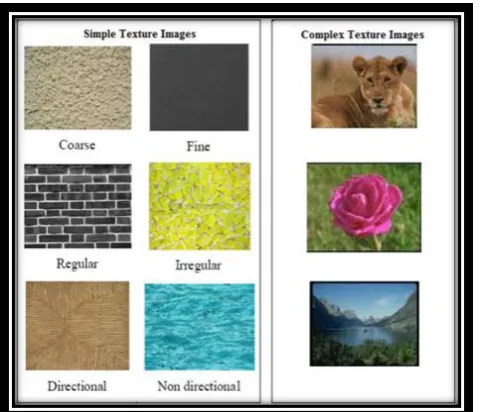
Figure 3. Examples of Texture Images
The surface can be repeated arrangement of pixels over the spatial space. Where, the random and unstructured surface can be displayed when it came into contact with noise. Texture is the visual descriptor of an image, which has homogeneity properties. There are different types of texture properties like regularity, directionality, smoothness, and coarseness, see left part of Figure 3. Texture perception might be more muddled. The different illumination
intensities give the hike to a blend of the different human perception of texture as shown in right part of Figure 3.
There is various type of Texture Descriptors which are described below.
1) Tamura feature
The first texture descriptor based on quantitative analysis given by Tamura [14] [15]. Which gives the six different texture feature like Coarseness, Contrast, Directionality, Line-Likeness, Regularity, and Roughness. The well-known system such as QBIC uses first three component of Tamura feature.
a) Coarseness: The Granularity of the Texture can be measured by coarseness. An image contains reoccurred textures arrangement at dissimilar scales, the objects of coarseness is to find out the largest size at which a texture present.
(3.1) Where, the average of neighborhood is size.
(3.2) b) Contrast: The distribution of intensities adjusted in an image can be measured by contrast.
(3.3)
(3.4) c) Directionality: The directionality measures the frequency distributionof edges which are oriented locally against its directional angles.
(3.5)
d) Line-Likeness: Line-Likeness in an image is the normal coincidence of direction of edges that co-happened in the sets of pixels separated by a distance along the edge direction in every pixel.
e) Regularity: Regularity is an essential property of tamura feature which evaluates the regular pattern present in image.
(3.6) f) Roughness: Summation of contrast and coarseness measures are called Roughness.
(3.7) 2) Gray level co-occurrence matrix
Gray level co-occurrence Matrix is an arithmetical method used for observing texture feature and distributing gray levels in the image. Gray level co-occurrence matrix create a matrix which shows how repeatedly pixels with intensity i occurs in a spatial relationship to pixel with intensity j. Haralick [16] [20] proposed 28 types of features of texture
]
|
,
|
Pr[|
)
(
1 2 2 1) (
i i
i C C
k
C
I
≡
p
−
p
=
k
p
∈
I
p
∈
I
© 2015-19, IJARCS All Rights Reserved 695 extracted from Gray level co-occurrence matrix (GLCM).
Assume an image has H total number of pixels in Horizontal directions and V total number of pixels in Vertical directions and assume gray level at each pixel is quantized at N number of levels. Suppose Nx=1,2,3…..H consist Horizontal
space and Ny=1,2,3,….V consist vertical space and
G=0,1,2,3,…..N consist N quantized gray level. Gray level co-occurrence matrix is a regularity matrix and its levels are determined by image gray level. Expression shown the co-occurrence matrix in different directions.
(4.1)
This paper describes five feature of GLCM like Energy, contrast, Entropy, correlation, homogeneity.
a) Contrast: Contrast find out the intensity of a pixel and its neighbor over the whole image and for the constant image, it is considered zero. It is also be known as variance and moment of inertia.
(4.2) b) Correlation: How pixel is correlated to its neighbor over the whole image, it is defined by correlation.
(4.3)
c) Entropy: Entropy gives measures of complexity of the image and this complex texture tends to higher entropy.
(4.4) d) Energy: Energy is the sum of squared elements in the GLCM and the default value of the constant image is one.
(4.5)
3) Local binary pattern
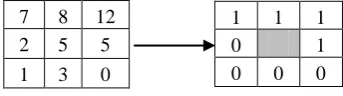
T. Ojala et al. [17] proposed local binary pattern (LBP). LBP is an image indexing technique based on texture analysis of image which is gray scale rotation invariant local pattern measure operator. LBP computes the local feature representation of the image. The LBP representation is calculated by comparing each pixel with surrounding neighbor pixel. The computation of LBP is shown in figure 4.
The value of the LBP code of pixel (xc,yc) is given by
(5.1)
(5.2)
[image:4.595.342.514.59.107.2]The computation of LBP is given below in figure 4.
Figure 4. Computation of Linear Binary Partition
LBP = 20*1+21*1+22*1+23*1+24*0+25*0+26*0+27*0=15 Where,
gc= the gray-scale value of center pixel,
gp
Due to highly discriminative, rotation invariant and gray-scale invariant, it is used in various application such as face recognition, image registration etc.
There are also various extensions of LBP which enhances the techniques of image retrieval such as CLBP, Dominant LBP, CS-LBP, Local tetra pattern (LTP), CS-LTP etc.[19].
There is some more texture extraction technique that is used to extract the feature from the images such as flourier transform, Walsh transform, Gabor descriptor, wavelet transform, co-occurrence matrix etc. [30] [33].
= the gray-scale value of its neighborhood pixel, P = the no. of neighbors,
R = the radius of neighborhood.
For calculating LBP descriptor, first, convert the image into grayscale image. For every pixel of the grayscale image, a neighborhood of r size is defined with surrounding the center pixel. Then LBP value is calculated for each center pixels and is stored in 2D array vector which contains same height and width as the input image.
C. Shape
The shape is known to play an important role in object recognition and perception. Visual shape features provide a powerful clue which shows object identity or we can also say that it describes the image content. The shape can be defined as it is part of space which is occupied by an object. The efficient shape feature must contain some properties such as identifiability, translation, the resistance of noise, affine invariance, statistically independent and some reliability. Humans can recognize objects solely from their shapes. The advantage of shape’s feature taking into account for CBIR can be seen from the fact that every major CBIR system holds some shape features in one form or another [21]. Shape feature representations are two types. They are boundary-based and region-based. In region-based techniques, to obtain the shape representation, all the pixels within a shape are taken into account. Common region based methods use various moment descriptors to describe shape efficiently [22] [23] [38] [39]. In the boundary based techniques, to obtain the shape representation, only the boundary pixels within a shape are taken into account means that the boundary information will be extracted [23].
There is various shape feature extraction techniques are given below.
1) Hu moments
In shape-based image retrieval system, Hu moments [24] produces good results because it is the non-linear function which has various properties like translation, rotation and scaling invariability. Formulation of Hu moments is given below:
Two-dimensional (p+q)th 7
order moments are given as follows.
8 12 2 5 5 1 3 0
1 1 1
0 1
© 2015-19, IJARCS All Rights Reserved 696
(6.1)
If, the image function f(x,y) is a piecewise continuous bounded function, the moments of orders exist and the moment sequence {mpq} is uniquely determined by f(x,y)
and correspondingly, f(x,y) is also uniquely determined by the moment sequence {mpq}.
The moments may not be invariant when f(x,y) changes by translating, rotation or scaling. By the help of the central moments, the invariant feature can be obtained using central moments, which can be measured as:
(6.2)
Where, and (6.3)
The pixel point are the centroid of the image f(x,y). The centroid moments µpq computed using the centroid of
the image f(x,y) is equivalent to the mpq whose center has
been moved to the centroid of the image. In this manner, the central moments are invariant to image interpretations. Scale invariance can be acquired by normalization. The normalized central moments are defined as follows:
(6.4)
γ = (p+q+2)/2,p+q=2,3,…. (6.5) Based on normalized central moments, Hu introduced seven-moment invariants:
(6.6)
(6.7)
(6.8)
(6.9)
(6.10)
(6.11)
(6.12) The first one, φ1, is similar to the moment of inertia around the image centroid, where the pixels’ intensities are analogous to physical density. The last one, φ7, is skew invariant that able to distinguish mirror images or identical images [21].
Hu moments take every pixel into account. The computational cost is much higher than boundary based invariants. To overcome this problem, Teague [25] suggested the use of orthogonal moment.
2) Zernike moments
Zernike moments [25] [26] are evaluated by using Zernike orthogonal polynomial. An orthogonal polynomial is present in the unit circle. It has less information redundancy as compared to the other method. It shows good rotation invariance. It is one of the most widely used shape descriptors.
Zernike moment is defined as:
(7.1)
Where, m = 0, 1, 2,………….,∞, image function, * represents hetero conjugation, n is an integer such that (m-|n|) is even and (|n|≤m).
Zernike moment can also be represented in the polar co-ordinates as follows:
(7.2)
Where, and
Assume as a Zernike polynomial in polar co-ordinate and is defined as:
(7.3) Where, and values are defined in the unit circle.
Orthogonal radial polynomial is defined as:
(7.4)
The integration can be converted into summation in case of digital image:
(7.5)
Where,
3) Interest point detection using surf
© 2015-19, IJARCS All Rights Reserved 697 invariant. Scale invariance and rotation invariance implies
that an object can be distinguished despite the fact that if the representation of object gets scaled in size or it is rotated around an axis in its representation of an image. Invariance is a very important property of image features, as a measurement of similarity is possible only with respect to those features between two images which can’t be duplicated.
The SURF feature technique is based on the Hessian matrix. To extract the scale and location of the descriptor, the determinant of Hessian matrix is used. The Hessian matrix is represented by for a given point
in an image as follows:
(8.1)
Where, is the convolution of the Gaussian second order derivative with the image I in the point x and similarly for and
The speed up robust feature approximates second order derivatives of the Gaussian with box filters. By using the integral images, the image convolutions can be calculated with these box filters. The determinant of the Hessian matrix is given as:
(8.2) 4) Convex hull
Basically, the convex hull [13] [28] or convex envelope of a set X of focuses in the contains X. Formally, the convex hull may be described as the intersection of all convex sets holding X or as the set of all descriptor is used to create Region of Interest (ROI) in an image.
There is some more shape-based feature technique such invariants, shape signature, contour segments, breakpoints etc. Some operator such as Sobel, Prewit, Cany edge detector etc. are also used to extract the edge features from the image.
III. SIMILARITY MEASUREMENT
Normally, Similarity Measurement [31] [32] [36] [40] can be defined as a matrix distance. Some efficient similarity measurements are given below.
A. Minkowski distance metrics
This distance can be measured as: Dk(P,Q) = ( |x1-y1|k + |x2-y2|k
B. Manhattan distance
) (9.1)
Where, P(x1, x2) & Q(y1, y2) are two points to calculate the distance.
Manhattan distance is the most common metric which is used to evaluate the distance between two points in multi-dimensional space. The distance between two images P and
Q with n-dimensional features vectors can be found as follows:
(9.2) Where, D(X,Y) = Manhattan distance between query image X and each image Y in the image database.
Xi = feature vector of the query image.
Yi
C. Euclidian Distance
= feature vector of database images.
The Euclidian Distance is frequently used in CBIR for similarity evaluation because it has greater accuracy as well as effectiveness. It measures the distance between two feature vectors of the image by following this equation.
(9.3) Where, D(X, Y) = Euclidian distance between query image X and each image Y in the image database.
Xi = feature vector of query image.
Yi
IV. PERFORMANCE METRICS = feature vector of database images.
A number of other metrics which are used in CBIR like Mahalanobis, Earth Movers, Proportional Transportation, relative deviation, city block etc. matrix have been proposed for specific purposes.
The performance of CBIR system can be expressed with these formula’s [34] [35] [36] [37].
(10.1)
(10.2)
(10.3) The recall is the ability of the system to represent all relevant images. The measure of ability of the system to represent only relevant images is called precision. Error rate can be measured as the number of the non-relevant images present in total number of image retrieved. There are various types of image database available such as wang database, sift database, mnist database etc. [12]. On that we can perform various experiments.
V. CONCLUSION AND FUTURE WORK
© 2015-19, IJARCS All Rights Reserved 698 techniques are studied. The performance of retrieval system
may depend on the different type of database. It is impossible to get an appropriate as well as efficient result from single technique or algorithm because only a feature vector can’t reflect the result more appropriately. So, it is required to combine two or more than two techniques and develop a hybrid approach. There is the considerable increase in efficiency when two or more than two feature extraction techniques or algorithm are combined. In image processing retrieval technique, Performance degradation is the major problem so for this we should have to use some mining technique so that we can reduce our database or can improve the efficiency of retrieval of the image. By the help of clustering and classification technique, the set of images is trained or grouped using supervised or unsupervised learning to enhance the retrieval efficiency and timing performance. For finding the best research, the modern approach is to focus on the high level as well as salience features with the descriptor of color, texture as well as shape at the processing stage. In CBIR, various optimization techniques as like fuzzy, support vector machine, ant colony optimization, the k-mean algorithm can be applied to get user corresponding results.
REFERENCES
[1] N. S. Chang, and K. S. Fu, “Query by Pictorial Example,” IEEE Trans. On Software Engineering, vol. 6, (1980) November, pp. 519-524
[2] AT. Kato, T. kurita, and N. Otsu, “A Sketch retrieval method for full color image database-query visual example,” Pattern Recognization, (1992) January, pp. 530-533
[3] Sagarmay Deb, “Multimedia System and Content Based Image Retrieval,” ISBN: 1-59140-265-4
[4] Zijun Yang, and C.-C. Jay Kuo, ”Survey onImage Content Analysis, Indexing, and Retrieval Techniques and status Report of MPEG-7,” Tamkang Journal of Science and Engineering, Vol. 2, No. 3(1999)
[5] Kondekar V.H., Kolkure V.S., and prof. Kore S.N., "Image Retrieval Technique Based on Image Features: A State of Art approach for CBIR," International Journal of Computer Science and Information Technologies, vol. 7(1), 2010, ISSN 1947-550
[6] M. Babu Rao, Dr. D. Prabhakar Rao et al. “Content based Image Retrieval System based on Dominant Color and Texture Features,” International Journal of Computer Applications, ISSN: 0975 – 8887 Volume 18– No.6, March 2014.
[7] Sukhmanjeet Kaur, and Mr. Prince Verma, “Content Based Image Retrieval: Integration of Neural Networks Using Speed-Up Robust Feature and SVM,” International Journal of Computer Science and Information Technologies, Vol. 6 (1), 2015, 243-248.
[8] Mohd Aquib Ansari, and Manish Dixit, “An Enhanced CBIR using HSV Quantization, Discrete Wavelet Transform and Edge Histogram Descriptor,” International Conference on Computing, Communication and Automation (ICCCA2017), ISBN: 978-1-5090-6471-7/17/$31.00 ©2017 IEEE (Article in a conference proceedings)
[9] Metty Mustikasari , Sarifuddin Madenda , Eri Prasetyo, Djati Kerami, and Suryadi Harmanto, “Content Based Image Retrieval Using Local Color Histogram,” International Journal of Engineering Research,vol. 3, issue no.8, pp:507-511,ISSN:2319-6890)(online),2347- 5013 (print) (2014)
[10] J. Huang, S.R. Kumar, M. Metra, W.J. Zhu, and Zabith, "image indexing using color correlogram," IEEE Int Conf. on Computer Vision and Pattern Recognition, pp. 762-768, Puerto Rico, June 1997.
[11] Xiang-Yang Wang, Yong-Jian Yu, Hong-Ying Yang, “An effective image retrieval scheme using color, texure and shape feature”, computer standard nd interfaces, vol 33, 2011, pp. 59-68.
[12] Wang Image Database, ”www.stat.psu.edu/~jiali/index. download.html”
[13] Su Xiaohong, Ding Jin, and MaPeijun, ”Image retrieval by convex hulls of interest points and SVM-based weighted feedback,” Chinese Journal of Computers, vol.32, no. 11, pp. 2221-2228, 2009.
[14] AH. Tamura, S. Mori, and T. Yamawaki, "Texture features corresponding to visual perception," IEEE Trans. On Systems, Man, and Cybernetics, vol. Smc-8, No. 6, June 1978.
[15] AM. Flickner, H. Sawhney, W. Niblack, J. Ashley, Q. Huang, B. Dom, and M. Gorkani, J. Hafner, D. Lee, D. Petkovic, D. Steele, and P. Yanker, "Query by image and video content: The QBIC system," IEEE Computer, Vol.28, No.9, pp. 23-32, Sept. 1995.
[16] Mahdi Saadatmand-Tarzjan, and Hamid Abrishami Moghaddam, “A Novel Evolutionary Approach for Optimizing Content-Based Image Indexing Algorithms,” IEEE Transactions on Systems, Man and Cybernetics—Part B: Cybernetics, Vol. 37, No. 1, February 2007
[17] T. Ojala, M. Pietikäinen, and T. Mäenpää, “Multiresolution gray-scale and rotation invariant texture classification with local binary patterns,” published in IEEE Trans. Pattern Anal. Mach. Intell., vol. 24, no. 7, Jul. 2002, pp. 971–987.
[18] Bor-Chun Chen, Yan-Ying Chen, Yin-His Kuo and Winston H. Hsu, “Scalable Face Image Retrieval Using Attribute- Enhanced Sparse Codewords,” IEEE Transactions on Multimedia, 2013, pp: 1-25.
[19] Komal Juneja, Akhilesh Verma, Savita Goel, and Swati Goel, ”A Survey on Recent Image Indexing and Retrieval Techniques for Low-level Feature Extraction in CBIR systems,” IEEE International Conference on Computational Intelligence & Communication Technology,978-1-4799-6023-1/15 DOI 10.1109/CICT .2015.92
[20] Neelima Bagri, and Punit Kumar Johari, “A Comparative Study on Feature Extraction using Texture and Shape for Content Based Image Retrieval,” International Journal of Advanced Science and Technology Vol.80, ISSN: 2005-4238, pp.41-52, 2015.
© 2015-19, IJARCS All Rights Reserved 699
[22] Amir Atapour Abarghouei, Afshin Ghanizadeh, and Siti Mariyam Shamsuddin, “Advances of Soft Computing Methods in Edge Detection,” Int. J. Advance. Soft Computing Appl., Vol. 1, No. 2, November 2009 ISSN 2074-8523.
[23] Zhang Dengsheng, and Lu Guojun, “Review of Shape Representation and Description Techniques,” ElsevierComputerScience, Pattern Recognition, The Journal of The Pattern Recognition Society, Pattern Recognition 37 (2004) 1-19
[24] Hu, “Visual Pattern Recognition by Moment Invariants,” IRE Transactions on Information Theory, (1962), pp. 179-187.
[25] M.R. Teague, “Image analysis by the general theory of moment,” J. Opt. Soc. Am. 70(8):920-30,1980
[26] A. Khotanzad, and Y.H. Hong., "Invariant image recognition by zernike moments," IEEE Transactions on Pattern Analysis and Machine Intelligence," 12(5):489-497,1990.
[27] AHerbert Bay, Andreas Ess, Tinne Tuytelaars, and Luc Van Gool, "Speeded-Up Robust Features (SURF)," IEEE transactions,vol.14,no.1,Sep.2008
[28] F. Xiang, H. Yong, S. Dandan, and Z. Jiexian, “An Image Retrieval Method Based on Hu Invariant Moment and Improved Annular Histogram,” elektronika ir elektrotechnika, ISSN 1392–1215, VOL. 20, NO. 4, 2014
[29] Katta Sugamya, Suresh Pabboju, and Dr. A.Vinaya Babu, ”A CBIR CLASSIFICATION USING SUPPORT VECTOR MACHINES,” International Conference on Advances in Human Machine Interaction (HMI-2016), 978-1-4673-8810-8/16/$31.00 ©2016 IEEE.
[30] Yogita Mistry, D. T. Ingole, and M. D. Ingole, ”Efficient Content Based Image Retrieval Using Transform and Spatial Feature Level Fusion,” The 2nd International Conference on Control, Automation and Robotics. 978-1-4673-9859-6116/ ©2016 IEEE.
[31] N. puviarasan, Dr. R. Bhavani, and A. Vasnthi, ”Image retrieval using combination of Textureand shape features," International Journal of Advanced Research in Computer and Communication Engineering, ISSN: 2319-5940, vol. 3, (2014) March, pp. 5873-5877.
[32] S. Manoharan, and S. Sathappan, “A Comparison and Analysis of Soft Computing Techniques for Content based Image Retrieval System,” International Journal of Computer Applications (0975 – 8887) Volume 59– No.13, December 2012.
[33] Manesh Kokare, P K Biswas, and BN Chatterji, “Cosine modulated wavelet packet based texture features for Content based image retrieval,” IETE Journal of Research ,vol 51, no 6, pp 477-483, 2005.
[34] Manish Kokare, Wavelet Based Features Texture Image Retrieval, Ph.D. Thesis, IIT Kharagpur,2004.
[35] Henning Muller, Wolfgang Muller, David McG. Squire, Stephane, Marchand-Maillet, and Thierry Pun, ”Performance Evaluation in ContentBasedImage Retrieval: Overview and Proposals,” pattern recognition letters, volume 22, issue 5, April 2001, pages 593-601.
[36] Diksha Kurchaniya, and Punit Kumar Johary, “Analysis of Different Similarity Measures in Image Retrieval Based on Texture and Shape,” International Research Journal of Engineering and Technology (IRJET), Volume: 04 Issue: 04 | Apr -2017, e-ISSN: 2395 -0056, p-ISSN: 2395-0072
[37] Nikita Upadhyaya, and Manish Dixit, “A Review: Relating Low Level Features to High Level Semantics in CBIR,” International Journal of Signal Processing, Image Processing and Pattern Recognition” vol. 9, No. 3, pp.433-444/2016.
[38] Nikita Upadhyaya, and Manish Dixit, “An Insight to Various CBIR Technique: A Survey,” International Journal of Advanced Research in Computer Science and Software Engineering, Volume 6, Issue 5, May 2016, ISSN: 2277 128X
[39] Garima Gupta, and Manish Dixit, “CBIR on Biometric Application using Hough Transform with DCD, DWT Features and SVM Classification,” International Journal of Engineering and Innovative Technology, ISSN: 2277-3754 , Volume 4, Issue 12, June 2016.
[40] Ruchi Jayaswal, and Jaimala Jha, “A hybrid approach for image retrieval using visual descriptors,” International Conference on Computing, Communication and Automation (ICCCA2017), ISBN: 978-1-5090-6471-7/17/$31.00 ©2017.