S. Werner (ed.),Proceedings of the 15th NODALIDA conference, Joensuu 2005, Ling@JoY 1, 2006, pp. 22–29
parallel text and co-occurrence statistics
Chris Biemann
and
Uwe Quasthoff
NLP department
University of Leipzig
Augustusplatz 10-11
D-04109 Leipzig
{biem,quasthoff}@informatik.uni-leipzig.de
Abstract
We present a simple and efficient approach for deriving bilingual dic-tionaries from sentence-aligned par-allel text by extending the notion of co-occurrences to a cross-lingual
setting. Dictionaries are evaluated
against gold standards and manually; the analysis accounts for frequency and corpus size effects.
1
Introduction
While more and more parallel text resources become available due to common regulations amongst different countries and the interna-tionalization of markets, there is a need for translational lexicons that can keep pace with the daily creation of new terminology. The stan-dard procedure amongst the Machine Trans-lation Community to extract transTrans-lation pairs from sentence-aligned parallel corpora can be
outlined as follows (cf. (Melamed, 1996),
(Moore, 2001) for an overview):
1. Define a measure which yields associa-tion scores between words of different lan-guages
2. Calculate the association scores between all possible pairs
3. To obtain translations for a given word, sort its trans-lingual associations by score and take the top N or apply a threshold.
The crucial choice in the first step is to define a well-suited measure, the problem in step two is the effectiveness of the calculation, and in the last step the challenge is to cut the list at the right point.
In (Melamed, 1996), the problem of selecting inappropriate translations due to indirect
asso-ciations is addressed: When e.g.European and
Council often occur together in one language
(here English) andEuropæiskeandRåd in the
translation (here Danish), the measure yields a
high association score betweenCounciland
Eu-ropæiskewhich is unwanted. He proposes a re-estimation method to alleviate this problem at the cost of long computation times. Other ap-proaches like e.g. (Moore, 2001) or (Lee and Chang, 1993) rely on language-dependent re-sources like taggers, parsers or transliteration modules or use string similarity for preferring cognates.
We present an approach that is especially suited for large data sets, as it scales well with the corpus size - processing time is about 2 hours for a bilingual resource with about 28
million tokens in each language. Further, it
does not make any assumptions on the guages and is therefore also suited for lan-guages that are by no means close in terms of edit distance or character set (for languages without whitespace like Chinese and Japanese, a segmentation step is assumed in the pre-processing). We argue that a language inde-pendent approach like ours is a good baseline where more problem-specific methods (like us-ing edit distances for cognates) can build upon.
Usually, co-occurrence statistics is used for
large monolingual texts. It returns pairs of
words that significantly often occur together within a predefined window. Implementations differ in the significance measure and the win-dow size used. For our experiments, we use a log-likelihood-measure (which has been noticed to be adequate for the translation relation, see
e.g (Tufi¸s, 2002)) and sentences as windows.
se-mantically related words similar to human as-sociations, cf. (Biemann et al., 2004).
For dictionary acquisition, we slightly modify the setting: Starting from a parallel corpus, we build a corpus containing bilingualbi-sentences built from pairs of aligned sentences. For tech-nical reasons, we add language information to each word. Next, the co-occurrence statistics returns pairs of words which significantly often occur together in such bi-sentences. Here we consider only pairs of words having different language tags. Hence, for a given word we get an ordered list of translation candidates.
2
Methodology
Following the methodology of (Biemann et al., 2004), we adopt the machinery to compute co-occurrences of monolingual corpora (see http://corpora.informatik.uni-leipzig.de for co-occurrences in different languages) for the ex-traction of translation candidates: We mark the words in a bilingual sentence pair by source language and only regard co-occurrences be-tween words of different languages. We call these significant trans-lingual associations trans-co-occurrences.
For two words A andB of different languages, each occurring a, b times in the corpus of bi-sentences and together in k of n bi-sentences in total, we compute the significance sig(A,B) of their trans-co-occurrence as follows:
sig(A, B) =
λ
−
k
log
λ+log
k!
log
n
withλ=ab
n
.
To illustrate the necessary preprocessing, we give some examples for German-English bi-sentences as used in our experiments, words are marked by language:
• Die@de drogenfreie@de Gesellschaft@de
wird@de es@de aber@de nie@de
geben@de .@de But@en there@en
never@en will@en be@en a@en drug-free@en society@en .@en
• Unsere@de Gesellschaft@de neigt@de
leider@de dazu@de ,@de Gesetze@de
zu@de umgehen@de .@de
Unfortu-nately@en ,@en our@en society@en is@en inclined@en to@en skirt@en round@en the@en law@en .@en
• Zum@de Glück@de kommt@de das@de
in@de einer@de demokratischen@de
Gesellschaft@de selten@de vor@de .@de Fortunately@en ,@en in@en a@en demo-cratic@en society@en this@en is@en rare@en .@en
• Ich@de sprach@de vom@de
Para-doxon@de unserer@de Gesellschaft@de .@de I@en mentioned@en what@en is@en paradoxical@en in@en society@en .@en
In all pairs,Gesellschaft@deandsociety@en occur. Exactly this is used by the trans-co-occurrence calculation mechanism to pro-duce the following top-ranked translation can-didates:
• Gesellschaft@de: society@en (12082), social@en (342), our@en (274), in@en (237), societies@en (226), Society@en
(187), women@en (183), as@en a@en
whole@en (182), of@en our@en (168), open@en society@en (165)
• society@en: Gesellschaft@de (12082),
unserer@de (466), einer@de (379),
gesellschaftlichen@de (328), Wissens-gesellschaft@de (312), Menschen@de (233), gesellschaftliche@de (219), Frauen@de (213), Zivilgesellschaft@de (179), Gesellschaften@de (173)
Note the large difference in significance be-tween the first and all the other translation can-didates. The significance values only have a lo-cal meaning: there is no global threshold for de-ciding whether candidates are good or bad, but within a ranked list of translation candidates for one word, they in fact tell the chaff from the wheat. To illustrate what happens if words have several possible translations, the follow-ing example lists candidates whose significance values do not differ considerably:
• hardly@en: kaum@de (825), wohl@de kaum@de (138), schwerlich@de (64), nicht@de (51), verwunderlich@de (43),
kann@de (37), wenig@de (37),
wun-dern@de (25), man@de (21), dürfte@de (17), gar@de nicht@de (17), auch@de nicht@de (16), gerade@de (16), über-rascht@de (15), fast@de (14), über-raschen@de (14), praktisch@de (13), ist@de (12), schlecht@de (12), verwun-dern@de (12), ...
Note that the methods produces a much longer list of candidates. Our machinery can deal with multi-words in a way that multi-words that are known beforehand can be treated as single units. For our experiments, we added multi-words that could be found in our evaluation dictionaries, e.g. "hardly any" in the examples above. To replace these manual resources, any approach for extracting collocations, e.g. (Sma-dia, 1993), could be applied in preprocessing; we did not undertake such efforts, which might be subject to further research.
3
Experiments
3.1 Data and resources
For evaluating our approach we use the mul-tilingual, sentence-aligned Europarl Corpus (Koehn, 2002) available within the OPUS col-lection (http://logos.uio.no/opus/). The corpus consists of transcribed and translated parlia-ment speeches of the EU parliaparlia-ment and cov-ers a variety of topics. In each of the 11 lan-guages, there are about 1 million sentences to-talling about 28 million words. The corpus was neither tagged nor lemmatized.
Using machine-readable dictionaries for judging the quality of the obtained dictionary has a number of deficiencies. First of all, dic-tionaries are never complete, which leads to misjudging translations which might be cor-rect, but not found in the dictionary. Sec-ond, a general-purpose dictionary might not suit domain-specific translations of the actual corpus. Third, if processing full forms, an auto-matic approach might give results in inflected form that cannot be found in a base-form dic-tionary, and lemmatizers or stemmers are not widely available for many of the European guages. Further, the differences between lan-guages w.r.t compounding may lead to confu-sion in automatic evaluation. The results
pre-sented here can therefore only account for a lower bound of precision.
Comparing evaluations within different works is difficult. Many researchers lemmatize the corpus, some remove function words and some use word class information. What is considered correct or not for this task is also differing. In (Melamed, 1996), three kinds of ’correct’ trans-lations are given: pairs that are proper transla-tions inat least one context, pairs that can be translations but have different parts of speech and pairs where one word is a possible part of the translation of another. Of course, this metric is much more relaxed then ours (which should not belittle his impressive results) and accepts entries you will never find in published dictionaries. Nevertheless, these entries are useful for machine translation or word align-ment, see section 4 for an example.
3.2 Evaluation
We obtained machine-readable dictionaries from Freelang (http://www.freelang.net). Ad-ditionally we asked persons with very good knowledge of the respective language pair to judge the results without giving them contexts. Due to availability of personal and dictionary resources, we tested our approach on the language pairs English-Danish, English-Dutch, English-Finnish, English-German, English-Italian, English-Portuguese and English-Swedish. Depending on the language, the method proposes at least three translation candidates for 34%-51% of total word types, which translates into 83%-89% coverage on tokens. For German-English, we used a larger dictionary in order to directly compare our ap-proach to (Sahlgren, 2004), who uses random indexing instead of co-occurrence analysis but operates on the same data otherwise.
To alleviate the problem of full forms in the cor-pus as opposed to base forms in the dictionary to some extend, we use the following similarity measure: The similarity between two strings (words) V and W is defined as the number of similar prefix letters divided through the length of the longest string:
pf m(V, W) = length of common prefix ofmax(length(v),length(WV))andW.
we checked the first three translation candi-dates for exact match (=1) and prefix match
≥ 0.6. This threshold produces almost no er-rors and takes flexations and sometimes part-of-speech change into account. It however does not capture Finnish case endings in all cases.
Table 3 in the appendix shows a randomly selected sample from the English-German data together with the maximum prefix match be-tween the trans-co-occurrence candidates and the translations in the dictionary.
Table 1 contains precision values in % for all words that could be found in the dictionary for the first three translation candidates. Both translation directions are combined into one value.
en-sv 44.7 57.7 16.8 32.8 8.4 20.2 64.1 72.0 en-it 52.0 61.5 14.3 29.3 7.1 19.0 66.4 73.3 en-pt 56.6 66.7 12.8 27.3 6.4 17.4 70.6 78.7 en-nl 47.3 57.0 14.2 24.9 7.9 15.6 62.4 69.2 en-de 52.6 61.4 16.4 31.2 9.0 20.0 68.2 75.1 en-da 50.9 61.6 15.1 29.3 7.3 26.0 67.7 74.3
en-fi 34.9 51.3 17.3 34.26 10.4 25.9 52.0 65.9 total 46.1 58.0 15.8 30.9 8.6 21.2 62.2 71.3
Table 1: Dictionary precision for top-3 transla-tion candidates in %
For manual evaluation, we presented about 200 randomly selected words for each pair and let our language experts chose amongst cor-rect, partially (part of a correct multiword, e.g. "Richter" instead of "Bundesrichter") and wrong. Table 2 depicts the results of manual evaluation.
As expected, results of manual evaluation are higher than comparing to electronic dic-tionaries. Results demonstrate that our ap-proach works in a language-independent fash-ion. Moreover, results for the first candidate are much higher than for the second, indicating that the association measure is appropriate. For the remainder, we use German-English to determine the influence of word frequency and corpus size.
language pair
1st candidate 2nd candidate
mode corr. part both corr. part both
de-en 64.5 19.6 84.1 25.5 22.4 47.9
en-de 52.8 26.4 79.2 35.9 25.5 61.4
da-en 55.5 21.8 77.3 12.7 18.2 30.9
en-da 56.8 27.0 83.8 27.9 25.2 53.1
sv-en 64.9 15.3 80.2 15.3 17.1 32.4
en-sv 67.6 13.5 80.1 36.0 10.8 46.8
nl-en 51.1 29.1 80.2 29.2 27.7 56.9
en-nl 56.6 18.9 75.5 32.0 24.5 56.5
Table 2: Precision in manual evaluation for first and second candidate in %
3.3 Influence of frequency
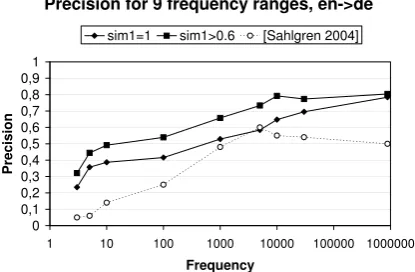
As has been previously observed, precision of translation pairs is dependent on word fre-quency. (Sahlgren, 2004) uses co-occurrence information as well but reduces complexity by random indexing and stemming. He describes experiments for English-German with the same corpus and evaluates against the same large dictionary (http://dict.tu-chemnitz.de/). Intu-itively, the more frequent a word is, the more reliable is the data for it, which should lead to higher results. The effect of using random indexing hence seems to prefer a certain fre-quency region, as Sahlgren obtained peak val-ues in the absolute frequency range of 1000-5000.
Precision for 9 frequency ranges, en->de
0
1 10 100 1000 10000 100000 1000000
Frequency
sim1=1 sim1>0.6 [Sahlgren 2004]
Figure 1: Dictionary precision for different fre-quency bands for English-German in compari-son to (Sahlgren, 2004).
all frequency bands, higher frequency leads to a higher precision, as figure 1 shows. Further, our method does not require brittle parameter tuning and does not introduce random.
3.4 Influence of corpus size
Another question we try to answer is the influ-ence of corpus size. Of course, more parallel data means more evidence, so better results can be expected. But how little is necessary to start the process and what quality can we ex-pect using much smaller parallel corpora?
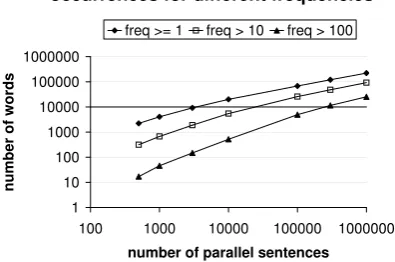
We conducted experiments with English-German and gradually increased the number of parallel sentences from 500 to 1 million. The number of words, for which at least one trans-co-occurrence exists, grows a little less than linear in corpus size, as figure 2 indicates. This is the same progression as the total amount of word types.
Number of words that have trans-co-occurrences for different frequencies
1
100 1000 10000 100000 1000000
number of parallel sentences
n
Figure 2: Number of words with trans-co-occurrences of different frequencies depending on corpus size
To measure whether corpus size influences the dictionary precision at absolute frequency count labels, we evaluated words of different frequency bands in our corpora of different sizes. We only took the highest-ranked co-occurrence into account and accepted a trans-lation as correct if a dictionary entry with prefix match ≥0.6 existed.The results as depicted in figure 3 indicate that precision is merely depen-dent on absolute frequency and not whole cor-pus size. The lower performance for the high-est frequency band available in small corpora can be explained by the impossibility to give 1:1 equivalences of function words (e.g. (Catizone
et al., 1989) give an example where Germanauf translates at least into Englishfor, in oron). As these words constitute the topmost entries in a word list ordered descending by frequency, they deteriorate evaluation results if not many other words in the same frequency class are considered.
Dictionary precision for different corpus sizes and frequency bands
0
100 1000 10000 100000 100000
0 Number of parallel sentences
p
Figure 3: Dictionary precision for different cor-pus sizes and frequency bands containing at least 100 words
Another factor that might influence precision in dictionary acquisition is the (average) length of an aligned unit. Where we used the compara-bly long sentences of Europarl (about 28 words per unit), there exist versions of the Hansards corpus (as e.g. used by (Melamed, 1996)) that are aligned on a sub-sentence level in units of about 16 words.
4
Word alignment
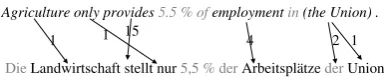
The ordered list of translation candidates per word can be used for word-to-word alignment of sentence-aligned corpora as follows: Given a sentence pair of L1 and L2, all words of L1 are linked to the word in L2 that can be found on the highest rank in the candidate list. In this way, even rare translations can be aligned, as the example in figure 4 shows: German stellt (usually English puts) and English pro-vides (usually Germanbeliefert, beschafft) are correctly linked, althoughstellt is ranked at po-sition 15 in the candidate list for "provides". High frequency words as well as numbers are omitted in alignment.
DieLandwirtschaft stellt nur 5,5 % derArbeitsplätze derUnion . Agriculture only provides5.5 % ofemploymentin(the Union) .
1 1 15 4 2 1
Figure 4: Grey words are not aligned, grey ar-rows indicate multiple alignments to the same word type. Numbers on arrows indicate the rank of the trans-co-occurrence. For a larger example, see figure 5.
for long parallel units is depicted. It indicates that we can handle scrambling of word order naturally: In the first line in figure 5, the verb setzen int the final position of the clause is aligned to setting at third position. A sim-ple heuristic could avoid multisim-ple alignments of several determiners, as can be observed be-tween a and ein, eine, einen. Finding several high-ranked trans-co-occurrences adjacent to each other (as withInkrafttretenandentry into force) gives rise to the detection of multi-word units and their alignment. This breaks the 1:1 mapping assumption, which is especially not met when languages forming one-word com-pounds are involved. A more elaborate evalu-ation of this method on the word alignment of Bible texts can be found in (Cysouw et al., forth-coming).
5
Conclusion and future work
Co-occurrence statistics have proved to be use-ful to find translation pairs using parallel text, especially aligned sentences. Moreover, the need for large parallel texts is shown to extract large vocabularies. The next and more com-plicated question is to get rid of the sentence alignment and use only nearly parallel text. Here we have to replace the above bi-sentences by bi-texts an to calculate co-occurrences at bi-text level. While such texts are available at large scale (for instance, the multilingual Reuters corpus or multilingual web sites, see (Resnik and Smith, 2003)), processing is much more complex because it is quadratic in the length of the bilingual objects (i.e. texts instead of sentences). Further, longer units introduce more noise in the process.
6
Acknowledgements
The authors would like to thank Philipp Koehn for the preparation of the Europarl corpus and
Wibke Kuhn, Ronny Melz and Pauliina Svensk for helping us with the manual evaluation.
References
Chris Biemann, Stefan Bordag, Gerhard Heyer, Uwe Quasthoff, and Christian Wolff. 2004. Language-independent methods for compil-ing monolcompil-ingual lexical data. InProceedings of CicLING 2004, Seoul, Korea and Springer LNCS 2945 Springer Verlag Berlin Heidel-berg, pages 215–228.
R. Catizone, G. Russel, and S. Warwick. 1989. Deriving translation data from bilin-gual texts. InProceedings of the First Inter-national Lexical Acquisition Workshop, De-troit, USA.
Michael Cysouw, Chris Biemann, and Matthias Ongyerth. forthcoming. Using strong’s num-bers in the bible to test an automatic align-ment of parallel texts. In: Michael Cysouw and Bernhard Wälchli (eds.) Parallel Texts: Using translational equivalents in linguistic typology. Special issue of Sprachtypologie und Universalienforschung.
Philipp Koehn. 2002. Europarl: A multilingual corpus for evaluation of machine translation (unpublished manuscript).
Chun-Jen Lee and Jason S. Chang. 1993. Acqui-sition of english-chinese transliterated word pairs from parallel-aligned texts using a sta-tistical machine transliteration model. In HLT-NAACL 2003 Workshop: Building and Using Parallel Texts, Data Driven Machine Translation and Beyond, Edmonton, pages 96–103.
I. Melamed. 1996. Automatic construction of clean broad-coverage translation lexicons. In Proceedings of the 2nd Conference of the Association for Machine Translation in the Americas, Montreal, Canada.
Robert C. Moore. 2001. Towards a simple and accurate statistical approach to learning translation relationships among words. In Workshop on Data-driven Machine Transla-tion, 39th Annual Meeting and 10th Confer-ence of the EACL, Toulouse, France, pages 79–86.
P. Resnik and N.A. Smith. 2003. The web as a parallel corpus. Computational Linguistics, 29(3):349–380.
Frank Smadia. 1993. Retrieving collocations from text: Xtract. Computational Linguistics, 19(1).
word cand.1 pfm1 cand.2 pfm2 cand.3 pfm3
acute akuten 0.66 akute 0.8 akuter 0.66
absolutely essential
absolut 0 unbedingt 0.166 unbedingt
notwendig
0.1
essential wesentlichen 0.83 wesentliche 0.909 ist 0
office Büro 1 Amt 1 Büros 0.8
pollutants Schadstoffe 1 Schadstoffen 0.916 Emission 0
expertise Fachwissen 0 Sachverstand 1 Sachkenntnis 1
prescribed vorgeschrieben 1 vorgeschriebenen 0.875 vorgeschriebene 0.93
means bedeutet 1 Mittel 1 heisst 0.09
industrial goods
Industriewaren 0.64 gewerbliche 0 Erzeugnisse 0
bill Gesetzentwurf 0.15 Gesetzesentwurf 0.133 Rechnung 1
approach Ansatz 1 Konzept 0 Vorgehensweise 0
audit Prüefung 0 Audit 1 Rechnungsprüfung 1
Table 3: Top three candidates for German-English sample with prefix match scores. Manually judged correct translations are marked inbold, part of translationsin italics. Note the disagree-ment between automatic and manual evaluation.
Indem wir denMitgliedstaaten für dieUmsetzung derRichtlinie kein spezifisches Datum setzen ,
By not setting a specific date (for the) Member States (to implement) the directive
sondern ihnen einen Zeitraum vondrei Monaten nach Inkrafttreten der Richtlinie zugestehen ,
andinstead giving them a periodofthree months after its(entry into force) ,
führenwir eine Flexibilitätsklausel ein ,
we are introducinga flexibility clause
dieeine unverzügliche Umsetzung gewährleistet .
whichensures that thedirectivewill beimplemented without delay .
1 1 1
2
1 7 1
4
1 1 15
1 1
1
1
1 1 1 1 1 1,2,3
1
1
4
1 1
1 1
1
2 1
1 1
1 1 1
4 4
4 5
1