Dependency Tree Based Sentence Compression
Katja Filippova and Michael Strube EML Research gGmbH
Schloß-Wolfsbrunnenweg 33 69118 Heidelberg, Germany http://www.eml-research.de/nlp
Abstract
We present a novel unsupervised method for sentence compression which relies on a de-pendency tree representation and shortens sen-tences by removing subtrees. An automatic evaluation shows that our method obtains re-sult comparable or superior to the state of the art. We demonstrate that the choice of the parser affects the performance of the system. We also apply the method to German and re-port the results of an evaluation with humans.
1 Introduction
Within the field of text-to-text generation, the sen-tence compression task can be defined as follows: given a sentenceS, consisting of wordsw1w2...wn, what is a subset of the words of S, such that it is grammatical and preserves essential information fromS? There are many applications which would benefit from a robust compression system, such as subtitle generation, compression for mobile devices with a limited screen size, or news digests. Given that to date most text and speech summarization systems are extractive, sentence compression tech-niques are a common way to deal with redundancy in their output.
In recent years, a number of approaches to sen-tence compression have been developed (Jing, 2001; Knight & Marcu, 2002; Gagnon & Da Sylva, 2005; Turner & Charniak, 2005; Clarke & Lapata, 2008, inter alia). Many explicitly rely on a language model, usually a trigram model, to produce gram-matical output (Knight & Marcu, 2002; Hori & Fu-rui, 2004; Turner & Charniak, 2005; Galley &
McK-eown, 2007). Testing the grammaticality of the out-put with a language model is justified when work-ing with a language with rigid word order like En-glish, and all but one approach mentioned have been applied to English data. However, compress-ing sentences in languages with less rigid word or-der needs a deeper analysis to test grammaticality. And even for languages with rigid word order the trigram model ignores the structure of the sentence and therefore may significantly distort the meaning of the source sentence. Approaches going beyond the word level either require a comprehensive lexi-con (Jing, 2001), or manually devised rules (Gagnon & Da Sylva, 2005; Clarke & Lapata, 2008) to de-termine prunable constituents. A lexicon is not al-ways available, whereas the hand-crafted rules may not cover all cases and are too general to be univer-sally applicable (e.g. PPs can be pruned).
2 Related Work
Many existing compression systems use a noisy-channel approach and rely on a language model to test the grammaticality of the output (Knight & Marcu, 2002; Turner & Charniak, 2005; Galley & McKeown, 2007). Other ways to ensure gram-maticality and to decide whether a constituent is obligatory or may be pruned are to utilize a sub-categorization lexicon (Jing, 2001), or to define a set of generally prunable constituents. Gagnon & Da Sylva (2005) prune dependency trees by remov-ing prepositional complements of the verb, subordi-nate clauses and noun appositions. Apparently, this does not guarantee grammaticality in all cases. It may also eliminate important information from the tree.
Most approaches are supervised and require train-ing data to learn which words or constituents can be dropped from a sentence (Riezler et al., 2003; McDonald, 2006). However, it is difficult to obtain training data. Still, there are few unsupervised meth-ods. For example, Hori & Furui (2004) introduce a scoring function which relies on such informa-tion sources as word significance score and language model. A compression of a given length which maximizes the scoring function is then found with dynamic programming. Clarke & Lapata (2008) present another unsupervised approach. They for-mulate the task as an optimization problem and solve it with integer linear programming. Two scores con-tribute to their objective function – a trigram lan-guage model score and a word significance score. Additionally, the grammaticality of the output is en-sured by a handful of linguistic constraints, stating e.g. which arguments should be preserved.
In this paper we suggest an alternative to the pop-ular language model basis for compression systems – a method which compresses dependency trees and not strings of words. We will argue that our formu-lation has the following advantages: firstly, the ap-proach is unsupervised, the only requirement being that there is a sufficiently large corpus and a depen-dency parser available. Secondly, it requires neither a subcategorization lexicon nor hand-crafted rules to decide which arguments are obligatory. Thirdly, it finds a globally optimal compression by taking syn-tax and word importance into account.
3 Dependency Based Compression
Our method compresses sentences in that it removes dependency edges from the dependency tree of a sentence. The aim is to preserve dependencies which are either required for the output to be gram-matical or have an important word as the dependent. The algorithm proceeds in three steps: tree transfor-mation (Section 3.1), tree compression (Section 3.2) and tree linearization (Section 3.3).
3.1 Tree Transformation
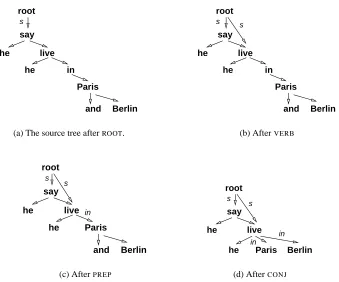
Before a dependency tree is compressed, i.e. be-fore some of the dependencies are removed, the tree is modified. We will demonstrate the effect of the transformations with the sentence below:
(1) He said that he lived in Paris and Berlin
The first transformation (ROOT) inserts an explicit rootnode (Fig. 1(a)). The result of the second trans-formation (VERB) is that every inflected verb in the
tree gets an edge originating from the rootnode (Fig. 1(b)). All edges outgoing from the rootnode bear the
s label. Apart from that we remove auxiliary edges
and memorize such grammatical properties as voice, tense or negation for verbs.
The purpose of the remaining transformations is to make relations between open-class words more explicit. We want to decide on pruning an edge judging from two considerations: (i) how important for the head this argument is; (ii) how informative the dependent word is. As an example, consider a source sentence given in (2). Here, we want to de-cide whether one prepositional phrase (or both) can be pruned without making the resulting sentence un-grammatical.
(2) After some time, he moved to London.
Paris
Berlin and
he live say
he
in root
s
(a) The source tree afterROOT.
Paris
Berlin and
he live say
he
in root
s s
(b) AfterVERB
Paris
Berlin and
he live say
he root
s s
in
(c) AfterPREP
live say
he root
Paris Berlin he
s s
in in
(d) AfterCONJ
Figure 1: The dependency structure of He said that he lived in Paris and Berlin after the transformations
element attaches to its head with (Fig. 1(d)). This way we can retain any of the conjoined elements in the compression and do not have to preserve the whole sequence of them if we are interested in only one. This last transformation is not applied to verbs.
3.2 Tree Compression
We formulate the compression task as an optimiza-tion problem which we solve using integer linear programming1. Given a transformed dependency tree (a graph if new edges have been added), we de-cide which dependency edges to remove. For each directed dependency edge from headhto wordwwe thus introduce a binary variablexlh,wwhere l stands for the edge’s label:
xlh,w=
(
1 if the dependency is preserved
0 otherwise (1)
The goal is to find a subtree which gets the highest score of the objective function (2) to which both the
1In our implementation we use lp solve (http://
sourceforge.net/projects/lpsolve).
probability of dependencies (P(l|h)) and the impor-tance of dependent words (I(w)) contribute:
f(X) =X
x
xlh,w·P(l|h)·I(w) (2)
Intuitively, the conditional probabilities prevent us from removing obligatory dependencies from the tree. For example, P(subj|work) is higher than
P(with|work), and therefore the subject will be preserved whereas the prepositional label and thus the whole PP can be pruned. This way we do not have to create an additional constraint for every obligatory argument (e.g. subject or direct object). Neither do we require a subcategorization lexicon to look up which arguments are obligatory for a cer-tain verb. Verb arguments are preserved because the dependency edges, with which they are attached to the head, get high scores. Table 1 presents the prob-abilities of a number of labels given that the head is study. Table 2 presents the probabilities for their German counterparts.
be-subj dobj in at after with to 0.16 0.13 0.05 0.04 0.01 0.01 0.01
Table 1: Probabilities of subj, d(irect)obj, in, at, after, with, to given the verb study
subj obja in an nach mit zu 0.88 0.74 0.44 0.42 0.09 0.02 0.01
Table 2: Probabilities of subj, obja(ccusative), in, at, af-ter, with, to given the verb studieren
tween different prepositions and could only calcu-lateP(pp|studieren)which would not be very in-formative. The probabilities for English are lower than those for German because we calculate the con-ditional probabilities given word lemma. In English, the part of speech information cannot be induced from the lemma and thus the set of possible labels of a node is on average larger than in German.
There are many ways in which word importance,
I(w)can be defined. Here, we use the formula intro-duced by Clarke & Lapata (2008) which is a modifi-cation of the significance score of Hori et al. (2003):
I(wi) =
l
N ·filog FA
Fi
(3)
wi is the topic word (either noun or verb),fi is the frequency ofwiin the document,Fiis the frequency ofwiin the corpus, andFAis the sum of frequencies of all topic words in the corpus. lis the number of clause nodes abovewandN is the maximum level of embedding of the sentencewbelongs to.
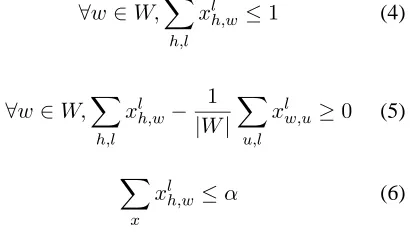
The objective function is subject to constraints of two kinds. The constraints of the first kind are stuc-tural and ensure that the preserved dependencies re-sult in a tree. (4) ensures that each word has one head at most. (5) ensures connectivity in the tree. (6) restricts the size of the resulting tree toαwords.
∀w∈W,X
h,l
xlh,w ≤1 (4)
∀w∈W,X
h,l
xlh,w− 1 |W|
X
u,l
xlw,u ≥0 (5)
X
x
xlh,w ≤α (6)
αis a function of the length of the source sentence in open-class words. The function is not linear since the degree of compression increases with the length of the sentence. The compression rate of human-generated sentences is about 70% (Clarke & Lapata, 2008)2. To approximate this value, we set the pro-portion of deleted words to be 20% for short sen-tences (5-9 non-stop words), this value increases up to 50% for long sentences (30+ words).
The constraints of the second type ensure the syn-tactic validity of the output tree and explicitly state which edges should be preserved. These constraints can be general as well as conditional. The former ensure that an edge is preserved if its source node is retained in the output. Conditional syntactic con-straints state that an edge has to be preserved if (and only if) a certain other edge is preserved. We have only one syntactic constraint which states that a sub-ordinate conjunction (sc) should be preserved if and only if the clause it belongs to functions as a sub-ordinate clause (sub) in the output. If it is taken as the main clause, the conjunction should be dropped. In terms of edges, this can be formulated as follows (7):
∀xscw,u, xsubh,w−xscw,u= 0 (7)
Due to the constraint (4), the compressed subtree is always rooted in the node added as a result of the first transformation. A compression of a sentence to an embedded clause is not possible unless one pre-serves the structure above the embedded clause. Of-ten, however, main clauses are less important than an embedded clause. For example, given the sentence
He said they have to be held in Beirut it is the
em-bedded clause which is informative and to which the source sentence should be compressed. The purpose of the VERB modification is to amend exactly this
problem. Having an edge from the rootnode to ev-ery inflected verb allows us to compress the source sentence to any clause.
3.3 Tree Linearization
A very simple but reasonable linearization technique is to present the words of a compressed sentence in the order they are found in the source sentence. This method has been applied before and this is how we
2
linearize the trees obtained for the English data. Un-fortunately, this method cannot be directly applied to German because of the constraints on word order in this language. One of the rules of German grammar states that in the main clause the inflected part of the verb occupies the second position, the first position being occupied by exactly one constituent. There-fore, if the sentence initial position in a source sen-tence is occupied by a constituent which got pruned off as a result of compression, the verb becomes the first element of the sentence which results in an undesirable output. There are linearization meth-ods developed for German which find an optimal word order for a sentence (Ringger et al., 2004; Filippova & Strube, 2007). We use our recent method to linearize compressed trees.
4 Corpora and Annotation
We apply our method to sentences from two corpora in English and German. These are presented below.
English Compression Corpus: The English data
we use is a document-based compression cor-pus from the British National Corcor-pus and American News Text Corpus which consists of 82 news stories3. We parsed the corpus with RASP (Briscoe et al., 2006) and with the Stan-ford PCFG parser (Klein & Manning, 2003). The output of the former is a set of dependency relations whereas the latter provides an option for converting the output into dependency for-mat (de Marneffe et al., 2006) which we use.
T ¨uBa-D/Z: The German corpus we use is a
col-lection of 1,000 newspaper articles (Telljohann et al., 2003)4. Sentence boundaries, morphol-ogy, dependency structure and anaphoric rela-tions are manually annotated in this corpus.
RASP has been used by Clarke & Lapata (2008) whose state of the art results we compare with ours. We use not only RASP but also the Stanford parser for several reasons. Apart from being accurate, the latter has an elaborated set of dependency relations
3The corpus is available from http://homepages.
inf.ed.ac.uk/s0460084/data.
4The corpus is available from http://www.sfs.
uni-tuebingen.de/en_tuebadz.shtml.
(48 vs. 15 of RASP) which is not overly large (com-pared with the 106 grammatical relations of the Link Parser). This is important for our system which relies on syntactic information when making prun-ing decisions. A comparison between the Stanford parser and two dependency parsers, MiniPar and Link Parser, showed a decent performance of the for-mer (de Marneffe et al., 2006). It is also of interest to see to what extent the choice of the parser influences the results.
Apart from the corpora listed above, we use the Tipster corpus to calculate conditional probabilities of syntactic labels given head lemmas as well as word significance scores. The significance score is calculated from the total number of 128 mil-lion nouns and verbs. Conditional probabilities are calculated from a much smaller portion of Tipster (about 6 million tokens). The latter number is parable to the size of the data set we use to com-pute the probabilities for German. There, we use a corpus of about 4,000 articles from the German Wikipedia to calculate conditional probabilities and significance scores. The corpus is parsed with the highly accurate CDG parser (Foth & Menzel, 2006) and has the same dependency format as T¨uBa-D/Z (Versley, 2005).
Although all corpora are annotated with depen-dency relations, there are considerable differences between the annotation of the English and German data sets. The phrase to dependency structure con-version done by the Stanford parser makes the se-mantic head of the constituent its syntactic head. For example, in the sentence He is right it is the adjec-tive right which is the root of the tree. Unlike that, sentences from the German corpora always have a verb as the root. To unify the formats, we write a set of rules to make the verb the root of the tree in all cases.
5 Evaluation
stan-dard variant divided over the total number of rela-tions in the output and in the human-generated com-pression respectively. According to Clarke & Lapata (2006), this measure reliably correlates with human judgements. The results of our evaluation as well as the state of the art results reported by Clarke & Lap-ata (2008) (LM+SIG+CONSTR), whose system uses language model scoring (LM), word significance score (SIG), and linguistic constraints (CONSTR), are presented in Table 3. The F-measure reported by Clarke & Lapata (2008) is calculated with RASP which their system builds upon. For our system we present the results obtained on the data parsed with RASP as well as with the Stanford parser (SP). In both cases the F-measure is found with RASP in or-der to allow for a fair comparison between the three systems. We recalculate the compression rate for the gold standard ignoring punctuation. On the whole corpus the compression rate turns out to be slightly higher than that reported by Clarke & Lapata (2008) (70.3%).
F-measure compr.rate
LM+SIG+CONSTR 40.5 72.0% DEP-BASED(RASP) 40.7 49.6% DEP-BASED(SP) 49.3 69.3%
GOLD - 72.1%
Table 3: Average results on the English corpus
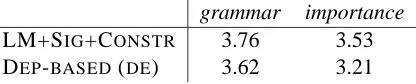
As there are no human-generated compressions for German data, we evaluate the performance of the method in terms of grammaticality and importance by means of an experiment with native speakers. In the experiment, humans are presented with a source sentence and its compression which they are asked to evaluate on two five-point scales. Higher grades are given to better sentences. Importance represents the amount of relevant information from the source sentence retained in the compression. Since our method does not generate punctuation, the judges are asked to ignore errors due to missing commas. Five participants took part in the experiment and each rated the total of 25 sentences originating from a randomly chosen newspaper article. Their ratings as well as the ratings reported by Clarke & Lapata (2008) on English corpus are presented in Table 4.
grammar importance
LM+SIG+CONSTR 3.76 3.53 DEP-BASED(DE) 3.62 3.21
Table 4: Average results for the German data
6 Discussion
The results on the English data are comparable with or superior to the state of the art. These were ob-tained with a single linguistic constraint (7) and without any elaborated resources which makes our system adaptable to other languages. This suggests that tree compression is a better basis for sentence compression systems than language model-oriented word deletion.
In order to explain why the choice of parser sig-nificantly influences the performance of the method, we calculate the precisionP defined as the number of dependencies shared by a human-generated com-pression (depc) and the source sentence (deps) di-vided over the total number of dependencies found in the compression:
P = |depc∩deps| |depc|
(8)
The intuition is that if a parser does not reach high precision on gold standard sentences, i.e. if it does not assign similar dependency structures to a source sentence and its compression, then it is hopeless to expect it to produce good compression with our dependency-based method. However, the precision does not have to be as high as 100% because of, e.g., changes within a chain of conjoined elements or appositions. The precision of the two parsers cal-culated over the compression corpus is presented in Table 5.
RASP Stanford parser precision 79.6% 84.3%
Table 5: Precision of the parsers
RASP and thus allows for finer distinctions between the arguments of different types.
Another point concerns the compression rates. The compressions generated with RASP are consid-erably shorter than those generated with the Stanford parser. This is mainly due to the fact that the struc-ture output by RASP is not necessarily a tree or a connected graph. In such cases only the first subtree of the sentence is taken as input and compressed.
The results on the German set are not conclu-sive since the number of human judges is relatively small. Still, these preliminary results are compara-ble to those reported for English and thus give us some evidence that the method can be adapted to languages other than English. Interestingly, the im-portance score depends on the grammaticality of the sentence. A grammatical sentence can convey unim-portant information but it was never the case that an ungrammatical sentence got a high rating on the im-portance scale. Some of the human judges told us that they had difficulties assigning the importance score to ungrammatical sentences.
7 Conclusions
We presented a new compression method which compresses dependency trees and does not rely on a language model to test grammaticality. The method is unsupervised and can be easily adapted to lan-guages other than English. It does not require a subcategorization lexicon or elaborated hand-crafted rules to decide which arguments can be pruned and finds a globally optimal compression taking syn-tax and word importance into account. We demon-strated that the performance of the system depends on the parser and suggested a way to estimate how well a parser is suited for the compression task. The results indicate that the dependency-based approach is an alternative to the language model-based one which is worth pursuing.
Acknowledgements: This work has been funded by the Klaus Tschira Foundation, Heidelberg, Ger-many. The first author has been supported by a KTF grant (09.009.2004). We would like to thank Yan-nick Versley who helped us convert T¨uBa-D/Z in the CDG format and Elke Teich and the three anony-mous reviewers for their useful comments.
References
Briscoe, Edward, John Carroll & Rebecca Watson (2006). The second release of the RASP sys-tem. In Proceedings of the COLING-ACL
In-teractive Presentation Session, Sydney, Australia,
2006, pp. 77–80.
Clarke, James & Mirella Lapata (2006). Models for sentence compression: A comparison across do-mains, training requirements and evaluation mea-sures. In Proceedings of the 21st International
Conference on Computational Linguistics and 44th Annual Meeting of the Association for Com-putational Linguistics, Sydney, Australia, 17–21
July 2006, pp. 377–385.
Clarke, James & Mirella Lapata (2008). Global in-ference for sentence compression: An integer lin-ear programming approach. Journal of Artificial
Intelligence Research, 31:399–429.
de Marneffe, Marie-Catherine, Bill MacCartney & Christopher D. Manning (2006). Generating typed dependency parses from phrase structure parses. In Proceedings of the 5th International
Conference on Language Resources and Evalua-tion, Genoa, Italy, 22–28 May 2006, pp. 449–454.
Filippova, Katja & Michael Strube (2007). Generat-ing constituent order in German clauses. In
Pro-ceedings of the 45th Annual Meeting of the As-sociation for Computational Linguistics, Prague,
Czech Republic, 23–30 June 2007, pp. 320–327.
Foth, Kilian & Wolfgang Menzel (2006). Hybrid parsing: Using probabilistic models as predictors for a symbolic parser. In Proceedings of the 21st
International Conference on Computational Lin-guistics and 44th Annual Meeting of the Associa-tion for ComputaAssocia-tional Linguistics, Sydney,
Aus-tralia, 17–21 July 2006, pp. 321–327.
Gagnon, Michel & Lyne Da Sylva (2005). Text summarization by sentence extraction and syn-tactic pruning. In Proceedings of Computational
Linguistics in the North East, Gatineau, Qu´ebec,
Canada, 26 August 2005.
com-pression. In Proceedings of Human Language
Technologies 2007: The Conference of the North American Chapter of the Association for Compu-tational Linguistics, Rochester, N.Y., 22–27 April
2007, pp. 180–187.
Hori, Chiori & Sadaoki Furui (2004). Speech sum-marization: An approach through word extraction and a method for evaluation. IEEE Transactions
on Information and Systems, E87-D(1):15–25.
Hori, Chiori, Sadaoki Furui, Rob Malkin, Hua Yu & Alex Waibel (2003). A statistical approach to automatic speech summarization. EURASIP
Jour-nal on Applied SigJour-nal Processing, 2:128–139.
Jing, Hongyan (2001). Cut-and-Paste Text
Summa-rization, (Ph.D. thesis). Computer Science
De-partment, Columbia University, New York, N.Y.
Klein, Dan & Christopher D. Manning (2003). Ac-curate unlexicalized parsing. In Proceedings of
the 41st Annual Meeting of the Association for Computational Linguistics, Sapporo, Japan, 7–12
July 2003, pp. 423–430.
Knight, Kevin & Daniel Marcu (2002). Summariza-tion beyond sentence extracSummariza-tion: A probabilistic approach to sentence compression. Artificial
In-telligence, 139(1):91–107.
McDonald, Ryan (2006). Discriminative sentence compression with soft syntactic evidence. In
Proceedings of the 11th Conference of the Eu-ropean Chapter of the Association for Computa-tional Linguistics, Trento, Italy, 3–7 April 2006,
pp. 297–304.
Riezler, Stefan, Tracy H. King, Richard Crouch & Annie Zaenen (2003). Statistical sentence con-densation using ambiguity packing and stochastic disambiguation methods for Lexical-Functional Grammar. In Proceedings of the Human
Lan-guage Technology Conference of the North Amer-ican Chapter of the Association for Computa-tional Linguistics, Edmonton, Alberta, Canada,
27 May –1 June 2003, pp. 118–125.
Ringger, Eric, Michael Gamon, Robert C. Moore, David Rojas, Martine Smets & Simon Corston-Oliver (2004). Linguistically informed
statisti-cal models of constituent structure for ordering in sentence realization. In Proceedings of the
20th International Conference on Computational Linguistics, Geneva, Switzerland, 23–27 August
2004, pp. 673–679.
Telljohann, Heike, Erhard W. Hinrichs & Sandra K¨ubler (2003). Stylebook for the T¨ubingen
tree-bank of written German (T¨uBa-D/Z). Technical
Report: Seminar f¨ur Sprachwissenschaft, Univer-sit¨at T¨ubingen, T¨ubingen, Germany.
Turner, Jenine & Eugene Charniak (2005). Su-pervised and unsuSu-pervised learning for sentence compression. In Proceedings of the 43rd
An-nual Meeting of the Association for Computa-tional Linguistics, Ann Arbor, Mich., 25–30 June
2005, pp. 290–297.
Versley, Yannick (2005). Parser evaluation across text types. In Proceedings of the 4th Workshop
on Treebanks and Linguistic Theories, Barcelona,