Volume 5, No. 4, April 2014 (Special Issue)
International Journal of Advanced Research in Computer Science
RESEARCH PAPER
Available Online at www.ijarcs.info
© 2010-14, IJARCS All Rights Reserved CONFERENCE PAPERCONFERENCE PAPER 149
Performance Evaluation of LEACH Protocol for Wireless Sensor Network in a Mobile
Environment
Padmalaya Nayak
Department of IT,
Gokaraju Rangaraju Institute of Engineering College, Hyderabad, India
D. Anurag
Department of IT,
Gokaraju Rangaraju Institute of Engineering College, Hyderabad,India
Ganji Sai Krishna
Department of IT,
Gokaraju Rangaraju Institute of Engineering College, Hyderabad,India
Abstract: Recent advances in VLSI and Micro-Electro-Mechanical (MEM) devices have led to the development of Wireless Sensor Networks, where energy awareness is an essential consideration. Many new protocols have been developed in order to extend the network lifetime by saving some battery power. However, most of the attention has given to the routing protocols as it differs depending on the Network application and architecture. Typically, sensors are deployed in a hazardous environment to gather the data periodically. During the data transmission, they consume considerable amount of energy. However, sensor nodes are constrained with battery power and bandwidth. So, there is a limitation on the lifetime of the battery power and it is a challenging issue. Low Energy Adaptive Clustering Hierarchy (LEACH) is the most famous hierarchical routing protocol, where the cluster head is selected randomly based on a threshold value and only cluster heads can send the information to the base station (BS). So, research on energy saving routings for static Wireless Sensor Networks that maximizes the network life time is well addressed in the literature. But, there is a lack of routing protocols for Mobile Wireless Sensor Networks in the existing literature. So, in this paper, attempt has been made to enhance the performance of LEACH protocol for Mobile Wireless Sensor Networks by introducing mobility at the base station. Simulation result shows that our proposed protocol maximizes the network lifetime 30%-40% over LEACH protocol.
Keywords: Enhanced Leach; Leach; Wsn; Sch; Fuzzy Logic
I. INTRODUCTION
Wireless Sensor Network presents a real time embedded system deployed in a particular region to sense various types of environmental parameters such as temperature, pressure, gas, humidity etc. The huge applications of WSN like habitant monitoring, forest fire detection, surveillances, transport monitoring etc. have created a lot of interest among the researchers in recent past to enhance the sensor network lifetime. Normally, WSNs are densely deployed in hazardous places where battery recharge and replacement is nearly impossible and monitoring these nodes is highly difficult. Due to the typical features; sensor nodes are prone to failure. Once the network is established, nodes keep on sensing the information and the battery power goes exponentially.
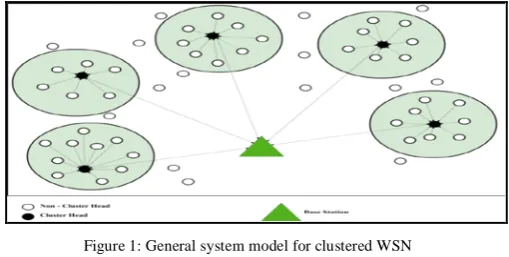
Whenever the nodes receive any information, these nodes send to the other nodes or to the base station. Sometimes, it happens that same information can be received by nearby sensor nodes and it reaches at the base station making the network inefficient.To avoid data redundancy and make the network most energy efficient, data aggregation and sensor fusion have been emphasized in the literature [1]. Many routing protocols have been proposed to make the network more energy efficient [14]. Cluster based routing protocol is one of them. In large size networks, the sensor nodes are divided into groups and one leader is selected in each group to co-ordinate among the sensor nodes called as Cluster Head (CH). Figure 1 shows the general
model for clustered WSN.Data aggregation is performed at the leader node or CH. LEACH [1, 2] is the most famous fundamental hierarchical routing protocol. In LEACH, the cluster head is selected in a probabilistic manner and tries to balance the load at the sensor nodes.
[image:1.595.313.568.658.786.2]The Cluster Head directly sends the message to the base station. Doing so, it consumes less energy and enhances the network life time. As LEACH relies on probabilistic model, there is a possibility in each round, that more than one cluster heads are selected or no cluster head is selected. Further, the cluster head may be selected at the boundary of the network which leads to the improper energy distribution. In [2] LEACH-C has been proposed which is a centralized approach to elect the cluster head. But, in LEACH and LEACH-C all the sensor nodes are assumed to be static. In this paper, attempt has been made to improve the LEACH performance by introducing mobility at the base station.
The remainder of the paper is organized as follows. Section II presents an overview of the related research work in this area. Section III discusses about the Radio Model. Section IV presents the proposed algorithm. Results and discussions are given in Section V. Section VI indicates our future work followed by the conclusive remark.
II. RELATEDWORK
In this section, we have focused on hierarchical routing protocols, where the cluster heads are selected in an energy efficient manner.
A. Hierarchical Routing Protocols based on clustering:
a. Leach:
LEACH [1,2] is an algorithm which selects cluster heads based on probabilities and each sensor node has equal chance to become cluster head. This protocol operates in two phases. These are set up phase and steady state phase. In set up phase, nodes go for cluster formation and in set up phase actual data transmission occurs. To become the cluster head each node chooses a random number between 0 and 1. If the number is less than threshold value T (n), the node becomes the cluster head for the current round. The threshold value T (n) is defined in equation (1).
r is the round which already ended, p is the probability of the nodes to be the cluster heads, G is a set of nodes which have never been cluster head in the last 1/p rounds. Although LEACH protocol distributes the load equally on each cluster head, still it has some drawbacks which are given below
a. There is no guarantee that in each round there one preferred number of Cluster Heads are selected. b. LEACH uses probabilistic model to decide Cluster
Head. So there is a possibility that two cluster heads which are close to each other are selected, which increases the overall energy depleted in the network. c. More CPU cycles are consumed because threshold
value is calculated and Random number is generated in each round.
d. If the selected node will be located near boundary of the network, other nodes will dissipate more energy to transfer message to Cluster Head.
b. Leach-C:
In LEACH-C [2] Cluster Head has been selected based on the centralized algorithm. So it can produce better clusters by dispersing Cluster Head nodes through the network. The main drawback of this centralised protocol is that the position of all the nodes must be known.
c. Pegasis:
Power Efficient and Gathering in Sensor Information Systems (PEGASIS) [3] is an improvement of LEACH protocol. PEGASIS finds another alternative to cluster and it forms chains from sensor nodes so that each node transmits and receives from other node and only one node is selected from that chain to transmit to the base station. The chain construction is obtained in a greedy way. The main difference between LEACH and PEGASIS is that PEGASIS
uses multihop routing by forming chains and selecting one node from the chain to transmit to the base station. Hierarchical-PEGASIS [21] is the extension of PEGASIS which aims at decreasing the delay incurred for packets during transmission to the base station.
d. Teen And Aapteen:
Threshold Sensitive Energy Efficient sensor network Protocol (TEEN) [4] is a hierarchical based routing protocol designed to response to sudden changes in attributes such as temperature. It is well suited for data centric approaches but it is not suitable for applications where periodic reports are needed. Adaptive Threshold Sensitivity Energy Efficient (AAPTEEN) is an extension of TEEN and responses to both periodic as well as time critical applications.
In [19] a different hierarchical routing algorithm has been proposed based on three-tier architecture where a TDMA based MAC is used for the nodes to send the information to the gateway. In [20] a self organizing protocol has been proposed.
B. Hierarchical Routing Protocol based on Fuzzy Logic:
a. Chef:
In CHEF [7] cluster head is elected based on two parameters which are proximity distance and energy. The fuzzy logic based approach selects the node with high energy and locally optimal node. Simulation result shows that the CHEF is 22.7% more efficient than LEACH. In [6] the author has considered three fuzzy parameters which are
energy, concentration and centrality. These three parameters are the key points to calculate the chance which can improve the network life time. Energy level is defined as available energy in each node, concentration is number of neighbor nodes and centrality is a value based on how central the node to the cluster. But problem with this protocol is all the nodes are not equipped with GPS receivers and in some places they might not be able to provide location information. In [12-16] many protocols have been proposed based on fuzzy techniques.
b. F-Mchel:
In F-MCHEL [10] cluster head is elected by applying fuzzy rules based on energy and proximity distance. The Master Cluster Head (MCH) which has the maximum residual energy among the cluster heads is elected as MCH and sends the aggregated message to the base station. F-MCHEL is an improvement of CHEF resulting in more stability of network as compared to LEACH and CHEF. In F-MCHEL the base station has been considered as static.
III. ENERGYMODELANALYSIS
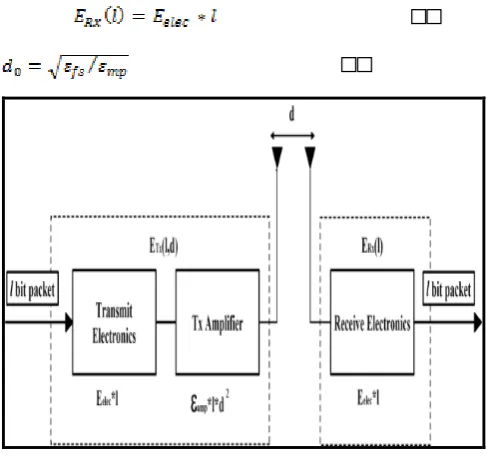
Figure 2 shows the radio model which has been referred from [9]. The amount of energy consumed from the transmitter to the receiver for l bits to a distance d during transmission and reception is given in equation 2.
(2)
a. Eelecrepresents the energy dissipated per bit to run the
© 2010-14, IJARCS All Rights Reserved CONFERENCE PAPER 151 b. are the characteristics of the transmitter
amplifier where is used for free space and for multipath
As the distance between transmitter and receiver is less than the threshold value d0, the free space model (d2 power
loss) is used. Otherwise, the multipath fading channel model (d4 power loss) is used. The equation 3 shows the amount of
energy consumption to receive l bit of data while equation 4 represents the threshold value which is the ratio of
��
[image:3.595.314.566.80.211.2]��
Figure 2: Radio Model
IV. WORKINGOFLEACHAND PROPOSEDLEACH PROTOCOL
In general, LEACH and our proposed modified LEACH protocol work in rounds. As discussed in Section 2, in each round, there are two distinct operational phases: Cluster set up phases and steady state phases. In cluster set up phases, cluster head advertisement and scheduling of nodes within a cluster takes place. In steady state phase, the transmission of data from the nodes to the respective cluster head at a scheduled time intervals takes place. There are two common aspects understood from the LEACH protocols. One is the rotation of cluster heads and another is the local compression to reduce the global communication. To know the detail design and working principle of LEACH, one can refer [1] [2]. In LEACH, base station is assumed as static. But in our proposed model, only difference is that the base station is assumed to be mobile.
A. System Assumption:
In our proposed model, it is assumed that the sensor nodes are deployed randomly in order to monitor the environment continuously.
a. All the sensor nodes are static except the base station b. The base station is mobile
c. Homogeneous networks have been considered such that all the sensor nodes have initial equal energy. d. The distance between the node and the base station
can be computed based on received signal strength Base station may take many different paths to collect the information from the cluster head as shown in Figure 3.
Our further aim is to consume less energy by transmitting less number of messages to the base station.
Figure 3: Paths taken by Base Station
B. The proposed algorithm:
/* for every round */
a. Select CHs based on threshold value. b. Select koptimal CHs in each round.
/* for koptimal CHs */
c. All CHs sends the aggregated data to BS
/* end of for */
d. BS collects the information from CH
/* end of rounds */
V. SIMULATIONSANDRESULTS
The entire network has been simulated using NS2 Simulator Version 2.34. The parameters taken into consideration for evaluating LEACH and LEACH with mobile base station are given in Table 1.
Table I. Configuration parameters with Mobile BS
PARAMETER VALUE
SIMULATION TIME 10000S
NUMBER OF NODES 40 BASE STATION MOBILITY RANDOM
INITIAL ENERGY OF NODES 2J CHANNEL CHANNEL/WIRELESS
ANTENNA MODEL ANTENNA/OMNI ANTENNA ENERGY MODEL BATTERY COMMUNICATION CHANNEL BIDIRECTIONAL
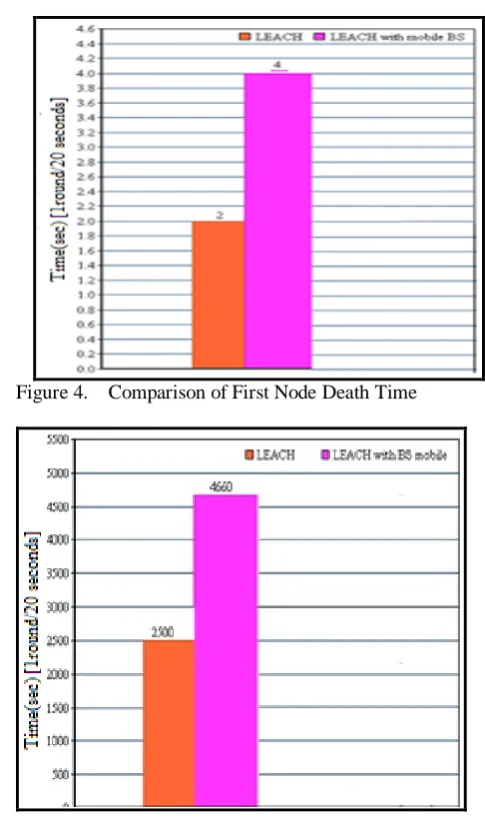
Results obtained for parameters of interest are shown in the following figures. In Figure 4, it is observed from the the simulation result that the first node dies in LEACH protocol only after 20s whereas in the case of LEACH with mobile base station, it dies after 40s. Similarly, it is observed from the Figure 5, the half nodes alive time for LEACH protocol is 2500s, whereas half nodes alive time is 4600s for LEACH with mobile base station. Table 2 provides the detail information about the first node dies and half node alive time. Thus, the time duration between first node dies to half nodes alive implies the network’s stability period. It is evident from the Figure 6 that LEACH with mobile base station provides better stability than the LEACH protocol.
Table 2. Values of FND and HNA metrics
ALGORITHM FND(S) HNA(S)
LEACH 2S 2500S
[image:3.595.35.279.172.402.2]Figure 4. Comparison of First Node Death Time
Figure 5. Comparison of Half Nodes Alive Time
Figure 6: Comparison of Network Stability Period
Again, we tried to simulate the residual energy of the Wireless Sensor Network. After extensive simulations, we concluded that the residual energy is 20% more in case of LEACH with mobile base station in compared to LEACH, which is shown in Figure 7. Further, we investigated about the network lifetime which is increased in case of mobile base station compared to static base station as shown in Figure 8.
[image:4.595.316.565.268.428.2]
Figure 7. Comparison of Residual Energy
Figure 8. Comparison of Network Lifetime
VI. FUTUREWORK
Our future work includes selecting a Super Cluster Head (SCH) among the cluster heads (CHs), from which mobile base station can collect the information. Our further aim is to design a new routing protocol which can prolong the network lifetime by consuming less energy while computing the path from source to base station. More simulations can be run to proof the performance parameters more efficient than the existing ones by using NS-2 as well as NetSim Simulator.
VII.CONCLUSION
[image:4.595.31.262.480.649.2]© 2010-14, IJARCS All Rights Reserved CONFERENCE PAPER 153 VIII.REFERENCES
[1] W. R. Heinzelman, A. Chandrakasan, and H. Balakrishnan, “Energy-efficient Communication Protocol for Wireless Microsensor Networks.”, in IEEE Computer Society Proceedings of the Thirty Third Hawaii International Conference on System Sciences (HICSS '00), Washington, DC, USA, Jan. 2000, vol. 8, pp. 8020.
[2] W. R. Heinzelman, A. Chandrakasan and H.
Balakrishnan,“An application-specific protocol architecture for wireless microsensor networks,” in IEEE Transactions on Wireless Communications, Oct. 2002, pp. 660 – 670
[3] S. Lindsey, C.S. Raghavendra, “PEGASIS: Power-Efficient Gathering in Sensor Information Networks”, Computer Systems Research Department, the Aerospace Corporation
[4] A Manjeswari, D.P. Agrawala, “TEEN: a protocol for
enhanced efficiency in wireless sensor networks”, in pro-ceedings of the 1st International Workshop on Parallel and Distributed Computing Issues in Wireless Networks and Mobile Computing, San Franscisco, CA, April 2001.
[5] A Manjeswari, D.P. Agrawala, “APTEEN: a hybrid
protocol for efficient routing and comprehensive information retrieval in WSNs” in proceedings of the 2nd
International Workshop on Parallel and Distribution Computing Issues in Wireless Networks and Mobile Computing FL, April 2002.,
[6] I. Gupta, D. Riordan and S. Sampalli, "Cluster -head Election using Fuzzy Logic for Wireless Sensor Networks", Communication Networks and Services Rearch Conference, pp.255-260, May 2005.
[7] Jong-Myoung Kim, Seon-Ho Park, Young-Ju Han,
TaiMyoung Chung,” CHEF: Cluster Head Election mechanism using Fuzzy logic in Wireless Sensor Networks “ICACT 2008,PP-654-659, feb 2008.
[8] Abhijeet Alkesh, Ashutosh Kumar Singh, N.Purohit, “A
moving base station strategy using fuzzy logic for life time enhancement in wireless sensor network”, in proc. of International Conference on Communication Systems and Network Technologies, 2011, pp 198-202,
[9] Hoda Taheri et.al., “An energy-aware distributed clustering protocol in wireless sensor networks using fuzzy logic”, Adhoc Networks 10 (2012) 1469-1481.
[10] Tripti Sharma, Brijesh Kumar, “F-MCHEL: Fuzzy Based
Master Cluster Head Election Leach Protocol in Wireless Sensor Network”, International Journal of Computer Science and Telecommunications, Volume 3, Issue 10, October 2012, pp. 8-13.
[11] Z.W.Siew, C.F.Liau, A.Kiring, M.S. Arifianto, K.T.K. Teo, “Fuzzy Logic Based Cluster Head Election for Wireless Sensor Network”, in Proc. of 3rd CUTSE International
Conference, Malaysia, 2011, pp. 301-306.
[12] Vibha Nehra, Raju Pal, Ajay K Sharma, “Fuzzy-based
Leader Selection for Topology Controlled PEGASIS Protocol for Lifetime Enhancement in Wireless Sensor Network”, International Journal of Computers & Technology, Volume 4 No. 3, March-April, 2013, ISSN 2277-3061, pp755-764.
[13] Ge Ran, Huazhong Zhang, Shulan Gong, “Improving on
LEACH Protocol of Wireless Sensor Networks Using Fuzzy Logic”, Journal of Information & Computational Science 7: 3 (2010) 767–775.
[14] Hironori Ando, Leonard Barolli, Arjan Durresi, Fatos
Xhafa, and Akio Koyama, "An Intelligent Fuzzy-based Cluster Head Selection System for WSNs and Its Performance Evaluation for D3N Parameter", 2010
[15] International Conference on Broadband, Wireless
Computing, Communication and Applications, pages 648-653, 2010.
[16] Zohre Arabi, "HERF: A Hybrid Energy Efficient Routing using a Fuzzy Method in Wireless Sensor Networks", International Conference on Intelligent and Advanced Systems (ICIAS), 2010.
[17] E.H. Mamdani, S. Assilian, An experiment in linguistic synthesis with a fuzzy logic controller, International Journal of Man–Machine Studies 7 (1) (1975) 1–13
[18] Kemal Akkaya, Mohamed Younis, “A survey on routing
protocols for wireless sensor networks”, Ad Hoc Networks 3 (2005) 325–349.
[19] M. Younish, M. Youssef, K. Arisha, “ Energy aware
routing in cluster based sensor networks”, in Proceedings of
10th IEEE/ACM International Symposium on Modeling
Analysis and Simulation of Computer and
Telecommunication Systems (MASCOTS2002), Fort Worth, TX, October 2002.
[20] M. Youssef, M Younis, K. Arisha, “A Constrained shortest path energy-aware routing algorithm for wireless sensor networks, in Proceedings of the IEEE Wireless Communication and Network conferences (WCNC), Orland, FL, March 2002.
[21] S. Lindsey, C.S. Raghavendra, K Sivalingam, “ Data