International Journal of Advanced Research in Computer Science
RESEARCH PAPER
Available Online at www.ijarcs.info
A Framework for a Computer Based Employees’ Performance Management Data
Mining System
Julius N. Obidinnu Virginia E. Ejiofor Boniface Ekechukwu
Department of Computer Science, Department of Computer Science, Department of Computer Science, Cross River University of Technology, NnamdiAzikiwe University, NnamdiAzikiwe University,
Calabar, Nigeria Awka, Nigeria Awka, Nigeria [email protected]
Abstract: In an earlier paper, it was founded that majority of the employees in the Nigerian Public Service perceive the operational Performance Management System as deficient, and that this has affected their levels of performances. This paper seeks the reasons, and establishes that the employees are demotivated to perform at higher levels becuase they perceive that the rewards emanating from the process are not largely contingent on performance, since the Business Process Intelligence used in determining these rewards are highly dissociated from the actual employees’ performances, thereby promoting inequity of evaluation standards, and making the process inconsequential. To reverse this trend, the paper presents the framework for the development of a computer based Employee Performance Management Data Mining System, which integrates the Business Process Intelligence from different organisational units into a Data Warehouse view, thereby making itcentrally and promptly available on near real-time basis for a more accurate and reliable analysis and reporting.
Keywords: Data Mining, Expectancy Theory, Business Process Intelligence, Performance Management, Public Service
I. INTRODUCTION
It was established in [10] that majority of the employees in the Nigerian Public Service (NPS) perceive the operational Performance Management System(PMS) as deficient, and that this is largely responsible for the widespread existence of counterproductive behaviours in the workplace, which further translates to the observed poor quality of service deliveryto the public. The paper also recommends the development of computer based data mining technologies in the aggregation, analysis, and reporting of employees’ performance management systems.
In this paper, we seek to discover why the operational PMS is perceived as deficient. And in order to achieve this, we perform a comparative analysis of the referred PMS process based on the critical success factors in the literature. This analysisprovides the necessary details, which this paper has utilised to produce the structures required for the development of employees’ performance managementdata mining system.
Adopting and implementing the proposals in this paper will bring about improvements in the quality of decisions-making in Employees Performance Management. It is our position that when the employees perceive that their behaviours and productivities are closely monitored, adequately reported, and rewards effectively implemented, they will become more conscious of performing according to their rules of engagement in the workplace.
The above position is in line with the postulations of the Expectancy Theory propounded by Vroom in 1964, and states that: Employees will be motivated to perform at higher levels if they believe that effort will lead to good performance (the effort to performance expectancy), that
rewards are contingent on performance (the performance to reward expectancy), and that these rewards are valued and salient in the sense that they are uppermost in the employees' minds (the valence of outcomes) [6].
II. METHODOLOGY
This paper adopts the Structured Systems Analysis and Design Methodology (SSADM) because it is process-oriented, focusing primarily on modelling the processes or actions that capture, store, manipulate, and distribute data as it flows through the system. Furthermore, it separates data from processes. In the next section, we analyse the features of the operational PMS in the NPS.
III. THE OPERATIONAL PMS IN THE NPS
Performance Management System is a framework used to ensure that the employeesconform to organisation’s mission and vision of doing,in an acceptable manner, what they ought to do in the workplace, in order to add the desired values to themselves, the organisation, the customers, and other stakeholders.The PMS process includes:
i. Keeping the Business Process Intelligence(BPI) of the plans for work that has to be done (performance planning),
ii. Keeping the BPIs of what work is being done and how it is being done (performance monitoring), iii. Measuring the work that has been done
(performance measurement) with the aid of available BPIs, and
iv. Rewarding work done according to organisational policies (reward processes).
context of key business processes, towards supporting decisions and actions that result in improved business
performance [11].
It is obvious therefore, from the foregoing, that employees’ perception of the outcome of the PMS process relies largely on the efficacy of the generated BPI. Consequently, a more accurate BPI will lead to a better informed employees’ performance decision. In other words, a sustainable PMS process has to be necessarily attached with a Business Process Model (BPM) of the organisation.
A BPM is a coordinated set of value-adding activities that operate over input entities to produce output (s) towards the attainment of organisational goals. A typical BPM is shown in Figure 1.
Figure 1: A Typical Business Process Model
A BPM therefore, coordinates how the actors (managers, secretaries, clerks, messengers, etc.) take actions (extent and manner) on the activities (creates a memo, types the memo, etc.). The foregoing indicates that the BPI should be generated from the BPM in near real time.
In the NPS, the only structured methodology at present, for evaluating the performances of the public servants is the “Annual Performance Evaluation Report (APER)”, and there is no record of the conduct of Public Servants that carries more weight than the APER[4]. The APER therefore, is the operational employees PMS in the NPS, and is substantially used to organise the BPI that should lead to the making of sound employees performance related decisions.
Consequently, the outcome of the APER process is supposed to be used to take such decisions concerning the need to be: sent for special training, counselled and/or coached to improve, rewarded positively for good performances, demoted for poor performances, transferred to a different unit for non-suitability, or even terminated if counselling, coaching and training fail. They are also supposed to be used as legal instruments in case of judicial processes arising from personnel decisions.
In the next section, we review the APER process in order to determine how it fits into the critical success factors of such processes in the literature.
IV. THE APER PROCESS
The APER process begins with the collection and filling of form by an employee, whose entries constitute a part of the input records required for the supervisor to rate his/her performances. The inputs are strictly driven by the provisions in the form. At the end of the employee’s entries, the form is submitted to the supervisor, who will rate the employee’s performances for the year. There are several fields meant for the supervisor to supply the required
information that would be utilised in the eventual evaluation of the subordinate. The process continues with the endorsements by the employee, the supervisor, and the immediate superior to the supervisor. Finally, the form is moved to the management’s committee responsible for taking the final decisions based on the recommendations in the forms. The abridged flow of this process is presented in Figure 2.
Figure 2: The Major Activities in the APER process
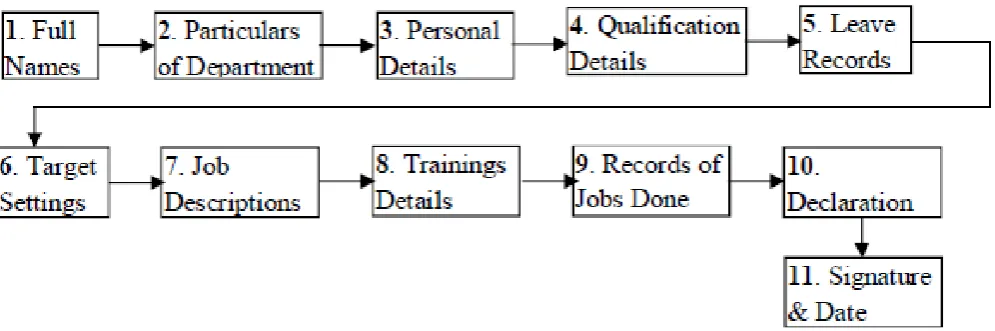
Activities 2 and 3 of Figure 2 require input data. While the subordinate will supply the input data into activity 2, the supervisor will supply the ones for activity 3. The expanded
scope of the data entries for activities 2 and 3 are presented in Figure 3 and Figure 4 respectively.
Figure 4: Expanded Scope of Supervisor’s Data Entries
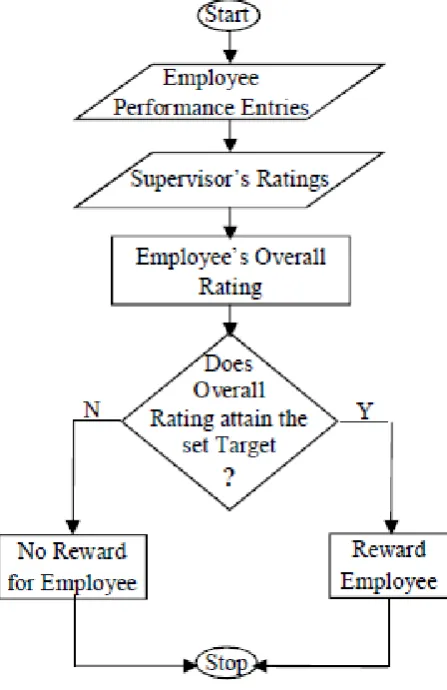
The flow of data between the filling of forms and the eventual management decision to reward or penalise the employee based on the outcome of the process is presented in Figure 5.
Figure 5: The Flow of Data in the APER Process
It could be seen in Figure 5 that the APER process is conducted only once in a year, within a period spanning two to three weeks, which largely isolates the BPIs from the BPMs. It is therefore, expected that the supervisor should memorise all the subordinates’ performance information within a whole year. Since this is not possible, the
supervisors rate their subordinates based on recent events and friendship dispositions.
V. FEATURES OF THE BPI’s IN USE IN THE NPS
Majority of the organisations in the NPS use manual paper technologies in the form of time-books, logbooks, among others, as process monitoring and tracking mechanisms. These are supposed to provide updated BPIfrom the business processes, for the purpose of improving the quality of decisions making. For instance, the time-book is an instrument for keeping record of punctuality and regularity of staff to work. However, even in the offices where the time-books exist, there is no provision in the APER for making useof the numerical data provided by it. This can be seen in the Work-Habits section of the APER, where a very flimsy reference that requires a subjective rating is made to Attendance.
More so, where the log-books exist, they are also not put to reckoning during the employee performance evaluation period. Our investigations reveal that the major reason for ignoring the benefits of mining data from these performance management instruments is the computational complexities involved. The complexities have simply overwhelmed the normal human being, as the data analysis and interpretation involves tremendous time and financial resources, but always end up with inaccuracies.
Because of these complexities, the APER is designed to award subjective ratings, since evidential justification is not a requirement. Consequently, the supervisors are at liberty to use their whims and caprices in rewarding and penalising perceived cronies and foes. This trend is dangerous since it leads toinequity in the evaluation standard.
that some staff refer to the evaluations as, “a dishonest annual ritual” [9],[2].
Referring to the APER as an annual ritual is a further indication that structured employee performance feedback reports can only be provided on annual basis. This is partly why it cannot encourage improvement. For instance, management could use regular feedbacks to communicate varrying ranges of rewards that encourage job engagement and promote commitment. The feedback reports can contain such messages as: commendations, opportunities to achieve, the scope to develop skills, and guidance on career paths. All these are nonfinancial rewards, which can make a longer-lasting and more powerful impact than financial rewards. And [1] also condemns this trend and states that a culture that allows a once-a-year feedback in the form of employee performance evaluations is a culture that encourages management malfeasance.
To reverse these negative trends, the right kind of information has to be collected on a continuous basis, and
used to inform learning and decisions-making, which in turn should lead to performance improvements. For this purpose, in the next section, we present the structures for the development of a computer based Employee Performance Management Data Mining System.
VI. COMPUTER BASED EMPLOYEE PERFORMANCE MANAGEMENT DATA MINING
SYSTEM
The weaknesses identified in the previous section could be strengthened with a computer based system that integrates the employees performance BPI in such a way that it is promptly available, directly accessible to management, and independently verifiable, with a view to removing biases from supervisors. Such design will also provide regular monitoring and reporting, as well as reduce the burden of computational complexities on the human beings. To achieve this, we adopt the PMS process recommended in [3], who affirm that for a PMS to be effective, it has to be a network of activities in the stages as depicted in Figure 6.
Figure 6: The Flow of Data in the Performance Management Process [3]
Figure 6 shows an all-year round continuous process. It begins with the establishment of job responsibilities and the criteria for determining the extent and manner in which
performance attainments. The attainments are then used to determine the reward for an employee. The rewards are
effectively implemented, and the process continues.
Implementations that will adequately provide for these features are referred to as data mining systems.
The design of data mining systemsbegins with the structure for integrating data from various sources. This will make it
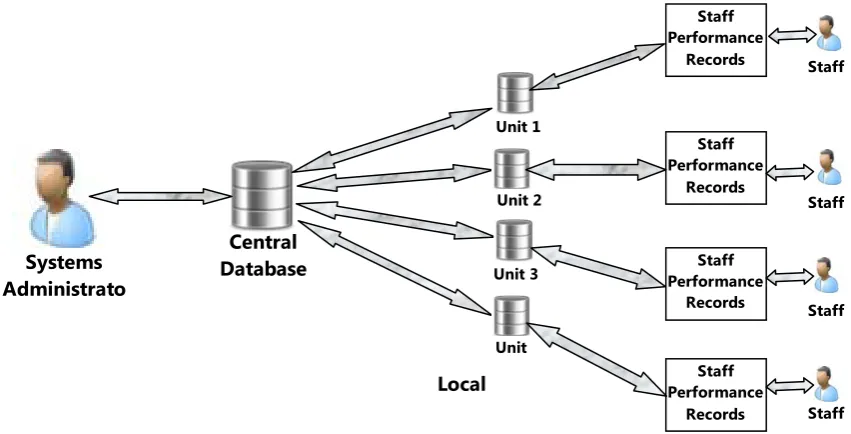
possible for employees’ performance data to be gathered from different divisions, departments, or units into a central location. This structure is shown in Figure 7.
Figure 7: The Database Structure of the Computer Based Performance Management Data Mining System
In Figure 7, the staff performance records emanate from the localised databases situated in the employee’s present departments or units. During processing, the datasets in the localised databases are sent to the central database to provide a Data Warehouse view of the organisation’s data. The Data Warehouse provides the organisation with memory which the human beings are not capable of storing, and which the paper technologies have not also been maintained effectively. The memory in the Data Warehouse is then mined in the process called, Knowledge Discovery in Databases (KDD). The problem therefore, is to mine useful information and provide graphical analysis capabilities from the datasets, which will facilitate the making of sound employee performance management decisions.
As stated earlier, the PMSprocess is an on-going communications process. The outcome of one stage provides the input for the next one in a dynamic manner. Consequently, it should be represented as a cycle of inter-related and interdependent activities that contribute to the attainment of organisational goals. We have therefore, conceived the composition of the PMS specification, representing the sequence of activities and their interconnectivities with one another. This is shown in Figure 8.
Figure 8: Process Specification for the Computer Based Performance Management Data Mining System
Depending on the focus of a software developer, the encircled components will form the minimum database entities for developing a PMBPM application. It could be expanded, but not reduced. In the following paragraphs, we present the minimum compositions for each of the components in Figure 8.
Employee’s Personal Details: The details of employees are very important in determining that the right people are placed in the right positions. It will further help to identify the skills that are mostly in need of development, and will alert management to talent deficiencies in a particular segment of the organisation. More so, the reward mechanisms revolve around individual employees as well as
Performance Plan Employee
Details
Performance Evaluation
Performance Monitoring Performance
Reports
Central Database
Unit 1
Unit 2
Unit Unit 3
Local Systems
Administrato
Staff Performance
Records
Staff Performance
Records
Staff Performance
Records
Staff Performance
Records
Staff
Staff
Staff
teams, thereby making personal details to be very essential. Some of the personal details that cannot be avoided include: Name, Staff Id, Qualifications, Rank, Date of First Appointment, Date of Present Appointment, and Phone No. The phone no, for instance will facilitate the introduction of a mechanism that will deliver regular performance feedback information to workers through their mobile phones. As such, an employee could be commended or admonished based on the performance attainments in a specific period. This will make the workers know that the system is watching, and could provide intelligence that will negatively affect one’s career. This encourages the workers to improve on their performance levels.
Performance Plan: Performance Planning involves the setting of performance expectations and goals for groups and individuals to channel their efforts toward achieving organisational objectives [7]. It enables an organisation to select the set of processes in which it will excel in order to create a sustainable difference in a competitive environment. A performance plan is a high-level business process that describes how to accomplish organisational vision. Depending on the intentions of an organisation, the plan may include: Mission, Vision, Objectives, Structure, Roles Profile, and the Definitions of the Key Performance Indicators (KPIs). The mission states an organisation’s basic function in the society, and defines the values that guide the employees’ activities in the delivery of services to the customers. The vision however, points out where the organisation aims to be in the future, defining the mid- to long-term goals of the organisation. Objectives are goals expressed in a form in which they can be measured. Structure represents the organisational supervisory hierarchy, otherwise known as the command structure. The Roles Profiles are the tasks associated with the various ranks in the organisation. These have to be clearly defined to enable every worker know the scope of his/her job responsibilities. A performance plan should also minimally include the definitions of the KPIs for: aspects, rewards, measures, weights and the targets used for determining the rewards. It should further clearly contain the organisational units’ nominal rolls, as well as the Review and Feedback Time-frames.
Performance Monitoring: Performance monitoring is concerned with the gathering of business process Intelligence.Depending on the organisational focus, the components making up the Intelligence should include, but not limited to: Daily KPIs Tracking, Weekly KPIs Tracking, Monthly KPIs Tracking, Quarterly KPIs Tracking, Track Queries within the Period, Track Leaves within the Period, and Annual KPIs Tracking.
Performance Evaluation: In this stage, the business process intelligence gathered at the monitoring stage is collated using the values associated with the KPIs, including the aspects, weights, measures, and the targets. The following specific reports could be generated from these computations: Daily KPIs outcomes, Weekly KPIs outcomes, Monthly KPIs outcomes, Quarterly KPIs outcomes, and Annual KPIs outcomes.
Reports: Reports are the reason for engaging the business process model. Therefore, it should be presented in a form that will motivate the workers to accept the outcome of the process. Consequently, tabular and graphical reports should be produced from the system. The minimal components of such reports should include: individual Employee Performance, Unit’s Performance, Organisation’s Performance, Advise on Training, Advise on Skills Deficiencies, Reprimand of low Performance, Particulars of Leaves, and Particulars of Queries.
VII. CONCLUSIONS
The outcome of the PMS process is used to take far-reaching decisions concerning the career of employees. And the perception of the employees regarding the efficacy of the outcome of the PMS process relies largely on the generated BPI. Therefore, a more accurate BPI will lead to a better informed employees’ performance decisions.
Consequently, a sustainable PMS process has to be necessarily attached to a domain of responsibility in a Business Process Model, which will coordinate how the BPI should be generated in near real-time as the actors take actions on the activities. And the nearer to real-time the BPI is generated from the BPM, the more effective the outcome of the PMS process shall become, and the better the perception of the employees on its powers. Therefore, in line with the Expectancy Theory, the employees will be motivated to perform at higher levels when they perceive that the rewards emanating from the PMS process are contingent on performance.
In this paper, we identify that the BPIs used for the operational PMS process in the NPS rely largely on supervisors’ subjective ratings, characterised by recent events and friendship dispositions, and highly isolated from the BPMs. And because the BPIs are highly isolated from the BPMs, the decisions made with such BPIs are usually very highly dissociated from the actual employees’ performances. The PMS process therefore, promotes inequity, since the outcome is highly determined by the perceptions of the supervisor without the requirement for evidential justification. Consequently, many of the employees perceive the process as inconsequential, since it could positively reward without recourse to performance achievements. And in line with the Expectancy theory, the employees will be demotivated to perform at higher levels since they perceive that the rewards emanating from the PMS process are not contingent on performance.
To reverse these negative trends, the right kind of information has to be collected on a continuous basis, and used to inform learning and decisions-making, which in turn should lead to performance improvements. For this purpose, this paper presents the framework for the development of a computer based Employee Performance Management Data Mining System, which integrates the data-structures from different organisational units into a Data Warehouse view, thereby making it centrally and promptly available on real-time basis for a more accurate and reliable analysis and reporting.
VIII. RECOMMENDATIONS
The framework for the development of a Computer Based Employee Performance Management Data Mining System has been presented. Since data mining systems support the aggregation, analysis, and reporting of data outcomes, it is therefore, imperative that such a system should ensure that these features happen on near real-time. Consequently, we recommend that a Computer Based Employee Performance Management Data Mining System should possess a minimum of the following features: (i) daily, weekly, monthly, quarterly, and annual monitoring and tracking of performance data, (ii) provision of computational relations and quantitative statistics pertaining to individuals, units, and the organisation as a whole; as this will minimise subjective decisions that works against the spirit of the Expectancy Theory, (iii) provision of regular feedbacks meant to encourage improvements, (iv) supporting of independent employees’ performance reviews, which will provide insights to management, and (v) becoming promptly available to management in a central, secured, and directly accessible repository, so as to facilitate data mining, which leads to the making of sound and justifiable performance management decisions.
VIII. REFERENCES
[1] API, “Performance Management in the Public Sector – What’s the score?”, 2011
[2] M. Armstrong, “Performance Management: Key Strategies and Practical Guidelines,” London: Kogan Page, 2009
[3] A. S. DeNisi, and R. W. Griffin, “Human Resource Management,” New York: Houghton Mifflin Company, 2001 [4] L. B. Dogarawa, “A New Model for Performance
Measurement in the Nigerian Public Service,” International Journal of Business and Management, December 2011; Vol. 6, No. 12: 212-221
[5] K. H. Han, S. H. Choi, J. G. Kang and G. Lee, “Performance-Centric Business Activity Monitoring Framework for Continuous Process Improvement,” Recent Advances in Artificial Intelligence, Knowledge Engineering and Data Bases. Seoul: Autoever Systems Corp, 2011
[6] C. D.Ittner, D. F. Larcker and M. W. Meyer, “Performance, Compensation, and the Balanced Scorecard,” The Wharton School, The University of Pennsylvania,1997
[7] United States Office of Personnel Management, “A Handbook for Measuring Employee Performance: Aligning Employee Performance Plans with Organisational Goals,” Washington: Workforce Compensation and Performance Service, 2001 [8] D. Otley, “Performance Management: A Framework for
Analysis,” In R. Thorpe & J. Holloway (Eds.), Performance Management: Multidisciplinary Perspectives (pp. 24-39). New York: PALGRAVE MACMILLAN, 2008
[9] W. S. Weyhrauch, “Effects of Performance Appraisal Purpose and Rater Expertise on Rating Error,” Master’s thesis, Kansas State University, 2010
[10] J. N. Obidinnu, B. Ekechukwuand V. E. Ejiofor, “Building Blocks for the Development of Electronics
EmployeesPerformance Management System,” West African Journal of Industrial and Academic Research, September 2013; Vol.8, No.1: 28-37
![Figure 6: The Flow of Data in the Performance Management Process [3]](https://thumb-us.123doks.com/thumbv2/123dok_us/697750.1077505/4.595.42.394.310.715/figure-flow-data-performance-management-process.webp)