Volume 3, No. 5, Sept-Oct 2012
International Journal Of Advanced Research In Computer Science
RESEARCH PAPER
Available Online At www.ijarcs.info
ISSN No. 0976-5697
A Study on Metadata Standards for Semantic Annotation of Learning Objects
Kalla. Madhu Sudhana*
Research Scholar, Dept of Computer Science St. Peter’s University
Chennai, India [email protected]
Dr V. Cyril Raj Head, Dept of Computer Science
Dr M.G.R University Chennai, India [email protected]
Dr T.Ravi
Principal, Srinivasa Institute of Engineering and Technology Chennai, India
Abstract: Learning objects offer a new conceptualization of the learning process; they provide smaller, self-contained, re-usable units of learning. The learning objects must have an external structure of information to facilitate their identification, storage and retrieval. This paper examines current metadata standards and their characteristics that provide semantic annotation related to learning Objects. Furthermore we explored the metadata application profiles in educational context along with their base schemes.
Keywords: Learning Objects, Metadata Standards, Semantic annotation, Educational Metadata, Application Profiles, characteristics of metadata schemata, goals of annotation.
I. INTRODUCTION
Access to learning resources relies on technical and economic matters that are being considered within the Open Educational Resources (OER) approach [1]. The Learning Object Repositories (LORs) have been created and maintained by many educational administrations and institutions because the provision of learning resources is essential for the development of Information and Communication Technologies (ICTs) in education [2]. From this perspective, design and policies contributing to the engagement and participation of the educational community will improve the uptake of these systems. Integrating semantic web technologies can be very useful for this purpose.
A major task during the process of creation of a learning object is to generate annotations according to Learning Object Meta-Data (LOM) standards [3]. These specifications distinguish different metadata categories (i.e. general, technical, educative, etc.) to describe a learning object. Among them, the classification category is used to accommodate the annotations related to a particular classification scheme (e.g. the Dewey’s decimal classification system [4], or the generalist taxonomies of the Open Directory Project [5]). In our work, we examined current Metadata Standards for Learning Object.
The rest of paper is organized as follows. Section 2 presents a brief note on the semantic annotation of learning objects. Sections 3 and 4 describe metadata standards overview and evaluation, respectively. Section 5 summarizes and compares metadata standards. Finally section 6 concludes the paper.
II. SEMANTICANNOTATIONOFLEARNING OBJECTS
To unify the description of learning resources, the IEEE LOM standard has been used in many repositories to describe the contained resources [6]. But the IEEE LOM standard has been criticized because of its limited possibilities to enrich learning objects with educational meaningful information [7]. In addition, research has shown that it is not recommendable to let authors enrich learning objects with metadata because this does not lead to sufficient quality of the metadata [8]. To ensure high qualitative metadata, domain experts are needed to tag the resources with an agreed taxonomy of keywords. As an alternative to IEEE LOM several repositories use an extended set of the Dublin Core Standard [9]. This extended set offers more flexibility to enrich learning resources with educational and competence development related information but in essence the expert problem remains.
The OKI is being developed in close cooperation with these standardization movements. Many, if not most, e-learning applications follow the same track, and are either compliant to these standards, or will soon be [15].
[image:2.612.313.560.147.447.2]At the same time, it has become increasingly evident that the educational community will not be able to accept semantic web technology for meta-data very quickly, although the potential benefits are many. For example, recently the popular IEEE LOM expressed in RDF [16], and in spite of this, most implementers and researchers remain with XML Schema-based technology for meta-data. We believe that the metadata format represented in RDF and Ontologies provide semantic rich annotation than XML based approach as shown in “Fig. 1”.
Figure 1. Metadata formats for semantic annotation
These forms of semantics become even more important within the emerging field of e-learning. In the learning context, the conceptual structure of the content is an essential part of the learning material.
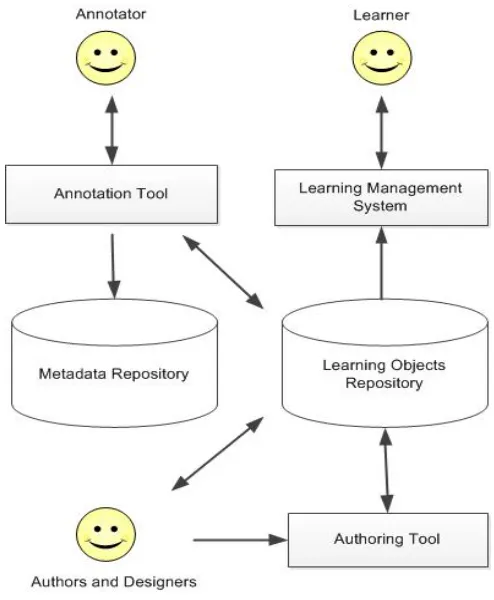
For semantic based accessing of learning-objects, it is required to annotate the learning-objects with appropriate metadata. ” Fig. 2” shows overview of semantic annotation process where authors and designers develop the required learning objects then they are being annotated by annotator with suitable metadata by using annotation tool.
The learning-object or any educational document that has an identifier can be annotated. There are already attempts in this direction: Annotea [17] is a project where annotations are created locally or on a server in RDF format. The annotations apply to educational documents such as learning-objects and are automatically fetched and incorporated into web pages via a special feature in the experimental browser like Amaya [18].
A. Annotation in an educational context:
The general purpose of using semantic annotation in an educational context is to classify and add information to existing learning resources. So that, they can be retrieved and searched by semantic means, which makes these web resources amenable for machine processing and that can help users to search for appropriate learning objects.
Figure 2. Overview of annotation process
Annotation in an educational context can be identified as having four goals.
a. Classifying (organizing into a hierarchy,
contextualizing):
a) E-learner can be really get benefited from the vast amount of E-learning object repositories on the Internet, If the system correctly classifies learning objects to the corresponding concepts. The classification category describes where this resource falls within a particular classification system. The classification describes this learning object in relation to a particular classification system.
b. Adding information (reformulating commenting
and documenting):
The annotation process provides comments on the educational use of the learning object and information on when and by whom it was created.
c. Planning (scheduling, indirect annotating):
[image:2.612.67.279.219.493.2]preconditions and to generate sequences of learning objects for achieving the learning goal.
d. Correlating:
The correlation category groups features that define the relationship between learning objects. The suitable learning objects retrieved are presented to learner according to the result of a ranking mechanism that employs the correlation-based algorithm; the correlation algorithm utilizes annotated information to finds the related learning objects.
III. METADATASTANDARDSOVERVIEW
Learning object metadata is a data model, usually encoded in XML, is used to describe a learning object and similar digital resources used to support learning. The purpose of learning object metadata is to support the reusability of learning objects, to aid discoverability and to facilitate their interoperability, usually in the context of online Learning Management Systems (LMS).
Several educational metadata schemata have been proposed over time in order to better characterize learning objects. A widely adopted metadata element set for this purpose is IEEE LOM, a standard which has been designed especially for the description of educational resources. According to Al-Khalifa and Davis [19], an important feature
of LOM is that it is simple to use and has an inherent extension capability. This extensibility allows for the easy incorporation of new elements and enables LOM to meet the specific needs of applications.
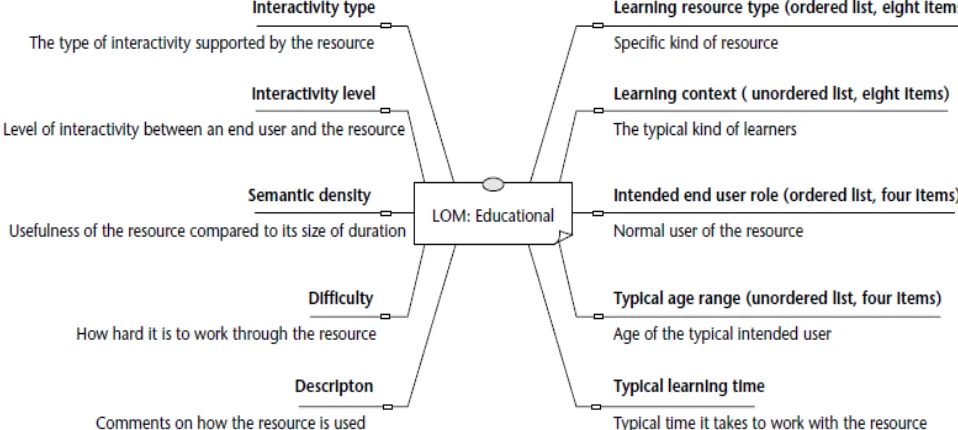
IEEE LOM defines a hierarchy of elements that are grouped into nine categories: General, Lifecycle, Meta-metadata, Technical, Educational, Rights, Relation, Annotation, and Classification. Each category is comprised of sub-elements that have some basic characteristics in common and appear either as a single element or as an aggregation of other elements. The complete metadata scheme of educational domain that can be pedagogically categorized is as shown in” Fig. 3”.
[image:3.612.54.533.365.580.2]The LOM approach specifies the syntax and semantics of learning object metadata. A learning object is any entity, digital or non-digital, which can be used, reused, or referenced during technology- supported learning. Examples of such applications include computer-based training systems, interactive learning environments, intelligent computer-aided instruction systems, distance learning systems, Web-based learning systems, and collaborative learning environments. Examples of learning objects include multimedia content, instructional content, instructional software, and software tools referenced during technology supported learning.
Figure 3. The metadata scheme of educational domain
The purpose of the Learning Object Metadata specification is to
a. Enable learners or instructors to search, evaluate, acquire, and reuse learning objects.
b. Enables the sharing and exchange of learning objects across any technology supported learning system
c. Useful for the development of learning objects in units that can be combined and decomposed in to meaningful ways
d. The computer agents can automatically and dynamically compose personalized lessons for an individual learner
e. Enable education, training and learning
organizations of both governmental and private institutions to express educational content and performance standards in a format separate from the content
concerning the applicability and effectiveness of learning objects
g. Support necessary security and authentication for the distribution and reuse of learning objects
IV. EVALUATION
It is important to observe that the resources considered as learning objects should be described by external descriptions called metadata. The metadata descriptions about the learning objects must be (although the term metadata is not exclusive for learning objects) with the following characteristics:
a. Metadata “says something” about the learning object, in a general sense.
b. Metadata is physically external to the educational resource; they can be in a separate file or be obtained from a different service.
c. Metadata use a technical format for their expression and for their interchange, often languages defined over XML.
d. A series of descriptors, fields or standardized elements allow metadata to obtain a certain level of interoperability between different systems.
The well-known metadata schemata designed to serve similar needs like IEEE LOM in the field of education are IMS [3], Alliance of Remote Instructional Authoring and Distribution Networks for Europe (ARIADNE) [20], DSpace [21], SCORM [22], DC-Ed [23], CanCore [24] and Dublin Core [11].
The characteristics of well-known metadata schemata is as shown below
IEEE - LOM
a. Learning Technologies Standard Committee (LTSC) and its draft standard is called Learning Object Metadata and it defines 80 fields within 9 categories as follows: 1-General, 2-Lifecycle, 3-Meta-Metadata, 4-Technical, 5-Educational, 6-Rights, 7-Relation, 8-Annotation and 9-Classification.
b. Sample fields of IEEE-LOM include: Title: the name given to the resource.
Language: the language of the intended user of the resource.
Description: a textual description of the content of the resource.
IMS
a. A further work on IEEE LOM b. Elements can be mapped to DC
ARIADNE
a. A set of 47 elements, 27 of which can be directly mapped to LOM elements
b. Organized in six categories: General, Semantics, Pedagogical, Technical, Indexation, Annotation c. Fully compatible with IEEE LOM
Dublin Core (DC)
a. A set of 15 core elements that can be further refined using attributes
b. A general metadata standard, suitable for describing digital objects of any kind
c. DC-Terms constitute the most up-to-date and formal version of the metadata terms properties roughly correspond to the whole set of DC elements and their qualifications
d. Dublin Core Metadata Initiative (DCMI)
Education12 consists of 23 elements that resulted from adding the 15 base DC elements to the extended 8 educational specific elements.
In the current e-learning industry, most learning management systems (LMSs) work in a closed-system manner. Some systems still use their own framework for learning content description rather than adopting LOM as the main standard. These minority frameworks include.
a. TArgeted Reuse
b. GEneration of TEAching Materials (TargeTeam) c. Tutorial Markup Language (TML)
d. Procedural Markup Language (PML)
V. EDUCATIONALMETADATAAPPLICATION PROFILES
As more and more applications are implemented using educational metadata, it becomes obvious that it would be difficult for a single metadata model to accommodate the functional requirements of all applications. This has created the need for what are known as application profiles.
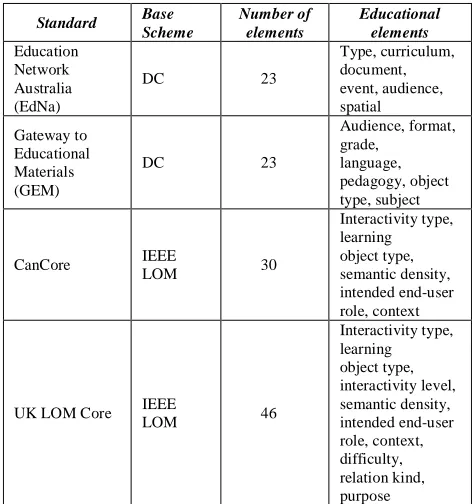
[image:4.612.323.560.473.725.2]Among the well-known application profiles is the UK LOM Core, an optimized version of IEEE-LOM standard designed for the use within the context of UK education and also the CanCore application profile is used in Canada. ” Table.1” shows some examples of the major application profiles along with their base scheme, number of elements and an enumeration of the educational elements field.
Table I. Major educational metadata application profile
Standard Base
Scheme Number of elements Educational elements Education Network Australia (EdNa)
DC 23
Type, curriculum, document, event, audience, spatial Gateway to Educational Materials (GEM)
DC 23
Audience, format, grade,
language, pedagogy, object type, subject
CanCore IEEE
LOM 30
Interactivity type, learning object type, semantic density, intended end-user role, context
UK LOM Core IEEE
LOM 46
VI. CONCLUSIONANDFURTHERWORK
One of the major challenges in e-learning development is search and discovery of appropriate learning objects from the distributed content repositories according to the needs and interests of the learner. For this, the educational objects must be annotated with standardized, semantic-based educational metadata. The recent development of semantic web technologies such as XML, RDF and ontologies has enabled the possibility for semantic-based e-learning services in the near future.
Identified the purpose and goals of the Learning Object Metadata standard specifications and classified the characteristics and application profiles of well known metadata standards of educational domain. The extension of this paper is to analyze the difference between conventional and semantic approaches in educational domain for searching learning objects.
VII.REFERENCES
[1] Guntram Geser. Open educational practices and resources – OLCOS Roadmap 2012.
[2] LIFE. (2006). Can European teachers find curriculum related digital learning resources?
[3] IMS, http://www.imsproject.org/.
[4] M. Dewey, The Man and the Classification, Gordon Stevenson & Judith Kramer-Greene (eds.).
[5] A.Gerhart, “Open Directory Project Search Results and ODP Status”, Search Engine Optimization, April 5, 2002.
[6] IEEE LTSC (2002). IEEE Standard for Learning Object Metadata. 1484.12.1-2002.
[7] Foroughi, R. (2004). Proposing New Elements for Pedagogical Descriptions in LOM. In: Uskov, V. (Ed.). Proceedings of the 7 th IASTED International Conference on Computers and Advanced Technology in Education, August 16-18, 2004, Kauai, Hawaii, USA. Acta Press. 328-332
[8] Barton, J., Currier, S. & Hey, J. (2003) Building quality assurance into metadata creation: an analysis based on the learning objects and e-prints communities of practice, DC-2003 Proceedings of the International DCMI Metadata Conference and Workshop, September 28-October 2, 2003, Seattle, Washington USA, pp. 39- 48.
[9] Mason, J. & Sutton, S. (2005). Dublin Core Metadata Initiative Education Working Group. Draft Proposal.
[10] IMS Global Learning Consortium.
[11] Dublin Core Metadata Initiative
[12] ISO/IEC JTC1/SC36 - Information Technology for Learning, Education, and Training
[13] Advanced Distributed Learning Network.
[14] MIT Open Knowledge Initiative.
[15] S. Gnagni.( 2001) Building Blocks - How the Standards Movement plans to revolutionize Electronic Learning. http://www.universitybusiness.com/0101/cover_building.ht ml,
[16] Mikael Nilsson.(2001) IMS 1.2 meta-data RDF binding.
[17] Annotea Project.
[18] Amaya, W3C’s Editor/Browser.
[19] Al-Khalifa, H., & Davis, H. (2006). The evolution of metadata from standards to semantics in E-learning applications. In Proc. of the 17th ACM Conference on Hypertext and Hypermedia.
[20] ARIADNE, http://www.ariadne-eu.org/.
[21] DSpace, http://www.dspace.org/.
[22] SCORM, http://www.adlnet.org/.
[23] DC-Ed,
http://projects.ischool.washington.edu/sasutton/dcmi/DC-EdAP-7-18-06.html.