pISSN 2320-1770 | eISSN 2320-1789
Research Article
Study of effectiveness of combined test Pap smear, visual inspection
with acetic acid and Lugols iodine for mass screening of premalignant
and malignant lesions of cervix
Nivedhitha V. S., Sankareswari R.*
INTRODUCTION
According to WHO, cervical cancer is the second most common cancer among females around the world. In India, cervical cancer ranks the list. Cervical cancer has been considered preventable as it has a long pre-invasive state and treatment of pre invasive lesions is effective. Cervix which is easily visualized provides the opportunity to do test for screening without invasive techniques. It has been established that well organized screening by cytology reduces the incidence of morbidity
and mortality from cervical cancer in developed countries.1 Developed countries with well-organized laboratories to collect material and specialized personnel to render diagnosis utilize newer approaches like automated Pap, liquid based cytology and HPV DNA testing using hybrid capture to implement cytology based prevention programmes.2 These newer diagnostic modalities are expensive and time consuming and not widely available sometimes even in tertiary hospitals as far as many developing countries like India are concern.2 Prompted by the need for optimal strategies of cervical Department of Obstetrics and Gynaecology, Sri Venkateswara Medical College Hospital & Research Centre, Ariyur, Pondicherry, India
Received: 04 January 2016
Revised: 14 February 2016
Accepted: 24 February 2016
*Correspondence:
Dr. Sankareswari R,
E-mail: [email protected]
Copyright: © the author(s), publisher and licensee Medip Academy. This is an open-access article distributed under the terms of the Creative Commons Attribution Non-Commercial License, which permits unrestricted non-commercial use, distribution, and reproduction in any medium, provided the original work is properly cited.
ABSTRACT
Background: Cancer cervix is the leading cause of morbidity and mortality in developing nations. This study aims to evaluate the usefulness of visual inspection with acetic acid (VIA) and Lugols iodine (VILI) as adjunct to improve the sensitivity of cervical cytology with Pap smear and to enhance the test performance.
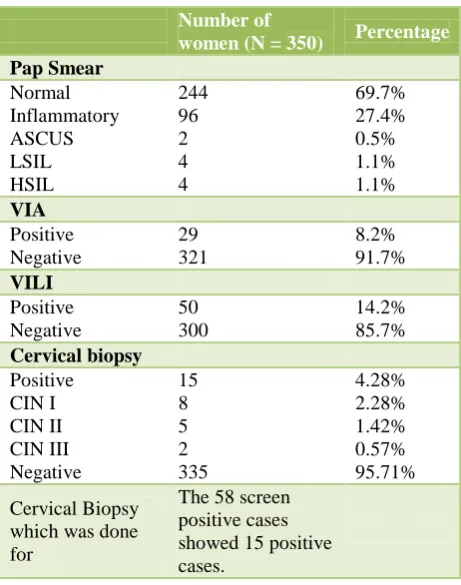
Methods: Study was conducted in Gynaec OPD clinic in SVMCH & RC, Ariyur, Pondicherry during the period of January 2015 to June 2015. 350 patients enrolled in the study, 10 patients (2.8%) had positive Pap smear, 96 patients (27.4%) had inflammatory smears and 244 (69.7%) had normal smear. VIA was positive in 29 patients (8.2%). VILI was positive in 50 patients (14.2%).
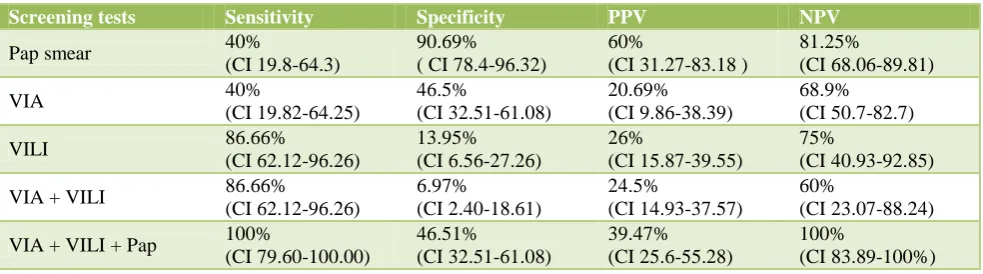
Results: Sensitivity of Pap smear = 40% (CI 19.82-64.25%), sensitivity of VIA=40% (CI 19.82-64.25%), sensitivity of VILI = 86.66% (CI 62.12-92.26%), sensitivity of VIA+VILI tests = 86.66% (CI 62.12-96.26), sensitivity of combination tests (Pap + VIA + VILI) = 100% (CI 79.60-100.00). As shown by our study, VILI picked up the maximum premalignant lesions confirmed by cervical biopsy (15 premalignant lesions on cervical biopsy, and VILI is positive in 13 cases) and 6 were picked up by VIA, whereas Pap was positive in 6 patients.
Conclusions: This study concludes that the effectiveness of cervical cancer screening can be improved by a combination test of Pap, VILI and VIA, even in tertiary centers in India.
screening in low resource settings, the role of Pap smear, & RC, Ariyur, Pondicherry during the period of Jan 2015 to June 2015. Sri Venkateshwaraa medical college is a 750 bedded post graduate institute. The hospital provides tertiary care services. The hospital caters services to people from surrounding villages, Pondicherry and Villupuram. In Gynaec OPD clinic, about 150-200 women utilise the services every week. To obtain representative sample of background population, the patients who satisfied the criteria mentioned below in Gynec OPD were included.
Inclusion criteria
Married women attending Gynaec OPD between 20 up to 70 years.
Exclusion criteria
1. Patients diagnosed with cancer cervix 2. Patients older than 70 years.
3. Pregnant women 4. Unmarried women
5. Post hysterctomised women.
Data collection
Patients to be screened were explained about the procedure to be performed, written informed consent was taken and the relevant obstetrical and gynecological history was also taken, with the patient being reassured that the procedure was painless. Firstly, smear was taken with Ayre's wooden spatula which will be later evaluated by the Bethesda system. Two slides were prepared, labelled, fixed in 95% ethyl alcohol and despatched to the pathology for Pap stain. Reporting is done according to the 2001 Bethesda system. Immediately after, VIA was performed with freshly prepared 3% acetic acid followed by Lugol's iodine test (VILI). Results of VIA and VILI were recorded after waiting for 1 minute as negative, single-positive and double-positive. All the tests were performed by trained residents and faculty who did not know the aims and objective of the study, and was also done separately by different residents/faculty. Patient is advised to report with cytology report. Cervical biopsy is done on the same day as OP procedure, if either one or all of screen test is positive. Based on cervical biopsy report, patient is counselled for further management.
RESULTS
In this study, 85.7% (N = 350) of patients were between the age 21 and 45 years, 66.5% of study population belong to 26-40 years and 71% (N = 249) of patients were multiparous women among which 41.7% (N = 146) patients were para 2. 60% (N = 211) were house wives, 8% were former by occupation. Out of 350 patients enrolled in the study, 10 patients (2.8%) had a positive Pap smear, 96 patients (27.4%) had inflammatory smears and 244 (69.7%) had normal smear. VIA was positive in 29 patients (8.2%) while the remaining 321 patients (91.7%) had normal VIA. VILI was positive in 50 patients (14.2%) and the remaining 300 patients (85.7%) had normal VILI (Table 1). Tests characteristic of screening tests in detecting CIN or worse lesion are shown in (Table 2). On follow up, the patients who had CIN 1 were advised 6 monthly follow up with cytology and patients with CIN 2 and 3 who completed family were counselled and underwent hysterectomy.
Table 1: Analysis of the results.
Number of patients who reported negative on Pap smear (but positive on other screening tests) had positive histopathological examination(Table 3).
Table 2: The sensitivity, specificity, PPV and NPV of different screening tests or their combinations.
Screening tests Sensitivity Specificity PPV NPV
Pap smear 40%
Table 3: Correlation of Pap smear with biopsy.
Biopsy results
Positive Negative
Pap Positive 6 4
Pap Negative 9 39
Table 4: Correlation of VIA with biopsy.
Biopsy results
Positive Negative
VIA Positive 6 23
VIA Negative 9 20
Of the 50 VILI-positive cases, 13 (i.e.70.83%) had CIN on biopsy and 2 (10.53%) that were missed on VILI (but positive on other screening tests) had positive biopsy (Table 5).
Table 5: Correlation of VILI with biopsy.
Biopsy results
Positive Negative
VILI Positive 13 37
VILI Negative 2 6
Of the 350 patients, 58 screen positive cases, 15 (i.e. 25.86%) had CIN on histopathological examination and no case was missed by using a combination of these tests. Thus, it has proved the adjunctive role of VIA and VILI to Pap smear in picking up premalignant and malignant lesions of the cervix, increasing the sensitivity of combination tests to100% (Table 6, 7). Of the total of 210 patients in whom VIA+VILI was performed, 33 (68.75%) had positive results. Of these 33 cases, 18 (i.e. 54.55%) had CIN on histopathological examination, one case (5.26%) was missed on a combination of tests (VIA+VILI), which was picked up to be positive on histopathological examination. This thus proved the role of VILI as a parallel screening test to VIA.
Table 6: Correlation of VIA and VILI with biopsy.
Biopsy results
Positive Negative
VIA+VILI Positive 13 40
VIA+VILI Negative 2 3
Table 7: Correlation of Pap smear, VIA and VILI with biopsy.
Biopsy results
Positive Negative
VIA+VILI+Pap Positive 15 23
VIA+VILI+Pap Negative 0 20
Table 8: Comparison of individual test.
DISCUSSION
In a study conducted by Yadav K et al VIA when compared with HPR had sensitivity of 88%, specificity of 67.0%, PPV of 74%, NPV 84% and VILI when compared with HPR had sensitivity 80%, specificity 95.87%, PPV 95%, NPV 85%.3 Our study results of VILI is comparable to the above study (sensitivity 86.67%, NPV 75%) (Table 2). In a study done on 350 women by Gosh P et al between 2008 and 2009, specificity for VIA, VILI and Pap smear was 91.2, 93.3 and 99.1% respectively.4 With respect to our study the sensitivity and specificity of Pap is comparable (40% and 90.69%) whereas VILI sensitivity is comparable (86.67%) but high false positive led to low specificity (13.95%) (Table 8). Mehta A et al studied 50 women of high risk group from 2008-2010 and found sensitivity, specificity and NPV for Pap to be 80%, 97%, 97% respectively.5 VILI showed sensitivity of 80% and NPV 97.6% (Table 8). All the results are comparable to our study except for the high specificity in the above mentioned study since the study population involved high risk women. In the IARC multicentre study done in India and Africa by Sankaranarayanan et alin 2004 which included 11 cross-sectional studies, the sensitivity of VIA ranged from 56.10% to 93.90% and the specificity ranged between 74.20% and 93.80%.6In our study also sensitivity of VIA is comparable at 40%. Considering the various studies (Table 8), our results of Pap smear as a screening test are comparable. In the present study, sensitivity of Pap smear was 40.0% and specificity 90.69%, sensitivity of VIA was 40.0%, which was similar to that of Pap smear, but had a lesser specificity than the Pap smear (Pap 90.69 % versus VIA 46.50%) (Table 8).This can be attributed to uptake of aceto white stain due to untreated infection and inflammation. Because of the high number of false-positive cases and low specificity of VIA, the usefulness of this procedure is limited. But, due to the high sensitivity of VIA, it is still used as primary screening in some developing countries for early detection of cervical carcinoma. In the present study, the results are in comparison with that of the above-mentioned studies, suggesting that VIA may find a place as an alternative low-resource technology and low-cost method of screening and case finding. In the IARC multicenter study done in India and Africa by Sankaranarayanan R et al in 2004, which included 11 cross-sectional studies, the sensitivity of VILI ranges from 76.00% to 97.00% and the specificity between 73.00% and 91.30%.6 In the present study, of the 350 patients, VILI was positive in 50 (i.e. 11.43%) patients. (Sensitivity 86.67% and specificity 13.95%) (Table 8, 2). In our study, the reason for high sensitivity and low percentage of FP results of VILI as compared with that of VIA (VILI versus VIA 86.67% versus 40.0%) are because Lugol's iodine produces characteristic non uptake yellow areas in suspected cases that are easy to interpret, and observation was based on the well-defined criteria to identify between iodine uptake and non-uptake, mahagony brown area versus
time for characteristic identification of lesions in case of doubt. In the present study, the combined sensitivity of VIA and VILI performed together was 86.67% (Table 2), which was significantly greater than the sensitivity of individual procedures, thus showing that VILI can be used as a parallel screening test to VIA to enhance its test performance. The Sankarnarayan et al, study showed a similar result and recommended the use of both VIA and VILI in parallel to increase test sensitivity. In our study, we found that combination of tests (i.e., Pap smear, VIA and VILI) improves the sensitivity of the screening tests. Our results showed that when all three (Pap smear + VIA + VILI) are used in combination, the sensitivity is 100%, (Table 2, 9) but this happens at the cost of increasing the percentage of false-positive and decreasing the specificity. Also, our study shows that combination test increases the negative predictive value to 100% (Table 2, 9). Our results are consistent with that of the Consul S et al at the Northern railway central hospital, New Delhi may 2007 to June 2008, whereas Denny et al and Shankaranarayan R et al studies, which showed that combining VIA and VILI with Pap smear markedly improved their performance as screening tests at the cost of large number of women being referred for further treatment in view of false-positive results and decreased specificity of the test.2,7,8 As shown by our study, all the premalignant lesion confirmed by cervical biopsy were picked up by VILI (15 premalignant lesions on cervical biopsy, and VILI is positive in 13 cases) and 6 were picked up by VIA, whereas Pap was positive in 6 patients. The current study highlights the role of VILI in picking up premalignant lesion. It has 86.67% sensitivity. VILI being inexpensive has more shelf life and shows high test positivity than VIA which can be due to the better colour contrast on visualization. Both can be done at the same time sitting as Pap smear, and if VIA/VILI becomes positive, patient can be counselled immediately, regarding more vigilant follow up with cervical biopsy, because patient needs to revisit for Pap smear report after 5 days for which some patients may not turn up to collect the cytology report. For example, in our study 22 patients didn’t turn up for cytology report, but the reports were found to be normal when collected by us.
CONCLUSIONS
This study concludes that the effectiveness of cervical cancer screening can be improved by a combination test of Pap, VILI and VIA, even in tertiary centers in India.
Funding: No funding sources Conflict of interest: None declared
Ethical approval: The study was approved by the Institutional Ethics Committee
REFERENCES
Association with organised screening programmes. Lancet. 1987;329:1247-9.
2. Sankaranarayanan R, Wesley R, Thara S, Dhakad N, Chandralekha B, Sebastian P. Test characteristics of visual inspection with 4% acetic acid (VIA) and Lugol's iodine (VILI) in cervical cancer screening in Kerala, India. Int J Cancer. 2003;106(3):404-8. 3. Yadav K, Patidar M, Bhargava M. A prospective
study for evaluating visual inspection after Acetic acid (VIA) and Lugols iodine (VILI) application in screening of premalignant lesions of cervix. Journal of Evolution of Medical and Dental Sciences. 2013;2(4):310-14.
4. Ghosh P, Gandhi G, Kochhar PK, Zutshi V, Batra S. Visual inspection of cervix with Lugol’s iodine for early detection of pre malignant & malignant lesions of cervix. Indian J Med Res. 2012;136:265-71. 5. Mehta A, Ladola H, Kotadiya K, Rebecca. Study of
high risk cases for early detection of cervical cancer by PAP smear and VILI. NHL Journal of medical sciences. 2013;2(1):65-8.
6. Sankaranarayanan R, Basu P, Wesley RS, Mahé C, Keita N, Mbalawa CC. Accuracy of visual screening
for cervical neoplasia: Results from an IARC multicentre study in India and Africa. Int J Cancer. 2004;110:907-13.
7. Consul S, Agrawal A, Sharma H, Bansal A, Gutch M, Jain N. Comparative study of effectiveness of Pap smear versus visual inspection with acetic acid and visual inspection with Lugol's iodine for mass screening of premalignant and malignant lesion of cervix. Indian Journal of Medical and Paediatric Oncology. 2012;33(3):161-5.
8. Denny L, Kuhn L, Pollack A, Wainwright H, Wright
TC. Evaluation of alternative methods of cervical cancer screening for resource-poor settings. Cancer. 2000;89:826-33.
9. Consul S, Agrawal A, Sharma H, Bansal A, Gutch M, Jain N. Comparative study of effectiveness of Pap smear versus visual inspection with acetic acid and visual inspection with Lugol's iodine for mass screening of premalignant and malignant lesion of cervix. 2012;33(3):161-5.