Page 1 of 5 Editorial Commentary
The risks of converting post-hoc findings into primary outcomes
in subsequent trials
Filipe B. Rodrigues1,2,3, Joaquim J. Ferreira2,3,4
1UCL Huntington’s Disease Centre, UCL Queen Square Institute of Neurology, University College London, London, UK; 2Laboratory of Clinical Pharmacology and Therapeutics, Faculdade de Medicina, Universidade de Lisboa, Lisbon, Portugal; 3Instituto de Medicina Molecular, Lisbon, Portugal; 4CNS—Campus Neurológico Sénior, Torres Vedras, Portugal
Correspondence to: Joaquim J. Ferreira. Laboratory of Clinical Pharmacology and Therapeutics, Faculdade de Medicina, Universidade de Lisboa, Lisbon, Portugal. Email: [email protected].
Provenance: This is an invited article commissioned by the Academic Editor Dr. Zhenxiang Zhao (Department of Neurology, Henan Provincial People’s Hospital, People’s Hospital of Zhengzhou University, People’s Hospital of Henan University, Zhengzhou, China).
Comment on: Reilmann R, McGarry A, Grachev ID, et al. Safety and efficacy of pridopidine in patients with Huntington's disease (PRIDE-HD): a phase 2, randomised, placebo-controlled, multicentre, dose-ranging study. Lancet Neurol 2019;18:165-76.
Submitted Sep 03, 2019. Accepted for publication Sep 18, 2019. doi: 10.21037/atm.2019.09.105
View this article at: http://dx.doi.org/10.21037/atm.2019.09.105
Huntington’s disease (HD) is a devastating neurodegenerative condition caused by a triplet repeat expansion of the huntingtin gene (1). Although rare it is amongst the most frequent autosomal dominant causes of dementia, frequently affecting individuals in the most productive decades of their lives. Clinically, it is characterized by a classic triad of fluctuating neuropsychiatric symptoms, and progressive movement and cognitive disorders, accompanied by other
symptoms such as weight loss and sleep impairment. It is
severely debilitating, has a huge impact on quality of life and
is fatal, with a median survival after motor onset of around a
quarter of a century (2).
The culprit genetic defect was first assigned to
chromosome 4 in 1983 (3) and sequenced in 1993 (4). Whilst great hope had been placed on this discovery, nearly three decades later there is still no cure or any intervention that delays or stops disease progression (5). Nevertheless, several promising compounds are currently active in the
drug development pipeline (6).
With regards to symptom management the therapeutic
armamentarium is broad, although few interventions are
supported by high quality evidence (7). As an example, for the hyperkinetic movement disorder (i.e., chorea)
characteristic of HD, there are currently two FDA-approved
medications—tetrabenazine and deutetrabenazine—
although unclarity still exists about how dissimilar their efficacy and safety profiles are (8,9).
H D i s a p r o m i s i n g d i s e a s e m o d e l t o s t u d y neurodegeneration, due to several characteristics, including: a precise pathogenic agent (4), a natural history that
comprises a long presymptomatic phase (10,11) followed
by an extended diseased survival (12), a broad symptomatic spectrum including most of the clinical features present on neurodegenerative diseases (motor, behavioural and
cognitive) (1), well-validated assessment tools (13-16),
pioneering imaging and biofluid biomarkers (10,17), and
well-organized research and patient networks (18). These
factors have encouraged drug developers to invest in HD as
shown by the proportionately high number of clinical trials
conducted in this rare disease population. Unfortunately, the success rate of the development pipeline underperforms
when comparing with other disorders (5).
Genetic interventions are only now coming to
age due to recent breakthroughs in DNA and RNA manipulation techniques, and optimization of drug stability, immunogenicity and delivery. There is optimism that
these new tools may help change the fate of diseases like
Huntington’s. The ideal drug development program needs
to happen with minimal human and financial burden and
maximal efficiency. This includes informative preclinical data and early phase trial results, but also early “go/no go” decision timings and criteria.
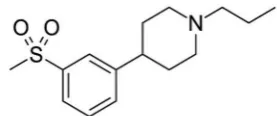
dopaminergic system—which is primarily involved in
the genesis of the disease phenotype—it is classified as a modulator as it can have both an agonistic and
antagonistic effects through a state-dependent effect on
dopamine receptors. When there is overactivity it acts as an antagonist, under underactivity conditions as an agonist, and
has little to no influence under physiological circumstances. In addition, it also seems to interact with N-Methyl-D-aspartate (NMDA) and sigma-1 receptors.
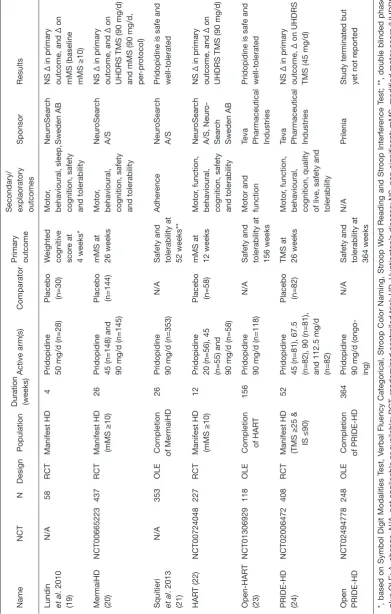
Thus far pridopidine has been tested in four successive randomized controlled trials (RCTs) in HD, enrolling a grand total of over 1,000 participants (Table 1) (19,20,22,24).
Unfortunately, in all of them the primary outcome was
not met.
At first, a small RCT tested 50 mg of pridopidine a day against placebo in 58 people with manifest HD, recruited from 6 centres in Sweden and Norway. The trial followed participants for 4 weeks and was not able to show an effect
on its primary outcome, a composite cognitive score. Nevertheless, secondary and exploratory analyses revealed a nominal improvement in the modified motor score (mMS), especially in a subgroup of more severely affected participants. This subscore of the Unified Huntington’s Disease Rating Scale (UHDRS) total motor score (TMS)
comprises items related with voluntary motor control (i.e.,
items 4–10 and 13–15) (19).
Building up on these results, two follow-up randomized
controlled studies ensued: the MermaiHD study in 32 European centres and the HART study in 27 North American centres. Based on the assumption that pridopidine could have an effect on voluntary movement control, both
were designed and powered to show a difference in the mMS and recruited people with manifest HD and a mMS
of 10 or more.
The MermaiHD study recruited 437 participants to investigate 45 and 90 mg of pridopidine daily compared
with placebo over 26 weeks. Alas, this trial did not show an
effect for its primary and secondary outcomes. Nonetheless,
the analyses were statistically significant for the comparison 90 mg versus placebo in the per-protocol sample (i.e., 70%
or greater compliance with treatment and completed the study) for the mMS and in the intention-to-treat sample for
the UHDRS TMS (20).
The HART study had a similar design and tested 3 dosages of pridopidine (20, 45 or 90 mg daily) against placebo in 227 participants. The primary outcome evaluated
at 12 weeks depicted no differences between the different dosages and the placebo arm, however secondary analyses showed a significant difference for UHDRS TMS for the
comparison 90 mg versus placebo (22).
Lastly, the PRIDE-HD study recruited 408 participants with manifest HD, at least 25 points on the UHDRS TMS and 90% or less in the UHDRS independence score (IS),
from 53 sites across 12 countries in Europe, North America
and Australia. Follow-up was 53 weeks, and four doses of pridopidine (45, 67.5, 90 and 112.5 mg daily) were tested against placebo. The primary outcome was changed in the UHDRS TMS at 26 weeks and failed to be achieved. Exploratory analyses for all tested dosages showed similar results at 52 weeks. Exploratory analyses revealed an effect
on the UHDRS total functional capacity (TFC) in the 45 mg
arm. Subgroup post-hoc tests found this effect to be more
evident in participants in earlier disease stages (24).
To summarise, the clinical development pipeline of
pridopidine began with a negative, relatively small and short-lasting trial aimed at cognition but with interesting findings on a voluntary movements’ secondary outcome. It was followed by two well-powered but also negative trials
designed to investigate the effects on voluntary movements.
Both showed differences in a semi-structured neurological
exam scale at the highest tested dosage (90 mg daily). A
forth well-powered trial was deployed to investigate the
effects on motor signs across a range of dosages. The
trial was also negative, and none of the dosages shaped compelling differences after 6 months and 1 year on motor
signs, but exploratory investigations disclosed an effect
on functional capacity with low-dose pridopidine in early
disease.
The cumulative evidence from these four trials seems
to support that pridopidine is relatively safe and
well-tolerated. The a priori hypothesis that it has an effect on the cognitive features of HD has been proven false. The findings on motor effects learnt from the earliest trials
were not replicated in a large built-for-purpose trial. Were
the first ones spurious positive results stemming from
exploratory analyses, or were the results of the latter trials
[image:2.595.95.234.84.142.2]just unfortunate? The investigators blame an unexpectedly high response by the placebo group in the primary
T
able 1
Clinical trials’ characteristics
Name
NCT
N
Design
Population
Duration (weeks)
Active arm(s)
Comparator
Primary outcome Secondary/ explaoratory outcomes
Sponsor
Results
Lundin et al
. 2010 (19) N/A 58 RCT Manifest HD 4
Pridopidine 50 mg/d (n=28) Placebo (n=30)
W
eighted
cognitive scor
e at
4 weeks*
Motor
,
behavioural, sleep, cognition, safety and tolerability
Neur
oSear
ch
Sweden AB
NS ∆ in primary outcome, and ∆ on mMS (baseline mMS ≥10)
MermaiHD (20)
NCT00665223
437
RCT
Manifest HD (mMS ≥10)
26
Pridopidine 45 (n=148) and 90 mg/d (n=145) Placebo (n=144) mMS at 26 weeks
Motor
,
behavioural, cognition, safety and tolerability
Neur
oSear
ch
A/S
NS ∆ in primary outcome, and ∆ on UHDRS TMS (90 mg/d) and mMS (90 mg/d, per
-pr
otocol)
Squitieri et al
. 2013
(21)
N/A
353
OLE
Completion of MermaiHD
26
Pridopidine 90 mg/d (n=353)
N/A
Safety and tolerability at 52 weeks**
Adher ence Neur oSear ch A/S
Pridopidine is safe and well-tolerated
HAR
T (22)
NCT00724048
227
RCT
Manifest HD (mMS ≥10)
12
Pridopidine 20 (n=56), 45 (n=55) and 90 mg/d (n=58) Placebo (n=58) mMS at 12 weeks
Motor
, function,
behavioural, cognition, safety and tolerability
Neur oSear ch A/S, Neur o-Sear ch Sweden AB
NS ∆ in primary outcome, and ∆ on UHDRS TMS (90 mg/d)
Open-HAR T (23) NCT01306929 118 OLE
Completion of HAR
T
156
Pridopidine 90 mg/d (n=118)
N/A
Safety and tolerability at 156 weeks Motor and function Teva Pharmaceutical Industries Pridopidine is safe and well-tolerated
PRIDE-HD (24)
NCT02006472
408
RCT
Manifest HD (TMS ≥25 & IS ≤90)
52
Pridopidine 45 (n=81), 67.5 (n=82), 90 (n=81), and 112.5 mg/d (n=82) Placebo (n=82) TMS at 26 weeks
Motor
, function,
behavioural, cognition, quality of live, safety and tolerability Teva Pharmaceutical Industries NS ∆ in primary outcome, ∆ on UHDRS TMS (45 mg/d)
Open PRIDE-HD
NCT02494778
248
OLE
Completion of PRIDE-HD
364
Pridopidine 90 mg/d (ongo
-ing)
N/A
Safety and tolerability at 364 weeks
N/A
Prilenia
Study terminated but yet not r
eported *, based on Symbol Digit Modalities Test, Verbal Fluency Categorical, Str oop Color Naming, Str oop W or d Reading and Str oop Interfer ence Test; **, double blinded phase
plus OLE; ∆, change. N/A, not applicable or available; RCT
, randomized contr
olled trial; HD, Huntington’
s disease; NS, non-significant; mMS, modified motor scor
e (UHDRS
TMS items 4–10 and 13–15); UHDRS TMS, Unified Huntington’
s Disease Rating Scale total motor scor
outcome. Indeed by the end of the study period, this was the arm with the largest effect size. The sponsor, Teva
Pharmaceutical Industries Ltd., focused their attention on
exploratory and post-hoc subgroup analyses concluding that
“pridopidine demonstrates slowing of progression of Huntington disease in PRIDE-HD study as measured by Total Functional Capacity”. After sparked criticism from the clinical and
scientific community, aware of the potential damages caused
by such interpretations, the European Huntington’s Disease
Network toned down the sponsor’s statement explaining
that “this should not be misunderstood as a demonstration of
disease modification or of neuroprotection”.
While there are multiple possible justifications for these
results, one should always consider the possibility that
pridopidine, as any other compound in development, may not induce the hypothesised clinical effect. The central nervous
system therapeutic area has a low success rate from first-in-man to registration of around 7–8% comparing with the grand mean of 11%, and other therapeutic areas such as cardiovascular where the success rate is around 20% (25).
In neurology, the drug development pipeline performs appreciably poorly in the phase III and registration phases (25). In HD only 2 molecules survived these phases, and overall
the success rate is even lower than that of other therapeutic
areas (5). Many reasons have been hypothesized to explain such phenomenon: incomplete understanding of the disease
physiopathology; weak association between the therapeutic
target, and the disease pathogenesis and natural history; limited animal models; incomplete evaluation of preclinical effects; suboptimal pharmacokinetic and pharmacodynamic characteristics; limitations of current study designs (no biomarkers, short study durations); unenthusiastic commercial interests, among others.
Pridopidine is an example where several of these factors came into play, halving the already low chances of first-in-man to registration success. It is well stablished that only
a small proportion of science generates positive results,
including rigorous and well-report clinical trials (26). While the scientific milieu should reward progress, industry
and researchers are often motivated by other factors. As
tempting as it may sound to regard these after-the-event
announcements relevant, history has thought us that
hypotheses and new trials generated by post-hoc positive results are legitimate but may be wrong.
Understandably and in the absence of better approaches, this strategy is frequently used across medicine. Pridopidine
seems unlikely to be clinically helpful for people with HD but we hope this story will teach us about the design of drug
development programmes and what to avoid in the future in order to deliver efficacious medicines and optimise drug
development.
Acknowledgments
None.
Footnote
Conflicts of Interest: The authors have no conflicts of interest
to declare.
Ethical Statement: The authors are accountable for all
aspects of the work in ensuring that questions related to the accuracy or integrity of any part of the work are
appropriately investigated and resolved.
References
1. McColgan P, Tabrizi SJ. Huntington's disease: a clinical review. Eur J Neurol 2018;25:24-34.
2. Rodrigues FB, Abreu D, Damásio J, et al. Survival, mortality, causes and places of death in a European
Huntington's disease prospective cohort. Mov Disord Clin Pract 2017;4:737-42.
3. Gusella JF, Wexler NS, Conneally PM, et al. A polymorphic DNA marker genetically linked to
Huntington's disease. Nature 1983;306:234-8.
4. A novel gene containing a trinucleotide repeat that
is expanded and unstable on Huntington's disease chromosomes. The Huntington's Disease Collaborative Research Group. Cell 1993;72:971-83.
5. Travessa AM, Rodrigues FB, Mestre TA, et al. Fifteen
years of clinical trials in Huntington's disease: a very low
clinical drug development success rate. J Huntingtons Dis
2017;6:157-63.
6. Rodrigues FB, Ferreira JJ, Wild EJ. Huntington's disease
clinical trials corner: June 2019. J Huntingtons Dis
2019;8:363-71.
7. Bachoud-Lévi AC, Ferreira J, Massart R, et al.
International guidelines for the treatment of Huntington's
disease. Front Neurol 2019;10:710.
8. Rodrigues FB, Duarte GS, Costa J, et al. Tetrabenazine
versus deutetrabenazine for Huntington's disease: twins or distant cousins? Mov Disord Clin Pract 2017;4:582-5. 9. Rodrigues FB, Duarte GS, Costa J, et al. Meta-research
comparison of deutetrabenazine and tetrabenazine for Huntington disease". J Clin Mov Disord 2017;4:19.
10. Tabrizi SJ, Scahill RI, Owen G, et al. Predictors of
phenotypic progression and disease onset in premanifest
and early-stage Huntington's disease in the TRACK-HD study: analysis of 36-month observational data. Lancet Neurol 2013;12:637-49.
11. Paulsen JS, Hayden M, Stout JC, et al. Preparing for
preventive clinical trials: the Predict-HD study. Arch Neurol 2006;63:883-90.
12. Rodrigues FB, Ferreira JJ. Overall survival and causes
of death in neurodegeneration-an overlooked and
underreported theme. JAMA Neurol 2017;74:1379. 13. Mestre TA, Busse M, Davis AM, et al. Rating scales
and performance-based measures for assessment of functional ability in Huntington's disease: critique and recommendations. Mov Disord Clin Pract 2018;5:361-72.
14. Mestre TA, Carlozzi NE, Ho AK, et al. Quality of life in
Huntington's disease: critique and recommendations for measures assessing patient health-related quality of life and caregiver quality of life. Mov Disord 2018;33:742-9.
15. Mestre TA, Forjaz MJ, Mahlknecht P, et al. Rating scales
for motor symptoms and signs in Huntington's disease:
critique and recommendations. Mov Disord Clin Pract
2018;5:111-7.
16. Mestre TA, van Duijn E, Davis AM, et al. Rating scales for behavioral symptoms in Huntington's disease: critique and recommendations. Mov Disord 2016;31:1466-78.
17. Byrne LM, Rodrigues FB, Johnson EB, et al. Evaluation of
mutant huntingtin and neurofilament proteins as potential markers in Huntington's disease. Sci Transl Med 2018. doi: 10.1126/scitranslmed.aat7108.
18. Landwehrmeyer GB, Fitzer-Attas CJ, Giuliano JD, et al.
Data analytics from enroll-HD, a global clinical research platform for Huntington's disease. Mov Disord Clin Pract 2016;4:212-24.
19. Lundin A, Dietrichs E, Haghighi S, et al. Efficacy
and safety of the dopaminergic stabilizer Pridopidine
(ACR16) in patients with Huntington's disease. Clin Neuropharmacol 2010;33:260-4.
20. de Yebenes JG, Landwehrmeyer B, Squitieri F, et al.
Pridopidine for the treatment of motor function in
patients with Huntington's disease (MermaiHD): a phase 3, randomised, double-blind, placebo-controlled trial. Lancet Neurol 2011;10:1049-57.
21. Squitieri F, Landwehrmeyer B, Reilmann R, et al. One-year safety and tolerability profile of pridopidine in patients with Huntington disease. Neurology 2013;80:1086-94.
22. Huntington Study Group HART Investigators. A
randomized, double-blind, placebo-controlled trial of pridopidine in Huntington's disease. Mov Disord 2013;28:1407-15.
23. McGarry A, Kieburtz K, Abler V, et al. Safety and
exploratory efficacy at 36 months in open-HART, an open-label extension study of pridopidine in Huntington's disease. J Huntingtons Dis 2017;6:189-99.
24. Reilmann R, McGarry A, Grachev ID, et al. Safety and
efficacy of pridopidine in patients with Huntington's disease (PRIDE-HD): a phase 2, randomised, placebo-controlled, multicentre, dose-ranging study. Lancet Neurol 2019;18:165-76.
25. Kola I, Landis J. Can the pharmaceutical industry reduce
attrition rates? Nat Rev Drug Discov 2004;3:711-5. 26. Munafò MR, Nosek BA, Bishop DVM, et al. A manifesto
for reproducible science. Nature Human Behaviour 2017;1:0021.