ISSN(Online): 2320-9801
ISSN (Print): 2320-9798
I
nternational
J
ournal of
I
nnovative
R
esearch in
C
omputer
and
C
ommunication
E
ngineering
(An ISO 3297: 2007 Certified Organization)
Vol. 4, Issue 9, September 2016
Effective Mobile Coordinated Wireless Sensor
Network for Real-Time Transmissions using
ESENMA
A.Poornima1, Dr. D.Maheashwari2
M.Phil Scholar, Department of Computer Science, Rathnavel Subramaniam College of Arts & Science, Sulur,
Coimbatore, India1
Assistant Professor
,
Department of Computer Science, Rathnavel Subramaniam College of Arts &Science, Sulur,Coimbatore, India2
ABSTRACT: In this paper implement the mobile access coordinated wireless sensor network (MC-WSN) a novel
energy efficient scheme for time-sensitive applications. In conventional sensor networks with mobile access points (SENMA), the mobile access points (MAs) traverse the network to collect information directly from individual sensors. In SENMA, the mobile access points (MAs) traverse the network to collect the sensing information directly from the sensor nodes. This project proposed a three-layer framework is proposed for mobile data transmission in wireless sensor networks, which includes the sensor layer, cluster head layer, and mobile collector layer. The framework employs distributed load balanced clustering and dual data uploading, which is referred to as ESENMA. The objective is to achieve good scalability, and low data transmission latency. At the sensor layer, a distributed Dynamic load balanced clustering (LBC) algorithm is proposed for sensors to self-organize themselves into clusters. In contrast to existing clustering methods, the scheme generates multiple cluster heads in each cluster to balance the work load and facilitate dual data uploading.
KEYWORDS: Dynamic Load Balancing, Mobile Collector, Mobile Access Point, Latency, Clustering, Dynamic
Uploading.
I. INTRODUCTION
Wireless sensor network (WSN) are spatially distributed autonomous sensors to monitor physical or environmental conditions, such as temperature, sound, pressure, etc. and to cooperatively pass their data through the network to a main location. The more modern networks are bi-directional, also enabling control of sensor activity. The development of wireless sensor networks was motivated by military applications such as battlefield surveillance; today such networks are used in many industrial and consumer applications, such as industrial process monitoring and control, machine health monitoring, and so on.
ISSN(Online): 2320-9801
ISSN (Print): 2320-9798
I
nternational
J
ournal of
I
nnovative
R
esearch in
C
omputer
and
C
ommunication
E
ngineering
(An ISO 3297: 2007 Certified Organization)
Vol. 4, Issue 9, September 2016
First, all the sensors are static and then the network is considered as static network. The static sensor node forwards the data to the sink by one or more hops. So, the sensor located nearer to the sink gets depleted soon. Second, the hierarchy form of data collection. The nodes can be categorized into lower layer and higher layer. The nodes in the lower level layers are homogenous sensor nodes. The nodes in the higher layer are more powerful than the no des in the lower layer. The higher layer nodes are called as cluster heads. The hierarchy topology is also called as clusters. Third, Mobile Collector is used to collect the data periodically access point.
A mobile data observer is used to collect the data dynamically. The nodes that can be located closer to the data observer can upload the data directly. The nodes that can be located far away from the observer can forward the data by relaying. Single Hop Data Gathering problem (SHDGP) and mobile Data Gathering are the two approaches that can be used to increase the lifetime of the network. Single Access Point selection Problem (SACP) is used to achieve the uniform energy consumption. The mobile Access Point algorithm is used to find the minimal set of points in the sensor network. It serves as data gathering points for mobile node.
II. RELATEDWORKS
Gokhan Mergen et al [1] describe a sensor network with mobile access (SENMA) is an architecture in which
randomly deployed low-power sensors are orchestrated by a few powerful mobile access points (APs). This paper considers SENMA from energy-efficiency and information theoretic perspectives. By allowing sensors to propagate data directly to mobile APs over multi-access channels, and relieving sensors from energy-consuming network functions, SENMA has the potential of offering orders of magnitude of improvement in energy efficiency over the multihop ad hoc architecture, as demonstrated by their analysis on scalability. Optimization configurations of SENMA such as the altitude, the trajectory, and the coverage of APs are considered next, using the sum-rate as the performance metric. Optimal strategies for single and multiple APs are determined. For multiple APs, the possibility of and the gain due to cooperation (i.e., joint decoding of signals received at different APs) are investigated. They consider the sensor network with mobile access scale sensor networks. SENMA has two types of nodes: sensors and mobile access points (APs). Sensors, often deployed randomly in large quantity, are low-cost nodes with limited processing and communication capability. For some applications, such as radio frequency (RF) tags, sensors may even be passive. The primary function of sensors includes data collection, local processing, and data delivery to mobile APs.
Jesus Capitan, J.R. Et al [2] presents the architecture developed in the framework of the AWARE project for the
autonomous distributed co-operation between unmanned aerial vehicles (UAVs), wireless sensor/actuator networks and ground camera networks. One of the main goals was the demonstration of useful actuation capabilities involving multiple ground and aerial robots in the context of civil applications. A novel characteristic is the demonstration in field experiments of the transportation and deployment of the same load with single/multiple autonomous aerial vehicles. The general objective of the project was the design, development and demonstration of a platform composed of heterogeneous systems that are able to operate in a distributed manner in disaster management scenarios without pre-existing (or with damaged) infrastructure. Thus, the platform should comprise self-deployment capabilities, i.e. autonomous transportation and deployment of different types of loads (small sensors, cameras, communication equipment, etc.) by means of one or several helicopters. The systems integrated in the platform included aerial robots, wireless sensor networks, ground-fixed cameras and ground vehicles with actuation Capabilities. There are several projects dealing with the integration of robots and wireless sensor networks.
Mai Abdel hakim et al [3] conventional sensor networks with mobile access points (SENMA), the mobile access
ISSN(Online): 2320-9801
ISSN (Print): 2320-9798
I
nternational
J
ournal of
I
nnovative
R
esearch in
C
omputer
and
C
ommunication
E
ngineering
(An ISO 3297: 2007 Certified Organization)
Vol. 4, Issue 9, September 2016
Gokhan Mergen et al [4] describe the maximum asymptotic stable throughput of an opportunistic slotted ALOHA
protocol provide a characterization of the maximum stable throughput as the number of users in the system goes to infinity. They apply their findings to CDMA networks with the Signal-to-Interference-Ratio (SIR) threshold model. It is shown that the slotted ALOHA protocol with the power/transmission control rule that equalizes the reception powers achieves 1 − O (log N/ √N) channel utilization, which is defined as the throughput divided by the optimal throughput N achieved by scheduling. This implies that the slotted ALOHA is asymptotically optimal in the sense that its channel utilization converges to 1 as the spreading gain goes to infinity. Opportunistic medium access aims to improve the system throughput by exploiting the multiuser diversity inherent in wireless systems. Recently, several schemes have been proposed to utilize the multiuser diversity .They considered achievable rates with distributed power control and distributed channel side information. They considered a channel aware version of slotted ALOHA with rate control. They also introduced a distributed splitting algorithm that exploits multiuser diversity.
Piyush Gupta, P. Et al [5] identical randomly located nodes, each capable of transmitting at bits per second and
using a fixed range, form a wireless network, the throughput rate obtainable by each node for a randomly chosen destination is log bits per second under a non-interference protocol. If the nodes are optimally placed in a disk of unit area, traffic patterns are optimally assigned, and each transmission’s range is optimally chosen. Thus even under optimal circumstances, the throughput is only bits per second for each node for a destination non-vanishingly far away. Similar results also hold under an alternate physical model where a required signal-to-interference ratio is specified for successful receptions. Fundamentally, it is the need for every node all over the domain to share whatever portion of the channel it is utilizing with nodes in its local neighbourhood that is the reason for the constriction in capacity. Splitting the channel into several sub channels does not change any of the results. Some implications may be worth considering by designers. Since the throughput furnished to each user diminishes to zero as the number of users is increased, perhaps networks connecting smaller numbers of users, or featuring connections mostly with nearby neighbours, may be more likely to be find acceptance.
III. MOBILE ACCESS COORDINATEDWIRELESS SENSOR NETWORK (MC-WSN)
A.GENERAL DESCRIPTION
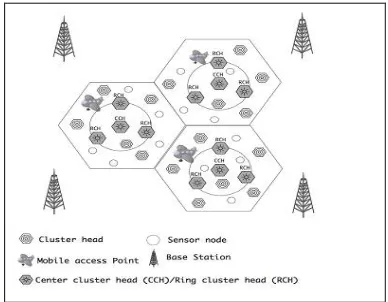
Assume the network is divided into cells of radius d. Each cell contains a single powerful mobile access point (MA) and n uniformly deployed sensor nodes (SNs) that are arranged into NCH clusters. Each cluster is managed by a cluster head (CH), to which all the cluster members report their data. CHs then route the data to the MA. A powerful Center cluster head (CCH) is employed in the middle of each cell, and Powerful ring cluster heads (RCH) are placed on a ring of radius Rt. The CCH and RCHs can establish direct communication with the MA or with other RCHs that are closer to the MA. All nodes within a distance R o from the nodes route their data to the MA through the nearest RCH. If a sensor is within the MA’s coverage range, then direct communications can take place when permitted or needed. After receiving the data of the sensors, the MA delivers it to a Base Station (BS). The overall network architecture is in Figure 5.3. The number of hops from any sensor to the MA can be limited to a pre-specified number through the deployment of CCH and RCHs.
MC-WSN architecture, the MA coordinates the sensors and resolves the node deployment issue as well as the energy consumption problem of wireless sensor networks. More specifically, the Mas are responsible for: deploying nodes, replacing and recharging nodes, detecting malicious sensors, then removing and replacing them, (iv) collecting the information from sensors and delivering it to a BS. When an MA needs to be recharged or reloaded, it sends a request to the MA base. The base will send a new MA to the cell, and the substituted MA will be called back to the base for maintenance services. The MAs can move on the ground, and can also fly at low altitude. Each MA traverses its cell mainly for replacing or recharging low-energy sensor nodes and cluster heads, as well as removing the malicious nodes. The recharging can be performed in a wireless manner. The MA moves physically for data collection only in the case when the routing paths do not work. Data collection from the sensors can be event based or periodic.
ISSN(Online): 2320-9801
ISSN (Print): 2320-9798
I
nternational
J
ournal of
I
nnovative
R
esearch in
C
omputer
and
C
ommunication
E
ngineering
(An ISO 3297: 2007 Certified Organization)
Vol. 4, Issue 9, September 2016
i.e., Rc>rc. We assume shortest path routing between the CHs and the CCH/RCHs. Note that the sensors are not involved in the inter-cluster routing in order to minimize their energy consumption. Due to the MA-assisted active network deployment, we can assume that the nodes are uniformly distributed in the network. It is therefore reasonable to place the powerful RCHs at evenly spaced locations on the ring Rt. To maximize the throughput and minimize the delay of data transmission from the sensors to the MA, the number of hops needed in routing should be minimized.
B. MC-WSN- FEATURES
The main advantages of MC-WSNMC-WSN is multi functionality of the mobile access, hop number control through topology design; and hierarchical and heterogeneous node deployment. More specifically, MC-WSN has the following features: Controlled network deployment and prolonged network lifetime. The proposed MC-WSN allows the MAs to manage the deployment of SNs and CHs. That is, the MA can add more nodes, relocate or replace exiting nodes. In addition, it can recharge or replace low-energy nodes. When a node has low remaining energy, it sends a control message to the MA notifying it with its energy level. The MA can then check and make the decision to replace the node or recharge it. Being coordinated by the MA, the MC-WSN architecture resolves the network deployment issue and can actively prolong the network lifetime.
C. TIME-SENSITIVE DATA TRANSMISSION
In conventional SENMA, a transmission is made only if an MA visits the corresponding source node; thus, data transmission is limited by the physical speed of the MAs and the length of their trajectory, resulting in low throughput and large delay. In MC-WSN, the delay is effectively managed through hop number control, and is independent of the physical speed of the MA; in addition, unlike, data transmission does not involve large amount of control messages for sink location acquisition.
FIG 3.3 MC-WSN Architecture
D. ENHANCED NETWORK SECURITY
ISSN(Online): 2320-9801
ISSN (Print): 2320-9798
I
nternational
J
ournal of
I
nnovative
R
esearch in
C
omputer
and
C
ommunication
E
ngineering
(An ISO 3297: 2007 Certified Organization)
Vol. 4, Issue 9, September 2016
itself compromised or destroyed, since it is much more powerful than other network nodes, and it moves randomly in the network where its location can be kept private
IV. ESENMA
Wireless sensor network (WSN) has been identified as a key technology in green communications, due to its indispensable role in both civilian and military applications, such as reconnaissance, surveillance, environmental monitoring, emergency response, smart transportation, and target tracking. Along with recent advances in remote control technologies, Unmanned Aerial Vehicles (UAVs) have been utilized in wireless sensor networks for data collection as well as for sensor management and network coordination. For efficient and reliable communication over large scale networks, sensor network with mobile access points (SENMA) was proposed.
In ESENMA, the mobile access points (MAs) traverse the network to collect the sensing information directly from the sensor nodes. ESENMA has been considered for military applications, where small low-altitude unmanned aerial vehicles (UAVs) serve as the mobile access points that collect sensing information for surveillance, reconnaissance and collaborative spectrum sensing.
When the energy consumption at the MAs is not of a concern, ESENMA improves the energy efficiency of the individual sensor nodes over ad-hoc networks by relieving sensors from complex and energy-consuming routing functions. While simplifying the routing process, a major limitation with ESENMA is that a transmission is made only if an MA visits the corresponding source node; thus, data transmission is largely limited by the physical speed of the MAs and the length of their trajectory, resulting in low throughput and large delay.
In addition to ESENMA, ad hoc networks with mobile sinks have also been explored by other researchers. In a mobile sink is utilized for data collection, where it visits a limited number of pre-defined collection points in the network. Each sensor routes its information to the nearest collection point through multihop routing, then data is delivered to the sink when it visits the corresponding location. Similar approach has been considered. As in the case of the conventional ESENMA, the main limitation of these approaches is that data transmission depends on the physical speed of the access point, which is not desirable for time-sensitive applications.
In this paper, by exploiting the most recent advances in unmanned Aerial Vehicles (UAVs) and wireless charging. It proposes a mobile access coordinated wireless sensor network (MC-WSN) for time-sensitive, reliable, and energy-efficient information exchange. In MC-WSN, the whole network is divided into cells, each is covered by one MA, and served with powerful center cluster head (CCH) located in the middle of the cell, and multiple ring cluster heads (RCHs) uniformly distributed along a ring within the cell. The MAs coordinate the network through deploying, replacing and recharging the nodes. They are also responsible for enhancing the network security, by detecting compromised nodes then replacing them. Data transmission from sensor nodes to the MA goes through simple routing with cluster heads (CHs), CCH or RCHs serving as relay nodes.
As in ESENMA, the sensors are not involved in the routing process. A major feature of MC-WSN is that: Through active network deployment and topology design, the number of hops from any sensor to the MA can be limited to a pre-specified number. As will be shown, the hop number control, in turn, results in better system performance in throughput, delay, energy efficiency, and security management.
In sensor networks with mobile sinks, as ESENMA, since there is a direct link between each sensor and the mobile sink, the system throughput is significantly superior to that of ad-hoc sensor networks. However, a sensor can only transmit when an access point is within the sensor’s communication range. Hence, the throughput is limited by the access point’s traversal speed and its trajectory length. The major contributions of this thesis can be summarized as follows:
ISSN(Online): 2320-9801
ISSN (Print): 2320-9798
I
nternational
J
ournal of
I
nnovative
R
esearch in
C
omputer
and
C
ommunication
E
ngineering
(An ISO 3297: 2007 Certified Organization)
Vol. 4, Issue 9, September 2016
malicious node detection, and data collection. The energy efficiency for individual sensors is maximized as they are not involved in the routing process, and do not need to receive beacon signals from the MA.
2) Through active network deployment, the number of hops from any sensor to its corresponding MA can be limited to a pre specified number. The hop number control ensures efficient system performance, and also makes the quantitative characterization of MC-WSN (in terms of throughput, stability, and delay) more tractable.
3) We present an optimal topology design for MC WSN such that the average number of hops between a sensor and its nearest sink is minimized, and show that the number of hops from any sensor to the MA can be limited to a pre-specified number.
4) It calculates the throughput of MC-WSN considering both single path and multipath routing between each source and its corresponding sink. More specifically:
It analyse the throughput from an information theoretic perspective, and show that as the packet length gets large, the throughput approximately equals to the average normalized information that passes through the channel between a source and its sink
It illustrates the effect of the number of hops on the throughput, and show that the throughput diminishes exponentially as the number of hops increases.
It shows that the throughput of MC-WSN is independent of the physical speed of the MA and the length of its trajectory, and is orders or magnitude higher than that of SENMA.
It provides energy efficiency analysis based on the radio energy dissipation modelling. We show that MC- WSN has significantly higher energy efficiency than the conventional ESENMA.
V.PESUDO CODE
Step 1: Generate all the possible routes.
Step 2: Calculate the TEnode for each node of each route using eq. (1).
Step 3: Check the below condition for each route till no route is available to transmit the packet. if (RBE < = TEnode)
Make the node into sleep mode. else Select all the routes which have active nodes end
Step 4: Calculate the total transmission energy for all the selected routes using eq. (2).
Step 5: Select the energy efficient route on the basis of minimum total transmission energy of the route. Step 6: Calculate the RBE for each node of the selected route using eq. (3).
Step 7: go to step 3. Step 8: End.
VI.SIMULATIONRESULTS
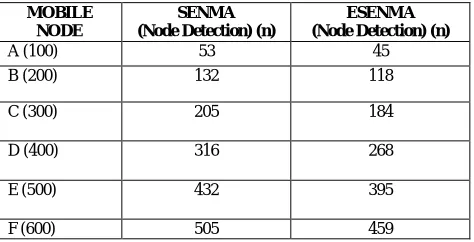
The following Table 5.1 describes experimental result for node detection for SENMA and ESENMA over all experimental result analysis. The table contains Mobile node, number of node occurrence with SENMA and ESEMA Model details are shown.
MOBILE NODE
SENMA (Node Detection) (n)
ESENMA (Node Detection) (n)
A (100) 53 45
B (200) 132 118
C (300) 205 184
D (400) 316 268
E (500) 432 395
F (600) 505 459
ISSN(Online): 2320-9801
ISSN (Print): 2320-9798
I
nternational
J
ournal of
I
nnovative
R
esearch in
C
omputer
and
C
ommunication
E
ngineering
(An ISO 3297: 2007 Certified Organization)
Vol. 4, Issue 9, September 2016
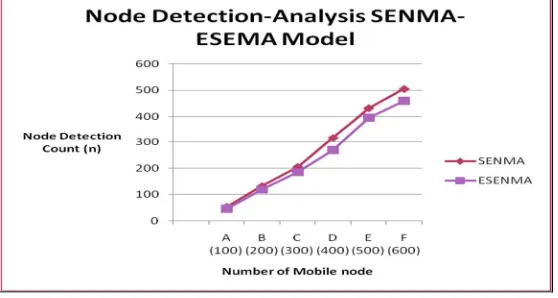
The following Fig 5.2 describes experimental result for node detection for SENMA and ESNMA over all experimental result analysis. The figure contains Mobile node, number of node occurrence with SENMA and ESEMA Model details are.
Fig 5.2 Mobile Node Detection-Analysis SENMA-ESEMA Model
VII.CONCLUSIONANDFUTUREWORK
A mobile access coordinated wireless sensor networks (MC-WSN) architecture was proposed for reliable, efficient, and time-sensitive information exchange. MC-WSN exploits the MAs to coordinate the network through deploying, replacing, and recharging nodes, as well as detecting malicious nodes and replacing them. The hierarchical and heterogeneous structure makes the MC-WSN a highly resilient, reliable, and scalable architecture. We provided the optimal topology design for MC-WSN such that the average number of hops from any sensor to the MA is minimized. We analysed the performance of MC-WSN in terms of throughput. It was shown that with active network deployment and hop number control, MC-WSN achieves much higher throughput and energy efficiency over the conventional SENMA. Our analysis also indicated that with hop number control, network analysis does become more tractable. Moreover, putting MC-WSN in the bigger picture of network design and development, we provided a unified framework for wireless network modelling and characterization. Under this general framework, it can be seen that MC-WSN reflects the integration of structure ensured reliability/efficiency and ad-hoc enabled flexibility.
REFERENCES
[1] G. Mergen, Z. Qing, and L. Tong, “Sensor networks with mobile access: Energy and capacity considerations,” IEEE Transactions on Communications, vol. 54, no. 11, pp. 2033–2044, Nov. 2006.
[2] I. Maza, F. Caballero, J. Capitan, J. Martinez-de Dios, and A. Ollero, “A distributed architecture for a robotic platform with aerial sensor transportation and self-deployment capabilities,” Journal of Field Robotics, vol. 28, no. 3, pp. 303–328, 2011.
[3] M. Abdel hakim, L. Lightfoot, J. Ren, and T. Li, “Architecture design of mobile access coordinated wireless sensor networks,” IEEE International Conference on Communications, ICC’13, pp. 1720–1724, Jun. 2013.
[4] G. Mergen and L. Tong, “Maximum asymptotic stable throughput of opportunistic slotted ALOHA and applications to CDMA networks,” IEEE Transactions on Wireless Communications, vol. 6, no. 4, pp. 1159–1163, Apr. 2007.
[5] P. Gupta and P. Kumar, “The capacity of wireless networks,” IEEE Transactions on Information Theory, vol. 46, no. 2, pp. 388–404, Mar. 2000. [6] E. J. Duarte-Melo and M. Liu, “Data-gathering wireless sensor networks: organization and capacity,” Computer Networks, vol. 43, no. 4, pp.
519–537, 2003, wireless Sensor Networks.
[7] M. Grossglauser and D. Tse, “Mobility increases the capacity of ad hoc wireless networks,” IEEE/ACM Transactions on Networking, vol. 10, no. 4, pp. 477–486, Aug. 2002.
[8] H. Wu, C. Qiao, S. De, and O. Tonguz, “Integrated cellular and ad hoc relaying systems: iCAR,” IEEE Journal on Selected Areas in Communications,, vol. 19, no. 10, pp. 2105–2115, 2001.