University of Windsor University of Windsor
Scholarship at UWindsor
Scholarship at UWindsor
Electronic Theses and Dissertations Theses, Dissertations, and Major Papers
2017
Agent-based Crowd Simulation Modelling for a Gaming
Agent-based Crowd Simulation Modelling for a Gaming
Environment
Environment
Songqiao Sun University of Windsor
Follow this and additional works at: https://scholar.uwindsor.ca/etd
Recommended Citation Recommended Citation
Sun, Songqiao, "Agent-based Crowd Simulation Modelling for a Gaming Environment" (2017). Electronic Theses and Dissertations. 7399.
https://scholar.uwindsor.ca/etd/7399
This online database contains the full-text of PhD dissertations and Masters’ theses of University of Windsor students from 1954 forward. These documents are made available for personal study and research purposes only, in accordance with the Canadian Copyright Act and the Creative Commons license—CC BY-NC-ND (Attribution, Non-Commercial, No Derivative Works). Under this license, works must always be attributed to the copyright holder (original author), cannot be used for any commercial purposes, and may not be altered. Any other use would require the permission of the copyright holder. Students may inquire about withdrawing their dissertation and/or thesis from this database. For additional inquiries, please contact the repository administrator via email
Agent-based Crowd Simulation Modelling
for a Gaming Environment
By
Songqiao Sun
A Thesis
Submitted to the Faculty of Graduate Studies through the School of Computer Science in Partial Fulfillment of the Requirements for
the Degree of Master of Science at the University of Windsor
Windsor, Ontario, Canada
2017
c
Agent-based Crowd Simulation Modelling for a Gaming Environment
by
Songqiao Sun
APPROVED BY:
M. Khalid
Department of Electrical and Computer Engineering
D. Wu
School of Computer Science
I. Ahmad, Advisor School of Computer Science
DECLARATION OF ORIGINALITY
I hereby certify that I am the sole author of this thesis and that no part of this
thesis has been published or submitted for publication.
I certify that, to the best of my knowledge, my thesis does not infringe upon
anyones copyright nor violate any proprietary rights and that any ideas, techniques,
quotations, or any other material from the work of other people included in my
thesis, published or otherwise, are fully acknowledged in accordance with the standard
referencing practices. Furthermore, to the extent that I have included copyrighted
material that surpasses the bounds of fair dealing within the meaning of the Canada
Copyright Act, I certify that I have obtained a written permission from the copyright
owner(s) to include such material(s) in my thesis and have included copies of such
copyright clearances to my appendix.
I declare that this is a true copy of my thesis, including any final revisions, as
approved by my thesis committee and the Graduate Studies office, and that this thesis
ABSTRACT
Crowd simulation study has become a favourite subject in the computer
graph-ics community in the past three decades. It usually is a sub-function within many
applications such as video games, films, and public security. This thesis proposes
an independent crowd simulation model that is capable of running an Agent-based
method through a gaming environment. It can simulate realistic human crowds with
user-controllable features to provide a gaming-like experience. Our approach features
an enhanced rendering system based on Distinguishable Agents Generating Method
(DAGM). This method can generate distinguishable and scalable 3D human models
in real-time. We also introduce our Multi-layer Collision System (MCS), which
fea-tures a collision-message collection system and an evaluation processing system. We
also introduce Building & City-planning Generating System (BCGS) for the purpose
of setting up obstacles for the crowd during an evacuation simulation. Moreover,
in this thesis, we also extend the study to other aspects such as crisis training and
human animations to provide a complete agent-based crowd simulation model.
Key Words: Agent-based Model, Crowd Simulation, 3D Visualization, Crisis
DEDICATION
AKNOWLEDGEMENTS
First of all, I would like to thank my supervisor Dr.Imran Ahmad, for his
inspira-tional thoughts and the willingness of sharing his wisdom to me. This thesis cannot
be accomplished without my supervisor’s insightful feedback and guidance. It is an
honour to be one of his students.
Second, I would like to appreciate my thesis committee members Dr.Dan Wu and
Dr.Mohammed Khalid for kindly offering their time, encouragement, and valuable
comments to me.
Meanwhile, I would like to express my special thank to my girlfriend Yaxin Li
who supported me through this unforgettable period.
Last, I would like to express my best gratitude to my mom, grandma, and the
rest family for the love, support, and sacrifice. You give me the chance to become
TABLE OF CONTENTS
DECLARATION OF ORIGINALITY III
ABSTRACT IV
DEDICATION V
AKNOWLEDGEMENTS VI
LIST OF TABLES IX
LIST OF FIGURES X
LIST OF ABBREVIATIONS/SYMBOLS XII
1 Introduction 1
1.1 Research Motivation . . . 2
1.1.1 Evacuation Simulation Needs . . . 3
1.2 Research Methods . . . 3
1.3 Thesis Objectives . . . 5
1.4 Contributions . . . 6
1.5 Thesis Organization . . . 7
2 Related Works 8 2.1 Agent-based Dynamics Method . . . 8
2.2 Crowd-Rendering Method . . . 10
2.3 Environment Generating Method & Summary . . . 11
3 Proposed Methodologies 13 3.1 Distinguishable Agents Generating Method . . . 14
3.1.1 Method Overview . . . 14
3.1.2 Separating Components Modelling Rule . . . 15
3.1.3 Random Colour Rendering System . . . 17
3.1.4 Random Character Size System . . . 20
3.1.5 Crowd Spread-level & Gender Ratio Control . . . 21
3.1.6 Summary . . . 23
3.2 Multi-layer Collision System . . . 23
3.2.1 Model Overview . . . 24
3.2.2 Collision Evaluation Function . . . 27
3.2.3 Stampede Thresholds . . . 28
3.2.4 Summary . . . 29
3.3 Building & city planning Generating System . . . 30
3.3.1 Model Overview . . . 31
3.3.3 Building Generating Step . . . 34
3.3.4 Performances . . . 35
4 Implementations 37 4.1 Hardware configuration & Software Platforms . . . 37
4.2 Operational Methods & Animations . . . 38
4.2.1 Control Methods . . . 38
4.2.2 Realtime Animations . . . 41
4.3 Program Procedures . . . 43
4.4 Experiments . . . 45
4.4.1 Priority Rule-based Navigation System . . . 50
4.4.2 Result . . . 52
5 Conclusions 56 5.1 Future Work . . . 57
REFERENCES 59
LIST OF TABLES
1 Density evaluation base on MCS . . . 27
2 Animation frames in each clip . . . 43
3 The time for evacuation after the application of the rule-based model 51
LIST OF FIGURES
1 2014 Shanghai stampede in New Years eve . . . 4
2 Several simulation scenes of our crowd simulation frameworks . . . . 5
3 Example of crowds moving under the Synthetic-Vision model steering 10
4 Our Agent-based crowd simulation model workflow . . . 14
5 Agent modelling samples under SCMR . . . 16
6 The result of the adjusted male head with proper texture assigned and
smoothed male pants model . . . 17
7 Three colour gradient controllers in our simulation system . . . 18
8 Two automatically generated male agents with different colour
combi-nations . . . 19
9 Two automatically generated female agents with different colour
com-binations . . . 19
10 Two female characters generated in our simulation with size differences 20
11 The spread-level changes while gender ratio, space size and population
remain the same . . . 22
12 The gender ratio changes while the spread-level, space size and
popu-lation remain the same . . . 23
13 An example of the MSC implementation on one agent . . . 25
14 The Mutli Layer Collision System . . . 26
15 A density evaluation chart showing the analysis on two crowds density
spread-level under the same space size . . . 30
16 A piece of the city-map of Manhattan . . . 32
18 The BCGS showcase and rendering results.(a) Four anchors placed on
the ground with building sections’ boundaries, (b) generated buildings
without the overlap issue, (c) the perspective view of buildings through
the in-game camera . . . 36
19 Examples of the camera zooming control function.(a) Zoomed view from our program camera. (b) standard field-of-views from our pro-gram camera. . . 39
20 The in-game UI system overview from the main camera . . . 41
21 Two animation scenes in our simulation. (a) walking agents in the navigating process, (b) an agent has fallen on the ground due to the high-density. . . 44
22 Crowd population affects on the FPS . . . 46
23 Density level affects on the FPS . . . 47
24 Gender ratio affects on the FPS . . . 48
25 Urban parameters affects on the FPS . . . 49
LIST OF ABBREVIATIONS/SYMBOLS
3D Three-dimensional
ACS Agent-based Crowd Simulation
BCGS Building & City-planning Generating System
BDI belief, desire, intention
CPU central processing units
DAGM Distinguishable Agents Generating Method
FPS frames per second
GPU graphics processing units
IDE Integrated development environment
k-NN k-Nearest Neighbours
LOD level of details
MACES Multi-Agent Communication for Evacuation Simulation
MCS Multi-layer Collision System
PC personal computer
PMFserv Performance Moderator Functions server
SCMR Separating Components Modelling Rule
CHAPTER 1
Introduction
Crowds are common and unavoidable in our daily lives. However, simulating this
general phenomenon using computer graphics is still a challenging work. The need
for crowd simulation long existed in film industry [24] and video games [4] for
en-tertainment purposes, in safety projects like crisis training [31], in city architectural
planning, and even in the education field. The natural crowd is usually gathered
because people or animals share a ‘common purpose’ or a ‘mutual destination’ [11].
However, those subconscious decisions are complex to computers and a simulation
usually cost massive computational resources at the early stage. Due to the
limi-tations of computer performance, some early models tend to focus on the dynamics
method of a crowd as a whole rather than its individual movements, which are
sim-plified methods to deal with the complicated crowd movements.
Examples of early models are the Flow-based model [38, 6] and the Entity-based
model [45, 23]. Hence, the crowd models proposed in early studies normally feel
‘un-realistic’ without individual behaviours [42, 29], and lack a genuine physical collision
system [3, 1] to support the simulation.
However, computer performances have been improved significantly in recent years.
Current computers have the ability to process much more sophisticated crowd
simu-lation programs than before. More functions [12, 22] and more detailed arrangements
can be applied to many recent simulation models; such as using high-quality 3D
mod-elling for both agents and environments [14] and individual interactions [19]. More
importantly, current computers’ performance can support the simulation operating
1. INTRODUCTION
advanced method, was firstly introduced in helbing’s model [13]. The principal idea
of ACS is controlling the dynamic of crowds that are constructed autonomously. ACS
model is considered as the best method [13] for the purpose of simulating crowds with
realistic behaviours, since it provides the movement by controlling every agent
indi-vidually. However, the cost of the simulation is also the highest. Thus, decreasing the
computational cost while increasing the simulation performances like the scalability,
flexibility, and realism have remained in high demand in the ACS study topics.
1.1
Research Motivation
The ACS studies usually focus on optimizing the decision-making ability and
nav-igation efficiency for autonomous crowds [8, 21, 10] to achieve realistic simulation
outcomes. However, in this thesis, we meant to improve the visual-performance and
realtime interactions between users and the machine for a humanoid crowd simulation
model instead of improving the locomotion method or decision-making approaches.
The efficiency of moving algorithms applied to crowds has been a popular in many
ACS [30, 28, 35] studies before, but many movement methods are similar to each
oth-er as the basic idea is mainly related to tackling the angular and tangential velocity
autonomously when agents meet obstacles. Another fact is that in computer
archi-tectures, central processing units (CPU) are capable of processing more sophisticated
algorithms than what we need in crowd simulation. In contrast, 3Dcomputer
graph-ics still consume considerable power from graphgraph-ics processing units (GPU). Therefore,
we attempt to create the 3Dagent with relatively low vertices, while the render
qual-ity is not sacrificed. We propose a dynamic collision-evaluation system to analyze
agents’ surrounding information while they are moving for the realtime monitoring
study. Our method plan is to monitor crowd movement in definable city maps which
are more complex than a plane. Thus our autonomous crowd can be examined in
1. INTRODUCTION
1.1.1
Evacuation Simulation Needs
Our thesis proposes an urban evacuation system featuring a simulation of a human
stampede that takes place in a high-density crowd. Crisis training system [32, 44]
is a practical topic for Crowd Simulation studies, but few studies have focused on
stampede probability [30]. The stampede is expected to happen when a large number
of people or animals are fleeing in fear [11, 25]. In the worst case, a stampede happens
under the condition of extreme dense situation, the death toll can be high. Although
historically crushes have been a relatively rare occurrence, the casualty number of
such events cannot be ignored. This is the original motivation for us to simulate
this man-made disaster. Using this simulation, we could make predictions about
and protect against stampedes in the future. Two features in our thesis method are
essential for our stampede study, first, our simulation can adjust crowd density and
size to achieve the appropriate density-level and crowd size that are enough for the
stampede situation; second, every agent has collision system and event-trigger system
to decide the surrounding condition and the falling possibility.
Figure.1 shows a case of dense crowds leading to a stampede. On December 31,
2014, a severe stampede happened in Shanghai, near Chen Yi Square, where nearly
300,000 people gathered in one relatively small area for the New Year celebration.
This tragedy, unfortunately, led to 36 fatalities and 49 injuries.
1.2
Research Methods
Visual rendering is the very direct way to show a crowd simulation. However, it
has not received much of the attention in recent research. It commonly remains at
the basic level in many crowd simulation studies while other aspects like collision
system and navigating system have been well documented. However, improving on
visual rendering quality does not only provides a plausible model for observation need,
but also helps in achieving authentic results. In this thesis, we have devised three
1. INTRODUCTION
Fig. 1: 2014 Shanghai stampede in New Years eve
1. We use the Distinguishable Agents Generating Method (DAGM) to model
a-gents that can build up the crowd. This method can generate
distinguishable-appearances agents with lower polygon mesh volume. A set of bionic human
animations corresponding to the agent model are also deployed for lifelike
mo-tion requirements.
2. We have implemented the Multi-layer Collision System (MCS) for the crisis
training study. Our MCS can provide synchronized feedback of the density
level around one agent. Based on the MCS, we also successfully simulated a
city evacuation scenario with the potential for human crashing.
3. The Building & City planning Generate System (BCGS) is designed to support
the environment and surrounding settings. In order to create a virtual system
consisting of more than just the human crowd; buildings and city roads are also
necessary. This system can place obstacles and walkable paths for each agent
1. INTRODUCTION
Fig. 2: Several simulation scenes of our crowd simulation frameworks
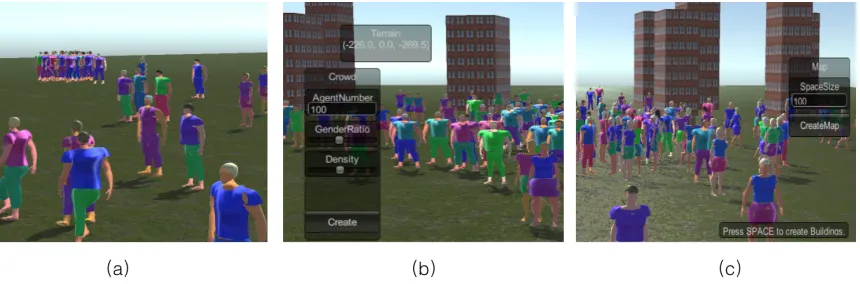
Figure.2 shows some general sketches from the simulation application.
Figure.2-(a) shows a group of male agents has gathered around the destination on the map
while some are still in the navigation process. Figure.2-(b) shows the interface of agent
control panels with information receiver at the top. Also the crowd and buildings were
generated by the control panel. Figure.2-(c) shows the initiation of the navigation
process on female characters to the desired destination and the city control panel on
the right of the screen.
1.3
Thesis Objectives
This thesis intends to study on three topics among the Agent-based crowd simulation
and with the different objectives in the selected topics as explained below.
Our first objective is to improve the modelling method for agent-rendering by
providing the realistic graphics with fewer pre-load resources. In previous research,
the common method for agent-rendering in crowd simulation are mainly divided by
graphical types, 2D shapes or 3D polygons. When the model is applied with 2D
shapes like dots or boxes to represent human agents, the 2Dmodel has the advantage
of less GPU power consumption. It is practical when summing up the dynamic
information such as the moving flows and patterns, but the non-realistic feeling is
the crucial drawback. Some studies [28, 26, 30] have implemented 3D graphics in
their models. However, their rendering model either uses several polygon shapes to
1. INTRODUCTION
load a massive volume of pre-modelled 3D resources to achieve the variety of agent
rendering types. In comparison, we achieved a high-level 3D graphic model with
massive agent appearances changes without the need of pre-loading model resources.
Next, we want to design a dynamic system for agents that can receive and analyze
information at realtime. We implemented the priority rule as the basic navigation
method for our agents to avoid the possible collision with one or more walkers while
the navigating is in process. Our MCS is the system we designed to help the
sur-rounding evaluation with a linear time algorithm complexity, but it can efficiently
perform the realtime collision feedback. This system is achieved with the help of
collision-detection function. On the other hand, our MCS can also assist our crisis
training study, especially, for the stampede simulation. In comparison, very few
re-searches have provided a collision system with realtime collision feedback. Also, the
research that has focused on evacuation simulation as its topic still rarely simulated
stampede events by its collision systems.
The third objective of our thesis is to present a method that can generate a city
scheme with blocking function to present environmental obstacles. Some approaches
have proposed similar functions to generate surroundings or a village-like architecture
model for realism purposes [37]. However, the interactions between a city environment
and human groups are usually weak. Buildings are typically used as representative
modelling instead of real obstacles, which can block agents when the emergency
hap-pened. Thus, in our model, structures and city-schemes could be assigned during
the simulation with random and controllable factors. Hence, the surroundings are
different with every time it is initiated.
1.4
Contributions
Our contributions are therefore the following: We developed a system for the ACS
study using theU nity game development engine. We created the DAGM for our
AC-S’s agent generating system, featuring the ability of generating high-quality rendered
1. INTRODUCTION
we can automatically create different types of agents without the need of manually
remodelling on the specific parts to make changes.
Second, we established a new dynamic scheme with two components involved.
Our MCS can evaluate individual density status at the realtime and supports our
crisis training purposes. Also, the priority-rule based navigation system can provide
a method to solve the ‘deadlock’ problem that commonly existed in many
decision-making models.
Third, on the surrounding system aspect, our BCGS can create buildings that
co-hesively interact with moving crowds. The major advantage of BCGS is that buildings
can be randomly placed in a pre-defined area within a few operating steps, but it is
flexible for some specific modifications such as the number of buildings and redefining
the ‘construction area’ to satisfy various city looks and patterns.
Lastly, our study can contribute to crisis training studies using the evacuation
results we received from the simulation system. Our model can also be used in
gaming environments with autonomous crowd needs. Because we designed our model
with a high accessibility, it is also suitable for educational purposes.
1.5
Thesis Organization
The rest of this thesis is organized as follows. In Chapter 2, we introduce and review
several typical agent-based crowd simulation models. In Chapter 3, we demonstrate
and discuss our proposed methodologies: the DAGM, MCS and BCGS. The details
of experiments and the evaluation of our proposed methods are presented in Chapter
CHAPTER 2
Related Works
In this section, we provide an overview of related works. However, crowd simulation
has many different aspects to investigate, such as dynamic methods, graphics models,
and global settings, etc., which a single model cannot cover comprehensively. For
example, an ACS approach may study the dynamic methods for acquiring a
non-collision navigation model, which improves on moving algorithms. Also, they could
study on the agent’s characteristics to provide a realistic behaviour system. Thus, we
review both the rendering and dynamics methods in previous studies and compare
them with ours. Additionally, other study topics like surrounding systems and crisis
training studies are also the focal points of this thesis. So we also provided some
reviews on other works related to this two topics.
2.1
Agent-based Dynamics Method
Several authors proposed their models for the Agent-based crowd simulation. Helbling
et al.’s Social Forced Model [13] settle the fundamental idea about how to apply the
agent-based approach to a crowd simulation model. In this model, authors apply the
repulsion and tangential forces on each agent; therefore, the steering agent can avoid
obstacles and other moving agents. However, the major drawback of this approach is
that every agent shares the same attributes without individual identity; also, agents
are navigated under the same moving speed; unlike a real human crowd, which has
individual differences regarding mobility. Besides, when Helbling’s moving method
2. RELATED WORKS
with increasing density and non-priority rule applied. Overall, Helbing’s model has
introduced the fundamental conception of the ACS study and his research inspired
us enormously.
Jan Ondrej et al. [28] proposed a Synthetic-Vision Based Steering approach for
crowd simulation, where they drive agents according to ‘visual perception’. In their
approach, agents use the visual field to receive information about their surroundings.
They analyzed the reason for a collision occurrence and what time it about to happen.
Then based on the information above, they proposed their collision-free locomotion
model. The primary principle is that each agent will adjust its angular and tangential
velocity based on the bearing angle with the obstacle in the current view and its
time-derivative. From the experimental results, this collision-free dynamic approach shows
the moving crowds similar to lines of disciplined soldiers passing through each other.
Figure.3 shows an example of crowd moving toward and across each other with the
collision-free approach applied. In comparison, our thesis is focusing on simulating an
ordinary crowd of citizens without any training experience. With this condition, there
is no reason to present a collision-free model because our citizens will flee in a chaotic
and panicked manner in the scenario. Although Jan Ondrej’s and our simulation
offer two different types of crowd motions, our study is still greatly influenced by
their work.
Dutra et al. proposed a gradient-based steering [7] algorithm which is derived
from the vision-based steering method. In their algorithm, each agent considers both
the risks of future collision and the desired destination. After computing the partial
derivatives, the agent moves by following the gradient on the map. This model has a
better range of perceiving information for each agent to make decisions of moving.
Classification and regression algorithms also have some contributions on the ACS
simulation process. Vermeulen et al. [40] proposed a comparative method based on
the k-Nearest Neighbour (k-NN) for solving the collision avoidance problem in their
2. RELATED WORKS
Fig. 3: Example of crowds moving under the Synthetic-Vision model steering
2.2
Crowd-Rendering Method
For the rendering aspect, some of the studies successfully applied the 3D graphics
[15, 25] into their simulation model. The necessity of 3D models in a crowd
simula-tion environment is not merely for the visual performance but also for the advanced
physical interactions in a 3Dsystem [7], which is the most similar computer model to
the real world environment. Furthermore, all agents can have one more dimension to
support the collision system, where the 2Dmodel [41] commonly does not include the
actual physical sizes of the agents’ bodies. That is the reason for some 2D particle
system methods that [9, 20, 2] can achieve extremely dense crowds by sharing one
spot for two or more agents. It means the positions is overlapped, but a real human
crowd is unlikely to reach the same density level as in a particle system. Thus we
decided to apply a human body ratios 3D characters in our model to enhance the
realism.
Nuria et al. [30]; the authors proposed a HiDAC system with cellular-automata
models. Although this model only uses several basic polygon shapes to assemble
a humanoid character in low-quality, it solved the common problem of overlapping
2. RELATED WORKS
and ‘squeezing’ between people. However, to the best of my knowledge, there are no
bionic animations attached to the human crowd.
Rahul et al. proposed their Aggregate Dynamics for Dense Crowd Simulation
[26]. This approach implements a standard human ratio model controlled by fluid
dynamics. It features scalable sizes [36] and adjustable densities. The agent is also
rendered in high-level graphics. Rahuls model can manage to simulate a large-scale
crowd moving around in one designated area. However, in his approach, agents are
produced by one 3Dmale prototype with fewer individual differences in the simulation
process.
In contrast, our method includes agents with gender differences and individual
body types. Those multi-factorial agents are produced by the DAGM. It can raise the
diversity of crowd composition in the rendering aspect. The benefit from it is that we
can automatically create a crowd with non-similar agents. With this function we can
have more individualized modifications on every agent’s identifications. In addition,
we could use the individuality for the idea of creating a multi-factorial
decision-making model that takes the individual attributes as mobility factors. For example,
an athlete usually is stronger than an average person after professional training. Also,
age could be another factor affecting strength-level; young people usually have more
power than elders. Those could be decisive factors influencing an individuals chances
of escape from an emergency scene. Thus all those physical attributes will combine
to create an integrated system to decide agent’s moving behaviour. Based on that,
agents in our model could present more individualized decisions when moving and
making other choices.
2.3
Environment Generating Method & Summary
Besides the dynamic method and rendering method in a crowd simulation model, some
other aspects that related to our model are also worth to mention. In our cases, urban
planning and surrounding system are designed to serve emergency crowd evacuation
2. RELATED WORKS
real-time. However, as the best we know from the authors’ paper, the village is
pre-modelled and not transformable. In contrast to our model, we can control the
building number and generating area at realtime. Hence, our model could satisfy
multiple environment requirements; making changes at the simulation time is also
possible. We also designed some functions, which do not typically exist in other
crowd simulation models, for example, a control system for run-time manipulations
and the stampede module for the crisis training.
In summary, there are plenty of topics inside the agent-based crowd simulation
subject, for instance, the reachable density-level, the capability of population size,
the applied dynamic method, and the visualization model type. Thus, most studies
generally focused to make improvements on the particular one or two topics. In
our case, we attempt to improve the visual-variety of 3D rendered crowd and the
CHAPTER 3
Proposed Methodologies
In this chapter, we present our thesis methodologies for the approaches that we used
to achieve the objectives in Chapter 1.
Our thesis involves the design and study of an operational real-time Agent-based
crowd simulation model. Comparing our model with previous agent-based crowd
simulation models, the major contributions are the diversity of creating crowd and
environments, and the operability of simulation processing. The actual methods to
achieve those advantages are explained in later paragraphs. However, a comprehensive
workflow can help to understand our thesis’ idea better.
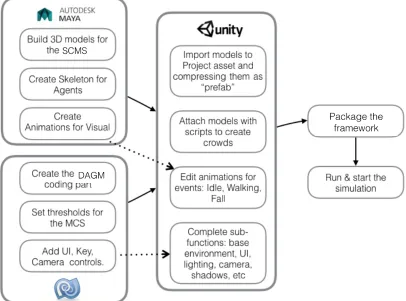
Figure.4 illustrates the complete workflow of our model. Each sub-box in this
workflow is our original work and the software we labeled in the workflow only provides
the working environment. We divide the working section into three main parts based
on the developing platforms that we use. First, the preparation works section, this
part includes character modelling for the DAGM requirements, rigging the skeleton for
characters and creating animations based on the skeleton joints transformation. All
of that work is done in Autodesk Maya, a commercial modelling software. After that,
we import the finished 3D models to the U nity game engine as part of development
assets. The work inside theU nitysoftware is closely related to the programming in the
M onoDevelop. TheM onoDevelopis an Integrated Development Environment (IDE)
that supports the scripting in the U nity. It provides the foundational environment
for us to implement many simulation functions, hence, our thesis’ methods can be
primarily built through programming. Our thesis ultimately presents an independent
3. PROPOSED METHODOLOGIES
Fig. 4: Our Agent-based crowd simulation model workflow
macOS operating systems, but it also can be ported to other operating platforms.
3.1
Distinguishable Agents Generating Method
3.1.1
Method Overview
Our DAGM is a multi-functional crowd generating system. This system is designed
to generate a number of agents at once with individual differences, which means
all agents have several distinguishable appearance-factors that provide us a chance to
make modifications. The generating function can be recalled unlimited times until the
program reaches the computational limits. It means the crowd size could be expanded
during the simulation process. Furthermore, all agents are supported by realistic
physical interactions between agents themselves and also with surroundings. We
3. PROPOSED METHODOLOGIES
method. First, we design and implement a new modelling method to create the male
and female characters; it features generating agents of different body types and visual
uniforms. Then we arrange it with our colour rendering method to give random body,
clothing and hair colours. Also, our DAGM has achieved several crowd attribute
control functions as:
1. Population control: takes an input value as number of people in the crowd.
2. Agent density control: capable of generating crowds with low-density or
high-density.
3. Agent gender ratio: male and female agents ratio in one crowd.
3.1.2
Separating Components Modelling Rule
We define the Separating Components Modelling Rule (SCMR) as a rule to create
a modifiable 3D human model without manual adjustment. The character that was
created under our SCMR can use fewer polygon meshes compared with normal
mod-elling methods, which means less computing time required. We created a group of
male and female model prototypes under the SCMR. Each character contains five
disconnected body parts: hair, head, torso, legs and arms, and two clothes, shirt and
trousers for male, skirt for female. The reason of using SCMR is due to the two points
below:
1. Detail Modifications: each agent’s parts can be re-scaled and painted
indi-vidually, because of this feature our agents can have random colour and size
differences. We introduce this part in the next two sections.
2. Saving computational power: we want to decrease the ‘PolyMesh’ numbers on
each agent to reduce the graphics power needed. It can improve the overall
simulation performance. Our models’ meshes are in a separated form without
the connection part, thus, the agent has fewer polygon count than a standard
modeled human agent.
Those separated model parts are used to assemble agents in the later process,
3. PROPOSED METHODOLOGIES
Fig. 5: Agent modelling samples under SCMR
visually distinguishable agents. Thus, each agent in a crowd has dissimilar body
styles without the need of loading different resources.
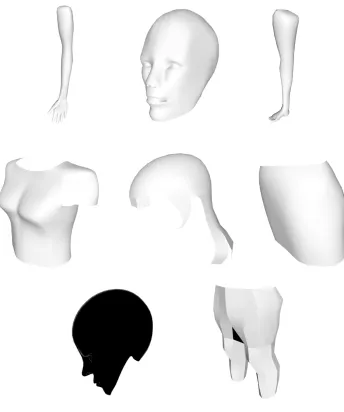
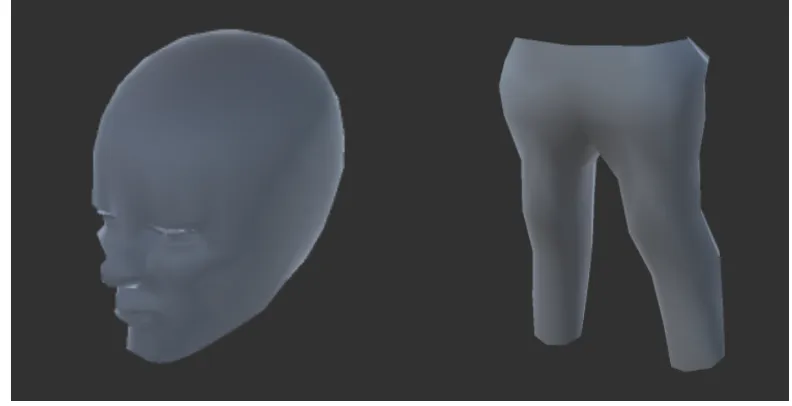
Figure.5 shows a set of character modelling samples under the SCMR, which are
in a preview-mode before importing to the developing environment. From top left to
right: female arm, female head and female leg, from middle left to right: female shirt,
female hair and female skirt, from bottom left to right: male head and male trousers.
In this preview mode, we can notice that most of our modelling resources kept in a
good and smooth quality. However, some male models have several exporting issues.
3. PROPOSED METHODOLOGIES
Fig. 6: The result of the adjusted male head with proper texture assigned and s-moothed male pants model
to the reversed mesh’s normals. Second, the trousers for the male model are in an
un-smooth condition and not qualified for the high-quality rendering. Although those
issues commonly existed when transplanting models from one software to another; it
still affects the overall quality of the visual experiment. However, we solved those
problems by correcting the mesh normals of the male head and adding more smooth
angles for the trousers model. The fixed models are shown in Figure.6.
3.1.3
Random Colour Rendering System
To give the diversity on clothing variation and body appearances, we divide each agent
into four major sections: skin colour, hair colour and two clothing colours. A normal
method of giving 3D models a random colour texture could be done by altering the
numeric representations of RGB triplet value, by providing random numeric value to
the specific red, green or blue colour. However, our method is more straightforward;
we created three colour gradient controllers, and each of them contains a different
range of hue degrees. The colour range is re-definable in the developing environment.
The main advantage of this hue system is that we can select one colour by adjusting
a single number instead of three in the RGB system. Thus, with the application of
3. PROPOSED METHODOLOGIES
Fig. 7: Three colour gradient controllers in our simulation system
selected. Figure.7 is an illustration of our hue colour controllers. The ‘Ran Color’ is
for the skin colour section. The ‘Ran Cloth C’ is to provide the colour range for each
clothing colour on one agent. Last, the ‘Ran Hair C’ can assign a random hair colour
to our agents.
In order to render realistic and distinguishable agents, we selected the hue range
for each colour controller according to the principle of avoiding similar colour tones.
It is hard to visually identify the clothing and skin on one agent if the both colours
are similar.
We assigned a random selection function to pick colours within the spectrum in
each gradient controller. To realistically render our agents, different body sections
should have preferred colour choices based on the reality, for instance, skin colour
should have the spectrum from white to yellow and black for race diversity. This
function helps our agents look close to a real human in terms of appearance. With
the wide colour range support, our simulation can avoid the issue of agents rendered
in similar colours without identifiable features. As in our observation, we can quickly
identify a single agent in a crowd without difficulty.
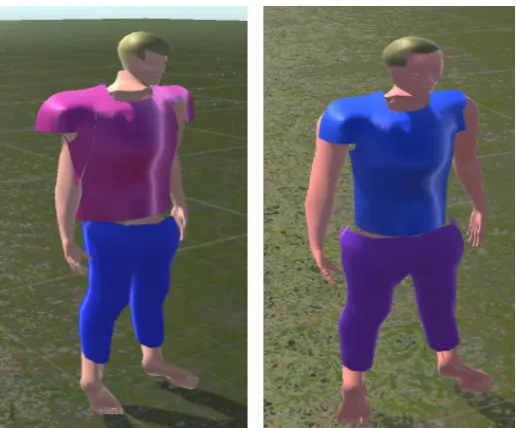
Figure.8 shows two male characters that were auto-generated under our random
colour system. The left man is rendered in a lighter skin colour tone and wearing
a violet shirt with blue trousers and comparing with the right male has darker skin
colour and clothing colour is different. Figure.9 is a same type of example of two
3. PROPOSED METHODOLOGIES
Fig. 8: Two automatically generated male agents with different colour combinations
3. PROPOSED METHODOLOGIES
3.1.4
Random Character Size System
Another objective of our DAGM is to provide body size variation on one agent. To
expand the diversity, we want to control one agent with several controllable
body-part sections and they are head size, arm size, torso size and leg size and we have
attached the clothing size on the torso size because we consider the cloth should
generally cover the body parts to make it sensible. By assembling body-parts with
individual variations, each agent can automatically have a wild range of changes on
body parameters in our simulation. Thus, a crowd can have an unique composition
of various agents without any manual settings.
Fig. 10: Two female characters generated in our simulation with size differences
Figure.10 is an example of our random body-size system implemented on two
female characters. We can directly observe that left female is slim and right one has
3. PROPOSED METHODOLOGIES
3.1.5
Crowd Spread-level & Gender Ratio Control
Our spread control function and gender ratio function are designed for supplying
various simulation needs on the crowd control stage. The crowd spread control adjusts
the spread-level for one pending to be generated crowd. The gender ratio adjusts the
proportion of male and female characters in one crowd after the total population is
specified.
The way to control the spread-level of one crowd in our approach is to enlarge or
narrow the possible position that every agent could be generated on. As we built our
model in a 3D environment, that commonly usex, y and z as the coordinate system
parameters, So we want to have control on the x&z value for the agent position
because the y represents the height and it should equivalent to the agent height to
make the agent feet on the ground. Therefore, the spread function is as follows:
a=random(1, S
D) (1)
x= (a−a0) (2)
z = (a−a”) (3)
Where ais a random value for us to control the agent positions, the a0 anda” are
two duplications of a, but the random value is singly assigned when creating. The
random range of a is from 1 to DS where S is the space size, and it is an input value
assigned by the user. D is the spread-level parameter and its assigned value from 1
to 5; the higher numerical value, the higher density-level on the crowd. Thus, we can
decide the possible positions for the agent by giving a range of values to the spread
control parameter. In our case, we can have a crowd in the constant space size but
with maximum five times changes on spread-level. After the random parameter is
calculated, the position parameter xand z could thus be calculated as in Equation.2
and Equation.3.
Figure.11 shows two groups of twenty (the entire generated amount, some may
3. PROPOSED METHODOLOGIES
with the different spread-level settings. The lower group has spread out more than
the upper group from the visual results.
Fig. 11: The spread-level changes while gender ratio, space size and population remain the same
The second operating method is to control the character gender proportion; the
control function is defined as:
M =bA
Rc (4)
F =A−M (5)
C =M+F (6)
Where A is an integer number as the user input and it represents the desired
crowd-size by the user. M is the desired male agent number, and F is the desired
female agent number. C is the total agent number that sums male and female agents’
number after the gender ratio control. R is the ratio value, which is assigned to
influence the crowd ratio. We set the value range from 0.01f to 1.0f, f means our
function can receive the fractional part of one real number in here. In our function,
we positively control the male character number by dividing the total agent number
by the ratio value and flooring the result. Then we assign this value as the male
character number in the simulation, and we can calculate the rest value as the female
character number.
Figure.12 shows the gender ratio controlling result in two simulations, such that
upper scene contains more female characters than male, conversely, the other one has
male numbers that outnumber than females. With the gender ratio controlling panel
3. PROPOSED METHODOLOGIES
Fig. 12: The gender ratio changes while the spread-level, space size and population remain the same
Those two functions that we just discussed are built inM onodevlopand using the
C# programming language.
3.1.6
Summary
In this section, we have demonstrated our DAGM and all sub-functions that included
to support this method. Overall, our DAGM builds the foundation of our crowd
system both on generating and manipulating. The DAGM features several unique
functions of a crowd generating method. On the individual level, it can create random
size and colour agents where we made the base model resources under the separating
components modelling rule. On the crowd level, the generating method could be
called multiple times to enlarge to the crowd size. We can use this feature to alter on
crowd’s specifications at each enlarging time, for example, assigning new crowd size,
density-level and gender ratio to differentiate the simulation results.
3.2
Multi-layer Collision System
Our Multi-layer Collision System has combined both collision-detection function and
physical-collision reaction system together. It can present a comprehensive system
that is qualified to support a modern designed agent-based crowd simulation model
on realistic dynamic interactions. Furthermore, we have implemented an evaluation
3. PROPOSED METHODOLOGIES
actual collisions. Thus, we can show the statistics of the risk-level around one agent
at realtime by summarizing the information that processed by the evaluation function,
whereas the principle of our MCS is explained in the following paragraph.
In the beginning, we first inspected on the real human anatomy because we want
to know that the scale of the visual field a person in a crowded circumstance. A
normal persons visual field has 70 degrees to 80 [16] in horizontal meridian. However,
we can gain a much wider field of view by twisting our neck and waist which extended
the visual field to nearly 360 degrees. Thus we can presume that people have a full
circle-perception of the environment in the standard situation. Moreover, the distance
between viewer and obstacles decides the warning-level in the viewer’s ‘mind’. For
example, an object that is far away from the viewer does not cause much attention
to the viewer, although the viewer maybe aware of the object existence. However,
an obstacle that is close to the viewer, may lead the viewer to make an immediate
decision to avoid it. This theory is the basis of our principle idea of the MCS.
Figure.13 is a sample implementation of MCS inside theU nity environment. The
agent positioning at the center has three layers to detect and react any collisions:
1. The outside ‘Collider’ which has a square shape and has the widest range to
detect the objects appearing.
2. The inner ‘Collider’ has a sphere shape and works for a narrower range to detect
the short-range objects with potential of crushing.
3. The core ‘Collider’ is a capsule shape collision detector that just cover the 3D
agent body to react the physic interactions with obstacles.
The details of our multi-layer function is discussed in the next section.
3.2.1
Model Overview
Our collision system is primarily based on the vision approach by Ondrej et al. [28]
where they presented a model of agents deciding their moves by a triangle shape of
3. PROPOSED METHODOLOGIES
3. PROPOSED METHODOLOGIES
is over restricted. Moreover, walkers can judge the surrounding obstacles by the
distance and this is the basic idea of our multi-layer collision system. As we show in
Figure.14, one agent in our model has three layers to detect the imminent collision
and auto-evaluate the risky level about current surroundings:
Fig. 14: The Mutli Layer Collision System
1. The vision layer: it represents the agent’s maximum visual distance in our
model. Obstacles or other agents appeared in this layer are recorded but it is
inferior than the information in other layers.
2. The warning layer: this layer gives the information about obstacles that are
going to collide with the agent; if there is no detour or slow down actions that
are taken by the agent. It requires the agent pays more attentions to avoid.
3. The physical layer: this layer represents the actual physical body of one
charac-ter. Any information retrieved from this layer means that a collision has already
happened. In the case of multiple agents crashing happened, there is a
possi-bility of falling. Agents fall due to multiple ‘competing forces’ which exceed
the individual durability on outside forces; and this durability is decided by the
3. PROPOSED METHODOLOGIES
Table 1: Density evaluation base on MCS
Threshold Density
E ≤10 Low-density
1<E ≤100 Medium-density 10<E≤1000 Dense
1000<E Overdense
3.2.2
Collision Evaluation Function
In our model, once a agent received the ‘visual’ information of surrounding, the MCS
can synchronize all those information into a data set which is updated by each frame
while the program running. The evaluation function can dynamically detect the
enter and exit of other agents from each layer. The method we transfer this ‘visual’
information to a numerical data set is by Equation.7 below:
E =
n X
i=0 V i+
n X
i=0 W i+
n X
i=0
P i (7)
This Equation.7 sums all ‘visual’ information that received from one agent’s MCS
and process it as a numerical feedback information. We compute the evaluation value
E from the summation of source layers. We make Vision, Warning and Physical as
three parameters to divide the information according which layer it comes from; and
they contain the weight of each three layers: the vision, the warning and the physical
where V < W << P. i as the obstacle amount indicator inside each layer, in this
case, the number of other agents inside of each layer. Thus we could calculate the
emergency level of one’s surrounding based on this weighted value.
After the value processed from Equation.7, we set several thresholds to evaluate
the current density-level of one agent’s surrounding and the results are shown in
Table.1. All data in Table.1 is based on the parameters’ value that are preset in
our program as V = 1, W = 10, P = 100. Note that the value of all parameter is
3. PROPOSED METHODOLOGIES
However, we can adjust the parameter value to achieve different dynamic results
where those parameters become factors for the stampede simulation study in next
section.
3.2.3
Stampede Thresholds
We could formulate our stampede scenario with the benefit from our MCS’s evaluation
system which introduced in the last section. An individual tends to fall if there are
several forces ‘pushing’ him [her] from one or several directions. This case in our model
is that any contact from the physical layer is a pushing force to one specific agent.
This agent could endure the forces with a certain amount of durability. Besides,
the durability varies on the individual attributes. Thus, those principles make the
foundation of our stampede simulation scheme. We first made an assumption that
each agent has some amount of durability, and the amount is decided by gender,
body size and current velocity. The durability can be considered as the thresholds of
falling. When the pushing force over the durability, the agent has the possibility to
fall. By the conditions above, we can form the equation for falling simulation as:
F =D −
n X
i=0
P i (8)
The interpretation of Equation.8 is as follows. The collapse indicator F is deter-mined by the threshold valueD, which each individual has their own calculated value in the simulation as the characteristic attributes. When the total forces Pni=0P i is
over the threshold D, then the equation returns a negative value on F, which means the agent is in a possible-to-fall condition. However, it is not a certainty condition
that once F meets the threshold, and the agent should fall. We consider that F
represents the ‘chance’ of falling instead of the ‘switch’ to fall or not. That means
afterF meets the condition, the agent’s status to fall or sustain that force are decided by our Falling Decision Algorithm as follows:
Algorithm 1 is the method we determine the agent’s status of falling or enduring,
3. PROPOSED METHODOLOGIES
Algorithm 1 Falling Decision Algorithm
Require: Falling chanceF, Random Parameter N
initialize and updateF from equation.8 and a loop counter i= 0
while Agent condition is not in F all and thevelocity>0 do if F ≤0 then
F ← |F |
Using pseudorandom number generator to generating a number as the value of N
if F +i >N then
Return agent condition as F all else
i+ +
return to while end if
else
return to while end if
end while
evaluation function. As more forces the agent suffering, the calculation resultF also increases; the higher risk he[her] falls. Furthermore, we applied a pseudo-random
number generator to produce the limitation trigger. This trigger gives a nonidentical
individual endurability on fallen event simulation in our model. The N’s value has the scale from 1 to 10 and we compare F with N. If F is greater than N in one loop, the agent falls. This algorithm gives the principal function to decide the falling
condition for any walker in the crowd. After the agents reached the ‘pushing forces
limit, they has more possibility to fall, when they hold the over limit forces longer.
However, the specific limitation value can be modified to catering particular study
goals. The time complexity of our Algorithm 1 is o(F).
3.2.4
Summary
Our MCS is an adequate tool when we target to analyze one agent’s surrounding in
a crowd. This system gives an instant feedback about both happened collisions and
foreseeable collisions at the current running frame. By analyzing feedback for every
3. PROPOSED METHODOLOGIES
people split by different density-levels. We can easily observe that people inCrowd1
share a higher density-level situation thanCrowd2 becauseCorwd1 has more people
in the dense and overdense bar. This kind of information that accumulated by MCS
can help us to understand a visually-complex human crowd by a highly summarized
data set.
Fig. 15: A density evaluation chart showing the analysis on two crowds density spread-level under the same space size
3.3
Building & city planning Generating System
Besides our model generating method, the DAGM, and our dynamic system, the MCS,
we have built an environment & obstacles system for our ACS system, Building &
City planning Generating System (BCGS). This system is designed for providing the
3. PROPOSED METHODOLOGIES
terror attacks happened more frequently in Europe cities and worldwide.
3.3.1
Model Overview
The BCGS contains two generating steps:
1. City planning step: at this step, the BCGS divide the ground into two sections:
the ‘building’ section and the ‘crowd’ section. One simulation map can contain
multiple ‘building’ and ‘crowd’ sections in it but each unit area should be
as-signed by one of this two sections to avoid the undefined problem. After this
compartmentalization step, all agent can only be generated on the land marked
as ‘crowd’ section, and all ‘building’ section would become obstacles to crowds.
2. Building generating step: the second step of our BCGS is creating buildings
within the ‘building’ area. For the convenience purpose, buildings can be
auto-generated by user’s control. Moreover, this step can be called unlimited times
during the simulation to make modifications on buildings’ amount, positions
and sizes.
After this two steps, the general ground has clearly defined boundaries that
prohib-ited agents generated into. Also, the buildings has restricted the agent’s movement.
In certain conditions, those obstacles can change the agent’s navigation path due to
the avoidance function in our navigation system.
3.3.2
City Planning Step
Before the city planning step, our agent can walk around on the entire ground that has
defined map size without limitation. Therefore, the default ground is a ‘crowd’ section
originally. What we need to do is adding the ‘building’ section boundaries above the
ground. We consider that with different building section boundaries applied, this
system can generate a street block, a residence area, or an urban downtown area
by modifying on the blueprints. Figure.16 provides a better explanation of our idea
3. PROPOSED METHODOLOGIES
3. PROPOSED METHODOLOGIES
to the ‘Building’ areas in our model. Those sections together formed the streets in a
city as the way we construct the ‘crowd’ section in our model. Our building section
can alter the size and shape for different city arrangements. The size editing can
not only provide more space to place buildings in it but also oppositely changes the
‘street’ width from wide to narrow. By enlarging the building section’s size, the street
is narrower and vice versa. Editing on the geometry shape of each section can provide
the stylish design for the urban planning. We have implemented a cross street sample
with four building sections and an intersection in the centre. Figure.17 is a simplified
2D map of the street block framework in our simulation. Giving more explanation
on this, the circle represents the map size and any position inside the circle area can
have crowds generated on it, except the grey squares which represent the building
areas and buildings are generated inside them. All agents still can move into the grey
section after they start the navigation process.
3. PROPOSED METHODOLOGIES
3.3.3
Building Generating Step
This step is a subsequence step after the city planning step finished. Due to the
buildings can only be placed after the city section is specified, and apparently these
two steps are nonreversible. The main point of this step is, after the city scheme is
constructed, we can to fill it with 3D buildings for placing obstacles and the urban
parameter performance testing.
In our model, all buildings are represented by shaded rectangles with the same
texture applied. However, to avoid the duplicate looking, we applied a random
func-tion on the building’s sizes. So that the buildings could have the differences in height
and width between each other, which can also increase the ‘city-like’ feeling. However,
we did not provide more modifications on this function and the main reason for this
simplification is in consider of the current geometric needs from our program. We
want all sub-functions only reach to the necessary level without spending too many
computational resources. Thus, we could optimize our computer power on the crowd
geometry performance. However, our BCGS is still capable of producing a realistic
environmental scenario with same rendering quality as in our agents.
Our surrounding approach can generate a number of buildings at one time. Thus,
there are two issues that need to deal with while we setup this function:
1. Recognition ability, buildings should positively recognize the position whether
is in the allow-to-place section before they are going to be assigned.
2. Avoiding overlap between buildings, due to our generating method can create
multiple buildings simultaneously, that may cause the polygon shapes across
with other models. So we need our algorithm has duplication detection function
to avoid this problem.
We have designed this Algorithm 2 by using the duplication testing method. It
has the ability to solve both the recognition and overlapping problem.
3. PROPOSED METHODOLOGIES
Algorithm 2 Building Collisions Detection Algorithm Require: Building positionX, Buildings amountA,i= 0
System generate a new position X automatically, if previous one failed. for i<A do
if CheckX is in building section then if X = any value in the array [X] then
Request a new position X
else
Place the building Store X to the array [X] i++
end if else
Request a new positionX
end if end for
simulation environment after satisfied our algorithm examination. ItsX, which is the position information is stored in the array ofX as [X] for later duplication checking process. Therefore our method can create non-overlapping buildings inside the fixed
area. The time complexity of Algorithm 2 is o(A).
The buildings can interact with crowds as solid obstacles that have the function to
block all agents to cross or access into it. If an agent is blocked by a building, he[she]
can only take a detour instead cross from it. We also provided a ‘refresh’ function for
the buildings’ establishing where old buildings are replaced by new if this function is
recalled during the simulation.
3.3.4
Performances
We implement a cross street scene by using our BCGS. Once the space size is specified
by the user, four ‘anchors’ are created around each corner of the rectangle ground.
Anchors’ positions are according to the fixed space size.
Figure.18 illustrates the procedures of implementing the environment by using
BCGS. The building section’s boundary appears as light green edged cubes. We
can observe that some buildings are partially out of the boundary and that is due
3. PROPOSED METHODOLOGIES
blocking function as a wall. After the simulation begins, the agent can walk into
the boundary but cannot cross through a building. The building’s variation on sizes
is showed in the right bottom picture of Figure.18, with this feature applied, the
building function provide more diverse looks of the modelled urban environment for
program observations.
CHAPTER 4
Implementations
In this chapter, we first provide information about the working environment of our
crowd simulation program. Next, we give a summary of the in-simulation operating
methods and additional system features that we designed for supporting the
simula-tion. After those, we present a step-by-step simulation sample as the user guide of
our ACS system, where we simulated a crowd that contains two hundred agents. The
experimental results are described in the last section of this chapter.
4.1
Hardware configuration & Software Platforms
We developed and tested our ACS program on a computer with macOS, and its
system configuration is 2.7 GHz Intel Core i5 CPU, 8 GB 1867 MHz DDR3 memory,
and the Intel Iris Graphics 6100 1536 MB integrated GPU. Our model could generate
a crowd with two thousand agents within seconds under the display resolution of 1024
x 768 pixels. Also, we tested our model’s performances by using another computer
with Windows 10 operating system, and its system configuration is 2.5 GHz Intel
Core i7 CPU, 8 GB memory and a NVIDIA GeForce GTX 970m dedicated GPU.
Our program is developed across multiple development platforms:
1. Unity 5.5.1f1 personal (64bit)
2. MonoDevelop 5.9.6
4. IMPLEMENTATIONS
4.2
Operational Methods & Animations
Besides the methods we have introduced in Chapter 3, our program also has the
controllability features for users through electronic devices like a mouse and keyboard.
By interacting with our model through those electronic devices, the gaming experience
can be significantly improved. On the other hand, we have created bionic animations
for character motions, and animations in the simulation can immensely enhance the
realistic feeling on the visualization aspect.
4.2.1
Control Methods
Camera Control: The way to inspect a 3Dgaming environment is to go through the
view camera. At this perspective, we set our camera with a good range of flexibility.
The default camera setting has 140o on the width and 60o on the height in terms
of the field-of-view. The rendering distance of the camera is set at one thousand
unit-distance in the U nity. This rendering distance can provide sufficient details
of all agents without wasting any additional resources. We place the camera ahead
of the crowd generating area and shoot with twenty-degree top-down angles for a
comfortable viewing angle to catch the most rendered objects in the scene.
We established some functions to extend the controllability on the camera view;
in the case that we want to observe more of the rendered model’s details on generated
crowds. There are two functions to support that:
1. Zooming function: the camera can zoom in or out by scrolling the
scroll-wheel on the connected computer mouse while holding the right-click button.
The zooming range are not easy to describe by words, thus we have provided
the comparison picture in Figure.19.
2. Rotation function: the rotation angle of the camera is by tracking the mouse
movement that is similar to many first-person shooting games. To avoid the
mishandling problem, we need users to move the mouse while holding the right
4. IMPLEMENTATIONS
4. IMPLEMENTATIONS
a 360o full-range view both horizontally and vertically.
Keyboard Control:
We applied several keyboard functions to control different in-simulation events
and they are listed below:
1. Key ‘R’ and Key ‘L’ control the male and female agents navigating system
separately. With the associate button pressed, agents in the current scene will
start walking towards their target point on the map.
2. Key ‘Space’ controls our buildings establishing function. Once ‘Space’ is pressed
during the simulation, a new group of buildings is created around the building
section by our BCGS. However, this function has to be applied after the space
size is defined, which is a prerequisite setting.
Mouse Control: Besides supporting zooming and rotating camera view in the
pro-gram, we have designed an information tracking function. It can acquire individual
agent information at the simulation scene. By right clicking on an agent in the scene,
we can display the information of the agent’s name (we arranged this by gender +
number) and his [her] current coordinates on the UI panel.
UI Control: Our crowd simulation system contains panel based user interfaces,
which has several interaction functions to control simulation parameters. We listed
them below, based on the interaction types:
1. Input field panel: this kind of panel can support users to enter any value by
a keyboard. As in our case, it is used to define the agent number (population)
and space size.
2. Slide bar panel: this panel has a slide bar to control the volume of the input
value. We use this type of panels to control the spread parameter and gender
ratio parameter. Both parameters have one same feature that percentage is
4. IMPLEMENTATIONS
3. Button panel: this panel has the function to initiate a defined event. We
use the buttons to apply the settings we have made in previous panels. To be
specific, we have separate buttons to control the crowd generating function and
the space generating function.
Fig. 20: The in-game UI system overview from the main camera
Figure.20 shows the layout of the UI system in our program. The left side
pan-els group are crowd control panpan-els with AgentNumber input, GenderRatio control,
Spread control and the Create button. The one on the top left is the tracking panel,
which we have introduced in the last section. On the right side, there are two
pan-els, the upper one is the Map control panel with SpaceSize and CreateMap button.
The last one is an instruction notice that tells users how to build buildings in the
environment.
4.2.2
Realtime Animations
Providing a realistic simulation process is our primary goal from both agent behaviour
aspect and the rendering quality aspect. We want them both as close as possible