Most Trending Topics with Pre-learned
Knowledge in Twitter
Leena Patil1, Kanchan Doke2
P.G. Student, Department of Computer Engineering, Bharati Vidyapeeth College of Engineering, Navi Mumbai,
Maharashtra, India1
Associate Professor, Department of Computer Engineering, Bharati Vidyapeeth College of Engineering, Navi Mumbai,
Maharashtra, India2
ABSTRACT: Finding trending topic from the large amount of user-generated content (UGC) in social media helps to make easier lots of downstream applications of intelligent computing. Topic models, as one of the most powerful algorithms, have been mostly used to discover the similar patterns in text collections. The weakness of topic models is that they need documents with particular length to provide reliable statistics for generating coherent topics. Tweets from the users are mostly short and noisy, in twitter. Observations of word co-occurrences are inconceivable for topic model so obtain better results, previous work tried to incorporate prior knowledge to deal with this problem. However, this strategy is not practical for the fast evolving UGC in Twitter. We first cluster the users according to the retweet network, and the user’s interests are mined as the prior knowledge, in this paper. Such data are then applied to improve the performance of topic learning. Users in the same community usually share similar interests, which will result in less noisy sub-data sets is the potential cause for the effectiveness. Our algorithm pre-learns two types of interest knowledge from the data set: the interest-word-sets and a tweet interest preference matrix. A dedicated background model is introduced further to judge whether a word is drawn from the background noise. Experiments on two real life twitter data sets show that our model achieves significant improvements over state-of-the-art baselines.
KEYWORDS: Topic model, social network, short texts.
I. INTRODUCTION
The tremendous amount of information generated by Online Social Networks (OSNs) has attracted enormous attention. Users in mobile social networks can share locations, textual content and videos with their friends, which raise great challenges for the existing data mining techniques. Topic modelling is one of the fundamental problems in the data mining applications. Statistical topic models, such as PLSA and LDA, provide powerful frameworks for analysing latent semantics underlying the news datasets. Naturally, researchers also apply them on social textual collections to discovering the fast evolving topics.
generate more meaningful topics. It assumes that words are drawn based on not only topics but also s-sets. DF-LDA takes domain knowledge in the form of must-links (i.e., words should occur together) and cannot-links (i.e., words should occur together) to restrain the distributions of topics. All these models are based on one assumption that the knowledge introduced is correct, and it can also be easily obtained. However, the rapidly evolving data in social media makes it difficult to obtain proper prior knowledge. In this paper, we propose a novel topic model called SILDA (LDA with Social Interest). We develop the model from two ways to achieve better performance: one is to promote the distinctiveness of topics by incorporating the interest knowledge. The other is to reduce the background noise. In the promoting process, the interests are regarded as prior knowledge, which is very similar to the must-links. However, discovering proper prior knowledge for the rapidly evolving tweets is extraordinarily difficult. Here we propose to learn it from the dataset itself, and then apply it to guide the model inference. In order to make the learned knowledge reliable, we first divide the dataset into several less noisy sub-datasets. The main reason why a traditional topic model performs poorly is that the noisy and short tweets overwhelm the valid co-occurrence observations. With the partition, texts in the same sub-dataset would share similar topics, and thereby be more concentrated. Thus it is convincing that the learned knowledge is better. According to the users’ relationships in twitter, we can conduct many kinds of partition methods. In this paper, we apply the re-tweeting behaviour of users. An individual retweet another only when he or she reads and approves the content. Users who are strongly connected by re-tweeting links are more probable to share similar interests. Our model mines two types of knowledge from the non-overlapping sub-datasets: the interest-word-sets and the tweet-interest preference matrix. In fact, most tweets are strongly related to the authors’ interests. Thus in the generative process, we add a new latent variable s denoting the interests, and assume a new topic distribution of topics overs. In other words, tweets are assigned with a higher probability to the topics which are related to its author’s interests. What is more, the interest-word-set will be promoted as a whole to make the final topics more coherent. In the noise removing process, a Bernoulli distribution is introduced to determine whether the word is from background noise. If the word has a higher probability drawn from the background model, it would be regarded as unnecessary information, thus it would remove from the learning phase. This step will remove many frequent but meaningless words such as the emoticons. Before going further, we discuss something about the partition methods. In our model, we treat the individuals as nodes, and assign an edge to two users if one person re-tweets any tweet of the other. The weight of an edge is defined as there-tweeting counts. The larger the weight is, the closer the two nodes are. Given the re-tweeting network, the simplest way for partition is to apply community detection algorithms. Many studies have been done in this field.
II. RELATED WORK
Traditional topic models, such as LDA and PLSA, provide powerful statistical frameworks to discover the latent topics in large text collections. Based on the observation of word co-occurrences, words with the same meanings are aggregated. Such unsupervised models are first proposed for news data which is rather longer than tweets. Previous studies noticed traditional topic models always perform poor on tweet datasets which are extremely short and noisy. However, witnessing the dramatic increase of online social media, many studies apply LDA as a basic method to explore the latent topical information in Twitter. Weng et al. combine all the tweets of an individual document to increase the documents length. However, it can hardly improve the model's performance. Some other work assumes that each tweet has exactly one topic. Actually, it is not a very reasonable hypothesis.
In order to solve these problems, researchers try to take advantage of the knowledge underlying the data, such as social relations, citation links and temporal information. Typically, by adding the network information to the similar function of PLSA, Mei et al. propose a very general framework, called NetPLSA, to model a kind of problems in which the datasets have accompanied network structures. Wang et al. analyze the topic sentiment of tweets with hashtag (``#'') which is a symbol manually de_ned as ``topic'' in social media to express common interests. All these studies have strong relationships with our proposed model, but none of them focuses on improve the model performance on the short tweets. With increasing popularity of social media, making topic models produce more coherent topics is stimulating more and more interests. Social text analysis has been a hot research spot for quite a few years. Many techniques have been proposed to mine the implicit information hidden in the social networks.
Zhou et al. propose a probabilistic model to extract the e communities based on the content of communication documents. The retweeting which is a kind of subjective behavior of individuals is always applied to analyze the propagation of events. Meanwhile, it is also considered as a good representation of users' interest or the content preferences. Combining textual content with retweeting networks is a very interesting _eld to perform topic modeling. However, very little attention has been paid in this _eld. Another very important phase in our model is to cluster users in the retweeting network. Many algorithms have been proposed to discover communities.Wu et al. propose a very comprehensive demonstration for spectral clustering applied in community detection. Since detecting community is a complex but well studied _eld, we do not describe too much detail in this paper. To overcome the sparsity problem of social networks, we apply the smart local moving (SLM) algorithm whose ef_ciency has been demonstrated by many previous studies.
III. TOPIC MODELING ISSUE
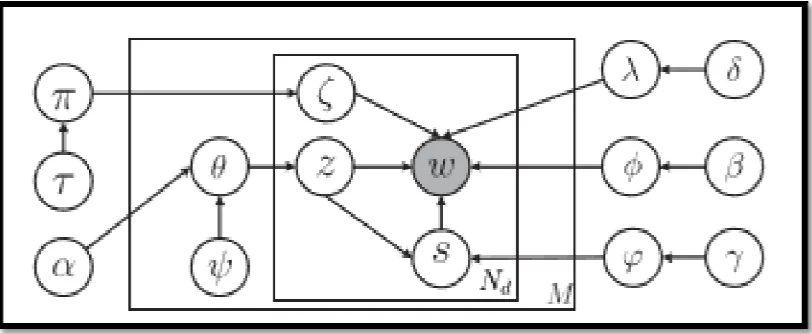
Figure 1: Topic modeling issue
IV.LDAFRAMEWORK
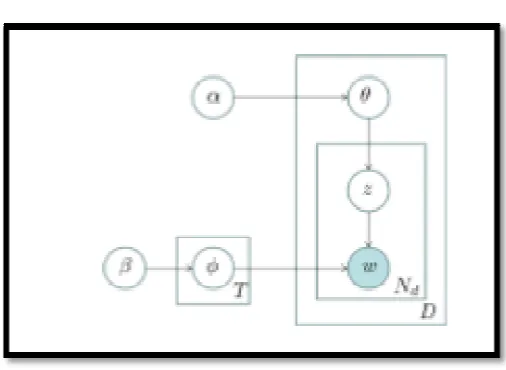
Figure 2: LDA framework
Graphical representation of LDA framework model is as shown in above figure. LDA framework is only used to analyse the twitter data. This framework is unable to extract the data in proper format.
Sr. No. Paper Methodology Feature Set Advantages Limitations
1. A smart local
moving algorithm for large-scale modularity-based community detection
SLA Algorithm Data extraction
from source like twitter data sorce
Provides good results only in small scale systems
Large number of iterations due to huge data which cannot be handled.
2. ETM: Entity
Topic Models for Mining Documents Associated with Entities Entity Topic Model (ETM)
To design topic model This technique solve the problem of word co-occurrence in pairs of topic and entity model Problem is occurred in entity information document of designing topic model.
3. Predicting the
content dissemination trends by repost behaviormodeling Social networks using PCA Popularity of contents in social network Tracks or captures the users behaviour Works in iterative manner which results in loss of
5. Twitterrank: Finding topic-sensitive influential Twitterers
LDA framework Analysis of data LDA framework
is used to analyse the large amount of data
LDA framework only analyse the data, unable to extract the data from sources.
6. Emerging Topic
Detection for Organizations from Microblogs
Real Time Framework
Analysis od data Real Time Framework is used to crawling the data, discover topics and to identify the topics.
Real Time Framework only analyse the data.
7. Personalization
and Context-awareness in
Social Local Search: State-of-the-art and Future
Research Challenges
Local Search Location-based
services Based on current user location, data emerged quickly.
Give best result locally only.
8. Influence
Propagation Model for
Clique-Based Community Detection in Social Networks Biased density metric
Active users Detect
interaction with neighbourhood
Communications between active users only
9. INDEPENDENT
COMPONENT ANALYSIS IN MULTIMEDIA MODELING Blind source separation method Independent component analysis ICA Multimedia data intelligently processed
Only analyse the data
10. Community
detection : topological vs topical Community detection approach Topology based and topic based
Analyse community data
V. REIMPLEMENTINGTHEPROPOSEDSYSTEM
Figure 3: Three-tier architecture
In this system we follow three tier system architecture as shown in previous figure. The twitter data / content added to the database using twitter API or form. The heading, content, hashtags and cities are added to database using form.Using User Interface to add data we send request to application server to add data to database.Application server forward the request which come from user interface i.e. client to the database server.After storing data to database, database server sends success response to the application server.If data is not stored in database, then database server send error response to the application server.Then application server sends success or error response to the user interface i.e. client.When we fetch the data from database, we send request to the application server to fetch data.Application server forward the data fetch request to the database server.Database server process the coming request and sends success response to the application server.If database server not process the request successfully then database server sends error response to the application server.Then application server sends the success / error response to the user interface that is client.
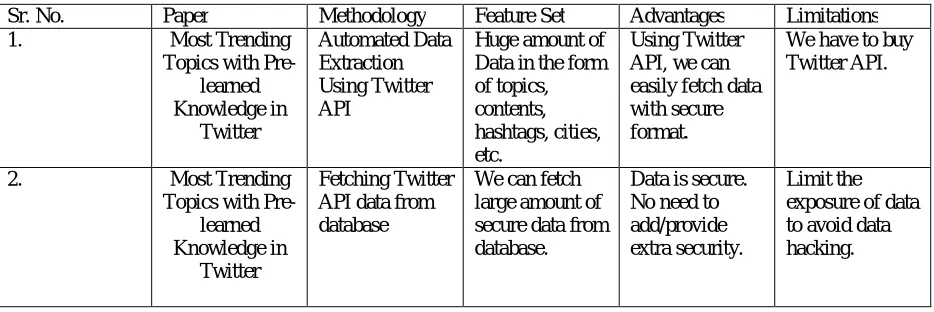
Sr. No. Paper Methodology Feature Set Advantages Limitations
1. Most Trending
Topics with Pre-learned Knowledge in
Automated Data Extraction Using Twitter API
Huge amount of Data in the form of topics, contents, hashtags, cities, etc.
Using Twitter API, we can easily fetch data with secure format.
VI.PSEUDO CODE
I. Step 1: Insert twitter data / tweets into database using twitter API.
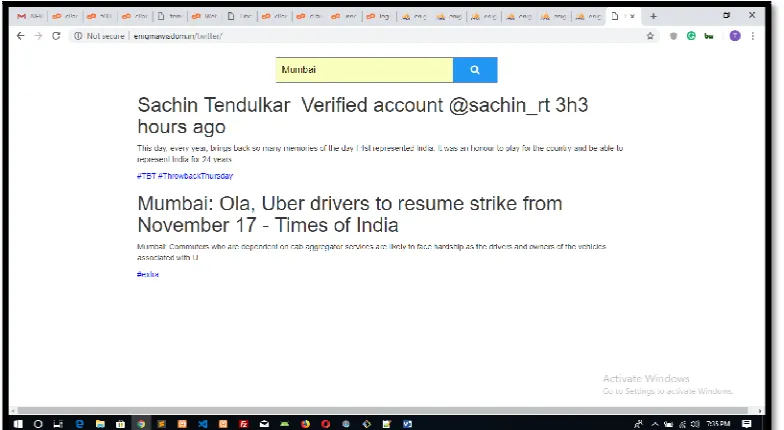
II. Step 2: Fetch heading, content, hashtags and cities of tweets from use of twitter API. III. Step 3: Store heading, content, hashtags and cities into database fetch from twitter API. IV. Step 4: Enter word which want to search in search box.
V. Step 5: Enter search word as name of city, heading, content or hashtags.
VI. Step 6: Word which want to search is checking into database with heading,content, hashtag or city. VII. Step 7: If search word match found with heading, content, hashtag or city thenrelated data will display. VIII. If($word == $row[‘data’])
IX. Then display the related data.
X. Else
XI. Data will not display.
VII. SIMULATIONRESULTS
The aid of this system are as follows:
I. It proposes to mine knowledge from the dataset itself, and then leverage it to promote the performance of topic modelling. We call such process learning twice from the data.
II. By introducing the latent interests, it can handle the cross-community interests and multiple senses problems. With a background model, it can reduce the noise, and produce more coherent topics.
III. Proposed model and state-of the- art baselines datasets are compared by the complete evaluation.
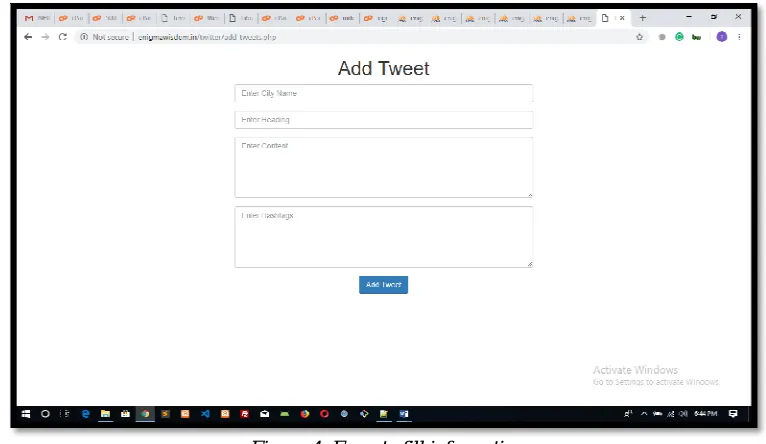
Screenshot 1: The input page for entering the details such as city name, heading of tweet, content of tweet and the hashtags, as shown in following screenshot:
Figure 4: Form to fill information
Figure 5: Form after entering information
VII. CONCLUSION AND FUTURE WORK
CONCLUSION
This paper presents the simplest method to fetch the data from Twitter. An API will be used to get the data from Twitter and to store into the database. The paper presents the simplest method to extract the data from the database dependent on the location, topic of interest and # tags. This facilitates the removal of unnecessary data so users can view their interested tweets real quickly. Also the overhead on machine to run complicated algorithms is reduced by implementing simplest method. It overcomes the issue of existing system like topic modeling which is unable to extract the data in desired manner. On the other hand proposed system provides expected results as required.
FUTURE WORK
I. Automatic Location Based Search: The user location can be fetched directly using Google Location Tracking API. The Search will be carried out on the basis of current location of the user. This will eliminate the need for user to each time select the location and can improve the experience.
II. Behavioural Search: The search can be added up with the ability to scan for user’s behavior. This can be achieved by checking for user’s login session or ip address and MAC address combination. The topics searched by the user are divided into the different categories like sports, entertainment, news or into different channels etc. and are stored into the database. The database maintains a separate table for login session and ip-MAC combination. Later whenever user goes for searching, system will show suggestions on the basis of last search. By implementing behavioural search, user’s experience can be further improved.
REFERENCES
[1] Z. Chen, A. Mukherjee, B. Liu, M. Hsu, M. Castellanos, and R. Ghosh, ``Discovering coherent topics using general knowledge,'' Proc. CIKM, New York, NY, USA, 2013, pp. 209218. [Online].
Available: http://doi.acm.org/10.1145/2505515.2505519
[2] D. M. Blei and J. D. Lafferty, ``Dynamic topic models,'' in Proc. ICML, New York, NY,USA, 2006, pp. 113120. [Online]. Available: http://doi.acm.org/10.1145/1143844.1143859
[3] Y. Chen, H. Amiri, Z. Li, and T.-S. Chua, ``Emerging topic detection for organizations frommicroblogs,'' in Proc. 36th Int. ACM SIGIR Conf. Res. Develop. Inf. Retr., 2013, pp.4352. [Online].
Available: http://doi.acm.org/10.1145/2484028.2484057
H. Kim, Y. Sun, J. Hockenmaier, and J. Han, ``Etm: Entity topic models for mining documents associated with entities,'' in Proc. ICDM, 2012, pp. 349358. [Online]. Available: http://dblp.unitrier.de/db/conf/icdm/icdm2012.html#KimSHH12
[5] D. Andrzejewski, X. Zhu, and M. Craven, ``Incorporating domain knowledge into topic modeling via dirichlet forest priors,'' in Proc. ICML, New York, NY, USA, 2009, pp. 2532. [Online].
Available: http://doi.acm.org/10.1145/1553374.1553378
[6] G. Miao et al., ``Latent association analysis of document pairs,'' in Proc. 18th ACM SIGKDD Int. Conf. Knowl. Discovery Data Mining, 2012, pp. 14151423.
[7] X. Lu, Z. Yu, B. Guo, and X. Zhou, ``Predicting the content dissemination trendsby repost behavior modeling in mobile social networks,'' J. Netw. Comput. Appl., vol. 42, pp. 197207, Jun. 2014. [Online]. Available: http://www.sciencedirect.com/science/article/pii/S1084804514000599 [8] G. A. Miller, ``WordNet: A lexical database for English,'' Commun. ACM, vol.38, no. 11, pp. 3941, 1995. [Online].
Available: http://doi.acm.org/10.1145/219717.219748
[9] D. Mimno, H. M. Wallach, E. Talley, M. Leenders, and A. McCallum, ``Optimizing semantic coherence in topic models,'' Proc. Conf. Empirical Methods Natural Lang. Process. Stroudsburg, PA, USA, 2011, pp. 262272. [Online].
Available: http://dl.acm.org/citation.cfm?id=2145432.2145462
[10] D. Ramage, D. Hal, R. Nallapati, and C. D. Manning, ``Labeled lda: A supervised topic model for credit attribution in multi-labeled corpora,'' in Proc. Conf. Empirical Methods Natural Lang. Process., Stroudsburg, PA, USA, 2009,pp. 248256.[Online].