A Multi-agent based Cyber Physical System
for Smart Campus
Pooja S Ahuja 1
I/C HOD, Department of Computer Engineering, Dr. D .Y. Patil Polytechnic , Akurdi, Pune, Mahrashtra, India1
ABSTRACT: Cyber-physical systems (CPS) are systems that combine a physical system with an embedded
information processing system such that the resulting system has capabilities that could not be achieved by either the physical or the computational entity alone. This paper describes grouping abstraction for Cyber-physical systems. This abstraction allows different applications to simultaneously use the same sensors and actuators. It describes the smart-campus technology which aims to increase smart-campus automation and security with reduced energy consumption and improving response time. A smart campus consists of intelligent sensors and actuators operating on different platforms with conflicting objectives. This paper proposes a multi-agent system (MAS) design framework to achieve smart campus automation. Case study of smart campus takes care of following functions classroom occupancy, attendance monitoring system and area access controlling and monitoring in a classroom are performed using the hardware unit and Java agent development module to demonstrate the advantages of the proposed method.
KEYWORDS: Sensor network, Cyber Physical System, Actuator, communications, computation, programming,
software.
I. INTRODUCTION
Recent advances in embedded computing, networking, and stream data management technologies have made it feasible to create Cyber-Physical Systems (CPS) that can sense and affect their environment in different ways and with different levels of sophistication. A common definition of a cyber physical system is “integrates computing and communication capabilities with the monitoring and/or control of entities in the physical world dependably, safely, securely, efficiently, and in real-time.” Such systems provide complex, situation-aware, and often safety or mission-critical ecosystems and services. Examples of such CPS ecosystems include engineering systems such as intelligent transportation systems (air and ground), smart power grids, structural monitoring and control of civil infrastructures such as bridges and dams; medical/healthcare systems (for assisted living, patient monitoring in hospitals, automated laboratories); smart spaces (buildings with surveillance and microclimate control); smart agriculture; flexible manufacturing systems (with self assembling structures); systems and processes used in defense , homeland security and emergency response (ad hoc ground/ airborne combat teams, intelligent fire fighting, etc.). In the medical domain, for example, the CPS ecosystem must bring together information from numerous devices that capture diverse physiological factors— such as heart rate, temperature, treatment and care; many of these devices are typically designed for isolated use; the composition of these devices to design perpetual life assistants for busy, older or disabled people and location-independent access to world class medicine is a grand challenge [1].
A. Multi-Agent Systems
An intelligent agent is an entity that is “able to act without the intervention of humans or other systems: that agents have control both over their own internal
state and over their behavior“
[14]. Therefore, each agent is self-content and acts autonomously. To enable autonomous decision making, agents observe their environment with sensors, act upon it, communicate and negotiate with other agents. Consequently, agents react on changing environmental influences by continuously sensing environment [15].whereas in competitive systems each agent acts selfish to reach its own objectives. Therefore, multi-agent systems show parallels to social structures, even to the human society.
The advantages of multi-agent systems are high flexibility, adaptability, scalability, and robustness of decentralized systems. As a result, the potentials of MAS are even higher in dynamic, distributed, and complex environments..
B .Challenges for Multi-Agent Systems and Cyber-Physical Concepts
Both trends in the field of Information and Communication Technologies (ICT), namely multi-agentsystems and cyber-physical systems, affect the ability to operate and control traditional automation technology. This address reduces complexity, handling dynamics, and integrating further systems. As a result, advantages of multi-agent systems are (i) it enables using different models and methods in every stage (ii) it may integrate and optimize a range of scheduling objectives related to different processes and it can adapt to changes in the environment while still achieving overall system goals; (iii) it provides a foundation to create an architecture that helps reaching the complexity reduction, flexibility, scalability and fault tolerance needed; (iv) it improves reactivity to events and enables dynamic scheduling problem resolution; (v) it allows rapid response to new system requirements through the addition of new modules or reconfiguration of existing ones; (vi) it enables to dynamically integrate new agents, remove existing ones or upgrade agents; (vii) agents operate asynchronously and concurrently, which results in computational efficiency. In conclusion, the case is also dedicated to cyber-physical systems as computational results from the multi-agent systems are used to control the speed of fan as strength of student’s increases or decreases and monitor the attendance in classroom influence the computational part.
II.RELATEDWORK
Currently there is very little published literature that compares grouping abstraction making our work unique. Some of them are as follows:-
Spatial Views create a group of nodes defined in terms of locations and service interfaces and make it possible to iterate over the members of this group. Heterogeneity, actuators, multiple networks or mobility of nodes are not addressed in this approach[6].
Spatial Programming provides an abstraction similar to spatial views. Applications use a mobile agent approach which is executed in a modified JavaVM [16].
Tiny GALS is another programming model for event-driven embedded system. Software components are composed locally through synchronous method calls to form modules, and asynchronous message passing is used between modules to separate the flow of control. This programming model is structured such that all asynchronous message passing code and module triggering mechanisms can be automatically generated from a high level specification [4].
A different way of grouping nodes in WSNs is the Generic Role Assignment Scheme. A predefined set of roles is distributed to all the nodes, which must decide at runtime which of these roles they currently comply with. A node choosing a specific role may cause other nodes to reevaluate their role membership, leading to toggling role memberships and messaging overhead.
III
.
GROUPING ABSTRACTIONCyber-physical systems (CPSs) become widespread include heterogeneous sensing and actuation devices, support intra and internetwork mobility, permit multiple applications to execute simultaneously and be accessible and controllable via the Internet.Ubiquitously deployed wireless sensor networks (WSNs) enhanced with actuators will create a new CPS infrastructure and along with body networks and sensor-based cell phones will create a situation with many interacting systems of systems. For this vision to become common place abstractions are required that support ease of programming, grouping sensors, and actuators of different kinds from different networks and administrative domains, and dynamically managing these groups in the presence of mobility and feedback control [4] .
IV.PROBLEMCHARACTERIZATION
Although the group based programming abstraction for cyber physical system is a powerful and flexible programming abstraction, but there are some limitations, mainly due to its centralized architecture which are as follows:-
A.In-network aggregation and local processing
It does not have the capability of in-network aggregation and processing. This results in more energy consumption than the distributed programming abstraction in some specific scenarios.
B. Response time
All the configuration messages from the applications must be first uploaded to the negotiator. After being processed, these messages go from the negotiator to the network nodes via the gateway. The updates from the network nodes also have to go to the negotiators first, from where they eventually reach the applications. Therefore, the response time is not as good as the other programming abstractions.
C.Dependency
Another limitation is that they create a strong dependency between the negotiators and the resource constrained sensors: the sensors must be able to communicate with their negotiator in order to configure themselves properly and store the data they generate [1].
V. PROPOSED IDEA
Current research areas in Cyber Physical Systems are energy control, secure control, transmission and management, control technique and grouping abstraction. The objective is to make improvement in grouping abstraction for Cyber physical system. Therefore, the design, implementation and evaluation of an agent based grouping abstraction are as follows:
A.Reduce Energy Consumption
To support in-network aggregation and processing for increasing the lifetime of the network.
B.Improving Response Time
To explore feasible solutions of an efficient message management system so as to improve the response time.
C.Independence
It would be not dependent on any other module.
VI. MATHEMATICAL MODEL
The energy used by a node consists of the energy consumed by computing, receiving and transmitting. The switching of state can also cause significant energy consumption. In the calculation of these operational energy costs in a sensor node, consider the MAC protocol, as it has a significant impact on energy consumption. In calculating energy consumption, use the maximum values of parameters for the worst case analysis.
A. Sensing Energy
Due to the wide diversity of sensors, the power consumption of sensors varies greatly. In general, a sensor, i, will have the following sensing energy consumption.
Esm = Vdc * Ii * Ti
where Ti is the time required for obtaining a single sample from sensor i and Ii is the current draw of sensor i. Ti depends on the start-up (Ts), response (Tr) and measurement (Tm) times of the sensors. As Tm is small in comparison to Ts and Tr for most sensors, we consider only Ts and Tr in calculating Ti.
Computational Energy
The computational energy cost (Ecomp) of sensor motes is a key constituent of the overall operational energy costs. Ecomp includes the MCU’s active mode and other modes’ (e.g., standby/idle/sleep) energy consumption. In cases of complex mathematical operations Ecomp can be expressed as:
Ecomp = Vdc * Imcu-active * Tmcu-active + Vdc * Imcu-sleep * Tmcu-sleep
B.Communication Energy
The constituents of Ecomm are listening, transmission, reception, sleeping and switching energy. The transmission energy, Etx, component of Ecomm refers to the energy consumed during the transmission of packets. Etx can be expressed as:
Etx = Vdc * Itx * Pb * Tb
where Itx is the current consumption in the transmission mode of the radio. Pb is the bit length of the packet to be transmitted and Tb is the transmission time of a single bit.
The reception energy, Erx, component of Ecomm refers to the energy consumed when receiving packets. Erx can be expressed as:
Erx = Vdc* Irx* Pbr* Tb
where Irx is the current consumption in reception mode and Pbr is the bit length of the packet to be received.
The listening energy, Elisten, is the radio energy consumption when the radio is active, but not receiving or sending packets. This listening is to check for messages low power listening. Elisten can be expressed as:
Elisten = Vdc* Ilisten * Tlisten
where Ilisten is the current draw in listen mode and Tlisten is the time in each sampling.
C.Response Time
The response time is in direct proportion to the wait time. The relationship among response, wait and processing time is:
Response time= wait time+ processing time
D.Delay calculation between nodes
Delay = Radio Propagation Time + Transmit Time
where radio propagation time is the time for a signal to propagate over the air to reach a receiver. Radio propagation speed is 300 meters per microsecond.
VII. DESIGN
To overcome the limitations characterized in the section 3, we present the proposed architecture and case study of Smart Campus.
Architectural Details are as follows:-
i. Physical Layer
This layer provides direct monitoring of sensors, actuators and control of field devices.
ii. Abstraction Layer
An abstraction layer collects the control or data messages from the Physical layer and forwards them to the Agent layer. The communication between the abstraction layer and the physical layer providers is through wireless protocols.
iii. Agent Layer
This layer provides information, networking architecture for a sensor network application. It formulates requirements, maps them into requests to other agents for further processing and provides users with answers from the application agents. The user can communicate with any agent to express its needs.
iv. Application Layer
It contains applications that periodically generate and cancel requirements for remote sensors and actuators by re-evaluating the membership.
B. Case Study
Smart Campus: In a campus environment, a number of users share a large amount of their information needs. These needs include information about schedules, locations of classrooms, lectures, assignments, lab equipments, presentations, seminars, sports events, student ads, etc. Much of this information is directly related to objects, places and people that are situated within the campus environment. The exhaustive installation of wireless computing facilities such as WLAN, WSN together with small handheld devices and technologies for detecting objects or locations makes it possible to satisfy the information needs of users in a campus environment in new ways. By embedding physical hyperlinks into the campus and attaching information to physical objects, visible entry points into the information space are created, enabling a natural interaction between the physical and the virtual environment and thus providing ubiquitous access to it. By linking the virtual to the real world, new interaction patterns emerge on both sides. This system focus on the aspect of linking virtual and physical elements in a campus environment. Smart campus provides the following functions:
i
. Classroom OccupancyThe electric appliance in the classrooms was being left on for a long period of time while the rooms unoccupied. Despite of having individuals turned the light off as they leave the classroom the problem persisted and the college experienced wasted energy and money. To stop this energy waste decided to use occupancy sensors.
Occupancy sensors control lights by turning lights on only when the classroom is occupied and turning lights off after a classroom is vacated. This decision to use sensors was based on the fact that occupancy sensors would perform to save energy without requiringany manual actions by occupants. Their function is automatic and this seems to be smart classroom.
ii. Area Access Monitoring and Controlling
Restricted area which can be accessed by only respective staff members in the campus area. For example account center, CAP center etc.
iii. Attendance Monitoring System in class
VII.SYSTEM IMPLEMENTATION
A. Hardware interface
Fig.2 shows the hardware unit that is a combination of sensors and actuators to perform the defined above functions of smart campus
B. Hardware Details
Hardware interface details are as follows:
i. 8-bit Microcontroller with 8K bytes In-System programmable Flash AT89S52
The AT89S52 is a low-power, high-performance CMOS 8-bit microcontroller with 8K bytes of in-system programmable Flash memory. It provides the following standard features:
a. 8K bytes of Flash b. 256 bytes of RAM
ii.8-Bit P Compatible A/D Converters with 8-Channel Multiplexer ADC0808/ADC0809
The ADC0808, ADC0809 data acquisition component is a monolithic CMOS device with an 8-bit analog-to-digital converter, 8-channel multiplexer and microprocessor compatible control logic.
Below are the following features: a. Easy interface to all microprocessors. b. Operates ratio metrically with 5 VDC. c. 0V to VCC input range.
iii. Leone Relay-SC5-Ag
Its specifications are as follows: a. Relay type: SC5
b. Contact Material- Ag Alloy c. Coil Voltage- 3~48VDC
iv. Obstacle Detecting Sensor
It is used to detect obstacles in front of sensor in applications. Sensor keeps transmitting modulated infrared light and when any object comes near, it is detected by the sensor by monitoring the reflected light from the object. Its features are as:-
a.Power Supply: 5V DC Power Consumption: 50mA max. b. Detection range 10 cm
c. Operation range varies according to the color of the object, light color has more range. d. Detection Indicator LED
v.
Nearest Field Communication(NFC) SensorNFC is smart card reader used to detect the presence of students in caseACR122T NFC Contact less Smart Card Reader: a. CCID-compliant
b. PC/SC-compliant&Read/write speed up to 424 kbps
c. Built-in antenna for contactless tag access, with card reading distance of up to 50 mm e. Support all 3 modes of NFC: reader, card emulation and peer-to-peer modes
VIII. RESULT
The Smart Campus application takes care of the following functions such as classroom occupancy, attendance monitoring and area access controlling.
This application requests for sensor access which transfers data when connected to cyber layer through the network. Snapshot in fig. 3 shows the function of classroom occupancy. As occupancy increases in classroom it automatically controls the speed of the fan. When in-sensor detects the number of occupants from 1 to 3 control speed is set to 1shown in Fig.4, for 3 to 6 control speed is set to 2 and for 7 to 9 control speed is set to 3 shown in Fig.5. When there are no occupants, the application returns 0 which automatically switches off the fan. With the use of this function, the energy consumption is minimized.
The second function is an attendance monitoring system in the classroom means as students enter the classroom the attendance gets automatically registered through NFC (Nearest Field Communication) sensor. Students filled registration form at the time of admission .It automates the manual process of attendance. Authentic data is generated. This function helps to improve response time.
IX. RESULT ANALYSIS
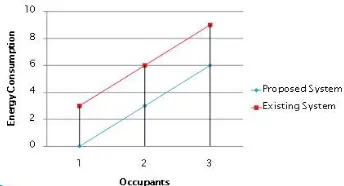
Results show that the proposed in-network mechanisms can facilitate the efficient use of constrained resources and satisfy data requirements in the presence of dynamics and uncertainty. The goal of the programming system being developed as part of this research is to provide abstractions and mechanisms to seamlessly access and integrate remote and distributed sensor data into computational models and support scalable in-network data processing. The underlying approach is to virtualize the physical sensor to match the representation of the physical domain used by the models, and dynamically discover and access sensor data independently of any change to the sensor network itself. Below table1 shows that in earlier systems, there is a limitation of in-network aggregation, which results in more energy consumption due to its centralized and distributed architecture. Now in the proposed system, it minimizes delay through which energy consumption is minimized using the concepts of an agent based approach for improving the lifetime of the network. It determines the value of the power consumption of sensors and actuators that are used in hardware unit.
Table 1. Energy Consumption between earlier system and proposed system
Below the graph in fig.6 shows that in earlier systems, there is a limitation of in-network aggregation, which results in more energy consumption due to its centralized architecture. Now in the proposed system, it is shown that energy consumption is reduced to enhance the lifetime of the network using the concepts of an agent based approach.
Fig.6 Energy efficient in proposed system
X. CONCLUSION
With the objective of maximizing the lifetime of network, it considered the problem of in-network aggregation and local processing. In-network aggregation is a mechanism for reducing the overall amount of power and bandwidth to process the user’s query. An agent based approach; termed improved group based programming abstraction for cyber physical system is proposed to solve the problem. It is managed and programming across pervasive computing networks, but with important capabilities for across system programming, mobility, automatic dynamic updates, fine grained access right control and conflict resolution mechanism, and support for actuators. Supports for both intra and inter network mobility and multiple application using the same sensor and actuator. It also facilitates in-network aggregation and local processing so that energy consumption and response time will be improved. It would validate on the application of smart campus, which considers following functions like classroom occupancy, attendance monitoring and area access controlling and monitoring.
Sr. No.
No. of Sensors and Actuators
Delay Energy Consumption (Earlier System)
Energy Consumption Proposed System) 1 7 300
361.4403
361.4397
REFERENCES
[1] Grit Denker, Nikil Dutt, Sharad Mehrotra, Mark-Oliver Stehr, Carolyn Talcott &NaliniVenkatasubramanian, “Resilient dependable cyber-physical systems: a middleware perspective”, Journal of Internet Services and Applications,Volume No.1 ,ISSN:1867-4828,April 2010. [2] Pascal A. Vicaire, Enamul Hoque, Zhiheng Xie, and John A. Stank Vic, “Bundle: A Group-Based programming Abstraction for
Cyber-Physical Systems”,IEEE Transactions on Industrial informatics, Volume No.8, ISSN: 1551-3203, pages 379-392, MAY 2012.
[3] Ashraf M. Tantawy, “Model based detection in Cyber Physical System”, Dissertation for the degree of Electrical Engineering, December 2011. [4] E. Cheong, J. Liebman, J. Liu, and F. Zhao, “Tiny gals: A programming model for event-driven embedded systems”, ACM Symposium
Application Computing, Volume18, pages 698-704, 2003.
[5] Kamin Whitehouse, Cory Sharp, Eric Brewer, David Culler, “Hood:A Neighborhood Abstraction for Sensor Networks”, 2nd International Conference on Mobile System Application Services, ISSN 1927-064, pages99-110, 2004.
[6] Yang Ni, Ulrich Kremer, and Liviu Iftode, “Spatial Views: Space-Aware Programming for Networks of Embedded Systems”, 16th International Workshop Languages Compilers Parallel Computing, Volume 2958, ISSN: 0302-9743, pages 258-272, 2003
[7] Matt Welsh and Geoff Mainland, “Programming Sensor Networks Using Abstract Regions”, 1st conference on Symposium on Networked Systems Design and Implementation, Volume 1 ,ISSN 1041-4347, pages 29-42, 2004.
[8] Ryan Newton,Matt Welsh, “Region Streams: Functional Macroprogramming for Sensor Networks”, ACM, Data Management for Sensor Networks, Volume 32, ISSN: 1556-4665, pages 78-87, 2004.
[9] . Pooja Sobhrajan, Swati Y Nikam, “Improving Energy Efficiency of Grouping Abstraction of Cyber Physical System”, International Journal of Computer Applications, Volume100-No.7, ISSN: 0975-8887, pages 44-50, August 2014.
[10] L. Luo, T. F. Abdelzaher, T. He, and J. A. Stankovic, “EnviroSuite: An Environmentally Immersive Programming Framework for Sensor Networks”, ACM Transactions on Embedded Computing System, Volume 5, ISSN: 1539-9087, Pages 543-576, 2006.
[11] D. Jacobi, P. E. Guerrero, I. Petrov, and A. Buchmann, “Structuring sensor networks with scopes”, 3rd IEEE European Conference on Smart Sensing and Context (EuroSSC), IEEE Communications Society, Oct. 2008.
[12] Luca Mottola and Gian Pietro Picco, “Logical Neighborhoods: A Programming Abstraction for Wireless Sensor Networks”, Second IEEE International Conference, Volume 4026, ISSN 0302-9743, pages150-168, 2006
[13] Fang-Jinx Wua, Yu-Fen Kaob, Yu-Chee Tseng , “From wireless sensor networks towards cyber physical systems”, Journal of Pervasive and Mobile Computing, Volume 7, pages 397-413, August 2011.
[14] G. Weiss, Multiagent systems: A modern approach to distributed artificial intelligence. Cambridge, Mass: MIT Press, 1999.
[15] R. Brooks, “A robust layered control system for a mobile robot,” Robotics and Automation, IEEE Journal of, vol. 2, no. 1, pp. 14–23, 1986. [16] C. Borcea, C. Intanagonwiwat, P. Kang, U. Kremer, and L.Iftode, “Spatial programming using smart messages: Design and implementation,”