iii
ALTERNATIVE STRIP METHOD FOR A LATERALLY DRIFTING SHIP IN WAVES
MUHAMAD BIN RAMLI
A dissertation submitted in partial fulfilment of the requirements for the award of the degree of Master of Engineering (Mechanical-Marine Technology)
Faculty of Mechanical Engineering Universiti Teknologi Malaysia
To my dear wife and my family, whose prayers always afforded me the power to accomplish this work. To all I dedicate this work
vi
ACKNOWLEDGEMENT
First of all, I would like to thanks ALlah for the sake of under His blessing, we can stay in the best condition to finish the job assigned. I wish to dedicate my highly appreciation to my supervisor, Dr. Faizul Amri Adnan for his spirit to guide, advice and encouragement throughout of this study. Without his continuous support and interest, this thesis would not have been complete as presented here. Additionally, the numerous and demanding hours spent in meetings together were of inestimable
benefit to me and my understanding of this study. I also would like to appreciate him
for his warm hospitality and detail elucidation extended to me during my time of uncertainty and meeting with problems.
My sincere thanks to all Marine Technology Lecturers whom had taught me invaluable knowledge and insight about the wonder of Naval Architecture and Marine Technology.
ABSTRACT
viii
ABSTRAK
Kajian ini adalah lanjutan untuk mengesahkan kaedah jalur bagi kapal yang bergerak dan mempunyai kesan hanyutan ke sisi. Pada kajian tersebut, permasalahan mengenai kesan hanyutan sisi yang disebabkan oleh daya yang dihasilkan oleh
ombak dan/atau angin telah diaplikasikan di dalam kajian New Strip Method oleh
TABLE OF CONTENTS
CHAPTER TITLE PAGE
DECLARATION iv
DEDICATION v
ACKNOWLEDGEMENT vi
ABSTRACT vii
ABSTRAK viii
TABLE OF CONTENTS ix
LIST OF TABLES xii
LIST OF FIGURES xiii
LIST OF SYMBOLS xv
1 INTRODUCTION 1
1.1 Introduction 1
1.2 Backgrounds of the Problem 2
1.3 Problem Statements 4
1.4 Objectives 5
1.5 Scope of Study 5
1.6 Significance of the Research 6
1.7 Structure of Dissertation 6
2 LITERATURE REVIEW 8
2.1 Introduction 8
x
2.3 Sign Convention of Ship Oscillation 12
2.4 Boundary Value Problem 13
2.5 Pressure and Forces 15
2.6 Conclusion 20
3 RESEARCH METHODOLOGY 22
3.1 Introduction 22
3.2 Research Flowchart 23
3.3 Research Procedures 24
3.4 New Offset Data 25
3.5 Derivations of Mathematical Formulations 29
3.6 Modification of Computer Programming 29
3.7 Generating Computational Results 29
3.8 Conclusion 30
4 MATHEMATICAL FORMULATIONS 31
4.1 Introduction 31
4.2 Modified Boundary Value Problems 31
4.3 Pressure and Forces 35
4.3.1 Pressure Acting on 2D Ship Section 35
4.3.2 2D Hydrodynamic Force Coefficients 38
4.3.3 Force and Moment Acting on 2D Ship Section 38
4.4 Time Domain Equation of Motions 42
4.4.1 Heaving Motion 43
4.4.2 Pitching Motion 43
4.4.3 Swaying Motion 44
4.4.4 Yawing Motion 44
4.4.5 Rolling Motion 45
4.5 Frequency Domain on the Equations of Motions 45
4.6 Conclusion 48
5 COMPUTATIONAL PROGRAM 49
5.1 Introduction 49
5.3 Description for Main Program 51
5.4 Conclusion 56
6 RESULTS AND DISCUSSIONS 57
6.1 Introduction 57
6.2 Result on Offset Data 57
6.3 Exciting Force Coefficients 58
6.4 Ship Motions 59
6.5 Comparison ASM with NSM and Discussions 60
6.5.1 Analysis on Exciting Force Coefficients 60
6.5.2 Analysis on Ship Motions 66
7 CONCLUDING REMARKS 78
7.1 Conclusions 78
7.2 Recommendations for Future Work 79
REFERENCES 80
xii
LIST OF TABLES
TABLE NO. TITLE PAGE
3.1 Principle dimensions of container ship model, SR108 25
LIST OF FIGURES
FIGURE NO. TITLE PAGE
1.1 Principle of Strip Theory 2
1.2 Lateral Drift effect on ship movement 4
2.1 Coordinate systems 10
2.2 Sign convention of ship oscillations 12
3.1 Research Flowchart 23
3.2 Body plan of container ship model SR108 25
3.3 Comparison between strip sections 26
3.4 Measured value at section a-a for certain waterline 27
3.5 Plotted graph for unsymmetrical offset 28
5.1 Flow chart of the main program 50
5.2 Input data file format 54
5.3 Hull data file format 55
5.4 Output File 56
6.1 Computed results of exciting force coefficients for heave at
various drift angles in head waves 60
6.2 Computed results of exciting force coefficients for pitch at
various drift angles in head waves 61
6.3 Computed results of exciting force coefficients for sway at
various drift angles in head waves 61
6.4 Computed results of exciting force coefficients for roll at
various drift angles in head waves 62
6.5 Computed results of exciting force coefficients for yaw at
xiv
6.6 Computed results of exciting force coefficients for heave at
various drift angles in beam waves 63
6.7 Computed results of exciting force coefficients for pitch at
various drift angles in beam waves 64
6.8 Computed results of exciting force coefficients for sway at
various drift angles in beam waves 64
6.9 Computed results of exciting force coefficients for roll at
various drift angles in beam waves 65
6.10 Computed results of exciting force coefficients for yaw at
various drift angles in beam waves 66
6.11 Computed results of heave motion at various drift angles in head
waves 68
6.12 Computed results of pitch motion at various drift angles in head
waves 69
6.13 Computed results of sway motion at various drift angles in head
waves 70
6.14 Computed results of roll motion at various drift angles in head
waves 71
6.15 Computed results of yaw motion at various drift angles in head
waves 72
6.16 Computed results of heave motion at various drift angles in beam
waves 73
6.16 Computed results of pitch motion at various drift angles in beam
waves 74
6.18 Computed results of sway motion at various drift angles in beam
waves 75
6.19 Computed results of roll motion at various drift angles in beam
waves 76
6.20 Computed results of yaw motion at various drift angles in beam
waves 77
LIST OF SYMBOLS
e
ω : Frequency of encounter
ω : Frequency of incident wave
υ : Wave number of incident wave
0
U : Forward speed
0
V : Lateral speed
0
β : Drift angle
xyz
o− : Body axis
XYZ
O− : Space coordinate systems
*
U : Average forward velocity
o
ψ : Yaw angle
χ : Angle of incident waves
i
Ξ : Time dependent motion displacement
1
φ : Time dependent roll motion
1
θ : Time dependent pitch motion
1
ψ : Time dependent yaw motion
( )
tXo : Ship position in longitudinal direction
( )
tYo : Ship position in transverse direction
: Perturbation potential around the ship
(
x,y,z,tΦ
)
G(P;Q) : Green’s Function
L : Ship length
B : Ship breadth
D : Ship draft
xvi
: Phase shift due to lateral drift
( )
t PA : Amplitude of incident waves
i : Complex number
: Outward normal unit vector of ship hull i
n
: Outward normal unit vector in 2D i
N
α : Vector of motion displacement
ω
ϕ : Time independent incident waves potential
ϕ : Scattering and radiation potential due to ship motion
: Acceleration of gravity g
i
ξ : Time independent ship oscillation
ε : Slenderness parameter
: Time dependent radiation potential r
Φ
I
ϕ : Simplified time independent incident wave potential
j
ϕ : Radiation potential
S
ϕ : Simplified scattering potential
j
Ml : 2D added mass coefficient
j
Nl : 2D damping coefficient
j
E : 2D exciting force
ij
A : 3D added mass coefficient for motion equation
ij
B : 3D damping coefficient for motion equation
ij
C : 3D hydrostatic restoring force coefficient for motion equation
c
F2 : 3D real exciting force for sway
s
F2 : 3D imaginary exciting force for sway
c
F3 : 3D real exciting force for heave
s
F3 : 3D imaginary exciting force for heave
c
F4 : 3D real exciting force for roll
s
F4 : 3D imaginary exciting force for roll
c
F5 : 3D real exciting force for pitch
s
c
F6 : 3D real exciting force for yaw
s
CHAPTER 1
INTRODUCTION
1.1 Introduction
Lateral drift is one of the effects that was included in the ship motion prediction to determine a rational ship seakeeping performance caused by wind forces and /or wave drifting forces acting on ships in actual seas. A research done by Faizul A. A. (2006) [1] has shown that lateral drift has a significant effect on the movement of ships. The method used in calculating the effects of lateral drift is the
strip methods with asymptotic expansion method by including the small-τ theory
referred as New Strip Method [1].
Another approach of identifying the lateral drift effect of ship motions is by using sets of offset data for each drift angle. The method, known as Alternative Strip Method (ASM) includes the offset data of the container ship (SR108) which is taken from different sets of drift angle in the strip method.
1.2 Backgrounds of the Problem
Strip method is the most popular tool used for the approximation of the coefficient for the equations of motions such as added mass coefficients and damping coefficients for slender ships that cruise at certain forward. According to J. N. Newman (1978) [2], the slenderness of the ship occurs when the length of the ship is much greater than the beam and draught for that particular ship. Generally, strip method assumes small motion in vertical and horizontal modes for a ship with symmetrical geometry shapes at port and starboard. It can be illustrated as in Figure 1.1.
Figure 1.1: Principle of Strip Theory [2].
A two-dimensional ship section is analysed using the offset of the ship hull. Only hydrodynamic effects of the wetted hull are taken into accounted. The calculations of strip method have been divided into two major steps. The first step is an evaluation of the two-dimensional sectional hydrodynamic coefficients by utilizing the boundary-element method for the oscillating ship bodies near a free surface.
3
the differential equations will be solved to obtain the equation of motions. These calculations can be performed either in the time domain or frequency domain.
When the ship is moving with certain forward speed, the strip method must take into account the possibility of the ships to deviate from the route caused by the wind forces and/or wave drifting forces acting on ships in rough sea condition.
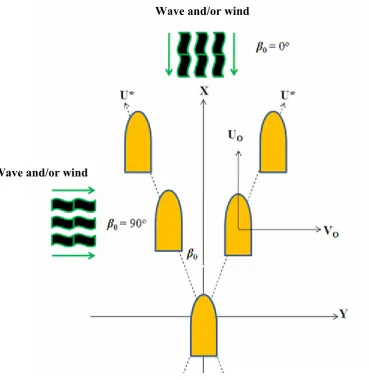
Ships which move at sea will experience lateral drift forces. As seen in Figure 1.2, a ship has set its intended course to Point A. When the ship moves, it will
experience external forces from waves and/or winds causing it to drift at an angle β.
This will cause the ship to drift to the position of point B. The forces caused by waves and/or winds are known as lateral drift.
Wave and/or wind
Wave and/or wind
Figure 1.2: Lateral Drift effects on ship’s movement.
1.3 Problem Statements
The problem statements of the study are as follows:
• What is the method to derive the equation of motions for
Alternative Strip Method?
5
• What are the significant of the effects of lateral drift on ship
motions?
• Is there any other simple approach to solve the problem related to
lateral drift effect on wave-induce motion?
• Is it possible to use original New Strip Method for the specified
problem?
• It is possible to include the effect of lateral drift in view of offset
data?
1.4 Objectives
The objectives of this study are:
1. To develop an Alternative Strip Method for a laterally drifting ship in
waves.
2. To further verify the computation result of ship motions using ASM.
1.5 Scope of Study
The scopes of this thesis are as follows:
1. The application of a Strip Method for ship motions prediction with lateral drift effect.
4. Analysis the results of ASM.
1.6 Significance of the Research
This study was carried out for the purpose of further validation of the effect of the lateral drift on wave-induced motion using the Alternative approach of the strip method. The outcome of this research will be used to verify whether the approach used in this research is applicable to solve recent problem and results pointed out by (Faizul A. A., 2006) [1]. The study will focus on the strip method for a lateral drifting ship in waves using unsymmetrical offset data. The finding of the study will be obtained through the research findings that will be conducted on container ship’s model SR 108.
1.7 Structure of Dissertation
This dissertation has been divided into several chapters. Each chapter has their own subtopics The layout of this dissertation have been organized comprehensively as follows:
7
Chapter 2 describes literature reviews. This section elaborate on the defined coordinate systems, the sign convention of ship oscillation and the use of boundary value problem with making some assumption.
Chapter 3 explains on the methodology for this research. It includes the research procedures and steps in obtaining the offset data and analysis data.
Chapter 4 discusses on the mathematical formulation. In addition, this chapter explains about the pressure and forces that need to be consideration and the equations of motion which define for heave, pitch sway, yaw and rolling motion and all equations have been modified to solve the unsymmetrical body with lateral drift effect.
Chapter 5 discusses the computational program. This chapter elaborates more on the flow of programming working process such as extract more subroutine of program for function of input data file and hull data file.
Chapter 6 discusses the comparison between results of unsymmetrical offset data and results of ASM.
![Figure 1.1: Principle of Strip Theory [2].](https://thumb-us.123doks.com/thumbv2/123dok_us/1369205.1169664/16.595.116.537.321.502/figure-principle-of-strip-theory.webp)