Experimental and simulation Studies of a Two Seater Light
Aircraft
Iskandar Shah Ishak, Shabudin Mat,Tholudin Mat Lazim, Mohd. Khir Muhammad, Shuhaimi Mansor, Mohd Zailani Awang
Department Aeronautics and Automotive, Faculty of Mechanical Engineering,
Universiti Teknologi Malaysia, 81310, UTM Skudai, Johor,
Malaysia.
Abstract: This paper presents the aerodynamic studies carried out on a three-dimensional aircraft model. The test model is a 15%
scaled down from a two-seater light aircraft that close to the Malaysian made SME MD3-160 aircraft. The aircraft model is equipped with control surfaces such as flaps, aileron, rudder and elevator and it is designed for pressure measurement testing and direct force measurement using a 6-components balance system. This aircraft model has been tested at two different low speed tunnels, at Universiti Teknologi Malaysia tunnel sized 1.5 x 2.0 meter2 test section, and at Institute Aerodynamic Research, National Research Council of Canada sized 3 x 2 meter2 tunnel. The speed during testing at UTM and IAR/NRC tunnels was up to 70 meter/second, which is corresponds to Reynolds numbers of 1.3 x 10⁶.The longitudinal and lateral directional aerodynamic characteristics of the aircraft such as coefficients of pressure, forces (lift, drag, side) and moments (roll, pitch and yaw) have been experimentally measured either using direct force measurement or pressure measurement method. The data reduction methods include the strut support interference factor using dummy image and the blockage correction have been applied in this project. The results showed that for the undeployed flap configuration, the stalling angle of this aircraft is 160 at C
LMax = 1.05 measured by UTM - LST, compared to CLMax =1.09 at stalling angle 150 by IAR- NRC. Beside the experimental study, simulation also be performed by using a commercial Computational Fluid Dynamics (CFD) code, FLUENT Version 5.3. Experimental works at UTM and IAR – NRC tunnel show that the aerodynamic characteristics of this light aircraft are in a good agreement with each other. Simultaneously, the aerodynamic forces obtained from experimental works and CFD simulations have been compared. The results proved that they are agreeable especially at a low angle of attack.
1.0 INTRODUCTION
Nowadays, the implementation of wind tunnel testing and simulation by CFD is a must in the stage of the design analysis process. This paper will present the wind tunnel testing technique on a 15% scaled-down model of two-seater light aircraft and the data reduction procedures. CFD simulation also is carried out for comparison purposes.
2.0 EXPERIMENTAL STUDY
A 15% scaled down model of two-seater light aircraft that close to the Malaysian made SME MD3-160 has been selected for the experiment. The testing was previously conducted at IAR/NRC (in Spring of 2000) and later at UTM-LST (in October 2002). For the data reduction, corrections have been made for wind tunnel flow angularity (including balance
misalignment), blockage, buoyancy,wall interference and STI (Strut, Tare and Interference) corrections. The following
discussion is based on the testing conducted at UTM-LST.
2.1 Wind Tunnel Flow Angularity Correction
This correction is to remove the effects of the wind tunnel flow angularity (upwash) and any misalignment between the balance lift vector and the free stream. In order to assess these effects, a model is run upright and inverted with main
struts and dummy struts installed. The two runs are over plotted and the corrections to
α
becomes apparent since in anideal tunnel, the two runs should overlay each other.
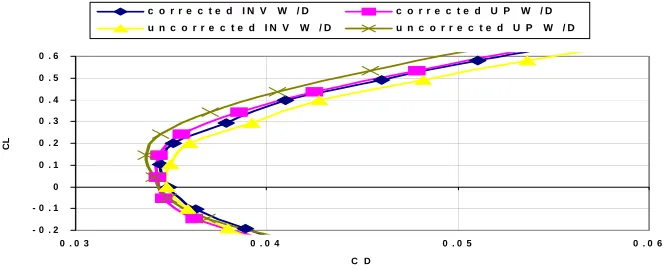
Fig. 2: Results from Upright and Inverted Pitch Runs, Main Dummies Installed
These two curves are parallel but offset by 0.52o. As shown in Barlow, the correction is equal to half of the angle offset
which is 0.26o. Therefore the model-upright data needs to have 0.26o added to the incidence angle and the model-inverted
data needs to have 0.26o subtracted.
The measured drag also needs to be corrected. This arises because the non-orthogonality of the lift vector to the flow means that a small component of the measured lift is actually drag. A shown in Barlow, the additive correction to drag coefficient for an upright model is ∆CD = CL * tan (
α
up) which in this case,α
up is 0.26o.Fig.3: Implementation of Flow UpWash Correction to Drag Polar
2.2 Blockage Correction
In preparation for removal of blockage and buoyancy effects, the data are converted to wind axis. Lift and yawing
moment are unchanged. With the subscripts W for wind axis and S for stability axis, and ψ defined as positive to the
right when viewed from above, the remaining equations are:
CYW = CYS cosψ - CDS sinψ CDW = CDS cosψ + CYS sinψ
- 0 .2 - 0 .1 0 0 .1 0 .2 0 .3 0 .4 0 .5 0 .6
- 5 - 4 - 3 - 2 - 1 0 1 2 3 4 5
a lp h a ( d e g )
CL
u n c o r r e c t e d IN V W /D u n c o r r e c t e d U P W /D
- 0 . 2 - 0 . 1 0 0 . 1 0 . 2 0 . 3 0 . 4 0 . 5 0 . 6
0 . 0 3 0 . 0 4 0 . 0 5 0 . 0 6
C D
CL
CmW = CmS cosψ + ClS sinψ*(b/c) ClW = ClS cosψ - CmS sinψ*(c/b)
The premise of the corrections is based on a perturbation velocity
ε
such that the corrected velocity, VC, can bedetermined from the uncorrected velocity, VU, as follows
VC = VU*(1+ ε) where ε = εsb + εwb
εsb = Solid blockage
εwb = Wake blockage
The rest of the equations are :
qc = qu [1 + (2 – M2) ε] Mc = Mu [1 + (1 + 0.2 M2) ε] Tc = Tu (1 – 0.4M2ε)
Pc = Pu (1-1.4M2ε)
ρc = ρu (1 – M2ε)
2.3 Buoyancy Correction
Before correcting the aerodynamic loads due to the effects of blockage, any buoyancy effects are removed from the wind axis drag.
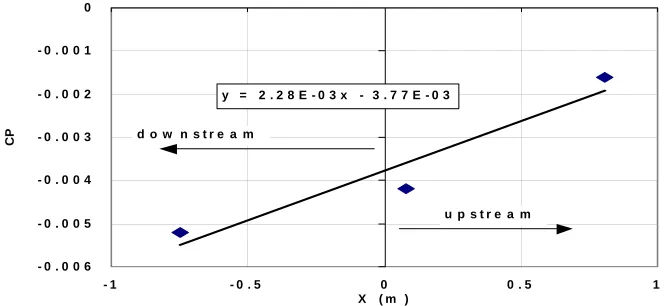
Fig. 4: Static Pressure Gradient in Empty Test Section of UTM-LST
The buoyancy can be expressed as :
∆CD = dCp/dx*(V/S) where S is the wing area and V is the fuselage volume
It is found that the buoyancy correction for the model under test is only about 1 drag count (∆CD = 0.0001).
With the completion of the corrections which are wind-axes based, the results can be transformed back to stability axes as follows (CL and Cn are unchanged) :
CYS = CYW cosψ + CDW sinψ CDS = CDW cosψ - CYW sinψ CmS = CmW cosψ - ClW sinψ*(b/c) ClS = ClW cosψ + CmW sinψ*(c/b)
y = 2 . 2 8 E - 0 3 x - 3 . 7 7 E - 0 3
- 0 . 0 0 6 - 0 . 0 0 5 - 0 . 0 0 4 - 0 . 0 0 3 - 0 . 0 0 2 - 0 . 0 0 1 0
- 1 - 0 . 5 0 0 . 5 1
X ( m )
CP
2.4 Corrections for Wall Interference
These corrections typically represent some of the largest corrections applied to 3D aircraft models. The corrections arise because of the reflection of the wing tip vortices in the tunnel walls, floor and ceiling.
2.5 STI Corrections
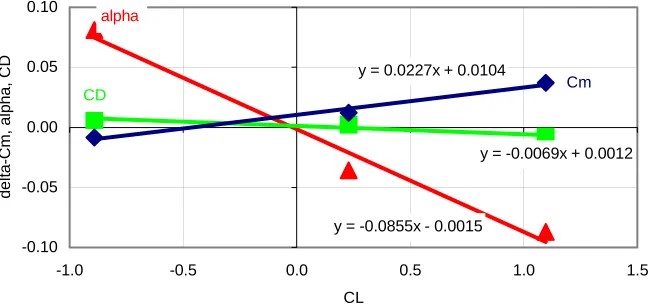
The STI correction are applied as the final correction of this data reduction. Data for STI were collected for a pitch run
only at α= -15°, 0° and +15° owing to current UTM-LST limitations.
y = -0.0855x - 0.0015
y = -0.0069x + 0.0012 y = 0.0227x + 0.0104
-0.10 -0.05 0.00 0.05 0.10
-1.0 -0.5 0.0 0.5 1.0 1.5
CL
de
lt
a-C
m
, a
lpha
,
C
D
alpha
CD Cm
Fig. 5: STI Corrections
STI corrections as developed by subtracting “all dummy inverted” data from “no dummy inverted” data that will need to be subtracted from “no dummy upright” data.
3.0 CFD SIMULATION
For a comparison purpose, simulation is done at a grace of a commercial CFD code, Fluent 5.3. A simplified 15% scaled
model is simulated at 1.3 x 10⁶ Reynolds number and the speed is increased from 60 to 70 m/s. In this project, the
simulations were carried out at two different number of elements, angle of attack varies from 00, 50, 100 and 150 with
using k-epsilon standard. First simulation, the model was simulated at 230 000 elements and second simulation was at 300 000 elements. Results for both simulations were then compared for a validation purposes. This is to ensure that the aerodynamic forces obtained from this study are free from the elements factor. Figure 6 gives a comparison results for both simulations.
CL
Alpha Simulation1 Simulation 2
0o 0.1990 0.2016
5o 0.6588 0.6601
10o 1.0649 1.0611
CFD Simulation for CL
0.0 0.5 1.0 1.5
0 5 10 15 20
Alpha (Deg)
CL
Simulation at 300 000 Simulation at 230 000
Fig. 6: CFD Simulation for CL
From figure 6, it can be seen that the lift coefficient is increased with the increase of angle of attack. There are only about
1% deviation comparatively between this two simulations. Figure 7 shows an example of simulations at 150 and 00 angles
of attack at 230 000 meshing elements.
Fig. 7: Simulation study at 150 and 00 angle of attack.
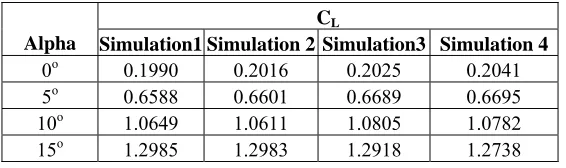
Beside the simulation with k-epsilon standard, the simulation also be done at k-epsilon RNG. Figure 8 shows a comparison of the lift coefficient for k-epsilon standard and k-epsilon RNG. Simulation 1 and 2 represent the lift coefficient for epsilon with 230 000 and 300 000 elements respectively whereas simulation 3 and 4 is the results for k-epsilon RNG with respects to the same amount of elements. Figure 8 shows that the lift coefficient is increased in average by using k-epsilon RNG compared to the k-epsilon standard and obvious at low angle of attack. Since the difference is merely small, the results can be accepted.
CL
Alpha Simulation1 Simulation 2 Simulation3 Simulation 4
0o 0.1990 0.2016 0.2025 0.2041
5o 0.6588 0.6601 0.6689 0.6695
10o 1.0649 1.0611 1.0805 1.0782
15o 1.2985 1.2983 1.2918 1.2738
Fig. 8: Lift Coefficients for k-epsilon and k-epsilon RNG.
The wing and fuselage velocity profile are then analysed, simulation result at the speed of 70 m/s and angle of attack of
50 is discussed. Figure 9 shows a velocity profile on the wing. The highest speed on wing is 90.97 m/s achieved on the
Fig. 9: Velocity profile on wing
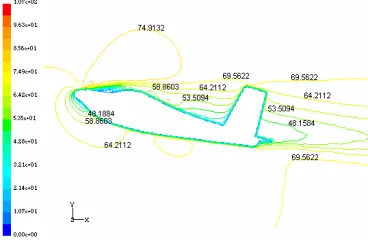
Figure 10 is the velocity profile on the centre of the fuselage at 70 m/s simulation. From this simulation it is found that the speed at the bottom front of this aircraft is only about 58 m/s. The speed behind the aircraft is merely around 48.16 m/s, this is might caused by the flow has been saturated and vortex flow has been generated at this particular location.
Fig. 10: Velocity profile on fuselage
4.0 RESULTS
Figure 11 shows a comparison results for the lift coefficient obtained from both studies in this project. Experimental
study at IAR – NRC showed that this aircraft stalled at 150angle of attack and equivalent to C
lmax of 1.09, whereas Clmax is
found to be 1.05 measured by UTM-LST at angle of attack 160. The coefficient of lift is found slightly higher by CFD
study. For example at 150, CFD depicts the coefficient of lift is about 1.29o whereas IAR/NRC and UTM – LST show
only 1.09o and 1.04o respectively. However, the slopes are agreeable by each other.
CL
Alpha IAR - NRC UTM-LST Simulation1 Simulation 2 Simulation3 Simulation 4
0o 0.24 0.17 0.1990 0.2016 0.2025 0.2041
5o 0.64 0.58 0.6588 0.6601 0.6689 0.6695
10o 0.92 0.88 1.0649 1.0611 1.0805 1.0782
CL Versus Angle of Attack
0 0.2 0.4 0.6 0.8 1 1.2 1.4
0 2 4 6 8 10 12 14 16
Angle of Attack
CL
IAR-NRC UTM-LST SIMULATION 1 SIMULATION 2
Fig. 11: Profile of Lift Coefficient
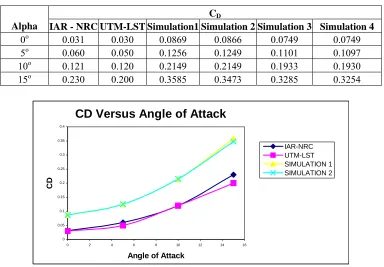
Figure 12 shows the profile of drag coefficient of this aircraft. From the experiment study at IAR/NRC, the drag
coefficient is 0.23 compared to 0.2 measured by UTM-LST at 150angle of attack. This shows that the drag measured by
both tunnels is agreeable each other at low angle of attack. Figure 12 also depicts that the drag coefficient is slightly
higher by CFD study compared to the experimental works. For example at zero angle of attack, CD obtained by CFD is
around 0.08 compared to 0.03 from the experiment. This small deviation may due to the inaccuracy and imperfection of the CFD model.
CD
Alpha IAR - NRC UTM-LST Simulation1 Simulation 2 Simulation 3 Simulation 4
0o 0.031 0.030 0.0869 0.0866 0.0749 0.0749
5o 0.060 0.050 0.1256 0.1249 0.1101 0.1097
10o 0.121 0.120 0.2149 0.2149 0.1933 0.1930
15o 0.230 0.200 0.3585 0.3473 0.3285 0.3254
CD Versus Angle of Attack
0 0.05 0.1 0.15 0.2 0.25 0.3 0.35 0.4
0 2 4 6 8 10 12 14 16
Angle of Attack
CD
IAR-NRC UTM-LST SIMULATION 1 SIMULATION 2
Fig. 12: Profile of Drag Coefficient
5.0 RECOMMENDATION
digitising the scan image of aircraft model using a software called Photomodeller Pro 3.0 might be advantageous. By this, it is hope that a real image of the aircraft model will be obtained.
6.0 CONCLUSION
Throughout this paper, the procedures and result of the experimental and simulation studies have been presented. Results for the lift coefficient show that both studies are in well agreement especially at a low angle of attack. Nevertheless, CFD simulation shows that the drag coefficient is slightly higher than experimental. For the STI Corrections, in future gathering data at a few intermediate angles (+ve and –ve) might be advantageous.
7.0 ACKNOWLEDGEMENT:
1) Institute Aerodynamic Research, National Research Council, IAR – NRC, Ottawa, Canada.
2) SME Aerospace, Kuala Lumpur, Malaysia.
8.0 REFERENCES:
[1]Barlow J.B., et al (1999), “Low Speed Wind Tunnel Testing” 3rd edition, New York: A Wiley – Interscience Publication.
[2] Alan Pope, M.S. (1954), “ Wind Tunnel Testing.” 2nd Edition, New Jersey – PrenticeHall.
[3] Katz,J. and Plotkin, A. (1991). “Low Speed Aerodynamic from wing Theory To Panel Methods.” New
York:McGraw Hill Inc
[4] Anderson, John D. (1995). “Computational Fluid Dynamics – The Basics with Applications”. New
York:McGraw Hill Inc.
[5] Singhal, A.K. ( 1998 ). “Key Elements of Verification and Validation of CFD Software.” Hustville,
AL : CFD Research Corporation.