A Comprehensive Review on Energy
Optimisation in Leach Protocol
Harshita Chaurasiya1, Dr.Shivnath Ghosh2
P.G. Student, Department of Computer Science and Engineering, MPCT, Gwalior, India1
Associate Professor, Department of Computer Science and Engineering, MPCT, Gwalior, India2
ABSTRACT: Wireless Networks includes a larger advantage in today’s communication application like environmental, traffic, military, and health observation. To realize these applications it's necessary to possess a reliable routing protocol. The main challenge in the WSN (Wireless Sensor Network) that researchers are facing is battery life (the power of a node). As a result, the cluster created by this low-energy node died at an early stage, wasting the entire network resource. Here, we have introduced a method for selecting cluster heads and energy efficient clustering. Considering that the LEACH protocol did not take into account the residual energy of the nodes in the cluster head selection, which may involve the selection of the relatively low energy node as the cluster header. As a result, the cluster created by this low-energy node died at an early stage, wasting the entire network resource.
KEYWORDS: Wireless Sensor Network, Cluster-based Routing Protocol, Energy Efficiency
I. INTRODUCTION
Wireless sensor network systems accommodates an oversized range of low-power sensor nodes and conjointly resource-limited devices [1]. These sensor nodes communicate wirelessly primarily via radio. The number of sensor nodes used to study a development may be within the hundreds or thousands, depending on the application. Therefore, a WSN are often both high and high density [2]. Wireless sensor networks are typically employed in massive geographical regions to gather information on environmental device nodes of interest and to produce information to users situated far from the geographical area [3].
It is a form of gathering of knowledge from sensor nodes and their wireless connections from remote areas or generally even hostile environments, depending on how the WSN is employed. The info collected by the sensor nodes may be environmental parameters like temperature, pressure, humidity, etc. o could also be an even image or video depending on the kind of application and also the type of sensory device put in within the nodes [4]. Environmental observation, smart home applications, health applications, wildlife observation, fireplace detection and signal systems, etc. [5].
Each node of a network encompasses a sensor material called sensors, a transceiver, a memory, a microcontroller, and a power supply. The energy needed to work a sensor node is extremely restricted owing to the utilization of batteries as an energy supply. After all, the battery runs out and therefore the node dies, which may result in a network failure. Therefore, energy is extremely necessary for the utilization of a sensor network. To attain the required results of the network, it's important to balance the energy consumption of the sensor nodes [6]. A technique to do this can be to search out a way to reliably route data packets from the nodes to the base. To this end, various sensor network routing protocols are projected and discovered, capable of conserving the energy consumed by the nodes and improving system performance [7].
The most constraints that may have an effect on WSN are as follows:
a.
Limited battery lifeb.
Quality of Service (QoS)c.
Reliabilityd.
Scalabilitye.
Security issues [9].Resource requirements (that is, processing, memory, memory, and communication bandwidth) are typically high for a node that participates in the security logs. There are several cryptographic schemes for WSN. The level of security provided by symmetric key cryptography techniques may not be very high as well as asymmetric key cryptography is not feasible for a WSN if we want to use economic sensor nodes in the system. The energy source for sensor nodes is an alkaline battery that can work between 3.2 and 2V. Therefore, battery life is another important concern. Taking all these limitations into account, it is necessary to design the most balanced security solution possible for a given situation.
II. CLUSTER BASED WSN
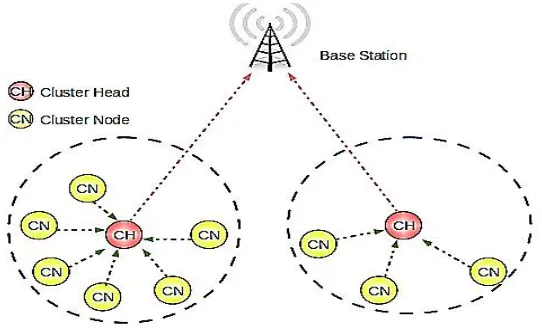
The cluster-based wireless sensor network is used to reduce network consumption and increase energy efficiency. The clustering in WSN is performed to minimize power consumption and reduce the transmission of data on the network required to transmit the message to the BS, since the CH is responsible for communication, which extends the service life of the network.
Figure 1: Cluster based WSN
capabilities. The problem of node energy is one of the main problems in wireless sensor networks [9]. Therefore, it has become one of the key technologies in the exploration of wireless sensor networks, how to ensure network quality and minimize the energy consumption of each node in the network to improve the network life cycle. In many wireless sensor network research projects, the network protocol is an essential part.
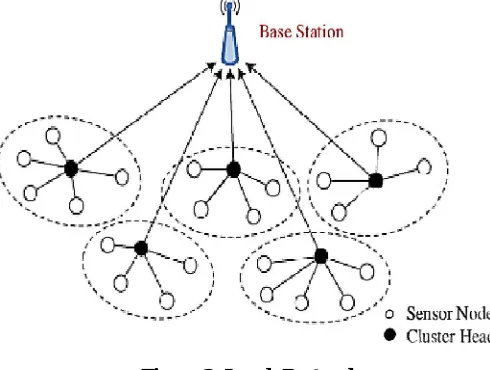
The routing protocol plays an important role in transmitting data from the source by forming a route to the destination via intermediate nodes and also helps to efficiently use the performance of nodes when they are not in transmission mode. The LEACH protocol (Low Energy Adaptive Clustering Hierarchy) is a type of hierarchical routing protocol.
Figure 2: Leach Protocol
LEACH randomly selects certain sensor nodes as cluster heads (CH) and transforms this role to distribute the energy load evenly across the network sensors. In LEACH, cluster header nodes (CH) compress data from nodes belonging to this group and send an aggregate packet to the base station to reduce the amount of information that needs to be sent to the base station. The operation of LEACH is separated into two phases i.e. the setup phase and the steady state phase.
During the construction phase, the clusters are organized and CH channels are selected, while in the stationary phase the actual data transmission to the base station takes place. During the installation phase, a predetermined fraction of nodes, p, is selected as CH as follows. A sensor node selects a random number r between 0 and 1. If this random number is less than a threshold T (n), the node becomes a group head for the current turn. The threshold is calculated based on an equation containing the desired percentage to become a cluster header (p), the current round (r), and the set of nodes that have not been selected as the cluster header in the last one.(1 / P), annotated G.
It is given by:
( ) =
(1− )
if n¢G
Where G is the set of nodes that are involved in the CH election.
III.RADIO ENERGY DISSIPATION MODEL
different amount of energy, so the best one is who sends packets at successful rate with consuming minimum energy [10].
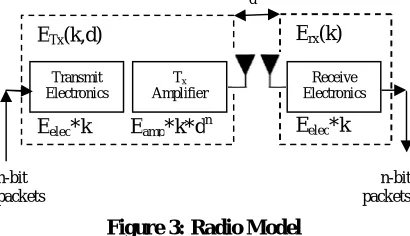
In WSN, the radio energy dissipation model is a simple model of wireless energy consumption. The transmitter circuit dissipates the energy needed to operate the transmission electronics and power amplifiers. The receiver circuit dissipates energy to operate only the electronics of the receiver [11].
The protocols was analyzed by using the radio model which is illustrated in figure 6.
Figure 3: Radio Model
In WSN, the radio energy dissipation model is a simple model of wireless energy consumption. The transmitter circuit dissipates the energy needed to operate the transmission electronics and power amplifiers. The receiver circuit dissipates energy to operate only the electronics of the receiver [12].
Depending on the distance between transmitter and receiver, multiple fade and free space channel patterns are used. The free space model (loss of power d2) is mainly used for communication in a cluster or when the threshold distance is less than d0, while the power loss model d4 is used for communication between clusters. The threshold distance is
greater than or equal to d0. The radio energy consumed by the transmitter to transmit a 1bit message at a distance d is:
(, )= − ( )+ − ( , )
= + , <
= + 4, ≥
And energy consumed by the receiver is:
( )= − ( )=
where Eelec = Per bit energy consumed to execute transmitter and receiver
Efs= amplifier energies for free space
Eamp = amplifier energies for multipath models
The threshold transmission distance may be chosen as follows:
=
IV.EXISTING WORK
With the growth of technology there is increased dependencies on wireless technology. So, WSN is becoming an most important research area. In cluster based routing protocols, sensor nodes are grouped together in a cluster in order to transmit data to the base station. For data transmission there is need to have a cluster head node which may transmit data on behalf of nodes to the base station or other cluster head nodes.
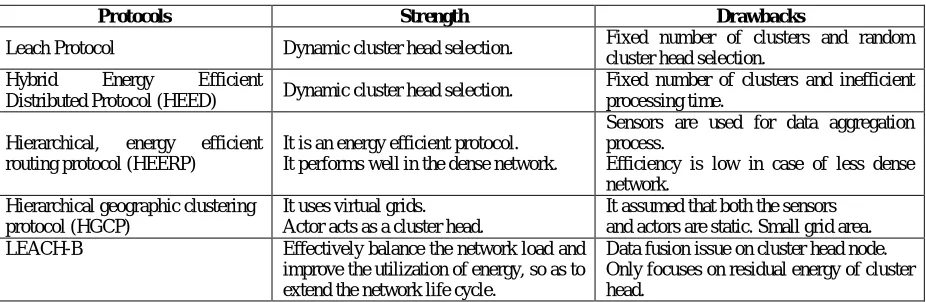
For such high transmission energy is required for cluster head node. So, for efficient utilization of available energy it is necessary to design such routing protocol which may requires less energy and survive in the network for more time. Some of the cluster based mostly routing protocols are analyzed below in Table I:
d
ETx(k,d)
Eelec*k Eamp*k*dn
Erx(k)
Eelec*k
Transmit Electronics
Tx
Amplifier
Receive Electronics
n-bit packets n-bit
Table I: Cluster based Routing Protocols for WSN
Protocols Strength Drawbacks
Leach Protocol Dynamic cluster head selection. Fixed number of clusters and random
cluster head selection.
Hybrid Energy Efficient
Distributed Protocol (HEED) Dynamic cluster head selection.
Fixed number of clusters and inefficient processing time.
Hierarchical, energy efficient
routing protocol (HEERP)
It is an energy efficient protocol. It performs well in the dense network.
Sensors are used for data aggregation process.
Efficiency is low in case of less dense network.
Hierarchical geographic clustering protocol (HGCP)
It uses virtual grids. Actor acts as a cluster head.
It assumed that both the sensors and actors are static. Small grid area.
LEACH-B Effectively balance the network load and
improve the utilization of energy, so as to extend the network life cycle.
Data fusion issue on cluster head node. Only focuses on residual energy of cluster head.
Some of the contribution in designing LEACH protocols are discussed below:
In [1], the method for selecting cluster and cluster heads has improved. First of all, the high convergence and overall optimization capacity of the BIRCH algorithm can substantially divide the whole network area into a plurality of parts. Then, taking into account the residual energy factor in the partial region, the group head is selected. The test result shows that LEACH-B offset the effective network load compared to the conventional LEACH routing protocol and can improve energy efficiency to extend the network life cycle.
In [2] the algorithm improves the LEACH threshold function with the distance and the number of metrics of the adjacent node develops a better energy saving function. Power amplification for selected selected power CH selected to increase network performance. The number of active nodes and the residual energy of a node based on the distance metrics are checked with the existing model. The result of the simulation shows that the proposed scheme has a high impact compared to existing methods for WSN networks.
In [3], the researcher proposed a CH fuzzy election algorithm based on the LEACH protocol. In fact, this algorithm uses the fuzzy logic method and takes into account the three criteria mentioned above. Our results of the simulations are compared with Leach, Election leader group with Fuzzy Logic (CHEF) and classification algorithm defined vague Energy-Aware (EAUCF) and show that our approach proposed these algorithms in terms of extending the life of the network and the residual energy savings exceed.
clustering based routing protocols such as Leach (Low Energy Adaptive Clustering Hierarchy) Heep (TEEN) (efficient sensitive network protocol environment threshold) and PEGASIS effectively control energy consumption. However, these protocols should be carefully studied and reviewed to achieve greater energy efficiency. [4] focuses on the LEACH protocol, with the cluster head selection process (CH) called "round" (r). Each cycle costs the configuration and the steady state phase of the network. Based on LEACH and its variants, the researcher suggests focusing on the energy model (EM). EM is applied to the CH and non-CH nodes to balance the energy in the network.
In [5] Author had designed three levels of performance measurement to monitor the power state of the network, reached the transfer settings for the modified Leach routing protocol, consider as an emergency without failures for a network The long life and management of the energy introduced the WAN. These proposed projects and strategies help the ZigBee network to last longer and reduce energy consumption compared to regular networks and the shared LEACH network.
and distance from BS to BS. The results of the simulation show that MHT-LEACH improves the durability, stability and productivity of the network compared to conventional LEACH.
In [7], an improved technique with multiple hopes (IMHT-LEACH) is proposed. Instead of all cluster heads (CH) to be distributed as MHT-Leach on two levels, IMHT-Leach distributes all CHs on multiple levels. It proposes a new technique for data routing through levels at the base station (BS). The results of the simulation indicate that IMHT-Leach improves the duration, stability and flow of WSN compared to conventional IMHT-Leach and MHT-IMHT-Leach protocols. In [8], when choosing a cluster head, an energy factor was introduced that avoids a node with very low energy at the top of the cluster. In the meantime, we performed a specific Leach simulation that improves the algorithm in terms of network life, network stability, data packet collection, and power consumption. The results of the simulation show that our improved algorithm works better than the LEACH protocol in these aspects.
In [9] we suggest the three Leach, TEEN PEGASIS and TEEN protocols that are more likely to provide better results than Leach and PEGASIS. Furthermore, it is a time-based approach that takes into account the temporal planning of events. This reduces the waste of energy and the life of the network. This review has expanded the current knowledge of energy efficient routing protocols for hierarchical routing.
In [10], the V-LEACH protocol with particle swarm optimization is proposed in the Multihop routing protocol.
In LEACH, the network is randomized into multiple clusters, with each cluster managed by a cluster header (CH). Sensor nodes transmit data to their cluster heads, which transmit aggregate data to the base station. Following problem are faced in LEACH protocols:
Fixed number of clusters. Inefficient processing time.
Only focuses on residual energy for cluster head selection.
V. CONCLUSION
In this paper a comprehensive study of the existing routing protocols for WSAN is presented. The study roughly separates the existing routing protocols into two categories, Cluster-based and non-clustered protocols. Cluster-based protocols structure the physical network in virtual groups, while non-clustered protocols use flood or communication transmission mechanisms. The proposed algorithm would be designed to select a cluster head node that takes into account the residual energy and the distance of each node in the cluster. The proposed algorithm would be designed for mobile nodes that should be energy efficient, scalable and dynamically select the cluster head. Performance should be analyzed in terms of average end-to-end time, packet delivery ratio, and average energy dissipation.
REFERENCES
1. Peng Li, Wanyuan Jiang, He Xu1,Wei Liu, “Energy Optimization Algorithm of Wireless Sensor Networks based on LEACH-B”, Springer, 2017. 2. Krishnakumar A, Dr. Anuratha V, “An Energy-Efficient Cluster Head Selection of LEACH Protocol for Wireless Sensor Networks”, IEEE, 2017. 3. WidedAbidi, TaharEzzedine, “Fuzzy Cluster Head Election Algorithm based on LEACH protocol for Wireless Sensor Networks”, IEEE, 2017.
4. N.G. Palan, B.V. Barbadekar, Suahs Patil, “Low Energy Adaptive Clustering Hierarchy (LEACH) Protocol: A Retrospective Analysis”, International Conference on Inventive Systems and Control, 2017.
5. Ali Al Essa, Xuan Zhang, Peiqiao Wu and AbdelshakourAbuzneid, “ZigBee Network Using Low Power Techniques and Modified LEACH Protocol”, IEEE, 2017. 6. Emad Alnawafa, Ion Marghescu, “MHT: Multi-Hop Technique for the Improvement of LEACH Protocol”, IEEE, 2016.
7. Emad Alnawafa, Ion Marghescu, “IMHT: Improved MHT-LEACH Protocol for Wireless Sensor Networks”, IEEE, 2017.
8. LI XingGuo, WANG JunFeng, Bai LinLin, “LEACH Protocol and its Improved Algorithm in Wireless Sensor Network”, IEEE, 2016. 9. Mr. Tushar Chauhan, Ms. Meenakshi Nayyer, “Review on Energy Efficient Protocol based on LEACH, PEGASIS and TEEN”, IEEE, 2016. 10. Alka Singh, ShubhangiRathkanthiwar, SandeepKakde, “LEACH based-energy efficient routing protocol for wireless sensor networks”, IEEE, 2016.
11. Sanjay Kumar Padhi, Prasant Kumar Pattnaik, ,B.puthal ,” Review of routing protocols in sensor and Adhoc networks,”International Journal of Reviews in Computing (2009- 2010),pp. 11-17.