University of Windsor University of Windsor
Scholarship at UWindsor
Scholarship at UWindsor
Electronic Theses and Dissertations Theses, Dissertations, and Major Papers
2011
Executable Attribute Grammars for Modular and Efficient Natural
Executable Attribute Grammars for Modular and Efficient Natural
Language Processing
Language Processing
Rahmatullah Hafiz University of Windsor
Follow this and additional works at: https://scholar.uwindsor.ca/etd
Recommended Citation Recommended Citation
Hafiz, Rahmatullah, "Executable Attribute Grammars for Modular and Efficient Natural Language Processing" (2011). Electronic Theses and Dissertations. 412.
https://scholar.uwindsor.ca/etd/412
This online database contains the full-text of PhD dissertations and Masters’ theses of University of Windsor students from 1954 forward. These documents are made available for personal study and research purposes only, in accordance with the Canadian Copyright Act and the Creative Commons license—CC BY-NC-ND (Attribution, Non-Commercial, No Derivative Works). Under this license, works must always be attributed to the copyright holder (original author), cannot be used for any commercial purposes, and may not be altered. Any other use would require the permission of the copyright holder. Students may inquire about withdrawing their dissertation and/or thesis from this database. For additional inquiries, please contact the repository administrator via email
Executable Attribute Grammars for Modular and
Efficient Natural Language Processing
by
Rahmatullah Hafiz
A Dissertation
Submitted to the Faculty of Graduate Studies
through School of Computer Science
in Partial Fulfillment of the Requirements for
the Degree of Doctor of Philosophy at the
University of Windsor
Windsor, Ontario, Canada
2011
c
Executable Attribute Grammars for
Modular Natural Language Processing
by Rahmatullah Hafiz
APPROVED BY:
Dr. Guy Lapalme , External Examiner
Dpartement d’informatique et de recherche oprationnelle, University of Montreal
Dr. Richard J. Caron, External Reader
Department of Mathematics and Statistics
Dr. Jianguo Lu, Internal Reader
School of Computer Science
Dr. Luis Rueda, Internal Reader
School of Computer Science
Dr. Richard A. Frost, Advisor
School of Computer Science
Dr. Jichang Wang, Chair of Defense
Department of Chemistry and Biochemistry
Declaration of Co-Authorship / Previous Publication
I. Co-Authorship Declaration
I hereby declare that this thesis incorporates the outcome of joint research
un-dertaken under the supervision of Dr. Richard A. Frost. The collaboration is
covered in Chapters 2, 3, 4 and 5 of the dissertation. In all cases, the key ideas,
primary contributions, experimental designs, data analysis and interpretation,
were performed by the Rahmatullah Hafiz (the candidate) and Dr. Richard A.
Frost (the supervisor) as primary authors and contributors, and for papers
in-cluded in chapters 2 and 3 Dr. Paul Callaghan, from the University of Durham,
was a contributory author.
I am aware of the University of Windsor Senate Policy on Authorship and I
certify that I have properly acknowledged the contribution of other researchers
to my thesis, and have obtained written permission from each of the co-author(s)
to include the above material(s) in my thesis.
I certify that, with the above qualification, this thesis, and the research to
which it refers, is the product of my own work.
II. Declaration of Previous Publication
This thesis includes three original papers that have been previously published,
and one original paper that has been recently accepted for publication in
Thesis Publication title/full citation Publication
Chapter Status
2 Modular and Efficient Top-Down Parsing Published
for Ambiguous Left-Recursive Grammars.
ACL-IWPT, 2007, 109 - 120
3 Parser Combinators for Ambiguous Published
Left-Recursive Grammars.
ACM-PADL, 2008, 167-181
4 Lazy Combinators for Executable Published
Specifications of General Attribute
Grammars. ACM-PADL, 2010, 167-182
5 A System for Modularly Constructing Accepted for publication
Efficient Natural Language Processors.
Computational Linguistics
Applications Conference 2011
I certify that I have obtained written permission from the copyright owner(s) to
include the above published material(s) in my thesis (see Appendix D). I certify
that the above material describes work completed during my registration as
graduate student at the University of Windsor.
I declare that, to the best of my knowledge, my thesis does not infringe
upon anyone‘s copyright nor violate any proprietary rights and that any ideas,
techniques, quotations, or any other material from the work of other people
included in my thesis are fully acknowledged. Furthermore, to the extent that
I have included copyrighted material that surpasses the bounds of fair dealing
within the meaning of the Canada Copyright Act, I certify that I have obtained
a written permission from the copyright owner(s) to include such material(s) in
my thesis.
I declare that this is a true copy of my thesis, including any final revisions,
as approved by my thesis committee and the Graduate Studies office, and that
Abstract
Language-processors that are constructed using top-down recursive-descent with
backtracking parsing are highly modular, and are easy to implement and maintain.
However, a widely-held inaccurate view is that top-down processors are inherently
exponential for ambiguous grammars and cannot accommodate left-recursive syntax
rules. It has been known that exponential time and space complexities can be avoided
by memoization and compact graph-structured representation, and that left- recursive
productions can be accommodated through a variety of techniques. However, until
now, memoization, compact representation, and techniques for handling left-recursion
have either been presented independently, or else attempts at their integration have
compromised modularity and correctness of the resulting parses.
Specifying syntax and semantics to describe formal languages using denotational
notation of attribute grammars (AGs) has been widely practiced. However, very
lit-tle work has shown the usefulness of declarative AGs for constructing computational
models of natural language. Previous top-down approaches fall short in
accommodat-ing ambiguous and general CFGs with arbitrary semantics in one pass as executable
specifications. Existing approaches lack in providing a declarative syntax-semantics
interface that can take full advantages of dependencies between attributes of syntactic
constituents to model linguistically-motivated cases.
syn-tactic and semantic analysis system, which is efficient and accommodates all forms
of CFGs. Moreover, this system provides notation to declaratively specify semantics
by establishing arbitrary dependencies between attributes of syntactic categories to
perform linguistically-motivated tasks such as: building directly-executable
natural-language query processors, computing meanings of sentences using compositional
se-mantics, performing contextual disambiguation tasks, modelling restrictive classes of
Dedication
To my father Md. Hafiz Uddin (1945 - 2009),
Acknowledgements
I express my deepest gratefulness to my supervisor Dr. Richard A. Frost for
believing in me. His passionate curiosity in solving problems, sincere commitment in
creating knowledge, and natural enthusiasm in mentoring have inspired me in every
step of my graduate study. His insightful observations and creative suggestions had
helped me to see the bigger picture and to overcome obstacles on a daily basis. It has
been a privilege to learn from him and to work with him so closely.
I want to convey my sincere thankfulness to my external examiner Dr. Guy
Lapalme, my external reader Dr. Richard J. Caron, and my internal readers Dr. Luis
Rueda and Dr. Jianguo Lu for their constructive feedback on my thesis report and the
defense presentation. I also would like to thank Dr. Paul Callaghan of the University
of Durham for his valuable contribution during the early stage of this work.
My parents’ unconditional love and trust still guide me through many
unproduc-tive days. I am grateful to my parents for providing me with shelves full of books of
diverse content. My heartfelt admiration goes to my wife and best friend Sanjukta
Dutta for handling my long hours with such a grace and understanding. Her integrity,
Contents
Declaration of Co-Authorship / Previous Publication iii
Abstract v
Dedication vii
Acknowledgements viii
1 Introduction 1
1.1 Introduction . . . 1
1.2 Thesis Statement . . . 2
1.3 Top-down Parsing Algorithm for General Syntax . . . 3
1.4 Efficient Combinators for General Syntax . . . 5
1.5 Fully-General Attribute Grammars . . . 8
1.6 NLP Tasks with Modular AGs . . . 11
1.7 Distinguishing Features for Effective NLP Applications . . . 13
Bibliography . . . 16
Grammars 19
2.1 Introduction . . . 20
2.2 Top-Down Backtracking Recognition . . . 26
2.3 Left Recursion and Top-Down Parsing . . . 28
2.4 The New Method . . . 31
2.4.1 Memoization . . . 31
2.4.2 Accommodating direct left recursion . . . 32
2.4.3 Accommodating indirect left recursion . . . 34
2.4.4 Extending recognizers to parsers . . . 36
2.5 Termination . . . 38
2.6 Complexity . . . 39
2.7 Implementation . . . 40
2.8 Experimental Results . . . 40
2.8.1 Tomita’s Grammars . . . 41
2.8.2 Highly ambiguous abstract grammars . . . 42
2.9 Concluding Comments . . . 43
Bibliography . . . 45
3 Parser Combinators for Ambiguous Left-Recursive Grammars 47 3.1 Introduction . . . 48
3.2 Background . . . 52
3.2.1 Top down parsing and memoization . . . 52
3.2.2 The need for left recursion . . . 53
3.3 The Combinators . . . 55
3.3.1 Preliminaries . . . 55
3.3.2 Memoizing recognizers . . . 55
3.3.3 Accommodating direct left recursion . . . 57
3.3.4 Accommodating indirect left recursion . . . 59
3.3.5 Building parse trees . . . 62
3.4 Experimental Results . . . 64
3.4.1 Tomita’ Grammars . . . 64
3.4.2 Highly ambiguous abstract grammars . . . 65
3.4.3 ATIS – A medium size NL grammar . . . 65
3.5 Related Work . . . 66
3.6 Concluding Comments . . . 67
Bibliography . . . 68
4 Lazy Combinators for Executable Specifications of General Attribute Grammars 70 4.1 Introduction . . . 71
4.2 General AGs and Parser Combinators . . . 75
4.3 Executable Specifications of General AGs . . . 76
4.3.1 Preliminaries . . . 76
4.3.2 Combinators for Syntax . . . 78
4.3.3 Accommodating Arbitrary Dependencies in Semantics . . . 80
4.3.4 Declarative Executable Specifications of Semantic Rules . . . . 82
4.5 Complexity Analysis . . . 85
4.6 Implementation and an Example Application . . . 86
4.7 Related Work . . . 88
4.8 Concluding Comments . . . 89
Bibliography . . . 90
5 A System for Modularly Constructing Efficient Natural Language Processors 93 5.1 Introduction . . . 94
5.2 General Notation . . . 95
5.2.1 Operators for Syntactic Analysis . . . 95
5.2.2 Operators for Semantic Analysis . . . 101
5.2.2.1 Computing Meaning . . . 101
5.2.2.2 Using Semantics for Disambiguation . . . 103
5.3 Background . . . 105
5.3.1 Grammar Formalisms . . . 106
5.3.2 Top-Down Parsing with Parser Combinators . . . 106
5.4 Declarative and Executable Attribute Grammars . . . 107
5.4.1 Forming Arbitrary Dependency . . . 107
5.4.2 Construction of Combinators for Executable AGs . . . 109
5.5 Modeling Unification-Based Formalisms . . . 110
5.6 Accommodating Phenomena Beyond Context-Free . . . 113
5.7 Concluding Comments . . . 117
6 Conclusion 120
6.1 Concluding Comments . . . 120
A Formal Properties of Our Approach 124 A.1 Termination . . . 124
A.2 Correctness Analysis . . . 128
A.3 Complexity Analysis . . . 132
A.3.1 Time Complexity w.r.t. the length of inputn . . . 132
A.3.2 Parsing complexity w.r.t. the size of the grammar p . . . 134
A.3.3 Space Complexity w.r.t. the length of the inputn . . . 135
Bibliography . . . 136
B Example NL Query-Processor Using the New Combinators 137 B.1 The Dictionary . . . 137
B.2 Executable Attribute Grammars . . . 142
B.3 Functions for Attribute Evaluation . . . 147
B.4 The Database . . . 151
B.5 Sample NL Input Query . . . 152
C List of Refereed Papers Related to the Thesis 154
D Copyright Releases 156
Chapter 1
Introduction
1.1
Introduction
We still lack systems that can help application developers to seamlessly build domain-specific natural language (NL) processing applications that can accommodate a wide
range of linguistic phenomenon. One way to address this problem is by reducing the gap between the notation that the developers are comfortable working with and
the theoretical foundations that are required for deep linguistic processing. The goal of this thesis is to provide an efficient and modular framework for syntactic and semantic analysis of natural languages. Here I describe the development of a
programming environment, which enables the construction of declarative descriptions of natural languages as directly-executable specifications. (Project home-page: http:
//cs.uwindsor.ca/~hafiz/xsaiga/proHome.html)
An effective natural language processor should accommodate linguistic features such
as correct construction of syntactic analysis, ability to compute meanings of sentences
following linguistic theories, ability to accommodate syntactic and semantic ambiguities,
mechanisms for disambiguation, capability to impose constraints to express characteristics
beyond context-freeness etc. This thesis attempts to provide these features within a
sin-gle system. The foundation of this work is a new top-down parsing algorithm that solves
in-cluding ambiguous left-recursive grammars in polynomial time and space [1, 2]. This
algo-rithm employs a depth-checking and context-determining technique for left-recursive rules,
uses a variation of memoization for time efficiency, and represents the potentially
expo-nential number of ambiguous trees in a compact form for space efficiency. Our approach
has been adopted by Python programmers in developing the Python library parser LEPL
(acooke.org/lepl/implementation.html).
Specifying syntax and semantics to describe formal languages using denotational
no-tation of attribute grammars (AGs) has been practiced extensively. However, very little
work investigates the usefulness of declarative AGs for computational models of natural
lan-guage. I have extended our general syntax analysis approach to allow declaratively coupling
semantic rules with syntax. I have defined a set of combinators (higher-order functions)
that enable the syntactic and semantic description of natural languages, using the
gen-eral notation of AGs, as directly-executable specifications ([3, 4]. The underlying method
depends on referential transparency of purely-functional definitions and on the non-strict
evaluation strategy to establish arbitrary dependencies in semantic rules. The combinators
are implemented in the purely-functional programming language Haskell (haskell.org).
I have proposed an innovative technique [5] that allows parses to be pruned by arbitrary
semantic constraints. This new technique is useful in modelling NL phenomena by
impos-ing unification-like restrictions, accommodatimpos-ing long-distance and cross-serial dependencies,
and performing limited forms of disambiguation tasks which cannot be handled by CFGs
alone.
1.2
Thesis Statement
This report contains four papers addressing different aspects of the theme outlined above.
Collectively these papers and the appendixes prove the following thesis statement:
“It is possible to build an efficient environment for the modular construction of
exe-cutable specifications of arbitrary natural languages where syntactic and semantic rules can
be expressed in a declarative notation.”
background information. Please see Appendix C for a list of all seven papers related to this thesis that I authored/co-authored.
1.3
Top-down Parsing Algorithm for General
Syn-tax
Chapter 2 contains a paper that describes a new top-down parsing algorithm that can accommodate any form of ambiguous context-free grammar (CFG) (including direct and
indirect left-recursive grammars) efficiently. A context-free grammar (CFG) G is 4-tuple
G= (N, T, P, S), where N is a finite set of non-terminals, T is a finite-set of terminals,P
is a finite-set of syntax rules, S is the start non-terminal , N ∩T = φ and (∀pi ∈ P) pi is of the form a ::= b where a ∈ N and b ∈ (N ∪T)∗. The foundation of the algorithm is a traditional recursive-descent backtracking search, which normally fails to terminate
while processing left-recursive grammar rules that would call itself indefinitely unless no
method of prevention is taken. For example, consider the CFG, S ::= S S ‘a‘ | that describes a language containing members of the set {a, aa, aaa, aaaa, aaaa, ...}. The naive recursive descent approach fails for this grammar as the top-most symbolS will keep calling itself endlessly. This grammar is highly-ambiguous (its ambiguity can be represented with
the Catalan number series [6, 7]), and even if left-recursion could be accommodated, the
traditional backtracking search would require exponential time to process this grammar and
exponential amount of space to represent the resulting parses.
The functional description of the top-down recursive-descent parsing algorithm treats
each rule of a grammar as a function-definition, which can contain left and right
re-cursion. Any rule or non-terminal of a CFG, say A, is in the form of A → α where
A∈ {nonterminals}, andα∈({nonterminals} ∪ {terminals})∗. The non-terminalAcan have more than one such definition, which are called alternative definitions. A recursive
rule can be direct (e.g., A ::=α1 A α2) or indirect (e.g., A::= α1 B α2, B ::=α3 A α4
). The primary input arguments of these functions are the input tokens. By the end of one
successful function execution, the rule consumes some or all of the tokens. In case of a right
or more input token, which ensures a finite number of recursive calls. On the other hand, a
left recursive rule does not consume any token before the next recursive call, and thus falls
into an infinite loop without giving all alternatives any chance to try to recognize or parse
any input. One way to accommodate left-recursion with top-down parsing is to convert the
left-recursive grammar into an equivalent right-recursive grammar [8]. But this technique
sacrifices the original syntactic structure that the left-recursive grammar would provide,
and as a result correct natural language semantic computations that utilizes syntactic
con-structs’ meanings may not be viable. Also, the transformation technique can introduce
many new rules in the grammar [9] that will require extra parsing time.
We can infer from the concept of accommodating all possible parses as the result, which
assumes that if all alternative definitions of a rule are applied to each input token then the
rules attempt to compute potentially ambiguous parses is correct (see Appendix A for more
discussion). This is possible when a left-recursive rule is stopped at a depth that provides
just enough of the remaining input for all alternatives to be applied to all of the remaining
input tokens systematically. In order to ensure this correct depth-restriction, our new
top-down algorithm keeps track of recursive calls for the current token and the length of the
input which is currently being processed. Each time a particular rule is being called during
recursive-descent, a ‘counter‘ is incremented by one indicating the depth of the parse. This
parse branch is curtailed when the counter exceeds the length of the remaining input and
the process backtracks to apply another alternative parse, if any exists.
This curtailment of left-recursive calls may cause the computation of incomplete results
for indirect left-recursive rules. This is because some non-terminals, that reside between
the curtailed path for an indirect left-recursive non-terminal, can compute different results
for the same input token in different contexts. As we use memoization to reuse a
non-terminal’s previously computed result for an input token, an intermediate non-terminal
may return a result containing an incomplete result for the current input, even though it
can potentially generates more elaborate result. To avoid this, we explicitly make sure that
the intermediate non-terminals are able to compare the previously-saved context (where the
result was computed) with the current context before reusing.
In this paper, termination of the parsing algorithm, and achieving polynomial time
al-gorithm’s initial implementation with Tomita’s [10] and Earley’s [11] parsing algorithms,
using four practical natural-language grammars, are also performed. This comparison
im-plies that the time and space requirements of the algorithm match well against Tomita’a
and Earley’s, which suggests similar polynomial upper bound of complexities in these three
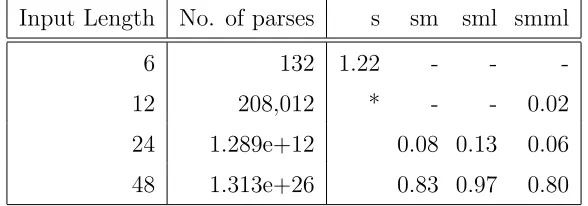
algorithms. The algorithm is also tested with four variations (i.e., non-memoized,
memo-ized left-recursive, memomemo-ized right-recursive, and highly-memomemo-ized versions) of a
massively-ambiguous grammar from Aho and Ullman [7], and it is evident that the algorithm can
generate billions of ambiguous parses compactly within a second when the grammars are
memoized, whereas the non-memoized version quickly runs out of space.
1.4
Efficient Combinators for General Syntax
In functional programming, use of a higher-order function as an infix operator in a
function-definition is known as a ‘combinator‘. A parsing method, which is constructed using
combi-nators, is called ‘combinatory-parsing‘ (as higher-order functions combine different parsers
together). A language-processor can be constructed by combining small processors with
combinators. Though the concept of combinatory-parsing was introduced by Burge in 1975
[12], it was Wadler [13] who first popularized this form of parsing. Wadler showed that
results (success orfailure) of a recognizer can be returned as a list. Multiple entries of this
list represent ambiguous results, whereas an empty list represents a failure.
For programming languages, parsers are generated automatically using tools like Lex
and Yacc (for imperative languages) or Happy (for functional language Haskell). One
drawback of this approach is the user needs to learn a new language (Lex, Yacc or Happy)
to generate a parser. Parser combinators are written and used within the same
program-ming language as the rest of the program. As function application in functional languages
isjuxtaposition, a language-processor written using combinators can be very close in
struc-ture to the BackusNaur Form (BNF) representation of a contextfree grammar. By nastruc-ture, a
combinatory-parsing system is a top-down, recursive-descent (with full backtracking), which
is able to accommodate ambiguity. These parser-combinators are straightforward to
con-struct, readable, modular, well-structured, and easily maintainable and alterable. However,
exhibit exponential time and space complexities at worst case when processing ambiguous
inputs, and they do not terminate when used to represent a left-recursive production rule.
Moreover, the traditional combinators are mostly used as recognizers [14, 15], and not as
complete parsing system.
In Chapter 3 I have included our paper that describes a general top-down parsing algorithm with the help of a set of combinators to take advantage of the modular, declarative
and directly-executable characteristics of parser-combinators. Combinators for sequencing
of symbols (i.e., *>) and for alternative grammar rules (i.e.,<|>) are defined in the
purely-functional languageHaskell ([16]) to form executable context-free syntax rules. Instead of
the more conventional input as a sequence of tokens, these definitions of combinators use
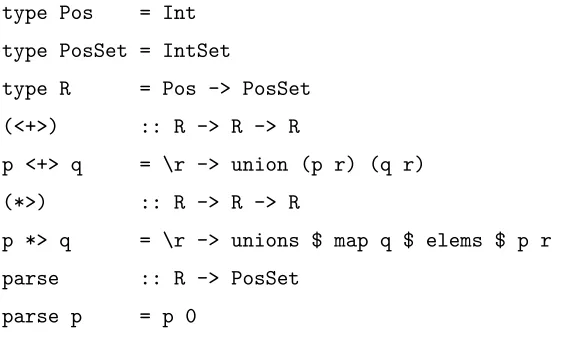
indices. Parser execution is now a mapping from the starting index of an input (Start) to a set of ending indices (End) of the input. This optimized approached is further improved by the use of a Haskell library IntMapfor sets of integers.
This paper shows the systematic development of our combinators from recognizers to
fully fledged parsers. The underlying definitions of these combinators now include
tech-niques (from Chapter 2) for accommodating direct and indirect left-recursion, a
memo-ization to ensure efficiency while processing highly ambiguous grammars, and a recursive
data-structure to represent potentially exponential number of parses in a compact space.
The data-structure that represents the graph of parse trees is of the following form:
type Start/End = Int
data P T ree Label = Leaf Label
| Branch[P T ree Label]
| SubN ode(Label,(Start, End))
The overall result of a non-terminal (that is commonly referred to as a parser) is a list
of theP T reeinstances -Result= [((Start, End),[P T ree Label])]. We form amemo-table with a list of parse names along with respectiveResults, and before every parser execution, the parser checks this table to find a previously computed result for the current input.
constructing parse trees. Ambiguous entries are merged as one entry in the memo-table so
that they are shared between many other entries that have pointers to ambiguous entries.
As non-strict and pure functional languages (e.g., Haskell) do not permit side-effects
(such as: assignments, exceptions, continuation etc), it is relatively complex to perform
operations like IO, maintaining states, raising exceptions, error handling etc. The concept
of a monad, which abstractly describes mathematical structures (categories) and relations
between them, appears as an easy solution to these kinds of problems. Moggi [17] and
other researches demonstrated that maintaining states, raising exceptions, error handling
etc. can be structurally performed using monads. Wadler established monads as a
conve-nient tool for structuring functional programs [18]. As a continuously changing state (or
the memo-table) has to be maintained for all parser executions, we opt to use a version
of the state-monad so that function-definitions can abstract the updated memo-table as
a function parameter implicitly. A changing state-variable can be passed around within
monadic function-definitions without forcing the functions to explicitly operate on it. One
simple way to define a state-monad is as follows:
type State a = S -> (a, S)
unit :: a -> State a
unit x = \s -> (x, s)
bind :: State a -> (a -> State b)-> State b
m ‘bind‘ k = \x -> let (p, y) = m x in
let (q, z) = k p y in (q, z)
Theunit andbind form the state monad. The output type of theunit is of typeState a;
that means a value of typeais contained in a state. Thebind takes two parameters - the first
one, the containerm, is of typeState aand the second one,k, which is a computation that
takes a value of typea(fromm) and returns a new state with the result of the computation
on the value of the type a. Our definitions of combinators satisfy the definitions of unit
computations in thebind are now operations for *>and <|>.
The optimized implementation of the general top-down parsing algorithm as
combi-natory parsers and by using faster Haskell libraries helped us to perform experiments to
utilize our approach in parsing large-scale practical natural language grammars. For
ex-ample, while parsing the grammar for the Air Travel Information System maintained by
Carroll [19], that consists of 5,226 rules with 258 nonterminals and 991 terminals, our
imple-mentation needs, on average, 1.88 seconds to parse ambiguous sentences from the test-set
of 98 NL sentences.
1.5
Fully-General Attribute Grammars
Chapter 4 includes a paper where I describe the extension of the efficient and modular parsing algorithm (chapters 2 and 3) not only for analyzing general context-free syntax but
also for accommodating declarative semantic rules. These semantic rules can be formed
by establishing arbitrary dependencies between syntactic constructs in a syntax rule of a
context-free grammar. Knuth [20] proposed a formalism, called Attribute Grammar (AG),
where the meaning of a formal language can be described in terms of the semantics
asso-ciated with the context-free syntax. In an AG, syntax rules of CFGs are augmented with
semantic rules to describe the meaning of the sentences of a context-free language. Although
different definitions are given, we prefer to define a general AG by imposing minimal
re-strictions on attribute dependencies. An AG is a 3-tuple AG = (G, A, R), where G is the founding CFG, A is a finite set of attributes and R is a finite set of semantic rules. Each
X ∈ (N ∪T) is associated with a set of attributes A(X) ⊂ A, and each a ∈ A(X) can be described by a function/expression r ∈ R. The set A(X) can be partitioned into two sets Ai(X) and As(X), which represent inherited and synthesized attributes respectively. A synthesized attribute is an attribute for the LHS non-terminal of a production rule, and
it can be computed using any attributes from the RHS terminals/non-terminals. Whereas
an inherited attribute is associated with a terminal/non-terminal that resides at the RHS
of the production rule, which can be computed attributes of terminals/non-terminals that
AG-based systems have been mostly used for the specification and construction of
com-pilable parser-generators for programming languages [21, 22, 23, 24]. These systems do not
need to accommodate ambiguity, general CFGs, and the preservation of original syntactic
structures. We differ from them by providing a declarative notation to build AG-like
exe-cutable specifications that strictly preserve the syntactic structure of general and ambiguous
CFGs. Our intended outcome is to take advantage of the modular top-down analyzing
ap-proach to build natural-language specifications where syntax and semantic descriptions can
be constructed and executed piecewise without affecting the rest of the specification in a
one-pass evaluation. Note that, most of the existing AG evaluation techniques require in
two-passes that may require the evaluator to do extra work.
We provide a set of combinators that can be used to build directly-executable AGs
fol-lowing conventional notation. For example, a text-book description of an AG for computing
values of simple arithmetic expressions is:
expr(E0) ::=expe(E1) op (O0) expr(E2)
{E0.val↑=O0.val↑(E1.val↑, E2.val↑)}
| num(N0)
{E0.val↑=N0.val↑}
op(O0) ::= +
{O0.val↑=λxλy(x+y)}
| ∗
{O0.val↑=λxλy(x∗y)}
| etc.
num(N0) ::= 1
{N0.val↑= 1}
| 2
{N0.val↑= 2}
| etc.
In the above, the underlying CFG is left and right recursive, ambiguous, and each syntax
rule (e.g., expr(E0) ::=expe(E1) op(O0) expr(E2)) is coupled with a set of semantic rules
syntactic constructs’ upward-propagating values (i.e., synthesized attributes) or downward
propagating values (i.e., inherited attributes). Using the combinators <|>, *>, parser, nt
etc. we can create notationally-similar executable-specifications of the above AG as follows
(see Chapter 4 for the descriptions of these combinators):
expr = memoize Expr
(parser (nt expr E1 *> nt op O1 *> nt expr E2)
[rule_s VAL OF LHS ISEQUALTO applyBiOp [synthesized VAL OF E1
, synthesized B_OP OF O1
, synthesized VAL OF E2]]
<|>
parser (nt num N1)
[rule_s VAL OF LHS ISEQUALTO copy [synthesized Val OF N1]] )
op = memoize Op
(terminal (term "+") [B_OP (+)] <|>
terminal (term "*") [B_OP (*)] <|> etc.
)
num = memoize Num
( terminal (term "1") [Val 1] <|> terminal (term "2") [Val 2] <|> etc.
When expr is applied to inputs such as1*2-3+5, the executable specification can pro-duce either just the result of the arithmetic expression or complete parse trees with
com-puted values attached in respective nodes. Along with utilizing the efficient top-down
parsing algorithm and a new way to organize the data-structure to process both syntax
and semantics, our approach also depends on non-strict evaluation (or lazy-evaluation or
call-by-need evaluation) strategy that is an integral part of modern purely-functional
lan-guages such as Haskell [25]. This strategy ensures that a function is not evaluated until
We treat the attributes as unevaluated pure-functions, group synthesized and inherited
functions for respective non-terminals, and map the synthesized functions to the ending
po-sitions and inherited functions to the starting popo-sitions of respective non-terminals’
result-sets. Now the result-set contains unevaluated semantic rules instead of attribute values, and
they are evaluated only when they are ultimately required in other functions’ executions.
This method allows to establish arbitrary dependencies (including dependencies from the
right, and except purely circular dependencies) between syntactic constituents in a
syn-tax rule, which is useful in creating linguistically motivated semantic rules. Utilizing this
technique, I have constructed domain-specific natural language query processor that is able
to answer hundreds of thousands of natural-language questions. See Appendix B for the
Haskell code for this query processor.
1.6
NLP Tasks with Modular AGs
Chapter 5 includes a paper that describes applications of our modular and executable attribute grammars (AGs) (chapter 4) for various natural-language processing (NLP) tasks.
These tasks are performed with arbitrary semantics by establishing various dependencies on
syntactic constructs. This approach demonstrates declarative prototyping of compositional
semantics of natural language. During the nineteen seventies in a series of papers Richard
Montague advocated that syntax and semantics of natural languages should be treated
similar to formal languages. His approach (better known as Montague semantic) computes
meaning of a NL phrase by primarily applying higher-order predicate logic and lambda
calculus on syntactic phrases’ meanings. Using our declarative notation for AG, we show
how an efficient set-theoretic version of Montague’s compositional semantics [27] and the
associated CFGs can be integrated to build descriptions of English for computing meaning.
Constraint-based approaches [28, 29] have been used extensively in grammar formalisms
to fulfill many linguistic requirements. The main objective of these formalisms is to unify
grammatical information in atomic or composite grammatical units (e.g., words, phrases,
sentences) by checking or imposing equality expressions on their associated sets of
attribute-value pairs. We propose an innovative technique to impose unification-like restrictions
declarative semantics, we introduce some special-purpose attributes for non-terminals that
are capable of discarding parses that are not satisfied by the condition-checking semantics.
This approach allows us to model unification-like formalisms as executable specification to
impose linguistic restrictions such as grammatical, and number/gender agreements etc.
This form of semantic-based pruning of syntactic structures can also be used to model
cross-serial and long-distance dependencies between syntactic categories that are necessary
for accommodating certain languages, which can not be modelled by CFGs [30]. For
exam-ple, cross-serial dependencies in Dutch, Swiss-German [31] and long-distance dependencies
in relative clauses need a slightly more powerful formalism than CFGs. We can write
declar-ative restrictive semantic to prototype processors for such languages by imposing conditions
on associated syntax rules. We also show that this type of agreement can be used to
dis-ambiguate some types of syntactic ambiguity by using linguistically-sound semantics.
In addition to the informal discussion on various properties of the overall top-down
analysis in individual chapters, Appendix A contains more elaborate discussions on these
properties. These properties include the termination analysis, time and space complexity
analysis, and correctness analysis of the parsing algorithm. As mentioned earlier, Appendix
B contains a sample natural-language database query application, which is constructed the
declarative notation described in this thesis. This application demonstrates the seamless
construction of language processors without mastering the underlying analysis technique.
The format of citations and references in the subsequent chapters are different to that in
the original papers. One uniform format for citations and references is used in all chapters to
conform to the university requirements for doctoral theses. Also, <|>, <+>, and‘orelse‘
are used interchangeably to represent the combinator for alternative rules, and *> and
‘thenS‘ are used interchangeably to represent the combinator for sequencing of symbols
1.7
Distinguishing Features for Effective NLP
Ap-plications
In this section we discuss some of the features of our system that provide advantages to
software developers over other techniques in building effective natural language processing
applications.
Modularity of Top-down Parsing
A top-down process satisfies a fundamental requirement for effective software development
- modularity or separation of concerns. Components of a top-down process can be easily
added or edited without affecting the rest of the system. For example, in a top-down parser,
new alternatives (to a production rule) can be created and tested separately and then added
to a larger parser. In this way, the top-down parser can be constructed piecewise (see
intro-ductory examples in Chapter 5). In our top-down system, a new component consisting of
syntactic and the related semantic rules can be developed and tested separately and then
added as a new alternative. In comparison, a general bottom-up parsing technique requires
maintaining an action table, which needs global change whenever a new rule is added. In
order to accommodate the semantic rules associated with a new syntax rule, the developer
needs to make extensive changes to the whole parser. This dependency between one
com-ponent (the implementation of the processing of the syntax and semantics associated with
a new rule) and the existing parser code violates modularity.
Ambiguity w.r.t. Natural Language Processing
While parsing programming languages, the compiler constructs only one syntax tree.
Am-biguity is undesirable as it may generate more than one machine-code output for program.
However, natural language (NL) is inherently ambiguous. Many NL sentences have more
than one meaning. This is why we want to generate all possible parses while processing
a NL sentence. Each ambiguous parse can potentially generate a different meaning, and
semantic processing is needed to determine which meaning is most likely to be the one
intended. Converting a left-recursive grammar into a non-left recursive form can, in some
Chapter 2 at page 23), and as a result, we may miss the intended meaning of the sentence.
This is why we want to accommodate left-recursive rules directly rather than transform to
non-left-recursive form.
Declarative Specifications
Our declarative combinatory programming approach allows us to build language processors
as executable specifications of syntax and semantics, which are very similar to the standard
declarative Attribute Grammar notation that is frequently used in textbooks (for example)
to describe languages. Owing to the fact that declarative notation does not specify the
order in which the processing associated with the description is to be carried out, reasoning
about the specification is relatively straight forward as equational reasoning and inductive
proofs can be used, rather than more complicated reasoning systems such as temporal logic.
Lazy Evaluation
Owing to the fact that lazy (or non-strict) evaluation delays computations until their
re-sults are needed, our functional combinators allow us to specify arbitrary dependencies
between semantic attributes (including inheritance from the right, where an attribute of a
syntactic component on the right hand side of a production rule can be defined in terms
of an attribute of some syntactic component on its right). The declarative nature of the
programming language, together with lazy evaluation, frees us from considering the order
in which the computations will take place.
In addition, lazy evaluation means that no attribute computation takes place until
required. Therefore even though the semantic rules and the syntactic rules are tightly
inte-grated (each executable production rule can be tested separately) no semantic action takes
place unless a syntactic parse is successful, and only then when the user requires the result.
For example, suppose if the user only wants the results of the first successful parse, then no
other attribute computations are carried out. This can be achieved in a non-lazy language
only through having a two-pass process (create the syntax tree and then compute values
for chosen trees - which results in a separation of the syntax and semantics for each rule)
The Kill Attribute
Our approach allows us to impose restrictions with the Kill attribute. As our evaluation
strategy is lazy, this Kill attribute prevents our one-pass parsing method from generating
unneeded trees, which would otherwise be generated if we had used a two-pass strategy.
Although some capabilities of the Kill attribute (phenomenon that can be accommodated
by CFGs e.g., number-gender agreements) can be achieved in a two-pass strategy by adding
extra grammar rues, that would require extra computational time for processing the added
rules.
Memoization
Memoization causes the reuse of results of functions that have been previously computed.
The use of the functional state-monad allows the procedural aspects of memoization to be
hidden in the executable specification. In fact, the developer of the executable specification
does not even require knowing that memoization is taking place. In particular, there is no
effect on the modularity of the specification, which mirrors the modularity of the grammar.
The use of memoization is quite different to dynamic programming where the developer
needs to think about which results are going to be reused and then develops the program
accordingly. Thus, the structure of the program is affected by the reuse of results. This is
not the case with memoization, which does not influence the structure of the program at
all (other than the insertion of the combinatory ”memoize” in front of functions which are
Bibliography
[1] Frost, R., Hafiz, R.: A new top-down parsing algorithm to accommodate ambiguity
and left recursion in polynomial time. SIGPLAN Notices 41(5)(2006) 46–54
[2] Frost, R., Hafiz, R., Callaghan, P.: Modular and efficient top-down parsing for
am-biguous left-recursive grammars. ACL-IWPT (2007) 109 – 120
[3] Hafiz, R.: Executable specifications of fully general attribute grammars with ambiguity
and left-recursion. In: Proceedings of the 22nd Canadian Conference on AI 2009,
Extended Abstract . (2009) 274–278
[4] Hafiz, R., Frost, R.A.: Lazy combinators for executable specifications of general
at-tribute grammars. In: ACM-PADL. (2010) 167–182
[5] Hafiz, R., Frost, R.A.: A system for modularly constructing efficient natural language
processors. In: Computational linguistics-Applications Conference. (2011)
[6] Church, K., Patil, R.: Coping with syntactic ambiguity or how to put the block in the
box on the table. Computational Linguistics 8, (3-4)(1982) 139–149
[7] Aho, A.V., Ullman, J.D.: The Theory of Parsing, Translation, and Compiling, Vol. 1,
Parsing. Prentice Hall (1972)
[8] Aho, A.V., Sethi, R., Ullman, J.D.: Compilers: Principles, Techniques and Tools.
Addison-Wesley Longman Publishing Co. (1986)
[9] Moore, R.C.: Removing left recursion from context-free grammars. In: Proceedings,
1st Meeting of the North American Chapter of the ACL. (2000)
[10] Tomita, M.: Efficient Parsing for Natural Language: A Fast Algorithm for Practical
Systems. Kluwer Academic Publishers (1986)
[11] Earley, J.: An efficient context-free parsing algorithm. Commun. ACM 13(2) (1970) 94–102
[13] Wadler, P.: How to replace failure by a list of successes. In: FP languages and
computer architecture. Volume 201. (1985) 113 – 128
[14] Frost, R., Launchbury, J.: Constructing natural language interpreters in a lazy
func-tional language. The Computer Journal32(2) (1989) 108–121
[15] Hutton, G., Meijer, E.: Monadic parser combinators. J. Funct. Program. 8(4) (1998) 437 – 444
[16] Hudak, P., Hughes, J., Peyton Jones, S., Wadler, P.: A history of haskell: being
lazy with class. Proceedings of the third ACM SIGPLAN conference on History of
programming languages (HOPL III) (2007)
[17] Moggi, E.: Computational lambda-calculus and monads. In: In Symposium on Logic
in Computer Science, Asilomar, California; IEEE. (1989) 14–23
[18] Wadler, P.: Monads for functional programming. 1st Spring School on Advanced FP
925 (1995) 24 – 52
[19] Carroll, J.: Efficiency in large-scale parsing systems -parser comparison. (2003)
[20] Knuth, D.: Semantics of context-free languages. Theory of Computing Systems,
Springer New York 2(2) (1968) 127–145
[21] Paakki, J.: Attribute grammar paradigms a high-level methodology in language
im-plementation. ACM Comput. Survey 27(2) (1995) 196–255
[22] Ekman, T.: Extensible Compiler Construction. PhD thesis, Comp Science, Lund
University (2006)
[23] Van Wyk, E., Bodin, D., Gao, J., Krishnan, L.: Silver: an extensible attribute grammar
system. In: LDTA. (2007) 103 – 116
[24] Kats, L., Sloane, A., Visser, E.: Decorated attribute grammars. attribute evaluation
meets strategic programming. In: 18th International Conference on Compiler
Con-struction. (2009) 142 – 157
[25] Hughes, J.: Why functional programming matters. The Computer Journal - Special
[26] Bird, R.: Intro. to Functional Programming using Haskell. Prentice Hall (1998)
[27] Frost, R., Fortier, R.: An efficient denotational semantics for natural language database
queries. In: Applications of NLDB. (2007) 12–24
[28] Shieber, S.: An introduction to unification-based theories of grammar,. CSLI Lecture
Notes Series, University of Chicago Press. (1986)
[29] Shieber, S.: Constraint-based grammar formalisms,. The MIT Press, Cambridge,
Massachusetts. (1992)
[30] Joshi, A.K.: Tree adjoining grammars: How much context-sensitivity is required to
provide reasonable structural descriptions? NL Parsing, Cambridge University Press
(1985)
[31] Shieber, S.: Evidence against the context-freeness of natural language. Linguistics and
Chapter 2
Modular and Efficient Top-Down
Parsing for Ambiguous
Left-Recursive Grammars
This paper was published as:
Frost, R., Hafiz, R. and Callaghan, P. (2007) Modular and Efficient Top-Down Parsing
for Ambiguous Left-Recursive Grammars. Proceedings of the 10th International Workshop
2.1
Introduction
Top-down parsers can be built as a set of mutually-recursive processes. Such
implemen-tations are modular in the sense that parsers for terminals and simple non-terminals can
be built and tested first. Subsequently, parsers for more complex non-terminals can be
constructed and tested. Koskimies (1990)[1], and Nederhof and Koster (1993) [2] discuss
this and other advantages of top-down parsing.
In functional and logic programming, top-down parsers can be built using parser
com-binators (e.g. see [3] for a discussion of the origins of parser comcom-binators, and [4] for a
dis-cussion of their use in natural-language processing) and definite clause grammars (DCGs)
respectively. For example, consider the following grammar, in which sstands for sentence,
np for nounphrase,vpfor verbphrase, and detfor determiner:
s ::= np vp
np ::= noun | det noun
vp ::= verb np
det ::= ’a’ | ’t’
noun ::= ’i’ | ’m’ | ’p’ | ’b’
verb ::= ’s’
A set of parsers for this grammar can be constructed in the Haskell functional
program-ming language as follows, whereterm, ‘orelse‘, and ‘thenS‘are appropriately-defined
higher-order functions called parser combinators. (Note that backquotes surround infix
functions in Haskell).
s = np ‘thenS‘ vp
np = noun ‘orelse‘ (det ‘thenS‘ noun)
vp = verb ‘thenS‘ np
det = term ’a’ ‘orelse‘ term ’t’
noun = term ’i’ ‘orelse‘ term ’m’
verb = term ’s’
Note that the parsers are written directly in the programming language, in code which
is similar in structure to the rules of the grammar. As such, the implementation can be
thought of as an executable specification with all of the associated advantages. In particular,
this approach facilitates modular piecewise construction and testing of component parsers.
It also allows parsers to be defined to return semantic values directly instead of intermediate
parse results, and parsers to be parameterized in order to accommodate context-sensitive
languages (e.g. [5]). Also, in functional programming, the type checker can be used to catch
errors in parsers attributed with semantic actions.
Parser combinators and DCGs have been used extensively in applications such as
proto-typing of compilers, and the creation of natural language interfaces to databases, search
en-gines, and web pages, where complex and varied semantic actions are closely integrated with
syntactic processing. However, both techniques are based on top-down recursive descent
search with backtracking. Commonly used implementations have exponential complexity
for ambiguous languages, cannot handle left-recursion, and do not produce compact
repre-sentations of parse trees. (Note, a left-recursive grammar is one in which a non-terminalp
derives an expansion p .. headed with a p either directly or indirectly. Application of a
parser for such a grammar results in infinite descent.) These shortcomings limit the use of
parser combinators and DCGs especially in natural-language processing.
The problem of exponential time complexity in top-down parsers constructed as sets
of mutually-recursive functions has been solved by Norvig (1991) [6] who uses memotables
to achieve polynomial complexity. Norvig’s technique is similar to the use of dynamic
programming and state sets in Earley’s algorithm [7], and tables in the CYK algorithm of
Cocke, Younger and Kasami. The basic idea in Norvig’s approach is that when a parser is
applied to the input, the result is stored in a memotable for subsequent reuse if the same
parser is ever reapplied to the same input. In the context of parser combinators, Norvig’s
approach can be implemented using a functionmemoize to selectively “memoize” parsers.
In some applications, the problem of left-recursion can be overcome by transforming
the grammar to a weakly equivalent non-left-recursive form. (i.e. to a grammar which
that are significantly larger than the original grammars. This problem of grammar size
has been solved by Moore [8] who developed a method, based on a left-corner grammar
transformation, which produces non-left recursive grammars that are not much larger than
the originals. However, although converting a grammar to a weakly-equivalent form is
appropriate in some applications (such as speech recognition) it is not appropriate in other
applications. According to Aho, Sethi, and Ullman [9] converting a grammar to non-left
recursive form makes it harder to translate expressions containing left-associative operators.
Also, in NLP it is easier to integrate semantic actions with parsing when both leftmost and
rightmost parses of ambiguous input are being generated. For example, consider the first
of the following grammar rules:
np ::= noun | np conj np
conj ::= "and" | "or"
noun ::= "jim" | "su" | "ali"
and its non-left-recursive weakly equivalent form:
np ::= noun np’
np’ ::= conj np np’ | empty
The non-left-recursive form loses the leftmost parses generated by the left-recursive
form. Integrating semantic actions with the non-left-recursive rule in order to achieve
the two correct interpretations of input such as["john", "and", "su", "or", "ali"]is
significantly harder than with the left-recursive form.
Several researchers have recognized the importance of accommodating left-recursive
grammars in top-down parsing, in general and in the context of parser combinators and
DCGs in particular, and have proposed various solutions. That work is described in detail
in section 2.3.
In this paper, we integrate Norvig’s technique with aspects of existing techniques for
dealing with left recursion. In particular: a) we make use of the length of the remaining
[2], c) we integrate memoization with a technique for dealing with left recursion as does
Johnson [11], and d) we store “left-recursion counts” in the memotable, and encapsulate
the memoization process in a programming construct called a monad, as suggested by Frost
and Hafiz [12].
Our method includes a new technique for accommodating indirect left recursion which
ensures correct reuse of stored results created through curtailment of left-recursive parsers.
We also modify the memoization process so that the memotable represents the potentially
exponential number of parse trees in a compact polynomial sized form using a technique
derived from the chart parsing methods of Kay [13] and Tomita [14].
As an example use of our method, consider the following ambiguous left-recursive
gram-mar from Tomita (1985) in which pp stands for prepositional phrase, andprep for
prepo-sition. This grammar is left recursive in the rules for sand np. Experimental results using
larger grammars are given later.
s ::= np vp | s pp
np ::= noun | det noun | np pp
pp ::= prep np
vp ::= verb np
det ::= ’a’ | ’t’
noun ::= ’i’ | ’m’ | ’p’ | ’b’
verb ::= ’s’
prep ::= ’n’ | ’w’
The Haskell code below defines a parser for the above grammar, using our combinators:
s = memoize "s" ((np ‘thenS‘ vp) ‘orelse‘ (s ‘thenS‘ pp))
np = memoize "np" (noun ‘orelse‘ (det ‘thenS‘ noun)
‘orelse‘ (np ‘thenS‘ pp))
vp = memoize "vp" (verb ‘thenS‘ np)
det = memoize "det" (term ’a’ ‘orelse‘ term ’t’)
noun = memoize "noun" (term ’i’ ‘orelse‘ term ’m’
‘orelse‘ term ’p’
‘orelse‘ term ’b’)
verb = memoize "verb" (term ’s’)
prep = memoize "prep" (term ’n’ ‘orelse‘ term ’w’)
The following shows the output when the parser function s is applied to the input
string "isamntpwab", representing the sentence “I saw a man in the park with a bat”. It
is a compact representation of the parse trees corresponding to the several ways in which
the whole input can be parsed as a sentence, and the many ways in which subsequences
of it can be parsed as nounphrases etc. We discuss this representation in more detail in
subsection 2.4.4.
apply s "isamntpwab" =>
"noun"
1 ((1,2), [Leaf "i"])
4 ((4,5), [Leaf "m"])
7 ((7,8), [Leaf "p"])
10 ((10,11), [Leaf "b"])
"det"
3 ((3,4), [Leaf "a"])
6 ((6,7), [Leaf "t"])
9 ((9,10), [Leaf "a"])
"np"
1 ((1,2), [SubNode ("noun", (1,2))])
3 ((3,5), [Branch [SubNode ("det", (3,4)), SubNode ("noun",(4,5))]])
((3,8), [Branch [SubNode ("np", (3,5)), SubNode ("pp", (5,8))]])
((3,11),[Branch [SubNode ("np", (3,5)), SubNode ("pp", (5,11))],
Branch [SubNode ("np", (3,8)), SubNode ("pp", (8,11))]])
6 ((6,8), [Branch [SubNode ("det", (6,7)), SubNode ("noun",(7,8))]])
((6,11),[Branch [SubNode ("np", (6,8)), SubNode ("pp", (8,11))]])
5 ((5,6), [Leaf "n"])
8 ((8,9), [Leaf "w"])
"pp"
8 ((8,11),[Branch [SubNode ("prep",(8,9)), SubNode ("np", (9,11))]])
5 ((5,8), [Branch [SubNode ("prep",(5,6)), SubNode ("np", (6,8))]])
((5,11),[Branch [SubNode ("prep",(5,6)), SubNode ("np", (6,11))]])
"verb"
2 ((2,3), [Leaf "s"])
"vp"
2 ((2,5), [Branch [SubNode ("verb",(2,3)), SubNode ("np", (3,5))]])
((2,8), [Branch [SubNode ("verb",(2,3)), SubNode ("np", (3,8))]])
((2,11),[Branch [SubNode ("verb",(2,3)), SubNode ("np", (3,11))]])
"s"
1 ((1,5), [Branch [SubNode ("np", (1,2)), SubNode ("vp", (2,5))]])
((1,8), [Branch [SubNode ("np", (1,2)), SubNode ("vp", (2,8))],
Branch [SubNode ("s", (1,5)), SubNode ("pp", (5,8))]])
((1,11),[Branch [SubNode ("np", (1,2)), SubNode ("vp", (2,11))],
Branch [SubNode ("s", (1,5)), SubNode ("pp", (5,11))],
Branch [SubNode ("s", (1,8)), SubNode ("pp", (8,11))]]
Our method has two disadvantages: a) it has O(n4) time complexity, for ambiguous
grammars, compared with O(n3) for Earley-style parsers [7], and b) it requires the length
of the input to be known before parsing can commence.
Our method maintains all of the advantages of top-down parsing and parser combinators
discussed earlier. In addition, our method accommodates arbitrary context-free grammars,
terminates correctly and correctly reuses results generated by direct and indirect left
recur-sive rules. It parses ambiguous languages in polynomial time and creates polynomial-sized
representations of parse trees.
In many applications the advantages of our approach will outweigh the disadvantages.
In particular, the additional time required for parsing will not be a major factor in the
overall time required when semantic processing, especially of ambiguous input, is taken into
account.
We begin with some background material, showing how our approach relates to previous
work by others. We follow that with a detailed description of our method. Sections 2.5, 2.6,
and 2.7 contain informal proofs of termination and complexity, and a brief description of a
A, and the Haskell code are available from the author’s sitecs.uwindsor.ca/~hafiz.
We tested our implementation on four natural-language grammars from Tomita (1986),
and on four abstract highly-ambiguous grammars. The results, which are presented in
section 2.8, indicate that our method is viable for many applications, especially those for
which parser combinators and definite clause grammars are particularly well-suited.
We present our approach with respect to parser combinators. However, our method
can also be implemented in other languages which support recursion and dynamic data
structures.
2.2
Top-Down Backtracking Recognition
Top-down recognizers can be implemented as a set of mutually recursive processes which
search for parses using a top-down expansion of the grammar rules defining non-terminals
while looking for matches of terminals with tokens on the input. Tokens are consumed from
left to right. Backtracking is used to expand all alternative right-hand-sides of grammar
rules in order to identify all possible parses. In the following we assume that the input is
a sequence of tokensinput, of length l inputthe members of which are accessed through
an index j. Unlike commonly-used implementations of parser combinators, which produce
recognizers that manipulate subsequences of the input, we assume, as in Frost and Hafiz
(2006), that recognizers are functions which take an indexjas argument and which return a
set of indices as result. Each index in the result set corresponds to the position at which the
recognizer successfully finished recognizing a sequence of tokens that began at positionj.
An empty result set indicates that the recognizer failed to recognize any sequence beginning
at j. Multiple results are returned for ambiguous input.
According to this approach, a recognizer term t for a terminal t is a function which
takes an indexjas input, and ifjis greater thanl input, the recognizer returns an empty
set. Otherwise, it checks to see if the token at position j in the input corresponds to the
terminalt. If so, it returns a singleton set containingj + 1, otherwise it returns the empty
set. For example, a basic recognizer for the terminal ’s’ can be defined as follows (note
a wide audience. We also use a list lookup offset of 1):
term_s = term ’s’
where term t j
= {} , if j > l_input
= {j + 1}, if jth element of input = t
= {} , otherwise
The emptyrecognizer is a function which always succeeds returning its input index in
a set:
empty j = {j}
A recognizer corresponding to a construct p | qin the grammar is built by combining
recognizers forpandq, using the parser combinator‘orelse‘. When the composite
recog-nizer is applied to index j, it appliesptoj, then it appliesqtoj, and subsequently unites
the resulting sets.:
(p ‘orelse‘ q) j = unite (p j) (q j)
e.g, assuming that the input is "ssss", then
(empty ‘orelse‘ term_s) 2 => {2, 3}
A composite recognizer corresponding to a sequence of recognizersp qon the right hand
side of a grammar rule, is built by combining those recognizers using the parser combinator
‘thenS‘. When the composite recognizer is applied to an index j, it first applies p to j,
then it applies qto each index in the set of results returned by p. It returns the union of
these applications of q.
e.g., assuming that the input is "ssss", then
(term_s ‘thenS‘ term_s) 1 => {3}
The combinators above can be used to define composite mutually-recursive recognizers.
For example, the grammarsS ::= ’s’ sS sS | empty can be encoded as follows:
sS = (term_s ‘thenS‘ sS ‘thenS‘ sS) ‘orelse‘ empty
Assuming that the input is "ssss", the recognizer sS returns a set of five results, the
first four corresponding to proper prefixes of the input being recognized as ansS. The result
5corresponds to the case where the whole input is recognized as an sS.
sS 1 => {1, 2, 3, 4, 5}
The method above does not terminate for left-recursive grammars, and has exponential
time complexity with respect to l inputfor non-left-recursive grammars. The complexity
is due to the fact that recognizers may be repeatedly applied to the same index during
backtracking induced by the operator ‘orelse‘. We show later how complexity can be
improved, using Norvig’s memoization technique. We also show, in section 2.4.4, how the
combinatorsterm, ‘orelse‘, and ‘thenS‘can be redefined so that the processors create
compact representations of parse trees in the memotable, with no effect on the form of the
executable specification.
2.3
Left Recursion and Top-Down Parsing
Several researchers have proposed ways in which left-recursion and top-down parsing can
coexist:
1) Kuno [10] was the first to use the length of the input to force termination of
of the remaining input, expansion of the current non-terminal is terminated. Dynamic
programming in parsing was not known at that time, and Kuno’s method has exponential
complexity.
2) Shiel [15] recognized the relationship between top-down parsing and the use of state
sets and tables in Earley and SYK parsers and developed an approach in which procedures
corresponding to non-terminals are called with an extra parameter indicating how many
terminals they should read from the input. When a procedure corresponding to a
non-terminal n is applied, the value of this extra parameter is partitioned into smaller values
which are passed to the component procedures on the right of the rule defining n. The
processor backtracks when a procedure defining a non-terminal is applied with the same
parameter to the same input position. The method terminates for left-recursion but has
exponential complexity.
3) Leermakers [16] introduced an approach which accommodates left-recursion through
“recursive ascent” rather than top-down search. Although achieving polynomial complexity
through memoization, the approach no longer has the modularity and clarity associated
with pure top-down parsing. Leermakers did not extend his method to produce compact
representations of trees.
4) Nederhof and Koster [2] introduced “cancellation” parsing in which grammar rules
are translated into DCG rules such that each DCG non-terminal is given a “cancellation
set” as an extra argument. Each time a new non-terminal is derived in the expansion of a
rule, this non-terminal is added to the cancellation set and the resulting set is passed on to
the next symbol in the expansion. If a non-terminal is derived which is already in the set
then the parser backtracks. This technique prevents non-termination, but loses some parses.
To solve this, for each non-terminaln, which has a left-recursive alternative 1) a function is
added to the parser which places a special tokennat the front of the input to be recognized,
2) a DCG corresponding to the rulen ::= n is added to the parser, and 3) the new DCG
is invoked after the recursive DCG has been called. The approach accommodates
left-recursion and maintains modularity. An extension to it also accommodates hidden left
recursion which can occur when the grammar contains rules with empty right-hand sides.
The shortcoming of Nederhof and Koster’s approach is that it is exponential in the worst
code to insert the special tokens.
5) Lickman [17] defined a set of parser combinators which accommodate left recursion.
The method is based on an idea by Philip Wadler in an unpublished paper in which he
claimed that fixed points could be used to accommodate left recursion. Lickman
imple-mented Wadler’s idea and provided a proof of termination. The method accommodates left
recursion and maintains modularity and clarity of the code. However, it has exponential
complexity, even for recognition.
6) Johnson [11] appears to have been the first to integrate memoization with a method
for dealing with left recursion in pure top-down parsing. The basic idea is to use the
continuation-passing style of programming (CPS) so that the parser computes multiple
re-sults, for ambiguous cases, incrementally. There appears to have been no attempt to extend
Johnson’s approach to create compact representations of parse trees. One explanation for
this could be that the approach is somewhat convoluted and extending it appears to be
very difficult. In fact, Johnson states, in his conclusion, that “an implementation attempt
(to create a compact representation) would probably be very complicated.”
7) Frost and Hafiz [12] defined a set of parser combinators which can be used to create
polynomial time recognizers for grammars with direct left recursion. Their method stores
left-recursive counts in the memotable and curtails parses when a count exceeds the length
of the remaining input. Their method does not accommodate indirect left recursion, nor
does it create parse trees.
Our new method combines many of the ideas developed by others: as with the approach
of Kuno (1965) we use the length of the remaining input to curtail recursive descent.
Follow-ing Shiel (1976), we pass additional information to parsers which is used to curtail recursion.
The information that we pass to parsers is similar to the cancellation sets used by Nederhof
and Koster (1993) and includes the number of times a parser is applied to each input
posi-tion. However, in our approach this information is stored in a memotable which is also used
to achieve polynomial complexity. Although Johnson (1995) also integrates a technique
for dealing with left recursion with memoization, our method differs from Johnson’s O(n3)
approach in the technique that we use to accommodate left recursion. Also, our approach