Copyright to IJIRCCE DOI: 10.15680/IJIRCCE.2016. 0406153 11866
A Study on Next Generation Communication
Technology: 5G
Niraj Kumar Tiwari, Abhishek Kumar Pandey, Prashant Srivastava
Assistant Professor, Department of Computer Science & Engineering, SIET, Allahabad, U.P., India
Associate Professor, Department of Computer Science & Engineering, SIET, Allahabad, U.P., India
Assistant Professor, Department of Computer Science & Engineering, SIET, Allahabad, U.P., India
ABSTRACT: The use of mobile communication networks has increased significantly in the past decades, in terms of complexity of applications, their required capacities, and heterogeneity of device types. So far, this trend has always been met by significant technological advancements and will continue to increase. Fifth-generation (5G) technology is a new revolution in today's global world because the number of people using mobile Devices in the world has exceeded Around 7 billion and this figure is continuing to grow. The objective of this paper is provides an inclusive and comprehensive analysis of recent developmental endeavors toward. In 5G, researches are related to the development of World Wide Wireless Web (WWWW), Dynamic ADHOC Wireless Networks (DAWN) and Real Wireless Communication. The most important factor of 5G technologies are Wireless Services for Local Area Networks (LAN) and Metropolitan Area Networks (MAN), Ad-hoc Persona area Network (APAN) and Wireless networks for digital communication. In Fourth Generation technology will include a lot of standards under a common umbrella, similar to Third Generation, but with IEEE 802.xx wireless mobile networks Integrated from the commencement. Nowadays Third generation mobile systems are on the ground providing IP connectivity for RTS and Non RTS. The main characteristic of 5G wireless network is that client can simultaneously connect the many wireless technologies and can
switch between them. This impending mobile technology will support flat IP and IPV6. Fifth Generation technology
will Provide the services like Documentation, supporting electronic transactions (Electronic Payments, Electronic transactions) etc.
KEYWORDS: Wireless networks, 5G Architecture, Evolution from First Generation to Fifth Generation, Remote servers, WWWW, Radio Access Network, Quality of Service.
I. INTRODUCTION
after World War II. Technologies used in 0G systems incorporated PTT (Push to Talk), MTS (Mobile Telephone System), AMTS (Advanced Mobile Telephone System), OLT (Norwegian for Offending Land mobile Telephony), and IMTS (Improved Mobile Telephone Service). Fifth generation should be more intelligent technology that interconnects the entire world without limits. The world of universal, uninterrupted access to information, entertainment and communication will open new dimension to our lives and change our life style significantly.
II. EVOLUTION OF MOBILE GENERATION First Generation:
The First Generation emerged in the early 1980s .FDMA [Frequency Division Multiple Access] Use of Analog Communication in 1G for Cell Phones Mobile Telephony. It Provides Voice Calls With Speed Up To 2.5 Kbps phone. It won't be like this for mobile telephone systems (MTS), advanced mobile phone system (AMTS), improved mobile telephone service (IMTS) introduction of mobile technologies, and push to talk (PTT). This frequency 150 MHz, a frequency-division modulation technique voice calls is used, which uses analog radio signal multiple access (FDMA) voice calls were after all the poor, handoff unreliable voice capacity, links, and no security to keep unwanted largely by third parties to make a victim of these calls Played back, radio towers
Second Generation:
2G emerged in late 1980s. It uses digital signals for voice transmission and has speed of 64 kbps. It provides Facility of SMS (Short Message Service) and use the bandwidth of 30 to 200 KHz. Next to 2G, 2.5G system uses packet switched and circuit switched domain and provide data rate up to 144 kbps. e.g. GPRS, CDMA and EDGE. In Finland [1990] A Standard System Is Introduced In Communication That Is GSM (Global System For Mobile Communication) With Digital Voice Technique With Implementation Of FDMA, TDMA With Improved Speed Around 64 Kbps, Known As 2G. After That 2g To 2.5G Circuit Switching And Packet Switching Technique Are Used By System Which Gives Data Rate Of 144 Kbps Such As GPRS, CDMA And EDGE. The Global System for Mobile communications (GSM) gained the most popularity as 2G digital system with data transmission up to 9.6 kbps. GSM was introduced in 1990and then evolved in 1995 with general packet radio service (GPRS) where GPRS is a radio technology for GSM networks that adds packet-switching protocols.
Third Generation:
International Mobile Telecommunications-2000, better known as 3G, is a production of values for mobile phones and mobile telecommunications services satisfying condition by the International Telecommunication Union. Data packets are sent through the technology called switching. Voice calls are explained through circuit switching. Verbal communication as well as its data services, television/video, like new, used for global roaming services. It operates at 2100MHz and high speed Internet service is a bandwidth of 15-20MHz used, video chatting. The Improvement In Communication Speed From 144kbps To 2Mbps Provides In 3G With Packet Switching Technology. 3G Technology Provides A Better, Uninterrupted Way Of Video Conferencing, Video Calling, Voice Over IP (VOIP), Online Gaming, Access To Global Roaming And Mobile TV Etc. 3G Technology Is Used Wide Band Voice Channel Which Provides Fast Communication.3.5G Provides Faster Downloading Internet Service.
Fourth Generation:
Copyright to IJIRCCE DOI: 10.15680/IJIRCCE.2016. 0406153 11868
Fifth Generation:
The 5G system will be the wireless enabler of the internet of things and, in addition to human users, must cater to different machine-type communications with widely different requirements.5G terminologies is not officially or technically adopted as it is indeed in research phase in communication field. This new expected technology is submitted into the standard arms. The idea was raised for new proposal of technology in 2012-2013 and expected release will be around 2020 and the expectation of communication world is totally wire less as WWWW. the commencement of the concept with the following amazing ultra densification, mm wave and massive MIMO (multiple input multiple output), the 5G will include massive featuring of very fast communication, more advanced security, SDR security (software define ratio), multiple data transfer path, better cognitive radio and huge bandwidth. MIMO stands for multiple input and Multiple Output. In wireless communication system this method is used to increase the capacity of channel in radio link using multiple transmit and receive antennas. MIMO has become an important element of wireless communication system standards including IEEE 802.11ac (WI-FI), WI-MAX (4G) etc. it has been mentioned that MIMO system consist multiple antennas at both the transmitter and receiver. Major advantages of 5G network in providing a lot of services to end users personalization, terminal and network divergent, intelligence
networking and network convergence among other benefits are highlighted.
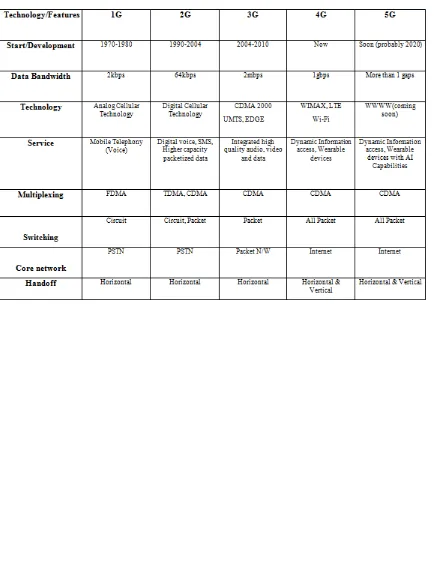
Figure 1: Evolution of All generation Technology III. COMPARISON OF ALL GENERATION TECHNOLOGY
Copyright to IJIRCCE DOI: 10.15680/IJIRCCE.2016. 0406153 11869
Table 1: Comparisons of Generations
Copyright to IJIRCCE DOI: 10.15680/IJIRCCE.2016. 0406153 11870
IV. FIFTH GENERATION ARCHITECTURE Need of 5G:
5G network can provide more facilities approach to a common man to utilize his available possessions in an enormous way to make him to feel the real progress. As a user point of view, the major difference between current generations and expected 5G techniques must be something else than increased maximum throughput; other requirements include:
i) It could make better revenue for current global operators as well as interoperability will become more feasible.
ii) Improved and innovative data coding and modulation techniques, which includes filter bank multi carrier way in
schemes.
iii) For wireless access and back haul use of millimetre wave frequencies is very useful.
iv) With the support of different conduction points with related coverage and surrounding the option of a supple usage
of resources for uplink and down link transmission in each cell is achieved by superior intrusion and mobility management.
v) To make 5G practical for all sorts of radio access technologies there should be a common platform unique for all the
technologies.
vi) Lower battery consumption & cheaper traffic fees due to low infrastructure deployment costs.
vii) Lower outage probability & multiple concurrent data transfer paths.
viii) More applications combined with Artificial Intelligent (AI) as human life will be surrounded by artificial sensors which could be communicating with mobile phones.
ix) Not harmful to human health & smart beam antenna systems.
x) Possible to1Gbps and higher data rate in mobility.
xi) More secure; better cognitive radio/SDR Security.
xii) Higher system level spectral efficiency.
xiii) World Wide Wireless Web (WWWW), wireless-based web applications that include full multimedia capability beyond 4G speeds.
Features of 5G Technology:
5G technology offer high resolution for cell phone users and bi-directional large bandwidth. The advanced billing interfaces of 5G technology makes it more attractive and effective. 5G technology also provides subscriber supervision tools for fast action. The high quality services of 5G technology based on Policy to avoid error. 5G technology is providing large broadcasting of data in Gigabit which will support almost 65,000 connections. The traffic statistics by 5G technology makes it more accurate. Through remote management offered by 5G technology a user can get better and fast solution. The uploading and downloading speed of 5G technology touching the peak.
5G Technology Specifications:
The parameters and their standards are yet to be defined for 5G technology. But from the estimated requirements of the 5G technology, some of the specifications can be defined as follows:
Data Rates: 1 to 10 Giga bits per second (Gbps) to the end mobile users.
Latency: Less than 1 millisecond (< 1ms).
Bandwidth: 1000 times the present bandwidth per unit area.
Signal Availability: 99.999
Power Consumption: 90% reduction in energy usage.
5G System Architecture:
The demands on 5G are stacking up. The technology will be called upon to deliver performance that is orders of magnitude higher than today’s networks, including1 ms network latency, more than10 Gbps peak data rates, 100 Mbps throughput anywhere and 10,000 times more capacity compared to 2010. 5G will also need to support 100 times more devices and have extreme reliability, which is becoming critical as mobile communications are increasingly used for control and safety. In Fifth Generation Network Architecture all IP based mobile applications and services such as Mobile portals, Mobile commerce, Mobile health care, Mobile government, Mobile banking and others, are offered via Cloud Computing Resources. The system consists of a user terminal and a number of independent, autonomous radio access technologies. Fifth generation mobile wireless and mobile network system model for all IP-based models. All-IP network (AIPN) cellular communication market is able to meet the growing demand. It technology Uses packet switching AIPN and provides customized performance and continued development costs all radio is a common platform for access. The concept of handheld devices is going to be revolutionized with the advent of 5G.Through 5G technology you can see Worldwide cellular phones and this technology also strike the world market.
Copyright to IJIRCCE DOI: 10.15680/IJIRCCE.2016. 0406153 11872
V. CONCLUSION
In this paper, we explain different mobile technology we want to include in a future mobile network. Fifth Generation mobile technology will offer high data rate, efficient and reliable communication at an affordable rate. It is possible to keep the network as simple, and ultimately deliver more functionality's initial Internet nodes for philosophy; mobile networks will become reality in the future generations of hope, here referred to as 5G.This technology helps to promote stronger links between people working in different fields creating future concepts of mobile communication, internet service, cloud computing and nanotechnology. Hence 5G will connect the entire network operators with single core and single infrastructure, 4G and 5G techniques will consume low battery, better coverage, high bit rates, and no infrastructure fees due to low infrastructure deployment cost, many users can use simultaneously.
VI. FUTURE SCOPE
5G is an opportunity for the industry to address this need with a single unified protocol stack for all services on the Internet, given that mobile is now the dominant use case. It can provide significant improvements: radio technology neutral, improved scalability and security, “flat” network structure, enhanced mobility functions. In future, there is a need to develop a new detection algorithm that can support the broad level of network integration promised the 5Gwireless system. 5G technology will provide supper and perfect utilization of cellular communication in future. We can monitor any place of the world from anywhere, observe space and watch TV channels at HD clarity in our mobile phones without any interruption. There will be exciting amusement unbelievable services. The 5G mobile phones will be a tablet PC and amazing. Many mobile embedded technologies will evolve .The 5G technologies include many types of advanced features and high efficient which make this technology most Dominant technology in near future.
REFERENCES
[1]A. Mahmood, "Cooperative Diversity in Wireless Networks ”,Journal of Computer Science and Engineering, pp. 184-187, Review 3 (1) (2010). [2] Aleksandar Tudzarov, Toni Janevski “Functional Architecture for 5G Mobile Networks” International Journal of Advanced Science and Technology Vol. 32, July, 2011.
[3] Aman Aryaputra, Bhuvaneshwari.N, “5G- The Future of Mobile Network”, Proceedings of the World Congress on Engineering and Computer Science 2011 Vol II WCECS 2011, October 19-21, 2011, San Francisco, USA
[4] Saurabh Patel, et. Al." 5G: Future Mobile Technology-Vision 2020 ", International Journal of Computer Applications (0975 – 8887) Volume 54– No.17, September 2012
[5] Ms Reshma S. Spakal, Ms Sonali S.Kadam,”5G Mobile Technology ", International Journal of Advanced Research in Computer Engineering & Technology (IJARCET) Volume 2, Issue 2, February 2013.
[6] Ms. Neha Dumbre, Ms. Monali Patwa, Ms. Kajal Patwa, “5G Wireless technologies” International Journal of Science, Engineering and Technology Research (IJSETR) Volume 2, Issue 2, February 2013.
[7] Pratishruti Saxena, Dr. Sanjay Kumar,”Challenges & Evolution of Next Generation in Mobile Communication Network”, International Journal of Advanced Research in Computer Science and Software Engineering, Volume 4, Issue 9, September 2014 ISSN: 2277 128X.
[8]M. Sathiya1, R. Gowthami2, G. Karpagam3, B. Saranya4, U. Suganya5, “cellular and network architecture for 5g wireless communication networks in mobile technology”, International Journal of Technical Research and Applications ISSN: 2320-8163, Volume 3, Issue 2 (Mar-Apr 2015), PP. 206-211.