University of Windsor University of Windsor
Scholarship at UWindsor
Scholarship at UWindsor
Electronic Theses and Dissertations Theses, Dissertations, and Major Papers
1-1-1967
Transient stress concentration.
Transient stress concentration.
Sharad Kumar
University of Windsor
Follow this and additional works at: https://scholar.uwindsor.ca/etd
Recommended Citation Recommended Citation
Kumar, Sharad, "Transient stress concentration." (1967). Electronic Theses and Dissertations. 6486.
https://scholar.uwindsor.ca/etd/6486
TRANSIENT STRESS CONCENTRATION
A Thesis
Submitted to the Faculty of Graduate Studies through the Department of Mechanical Engineering in Partial Fulfilment
of the Requirements for the Degree of Master of Applied Science at the
University of Windsor
by
Sharad Kumar
UMI N um ber: E C 5 2 6 6 7
INFORMATION TO USERS
The quality of this reproduction is dependent upon the quality of the copy
submitted. Broken or indistinct print, colored or poor quality illustrations and
photographs, print bleed-through, substandard margins, and improper
alignment can adversely affect reproduction.
In the unlikely event that the author did not send a complete manuscript
and there are missing pages, these will be noted. Also, if unauthorized
copyright material had to be removed, a note will indicate the deletion.
UMI
UMI Microform EC52667
Copyright 2008 by ProQuest LLC.
All rights reserved. This microform edition is protected against
unauthorized copying under Title 17, United States Code.
ProQuest LLC 789 E. Eisenhower Parkway
/ )
APPROVED BY : /
ABSTRACT
This study reports an experimental investigation of
stress concentration at a discontinuity in a structural
member loaded dynamically*
The geometry considered was a thin rectangular bar of
finite width containing a semicircular discontinuity located
symmetrically on opposite sides* The experimental procedure
involved dynamic photoelasticity with a high intensity micro
flash and the low modulus urethane model material* The
dynamic loading resulted from a falling mass*
The size of the discontinuity and the time after impact
were the two parameters considered and the investigation was
restricted mainly to the comparison of;
(1) Dynamic and static stress concentration factor
(2) Response of the discontinuity to tensile and
compressive impact*
It was found in this case, that the dynamic stress con
centration factor was always lower than the corresponding
static value; however, it increases as the discontinuity
becomes smaller. The stress concentration factor also
increases with time after impact in the range of time
considered with a trend indicating an optimum.
It was concluded that in the dynamic case, some of the
energy associated with the propagating stress wave was
captured by regions of low stress, hence reducing the
stress concentration at the critical points.
Little variation was apparent in dynamic stress concen
tration when the propagating stress wave was tensile or
compressive in nature.
ACKNOWLEDGMENT
The guidance, help, and constructive criticism
given to me by Dr, W,P,T, North during various
stages of this work is sincerely appreciated.
The financial support of the Defence Research
Board, Grant Number 1330-02, which made this work
possible, is highly valued*
Special thanks is given to Mrs, Jean Deslippe
CONTENTS
Page
ABSTRACT iii
ACKNOWLEDGMENT V
TABLE OF CONTENTS vi
LIST OF FIGURES
NOMENCLATURE xi
CHAPTER
1 INTRODUCTION 1
1.1 Importance of Dynamic Stress Concentration 1
1.2 Scope of this Investigation 1
2 LITERATURE REVIEW 2
2.1 Stress Concentration 2
2.2 Dynamic Stress Concentration 2
3 THEORETICAL AND EXPERIMENTAL CONSIDERATIONS 7
3.1 Stress Wave Propagation 7
3.2 The Effect of Impact Pulse Duration 8
3.3 Use of Low Modulus Model Materials 9
3.4 Dynamic Stress Concentration Factors 10
4 OUTLINE OF EXPERIMENTAL PROCEDURE 12
4.1 Particular Problem Studied 12
4.2 Description of the Models 12
4.3 Technique of Recording the Phenomenon 12
Page
CHAPTER5 RESULTS AND DISCUSSION 15
5.1 Birefringence Photographs 15
5*1.1 Fringe Propagation in a Model 15
Without Discontinuity
5*1*2 Wave Propagation Through the 17
Discontinuity
5.2 Graphical Interpretation of Photoelastic 19 Data Obtained from the Biréfringent
Information
5.2.1 Stress Distribution Around the 19
Discontinuity
5.2.2 Maximum Fringe Order as a Function 20 of Time
5.2.3 Effect of Time After Impact on 20 Stress Concentration Factor
5.2.4 Dynamic Stress Concentration as a 22 Function of r/w Ratio
5.2.5 Comparison of Dynamic Stress 23
Concentration
5.3 Optimum Design Criteria 25
5.4 Experimental Error — Estimation 26
6 RECOMMENDATION FOR FUTURE WORK AND IMPROVEMENTS 27
6.1 Suggestions for Future Work 27
6.2 Suggestions for Improvements 27
7 CONCLUSIONS 29
BIBLIOGRAPHY 31
APPENDIX
A CALIBRATION OF HYSOL 4485 54
A , 1 Static Calibration 54
A , 2 Dynamic Calibration 55
Page
APPENDIXB THEORETICAL AND EXPERIMENTAL DETERMINATION 60
OF MAXIMUM STRESS DURING IMPACT
B,1 Stress in a Model Without Discontinuity 61
B*2 Stress in a Model With Discontinuity 62
C STRESS WAVE PROPAGATION IN A RECTANGULAR BAR 64
C . 1 Fixed Bar Subjected to Impact 66
C,2 Effect of Variable Cross-Section 68
D DESCRIPTION OF EQUIPMENT 70
D , 1 Main Equipment 70
D,2 Circuit Diagrams 71
E PHOTOELASTICITY - BASIS OF ITS THEORY AND 79 RELATED INFORMATION
VITA
E.l Optical Interference and Simple Polariscope 79
E.2 Photoelasticity 81
E.3 Stress Optic Law 82
E.4 Isoclinics 83
E.5 Stress Trajectory 84
E.6 White Light Illumination 85
87
FIGURES
Figure
Page
1 Block diagram of the experimental 35
arrangement
2 Photograph of laboratory equipment 36
3 Dimensions of the models used 37
4 Repeatability test 38
5 Birefringence photographs showing the wave 39 propagation in a model without any
discontinuity
6 Development of dynamic birefringence for 42 r/w = 0,156
7 Displacement of half-order fringe vs. 45
time after impact
8 Dynamic and static stress distribution 46 around the discontinuity
9 Maximum fringe order at the discontinuity 47 vs. time after impact
10 Stress concentration factor vs, time 48
after impact
11 Strain curve from the oscilloscope records 49
12 Stress concentration factor vs. relative 50 size of discontinuity
13 Difference in dynamic and static concentration 51 factor vs, time after impact
14 Fringe order at the position of the dis— 52 continuity vs. time after impact in tension
and compression in a model without discontinuity
Figure
Page
15 Stress concentration factor vs. time 53
after impact in tension and compression
A— 1 Static stress— strain curve 58
A — 2 Velocity of propagation of different 59
fringe orders
B-1 A bar subjected to impact 63
C — 1 Free body diagram showing the forces on 65 the two adjacent cross-sections of a bar.
subjected to axial tensile impact
C —2 Expansion zone in a prismatic bar 66
subjected to impact
D— 1 Circuit diagram of transistorized time 73
delay unit
D —2 Photocell circuit 74
D-3 Electromagnet arrangement 74
D—4 Regulated power supply for the circuits 75 shown in figures D— 1 through D —3
D-5 Circuit of the light output recorder 76
D-6 Power supply for the output recorder 77
D-7 Light pulse from the stroboscope 78
E — 1 Arrangement of the various elements of 86 a plane polariscope
NOMENCLATURE
C Velocity of propagation of longitudinal wave, in/sec
E Static modulus of elasticity, psi
Ej Dynamic modulus of elasticity, psi
f<r Material fringe value, psi-in/fringe (based on shear)
h Thickness of the model, inch
K Static stress concentration factor
Kjjyn Dynamic stress concentration factor
N Fringe order
r Radius cf discontinuity, inch
1: Time after impact, millisec
w Width of the model, inch
P Mass density, Ib-sec^/in^
a Stress, psi
Poisson's ratio
1, INTRODUCTION
1.1 Importance of Dynamic Stress Concentration
Analysis of the behaviour of discontinuities like holes,
notches, etc., present in a structure is of fundamental
importance. Such discontinuity alters the stress distribu
tion in its neighbourhood so that elementary stress equations
no longer describe the state of stress in the structure.
The increasing trend towards higher performances in
projectiles and other dynamically loaded structures has made
it imperative to know the stress concentration factors and
stress distribution at discontinuities. In dynamic loading,
the response of these discontinuities is different than in
the case of static loading. This is mainly because in impact
the action of an external force is not transmitted immediately
or invariably to all parts of the member. Deformations and
corresponding stresses thus produced are propagated in the
form of waves, which react differently than the corresponding
statically applied load,
1.2 Scope of this Investigation
pre-2
litninary investigations on stress concentration factors andstress distribution in a member under dynamic load conditions.
The effect of the size of the discontinuity, the time after
impact and whether the impulse was tensile or compressive in
nature were the main factors considered.
The particular geometry considered here was a thin, finite
width plate containing a semicircular discontinuity on both
sides, A photoelastic technique of stress analysis was used
2, LITERATURE REVIEW
2.1 Stress Concentration
The study of stress concentration has been a field of wide
interest, since it gives basic information to the designer
about the probable response of irregularities which are
inevitable in any design. Many papers have been published
which give the value of stress concentration factors under
static load conditions found from experimental and theoretical
investigations. Research conducted by Coker and Filon (2),
Maunsell (19), Neuber (22), Ling (17), Howland (13), Ibrahim
and McCallion (14), etc, theoretically and by Wahl and
Eeeuwkes (28), Frocht (11), etc, experimentally has provided
a great deal of useful information on the behaviour of the
most common discontinuities under static load conditions.
The Engineering Sciences Data Unit of the Royal Aeronautical
Society and the Institute of Mechanical Engineers has recently
published extensive design data sheets on stress concentration
factors (9),
2.2 Dynamic Stress Concentration
With the establishment of the fact that the discontinuities
react differently in dynamic loading, it would be of interest
to know their exact reaction in actual practice.
Relatively few investigations have been made in this area
because of the complex nature of the problem. So far as the
author is aware, the particular geometry of a semicircular
groove on either side of a thin rectangular plate has not
been analyzed by any worker. However, plates with a circular
discontinuity at the centre have been of interest to a few,
Pao (24) has theoretically studied the effect of a plane,
compressional wave around a circular cavity in an infinitely
extended, thin elastic plate. He tackled this problem
basically as one of the scattering of stress waves, which, in
fact, more closely approximates the phenomenon of vibratory
loading. He established that the dynamic stress concentration
factors are dependent on the hole size, the incident wave
length and Poisson*s ratio for the plate material and at
certain wavelengths, the stress concentration factors are
larger than those encountered under static loading.
Dally and Halblieb (3) studied a similar problem photo—
elastically and noted that the dynamic stress concentrations
differ significantly from the static stress concentrations
and that this difference is dependent on the geometry of the
5
North and Taylor (20) in a similar approach observed thatthe dynamic stress concentration factors do not experience
the very large values characteristic of the static loading
conditions. They also noted that the dynamic stress concen
tration factors varied almost linearly with the ratio of hole
diameter to width of the plate. The same effect was observed
by Dally and Halblieb (3) as well. It should be noted that
Dally and Halblieb (3) and North and Taylor (20) did not
consider the effect of incident wavelength or Poisson's ratio.
Shea (26) approached the same problem using strain gauges
on thin plexiglass. He concentrated on the effect of pulse
wavelength and observed that dynamic concentration factor
varies significantly with pulse wavelength. He, however, '
concluded that the value of dynamic stress concentration factor
is significantly lower than the static value,
Flynn (10) and Durelli and Dally (6) also investigated the
same problem, but their investigations were of preliminary
nature and nothing very significant was observed.
It should be noted that all workers have confined their
studies to the effect of compressive loading, hence it was
considered of interest to determine the effect of tensile
waves in the present study. In one of his recent papers,
the material to tensile and compressive loadings respectively.
He has attributed this difference toward the possibility of a
material changing its properties under the two types of
loading. In his paper, he also establishes the criterion for
3. THEORETICAL AND EXPERIMENTAL CONSIDERATIONS
3,1 Stress Wave Propagation
It has been recognized that a dynamic load can create
stress waves in a medium. In the event of loading such as
that occurring in the present case (a weight falling on a
thin, long, rectangular bar), the waves generated are longi
tudinal (see Appendix C), The velocity of propagation of
these stress waves along the bar can be expressed as
^ ” y ^d/p
where E ^ = dynamic modulus of elasticity of the
material of the bar,
p = mass density of the material,
and C = propagation velocity of a longitudinal wave.
Dally, Riley and Durelli (4) in their paper established
that in dynamic photoelasticity, the fringes follow the same
law of propagation and reflection as the law for stress waves.
They used a rectangular strut subjected to an axial impact to
illustrate the potentiality of the method of photoelasticity
in visualizing the stress waves in the form of fringes. So
the study of stress waves is essentially the study of these
8
3*2 The Effect of Impact Pulse DurationThe phenomenon of dynamic loading can be divided into
three main groups, viz, (a) processes with a quasistatic
state of stress, (b) vibrations, a nd (c) the stress waves
(Ref, 26), The titi^ of contact of the falling weight with
the body is an important factor in categorizing the process
of loading into one of the above groups. Briefly, a
quasi-static state of stress would occur if the time of contact
during impact is much longer than the time of one free—
vibration cycle or the time that a stress wave would take
in passing through the body. This state of stress can more
closely be approximated by static loading conditions and no
real dynamic effect is observed, A state of vibration would
occur if the time of contact is the same as the time of one
cycle of resonance frequency. Finally, the stress waves are
produced only if the time of contact is shorter than the
time of one cycle of a free vibration at resonant frequency,
which for this material and geometry is about three milli
seconds.
Hence, it is apparent that in order to produce any
effective dynamic loading, the time of contact in the process
of impact should be much shorter than the time that a stress
3,3 Use of Low Modulus Model Materials
Urethane rubber, commercially known as Hysol 4485 was used
as the model material in obtaining biréfringent information,
Hysol 4485 has an exceptionally low modulus of elasticity of
about 500 psi.
Since the velocity of propagation of the stress waves is
proportional to the square root of the modulus (c^ = E ^ / p ),
such a low value of modulus reduces the velocity in the model
to a great extent compared to the conventional, more rigid
photoelastic model materials. The low velocity of propagation
helps the investigation in two ways:
1, Slow moving fringes can be photographed relatively
easily,
2, It takes longer for a stress wave to pass through
the body. This makes it possible to satisfy the
dynamic loading condition when a falling mass
generates the impact load.
Besides this, Hysol 4485 has a very high sensitivity. It
exhibits low strain sensitivity so that the time edge effects
are negligible,
Hysol 4485, however, suffers from certain undesirable
characteristics. It exhibits pronounced deviation from
10
Like many other photoelastic material* its viscoelasticbehaviour is prominent. Finally, Hysol 4485 has relatively
poor machinability,
3.4 Dynamic Stress Concentration Factors
In this report, the dynamic stress concentration factor
has been defined as
Kd(t) = (1)
( % o m ( t )
where “ the maximum dynamic stress at the
boundary of discontinuity as a
function of time, and
O n o m ( t ) “ the stress that would occur at
the same instant and position if
no discontinuity existed.
By making the assumption that the stress waves are only
longitudinal in the present investigation (see Appendix C),
and applying the stress optic law (Appendix E), equation (1)
can be reduced to
( t ) = max (t ) X
^0" nora(f) X Nnom(t)
(
2)
where f g max(t) = the maximum stress optical
11
±(f nom(t) “ the nominal stress optical
coefficient, ’
^max(t) “ the maximum fringe order obtained
at the boundary o f discontinuity,
aoid
Nnom(t) = the fringe order at the same
position and time if no discon
tinuity existed.
Dally, Durelli and Riley (4) observed that for Hysol 4485
for a large range of strain rate (8 in/in-sec to 65 in/in-sec)
f<r max(t) equal to nom(t) all values of t. In the
present investigation, the strain rate had been estimated as
about 17 in/in— sec. This reduces equation (2) to
■
S
s
It should be noted that the conventional definition of
stress concentration factor is different than the one given
above. It is generally defined as
K =
O h o m
where O^iom Is calculated by using the net area of
4, OUTLINE OF EXPERIMENTAL PROCEDURE
4.1 Particular Problem Studied
The problem involved studying the effect of tensile
dynamic loading on stress concentration factors at a dis
continuity, The discontinuities were in the form of semi
circular notches on both the sides of the model, Hysol 4485,
Urethane rubber was used as the model material.
Loading was accomplished by dropping a guided steel
weight of 1-1/2 ounces a distance of 40 inches onto the top
of the load— cell which, in turn, loaded the model in tension,
(See figures 1 and 2,)
4.2 Description of the models
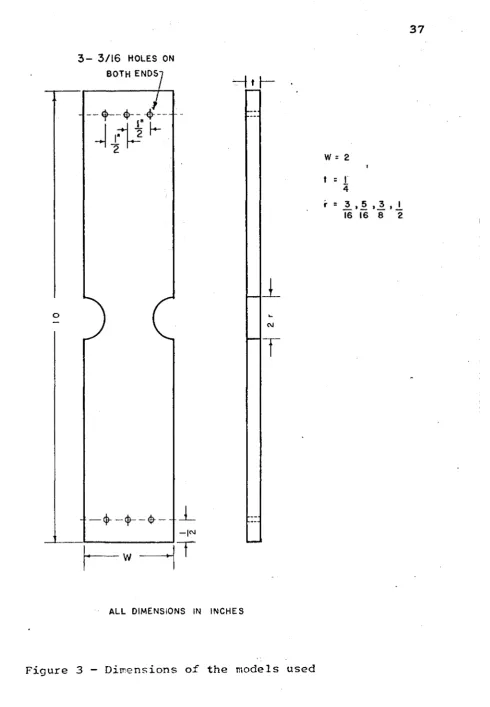
The models were machined from a 1/4 inch thick Urethane
rubber sheet. The geometric details of the models tested are
shown in figure 3,
4.3 Technique of Recording the Phenomenon
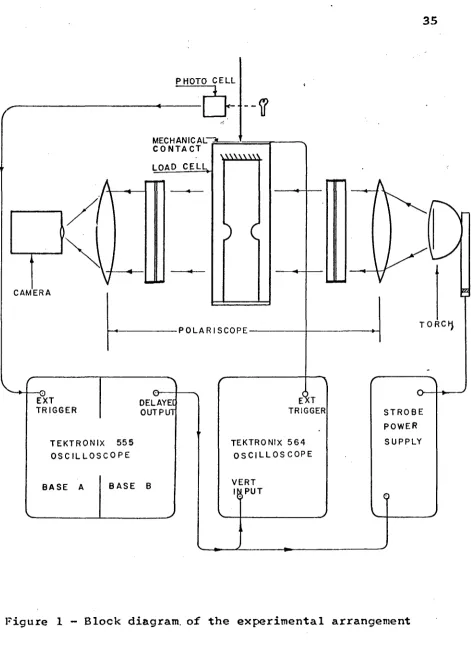
The repeatability technique was used to record the biré
fringent information. The main requisites for this technique,
besides a conventional polariscope, are a still camera, a
13
and short duration, a triggering device synchronized withthe event and a delay circuit. This works as follows;
a. The event begins when a steel weight is released
from its elevated position.
b. The falling weight trips a photoelectric trigger
that monitors the time delay,
c. The weight impacts the load cell on the model and
the fringes begin propagating the length of the
model. This impact also triggers the time delay
circuit,
d. The output from the time delay circuit triggers the
light source and thus a photograph is recorded at a
predetermined time as given by the time delay
circuit,
e. The repetition of the same procedure for different
delay times gives a series of photographs, describing
the entire event.
It should be noted that the camera is left wide open
throughout each cycle and the light source acts as its own
shutter. (See figure 1.)
In this investigation, the falling weight initiates the
triggering pulse by shorting an electrical contact while
14
assembled in the University Research shop, the incorporateddelay circuit of a Tektronix 555 oscilloscope was found
more reliable and easier to handle, and it was used to delay
the pulse throughout the study*
This delayed output from the oscilloscope externally
triggered the light source* The light source used was a
high intensity stroboscope, which provides a light pulse of
about 10 microseconds duration (Appendix D), In this time
interval, the longitudinal wave moves approximately *033
inches and the action is effectively stopped.
Type 47 Polaroid film, which has a very high speed
rating of 3000 A S A was used* The description of the complete
equipment used is given in Appendix D,
The repeatability technique of recording the birefringence
information is probably the best, since it gives large,
accurate, full— field photographs* The high degree of repeat
ability demonstrated in figure 4 shows the potential of the
5* RESULTS AND DISCUSSION
5.1 Birefringence Photographs
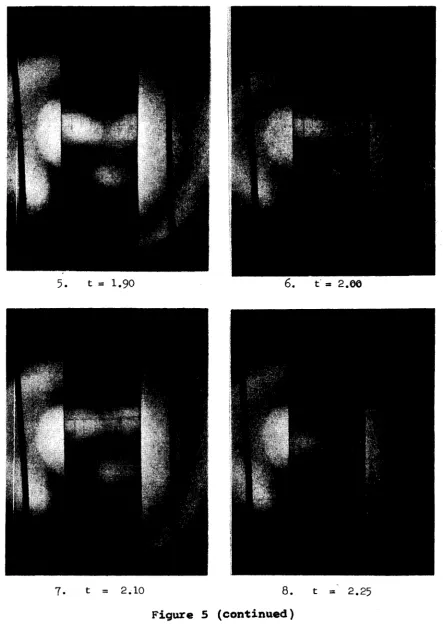
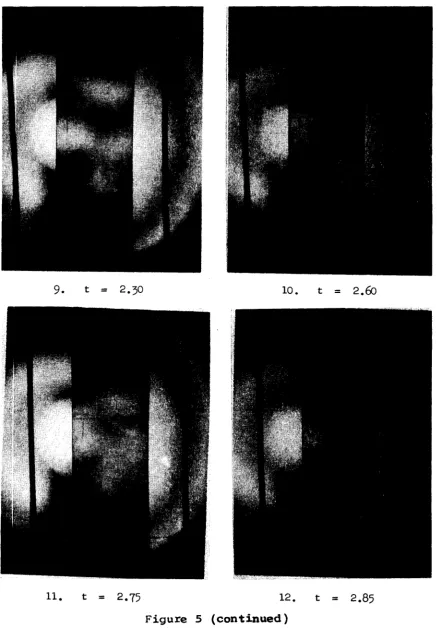
5*1.1 Birefringence Photographs Showing Fringe Propa
gation in a Model Without Discontinuity — Figure 5 is a
series of biréfringent photographs showing the propagation
of fringes in a model without discontinuity. The models
were loaded in tensile impact initiated at the bottom of
the photograph. Photograph 1 shows the no-load condition.
The following should be noted:
a, A-A is the position of the centreline of all dis
continuities of different sizes*
b, B and C are the fringes due to clamping stresses and
should not be mistaken as loading stress,
c. All irregular dark and light spots, such as D, are
due to uneven distribution of light around the
filament of the light source*
d. Dark edges on both the sides of the model show the
poor machinability of Urethane rubber; also, since
the light field is not parallel, boundary definition
is not good*
16
The half-order fringe can be seen in photograph 2 offigure 5, Warping of the plane section of the bar is
suggested by the prominent curvature shown by this
half-order fringe. The 1,5 half-order fringe is almost straight and
the 2,5 order fringe, which appears in photograph 7, is
straight or slightly curved in the opposite direction. This
phenomenon was expected and has been justified theoretically
by Jones and Ellis (15) as a result of the development of a
two dimensional state of stress. An inspection of photographs
from 2 to 7, however, shows that the fringes have a tendency
to reduce their curvature as they propagate. This effect,
however, has not been considered when describing the stress
concentration factor which was defined for uniaxial stress,
(Sec, 3,1,1*)
It can be confirmed from these photographs that fringes
of different order move at different but almost constant
velocities* Velocity of the half— order fringe was determined
as 3250 inches per second. It is worth mentioning here that
Dally, Riley, and Durelli (4) found the half-order fringe
velocity to be as high as 3420 inch/sec in the same material —
Urethane rubber. Since the velocity of propagation is a
function of the material properties like modulus of elasticity
and density, it suggests that the material properties vary
17
Appendix A shows the velocity of each fringe order as determined in this investigation.
5,1,2 Wave Propagation Through the Discontinuity —
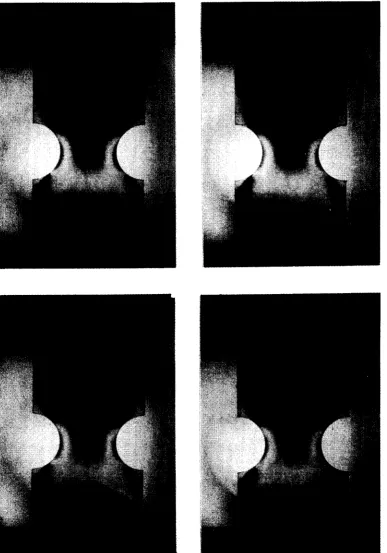
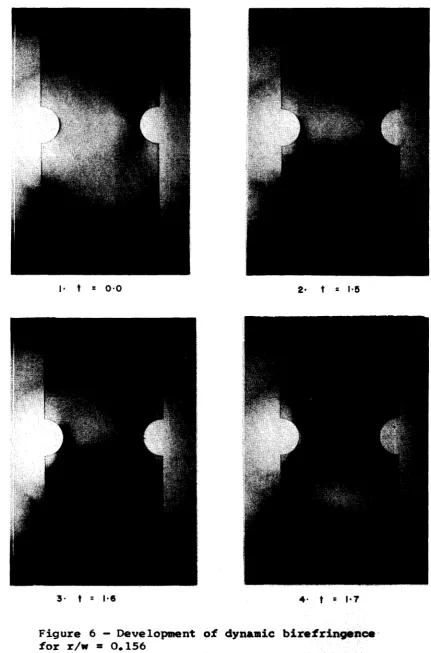
Figure 6 presents a series of photographs showing the wave
propagation through the discontinuity for a r/w ratio of
0,156, Photograph 1 of figure 6 again shows the no-load
condition and the tensile impact is initiated at the bottom
of the photograph©
A slight increase of the fringe order at the discontinuity
in photograph 2 suggests that the wavefront has arrived at
the discontinuity, although the half-order fringe is quite
far from the discontinuity. This suggests that the pulse
wavelength is very long.
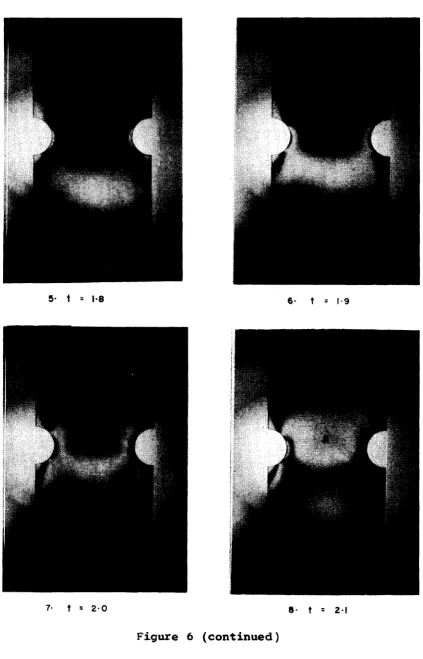
An inspection of photographs 6 , 7 and 8 gives an impression
that the half-order fringe (or the lower stress) has a tendency
to stick to the discontinuity (photographs 6 and 7) until the
1,5 order fringe (higher stress) pushes it out the narrower
section, such that the area A in photograph 8 is completely
and suddenly occupied by a higher order fringe. This
observation suggests a kind of forced propagation of waves
in the bar.
Figure 7 shows a relation between time and distance
photo-18
graphs of figure 6* The datum of the measurements was apoint about 0,9 inch below the centreline of the discontin
uity, The half— order fringe arrives at this point 1,5
milliseconds after the impact.
The slope of this curve at any point, therefore, gives
the velocity of half— order fringe at that moment.
Three different zones A, B, and C of the curve are
apparent. Lines ab and cd represent the lower and the upper
boundaries of the discontinuity respectively.
The linear portion Πof the curve in zone A shows the
smooth upbound motion of the wave with almost constant
velocity. Beginning at point E, the slope of the line
decreases rapidly, suggesting a very low wave velocity in
zone B, In zone C, this trend reverses and the slope reaches
a terminal value that is approximately 35 per cent greater
than that in zone A,
It should be noted that zone B starts at a point a little
lower than the beginning of the discontinuity and extends to
about 2 0 per cent of the span of the hole.
It appears that an analogy can be established between the
fringe propagation through the discontinuity and the fluid
19
Velocity of flow goes down at a point just before theentrance to the nozzle and keeps falling down to a point a
little after the entrance, forming a similar zone B, After
that, the velocity shoots up according to the change in area
of cross— section, forming something similar to zone C of our
case*
5*2 Graphic Interpretation of Photoelastic Data Obtained
from the Biréfringent Information
5.2*1 Stress Distribution Around the Discontinuity
-Figure 8 shows the distribution of stress around one inch
diameter discontinuity 3,5 milliseconds after impact. The
highest fringe order of 9,6 fringes was found at the centre
of the hole ( 0 = O” ), To compare this stress distribution
under dynamic loading to that under static loading, the same
model was loaded to 9.6 fringes under static tensile loading,
and this stress distribution is also shown in figure 8,
An inspection of figure 8 shows that at 0 close to 90°,
the associated stresses in the dynamic case are higher than
in the static case. This observation probably reveals the
significant difference between dynamic and static loadings.
It is entirely possible, indeed probable, that in the dynamic
case, some of the energy associated with the wavefront is
20
static conditions.5.2.2 Maximum Fringe Order as a Function of Time —
Figure 9 shows the effect of the time after impact on maximum
fringe order at the discontinuity,
5.2.3 Effect of Time after Impact on Stress Concentration
Factor — Figure 10 shows the variation of stress concentration
factor with time lapse after impact. It should be noted that
dynamic stress concentration factor is always lower than the
static stress concentration factor in the entire range
studied. This difference between the stress concentration
factors varies from 15 per cent to 50 per cent — depending
upon the time after impact. This effect has been observed
by many workers (Ref, 3, 12, 21, 26) but could not be explained
very satisfactorily© The interesting result mentioned in
section 5,2,1 may probably explain this behaviour. It was
expected that some of the energy associated with wavefront
gets captured by the corners and because a part of the
energy is so removed to an area of low stress, it is reason
able to expect lower stress concentration.
It should also be noted that dynamic stress concentration
factor is time dependent. The same effect was observed by
Dally and Halblieb (3) and North and Taylor (21); although
concentra-21
tion depends only on size of the discontinuity, impulsewavelength and Poisson's ratio. Both of these latter para
meters are constant here.
The trend towards increasing stress concentration as the
time after impact increases, however, seems to be reasonable
and can be explained. Although no actual measurements were
made to record the pulse shape, figure 1 1, which has been
taken from an investigation by Clark (1) would suffice to
give the explanation. The wavefront has relatively low energy
associated with it. As the wavefront reaches the discontinuity,
the part of the energy associated with it which is captured .
by the low stress area, forms an appreciable fraction of the
total energy. Now, as the latter part of the stress pulse
approaches the discontinuity, little or no energy is
captured by the corners since they are already stressed,
thus increasing the concentration at the critical area pro
gressively, This would obviously give rise to progressively
higher stress concentration factors till the peak of the
pulse reaches the position of the discontinuity. If the
study were extended to a longer period after impact, it
should be expected that the stress concentration factor would
tend to decrease as the trailing part of the pulse passes
through the discontinuity. From the curves in figure 10, this
22
5*2.4 Dynamic Stress Concentration Factor as a Functionof r/w Ratio — Figure 12 shows the effect of the size of
discontinuity on stress concentration factor. Values of static
stress concentration factor have been obtained from Peterson
(25).
Figure 13 shows the curves giving per cent decrease of
dynamic stress concentration factor over the corresponding
static value for various hole ratios. A well defined minima
can be noticed in every curve. The difference in the two
values decreases for low values of r/w ratios and then
increases rapidly.
It appears that the net effect of the following two factors
is responsible for this behaviour. Firstly, the deflection
of the energy in the low stress area. This effect would tend
to decrease the stress level. Secondly, the reduction of the
area at the discontinuity, which tends to increase the stress
level.
The initial portion of the curve suggests that the former
factor is gradually losing its effect with the increase in
r/w ratio until its value reaches about 0,2, At this point,
the size of the discontinuity starts getting so large that
the wavefront tends to see it as more of an infinite surface
23
An attempt was made to correlate the dynamic stress concentration factor to the hole ratio by a mathematical expression.
The following empirical equation for the dynamic stress
concentration at 2 , 2 milliseconds after impact gives values
agreeing approximately with the test results (see figure 1 2),
K^yn = 1.615 + 3.301 (r/w) + 17.767 (r/w)^ - 64.097 (r/w)3
(0.08 < r/w < 0.26)
Wahl and Beeuwkes (28) found a similar equation^ for the
static stress concentration factor as
K = 2.75 + 1.28 (r/w)2 + 8,00 (r/w)^
5,2,5 Comparison of Dynamic Stress Concentration Factors
under Tensile and Compressive Impact — A model with r/w ratio
of 0,156 was tested for compression impact also. Dynamic
stress concentration factor as determined in this case is
given in figures 14 and 15 as a function of time and compared
with the results of tension impact.
It is apparent that dynamic stress concentration factor
under tensile and compressive loading is equivalent until
about 2 milliseconds after impact, after which the concentra
tion factor obtained under compression impact is lower than
1 This equation has been modified according to the changed definition of stress concentration factor used here. The actual equation given by Wahl and Beeuwkes (28) is
24
that obtained under tension impact#It is quite probable that the tensile properties of the
material may be different from the compressive properties
which may give rise to the difference in wave propagation*
It should be noted, however, that a difference of only two
per cent was found between the values of concentration
factors under tension and compression, which may be attri
buted to experimental error* Although every effort was made
to have the same physical arrangement of loading in both
cases, it was found hard to load the model in compression
because of its flexibility#
Davison (5) established, by purely theoretical considerations,
that a condition of shock prevails when the wave speed increases
upon the passage of the disturbance and centred simple waves
prevail when the wave speed decreases upon the passage of the
disturbance* It was observed that the velocity of fringe
propagation increases when it passes through the major portion
of the discontinuity (see section 5*1*2 — chapter 5), Figure
7 shows an increase of approximately 35 per cent in the fringe
velocity while passing through zone C* Thus, it can rightly
be suspected that it is a condition of shock that is being
observed in zone C of the model# However, Davison showed
25
material used behaves as a hardening material in dynamicloading at high strain rate, although no experiment was or
could be executed with the existing apparatus to test this.
The static ttsts for the material indicate that it is not a
hardening material; however, the viscoelastic nature of this
material precludes the assumption that this is still true at
higher strain rates,
5,3 Optimum Design Criteria
If one calculates the maximum stress at this type of
discontinuity theoretically, assuming that all of the
potential energy of the falling weight is absorbed in the
model elastically, and that the static stress concentration
factors are representative, then the design in this material
would certainly be conservative, i.e. this theory gives a
stress that is at least 80 per cent higher than actually
exists (see Appendix B ) . In many situations, this is accep
table since an experimental program is not possible or
economical however, when cost and particularly weight
considerations are important, then this approximate answer
is unacceptable, particularly if 45 per cent of the area can
be removed, thus reducing the weight. Similarly, employing
a simplified stress wave propagation theory (see Appendix C)
and corresponding static stress concentration factor, the
26
5*4 Experimental Error - EstimationAlthough no actual calculations can be made to determine
the experimental errors, the following has been estimated
after various trials :
a. Repeatability of the Experiment
It is estimated that the whole experiment can be
repeated within a range of - 5 per cent. This high
repeatability can be attributed towards the use of
precision controls and a reliable technique of
recording the phenomenon*
b* Interpretation of the Information
It is estimated that the interpretation of the
biréfringent information can involve an error as
high as - 15 per cent. This is because of poor
photographs resulting from the use of the low
intensity, nonmonochromatic, relatively long duration
6 .
RECOMMENDATION FOR FUTURE WORK AND IMPROVEMENTS
6,1 Suggestions for Future Work
(1) Since it has been recognized that dynamic stress
concentration factor is dependent on pulse wavelength.
Poisson‘s ratio and the time after impact, an extensive
study should be conducted involving all the above parameters,
(2) The semicircular discontinuity provides sharp corners
that form the region of low stress. It was found that a part
of the energy of the propagating disturbance gets captured
by this low stress area. Different behaviour should be
expected from a discontinuity which does not provide a
similar low stress region. It would, therefore, be of interest
to study the behaviour of discontinuities of other than a
semicircular nature.
(3) Models of different width should be used to make the
study more general.
(4) Use of more than one model material is recommended
since it is suspected that the material properties in tension
may be different from its properties in compression.
(5) Model material should be completely calibrated
dynamically for stress and strain optical coefficients and
modulus of elasticity.
28
6,2 Suggestions for Improvements(1) Improvements must be made in the present setup for
producing tension impact such as :
(i) Some stiffer material should replace bakelite
for the load cell. Magnesium can make a good
substitute,
(ii) The motion of the load cell should be guided
to prevent it from side swaying,
(2) Since a stress pulse of shorter wavelength is desirable,
it is suggested that loading by an exploding charge or by a
propagating missile be considered,
(3) Efforts should be made to have accurate measurements
\ of
(i) duration of impact, and
(ii) variation of applied load with time.
This would assist in having a comparatively clear view of the
whole phenomenon,
(4) The low intensity of the light obtained from the
stroboscope made it impossible to use monochromatic light.
This has resulted in the poor biréfringent photographs, A
ruby laser can be an ideal substitute for light source here,
since its output has almost all the desirable qualities for
use in dynamic work; namely, highly intense, monochromatic,
7 CONCLUSIONS
(1) Dynamic stress concentration factor, as determined
in this study and in the region of r/w ratio tested, is always
lower than the corresponding static value, in some cases from
1 5 per cent to 5 0 per cent less than the static value
depending on the time after impact,
(2) The difference between dynamic and static concentra
tion factors diverges rapidly for large r/w ratios. It
appears that the wavefront tends to see the increasing size
of discontinuity as more of an infinite surface, thus
reflecting from it and reducing the boundary stress,
(3) Dynamic stress concentration factor depends signi
ficantly on the time after impact. It was found to vary
almost linearly from 1,7 milliseconds to 2.1 milliseconds.
After 2,1 milliseconds of impact, it was almost constant for
higher values of r/w ratio. For the r/w ratio of 0,093,
however, it had a tendency to increase throughout the time
span considered (1,7 milliseconds to 2,3 milliseconds),
(4) Little difference is apparent in stress concentration
for a tensile and compressive dynamic load,
(5) It was found that in case of impact, a part of the
30
energy gets captured by the region of low stress, thuslowering the stress concentration at the critical points and
therefore it would appear that streamlining the discontinuity
would not improve the stress concentration in the dynamic
case as much as it does in the static case,
(6 ) The theoretical estimation of the maximum stress
induced during the impact yields a value which is at least
80 per cent higher than actually exists (see Appendix B).
(7) In general design problems,- it would appear that
the use of the recorded values for static stress concentra
tion factor will give conservative results when dynamic loads
BIBLIOGRAPHY
1, Clark, A.B.J. "Static and Dynamic Calibration of a
Fhotoelastic Model Material, C R — 39," S.E*S«A.
Proceedings, XIV (NO.l), 195-204,
2, Coker, E,G,, and L,N,G, Filon. Photoelasticity,
Cambridge: Cambridge University Press, 1931,
3, Dally, J,W, and W.F. Halbleib, "Dynamic Stress Concen
trations at Circular Holes in Struts," The Journal
of Mechanical Engineering Science, March, 1965
4, Dally, J,W*, W.F, Riley, and A,J, Durelli, "A
Photo-elastic Approach to Transient Stress Problems
Employing Low— Modulus Materials," Journal of
Applied Mechanics, Trans, A.S.M.E., December, 1959,
613-620,
c::>, Davison, L. "Propagation of Plane Waves of Finite
Amplitude in Elastic Solids," 2* M e c h , Fhys, S o l i d s ,
XIV (1966) 249-270,
6, Durelli, A.J, and J,W. Dally, "Stress Concentration
Factors under Dynamic Loading Conditions," Journal
of Mechanical Engineering Science, I (NO.l, June 1959),
1
.
7, Durelli, A.J, and W.F, Riley Introduction to Photo
mechanics, Englenwood Cliffs, N.J., Prentice—Hall,
Inc., 1965,
8 o Durelli, A.J, and W,F, Riley, "Stress Distribution on the
Boundary of a Circular Hole in a Large Plate During
Passage of a Stress Pulse of Long Duration," Journal
of Applied Mechanics, Tyans, A ,S,M,E . , (June , 1961),
32
9, Engineering Sciences Data Unit, Stress ConcentrationD a t a , NOo 65004, London: Engineering Sciences Data
Unit, Inst* Mech, Engrs,, 1965,
10, Flynn, I.D, "Studies in Dynamic Fhotoelasticity,"
Ph,D, thesis, Illinois Institute of Technology,1954,
11, Frocht, M,M, "Factors of Stress Concentration Determined
by Fhotoelasticity," Journal of Applied Mechanics,
Trans, A.S.M.E,
12, Halbleib, W.F. "The Experimental Determination of the
Stress Concentration Factors at the Boundary of a
Central Circular Hole with Both Soft and Rigid
Struts Having Various Hole Diameters to Width
Ratios when Subjected to Longitudinal Dynamic Impact
Loads," Ph,D, thesis, Cornell University, 1961,
13, Howland, R.C.J. "On the Stresses in the Neighbourhood of
a Circular Hole in a Strip Under Tension," Proc,
Royal Society, 1930, (A229), 49,
14, Ibrahim, S.M, and H, McCallion, "Elastic Stress Concen
tration Factors in Finite Plates Under Tensile
Loads," Journal of Strain Analysis, I (No, 4, 1966),
306-311,
15, Jones, 0,E, and A.T, Ellis, "Longitudinal Strain Pulse
Propagation in Wide Rectangular Bar— Part I,II,"
Journal of Applied Mechanics, Trans, A.S.M.E., I
(No, 4, March 1963), 51— 69,
16, Kuske, Albrech, "Photoelastic Research on Dynamic
Stresses," Experimental Mechanics, VI (NO, 2, Feb.
33
17. Ling, C.B. "Stress in a Notched Strip Under Tension,"Journal o f Applied Mechanics, Trans. A.S.M.E., XIV
(No. 4, Dec. 1947) 275.
18. Lubahn, J.D, "Comparison of Methods of Determining Stress
Concentration Factors," S.E.S.A. Proceedings, XVI
(No, 2), 139-144,
19, Maunsell, F.G, "Stress in a Notched Plate Under Tension,"
Philosophical Magazine, XXI (1936), 765,
20, North, W.P.T., and C.E, Taylor, "Dynamic Stress Concen
tration Using Photoelasticity and Laser Light Source,"
Experimental Mechanics, XVI (No, 7, July 1966) 337,
21, North, W.P.T. "A Laser Light Source in Dynamic
Photo-elasticity," Ph.D. thesis, T A M department.
University of Illinois, Urbana, 1965.
22. Neuber, H, "Theory of Notch Stresses: Principles for
Exact Stress Calculation," Julius Springer, Berlin,
1937. Translated by F.A. Raven, David Taylor,
Model Basin, Washington, D.C., Nov. 1945.
23. Ozane, J. "Strain Calibration in Dynamic Photoelasticity,"
Master's thesis, T A M department. University of Illinois,
Urbana, 1965.
24, Pao, Y.H, "Dynamical Stress Concentration in an Elastic
Plate," Journal of Applied Mechanics, Trans, A.S.M.E.
XXIX (No, 2, June, 1962), 299-305.
25» PPterson, R.E. Stress Concentration Design Factors, New
York: John Wiley and Sons, Inc,
26. Shea, Richard. "Dynamic Stress Concentration Factors,"
34
27, Stein, K,0, "Dynamic Photoelasticity-A critical Reviewand Experimental Study," M a s t e r ’s thesis, TAM
department, University of Illinois, Urbana, 1963,
28, Wahl, A,M, and Beeuwkes, R . , Jr, "Stress Concentration
Produced by Holes and Notches," Trans, A.S.M.E.
35
P H O T O C E L L
MECHANICAL: C O N T A C T
l o a d c e l l.
CAMERA
TORCL)
P O L A R I S C O P E
E X T
T R I G G E R DELAYEEOUTPUT TRI GGER S T R O B E
P O W E R S U P P L Y T E K T R O N I X 5 5 5
O S C I L L O S C O P E
T E K T R O N I X 5 6 4 O S C I L L O S C O P E
V E R T I N P U T B A S E
B A S E A
UJ
>-q:
g <
(T
O
CD
<
X
a. < X o o
I
-0
X 01
Cd UJ
37
3- 3/16 HOLES ON
^ -— --^— _|CVJ
CM
W = 2
1
♦ = i 4
r = 2 . 5 ,1 16 16 8 2
AL L DI MENSI ONS IN I N C H E S
Figure 4 - Repeatability test
t = 0 0 t « I 3 0
3. t * 1-50 1*75
5. t = 1.90
7. t = 2.10 8. t = 2.25
9. t = 2.50 10. t = 2.60
11. t = 2.75 12.
Figure 5 (continued)
|. t = 0 0 2* t = 15
3- t = 1-6 4- t ® 1-7
Figure 6 - Development of d y n a m i c b i r e f r i n g e n c e
5- t = 18 6- f = 19
7- t * 2-0 8- t = 2 1
9" t = 2 2 I0« t » 2 3
45
18
r/w = 0 25
o
o XI
CL
c o
Ü c
h-z LÜ
5
0-8
o
<
_J
Û. if) Q 0 6
UJ
o
z
or u_ 0 4
0 2
00
15 1-6 1-7 18 19
2 0
2 1TIM E AFTER IMPACT , millisec
46
O 0) o CO o N o u> o lO o ■t o rO O CM o> 0) i_ O' O) TJ CD +» •H 3 C O u (A •H •O O +> •0 c 9 O w <cg
•H •H 9 •H U (A •H •0 (A (A 0 *4 ■H (A U •H +» (C ■*-» (A •g <c ü •H E <0 C Q 1 002
9 •S'00 CD CM
47
HOLE RATIO r/w 6 0
0 250
0 188
0-156
0:098
5 0
cc ÜJ o cc
o
LÜ CD z cn
U-3 0
2
0
0
0
15 175
2
0
225 2 5 275TIME AFTER IM P A C T, millisec
Figure 9 - Maximum fringe order at the
48
Q: O h-O<
ü_ Z O H<
ir LU o zo
ü (fi (fi LU CE t-(fi3 5
3 0 2 52
0
15 1 0 STATIC DYNAMICr/w* HOLE RATIO
____________ r/w 025
•098,0188 015 6
r/ w
= 0 25
•188
•156
.098
15 I 75 2 0 2 25
TI M E A F T E R I M P A C T , millisec
2-5
49
o ô to o m CM o o CM O lO o 0) c/> o ÜJ 2 o o o lO(D st <M o
ujo *iMVd90"inioso N i v d i s j o aanindkMV
50
a:o
h-o < ü_ Zo
t-<
(T h-z LU ü Zo
o co en LU CH h-co 4 0T IM E A F T E R IM PA C T,m illisec
3 0
S T A T IC
0
2 0
0
0 05 010 015
0
20
0 25 0 30HOLE R A T I O , r/w
51
6 0 0
5 0 0
t = T IM E A F T E R IM P A C T , mlllsec
4 0 0
c O) Ü
k .
<D a.
3 0 0
20-0
2 ^
100
0 0
0 05 010 0 15 0 20 0 25 0-30
HOLE RATIO , r / w
52
T E N S IO N
6*0
C O M P R E S S IO N5 0
ir LÜ Q
tr o
4 0
UJ CD
z
tr
^ 3 0
3
X
<
2
2
0
0
0
15 1-75
2
0
2 25 2 5 2 75TIME AFTER IM P A C T, millisec
53
a: o I -o<
o h-< ce h-z LU O Z o o co to LU cr H (O3*0
2 52
0
15H O L E R A D IU S r / w = O I56
o T E N S IO N X C O M P R E S S IO N
STATIC ( T E N S IO N )
D Y N A M I C
15 I 75 2 0 2 25 2 5
TIME A FT ER IMPACT, millisec
2 75
APPENDIX A
CALIBRATION OF H Y S O L 4485
A,1 Static Calibration
(1) Modulus of Elasticity - E
A specimen, fabricated from Hysol 4485 was loaded in
tension. Figure A-1 shows the stress— strain curve obtained
by measuring load and elongation.
The stress level attained during the experiment can be
approximated to be in the range of 3 0 to 40 psi. The static
stress-strain curve of figure 14 has an almost constant slope
of 500 psi in this range. This gives E = 500 psi,
(2) Material Fringe Constant
-A circular disk of Hysol 4485 under diametral loading was
tested for determining the material fringe constant. It was
found that f^^ = 0,51 psi-in/fringe (based on shear stress),
(3) Density — P
Density of the material was found to be
2 = Go0 0 0 1 0 0 lb-sec
in4
(4) Poisson*s ratio is approximately 0,47,