University of Windsor University of Windsor
Scholarship at UWindsor
Scholarship at UWindsor
Electronic Theses and Dissertations Theses, Dissertations, and Major Papers
1-1-1980
Dimensions of social sensitivity in two types of learning-disabled
Dimensions of social sensitivity in two types of learning-disabled
children.
children.
Edite Janine Ozols
University of Windsor
Follow this and additional works at: https://scholar.uwindsor.ca/etd
Recommended Citation Recommended Citation
Ozols, Edite Janine, "Dimensions of social sensitivity in two types of learning-disabled children." (1980). Electronic Theses and Dissertations. 6737.
https://scholar.uwindsor.ca/etd/6737
This online database contains the full-text of PhD dissertations and Masters’ theses of University of Windsor students from 1954 forward. These documents are made available for personal study and research purposes only, in accordance with the Canadian Copyright Act and the Creative Commons license—CC BY-NC-ND (Attribution, Non-Commercial, No Derivative Works). Under this license, works must always be attributed to the copyright holder (original author), cannot be used for any commercial purposes, and may not be altered. Any other use would require the permission of the copyright holder. Students may inquire about withdrawing their dissertation and/or thesis from this database. For additional inquiries, please contact the repository administrator via email
NOTE TO USERS
This reproduction is the best copy available.
_ _<9
UMI
DIMENSIONS OF SOCIAL SENSITIVITY
IN TWO TYPES OF LEARNING-DISABLED CHILDREN
by
Edite Janine Ozols
B.Sc., University of Toronto, 1976
A Thesis
Submitted to the Faculty of Graduate Studies Through the Department of Psychology
in Partial Fulfillm ent of the Requirements for the Degree
of Master of Arts at the University of Windsor
Windsor, Ontario, Canada
1980
UMI Number: EC54731
IN F O R M A T IO N T O U SER S
The quality of this reproduction is dependent upon the quality of the copy
submitted. Broken or indistinct print, colored or poor quality illustrations
and photographs, print bleed-through, substandard margins, and improper
alignment can adversely affect reproduction.
In the unlikely event that the author did not send a complete manuscript
and there are missing pages, these will be noted. Also, if unauthorized
copyright material had to be removed, a note will indicate the deletion.
UMI Microform E C 5 4 7 3 1 Copyright 2 0 1 0 by ProQuest LLC
All rights reserved. This microform edition is protected against unauthorized copying under Title 17, United States Code.
ProQuest LLC
789 East Eisenhower Parkway P.O. Box 1346
Ann Arbor, Ml 4 8 1 0 6 -1 3 4 6
. OZOLS, E . J . Dimensions o f s o c i a l . . . l e a r n i n q - d i s a b l e d c h i l d r e n . M.A. 1980
COPYRIGHTED MATERIAL, LEAVES 81 t o 94 NEED AUTHOR'S PERMISSION.
E d ite J an in e O zols 1980
ABSTRACT
The principal purpose of this study was to investigate whether
two groups of learning-disabled children, classified according to th e ir
pattern of neuropsychological a b i l i t i e s , would d if f e r in th e ir
performance on fiv e exploratory tasks of social s e n s itiv ity . Seven
children with primarily auditory-perceptual d if f ic u lt ie s (Group 2) were
compared to 7 children with primarily visual-spatial d if f ic u lt ie s (Group
3) on th e ir recognition of fa c ia l expressions and nonverbal gestures,
and on th e ir verbal labelling and explanations of feelings. The
children ranged in age from 8 to 11 years, and th e ir performances on
these tasks were compared to a group of average-achieving children
(Group 1). S t a t is tic a lly sig nificant differences between groups were
found fo r the combination of dependent variables (MANOVA £ = 2.20,
£ < . 0 5 ) as well as fo r the two tasks requiring verbal responses. The
pattern of group performance was in the hypothesized direction on
four of the fiv e tasks. Discussion of the results f i r s t considered the
lim itations of the exploratory tasks, followed by comments regarding
the composition of the two sub-types of learning-disabled children.
i i i
ACKNOWLEDGEMENTS
I sincerely acknowledge the clear and trusting guidance provided
by Dr. Byron Rourke, the Chairman of my Thesis committee. Dr. Akira
Kobasigawa and Professor Pat Taylor, committee members, made valuable
comments, c ritic is m s , and recommendations regarding my research.
Many helped in the completion of this project. The work of
Dr. B i l l McDermott and John Strang, M.A., provided i n i t i a l inspiration.
S ign ifican t assistance with s t a t is t ic a l procedures and analyses v/as
provided by Dr. Meyer Starr and Dr. Martin Morf. Administrative
and technical assistance was received from Dr. Martin Girash, Marilyn
Chedour, B.A., and Janet Orr, B.A. The excellent typing s k ills of
Mrs. Irene Arseneau were much appreciated. F in a lly , a personal thanks
is extended to Kathleen Barnett, a fellow graduate student, for her
encouragement and friendship throughout our concurrent thesis work.
iv
»
TABLE OF CONTENTS
Page
ABSTRACT ... . ... i i i
ACKNOWLEDGEMENTS ... iv
LIST OF TABLES ... v i i CHAPTER I INTRODUCTION ... 1
Social and Emotional D if f ic u lt ie s of Learning-Disabled Children ... 1
The Development o f Social Cognition ... 7
Sub-types of Learning-Disabled Children ... 12
I I METHOD ... 17
Subjects ... 17
Group 1 Subjects and Selection Procedure ... 17
Groups 2 and 3 - Selection Procedure ... 18
Group 2 Subjects ... 22
Group 3 Subjects... ... 23
Measures ... 24
Task A: Recognition of Facial Expression ... 26
Task B: Recognition of Nonverbal Gestures ... 29
Task C: Matching of Facial Expression... 31
Task D: Labelling of Feeling ... 33
Task E: Explanation of Feeling ... 33
Scoring C r ite r ia ... 34
Experimental Procedure ... 37
.: I I I RESULTS ... 38
Investigation of Hypotheses ... 38
Item Analysis ... 42
Observational Findings ... 48
v
Page
CHAPTER
IV DISCUSSION ... 50
Test Performance on Nonverbal Response Measures ... 51
Test Performance on Verbal Response Measures ... 57
Composition o f Learning Disabled Groups ... 61
Conclusions and Im plications ... . . 65
APPENDIX A Academic Rating Form f o r Group 1 Children ... 68
B Consent Form fo r Group 1 Children ... 70
C Contact L e tte r fo r Group 2 and 3 Children ... 72
D Scoring C r it e r ia and Scoring Procedure fo r Tasks D and E .. 74
E Test Materials - WRAT Form, HISC Form, Test Protocol ... 81
F Data Summary Sheet ... 95
REFERENCES ... 97
VITA AUCTORIS ... 103
vi
LIST OF TABLES
T a b le Page
1 Mean Scores o f Selected Group 1 Children and a l l Control___
Group Children ... 19
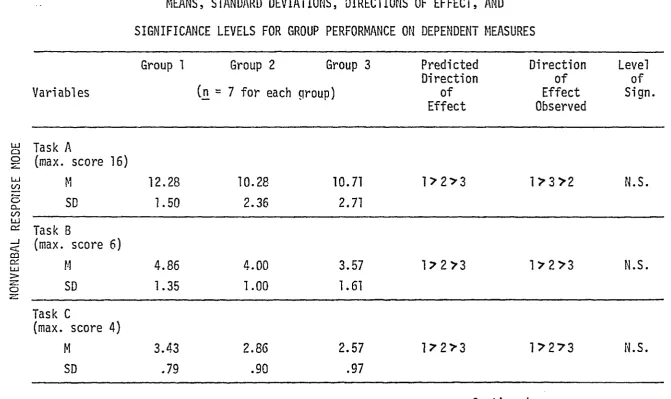
2 Means and Standard Deviations f o r Selection Variables ... 25
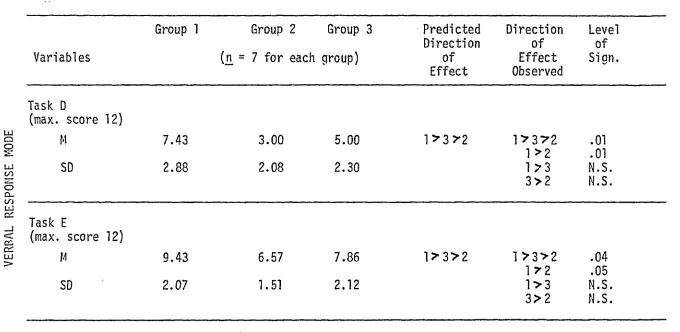
3 Means, Standard Deviations, Directions of E ffe c t, and ...
Significance Levels fo r Group Performance on Dependent ...
Measures
. 1
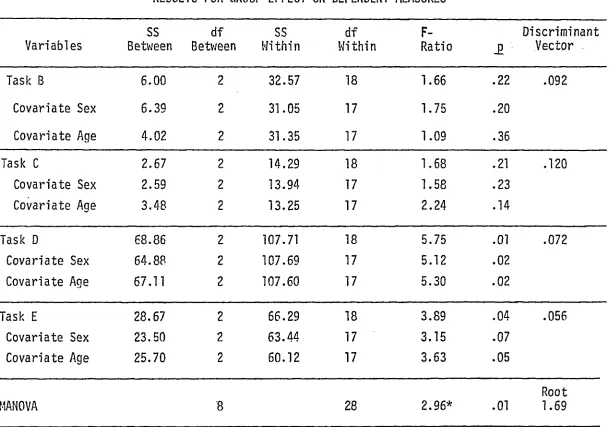
... 404 Summary Table o f MANOVA, ANOVA, and ANCOVA Results f o r Group
E ffe c t on Dependent Measures ... 43
5 Correlation C oefficients fo r Dependent Variables ... 44
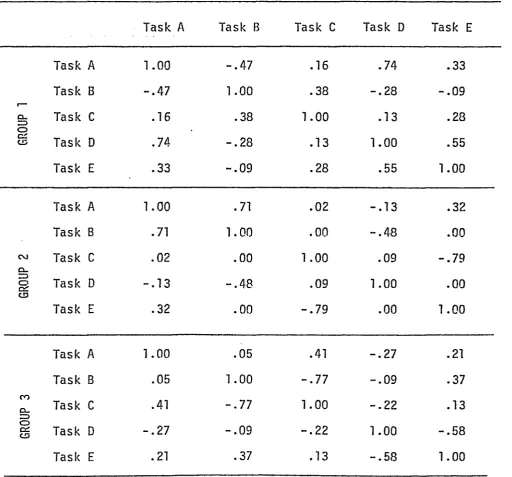
6 Correlation C oefficients f o r Dependent Variables by Group.. 45
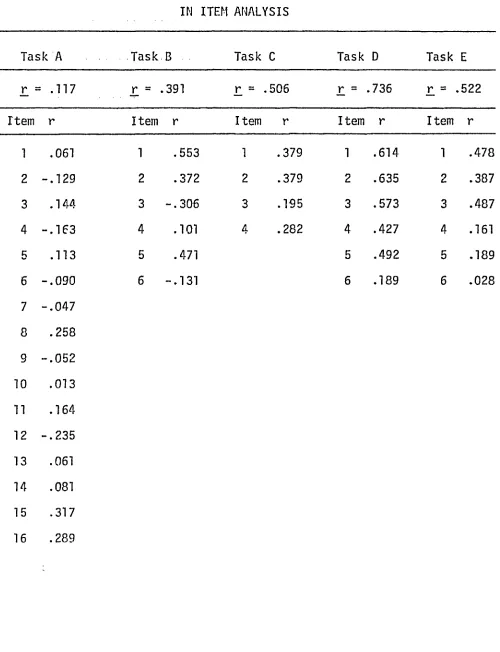
7 P o in t-B is e ria l Correlations and Alpha Coefficients in Item.
Analysis ... 47
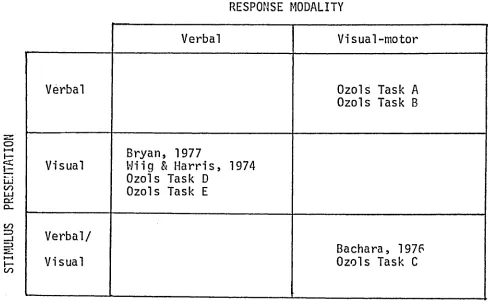
8 Stimulus Presentation and Response Modalities Used i n ...
Studies Inv estigating Social S e n s itiv ity of Learning-...
Disabled Children ... 52
CHAPTER I
INTRODUCTION
The purpose o f th is study was to investigate whether two groups
o f learning-disabled children, c la s s ifie d according to t h e i r pattern of
neuropsychological a b i l i t i e s , would d i f f e r from one another in th e ir
a b i l i t y to recognize and in te rp re t various social s tim u li. Children with
p rim a rily auditory-perceptual d i f f i c u l t i e s were compared to children
with p rim a rily v is u a l-s p a tia l d i f f i c u l t i e s on t h e ir in te rp re ta tio n of
nonverbal communication, using pictures o f fa c ia l expressions, hand
gestures, and social s itu a tio n s. Their performances on these tasks were
compared to a group o f average-achieving children.
In this review of the relevant past research the following topics
w il l be examined: 1) social and emotional d i f f i c u l t i e s o f
learning-disabled children, 2) the development of social cognition, with an
emphasis on studies of recognition of fa c ia l expression, and 3)
differences between the neuropsychological a b i l i t i e s of the two
sub-types of learning-disabled children relevant to this study. The present
study attempted to r e la te two previously d is tin c t areas o f research:
the neuropsychology o f learning disorders, and the development o f social
cogni tion .
Social and emotional d i f f i c u l t i e s of learning-disabled children
Throughout the long history of research on learning d is a b ilit ie s
i t has: been assumed th at a positive relationship exists between learning
disorders and emotional problems (Connolly, 1971). However, there has
1
been l i t t l e systematic study of the variables influencing the development
of social and emotional problems. I t is not clear which emotional
reactions w il l be manifested under which learning conditions.
Bryan Cl979) has provided an inclusive review of the recent, more
systematic research concerning the social s k i ll s and social relationships
of learning-disabled children. Researchers have attempted to elucidate
social and emotional ch a ra c teris tic s p rim a rily through use of parent
observations (Owen, Adams, Forrest, S to lz, & Fisher, 1971), teacher
ratings (Bryan & McGrady, 1972; Keogh, T ch ir, & Windeguth-Behn, 1974),
peer ratings (Bryan, 1974a), and classroom observations of the
interactions of learning-disabled children (Bryan & Wheeler, 1972; Bryan,
1974b). In comparison to t h e ir peers and siblings the learning-disabled
children tend to be judged in more negative and re je c tin g terms.
Bruinincks (1978) has also shown that these children are less accurate
in perceiving th e ir own social status, and they may therefore be less
l i k e l y to modify th e ir social behaviour. These studies have led Bryan
& Bryan (1978) to conclude that:
In summary, i t appears that the learning-disabled child is confronted with a social world in which he is
d is lik e d , a t worst, or ignored, a t best, by his peers, classroom teachers, and even, perhaps, his parents (.P . 139); learning disabled children do not su ffer only from academic f a i l u r e ; many carry an additional burden of social f a i l u r e , (p. 124)
The finding that the learning-disabled child is not as popular
as his peers has implications fo r the c h ild 's fu tu re ad u lt adjustment.
Recent studies have demonstrated th at peer a c c e p ta b ility is highly
correlated with mental health in adult l i f e , and Cart!edge & Mil burn
(1978) go so fa r as to claim th at a c h ild 's social adjustment is more
important than his academic achievement in determining his level of
3
adult adjustment. Asher, Oden & Gottman (1976) reviewed follow-up
studies of social status, and indicated that so c ia lly isolated children
are more l i k e l y to have mental health problems in adult l i f e . A follow-up
study by Cowen, Pederson, B abijian, Izzo and Trost (1973) revealed that
children regarded negatively by th e ir peers were most l i k e l y to have
mental health problems eleven years l a t e r . As the observational
studies by Bryan and others have demonstrated the learning-disabled
c h ild 's d i f f i c u l t i e s in social adjustment, the question of etiology
remains the next consideration.
There are three viewpoints, each perhaps representing a d if f e r e n t
group of children, fo r resolving the question of etiology in the issue
of whether emotional problems or learning problems are primary.
Psychoanalytic theorists ( i . e . , Sylvester & Kunst, 1943) have large ly
been concerned with the group of children whose reading and school
f a i l u r e may be caused by emotional disturbance. The prerequisite
perceptual and cognitive a b i l i t i e s fo r reading are considered to be
in ta c t fo r this group.
The second viewpoint considers the socio-emotional d i f f i c u l t i e s
to re s u lt from the learning-disabled c h ild 's experience of constant
f a i l u r e , disapproval by adults, and rejec tio n by peers. This viewpoint
assumes that the c h ild 's emotional problems w il l disappear when his
learning problems are overcome.
Attempts to c la s s ify children with learning problems into one
of these two groups have not always proven successful, nor useful.
A clear dichotomy does not e x is t between learning and emotional
varia bles , fo r as Connolly (1971) has shown in the following
diagram, a 'vicious c i r c l e ' often confuses the question o f etiology
in the case o f the learning-disabled child* Furthermore, the
r
LEARNING DISABILITY
POOR ACHIEVEMENT IMPEDES PROGRESS
r
j
BEHAVIOURS NOT FRUSTRATION
CONDUCIVE TO >
LEARNING —________ ^
treatment fo r a p a r tic u la r c h ild may not necessarily be dictated by the
cause of his problem. For example, i f a child is f a i l i n g math because
of emotional trauma, treatment w i l l s t i l l have to consider remedial
techniques appropriate fo r math problems, and not simply psychotherapy
alone.
The present study approached the issue of etiology from a th ird
viewpoint, namely, th at both learning and social d i f f i c u l t i e s may be a
function o f deficiencies in cognitive a b i l i t i e s . In this connection,
Bryan (1979) has stated:
I t is believed th a t problems in social relationships may be secondary effe cts of academic d e fic its fo r
some children, but that fo r many children the d i f f i c u l t i e s in social relationships and social s k i ll s r e fle c ts the same problems which cause the child to have problems in the acquisition of academic
s k i l l s . (Bryan, 1979, p. 6)
Furthermore, these "problems" may be influenced by the c h ild 's unique
pattern of cerebral functioning. Sub-groups of learning-disabled
children may vary in the nature and in te n s ity of t h e ir socio-emotional
problems, according to t h e i r coqnitive strengths and weaknesses as
measured by neuropsychological tes ts .
The research in etiology is beset by many methodological
d i f f i c u l t i e s . There i.s much, semantic confusion over terms such as
"emotional adjustment" and "learning d is a b i li t y " . I t has proven d i f f i c u l t
to quantify and measure emotional functioning. The many socio-emotional
d i f f i c u l t i e s have not been c la s s ifie d into useful categories related to
p a rtic u la r d e f ic it s and causes (Sampson, 1966). An important b a rrie r
to drawing conclusions from this research is the f a c t th at
learning-disabled children have been treated as a homogenous population in these
studies.
The general research in etiology has indicated the importance of
finding the cognitive or perceptual s k i ll s that may account fo r the
learning-disabled c h ild 's academic and social f a i l u r e . Recent attempts
to specify these s k i ll s have focussed on the learning-disabled c h ild 's
a b i l i t y to perceive accurately a ffe c tiv e states in other people.
Mon-verbal cues, such as fa c ia l expression, are an important source of
knowledge concerning another's feelings (Mehrabian, 1971).
There have been three studies investigating the learning-disabled
c h ild 's a b i l i t y to in te rp re t accurately the a ffe c tiv e states of others.
In a study by Wiig & Harris (1974), learning-disabled adolescents were
found to be s ig n ific a n tly less e f f i c i e n t a t la b e llin g the emotion 1
expressed by a young female's videotaped nonverbal expressions of
anger, embarrassment, and other emotions. However, i t may be the case
that the d i f f i c u l t y fo r the learning-disabled child on a task o f this
nature is not in the recognition and understanding of appropriate
f a c i a l 1 expression, but i t may be in th e ir d i f f i c u l t y in attaching a
verbal label to a nonverbal expression.
Bachara (1976) used a format developed by Borke (1971) in
6
presenting stories to learning-disabled children, aged 7 to 12. The
children selected the appropriate fa c ia l expression from a set of
pictures of faces expressing happiness, anger, sadness, and fear. The
learning-disabled children made s ig n ific a n tly more errors than did the
normals.
F in a lly , Bryan (1977) presented a film , known as the Pons
(Rosenthal e t a l , 1977), of an adult female expressing various a ffe c ts ,
and had subjects in Grades 3, 4, and 5 choose the statement that best
described the scenario. Again, a s ig n ific a n t difference was found
between the disabled subjects and the normals, with the
learning-disabled group being less able to describe accurately the scenario.
These three studies d i f f e r in the amount and type of information
presented to the subjects, and in the type of response demanded of the
subjects. In two o f the studies language a b i l i t i e s were implicated
in the subjects' responses, and the th ird study required a nonverbal
response (p ointin g). In the present study, these important variables
-the verbal or nonverbal nature of both independent and dependent
variables - were systematically manipulated.
In summary, the research on social and emotional d i f f i c u l t i e s
of learning-disabled children suggests that this.group may experience
severe problems in the socio-emotional realm. As an attempt to specify
reasons fo r th e ir social f a ilu r e recent studies have demonstrated that
these children are less adequate in perceiving and interpreting the
a ffe c tiv e states of others. The present study investigated a
neuropsychological basis fo r the learning-disabled c h ild 's deficiency \ / ' V' \ /
in interp reta tion of social cues.
The development o f social cognition
The following section of th is review wi.ll b r i e f l y consider studies
on social cognition, conducted in the area of developmental psychology.
I t is important to understand how the average child acquires s k i ll s
and c a p a b ilitie s in the social realm to help explain why the
learning-disabled ch ild experiences d i f f i c u l t y in social s itu a tio n s . The area of
social cognition has been reviewed by Shantz (1975) who states that:
the area o f social cognition refers to the c h ild 's in t u i t i v e or logical representation of others, th at i s , how he characterizes others and makes inferences about th e ir covert, inner psychological
experiences. (Shantz, 1975, p. 258)
The research category o f social cognition most relevant to the
present study is th at which discusses the c h ild 's a b i l i t y to in fe r what
another person is fe e lin g . Although there has been l i t t l e agreement on
a d e fin it io n of empathy, i t is generally accepted th at empathy may have
both cognitive and a f f e c t iv e components. D iffe r e n t measures of empathy
have been used, the most common involving a visual stimulus presented
to the c h ild , and a verbal response beinq required. Feshbach & Roe
(1968) showed young children (aged 6 and 7) a series o f slides
depicting various social situations ( i . e . , attending a birthday party)
and subjects were asked "What do you feel?" and "What does he/she
feel?" Borke (1971) presented subjects (aged 3 to 8) with a picture
o f a social s itu a tio n accompanied by a b r ie f story. The children were
asked to select the appropriate fa c ia l expression and place i t on the
s to ry -c h ild . Burns & Cavey (1957) presented pictures of situations
wherein the c h ild 's fa c ia l expression co n flicted with the situ ation in
which he was portrayed ( i . e . , a young child smiling as a doctor is
about to poke him with a big needle). Preschoolers attended more to
situational cues, and would disregard fac ial expression when stating
the feeling of the story-child.
Results from various studies using these and other methods suggest
that even three-year-olds may be able to recognize simple emotions, such
as happiness, involved in fa m ilia r situations. Between the ages of 4
and 7 the child becomes increasingly more accurate in identifying
situations that e l i c i t fe a r, sadness and anger, while recognition of
other emotions, such as surprise and scorn, develops s t i l l a fte r age 7.
Information on age norms varies according to several factors, such as
the nature o f the task and the specific emotional expressions being
investigated. For example, Izard (1971) found that children aged
2 1/2 - 9 years could recognize expression of emotions (when subjects
were shown a set of pictures and asked "Show me the one who is ________ ")
f a r sooner than they could attach the correct verbal label to an
expression (when asked "How is this person feeling?").
A ffective perspective taking (the a b i l i t y to recognize the
appropriate facial expression fo r a given situation) should
th e o re tic a lly correlate with the ch ild 's s k ill a t other perspective
taking tasks. However, Kurdek & Rodgon (1975) report low correlations
between children's perceptual perspective taking, th e ir cognitive
perspective taking, and th e ir a ffe c tiv e perspective taking,
suggesting that the relationship between the development of social
cognition and cognitive development is not clear.
Many assume that the ch ild 's a b i l i t y to in fe r and interp ret
others' feelings adequately is related to his social adjustment.
Piaget (1926) proposed that the ch ild 's a b i l i t y to take another's
9
vtev/polnt w ill a ffe c t hts social status or popularity. Although
several researchers claim there i.s a positive relationship between social
s e n s itiv ity and social adjustment, there is a scarcity of research
exploring this issue. Izard 0 9 7 1 ) has reported a s ig n ific a n t positive
relationship between a c h ild 's verbal emotion lab ellin g score and his
score on a social adjustment rating scale, in a p il o t study with
c h i l d r e n aged 2 to 7 years. Testing w i t h o l d e r c h i l d r e n (aged 6 - 11)
revealed a s im ilar positive relationship, with correlations reaching
s t a t is t ic a l significance a t ages 6, 9, and 11 ( l2ard, 1971). Recently
i t has been demonstrated that emotionally disturbed children are
s ig n ific a n tly less p ro fic ie n t than nondisturbed children a t recognition
of emotions in fa c ia l expressions (Zabel, 1979). However, due to the
varie ty of measures used to study both adjustment and a ffe c tiv e
perspective taking, Shantz has stated that "the re latio n between social
cognition and interpersonal behaviour may be one of the largest
unexplored areas in developmental psychology today" (Shantz, 1975,
P. 303).
In contrast to a research orientation emphasizing deviance and r
social maladjustment, researchers have recently focussed on a %
preventive approach, including the study of social competence (Kent &
R olf, 1979). Measures used f o r judging interpersonal competence (a
concept often linked to social adjustment) have included teacher
ratings, peer nominations, and d iffe re n t sociometric measures. In
attempting to delineate variables affecting peer popularity, Hartup
has noted that a willingness to give and receive frie n d ly overtures,
and a lack of withdrawal are p os itive ly related to peer acceptance
(Hartup, 1970).
Several c ritic is m s o f the research on recognition of fa c ia l
expression were re le v a n t to the present study. Studies on the.
development o f social inferences have usually required a verbal
response by the c h ild : fo r example, the c h ild was often asked to state
what another v/as fe e lin g in a given s itu a tio n . Thus, l in g u is t ic
a b i l i t i e s , as well as cognitive a b i l i t i e s , have been re fle c te d in the
c h ild 's response. As we can assume th at the m a jority o f children
c la s s ifie d as learning disabled exhibited a t le a s t a mild deficiency in
verbal s k i l l s , a verbal response v/as l i k e l y not a v a lid measure of the
c h ild 's cognitive a b i l i t y to make social inferences. A second c ritic is m
of these methods is th a t the children were presented with isolated b its
of information extracted from actual social situ atio n s (Rothenberg,
1970). Thus, motion pictures or filmed social episodes may be
considered a more appropriate stimulus fo r measuring social cognition.
A th ir d d i f f i c u l t y in in te rp re tin g research on recognition of fa c ia l
expression is th a t the amount of information (visual and verbal)
presented to the c h ild has varied. A fourth c r itic is m is th a t the
sex and age of the characters expressing the emotions in the task have
not been c o n tro lle d . A f in a l problem is th a t the cognitive processes
involved in making inferences from s itu a tio n a l (v is u a l) cues are not
well delineated.
These studies on social cognition point to the importance of
nonverbal cues in in fe r r in g another's a f f e c t iv e perspective. Children's
a b i l i t y to use fa c ia l expressions to i n f e r what another is fe e lin g is
a s k i l l th a t improves with age. The learning-disabled c h ild with
v is u a l-s p a tia l d i f f i c u l t i e s w i l l encounter problems a t the most basic
step of the in f e r e n t ia l process - he may not be able to perceive
v is u a lly the s itu a tio n adequately.
The area of psychological ca u s a lity and interpersonal inference
has received scant a tte n tio n in the l i t e r a t u r e . Relevant to th is
discussion is mention of Flapan's (1968) study, in which she showed
f i lm episodes to 6, 9, and 12-year-olds, and categorized t h e i r
spontaneous descriptions o f the episodes, as well as t h e i r responses
to questions about characters' feelin gs and inte n tio n s . The purpose
o f th is study was to in v e s tig a te " . . . c h i l d r e n ' s a b i l i t y to perceive
or to make inferences about fe e lin g s , thoughts and in te n tio n s , and
o f t h e i r a b i l i t y to in t e r p r e t or explain sequences o f behaviour th at
occur in interpersonal re la tio n s h ip s ." (Flapan, 1968). The re su lts
o f th is study revealed a developmental trend from explanations in
s itu a tio n a l terms ( i . e . , descriptions of overt actions) to explanations
in psychological terms, to explanations in terms o f interpersonal
perceptions. A ch ild with impaired v is u a l-s p a tia l s k i l l s may not be
able to provide adequate descriptions and in te rp re ta tio n s of the visual
scene because o f his d i f f i c u l t y in perceiving the visual stimulus,
and the c h ild with auditory d i f f i c u l t i e s may not provide adequate
in te rp re ta tio n s due to a d e f i c i t in verbal expressive s k i l l s .
Thus, i t appears to be important and useful to study the
p re re q u is ite cognitive and perceptual s k i l l s involved in such tasks
o f social inference. In the present study learning-disabled
ch ildren were c la s s ifie d according to t h e ir neuropsychological
p r o f i l e into one of two groups, in order to compare t h e i r performance
on tasks o f social s e n s i t iv it y .
12
Sub-types o f learning-disabled children
Studies investigating the neuropsychology of learning disorders
rece ntly isolated the two sub-types of learning-disabled children used
in the present study. A study by Rourke & Finlayson (J978) c la s s ifie d
three sub-types of learning-disabled children according to th e ir pattern
o f performance on the Reading, Spelling and Arithmetic sub-tests of the
Wide Range Achievement Test (Jastak & dastak, 1965). Children in
Group 1 were uniformly d e fic ie n t in reading, sp elling and a rith m etic.
Children in Group 2 were r e l a t i v e l y adept a t a rith m e tic , as compared to
t h e i r performance in reading and s p e llin g ; a th ird group (Group 3)
was composed of children whose reading and spelling performances were
average or above, but whose arithm etic performance was r e l a t i v e ly
d e f ic ie n t. The performance of Group 3 was superior to th at of Group 2
on measures of verbal and auditory-perceptual a b i l i t i e s ; the performance
o f Group 2 was superior to th at o f Group 3 on visual-perceptual and
v is u a l-s p a tia l a b i l i t i e s . From the t e s t results i t was inferred that
children in Group 3 were impaired in the a b i l i t i e s o rd in a r ily thought
to be subserved p rim a rily by the r ig h t cerebral hemisphere, whereas
*
the children in Group 2 were impaired in a b i l i t i e s o r d in a r ily thought
to be subserved p rim a rily by the l e f t cerebral hemisphere. Rourke &
Strang (1978) found th a t Group 3 subjects showed impaired performance ^
on complex psychomotor measures and on a composite tac tile -p e rc e p tu a l
measure, r e l a t i v e to the performance of Group 2 children.
Two e a r l i e r studies by Rourke and his colleagues (Rourke &
Telegdy, 1971; Rourke, Young & F lew e llin g , 1971) c la s s ifie d three
groups o f learning-disabled children on the basis of the relationship
between t h e i r Verbal IQ and Performance IQ on the Wechsler In te llig e n c e
Scale fo r Children (Mechsler, 1949). The PIQ o f children in Group 1
(HP - LV) was a t le a s t 10 points higher than t h e i r VIQ; Group 2 (Vs* P)
consisted o f subjects w ith VIQ and PIQ w ith in 4 points of each other;
and Group 3 (HV - LP) children had VIQ values a t le a s t 10 points higher
than t h e i r PIQ. Children in Group 3 (HV-/- LP) showed c le a r s u p e rio rity
on most measures o f verbal and auditory-perceptual a b i l i t i e s , and
children in Group 1 (HP - LV) were c le a r ly superior on those tasks th a t
p rim a rily involved visual-perceptual s k i l l s . Furthermore, th is group
showed c le a r s u p e rio rity on most measures o f complex motor and psycho
motor a b i l i t i e s .
The present study used a combination o f c r i t e r i a from these four
studies to specify two sub-types of learning d i s a b i l i t i e s : a group
i i
o f learning-disabled children with p rim a rily auditory-perceptual
v-d i f f i c u l t i e s (Group 2 ) , anv-d a group o f chilv-dren with p rim a rily v is u a
l-sp atial and visual-perceptual d i s a b i l i t i e s (Group 3 ).
The children c la s s if ie d in Group 3 were considered to e x h ib it a
nonverbal learning d i s a b i l i t y . Johnson & Myklebust Cl967) discussed
t h e i r c l i n i c a l observations on th is sub-type they c la s s ifie d as the
nonverbal disorders of learning. There is a paucity o f research on
th is p a r t ic u la r group o f learning-disabled c h ild re n , as t h e i r d e f ic it s
are much less common than the d i s a b i l i t i e s o f dyslexic children.
Myklebust (1975) has suggested th a t nonverbal disturbances may
u ltim a te ly be more d e b ilit a t in g f o r a c h ild , as he may be unable to
adequately develop social perception ("the c h ild 's a b i l i t y , or lack of
a b i l i t y , to understand his social environment, es p ec ia lly in terms of
his own behaviour" (Myklebust, 1975, p. 8 6 ). Furthermore, these authors
14
suggest that social imperceptjon and other nonverbal disturbances are
related to dysfunctions p rin c ip a lly on the rig h t cerebral hemisphere.
A recent paper on this subject suggests that the child with a
nonverbal learning d is a b ilit y w ill l ik e l y exh ib it the following
characteristics: his reading (word recognition), spelling and speech
a b i l i t i e s w ill be a t an average or above-average lev e l; he w ill exhibit
r e la t iv e ly poor Arithmetic a b i l i t i e s ; his WISC Verbal IQ w ill be a t least
average, but his Performance IQ w ill be below average; he w ill exhibit
b ila te ra l tactile-perceptual d e fic its and d i f f i c u l t i e s in complex
psychomotor a c t iv it y ; and he w ill show f a i r l y consistent and profound
impairment on tasks of a visual-spatial nature (Strang, 1979). Several
factors may contribute to this c h ild 's .misunderstanding or lack of
understanding of his social world; he may be unable to understand the
nonverbal gestures of others, he may lack basic understanding of
physical causality due to inadequate sensory-motor experience, he may
use inappropriate gestures and fa c ia l expressions to accompany his
own remarks, and he may be unable to generate adequate visual images in
association with fa m ilia r sounds (Strang, 1979). This child simply nay
not receive the type of visual-perceptual and vis ual-spatial experience
thought to be important fo r social development.
The posterior rig h t cerebral hemisphere has also been implicated in
neuropsychological research on fa c ia l recognition and prosopagnosia
using adult subjects. Studies using the tachistoscopic paradigm with
normals show consistent l e f t visual f i e l d superiority in accuracy of
facial' recognition. Warrington & James (1967) suggest that recognition
and la b e llin g o f fa c ia l expression involve two d iffe r e n t cerebral
processes - patients with rig h t hemisphere lesions made errors in
i i
15
recognition, whereas patients w ith l e f t hemisphere lesions p rim a rily
made errors in naming the expression.
Hypotheses
Bryan has stated th a t no differences in social adjustment have y e t s y t /
been found between children w ith learning d i s a b i l i t i e s , and states th a t:
i t is not too l i k e l y in the immediate fu tu re th a t we w i l l be able to point to a p a r t ic u la r academic d e f i c i t and say th a t i t is the s k i l l area most l i k e l y to be
associated with social problems. At th is point i t
is c le a r ly speculation as to which learning disabled t V
c h ild has the social s k i l l s problem. (Bryan, 1979 ,
p. 41)
The present study was designed to in v e s tig ate th is issue, by examining
differences in social s e n s i t iv it y between s p e c ific types o f lea rn in g
-disabled children.
The performance o f the learning-disabled c h ild on social s e n s it iv it y
tasks was expected to vary according to the nature o f the c h ild 's
p a r t ic u la r d i s a b i l i t y and according to the'verbal or nonverbal nature
o f the task. Five d if f e r e n t tasks were used to assess ch ild re n 's
social s e n s i t iv it y ; three o f the tasks required a nonverbal response
by the subjects (Tasks A, B, and C), and tv/o o f the tasks required verbal
responses (Tasks D and E). Task A involved recognition o f fa c ia l
y
expressions, Task B involved recognition of nonverbal gestures, Task C
involved matching o f f a c ia l expressions, Task D involved the verbal
la b e llin g of fe e lin g s , and Task E involved the verbal explanations of
fe e lin g s .
The following hypotheses were investigated: Hypothesis 1: I t
was expected th a t children with v is u a l-s p a tia l d i f f i c u l t i e s (Group 3)
would show a marked impairment o f a b i l i t y to recognize and match
16
fa c ia l expressions in comparison to the performance of normal children
CGroup 1} and children with, verbal d i s a b i l i t i e s (.Group 2}. Thus, on
Tasks A and C the expected pattern o f group performance was in the
d ire c tio n Group 1 > Group 2>Group 3.
Hypothesis 2: I t was expected th a t children with v is u a l-s p a tia l
d i f f i c u l t i e s (Group 3) would show a marked deficiency in a b i l i t y to
in t e r p r e t nonverbal gestures in comparison to the performance o f normal
children ( G r o u p ■]) ancj children with verbal d i s a b i l i t i e s (Group 2 ).
Thus, on Task B the expected pattern o f group performance was in the
d ire c tio n Group 1 > Group 2 > Group 3.
Hypothesis 3: I t was expected th a t children with verbal d i s a b i l i t i e s
(Group 2 ) , would show a marked deficiency in a b i l i t y to label feelings
and provide explanations f o r the feelings in comparison to the
performance of normal children (Group 1 ). Children with v is u a l-s p a tia l
d i f f i c u l t i e s (Group 3) were also expected to be d e fic ie n t in t h e i r
verbal explanations in comparison to the performance o f normal c h ild re n ,
and to a less s ig n ific a n t degree than the children with verbal
d i s a b i l i t i e s . Thus, on Tasks D and E the expected pattern o f group
performance was in the d ire c tio n Group 1 >Group 3>Group 2.
CHAPTER I I
METHOD
SUBJECTS
Group 1 Subjects and Selection Procedure
The research committee of the Essex County Board of Education
granted permission to conduct the study. The p rincip al of Sandwich
West Public School U nit agreed to have children in his school
p a r t ic ip a t e , and the guidance counsellor of th is school co-ordinated
the p ro je c t. The school requested th a t a summary of the study be sent
to them, as well as s p e c ific information concerning any child th a t
deviated s ig n i f i c a n t l y from the norm. The guidance counsellor was asked
to se le c t children who were average achievers, had never f a ile d a
grade, and spoke English in the home. The School Psychometrist f o r the
Essex County Board v e r if ie d th at none of the selected children had been
re fe rre d fo r an emotional and/or learning problem. The four
p a rtic ip a tin g teachers were asked to complete a simple unstandardized
form ind ica tin g whether the selected children were performing a t an
average, below-average or above-average le v el (in comparison to t h e ir
classmates) in Reading, S p e llin g , and Arithm etic (Appendix A ).
Twenty-two permission s lip s (Appendix B) were d is tr ib u te d , and twenty
s lip s were returned s ta tin g parental consent.
/
/ These 20 children were tested during the week of June 11 - 15,
1979. The author escorted p artic ip an ts in d iv id u a lly from th e ir
classroom to a q u iet tes tin g room with c h ild - s iz e f u r n it u r e .
17
Each c h ild was told the nature of the testing and was asked to give
consent before testing proceeded. Testing required approximately
1 hour, 15 minutes per c h ild . At the end of the testing session each
child was thanked and given a coloured f e l t pen.
The 20 subjects ranged in age from 102 to 148 months (M_ = 127.15,
SD = 15.42 ), with an average age of approximately 10 years, 7 months.
Nine of the children were female; eleven were male. Six of the children
were in Grade 3, 11 were in Grade 5, and 3 were in Grade 6.
r* |
Seven of these 20 children were selected as the f in a l Group 1 ^
subjects. Selection c r i t e r i a were: 1) Wide Range Achievement Test
(W.R.A.T.) Reading percentile score ^ 45, 2) W.R.A.T. Spelling
percentile score * 35, 3) W.R.A.T. Arithmetic p ercentile score - 30, 4)
Wechsler In te llig e n c e Scale fo r Children (W .I.S .C .) Prorated FSIQ ^ 90,
5) W .I.S.C . Prorated VIQ * 90, 6) W .I.S.C. Prorated PIQ ^ 9 0 , 7) W.I.S.C.
Vocabulary scaled score ^ 8, 8) W .I.S .C . Object Assembly scaled score - 8,
9) a teacher ra tin g of a t le a s t "average" in Reading, Spelling and
Arithmetic. Seven of the 12 children who met these c r i t e r i a were selected
as the closest matched with the seven Group 3 subjects on the basis of
age, sex, and W .I.S.C. FSIQ.
The seven Group 1 subjects ranged in age from 102 to 134 months
CM = 122.86, SD_ = 12.58), with an average age of approximately 10 years,
3 months. Four of the children were female; 3 were male. A comparison
of mean scores between the selected Group 1 children and the twenty
control group children tested is presented in Table 1.
Groups' 2 and 3 - Selection Procedure
The learning-disabled subjects were selected from approximately
19
TABLE I
MEAN SCORES OF SELECTED GROUP I CHILDREN AND ALL CONTROL GROUP CHILDREN
V ariable
Group 1
n = 7
Control group
n = 20
Age (in months) 122.86 127.15
WRAT Reading p e rc e n tile score 65.57 62.5
WRAT S p elling p e rc e n tile score 58.14 56.4
WRAT Arithm etic p e rc e n tile score 41.0 37.45
WISC Full Scale IQ (Prorated) 107.71 104.95
WISC Verbal IQ (Prorated) 109.14 104.7
WISC Performance IQ (Prorated) 105.14 104.7
700 case records o f children re fe rre d to the Neuropsychology U n it,
Regional Children's Centre, Windsor Western Hospital Centre. In a l l
cases, the subjects had been re fe rre d because of a "learning" and/or
a "perceptual" problem to which i t was thought th a t cerebral dysfunction
might be a contributing fa c t o r . The subjects had received extensive
neuropsychological assessments w ith in two years previous to the time of
the study. A comprehensive description o f the assessment procedures
employed can be found in Rourke (1975, 1976a). According to the working
d e f in it io n adopted by Rourke (1976a) a learning d i s a b i l i t y is seen as a
re ta rd a tio n or delayed development in one or more o f the processes of
speech, language, reading, w r it in g , a r ith m e tic , or other school subjects
which re s u lts from fac to rs other than emotional disturbance, mental
re ta r d a tio n , sensory d ep riva tio n , or c u ltu ra l or in s tru ctio n al fa c to rs .
Twenty-eight learning-disabled children were tested fo r the
purposes o f th is study during the months o f June, Ju ly, and August,
1979.
Two psychometrists from the Neuropsychology U n it, as well as the
author, contacted the m ajority of the selected learning-disabled
subjects by telephone. The nature of the study was b r i e f l y explained
to the parents, and t h e ir c h ild 's p a rtic ip a tio n was requested.
Most parents were offered an interview with Neuropsychology Unit
personnel to c l a r i f y any questions they had concerning t h e ir c h ild 's
previous neuropsychological assessment and/or t h e i r c h ild 's learning
d i f f i c u l t i e s . I f the parents gave t h e i r verbal consent an appointment
time was arranged fo r te s tin g . The children and t h e ir parents were
met by the author in the lobby of the Regional Children's Centre, and
v/ere then brought to an interview room where the te s t procedure was
21
explained to the parents, and relevant questions were answered. At the
end of the testin g session the ch ild v/as brought to his/h er parents in the
lobby. The fam ily members were thanked fo r t h e i r p a rtic ip a tio n and
were informed they would receive a l e t t e r providing feedback on te s t
results when the study v/as completed.
The exceptions to th is general procedure were as follows: 1)
three o f the learning-disabled children were contacted through and
tested a t the Children's Achievement Centre, where they v/ere elementary
school pupils; 2) two children were contacted through the Student
Services O f f ic e r , Kent County Roman Catholic Separate School Board,
and v/ere tested a t t h e ir respective schools in Wallaceburg, Ontario;
3) four children were i n i t i a l l y contacted by a l e t t e r explaining
the purpose of the study and requesting t h e ir p a rtic ip a tio n (Appendix
C); 4) special arrangements were made to te s t tv/o o f the
learning-disabled children as they attended t h e ir treatment program at the
Regional Children's Centre.
Of the 31 testing appointments set up, one fam ily cancelled and
two f a i l e d to a r r iv e f o r t h e ir appointments. Two parents requested
and received interviews with Neuropsycholoay personnel.
-Qr2 ^
A ll Group 2 and 3 children were selected on the basis o f t h e ir .
pattern of te s t performance on the neuropsychological assessment.
The complete W.R.A.T. and f iv e W .I.S .C . sub-tests v/ere readministered
in the present study to ascertain th at the c h ild 's pattern of
performance remained the same as on the previous neuropsychological
assessment. The f i v e W .I.S .C . sub-tests administered were Comprehension,
A rithm etic, Vocabulary, Picture Arrangement and Object Assembly.
Glasser and Zimmerman (1967) reviewed 20 abbreviated forms of the
22
W .I.S .C ., and stated th at a b r ie f form should y ie ld a t least a .90
correlation with the W.I.S.C. Full Scale IQ. The present abbreviated
form yields a .94 correlation with the Full Scale IQ a t age 7 1/2, a
.96 correlation at age 10 1/2 , and a .96 correlation at age 13 1/2.
Group 2 Sub.iects
The 15 children who were tested as potential Group 2 subjects
ranged in age from 99 to 144 months (M = 117.73, SD = 14.39). Six of
the children were female; nine were male. -i
Seven of these 15 children were selected as the fin a l Group 2 \JO
subjects. Selection c r i t e r i a were: 1) W.R.A.T. Reading percentile
score — 20, 2) W.R.A.T. Spelling percentile score ^ 20, 3) W.I.S.C.
Verbal IQ - 90, 4) W.I.S.C Full Scale IQ ^ 85, 5) W.I.S.C. Performance
IQ - W .I.S .C . Verbal IQ2:10, 6) W.I.S.C. Vocabulary sco re £ 8, 7)
W.I.S.C. Object Assembly scaled score^lO. At least two of the
following four c r i t e r i a also needed to be met fo r selection: 8) an
average score on the Target Test, 9) an average score on the Tactual
Performance Test (TPT) both hands, 10) average score on the TPT
-l e f t hand, 11) average TPT Loca-lization score. Children were excluded
from the study i f th e ir neuropsychological formulation indicated the
c h ild 's pattern of functioning was "contraindicative" of dysfunction a t
the level of the cerebral hemispheres and that emotional problems v/ere
contributory to the c h ild 's learning problem.
Previous studies (Rourke & Telegdy, 1971; Rourke & Finlayson,
1978;.Rourke & Strang, 1978) supported the use of these eleven c r i t e r i a
as a selection basis of learning-disabled children with predominantly
verbal and auditory-perceptual d i f f i c u l t i e s .
The seven Group 2 subjects ranged in age from 101 to 143 months
(M = 119.71, SD = 1 3 .91 ), with an average age of approximately 10 years,
0 months. Two of the children were female; f iv e were male. A ll children
showed right-hand dominance established, and a l l children were fre e of
primary psychiatric disturbance. Three of the children came from
single-parent homes, and one spoke a language other than English in
the home.
Group 3 Subjects
Thirteen children were tested as potential Group 3 subjects, and
ranged in age from 97 to 188 months (M = 120.15, SD = 2 2 .7 1 ). Six of *
the children were female; seven were male.
Selection c r i t e r i a were based on the results of previous studies
(Rourke & Telegdy, 1971; Rourke & Finlayson, 1978; Rourke & Strang,
1978) inv estig atin g the te s t performances o f children with v is u a
l-perceptual and v is u a l-s p a tia l d i f f i c u l t i e s . Selection c r i t e r i a were:
1) W.R.A.T. Arithmetic p erc en tile score ^ 25, 2) W .I.S .C . Performance
IQ — 90, 3) W .I.S.C . Full Scale IQ ^ 8 5 , 4) W .I.S.C . Verbal IQ
-W .I.S .C . Performance I Q ~ 1 0 , 5) -W .I.S .C . Vocabulary scaled s c o r e d
9> 6) W .I.S .C . Object Assembly scaled score 8. At le a s t two o f the
following four c r i t e r i a needed to be met: 7) Target Test score a t
le a s t 1 S|) below average, 8) TPT Both hands score a t le a s t 1 SJ3 below
average, 9) TPT L e ft hand score a t le a st 1 SD below average, 10) TPT
Localization score a t le a s t 1 SD below average. Children were excluded
from the study i f the neuropsychological formulation indicated t h e ir
pattern of te s t functioning v/as "contraindicative" of dysfunction a t
the level of the cerebral hemispheres and th a t emotional problems
were contributory to th e ir learning problem.
The seven Group 3 subjects ranged in age from 104 to 126 months
(M = 113.57, SD = 9 .2 5 ), with an average age of approximately 9 years,
6 months. Four of the children were female; three were male. Six
children showed righthand dominance established; one child was l e f t
-handed in writing but showed a right-hand preference on other tasks.
All of the children were free of primary psychiatric disturbance. One
child came from a single-parent home and a l l of the children spoke
English in the home.
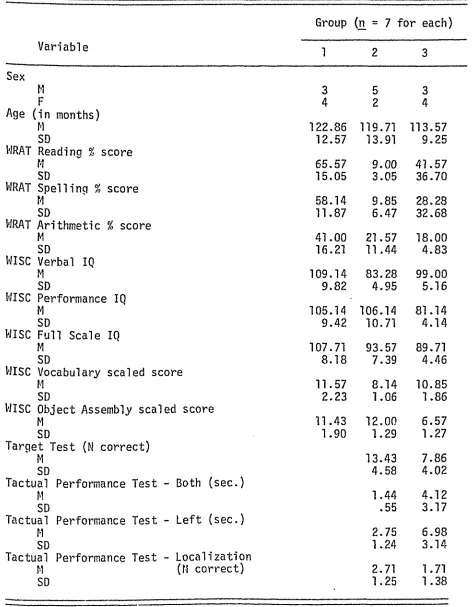
The means and standard deviations fo r the selection c r it e r ia
for subjects in each of the three groups are presented in Table 2.
MEASURES
P ilo t testing v/as carried out with a random sample of
learning-disabled children in May, 1979. Ten children ranging in age from 100
to 135 months (M = 111.9) were tested on the same day they received a
neuropsychological assessment a t the Regional Children's Centre. Four
children were female; six were male. Testing required approximately 20
minutes. The purpose o f the p il o t testing was to derive an estimate
of the d i f f i c u l t y level of the constructed tasks, and to make
modifications of the tasks based on this information. In general, the
te s t performances of the p il o t group were quite good, and the tasks v/ere
subsequently modified to increase th e ir level of d i f f i c u l t y ( i . e . , to
raise the ceilings of the te s ts ).
Five measures were designed and employed to investigate differences
in social s e n s itiv ity between Groups 1, 2 and 3. Tasks varied according
to th e ir modality of stimulus presentation: two of the tasks were
TABLE 2
MEANS AND STANDARD DEVIATIONS FOR SELECTION VARIABLES 25
Group (n = 7 for each)
Variable 1 2 3
Sex
M 3 5 3
F 4 2 4
Age (in months)
M 122.86 119.71 113.57
SD 12.57 13.91 9.25
WRAT Reading % score
M 65.57 9.00 41.57
SD 15.05 3.05 36.70
WRAT Spelling % score
M 58.14 9.85 28.28
SD 11.87 6.47 32.68
WRAT Arithmetic % score
M 41.00 21.57 18.00
SD 16.21 11.44 4.83
WISC Verbal IQ
M 109.14 83.28 99.00
SD 9.82 4.95 5.16
WISC Performance IQ
M 105.14 106.14 81.14
SD 9.42 10.71 4.14
WISC Full Scale IQ
M 107.71 93.57 89.71
SD 8.18 7.39 4.46
WISC Vocabulary scaled score
M 11.57 8.14 10.85
SD 2.23 1.06 1.86
WISC Object Assembly scaled score
M 11.43 12.00 6.57
SD 1.90 1.29 1.27
Target Test (N correct)
M 13.43 7.86
SD 4.58 4.02
Tactual Performance Test - Both (sec.)
M 1.44 4.12
SD .55 3.17
Tactual Performance Test - Left (sec.)
M 2.75 6.98
SD 1.24 3.14
Tactual Performance Test - Localization
M (N correct) 2.71 1.71
SD ■ 1.25 1.38
26
visual presentations, two tasks involved verbal presentations, and one
task involved a combined verbal-visual presentation. Tasks also varied
according to the nature of the response required: two of the tasks
required a verbal response, and three tasks required a visual-motor response
from the subjects.
The visual stimuli used in the present study were selected from
L-/
materials in the 'Toward A ffe ctive Development' (T.A .D .) k i t (Dupont,
Gardner, & Brody, 1974), an educational tool designed to fu rther children's
social and a ffe c tiv e growth. The k i t was designed fo r use by 8 to 12-year-old
children in the regular classroom se ttin g . The advantages of the T.A.D. k i t
Pictures over other stimuli previously used in studies of fa c ia l recognition
( e . g . , Borke, 1971) were that the pictures were generally more colourful,
d etailed and r e a l i s t i c . Three sets of pictures were used: one involved
individual children's faces from the neck up, another set were sketches of
individual children's bodies in various gestures, and the fin a l set were
coloured pictures of children involved in various social interactions.
For the purposes of testing the size of the pictures in the f i r s t two
sets were reduced from th e ir original size , and minor modifications
were performed on the drawings to make them more sim ilar in th e ir sex
ch a rac teris tic s. The verbal descriptions o f the fa c ia l expressions
were taken from the T.A.D. k i t manual.
The standard introduction to the f iv e tasks was: Now I am going to
show you some pictures and ask you some questions. I j u s t want you to
t r y to do your best.
TASK A: Recognition of Facial Expression
The purpose o f this task was to investigate children's a b i l i t y
to select an appropriate fa c ia l expression on the basis o f information