Development of a New Routing Protocol to
Enhance Efficiency in Wireless Sensor
Networks
Nitisha1, Dr. Surender Singh2
Ph.D. (Computer Science) Scholar, Venkateshwara University, Gajraula, Amroha, U.P., India Dept. of C.S.E., Associate Professor, Venkateshwara University, Gajraula, Amroha, U.P., India
ABSTRACT: In this paper, we describe the wireless sensor networks, characteristics study of routing protocols of
WSN, routing challenges and design issues in WSNs, a comparison study of routing techniques in WSN. This paper attempts the construction of an advance routing protocol to enhance efficiency in wireless sensor networks.
KEYWORDS: Energy Wireless Sensor Networks, Routing Protocols, MANETS, fuzzy logic
I. INTRODUCTION
A wireless sensor network (WSN) (sometimes called a wireless sensor and actor network (WSAN)) are spatially distributed autonomous sensors to monitor physical or environmental conditions, such as temperature, sound, pressure, etc. and to cooperatively pass their data through the network to a main location.
The WSN is built of "nodes" – from a few to several hundreds or even thousands, where each node is connected to one (or sometimes several) sensors.
Each such sensor network node has typically several parts:
a radio transceiver with an internal antenna or connection to an external antenna,
a microcontroller, an electronic circuit for interfacing with the sensors and an energy source, usually a battery or an embedded form of energy harvesting.
A sensor node might vary in size from that of a shoebox down to the size of a grain of dust, although functioning "motes" of genuine microscopic dimensions have yet to be created.
The main objective of the work is “DEVELOPMENT OF A NEW ROUTING PROTOCOL TO ENHANCE EFFICIENCY IN WIRELESS SENSOR NETWORKS”
The proposed research work aimed at:
Investigating various routing protocols for WSN.
Investigating the problems in existing routing protocols w.r.t. efficiency in WSN
Designed new routing protocol or to improve the existing algorithms w.r.t. efficiency in WSN.
Compared new routing protocol with past routing protocols in WSN.
Designed, developed and delivered algorithm(s) that cater above needs in WSN
II. RELATED WORK
Construction of an Advance Routing Protocol to Enhance Efficiency in Wireless Sensor Networks:
Wireless Sensor Network (WSN) is a specific type of MANET. This network is a wireless multi-hop technology realized through a set of wireless nodes that communicate with each other. As in MANET, each node operates not only as a host but also as a router, forwarding packets on behalf of other nodes that may not be within direct wireless transmission range of their destinations. In this way wireless sensor technology is used to build cost-effective outdoor wireless networks for private or public use. A Wireless Sensor Network (WSN) is basically based on ad-hoc networks, where each node transfers data to and from an Access Point (AP) which is connected to the Internet by a wired or wireless network. These AP need not be in the reach of all the nodes in the network. Nodes around the AP forward the packets from the faraway nodes to the AP. If there are a significant number of nodes in the network, faraway nodes can transfer data with the AP in a few hops. Besides mobility, WSNs have the advantages viz., they can work in a decentralized fashion, are cheap with minimum investment for initial infrastructure, more reliable, scalable and provide increased coverage. They are widely used in campus networks, metropolitan area networks, transportation system, security surveillance system, etc. Thus, they eliminate the drawbacks predominant in a traditional network which uses a wired connectivity to a base station, wherein every user connects it through a point to multi-point protocol. Instead of using WSN, few access points can be setup which can schedule the medium usage scheduling for the different users in the network. Users may use different routes based on the routing protocol. For streaming of audio and video information, a feasible path is to be chosen based on multiple constraints. This is called multi constraint routing. The constraints can be for a link and/or for a path. In the case of a link, the constraints specify the restrictions for a single link whereas for a path, the constraints are for the entire path (end to end). In addition to this, other issues such as routing for multicast applications, scalability of routing protocols, cross-layer design between routing and MAC protocols are also under study. This could become a cheap and simple alternative to wired telephone and cable networks. But there are many important issues such as, integrating multiple performance metrics into a routing protocol to achieve an optimal overall performance, scalability of routing protocols, routing for multicast applications, and cross-layer design between routing and MAC protocols.
On the other hand, wireless routers in WSNs are expected to be unstable. Apart from routers, wireless links can be unstable. The quality of data transmission can be weakened by multi-path fading effects, external interference and weather conditions. The potential instability of routers and links can appear after determining the optimal route, during transmission of data, which brings us additional requirements related to the protocol. Existing routing protocols applied to WSNSs do not have enough scalability. Some protocols perform an additional check after finding an optimal route, but it is certain that the conditions can changed over time. Usually, the changes are detected only when the link fails or if some of the routers do not respond. The authors of suggested some solutions, where the route testing is done periodically, but the testing interval is not small enough to follow current network monitoring. Besides, the protocol should obtain adaptability in a sense of topology change, as well as adaptability of routers and links, which is quite often in WSNs. In addition to the problem of defining the optimal routing protocol, while designing the WSN, the problem of the quality of wireless transmissions has to be considered. Several authors have provided suggestions for solving the transmission problem and making optimal use of the available spectrum.
III.PROPOSED ALGORITHM
A. DESIGN CONSIDERATIONS:
In this paper, one solution for optimal routing in WSNs is proposed, more specifically, the one emphasizing the management of network resources. Taking into consideration all particularities of WSNs, the proposed solution provides, in the Pareto sense, the optimal route selection, in the shortest time interval, taking into account the current state of the network and optimal use of all network resources. In that way, it is necessary to choose the route in accordance with the needs of future subscribers and their traffic, with as small as possible number of rerouting and the optimal loading balance of the entire network.
usage. Various constraints that are considered are buffer occupancy, residual energy of nodes and the distance of source (hops) from the AP.
THE PROPOSED ROUTING MECHANISM:
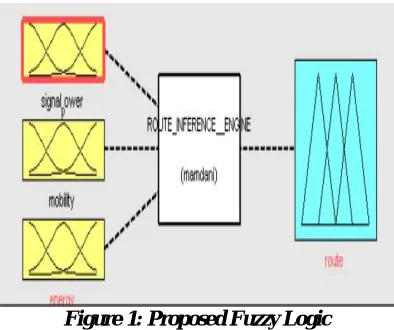
Here Fuzzy Logic has been used for routing and management of a Wireless Sensor Network. Theproposed fuzzy logic based routing algorithm takes intoaccount of three input variables, signal power andmobility and energy.
Figure 1: Proposed Fuzzy Logic
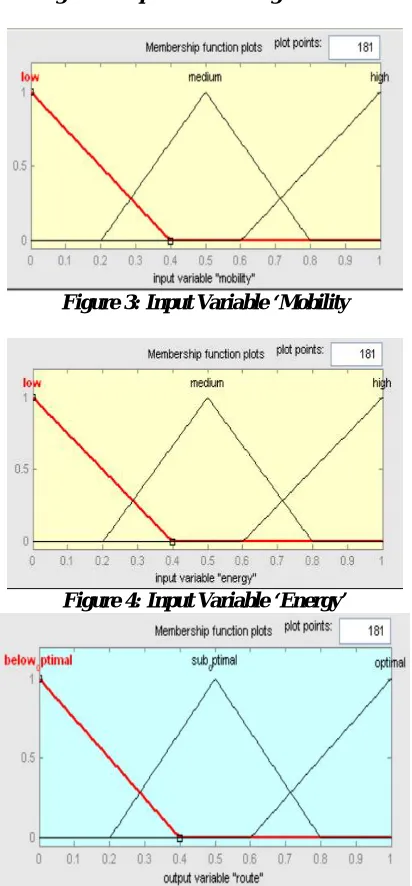
The absolute value of each of theseparameters can take a large range at different points onthe network. We have considered the normalized values for each parameter. Now, ‘crisp’ normalizedvalues are being converted into fuzzy variables. For this, three fuzzy sets have been defined for eachvariable. The sets, poor (from 0 to 0.4), average (from 0.2 to 0.8) and excellent (from 0.6 to 1.0) have been usedfor the input variable signal power (figure 1) and thesets, low (from 0 to 0.4), medium (from 0.2 to 0.8) andhigh (from 0.6 to 1.0) have been used for inputvariable mobility (figure 2) and the sets, low (from 0 to0.4), medium (from 0.2 to 0.8) and high (from 0.6 to1.0) have been used for the input variable energy(figure 3). The normalized value of each parameter ismapped into the fine sets. Each value will have somegrade of membership function for each set. The memberships that have been defined for each of the fuzzy set for any particular input variable are triangular in shape. Next the rules of inference have been written. Initially total 27 rules were devised. The crisp value of input variable was given and a defuzzified crisp value for selected variable was calculated from the derived algorithm. An output linguistic variable is used to represent the route. Proposed optimal routes are based upon the fuzzy rules for different ranges of the metric availability. The routes (figure 4) are defined as below optimal (from 0 to 0.4), suboptimal (from 0.2 to 0.8) and optimal (from 0.6 to 1.0) between two mobile hosts. The below optimal indicates not optimal path, the sub optimal indicates good path and the optimal path indicates the best path.
The proposed routing algorithm can apply to different routing metrics. These routes have to satisfy the mobility, signal power and energy requirements of the network.
Figure 2: Input Variable ‘Signal Power’
Figure 3: Input Variable ‘Mobility
Figure 4: Input Variable ‘Energy’
The Fuzzy Inference rules for the proposed routing technique are:
Rule No.1: If Signal Power is average and Mobility is low and Energy is medium then route is sub-optimal.
Rule No.2: If Signal Power is excellent and Mobility is medium and Energy is medium then route is sub-optimal.
Rule No.3: If Signal Power is poor and Mobility is high and Energy is high then route is sub-optimal.
Rule No.4: If Signal Power is average and Mobility is low and Energy is medium then route is sub-optimal.
Rule No. 5: If Signal Power is average and Mobility is medium and Energy is high then route is sub-optimal.
Rule No.6: If Signal Power is excellent and Mobility is low and Energy is high then route is optimal.
Rule No. 7: If Signal Power is poor and Mobility is high and Energy is low then route is sub-optimal.
Rule No.8: If Signal Power is excellent and Mobility is medium and Energy is low then route is sub-optimal.
Rule No.9: If Signal Power is poor and Mobility is low and Energy is low then route is below optimal.
IV.SIMULATION RESULTS
The routes based upon the above rules have been shown with the help of the following graphs:
Figure 6: ‘Route’ O/P w.r.t. ‘Poor Signal Power’, Poor ‘Mobility’ and Low ‘Energy’
The figure 6 illustrates that when signal power is poor (0.253), mobility is high (0.949) and energy is low (0.386) then
in this condition the route is sub-optimal (0.5). So this algorithm works well when mobility is high and energy is low.
Figure 7: ‘Route’ O/P w.r.t. ‘Mobility’ and ‘Signal Power’
In figure 7 mobility and signal power are the fuzzy input variable for the proposed routing algorithm which lies on the
Figure 8: ‘Route’ O/P w.r.t. Poor ‘Signal Power’, Low ‘Mobility’ and Low ‘Energy’
The figure 8 illustrates that when signal power is poor (0.184), mobility is low (0.221) and energy is low (0.279) then
in this condition the route is below-optimal (0.189).
Figure 9: ‘Route’ O/P w.r.t. ‘Mobility’ and ‘Energy’
In figure 9 mobility and energy are the fuzzy input variable for the proposed routing algorithm which lies on the
horizontal axes and route is the output variable which has been shown on the vertical axis.
Figure 10: ‘Route’ O/P w.r.t. ‘Signal Power’ and ‘Mobility’
Figure 11: ‘Route’ O/P w.r.t. Excellent ‘Signal Power’, Low ‘Mobility’ and High ‘Energy’
The figure 11 illustrates that when signal power is excellent (0.923), mobility is low (0.0771) and energy is high (0.96) then in this condition the route is optimal (0.865). So this algorithm works well when mobility is low and energy is high.
Figure 12: ‘Route’ O/P w.r.t. ‘Energy’ and ‘Signal Power’
In figure 12 energy and signal power are the fuzzy input variable for the proposed routing algorithm which lies on the
horizontal axes and route is the output variable which has been shown on the vertical axis.
V. PSEUDO CODE
Proposed optimal routes are based upon the fuzzy rules for different ranges of the metric availability. The routes (figure 4) are defined as below optimal (from 0 to 0.4), suboptimal (from 0.2 to 0.8) and optimal (from 0.6 to 1.0) between two mobile hosts. The below optimal indicates not optimal path, the sub optimal indicates good path and the optimal path indicates the best path.
The proposed routing algorithm can apply to different routing metrics. These routes have to satisfy the mobility, signal power and energy requirements of the network.
VI.SIMULATION RESULTS
One of the most important factors influencing performance of wireless sensor network is the routing protocol used. Existing protocols such as traffic balancing select the routes based on its usage and AODV chooses routes based on their length. To maximize the performance, and to reduce the overhead of the entire network, we have proposed our new routing mechanism based on signal power, mobility and energy. After fully describing its functions and mechanism, we have suggested various optimizations to the protocol and utilized the concept of stability index. Experimental simulation results using fuzzy logic toolkit of MATLab 7.0 shows that our routing mechanism is functional and effective. We do see the need in further experimentation in order to accurately access the practical effectiveness of our routing technique in a medium to large size network.
VII. CONCLUSION AND FUTURE WORK
One of the most important factors influencing performance of wireless sensor network is the routing protocol used. Existing protocols such as traffic balancing select the routes based on its usage and AODV chooses routes based on their length. To maximize the performance, and to reduce the overhead of the entire network, we have proposed our new routing mechanism based on signal power, mobility and energy. After fully describing its functions and mechanism, we have suggested various optimizations to the protocol and utilized the concept of stability index. Experimental simulation results using fuzzy logic toolkit of MATLab 7.0 shows that our routing mechanism is functional and effective. We do see the need in further experimentation in order to accurately access the practical effectiveness of our routing technique in a medium to large size network.
REFERENCES
1. Nitisha Garg et.al, “A Characteristics Study of Wireless Sensor Networks Along with Open Issues in Routing Protocols”, Int. J. of Advanced and Innovative Research (IJAIR), Vol. 2, issue 7, pp. 256-269, 2013.
2. Nitisha Garg et.al, “A Characteristics Study of Routing Protocols in Wireless Sensor”, Int. J. of Current Engineering and Technology (IJCET), Vol.5, no.3, June 2015.
3. Nitisha Garg et.al, “Comparison Study of Routing Techniques in WSNs with MANETs”, Int. J. of Engineering and Management Research, Vol. 4, issue 3, pp. 75-79, June 2014.
4. K. Sohraby, D. Minoli and T. Nati, “Wireless sensor networks: technology, protocols, and applications”, John Wiley and Sons, pp. 203–209, 2007.
5. Pushpender and Sohan Garg, “A New Routing Technique Based on Fuzzy Logic for Multi-Hop Wireless Mesh Networks”, Int. Organisation of Scientific Research - J. of Eng. (IOSRJEN), Vol. 3, Issue 11, pp. 01-08, November 2013.
6. Nitisha Garg et.al., “Construction of advance routing protocol to enhance efficiency in wireless sensor networks”, National Conference on Emerging Trends & Innovations in Computer & Communication I.T.M. Rewari, 19 October 2013.
7. Nitisha Garg et.al., “ Wireless Sensor Networks Architecture, applications, Routing protocols, their design constraints and classification: A review”, National Conference Advances in Computing Communication Networks and Electrical Systems (NCACCNES-2014) , February 27-28, 2014.
8. L.A. Zadeh, “Toward a theory of fuzzy systems, in aspects of networks and system theory”, ed. R E Kalman and N.Declairs , Newyork: Holt, Rinehart and Winston, pp. 469-490, 1971.
9. L.A. Zadeh, “Fuzzy algorithms”, Information Control, vol. 12, pp. 94-102, 1968.
10. W. Rabiner et al., “Energy-efficient communication protocol for wireless microsensor networks”, in Proc. 33rd Int. Conf. on System Sciences, Hawaii, 2000.
11. Yan Yu et al., “Networking Issues in Wireless Sensor Network”, J. of Parallel and Distributed Computing, Vol. 64, issue 7, pp. 799–814, July 2004.
12. L. Mihail, “Wireless Mesh Networks: Opportunities and Challenges”, in Proc. Wireless World Congress, CA, USA, pp. 1-6, 2005.
BIOGRAPHY