A Survey on Smart Car-Parking System Using
On Internet-of-Things
Samrudha Y. Jondhale1, Nikhil Supekar1, Aditya Garud1, Adwait Jagtap. V2
B.E. Students, Dept. of Computer Engineering Shri Chatrapati Shivaji Maharaj College of Engineering, Nepti ,
Maharashtra, India1
Asst. Professor, Dept. of Computer Engineering Shri Chatrapati Shivaji Maharaj College of Engineering, Nepti,
Maharashtra, India 2
ABSTRACT: Internet of Things (IOT) plays a vital role in connecting the surrounding environmental things to the network and made easy to access those un-internet things from any remote location. It’s inevitable for the people to update with the growing technology. And generally people are facing problems on parking vehicles in parking slots in a city. In this study we design a Smart Parking System (SPS) which enables the user to find the nearest parking area and gives availability of parking slots in that respective parking area. And it mainly focus on reducing the time in finding the parking lots and also it avoids the unnecessary travelling through filled parking lots in a parking area. Thus it reduces the fuel consumption which in turn reduces carbon footprints in an atmosphere.This paper introduces a novel algorithm that increases the efficiency of the current cloud-based smart-parking system and develops a network architecture based on the Internet-of-Things technology. This paper proposed a system that helps users automatically find a free parking space at the least cost based on new performance metrics to calculate the user parking cost by considering the distance and the total number of free places in each car park. This cost will be used to offer a solution of finding an available parking space upon a request by the user and a solution of suggesting a new car park if the current car park is full. The simulation results show that the algorithm helps improve the probability of successful parking and minimizes the user waiting time. We also successfully implemented the proposed system in the real world.
KEYWORDS: Smart-parking system, performance metrics.
I. INTRODUCTION
several innovative technologies and can automatically monitor and manage car parks. Furthermore, in the proposed system, each car park can function independently as a traditional car park. This research also implements a system prototype with wireless access in an open-source physical computing platform based on RFID technology using a smartphone that provides the communication and user interface for both the control system and the vehicles to verify the feasibility of the proposed system.Internet of things was first introduced in 1999 at auto-ID center and first used by Kevin Ashton. As evolving this latest burning technology, it promises to connect all our surrounding things to a network and communicating with each other with less human involvement. Still internet of things is in beginning stage and there is no common architecture exists till today. There is lot of researches and implementations are currently being going on in all the respective areas. Thus there is no guidelines or boundaries exists to define the definition of internet of things. So depending on the context, application the internet of things has different definitions. Shortly it is defined as the things present in the physical world or in an environment are attached with sensors or with any embedded systems and made connected to network via wired or wireless connections. These connected devises are called as smart devices or smart objects. And it consists of smart machines which communicating interacting with other machines, environment, objects etc. And also it incorporates to connect any two machines, machine to human and vice-versa etc. this communication is called as M-M communication. As M-M communication is developing by the various standardization bodies such as Open Mobile Alliance (OMA), European Telecommunication Standards Institute (ETSI), Institute of Electrical and Electronic Engineers (IEEE), 3rd Generation Partnership Project (3GPP) organization have performed some activities on M-M communication [4]. It makes daily life things to equip with transceivers, sensors, actuators and microcontrollers etc. for communication. Some important benefits of internet of things includes 1) tracking behaviours; 2) enhanced situational awareness; 3) sensor driven decision analytics; 4) instantaneous control and response. Etc.
IOT technology grows in various fields of smart applications but we have not yet found boundary constraints of this technology. Some smart applications which it has implementing currently such as on smart grids, smart lighting, smart energy, smart city, smart health etc. This is broadly classified into three categories such as sensing, processing and connectivity. Whereas sensing includes sensing the speed of vehicles and humans or any objects (accelerometer), sensing of temperature, pressure etc. [9]. And these can be processing by using some processors such as network processor, hybrid processor MCU/MPU etc. And the devices are connected by using some technologies called GPS, Wi-Fi, BT/BTLE, and RFID.
II. RELATED WORK
reserved space. The system will periodically update the status of the parking space in real time to help ensure system accuracy. System performance is measured through the accuracy of the inertial navigation systems run in an indoor environment, and the system implementation is evaluated by considering the accuracy of the GPS. In this paper, we have not evaluated the performance of the parking services, they do not provide any mathematical model of the system, and do not consider the waiting time of each vehicle for service. Other researchers have designed architecture for parking management in smart cities [6]. They proposed intelligent parking assistant (IPA) architecture aimed at overcoming current public parking management solutions. This architecture provides drivers with information about on-street parking stall availability and allow drivers to reserve the most convenient parking stall at their destination before their departure. They use RFID technology in this system. When a car parks or leaves the IPA parking spot, the RFID reader and the magnetic loop detect the action and send this information to the unit controller to update the information on the car park status. This study uses only some simple mathematical equations for the system architecture and does not create a large scale parking system. In other works, authors have designed and implemented an SPS [7] to solve the parking problem. A part of this system is implemented in the Zigbee network which sends urgent information to a PC through a coordinator and then updates the database. The application layer can quickly pass the parking information over the Internet, and use the advantages of a web service to gather all the scattered parking information for the convenience of those who want to find a parking space. This paper simply reports the design and implementation of an SPS and does not evaluate the system performance.
III.PROPOSED ALGORITHM
A. SYSTEM OVERVIEW:
The system is derived from the idea of IoT. The system uses the sensors and GPS system technology to monitor car parks.
reserve it. If after a certain period of pending time the system determines that no car is parked in that space, then it changes the status to ``available.'' The system will update the status from the WSN node (the status of car park spaces) when a new car joins in the system. Therefore, the status of the overall parking system is always updated in real time. The system will help plot the parking time for each parking space in real time and can support the business with hourly parking charges.)
B. SYSTEM ARCHITECTURE:
Fig. 1 shows our smart IoT parking system. Elements in the system:
1. Cloud-Based Server: This is a Web entity that stores the resource information provided by local units located at each car park. The system allows a driver to search and find information on parking spaces from each car park without the need to directly access the local server node by directly accessing the cloud-based server.
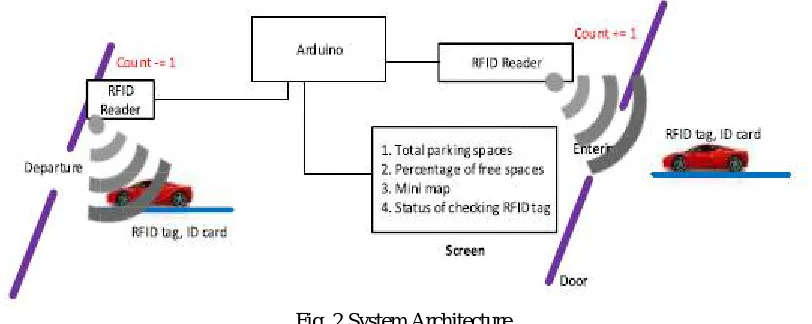
Fig. 2 System Architecture
2. Local Unit: This unit is located in each car park and stores the information of each parking space, as shown in Fig.2. The local unit includes the following:
Control Unit: This is an Arduino module, which is connected using an RFID reader. The card reader authenticates the user information and then displays this information on the screen. If the information
of the RFID tag or card is correct, the Arduino module will control the opening of the door for the vehicle to enter. The Arduino module connects with the cloud server through an Internet connection to transfer data from the local car park to the cloud server database.
Screen: This displays information on the capacity of the local car park, the total current percentage of free spaces, the status of the RFID tag check, the user card when entering, and a mini map of the local car park.
RFID Tag or ID card: This is used to check and authenticate user information and calculate the percentage of total free spaces in each car park.
IV.CONCLUSION
This designed automatic smart parking system which is simple, economic and provides effective solution to reduce carbon footprints in the atmosphere. It is well managed to access and map the status of parking slots from any remote location through web browser. Thus it reduces the risk of finding the parking slots in any parking area and also it eliminates unnecessary travelling of vehicles across the filled parking slots in a city. So it reduces time and it is cost effective also.The simulation of our system achieved the optimal solution when most of the vehicles successfully found a free parking space. The average waiting time of each car park for service becomes minimal, and the total time of each vehicle in each car park is reduced. In our future study, we will consider the security aspects of our system as well as implement our proposed system in large scales in the real world.
REFERENCES
1. Y. Geng and C. G. Cassandras, ``A new `smart parking' system based on optimal resource allocation and reservations,'' in Proc. 14th Int. IEEE Conf. Intell. Transp. Syst. (ITSC), Oct. 2011, pp. 979984.
2. Y. Geng and C. G. Cassandras, ``New `smart parking' system based on resource allocation and reservations,'' IEEE Trans. Intell. Transp. Syst., vol. 14, no. 3, pp. 11291139, Sep. 2013.
3. X. Zhao, K. Zhao, and F. Hai, ``An algorithm of parking planning for smart parking system,'' in Proc. 11th World Congr. Intell. Control Autom. (WCICA), 2014, pp. 49654969.
4. L. Mainetti, L. Palano, L. Patrono, M. L. Stefanizzi, and R. Vergallo, ``Integration of RFID and WSN technologies in a smart parking system,'' in Proc. 22nd Int. Conf. Softw., Telecommun. Comput. Netw. (SoftCOM), 2014, pp. 104110.
5. C. W. Hsu, M. H. Shih, H. Y. Huang, Y. C. Shiue, and S. C. Huang,``Verication of smart guiding system to search for parking space via DSRC communication,'' in Proc. 12th Int. Conf. ITS Telecommun. (ITST), 2012, pp. 7781.
6. R. E. Barone, T. Giuffrè, S. M. Siniscalchi, M. A. Morgano, and G. Tesoriere, ``Architecture for parking management in smart cities,'' IET Intell. Transp. Syst., vol. 8, no. 5, pp. 445452, 2014.
7. C. Shiyao, W. Ming, L. Chen, and R. Na, ``The research and implement of the intelligent parking reservation management system based on ZigBee technology,'' in Proc. 6th Int. Conf. Meas. Technol. Mechatronics Autom. (ICMTMA), 2014, pp. 741744.
8. D. J. Bonde, R. S. Shende, K. S. Gaikwad, A. S. Kedari, and A. U. Bhokre, ``Automated car parking system commanded by Android application,'' in Proc. Int. Conf. Comput. Commun. Inform. (ICCCI), 2014, pp. 14.