Scholarship at UWindsor
Scholarship at UWindsor
Electronic Theses and Dissertations Theses, Dissertations, and Major Papers
2009
Appraisals of importance and control of thoughts: An
Appraisals of importance and control of thoughts: An
experimental analysis
experimental analysis
Robert I. Ferguson University of Windsor
Follow this and additional works at: https://scholar.uwindsor.ca/etd
Recommended Citation Recommended Citation
Ferguson, Robert I., "Appraisals of importance and control of thoughts: An experimental analysis" (2009). Electronic Theses and Dissertations. 7973.
https://scholar.uwindsor.ca/etd/7973
This online database contains the full-text of PhD dissertations and Masters’ theses of University of Windsor students from 1954 forward. These documents are made available for personal study and research purposes only, in accordance with the Canadian Copyright Act and the Creative Commons license—CC BY-NC-ND (Attribution, Non-Commercial, No Derivative Works). Under this license, works must always be attributed to the copyright holder (original author), cannot be used for any commercial purposes, and may not be altered. Any other use would require the permission of the copyright holder. Students may inquire about withdrawing their dissertation and/or thesis from this database. For additional inquiries, please contact the repository administrator via email
This reproduction is the best copy available.
AN EXPERIMENTAL ANALYSIS
by
Robert I. Ferguson, M.A.
A Dissertation
Submitted to the Faculty of Graduate Studies through Adult Clinical Psychology in Partial Fulfilment of the Requirements for
the Degree of Doctor of Philosophy at the University of Windsor
Windsor, Ontario, Canada
2009
1 * 1
Published Heritage Branch
Direction du
Patrimoine de I'edition
395 Wellington Street Ottawa O N K1A 0N4 Canada
395, rue Wellington Ottawa ON K1A 0N4 Canada
Your file Votre reference ISBN: 978-0-494-57567-3 Our file Notre r6f6rence ISBN: 978-0-494-57567-3
NOTICE: AVIS:
The author has granted a
non-exclusive license allowing Library and Archives Canada to reproduce, publish, archive, preserve, conserve, communicate to the public by
telecommunication or on the Internet, loan, distribute and sell theses
worldwide, for commercial or non-commercial purposes, in microform, paper, electronic and/or any other formats.
L'auteur a accorde une licence non exclusive permettant a la Bibliotheque et Archives Canada de reproduire, publier, archiver, sauvegarder, conserver, transmettre au public par telecommunication ou par I'lnternet, prefer, distribuer et vendre des theses partout dans le monde, a des fins commerciales ou autres, sur support microforme, papier, electronique et/ou autres formats.
The author retains copyright ownership and moral rights in this thesis. Neither the thesis nor substantial extracts from it may be printed or otherwise reproduced without the author's permission.
L'auteur conserve la propriete du droit d'auteur et des droits moraux qui protege cette these. Ni la these ni des extraits substantiels de celle-ci ne doivent etre imprimes ou autrement
reproduits sans son autorisation.
In compliance with the Canadian Privacy Act some supporting forms may have been removed from this thesis.
While these forms may be included in the document page count, their removal does not represent any loss of content from the thesis.
Conformement a la loi canadienne sur la protection de la vie privee, quelques formulaires secondaires ont ete enleves de cette these.
Bien que ces formulaires aient inclus dans la pagination, il n'y aura aucun contenu manquant.
1*1
Declaration of Previous Publication
This dissertation includes information that has been submitted for publication
with the journal, Behaviour Research and Therapy (BRAT). On the date on which BRAT
copyright information was examined (September 13,2008), the copyright page of their
website (http: //www.elsevier. com/wps/ find/authorshome. author s/copyright#whatrights)
stated, "As a journal author, you retain rights for a large number of author uses,
including use by your employing institute or company. These rights are retained and
permitted without the need to obtain specific permission from Elsevier. These include:
- the right to include the journal article, in full or in part, in a thesis or dissertation ".
Note that other less relevant rights included on the website are not presented here.
I certify that the material in this dissertation describes my work completed during
my registration as a graduate student at the University of Windsor. I declare that, to the
best of my knowledge, my dissertation does not infringe upon anyone's copyright nor
violate any proprietary rights and that any idea, techniques, quotations, or any other
material from the work of other people included in my dissertation, published or
otherwise, are fully acknowledged in accordance with the standard of referencing
practises.
I declare that this is a true copy of my dissertation, including any final revisions,
as approved by my dissertation committee and the Graduate Studies office, and that this
dissertation has not been submitted for a higher degree to any other University or
ABSTRACT
Cognitive theory of obsessions hypothesizes that faulty appraisals of intrusive thoughts
are paramount in the development and persistence of obsessive-compulsive disorder
(OCD). Types of faulty appraisals include interpretations of excessive responsibility for
preventing an adverse outcome (responsibility), appraisals of exaggerated personal
importance (importance of thoughts), and interpretations that focus on having total
control over one's own thoughts (control of thoughts). Previous research suggests that
importance and control of thoughts appraisals (Ferguson, Jarry, & Jackson, 2006) and
beliefs (Obsessive Compulsive Cognitions Working Group, 2005) are better described as
one construct. Although there are numerous experimental studies suggesting that
appraisals of excessive responsibility lead to more severe OCD symptoms, only two have
demonstrated this effect with importance of thoughts appraisals (Teachman, Woody, &
Magee, 2006; Teachman & Clerkin, 2007), and none have experimentally examined the
combined effect of importance appraisals and efforts at mental control. The present
research investigates the impact of an experimental manipulation of importance
appraisals and attempts at mental control on the severity of OCD associated
manifestations. Participants had an unwanted mental intrusion provoked through the use
of a well-established intrusive thought provocation procedure (Rachman, Shafran,
Mitchell, Trant, & Teachman, 1996). Appraisals of importance were experimentally
manipulated by systematically varying information given to participants about having an
intrusive thought (i.e., whether it is meaningful or not). Attempts at mental control were
by people in response to an intrusive thought in order to regain mental control. Results
revealed that participants who were exposed to importance interpretations, and those who
were not given any feedback about their intrusive thought (Control group), reported more
severe dysfunctional appraisals of importance and mental control, as well as higher levels
of OCD associated symptoms than did those who had their intrusive thought normalized.
Participants who were instructed to exercise mental control via thought suppression did
not report more severe levels of obsessive-compulsive symptoms than did those who
were not given such instructions. Finally, the findings clearly suggest that
DEDICATION
This research is dedicated to those individuals that experience distressing obsessions and
compulsions. It is my sincere hope that research, such as the study presented herein, will
facilitate the understanding of obsessive-compulsive symptoms, and in turn, lead to
ACKNOWLEDGEMENTS
This writer is incredibly honoured to have such a knowledgeable doctoral dissertation
committee. Your input has been greatly appreciated throughout the entire process. In
particular, to my research advisor, Dr. Josee Jarry, thank you for your ongoing support
and adding your expertise to this project. To my family, Donna, Ian, Scott, and Rosie,
your love is always felt. Finally, to my partner, Amanda, thank you for your constant love
TABLE OF CONTENTS
DECLARATION OF PREVIOUS PUBLICATION iii
ABSTRACT iv
DEDICATION vi
ACKNOWLEDGEMENTS vii
LIST OF TABLES xii
LIST OF FIGURES xii
CHAPTER
I. INTRODUCTION
Overview
Context of the Problem
Definitional/Conceptual Issues
Obsessions
Compulsions 2
Obsessive-Compulsive Disorder 3
Behavioural Conceptualization of OCD 3
Cognitive Conceptualization of OCD 6
Behavioural Versus Cognitive Treatment of OCD 8
Cognitive Behavioural Theory of Obsessions: 8 Responsibility
Empirical Support for the Cognitive Behavioural 10 Theory of Obsessions
Control of Thoughts
Empirical Support for the Breakdown of Mental 16 Control Theory of Obsessions
Cognitive Theory of Obsessions: Importance of Thoughts 17
Empirical Support for the Cognitive Theory of 19 Obsessions
Obsessive Compulsive Cognitions Working Group and 23 Importance/Control Appraisals
Developing and Experimental Design to Investigate 26 Appraisals of Importance/Control of Thoughts
Provocation of an Intrusive Thought 27
Importance of Thoughts Manipulation 28
Control of Thoughts Manipulation 29
An Importance/Control of Thoughts Manipulation 3 3
Purpose of the Present Research 35
Research Question 35
Hypothesis 35
II. METHOD 37
Participant Numbers and Characteristics 37
Overall Design 38
Recruitment Method 39
Measures 40
Beck Anxiety Inventory 40
Obsessing subscale of the Obsessive Compulsive 41 Inventory - Revised
Rosenberg Self-Esteem Scale 42
State Self-Esteem Scale 43
Obsessive-Compulsive Disorder Inventory 44
Interpretation of Intrusions Inventory - 1 9 44
Measure of Obsessive-Compulsive Behaviour 46
Positive and Negative Affect Schedule 47
Demographic Questionnaire 47
Procedure 48
Approach to Data Analysis 53
III. RESULTS 56
Descriptive Statistics 56
Manipulation Checks 58
Main Analyses 59
Main Effect of Importance 62
Main Effect of Suppression 70
Neutralizing Behaviour 72
Exploratory Analyses: Responsibility Effects 73
Debriefing Results 74
IV. DISCUSSION 76
Suppression Manipulation 83
Normalization Manipulation 85
Methodological Considerations 86
Limitations and Future Research 89
Summary 93
REFERENCES 95
APPENDICES 106
Appendix A Letter of Information 106
Appendix B Consent Form 108
Appendix C Obsessing Subscale of Obsessive Compulsive 111 Inventory - Revised - Trait
Appendix D Obsessing Subscale of Obsessive Compulsive 112 Inventory - Revised - State
Appendix E Rosenberg Self-Esteem Scale 113
Appendix F States Self-Esteem Scale 114
Appendix G Obsessive-Compulsive Distress Inventory 115
Appendix H Interpretation of Intrusions Inventory - 1 9 117
Appendix I Measure of Obsessive-Compulsive Behaviour 119
Appendix J Positive and Negative Affect Schedule 120
Appendix K Demographic Questionnaire 121
Appendix L Debriefing for Deception 123
Appendix M Correlation Table of Dependent Variables 128
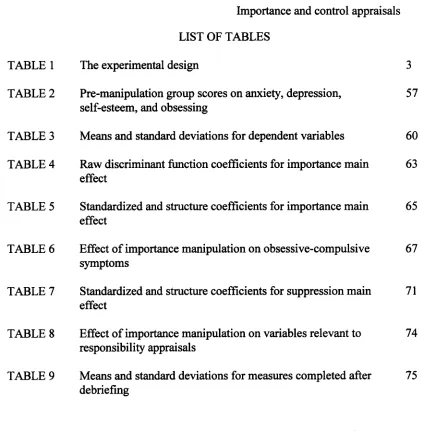
LIST OF TABLES
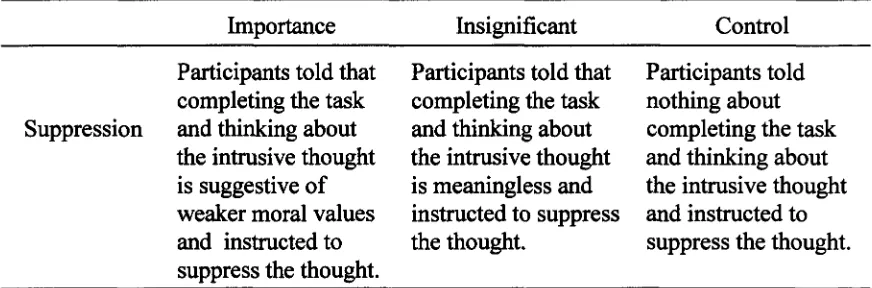
TABLE 1 The experimental design 3
TABLE 2 Pre-manipulation group scores on anxiety, depression, 57 self-esteem, and obsessing
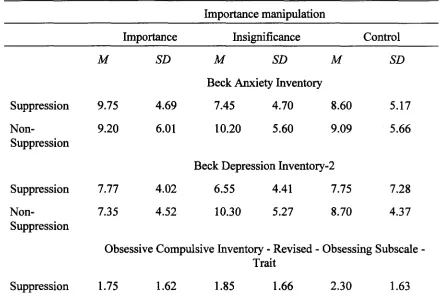
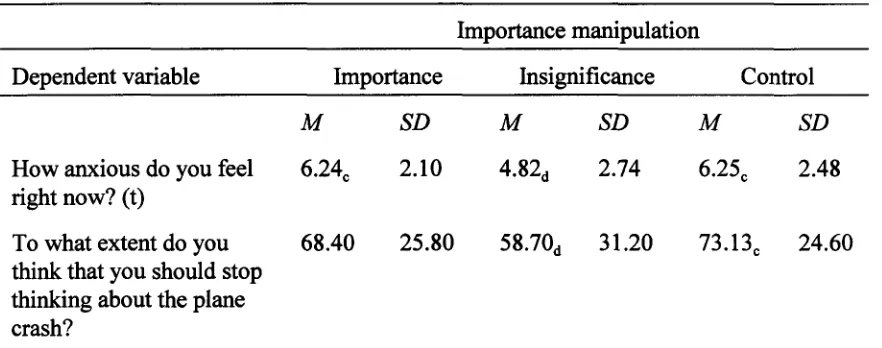
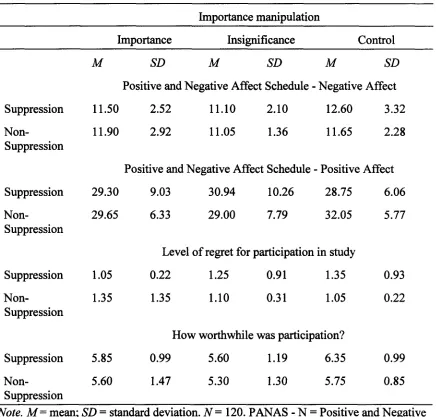
TABLE 3 Means and standard deviations for dependent variables 60
TABLE 4 Raw discriminant function coefficients for importance main 63 effect
TABLE 5 Standardized and structure coefficients for importance main 65 effect
TABLE 6 Effect of importance manipulation on obsessive-compulsive 67 symptoms
TABLE 7 Standardized and structure coefficients for suppression main 71 effect
TABLE 8 Effect of importance manipulation on variables relevant to 74 responsibility appraisals
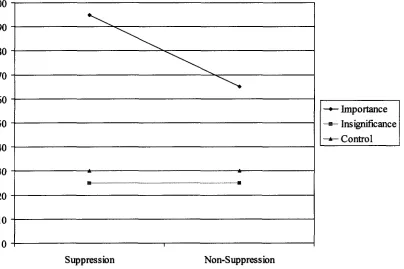
LIST OF FIGURES
FIGURE 1
FIGURE 2
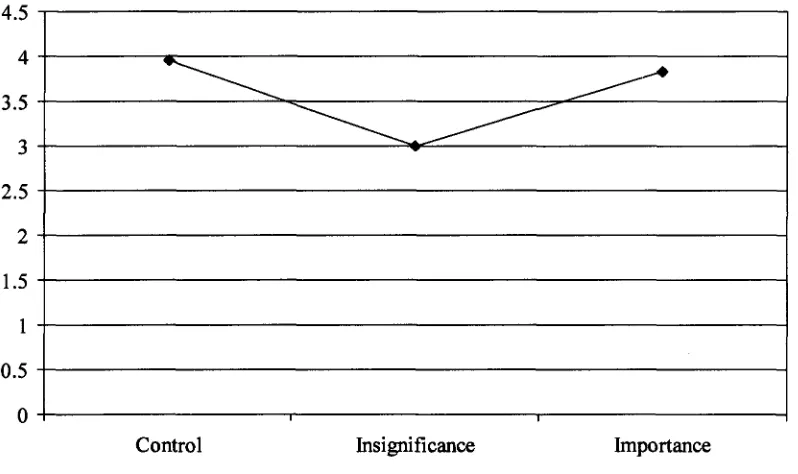
Predicted severity level of obsessive-compulsive symptoms by experimental condition
Importance, Insignificance, and Control group means on
multivariate composite variable assessing obsessive-compulsive features
36
64
Chapter I
INTRODUCTION
Overview
Context of the Problem
Individuals with obsessive-compulsive disorder (OCD) suffer from symptoms
that can be extremely tormenting, debilitating, and time consuming. The World Health
Organization (WHO) rated OCD as the tenth leading cause of disability in the world
(WHO, 1996). OCD was once thought to be a rare mental disorder with initial prevalence
ratings of 0.05% (Rudin, 1952, as cited in Antony, Downie, & Swinson, 1998). However,
findings of a Canadian epidemiological study suggest that OCD is a relatively common
mental disorder, with an estimated lifetime prevalence rate of 3% in the general
population (Bland, Orn, & Newman, 1988). Results from the Epidemiological Catchment
Area study estimated lifetime prevalence rates to be between 1.9 and 3.3% (Karno,
Golding, Sorenson, & Burnam, 1988). A more recent study conducted by Weissman et al.
(1994) found the lifetime prevalence of OCD to be within this range at approximately
2.3%. In adult clinical samples, the ratio of males to females is approximately 1 : 1 and
males tend to have an earlier age of onset compared to women (American Psychiatric
Association, 2000).
Definitional/Conceptual Issues
Obsessions
The most recent edition of the Diagnostic and Statistical Manual of Mental
impulses, or images that are experienced as intrusive and inappropriate and that cause
marked anxiety or distress" (American Psychiatric Association, 2000, p. 457). Examples
of obsessions include impulses to harm a loved one, thoughts of being contaminated, and
repeated doubts that one left an appliance plugged in and consequently that one's house
will catch fire. Obsessions are distinguished from worry in that the latter are experienced
as ego-syntonic and are usually focussed on real life concerns, such as family, work, or
finances, whereas obsessions are experienced as intrusive and are less focussed on normal
experiences of everyday life (Turner, Beidel, & Stanley, 1992). Furthermore, worry tends
to take the form of ordinary thoughts whereas obsessions may take the form of thoughts,
images, or impulses (Turner et al., 1992). For the sake of parsimony, the term "intrusive
thoughts" is used throughout this document to refer to all types of cognitive intrusions
(i.e., thoughts, impulses, or images).
Compulsions
Compulsions are defined in the DSM-IV-TR (American Psychiatric Association,
2000) as "repetitive behaviours (e.g., hand washing, ordering, checking) or mental acts
(e.g., praying, counting, repeating words silently) the goal of which is to prevent or
reduce anxiety or distress, not to provide pleasure or gratification" (p. 457). Examples of
common compulsions include excessively cleaning oneself to wash away or prevent
perceived contamination, repeatedly checking the stove to ensure the dials are turned off
so as to prevent a fire from occurring, and repeating a certain phrase over and over.
Compulsions are distinct from impulse control disorders (e.g., pathological gambling,
compulsions are designed to reduce risk and avoid harm or distress whereas impulsive
behaviours involve risk taking and are engaged in for more pleasurable purposes, at least
in the short term (Veale, 2003).
Obsessive-Compulsive Disorder
OCD is categorized as an anxiety disorder in the DSM-IV-TR (American
Psychiatric Association, 2000). The rationale for this classification is that obsessive
thoughts engender a feeling of anxiety and discomfort. Compulsions are typically
performed in order to neutralize such anxiety and discomfort. The criteria in the
DSM-IV-TR require sufferers to experience clinically significant obsessions and/or compulsions in
order to be diagnosed with OCD. This means that the obsessions and/or compulsions
must cause marked anxiety or distress or have a significantly adverse impact one's social
and/or occupational functioning. Typical OCD presentations involve the presence of
obsessions and compulsions, although conjoint presentation is not required for a
diagnosis of OCD. In rare instances, individuals with OCD may have obsessions without
compulsions, or compulsions in the absence of obsessions (de Silva & Rachman, 1998;
Mayerovitch, du Fort, Kakuma, Bland, Newman, & Pinard, 2003).
Behavioural Conceptualization of OCD
The behavioural conceptualization of OCD stems from Mowrer's (1960)
two-factor theory that describes how classical and operant conditioning combine to facilitate
the onset and maintenance of fear. This theory is not specific to OCD but it does help
provide an understanding of the manner by which anxiety develops and persists in OCD.
of a specific fear, referred to as a conditioned response (CR), occurs when a conditioned
stimulus (CS) is paired with a naturally aversive stimulus, referred to as an unconditioned
stimulus (US). For example, a child may learn to fear (CR) a teddy bear (CS) if the
presence of the teddy bear coincides often enough with a loud, unpleasant noise (US).
Eventually the presence of the teddy bear will elicit the fear response because it will be
associated with the aversive stimulus, in this case, the unpleasant noise. Operant
conditioning contributes to the maintenance of the fear response. According to Mowrer, a
fear response engenders motivational efforts to reduce the uncomfortable state. Any
behaviour that works to reduce the level of fear (e.g., escape or avoidance) is reinforced
because of its success in temporarily reducing or eliminating the fear. Despite the
short-term effectiveness of escape or avoidance behaviours to reduce fear, such behaviours
contribute to the maintenance of the fear in the long term because they prevent the
extinction of the CR. That is, these behaviours prevent the opportunity for one to be
exposed to his or her feared stimulus for an extended period of time and to habituate to
the stimulus. Repeated exposure to the CS without presentation of the US leads to
extinction of the CR.
Mowrer's (1960) two-factor theory can be used in a more specific manner to
conceptualize the onset and persistence of OCD. Upon occurrence of an intrusive
thought, individuals with OCD experience anxiety or distress. They learn to reduce the
anxiety initially by escaping and in the future by avoiding fearful stimuli. They may also
engage in compulsive rituals in order to reduce their anxiety. The success of the
distress is reinforcing and increases the probability that such behaviour will recur in the
future. Individuals come to think that they avoided negative consequences (e.g., their
feared thought coming true) by engaging in compulsive rituals or escaping/avoiding
situations associated with their obsessions. The cycle of fear in response to obsessions,
followed by compulsions or escape/avoidance behaviours is maintained because engaging
in these behaviours precludes the opportunity to habituate to the anxiety and to
disconfirm faulty beliefs.
Because of this pattern, individuals with OCD never have the opportunity to learn
that the feared events will not happen and that their anxiety or distress will eventually
subside without engaging in compulsive rituals or escaping the situation. For example, a
person begins to have intrusive thoughts that he/she will be contaminated and
subsequently, will become gravely ill. The individual experiences anxiety and fear when
he/she has these repetitive intrusive thoughts of becoming contaminated by germs. Upon
feeling contaminated, the individual engages in repetitive and excessive washing rituals
to rid him/herself of any possible contamination. The individual also attempts to avoid
situations that are perceived to be of elevated risk for contamination. The compulsive
rituals and avoidance behaviour prove effective (at least in the short-term) in reducing the
anxiety experienced from the intrusive thoughts of contamination. Thus, these behaviours
are negatively reinforced because they are successful in reducing anxiety. This negative
reinforcement is also implicated in landmark cognitive conceptualizations of OCD as
being a key contributor in the persistence of OC symptoms (Rachman, 1998; Salkovskis,
the fear because the individual does not have an opportunity to be exposed to their fears
in the absence of their anticipated consequences. Repeated exposure to situations in
which the individual feels contaminated in the absence of performing any compulsions or
escaping the situation would help the individual habituate to the fear and disconfirm any
faulty beliefs that he/she will become contaminated in situations in which dirt and germs
are present.
This behavioural conceptualization of OCD proved to be tremendously influential
as it led to a type of treatment called exposure and response prevention (ERP) whereby
individuals are systematically exposed to the feared situations that provoke their
obsessional thoughts while they simultaneously refrain from carrying out their
compulsive rituals (Meyer, 1966). The rationale for this method of treatment is to allow
OCD sufferers to disconfirm the feared consequences associated with not performing
their compulsions. Although ERP has proven to be an effective treatment for many
people with OCD, a substantial proportion of sufferers (20-30 percent of individuals)
refuse this intense method of treatment and of those who complete ERP treatment,
approximately 25 percent fail to improve (see Clark, 2004 for more on the limitations of
ERP). Additionally, this conceptualization does not adequately account for the cognitive
biases present in OCD (Clark, 2004). For these reasons, gaining further understanding of
OCD was necessary to improve treatment methods for the disorder.
Cognitive Conceptualization of OCD
The development of the cognitive theory of OCD largely stems from the seminal
of individuals with OCD and in a non-clinical sample. Findings from their landmark
study revealed that 80% of non-clinical participants experienced intrusive thoughts or
impulses. Furthermore, the intrusive thoughts reported by the non-clinical participants
were indistinguishable in content and form (i.e., thoughts or impulses) from those
experienced by the sample of individuals with OCD. However, those with OCD reported
greater frequency and intensity of intrusions and heightened difficulties in their ability to
successfully dismiss the unwanted thoughts. This was the first study to suggest that
intrusive thoughts are not specific to individuals with OCD, but rather are a universal
phenomenon. These results were later replicated by Salkovskis and Harrison (1984), who
found an even higher prevalence of intrusive thoughts (88%) in non-clinical participants.
The finding that intrusive thoughts are not specific to people with OCD made it
clear that the presence of such thoughts was not the central factor in determining whether
an individual developed OCD. Rather, cognitive-behavioural theorists suggest that how
individuals appraise (interpret) their intrusive thoughts largely influences whether or not
they will develop OCD-related problems (Clark & Purdon, 1993; Rachman, 1997,1998;
Salkovskis, 1985,1989). These theorists believe that individuals prone to developing
OCD make maladaptive appraisals of their intrusive thoughts. Although there appears to
be agreement on the central role of faulty intrusive thought appraisals in the development
and maintenance of OCD, various theorists have implicated different types of faulty
appraisals in the development of the disorder. These different types of maladaptive
intrusive thought appraisals, and the research that supports them, will be reviewed below.
OCD.
Behavioural Versus Cognitive Treatment of OCD
McLean et al. (2001) conducted a treatment study comparing ERP (behaviourally
focussed treatment) and cognitive therapy for OCD in group format. The goal of ERP was
to help patients extinguish the fears via repeated gradual exposures to their feared
situations. The focus of cognitive therapy was to identify and restructure faulty appraisals
of intrusive thoughts and obsessional beliefs. Results indicated that both treatments were
more effective than a control condition and ERP was marginally more effective than
cognitive therapy in reducing the severity of OCD symptoms. This marginal difference
persisted at 3-month follow-up. Whittal, Robichaud, Thordarson, and McLean (2008)
reported on a two-year follow-up study evaluating the effectiveness of ERP and cognitive
therapy for OCD, in both individual and group formats. Findings revealed that both
treatments had a similar positive impact on the reduction of OCD symptoms in
individualized treatment. However, in group format, those patients who underwent ERP
endorsed less severe OCD symptoms at 2-year follow-up compared to those who
underwent cognitive therapy. Whittal et al. (2008) report that OCD treatments have not
continued to improve over time. Further understanding of the cognitive mechanisms
associated with OCD may help to overcome this apparent plateau in treatment outcome.
Cognitive-Behavioural Theory of Obsessions: Responsibility
Salkovskis (1985, 1989) postulates that intrusive thought appraisals that increase
one's likelihood of developing OCD symptoms are those in which the individual
and/or as being responsible for the perceived harmful consequences (content) associated
with the thought. In the context of faulty intrusive thought appraisals, Salkovskis defined
responsibility as,
The belief that one has power which is pivotal to bring about or prevent
subjectively crucial negative outcomes. These outcomes are perceived as essential
to prevent. They may be actual, that is, having consequences in the real world,
and/or at a moral level (cited in Salkovskis et al., 2000, p. 350).
Upon the occurrence of an intrusive thought, individuals with OCD experience an
inflated perception of responsibility to prevent some perceived negative outcome.
Neutralizing rituals, whether overt (e.g., checking) or covert (e.g., praying), are performed
in order to prevent harm or negative consequences from befalling the self or others and/or
to reduce one's sense of responsibility (Salkovskis, 1989; Salkovskis & Wahl, 2003).
These neutralizing behaviours contribute to the persistence of the disorder because they
prevent the opportunity for rigid responsibility-related beliefs to be disconfirmed. That is,
by engaging in neutralizing behaviour, one will not see that his or her feared thought will
not actually happen. Instead, failure of the feared thought to come to fruition is attributed
to having performed the neutralizing rituals, which are subsequently reinforced.
Individuals with OCD typically feel that if their feared thought (impulse, image) actually
occurs in the real world, it will be their fault because they failed to prevent it (e.g., by not
checking enough, or cleaning enough, etc.). This superstitious type of thinking often
precedes compulsive behaviours. In fact, individuals who never present for treatment
difference being that the latter group finds it to be significantly more distressing
(Rachman & Hodgson, 1980). Finally, Salkovskis (1985) theorizes that thoughts about
intrusions in which a perceived feeling of personal responsibility is absent are unlikely to
be followed by compulsive rituals because there would be no reason to perform such
rituals (i.e., no anxiety/distress would be present if the intrusive thought was appraised
adaptively).
Empirical Support for the Cognitive-Behavioural Theory of Obsessions. The
concept of inflated responsibility has received extensive empirical support. Rachman
(1993) acknowledged the importance of the relationship between responsibility appraisals
and OCD symptoms and stated that a sense of inflated responsibility is particularly
common in individuals who compulsively engage in checking rituals. In an experimental
study, Lopatka and Rachman (1995) examined whether changes in perceived level of
responsibility are causally related to compulsive checking. Individuals with OCD were
randomly assigned to a high or low responsibility condition, or to one of two control
conditions. Perceived level of responsibility was manipulated through instructions
provided by the experimenter. These instructions were presented to participants prior to
exposure to a situation in which they would typically engage in excessive checking
behaviour. Participants in the low responsibility condition were informed that the
experimenter would take foil responsibility for anything that would happen during the
task, whereas participants in the high responsibility condition were told that they were
folly responsible for anything that might happen during the task as a result of them not
information. The results demonstrated support for Salkovskis' (1985,1989) theory in that
individuals in the low responsibility group (who had their perceived level of
responsibility decreased) reported significantly lower levels of distress and urges to
engage in checking behaviours compared to the control groups. Furthermore, a trend
towards significance was present as inflating participants' perceived level of
responsibility appeared to increase their distress (p = .10) and desire to engage in
checking behaviours {p = .10) compared to those that were not exposed to a responsibility
manipulation. Lopatka and Rachman (1995) argue that this lack of significant finding
may be attributable to participants' (i.e., individuals with OCD) already elevated levels of
responsibility, thus resulting in a ceiling effect.
In a study conducted to assess the role of perfectionism and responsibility in
obsessive-compulsive symptoms, a sample of undergraduate students completed
measures of perfectionism, responsibility, and obsessive-compulsive (OC) symptoms.
Responsibility was a better predictor of OC symptoms than was perfectionism, although
the latter accounted for a significant proportion of unique variance (Rheaume, Freeston,
Dugas, Letarte, & Ladouceur, 1995).
Ladouceur et al. (1995) conducted an experimental study in which responsibility
in a non-clinical sample was manipulated. Participants were randomly assigned to a high
responsibility or low responsibility condition. In the high responsibility condition,
participants were falsely told that the research lab was mandated by a pharmaceutical
company to improve classification of medicinal capsules to facilitate distribution to
informed that their accurate classification of various coloured capsules could directly
affect the production of the capsules. Alternatively, participants in the low responsibility
condition were informed only that the researchers were interested in the perception of
colours and that their performance was a practice trial before the real study began.
Overall, participants in the high responsibility group were found to exhibit significantly
more hesitations, overt checking behaviours, anxiety, and reported a higher level of
perceived responsibility than did those in the low responsibility group.
Bouchard, Rheaume, and Ladouceur (1999) conducted another experimental study
investigating the impact of varying levels of responsibility appraisals on OC symptoms in
individuals with varying levels of perfectionism. Participants were assigned to either the
highly perfectionistic or moderately perfectionistic group based on their scores on a
measure of perfectionism. Participants were then randomly assigned to a either a low
responsibility condition, in which they were asked to complete a task and told that the
results were of no importance, or a high responsibility condition in which participants
were instructed to complete an important task that would have a significant impact on
many people. Findings indicated that those in the high responsibility group showed a
greater frequency of checking behaviour than did those in the low responsibility group.
Additional results indicated that in the high responsibility condition, those who were
highly perfectionistic reported higher levels of perceived personal responsibility for
negative outcomes than did the moderately perfectionistic group. These findings suggest
that responsibility appraisals are related to OCD symptoms and that highly perfectionistic
Findings of a treatment study revealed that cognitive therapy aimed at reducing
one's perceived level of responsibility significantly reduced OCD symptoms in a clinical
sample high on compulsive checking (Ladouceur, Leger, Rheaume, & Dube, 1996). This
finding was particularly impressive in light of the fact that the therapy focussed solely on
changing maladaptive appraisals of inflated responsibility, without any exposure and
response prevention. Nevertheless, these individuals experienced clinically significant
reductions in their level of perceived responsibility and the severity of their OCD
symptoms.
In a controlled study by Foa, Amir, Bogert, Molnar, and Prezworski (2001) that
examined responsibility, individuals with OCD were compared with social phobia
sufferers and non-clinical controls. Participants completed the Obsessive Compulsive
Responsibility Scale, a self-report scale designed to measure the perceived level of
responsibility in individuals in low- and high-risk situations as well as in situations that
are specifically relevant to OCD. The OCD group demonstrated inflated responsibility
compared to the non-clinical and social phobia groups in low-risk and OC-relevant
situations. Alternatively, no group differences emerged in high-risk situations. This
finding may be a result of non-clinical individuals reporting increased levels of
responsibility for high-risk situations while individuals with OCD were already high,
possibly resulting in a ceiling effect.
Foa, Sacks, Tolin, Prezworski, and Amir (2002) conducted further research on
perceived levels of responsibility and checking behaviours. Participants consisted of a
individuals with an OCD diagnosis but who did not engage in checking rituals (OC
non-checkers), and a non-clinical group. Results indicated that the group of OC checkers
reported greater urges to rectify situations, greater feelings of relief upon doing so, and
higher perceived responsibility for preventing harm than did the non-clinical group in
situations that were deemed to be of low- and moderate-risk. OC checkers endorsed
greater urges to rectify situations, greater relief when doing so in low- and moderate-risk
situations and higher perceived inflated responsibility in moderate-risk situations
compared to OC non-checkers. OC non-checkers did not score significantly different
from the non-clinical group on any of the dependent variables. These findings suggest
that responsibility is useful in conceptualizing the development and maintenance of OC
checking behaviour. Foa, Sacks et al., (2002) suggest that responsibility may have less
explanatory power for the broad scope of OCD presentations (e.g., washers, orderers,
hoarders, etc.). However, there is empirical evidence to suggest that faulty interpretations
of inflated responsibility are as relevant to OC washers as they are to OC checkers. For
example, Wilson and Chambless (1999) failed to find any significant difference between
correlations of OC checking and OC washing measures with measures of responsibility,
using a sample of non-clinical individuals. Such findings contradict the assertions of Foa,
Sacks et al. and suggest that appraisals of responsibility are also present in washers.
Providing further support for the influence of responsibility appraisals on
symptoms of OCD, Salkovskis et al. (2000) found that patients with OCD (unspecified
subtypes) experienced more responsibility interpretations than did anxious and
Furthermore, Williams, Salkovskis, Forrester, and Allsopp (2002) conducted a pilot study
in which six adolescents with various OCD subtypes (e.g., washers, checkers, etc.)
received cognitive-behavioural therapy whereby faulty appraisals of inflated
responsibility were targeted. Results indicated that reductions in perceived level of
responsibility coincided with a less severe levels of OC symptoms.
Breakdown of Mental Control Theory of Obsessions: Control of Thoughts
Clark and Purdon (1993) emphasize the prominent role of intrusive thought
appraisals in the onset and maintenance of OCD and suggest that less emphasis should be
placed on appraisals of responsibility. Instead, they believe that obsessions arise when an
individual perceives him or herself as no longer having mental control. Clark and Purdon
(1993) postulate that individuals prone to developing OCD have dysfunctional thought
control beliefs whereby they exaggerate the extent to which they should be in control of
their own thoughts. These dysfunctional thought control beliefs are hypothesized to be
quite stringent in that individuals with these beliefs think that they should be in control of
their thoughts at all times. According to this theory of obsessions, those who have these
faulty thought control beliefs appraise the occurrence of intrusive thoughts as
unacceptable and they attempt to suppress them. Research has demonstrated that attempts
at thought suppression actually have a paradoxical effect resulting in an increase in the
occurrence of the intrusion (Lavy & van den Hout, 1990; Wegner, Schneider, Carter III,
& White, 1987). Therefore, attempts at suppressing intrusive thoughts are liable to fail
with a resulting increase in thought occurrence. According to Clark and Purdon (1993),
indicating that they have lost mental control. Although this theory of obsessions puts little
focus on the development of compulsions, Clark and Purdon (1993) do posit that
compulsive rituals arise as a final attempt to gain control over cognitive intrusions.
A case example will be used to demonstrate how obsessions might develop
according to the theory proposed by Clark and Purdon (1993). An individual who holds
the belief that it is extremely important to be in control of one's own thoughts
experiences an intrusive impulse to drive his/her car into oncoming traffic. The person
interprets this thought as being unacceptable, and as an indicator that he/she is not in
control of his/her mind. This leads to attempts to suppress this impulse, however, this
makes the thought more salient which results in the person experiencing this intrusive
impulse more often. Repeated failed attempts at thought suppression suggest to the
individual that he/she has lost control of his/her thought processes. As a final attempt to
gain more control over the unwanted impulse he/she compulsively repeats the phrase "I
am not losing my mind." This example demonstrates how maladaptive appraisals
involving the excessive need to always be in control of one's own mind contribute to the
onset of OC symptoms.
Empirical Support for the Breakdown of Mental Control Theory of Obsessions.
Clark and Purdon's (1993) conceptualization has received empirical support. For
instance, non-clinical participants holding the belief that they need to be in control of
their thoughts have been shown to exhibit more severe symptoms of OCD compared to
individuals who do not hold such a belief (Purdon & Clark, 1994). Furthermore, Clark,
unable to control one's thoughts were significant predictors of the frequency of
obsessions.
Purdon, Rowa, and Antony (2005) examined the effects of thought suppression in
a sample of individuals with OCD. Participants initially completed a measure of intrusive
thought appraisals and they were subsequently asked to identify their most upsetting
mental intrusion. Participants' most distressing intrusive thought was then primed further
by instructing them to think of a scene that involved the intrusion for a 30-second period.
Then they were exposed to either a thought suppression or a non-suppression condition.
Findings indicated an absence of any paradoxical effect of thought suppression. However,
recurrences of one's intrusive thought during a second thought monitoring period led to
negative appraisals about one's inability to control his or her thoughts. Such
control-related appraisals predicted distress caused by thought occurrences, lowered mood, and
more intense thought suppression efforts.
Cognitive Theory of Obsessions: Importance of Thoughts
Rachman (1997,1998) proposed that individuals with OCD catastrophically
misinterpret the significance of their intrusive thoughts by attaching excessive personal
significance to their intrusions. Attaching undue personal importance to intrusions results
in them becoming more salient and meaningful by way of being personally relevant,
threatening, and revealing of the person's character (Rachman, 1997). According to
Rachman (1997), obsessions will persist as long as the faulty interpretations persist, and
will diminish as the perceived importance of such thoughts lessen. Additionally, the
increases one's propensity to develop OCD whereas the tendency to make adaptive
intrusive thought appraisals, in which intrusions are not interpreted as catastrophic,
decreases the likelihood of developing OC symptoms.
A case example is presented here to demonstrate the onset and persistence of OC
symptoms according to the theory proposed by Rachman (1997,1998). An individual
who attends church regularly begins to have an intrusive impulse to blurt out an obscene
remark in church. He/she interprets this to mean that he/she is a disgusting person. This
misinterpretation of the intrusion increases the range of distressing stimuli because
certain neutral stimuli now become threatening, as they become associated with both
negative appraisals about what his/her intrusive impulse means about him/her as a person
and anxiety (Rachman, 1998). For instance, the individual not only experiences fear while
at church, but also fears going to social events with members of his/her church or even
driving past the church, because these situations trigger the same type of intrusive
impulses (and negative personally-relevant appraisals) that the person experiences while
at church. With increased stimuli provoking the intrusive thoughts, those thoughts
become increasingly salient and occur more often, and ultimately develop into obsessions
(Rachman, 1998). According to Rachman (1998), maladaptive interpretations of feared
stimuli leads to avoidance of the stimuli. Repeated avoidance prevents the opportunity to
disconfirm inaccurate interpretations. That is, the person who continually avoids church
because of the intrusive impulses he/she experiences while there, never gives him/herself
a chance to learn that were he/she to remain at church for an extended period of time,
knowledge that intrusive thoughts are a universal phenomenon, the individual may
continue to think that his/her intrusions represent some sort of character flaw. Thus, the
obsessional thoughts persist. Rachman (1997,1998) argues that when the
misinterpretation is reduced or eliminated, the feared stimuli are converted into neutral
stimuli. Thus, the chance of provoking the obsessional thought is drastically reduced
thereby lowering or eliminating the occurrence of the obsession.
Empirical Support for the Cognitive Theory of Obsessions. Rachman's (1997,
1998) theory that individuals prone to developing OCD attach excessive
personally-related importance to their intrusive thoughts has received empirical support. Findings
from Rachman and de Silva's (1978) landmark study demonstrated that almost all people
appraise their mental intrusions as having personally significant meaning and most
appraise their intrusions as being in contradiction to their normal self. In accordance with
this, individuals reporting on their most upsetting intrusive thought have indicated that
the thought contradicted valued aspects of the self to a greater extent than did individuals
who reported on their least distressing intrusion (Rowa & Purdon, 2003). Additionally,
ratings about the personally-relevant meaning attached to intrusive thoughts predict the
frequency of obsessional thoughts (Clark & Claybourn, 1997).
Studies by Teachman and colleagues (Teachman & Clerkin, 2007; Teachman,
Woody, & Magee, 2006), which attempted to experimentally manipulate importance of
thoughts appraisals in a non-clinical sample, have found partial support for the cognitive
theory of obsessions proposed by Rachman (1997,1998). Teachman et al.'s (2006) study
Prior to the manipulation, participants completed measures to assess pre-existing severity
of depressive and OC symptoms, as well as beliefs about obsessions. Thereafter,
participants were asked to recall previously experienced mental intrusions and then they
were randomly assigned to receive an importance or a meaningless manipulation, or were
assigned to a control group. Those in the importance condition were told (falsely) that
their intrusive thoughts said a lot about them as a person. Individuals in the meaningless
condition were informed that their intrusions lack any significance, while those in the
control group were simply told to think about their intrusive thoughts. Participants then
completed self-report measures to assess explicit appraisals and a computer task used to
assess implicit appraisals of their intrusive thoughts. Participants were provided with
definitional information about intrusive thoughts and were primed to recollect some of
their own previously experienced intrusive thoughts. They were informed that they would
not be asked to share their specific intrusive thoughts. Participants were then randomly
assigned to one of three conditions: importance, meaningless, or a control condition.
In the importance condition, the experimenter told participants that their intrusive
thoughts were important and might reflect their personal values. In contrast, participants
in the meaningless condition were informed that their intrusive thoughts were
meaningless and unrelated to their personal values. Participants in the control condition
were not given any information about their intrusive thoughts. All participants completed
an association task on a computer in order to examine implicit (i.e., automatic,
involuntary) appraisals of intrusive thoughts. Then participants completed a self-report
they attached to the intrusions.
As expected, the strongest implicit associations of intrusive thoughts and
importance were found in participants in the importance condition. Contrary to
expectations, no group differences were found on an explicit measure of the personal
significance one attaches to intrusive thoughts. That is, according to the self-report
information provided, participants in the importance condition did not attach more
personal significance to their intrusive thoughts than those in the meaningless or control
conditions. No differences were found between the meaningless and control groups on
implicit or explicit measures, which is consistent with the cognitive model of obsessions
in that healthy individuals are expected to interpret the occurrence of the intrusive thought
in a relatively harmless and unimportant fashion (Teachman et al. 2006). It is important to
note that the authors indicated that their manipulation check was not significant and,
therefore, they concluded that they could not be certain as to whether or not the
experimental manipulation caused participants to appraise their intrusive thoughts in a
different manner (although the importance manipulation did appear to have an effect on
implicit appraisals).
Teachman and Clerkin (2007) employed the same methodology as Teachman et
al., (2006) to further investigate the impact of importance-related appraisals on
obsessional thought patterns. Participants' explicit appraisals of personal significance and
their state self-esteem ratings were predicted by pre-existing beliefs about obsessions, but
not by the experimental importance manipulation. Alternatively, participants' scores on
obsessional beliefs (the need to be certain and the perceived importance of thoughts) and
the importance manipulation. The authors indicated that there may be distinct predictors
of implicit and explicit appraisals of mental intrusions. However, they also noted that
explicit appraisals, which are measured via self-report, could have been controlled by
participants. That is, participants may have responded to demand characteristics and
voluntarily controlled their responses in a more socially desirable fashion. This
explanation would not apply to implicit appraisals, which are deemed to be outside one's
level of conscious control. Again, these results partially support the cognitive theory of
obsessions proposed by Rachman (1997,1998) in that the manipulation of interpretations
of intrusive thoughts influenced implicit appraisals.
One shortcoming of the studies conducted by Teachman and colleagues
(Teachman & Clerkin, 2007; Teachman et al., 2006) may have been that the researchers
did not use a measure that has sufficient sensitivity to assess state OC symptoms and
appraisals. They used the Obsessive-Compulsive Inventory - Revised (Foa, Huppert et al.,
2002) which was not designed to measure state-like OC symptoms. Further, the Personal
Significance Scale (Rachman, 2001, as cited in Teachman et al., 2006) used to assess
importance appraisals of intrusive thoughts had untested psychometric properties,
particularly with respect to whether it is sensitive to state effects (Teachman et al., 2006).
Also, it remains to be seen whether individuals exposed to an importance manipulation
would experience more severe levels of compulsive behaviour than individuals not
Obsessive Compulsive Cognitions Working Group and Importance/Control Appraisals
In 1995 an international group of experts on OCD collaborated to form the
Obsessive Compulsive Cognitions Working Group (OCCWG) in order to develop
common methods of assessing cognitive aspects of OCD. They developed the Obsessive
Beliefs Questionnaire (OBQ) to assess six general belief domains associated with OCD
including: inflated responsibility, overimportance of thoughts, excessive desire to control
one's own thoughts, perfectionism, overestimation of threat, and intolerance of
uncertainty (OCCWG, 1997,2001). In a psychometric validation study, factor analytic
results of the OBQ suggested that the six theoretically-derived subscales were better
understood as measuring three constructs: responsibility and threat estimation,
perfectionism and intolerance for uncertainty, and importance and control of thoughts
(OCCWG, 2005).
The OCCWG (2001) also created the Interpretation of Intrusions Inventory (III), a
self-report measure that assesses how individuals interpret their intrusive thoughts. This
instrument is designed to measure specific appraisals or interpretations of recently
occurring intrusive thoughts, whereas the OBQ was developed to measure more general
trait-like beliefs related to OCD. The III contains three subscales: Importance of
Thoughts, Control of Thoughts, and Responsibility. All III items were theoretically
developed by OCCWG members. Factor analytic results of the III revealed that one factor
emerged, described generally as "negative interpretation of intrusive thoughts" (OCCWG,
2005, p. 1537). The result that the theoretically-derived subscales could not be
Ferguson, Jarry, and Jackson (2006) subjected data from university students to
confirmatory factor analyses to test the empirically-derived one-factor model of the III
and the theoretically-derived three-factor model of the III. Both models had a poor fit,
thus an exploratory analysis was undertaken and produced a 19-item two-factor structure
of the III consisting of two factors, a Responsibility factor and an Importance/Control of
Thoughts factor. This instrument is referred to as the III-19. The Responsibility factor
consists of nine items whereas the latter factor consists of ten items, five from each of the
original Importance and Control of Thoughts subscales. The Importance/Control of
Thoughts factor reflects intrusive thought appraisals focussing on the excessive personal
significance associated with the occurrence of the thought and the perceived need to
control one's thoughts.
The finding that the Importance and Control of Thoughts subscales loaded
together on one factor was not entirely surprising based on a recent cognitive
conceptualization of OCD and empirical findings. Clark's (2004) cognitive control theory
of obsessions proposes that individuals with OCD make primary appraisals of the
occurrence of intrusive thoughts and secondary appraisals of mental control. Clark posits
that primary intrusive thought appraisals may focus on exaggerated importance of the
intrusive thought, excessive responsibility, and threat. Secondary appraisals involve
interpretations that one should be able to control what enters into their mind, therefore,
occurrences and recurrences of an unwanted intrusive thought are perceived as being
indicative of personal deficiencies in one's ability to attain mental control. That is, once
they should not be thinking about such thoughts and they try to control them. This theory
explains why the Importance of Thoughts and Control of Thoughts items loaded together
in the factor analysis conducted by Ferguson et al. (2006). In terms of additional
empirical support demonstrating that the Importance and Control of Thoughts appraisals
on the III are better described as measuring a single unitary construct, recall that the factor
analysis of the OBQ conducted by the OCCWG (2005) found that the Importance and
Control of Thoughts items loaded on one factor. Furthermore, in a study examining
attributions of failed thought control efforts, individuals with OCD attributed their
thought suppression failure to internal character flaws to a greater extent than did the
non-clinical group (Tolin, Abramowitz, Hamlin, Foa, & Synodi, 2002), which again suggests
that appraisals of excessive personal importance coincide with appraisals of failed
thought control in the experience of OCD.
Finally, research from the directed forgetting literature may aid in understanding
how one may develop OC problems through maladaptive appraisals of importance and
mental control. Wilhelm, McNally, Baer, and Florin (1996) exposed a group of
individuals with OCD and a non-clinical group to a directed forgetting paradigm in which
participants were instructed to either remember or forget certain words presented
sequentially in a randomized order on a computer screen. The words had negative (e.g.,
violence), neutral (e.g., tables), or positive (e.g., laugh) connotations. Later, participants
completed recall and recognition tasks. Interestingly, the OCD group was less successful
at forgetting negative words (compared to positive or neutral) that they had been
findings by using words that the OCD participants indicated were relevant to their OCD
(e.g., "dirty" or "certainty"). Findings revealed that individuals with OCD were able to
forget positive, negative, and neutral non-OCD-relevant words. However, the OCD group
experienced significant difficulty in their attempts to forget OCD-relevant negative and
positive words. The fact that OCD sufferers had little success in forgetting OCD-relevant
words suggests that such individuals may have difficulty forgetting thoughts that are
perceived as related to OCD symptoms. In terms of the development of OCD, thoughts
perceived to have relevance to OCD (i.e., perceived as important) are likely to result in
attempts to forget or suppress such thoughts (Clark, 2004). Perceived difficulties in
forgetting or suppressing the thought may result in secondary appraisals of being unable
to achieve or maintain mental control (Clark, 2004).
Developing an Experimental Design to Investigate Appraisals of Importance/Control of
Thoughts
Although there is ample correlational research suggesting that faulty appraisals of
intrusive thoughts are associated with OC symptoms, experimental research capable of
demonstrating a cause-and-effect relationship between maladaptive appraisals and OC
symptoms is much sparser. The majority of such research has focussed on manipulations
of appraisals of inflated responsibility and has found that these appraisals lead to
increases in OC symptoms (Bouchard, Rheaume, & Ladouceur, 1999; Foa et al., 2001;
Ladouceur et al., 1995; Lopatka & Rachman, 1995). However, to date,
importance/control of thoughts appraisals have not been experimentally manipulated.
experimentally manipulated importance of thoughts appraisals but did not assess the
mental control aspect of importance/control of thoughts appraisals. These studies also had
some limitations, for instance, the effect of the manipulation was evaluated with a single
measure that may not be sensitive to state effects. Furthermore, there was an absence of
any state measures of OC symptoms. Finally, in these studies participants recalled an
intrusive thought that they had experienced in the past. This may have resulted in
participants not feeling the same way that they did when they originally had the intrusive
thought. Anxiety and distress caused by obsession-like thoughts subside over time
(Rachman et al., 1996), therefore, when participants recalled their previous intrusive
thought, it may have lacked much of its original distressing quality. Thus, it is less likely
that the intrusion would have been experienced as intensely unacceptable, nor is it likely
to have produced as much anxiety or distress as it did originally. Provoking intrusive
thoughts as part of the experimental manipulation may be an important first step in the
development of a more valid experimental design to investigate appraisals of these
thoughts. The validity of the design would be improved because it would permit
investigation of appraisals while participants are actively experiencing an obsession-like
thought. When an intrusive thought is provoked, it would likely be more salient and
produce more anxiety and distress than would recalled intrusions.
Provocation of an Intrusive Thought. Prior to investigating the effect of different
types of thought appraisals on the severity of OC symptoms one must first get participants
to experience an intrusive thought. A previous experimental study (Rachman et al., 1996),
design to provoke an obsession-like intrusive thought. In Rachman et al.'s study, the
experimenter asked participants to think about a close friend or relative and then
instructed them to complete the following sentence by inserting that person's name in the
blank: "I hope is in a car accident" (p. 891). Participants' anxiety level, recorded
on a Visual Analogue Scale from "0" to "100", significantly increased from 14.6 to 67.4
after this sentence completion task [>(62) = 24.6,p. < 0.001].
Importance of Thoughts Manipulation. The sentence task designed by Rachman et
al. (1996) was deemed to be particularly distressing for individuals prone to the
thought-action fusion (TAF) cognitive bias. TAF has been defined as the "tendency for
individuals to assume that certain thoughts either imply the immorality of their character
or increase the likelihood of catastrophic events" (Berle & Starcevic, 2005, p. 263). Thus,
it has two components: (1) the belief that thinking about an adverse event makes it more
likely to occur (referred to as "TAF Likelihood"), and (2) the belief that thinking an
immoral thought is equivalent to actually carrying out an immoral action (referred to as
"TAF Moral"; Shafran, Thordarson, & Rachman, 1996). The two types of TAF appear to
have relevance to the types of intrusive thought appraisals that were previously described.
For example, TAF Likelihood assumptions, which focus on the likelihood that an event
will occur, have relevance to appraisals of responsibility whereby individuals are
focussed on preventing an adverse real-world event from occurring. TAF Moral has the
most relevance to importance/control of thoughts appraisals (specifically the
"importance" aspect) because the appraisals are more focussed on the immorality
event actually occurring in the real world. Thus, it stands to reason that an experimental
procedure encouraging participants to make TAF Moral assumptions will be effective in
increasing appraisals of the importance of thoughts. This method is consistent with that
used in Teachman et al. (2006) in which the experimenter in the "importance" condition
told participants that their intrusive thoughts were important and revealing of their
character.
Control of Thoughts Manipulation. To develop an experimental manipulation that
incorporates the mental control aspect of importance/control of thoughts appraisals, it is
beneficial to examine preexisting literature on thought suppression. Upon experiencing an
intrusive thought, many people try to suppress it for the very reason that it is unpleasant
and they would rather not think about it. Additionally, it is prudent to recall Clark and
Purdon's (1993) theory that proposes that individuals who are prone to developing OCD
have dysfunctional thought control beliefs in which they think that they should be in
control of what enters their minds at all times. To these individuals, the presence of an
intrusive thought indicates that they are not in control of their minds and they attempt to
seek mental control via suppression of the disturbing thought. Hence, thought suppression
may be a fruitful avenue to explore when attempting to create manipulations of the
control aspect of importance/control of thoughts appraisals. Unfortunately, the thought
suppression literature has very mixed findings related to immediate and rebound ironic
effects of thought suppression (see Purdon (1999) and Rassin, Merkelbach, and Muris
In the seminal research by Wegner et al. (1987), non-clinical participants were
asked to verbalize their thoughts for two five-minute periods. One group was instructed to
try not to think of a "white bear" during the first period, and later they where instructed to
try to think about the bear as much as possible for a second monitoring period (initial
suppression group). Participants were instructed to ring a bell each time they thought of a
white bear. The other group was instructed to think about a white bear as much as
possible during the first five-minute period and then to try to not think about a white bear
during the second period (initial expression group). Although no effect of thought
suppression was found in period one (no immediate enhancement effect), participants
who initially suppressed the intrusive thought had more frequent occurrences of the target
thought in the second five-minute period than did those in the initial expression group (a
rebound effect). However, findings from Lavy and van den Hout (1990) did suggest that
thought suppression had an immediate paradoxical effect. These researchers had one
group of participants suppress the thought of "vehicles" whereas another group were
instructed to think about whatever they wanted, including "vehicles." Participants in the
suppression group reported significantly more thoughts of vehicles than did those in the
non-suppression group. Clark, Ball, and Pape (1991) conducted a study to further
investigate the effects of thought suppression. All participants listened to a story and then
one group was instructed to suppress details of the story. One of the control groups was
simply instructed to think about anything that they wished to think about and the second
control group was told to think about anything they wanted to, including thoughts of the
groups during the initial monitoring period (no immediate enhancement effect). Later, all
participants were instructed to think about anything they wanted. This time a rebound
effect was found in that the group that had initially suppressed the details of the story
reported more frequent thoughts about the story than did controls.
In the above studies the thoughts to be suppressed were neutral (e.g., a white
bear). Obsessions are not neutral, they are unwanted and intrusive. Thus, to investigate
thought suppression in relation to OCD it may be more valid to use target thoughts that
possess the ego-dystonic quality of obsessional thoughts. Salkovskis and Campbell
(1994) suggest that intrusive thoughts have an impact on one's emotions which may
influence the manner in which they are processed. These researchers had non-clinical
participants identify an intrusive thought that they had experienced during the previous
month. Participants were given instructions to either suppress their intrusive thought,
simply monitor the occurrence of their intrusive thought, suppress the intrusive thought
and engage in distraction (no specific distraction task mentioned), suppress the intrusive
thought and not engage in distraction, or suppress the thought and engage in a specific
distraction task that was recommended. Participants recorded occurrences of their own
intrusive thoughts by clicking a counter. In a second period, participants were instructed
to think about anything, and to again record occurrences of their intrusive thought.
Overall, the results indicated that the suppression groups experienced more intrusive
thoughts than the control group (who were asked to simply monitor and record
occurrences of their intrusive thoughts) during both periods. Salkovskis and Campbell