Electronic Theses and Dissertations Theses, Dissertations, and Major Papers 1-1-1987
A comparison study of cognitive restructuring + in vivo exposure
A comparison study of cognitive restructuring + in vivo exposure
versus in vivo exposure in the group treatment of agoraphobia.
versus in vivo exposure in the group treatment of agoraphobia.
Shawn S. Steggles
University of Windsor
Follow this and additional works at: https://scholar.uwindsor.ca/etd
Recommended Citation Recommended Citation
Steggles, Shawn S., "A comparison study of cognitive restructuring + in vivo exposure versus in vivo exposure in the group treatment of agoraphobia." (1987). Electronic Theses and Dissertations. 6146.
https://scholar.uwindsor.ca/etd/6146
This online database contains the full-text of PhD dissertations and Masters’ theses of University of Windsor students from 1954 forward. These documents are made available for personal study and research purposes only, in accordance with the Canadian Copyright Act and the Creative Commons license—CC BY-NC-ND (Attribution, Non-Commercial, No Derivative Works). Under this license, works must always be attributed to the copyright holder (original author), cannot be used for any commercial purposes, and may not be altered. Any other use would require the permission of the copyright holder. Students may inquire about withdrawing their dissertation and/or thesis from this database. For additional inquiries, please contact the repository administrator via email
This reproduction is the best copy available.
by
Shawn S. Steggles
M.A. University of Windsor, 1901
A D i s s e r t a t i o n
Submitted to the Faculty of Graduate Studies through the Department of Psychology
in Partial Fulfillment of the Requirements for the Degree of
Doctor of Philosophy at the University of Windsor
Windsor, Ontario, Canada
INFO RM ATION TO USERS
The quality of this reproduction is dependent upon the quality of the copy
submitted. Broken or indistinct print, colored or poor quality illustrations
and photographs, print bleed-through, substandard margins, and improper
alignment can adversely affect reproduction.
In the unlikely event that the author did not send a complete manuscript
and there are missing pages, these will be noted. Also, if unauthorized
copyright material had to be removed, a note will indicate the deletion.
UMI Microform D C 5 3 2 4 3 Copyright 2009 by ProQuest LLC
All rights reserved. This microform edition is protected against unauthorized copying under Title 17, United States Code.
ProQuest LLC
789 East Eisenhower Parkway P.O. Box 1346
Agoraphobia Is the most pervasive and serious of all the phobic disorders, narks
(1969) reported that agoraphobics represent between 505S-605S of all phobic clients seen
by practicing mental health professionals. The syndrome Includes fears of leaving home,
being in closed spaces, shopping, and traveling especially when alone. There 1s much fear
generalization throughout the course of the disorder, and numerous other symptoms are
commonly present, including panic attacks, tension, dizziness, frequent depression,
depersonalizations and obsessions.
The purpose of the present investigation was to determine whether In vivo exposure
treatment of agoraphobics could be made more efficient by Incorporating cognitive
restructuring procedures Into the behavioral treatment. Thirty-two adult subjects, were
recruited through the clientele of the outpatient department at the Foothills Hospital,
Calgary, Alberta, and from announcements in local media of a program to treat agoraphobia.
Subjects were randomly assigned to either the In vivo exposure group ( noncognitfve group;
a = 12), the in vivo exposure + cognitive restructuring (cognitive group; a » 1 D o r the
waiting list control group ( a = 9). Subjects In the two therapy groups received 22 weekly
group therapy sessions lasting approximately two hours each. The waiting list control
group did not receive any treatment at this time.
A multifaceted assessment procedure Including, a) a measure of frequency of panic
attacks, b) measures of general anxiety, c) measures of phobic anxiety, d) measures of
three groups. These were administered before treatment began ( pretreatment assessment),
after 11 weeks of treatment ( intermediate treatment assessment) and after the completion
of treatment (posttreatment assessment)
Results of the present Investigation clearly suggest that in vivo treatment of
agoraphobia could not be made more efficient by Incorporating cognitive restructuring Into
the behavioral treatment. Multiple measures of change yielded no significant Improvement
1n phobic symptomotology for subjects In the waiting list control group. The lack of change
In the control group contrasted with the Improvement obtained In the two therapy groups.
Both therapy groups were accompanied by marked and significant reduction In phobic
symptomotology as measured on the following scales (a) Watson and Marks rating scale of
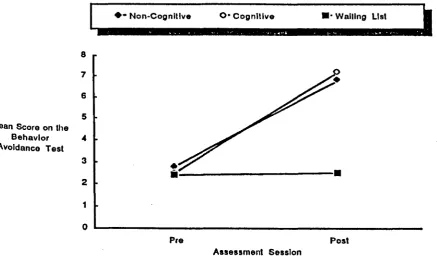
phobic anxiety, ( b) Watson and Marks rating scale of avoidance and (c) Behavior avoidance
test. The two therapy groups displayed a consistent but nonsignificant trend toward
Improvement on ten of the remaining eleven measures. There was no evidence to Indicate
that the noncognitive or cognitive groups differed significantly from one another on any of
the dependent measures.
The results of the present study essentially corroborated the findings of Emmelkamp et
al. (1986), Emmelkamp & Mersch (1982), Last et al. (1984), MavissakalIan et al
(1 9 8 3 ), and Williams and Rappoport (1983). Comparisons with relevant research,
reasons for the lack of therapy differences, methodological concerns, theoretical
implications and suggestions for future research were discusssed.
I am grateful to the members of my dissertation committee — Professors Robert Fehr
(Chairperson), Neal Holland, Dave Reynolds, Pat Taylor and Nick Spanos ~ for their
continued help and advice 1n the Implementation and presentation of this research.
Thanks also to B ill Ross for introducing me several years ago to the problem of
agoraphobia and its treatment, to Neal Holland for Introducing me to cognitive-behavior
therapy approaches (amongst others), and to Hank Stam for his statistical advice and
editorial comments.
On a more personal note, I especially appreciate the long and enlightening conversations
with Bob Fehr. His ideas have both challenged me to think and have provided excellent
feedback In shaping my Ideas and views of life. His support and encouragement through some
difficult times has been very Important.
And finally, to my wife Donna, she has always encouraged me to pursue my academic
career and her interest and Involvement In my work and life has been unwavering. Thank
Page
ABSTRACT... 11
ACKNOWLEDGEMENTS... 1v
LIST OF TABLES... IX
LIST OF FIGURES... X
CHAPTER
I INTRODUCTION... 1
Overview of Agoraphobia Syndrome... 2 Theories of the Acquisition of Phobias
1. Two factor theory: Classical and
operant conditioning... 5 2. Cognitive models... 8 Behavior Therapy for Phobias
Effectiveness of Behavior Therapy
for Phobias... 10 Effectiveness of Behavior Therapy
for Agoraphobics... 11 Cognitive Therapy for Phobias
Overview... 17 Effectiveness of Cognitive Therapy
for Phobias... 22 Effectiveness of Cognitive Therapy
for Agoraphobia
1. Use of Cognitive Modification Alone... 23 2. Cognitive Modification with In Vivo
Exposure... 26 Cognitive Restructuring as a Treatment
Procedure: Rationale
1. Common Maladaptive Thinking
Patterns... 30 2. Effect of Thinking Patterns on
Behavior... 33
( J) "Panic Attack "Hypotheses... 39
(2 ) "General Anxiety" Hypotheses... 40
(3 ) "Phobic Anxiety" Hypotheses... 40
(4 ) "Behavioral Avoidance" Hypotheses... 41
(5 ) "Global Distress" Hypotheses... 41
Subsidiary Hypotheses (1 ) "Treatment Expectations" Hypothesis... 42
(2 ) "Fear Hypotheses" Hypotheses...42
II METHOD... 43
Diagnostic Criteria for Subject Selection... 43
Screening Criteria for Subject Selection... 45
Subjects... 45
Treatment Procedures Treatment procedures for Noncognltive Group 46 Treatment procedures for Cognitive Group... 53
Treatment procedures for Waiting List Control 53 Assessments... 54
Instrumentation (1 ) Frequency of panic attacks... 55
(2 ) General anxiety... 55
(3 ) Phobic anxiety... 56
(4 ) Phobic avoidance... 56
(5 ) Global Distress... 58
Additional Instrumentation... 59
Summary of Methodology... 60
III PRESENTATION OF RESULTS... 61
Analyses of Variance on Pre-Treatment Scores 61 ' Introduction to Hypothesis Testing... 61
Main Hypotheses ( I ) "Panic Attack" Hypotheses Hypotheses la and 1b: Frequency of Panic Attacks Measure... 65
Hypotheses 2ab (2): Anxiety Dimension of
Brief Symptom Inventory... 74 (3 ) “Phobic Anxiety" Hypotheses
Hypotheses 3ab (1): Phobic Anxiety Dimension
of Brief Symptom Inventory... 77 Hypotheses 3ab (2): Obsessive-Compulsive
Dimension of Brief Symptom Inventory 79
Hypotheses 3ab (3): Watson and Marks (1971) Rating Scale of Phobic Anxiety... 80 Hypotheses 3ab (4): Agoraphobic Cognitions
Questionnaire... 83 Hypotheses 3ab (5): Bod/ Sensations
Questionnaire... 86 Hypotheses 3ab (6): Self-Report of Anxiety
on the Behavior Avoidance Test... 89 (4 ) "Behavioral Avoidance" Hypotheses
Hypotheses 4ab (1): Watson and Marks (1971) Rating Scale of Avoidance... 91 Hypotheses 4ab (2): Behavior Avoidance Test... 93 (5 ) "Global Distress" Hypotheses
Hypotheses 5a and 5b: Global Distress Measure
from the Brief Symptom Inventory... 96 Subsidiary Hypotheses
(1 ) "Treatment Expectations" Hypothesis... 98 (2 ) "Fear" Hypotheses
Hypotheses 2ab (1): Total Phobia Score on the
Marks and Mathews Fear Questionnaire 99
Hypotheses 2ab (2): Agoraphobic Score on the
Marks and Mathews Fear Questionnaire 101
IV DISCUSSION... 104
Review of Hypothesis Testing... 104 Comparisons with Relevant Research... 11 O' Lack of Therapy Differences... 114 Cognitive Restructuring...117 Methodological Issues
1. SampleSize... 121 2. Subject Attrition...124 3. Sensitivity of Dependent Measures... 125
Summary... 132
REFERENCES...134
APPENDICES...143
A. Personal Data Questionnaire... 144
B. Client Contract...156
C. I nformed Consent Form... 158
D. Advertisement for Agoraphobia...160
Treatmept-Research Program E. Therapist's Manual: In Vivo Exposure... 162
F. Therapist's Manual: Cognitive Restructuring... 164
+ In Vivo Exposure 6. Frequency of Panic Attacks... 165
H. State-Trait Anxiety Inventory... 167
I. Brief Symptom Inventory... 169
J. Phobic Avoidance and Anxiety...173
K. Agoraphobic Cognitions Questionnaire... 175
and Body Sensations Questionnaire L. Behavioral Avoidance Test... 178
M. Treatment Expectations... 182
N. Fear Questionnaire... 184
0. Correlation Coefficients for Self-Report Measures... 188
VITAAUCTORIS...195
Table Page
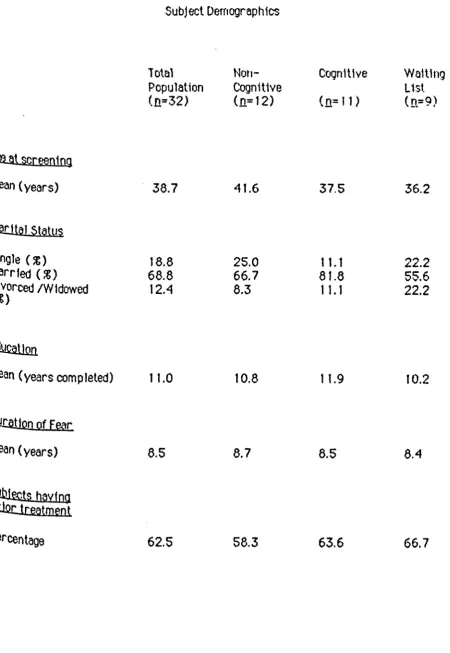
1. Subject Demographics... 47
2. Summary of Therapy Procedures... 48
3. One Way Analyses of Variance on Pretreatment Scores for... 62 A ll Dependent Measures
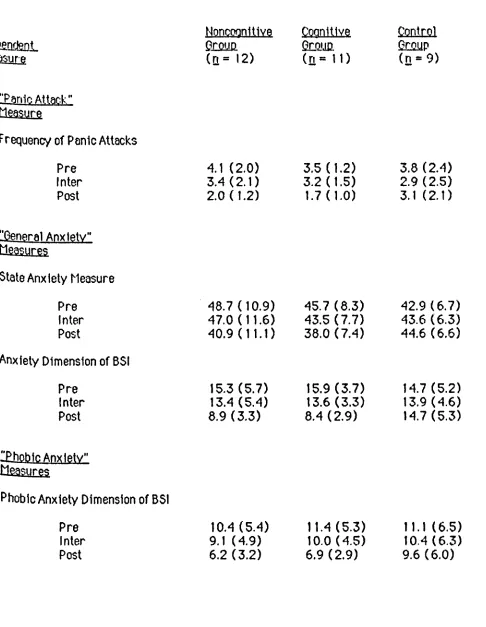
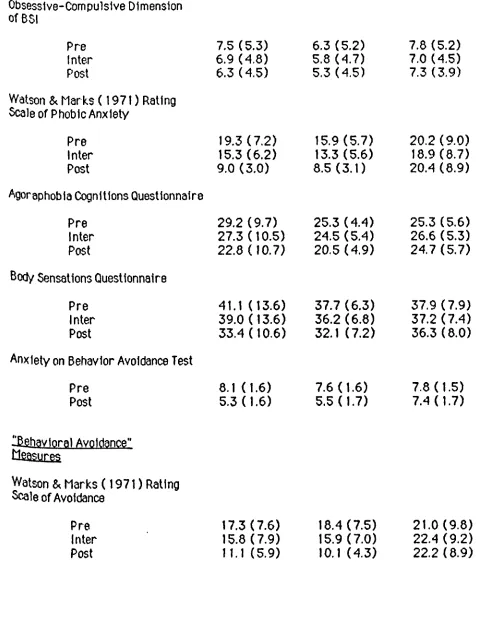
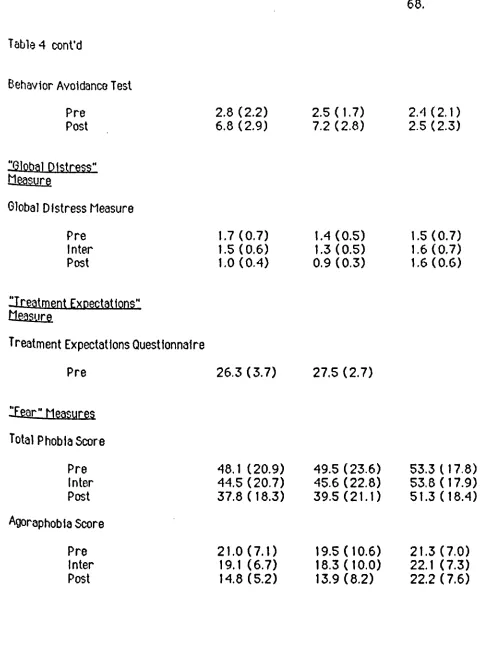
4. Means and Standard Deviations for Dependent Measures... 66
5. Significance of Treatment, Session, Interaction, and Simple... 70 Main Effects for Dependent Measures
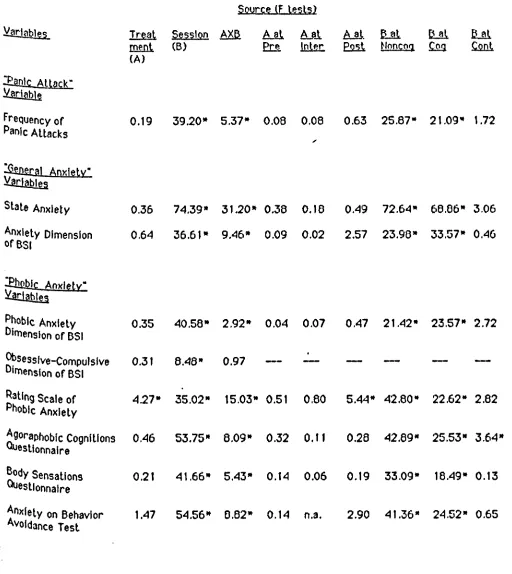
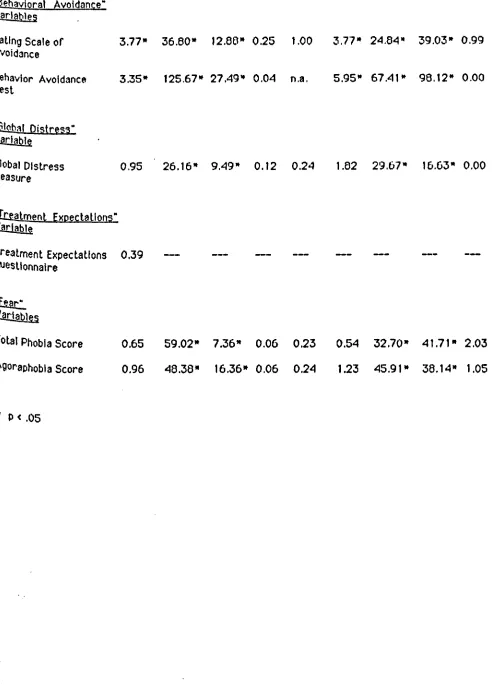
6. Summary of Hypothesis Testing... 106
7. Correlation Coefficients for Self-Report Measures... 188
Figure Page
1. Subjects’ Mean Self-Reported Frequency of Panic Attacks... 69 at P re-, Inter- and Posttreatment
2. Subjects' Mean State Anxiety Score from the State-Trait... 73 Anxiety Inventory at P re-, Inter- and Posttreatment
3. Subjects’ Mean Score on Anxiety Dimension of Brief Symptom 76 Inventory at P re -, Inter- and Posttreatment
4. Subjects’ Mean Score on Phobic Anxiety Dimension of B rie f. 78 Symptom Inventory at P re-, Inter- and Posttreatment
5. Subjects’ Mean Obsessive-Compluslve Score from the B rie f 81 Symptom Inventory at P re -, Inter- and Posttreatment
6. Subjects' Mean Score on Watson and Marks Rating Scale o f. 82 Phobic Anxiety at P re -, Inter- and Posttreatment
7. Subjects' Mean Score on the Agoraphobic Cognitions... 85 Questionnaire at P re-, Inter- and Posttreatment
8. Subjects' Mean Score on the Body Sensations Questionnaire... 87 at P re -, Inter- and Posttreatment
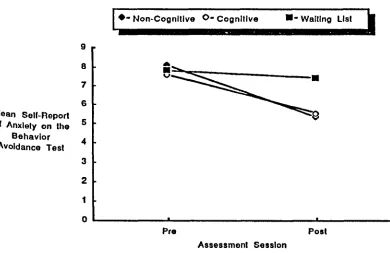
9. Subjects’ Mean Self-Report of Anxiety Score on the Behavior 90 Avoidance Test at P re -, and Posttreatment
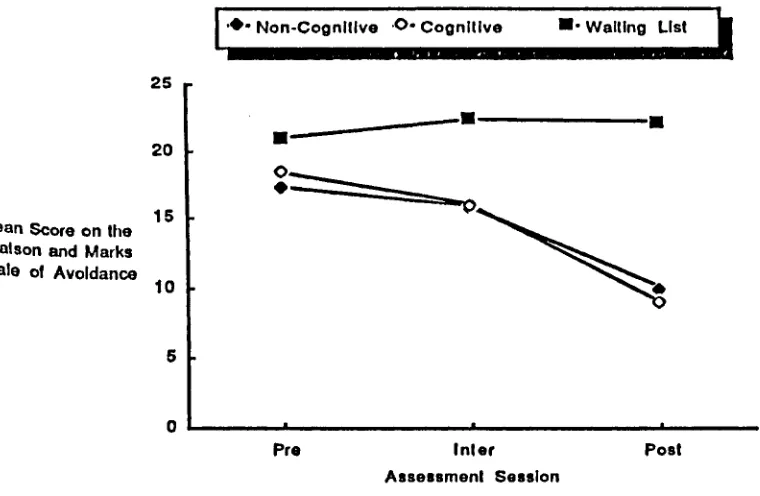
10. Subjects’ Mean Score on the Watson and Marks Scale o f.. . . ; ... 92 Avoidance at P re -, Inter- and Posttreatment.
11. Subjects’ Mean Score on the Behavior Avoidance Test at... 94 P re -, and Posttreatment
12. Subjects' Mean Global Severity Index Score from the B rie f... 97 Symptom Inventory at P re -, Inter- and Posttreatment
13. Subjects’ Mean Total Phobia Score on the Marks and Mathews 100 Fear Questionnaire at P re-, Inter- and Posttreatment
Agoraphobia Is the fear of experiencing overwhelming anxiety In various public
places, e.g., elevators, airplanes, crowded stores, traveling, or busy streets. A central
theme with agoraphobics Is that of feeling trapped where immediate escape from the feared
situation is not thought to be possible. Agoraphobia is the most pervasive and serious of all
the phobic responses and has been reported to be very difficult to treat ( Goldstein &
Chambless, 1978). Although this problem has long been reported to be very resistant to
treatment, Interventions which involve Interaction with the actual feared situation ( "in
vivo exposure") have been reported to be effective (e.g., Emmelkamp & Wessels, 1975;
Hafner & Marks, 1976).
Theorists and therapists (e.g., Beck & Emery, 1979) working in the field of
agoraphobia, noting the debilitating thoughts and thinking styles of their clients, have
suggested that cognitive therapy may be effective in changing such thinking patterns and
subsequently succeed in reducing phobic behavior. Only two studies (W illiams &
Rappoport, 1983; Emmelkamp & Merch, 1982) have examined the integration of cognitive
restructuring with in vivo exposure for agoraphobics and then examined the treatment'
outcome. Both studies suggested an equivalence of treatment methods, however, both studies
were methodologically flawed and deserve replication and extension with design
-Improvements. Despite the above two studies, there Is reason to think that such a combined
approach may enable people to utilize more effectively cognitive Interventions.
The purpose of the present study was to determine whether in vivo exposure treatment of
agoraphobia could be mads more efficient by incorporating cognitive modification techniques
into the treatment. It Is hypothesized that In vivo exposure combined with cognitive
restructuring w ill be superior to In vivo exposure In treating the debilitating problem of
agoraphobia.
In itia lly, the agoraphobia syndrome w ill be described. Subsequent sections w ill
examine the theories of acquisition of. phobias, behavioral and cognitive treatment
approaches to phobias and to agoraphobia In particular. The rationale for the cognitive
therapy procedures and a brief description of these techniques w ill be outlined. A statement
of the purpose of this study and the hypotheses to be tested w ill conclude the Introductory
chapter.
. Overview of Agoraphobia Syndrome
The term "agoraphobia” was firs t coined by Westphal, a German psychiatrist, who, In
1871, published a manuscript, Die Agoraphoble, which described the experiences of three
males who had Intense anxiety when walking across open spaces or through empty streets.
His account was cited by Errera (1962):
Impossibility of walking through certain streets or squares, or
possibility of doing so only with resultant dread of anxiety... no loss of consciousness... vertigo was excluded by all patients... no hallucinations or delusions to cause this strange fe a r... agony was much Increased when the particular streets dreaded were deserted and the shops closed. The
comparative comfort. One man even sought, without immoral motives, the companionship of a prostitute as far as his own door ... Some localities are more difficult of access than others; the patient walking far 1n order not to traverse them... Strange to say, In one Instance, the open country was less feared than sparsely housed streets In town. Case 3 also had a dislike for crossing a certain bridge. He feared he would fall 1n the water.
In this case there was also apprehension of Impending Insanity.
In two cases, the onset of the disease had been sudden; In the third, the fear had been gradually Increasing for a number of years, (p. 332)
Today, over one hundred years later, agoraphobia remains the most disabling of
phobias (Goldstein & Chambless, 1978). While agoraphobia Is often defined as a fear of
open spaces, this 1s really a misnomer since agoraphobics typically exhibit a wide variety of
avoidance behaviors Including an Inability to enter closed spaces, and of shopping, traveling,
and entering social situations, especially when alone. There Is much fear generalization to
additional stimuli throughout the course of the disorder, and numerous other symptoms are
commonly present, Including panic attacks, tension, dizziness, frequent depression,
depersonalization, and obsessions.
The Diagnostic and Statistical Manual, 3rd ed. (American Psychiatric Association,
1980) contains two categories, "Agoraphobia with Panic Attacks" and "Agoraphobia without
Panic Attacks," both described as follows:
The essential feature Is a marked fear of being alone, or being In public places from which escape might be difficult or help not available In case of sudden Incapacitation. Normal activities are Increasingly constricted as the fears of avoidance behavior dominate the Individual's life. The most common situations avoided Involve being In a crowd, such as on a busy street or In crowded stores, or being In tunnels, on bridges, on elevators, or in public transportation. Often these Individuals Insist that a family member or friend accompany them whenever they leave home.
... The Individual develops anticipatory fear of having such an attack and becomes reluctant or refuses to enter a variety of situations that are associated with these attacks. ( p. 226)
The DSM-111 describes "panic attacks" as follows:
Panic attacks are manifested by the sudden onset of intense apprehension, fear, or te rro r, often associated with feelings of Impending doom. The most common symptoms experienced during an attack are dyspnea;
palpitations; chest pain or discomfort; choking or smothering sensations; dizziness, vertigo, or unsteady feelings; feelings of unreality
(depersonalization or dereallzatlon); paresthesias; hot and cold flashes; sweating, faintness; trembling or shaking; and fear of dying, going crazy, or doing something uncontrolled during the attack. Attacks usually last
minutes; more rarely, hours.... panic (anxiety) attacks.... (may) occur at times unpredlctably, though certain situations, e.g., drivtng a car, may become associated with a panic attack. ( p. 230)
These panic attacks are typically accompanied by a sense of doom and fear that one Is
dying of a heart attack or stroke, Is going crazy, or Is going to faint, or lose control In some
way as to be publicly humiliated. Agoraphobics seek to flee when such attacks occur, and
fear and avoid any place where flight to safety Is likely to be prevented. It is for this
reason that a number of authors (Goldstein & Chambless, 1978; Weekes, 1976) have
proposed that agoraphobia Is p rim a rily a "fear of fear", with the fear of places being
secondary.
The prevalence of agoraphobia 1n the general community has been estimated at
6.3/1000 (Agras, Sylvester & Ollveau, 1969). The proportion of psychiatric patients*
who are diagnosed phobic is about 2 - 3 £ (Terhune, 1961), and of these, the majority are
agoraphobic. The majority of patients who present themselves for either psychiatric or
A prominent characteristic of this syndrome Is that approximately two-thirds of
patients are women (Marks, 1970;Terhune, 1949). The majority are married and tend to
marry at ages comparable to normal populations (Marks & Gelder, 1965). Most authors
have claimed that agoraphobics are not unusual In Intelligence, education, religion, ethnic
groups, socioeconomic status or occupation (Fensterhelnm &Beer, 1977; Marks, 1969;
Weekes, 1976).
Agoraphobia normally begins In young adult life (1 8 -3 5 years). Marks (1 9 7 0 ) and
Bowen and Kohout (1 9 7 9 ) report two peak ages of onset, at about 20 years and at about
3 0 -3 5 years. Most research reported Indicates that agoraphobics seek treatment In their
thirties, although the time from onset to professional contact varies considerably (Marks,
1970). A more detailed description of the agoraphobic syndrome can be found In a number
of excel lent reviews (Chamb1ess&Goldstein, 1982; Mathews, Gelder & Johnston, 1981).
Theories of the Acquisition of Phobias
The discussion which follows b riefly examines theories for the acquisition of phobias.
These theories fall Into two broad classifications, learning theories and cognitive models.
1. Two factor theory: Classical and operant conditioning
The most influential p r e - 1970 formulation of phobias In learning theory terms Is the
two-processor two-factor theory (Eysenck & Rachman, 1979; Mowrer, 1960), In which
the two 'factors' Involved are classical and Instrumental conditioning prxedures. Central to
two-factor theory Is the claim that avoidance behavior Is acquired and maintained "by the
Mowrer (1 9 6 0 ) proposed that all fears are In itia lly acquired through Pavlovlan
(classical conditioning) processes, and are maintained as a result of operant-conditioned
learning. In the classical conditioning component, the phobic situation (o r, more
accurately, the environment In which phobic behavior 1s manifested) has acquired the
potential to evoke anxiety, a conditioned reponse (CR), through pairing with a noxious
unconditioned stimulus ( UCS). Reiss (1 9 8 0 ) summarizes the concepts In this way.
In itia lly neutral stimuli become conditioned ellcltors of fear when
experienced In temporal contiguity with such averslve events as conflict, trauma, pain, and confinement. A phobic stimulus Is regarded as a
conditioned stimulus (CS), acquired fear Is regarded as a conditioned response (CR), and averslve events are regarded as reinforcing stim uli and as unconditioned stim uli (USs). ( p. 381)
The acquisition and maintenance of avoidance responses are attributed to negative
reinforcement ( Instrumental) contingent upon avoidance of the feared object or situations.
Escaping the CS, or phobic situation Is negatively reinforced by anxiety-reduction. Because
of this, escaping becomes established as a habitual response to the phobic surroundings, and
more Important the escape behavior curtails exposure to the CS. B rief exposure to the CS Is
likely to be Insufficient to promote extinction of the CR, and, furthermore,
anxiety-reduction becomes correlated with new environments that may assume the
connotation of safety. Avoidance of the CS In the firs t place, another prominent feature of
phobic behavior, equally protects the CR from extinction. SJdman (1 9 6 6 ) summarizes the
sequence of events as follows:
The literature on avoidance behavior consists largely of a series of
The most significant support for classically conditioned acquisition of fear generally Is
derived from experiments with laboratory animals (see reviews by Broadhurst, 1960,
1972; and Wolpe, 1958). There have been a few reported Instances of conditioned fear
responses In humans, however, It has been difficult to demonstrate this phenomenon In the
laboratory ( Rachman, 1977). Supporters of the operant conditioning theory Justify their
position by reporting on the successful use of learning schemes based on this theory with
both animals and humans (e.g., Blackman, 1974). However, the success of techniques based
on a particular theory do not necessarily demonstrate the validity of the theory. In fact,
there are serious objections to the validity of both the Pavlovlan theory of fear acquisition
and the operant conditioning theory of avoidance behavior.
A number of objections to Pavlovlan theory Include (8) the difficulty In demonstrating
that the CS Is not a discriminative stimulus ( I.e., a signal that the UCS may occur) rather
than a stimulus that has acquired response-evoking properties In Itself (e.g., Herrnsteln,
1969); ( b) the finding that extinguishing of fear responses does not necessarily occur, 8S
predicted by the theory, upon repeated presentations of the CS in the absence of any
externally-occurring traumatic events (e.g., repeated exposure to being away from home
without harm has little effect upon agoraphobics’ fears of such exposure); (c) the fact that
the theory seems to require a concept of equfpotentially: that Is, that any stimuli coinciding
with the elicitation of fear could become a CS and this clearly does not happen; (d) that
patients with strong fears often deny that any traumatic event was associated with acquisition
of the fear, and that some phobics have never been exposed to the situations they fear. A
fuller discussion of the shortcomings of classical conditioning theory Is considered beyond the
A number of deflclences of the operant model of avoidance maintenance are that (a)
people often choose to confront stimuli they fear rather than avoid them; ( b) avoidance 1s not
necessarily associated with anxiety nor with reinforcement (Bolles, 1972; Rachman,
1976); (c) the theory does not explain nor predict behavior, since "Reinforcement" is
defined as "those contingencies which modify behavior," and so the theory becomes
tautological: A person avoids because reinforcement Is contingent upon the avoidance
response; the contingency Is reinforcing because the person is observed to avoid. As 1n the
case with Pavlovlan conditioning, a discussion of the inadequacies of the operant model is
considered beyond the scope of this essay, however, the interested reader Is directed to
Bolles, 1972.
2. Cognitive models
Other models have been suggested (Bandura, 1977; Bolles, 1972; Rachman, 1977;
Reiss, 1980) for fear acquisition, that are purported to be more adequate theoretically.
These models have received some experimental support. Bolles (1 9 7 2 ), Reiss (1 9 80 ),
Bandura (1 9 7 7 ), and Rachman (1 9 7 7 ) all stressed the cognitive aspects of fear acquisition
and modification. Bandura (19 69 ) has alread/ demonstrated that fears may be acquired
vicariously through modeling and other symbolic means. Bolles (1 9 7 2 ) proposed that
processes underlying operant conditioning paradigms are more adequately described by an
expectancy model, in which two kinds of expectancies are learned: that certain responses are
likely to lead to certain consequences. Bolles (19 72 ) suggested that avoidance responses to
CSs are more adequately explained by considering the Informational value of the CS (that an
Inherently reinforcing.
Reiss (19 80 ) extended the expectancy concept to Pavlovlan conditioning by pointing
out the importance of the Informational value of the stimuli which become CSs, and suggested
that subjects respond to the expected appearance of the UCS rather than to other properties
acquired by the CS. Reiss (19 80 ) proposed an expectancy model of phobias. Assumptions of
this model are that, (a) classical conditioning is a form of stimulus-expectancy learning,
and ( b) the laws governing the acquisition of expectancies and CRs are essential ly the same.
There are, then, according to Reiss (1980) four processes In the acquisition of a phobia:
(1 ) The acquisition of "initiating (danger) expectancies". These
expectancies of physical or social danger can result from cognitive learning, associative learning, covert conditioning, observations from models, or a combination of these factors.
(2 ) The acquisition of "anxiety expectancies" through In vivo or covert experiences.
(3 ) Initial avoidance, which at least sometimes occurs via negative reinforcement.
(4 ) The persistence of avoidance by means of self-regulatory processes.
Bandura (1977) has elaborated a cognitive model of behavior change which proposes
that performance-based treatments for phobic disorders decreases fear and avoidance
behavior by Increasing perceived self-efficacy. Self-efficacy may be defined as an
Individual's expectations of personal effectiveness In dealing with the particular feared
situation. The level of perceived self-efficacy, or expectations of personal effectiveness,
may be derived from four major sources: (1 ) behavioral experience, (2 ) vicarious
experience, (3 ) verbal persuasion and exhortation, and (4 ) level of physiological arousal
(1 9 7 7 ) has Interpreted his and other research findings, with phobic subjects, as
supporting the position that Information gathered from all four sources Including cognitive
ones Is seen as contributing to the success of performance-based treatments. The
self-efficacy model has received some empirical support from studies with snake phobics
( Bandura & Adams, 1977), acrophoblcs (Bourque &l_adoucer, 1980), and agoraphobics
(Bandura, Adams, Hardy & Howells, 1980), but further work 1s needed to provide adequate
support for the theory.
To summarize, more recent theories proposed to explain acquisition, maintenance, and
reduction of fear In humans have given strong emphasis to cognitive processes. Some of
these theories have been b rie fly presented for the readers’ Interest. These more recent
theories seem to have greater explanatory and predictive power than the older, two-factor
theory, but experimental support for them Is Just beginning to be reported.
Pehpvlpr Theropy .fpr Phobia?
The discussion which follows examines some of the evidence regarding the therapeutic
efficacy of behavior therapy, as It pertains to phobias In general, and as related to
agoraphobia In particular.
Effectiveness of Behavior Therapy for Phobias
Since the early 60’s, a large body of literature has been devoted to the behavioral
treatment of phobic disorders. Several critical reviews of the research have appeared that
have attempted to unify the findings In this area, and It has been suggested that the
therapeutic element common to successful treatments of phobias Is exposure to phobic
term "exposure treatments" has been proposed by Marks (1978) and utilized to signify all
treatment strategies that Involves exposing the phobic client to the threatening rea l-life
situation for extended periods of time.
Exposure treatments have been conducted In a variety of ways, over the years,
differing, at least procedurally, on several Important dimensions. Marks (19 78 ) has
summarized the varieties of approach to the phobic stimulus In exposure treatments, and
has concluded that some of the more common ways In which treatments vary Include,
Imagined versus live ( in vivo) exposure, and therapist-assisted versus self-exposure.
Different combinations of these variables have resulted In a number of different treatment
strategies all of which have been shown to be relatively effective when Incorporating some
form of exposure to fear-eliciting situations ( Mavlssakallan & Barlow, 1981).
The single common thread that unifies all of the above mentioned treatment strategies
may be found in the concept of exposure. It appears clear that exposure of phobics to feared
situations results In fear reduction, and there Is some indication that direct or live
confrontation with phobic stimuli may be most effective In facilitating this goal.
Effectiveness of Behavior Therapy for Agoraphobics
The application of behavioral treatments with agoraphobics has been Investigated in a
large number of studies with encouraging results overall. Among the behavioral procedures
that have been studied with agoraphobics Include systematic desensitization (Gelder &
Marks, 1966;Gelder, Marks&W olff, 1967), ImagJnal flooding (Marks, Boulougour Is &
Marset, 1971; Gelder, Bancroft, Gath, Johnston, Mathews & Shaw, 1973), successive
1972). self-observation (Emmelkamp, 1974; Emmelkamp & Ultee, 1974), group In vivo
flooding (Hand, Lamontagne & Marks, 1974; Stern & Marks, 1973; Teasdale, Walsh,
Lanshlre & Mathews, 1977; Watson, Mullett & Plllay, 1973) and participant modeling
(Bandura, Adams, Hardy & Howells, 1980). Each of the treatment procedures mentioned
above Involve exposing the phobic Individual to the feared situations. The various
treatments differ mainly 1n terms of certain parameters of exposure namely, mode of
presentation (tmaglnal vs. In vivo), Intensity (graded vs. ungraded), and mode of
facilitation (therapist aided, partner aided, or self-directed).
Taken together, the studies cited above provide overwhelming support for the efficacy
of behavioral methods In treating those suffering from agoraphobia. With few exceptions 1n
vivo exposure procedures have been demonstrated to be superior to Imagery-based therapy
procedures (Chambless &. Goldstein, 1982; Mathews, Gelder & Johnston, 1981). In fact,
Marks (1975) concluded that "real life exposure Is the most powerful therapeutic factor so
far Identified" (p. 93).
A number of the studies cited above are particularly relevant to the use of In vivo
exposure for agoraphobics. Five of these studies are worthy of more detailed review, as they
Illustrate the usefulness of behavioral treatment and Indicate the type of methodology typical
of research In the field
(1 ) One of the earliest studies to examine the efficacy of behavioral treatment for
agoraphobics was conducted by Gelder, Marks, Wolff, and Clarke (1967). This study used
agoraphobics, social phobics, and single-situation phobics to compare the outcome of three
forms of treatment: Individual psychoanalytic psychotherapy, group psychoanalytic
per week for 50 weeks, 1 112 hours per week for 80 weeks, and 1 hour per week for 36
weeks, respectively. Approximately half of the subjects were agoraphobics. Subjects In the
behavior therapy condition received systematic desensitization and graduated 1n vivo tasks to
be carried out between sessions. Outcome was assessed using rating scales completed by
patients, therapists, and assessors. After 6 months of treatment, patient ratings of
improvement on "main phobia" were significantly better for the behavior therapy group
than for the other two groups, and behavior therapy was better than group therapy on
therapists' and assessors' ratings on "main phobia." These differences had disappeared by
the 12th month assessment (at which the psychotherapy groups had received 3 months’
additional treatment compared to the behavior therapy group). By the end of treatment
there was some Indication that the two Individual treatments were better than the group
condition, but the Individual treatments were not distinguishable from one another. Since
the behavior therapy group received less treatment than the psychotherapy patients (36
hours versus 50 hours), the behavioral treatment was more cost effective.
(2 ) Crowe, Marks, Agras, and Leltenberg (19 72 ) compared Imeglnal flooding,
systematic desensitization and "shaping" or "reinforced practice" In a cross-over stud/ of
fourteen phobics Including four agoraphobics. The shaping procedure required the subjects
to approach the actual feared situation In graduated steps, with Instructions to turn back as
soon as he/she became anxious. The therapist delivered social reinforcement In the form of
praise for Improved performance. This Is the firs t report of a well conceived and executed
In vivo procedure for agoraphobics. Each subject received one block of four sessions of each
treatment In random order. Sessions were held twice weekly and the duration of exposure
ratings were used In the assessments, which were made prior to treatment and after each
treatment block.
On the behavioral test the shaping condition was found to be significantly better than
systematic desensitization, while flooding was In an Intermediate position and did not differ
significantly from either of the other two treatments. No differences were found among
conditions on the rating scales. Comparing the agoraphobics to the slngle-sltuatlon phobics,
no differences were found In response to the three conditions. For the agoraphobics the
order of effectiveness of the treatments was the same on all measures
(shaping— flooding--systematic desensitization), while for the single-situation phobics no
consistent order was found. The authors Justifiably conclude that for agoraphobics, shaping
seems to be especially worthy of further study.
(3 ) Emmelkamp and Wessels (1 9 7 5 ) compared flooding In vivo versus flooding in
imagination versus a combination of the two procedures with 19 agoraphobic subjects (1 8
females and 1 male). Subjects were matched on duration of symptoms and amount of time
they were able to walk around on the street alone. Three groups were generated. The firs t
received four sessions of flooding In Imagination, and the third received four sessions of a
combination of flooding in imagination and flooding in Yivo, and then each subject carried out
eight sessions of in vivo exposure with minimal therapist contxt. Assessments were made
at pretreatment, after the firs t four sessions, at post treatment, and at follow-up. Both
behavioral tests and rating scales were used. Treatments were performed In subjxts* home,
and the home was the starting point In the exposure conditions.
At the intermediate assessment subjxts in the two xnditions which Included In vivo
while subjects In the Imaginal treatment reported reduced anxiety but showed no change In
avoidance behavior. The In vivo exposure condition was superior to the combined treatment
on many variables, 8nd the combined treatment was superior to the imaginal-only condition
on therapist ratings only. At posttest, after all groups had eight sessions of In vivo
exposure, no differences were found between the groups, and all groups showed significant
improvement on most measures. In vivo exposure was clearly shown to be superior to
Imaginal flooding.
(4) Emmelkamp, Kuipers, and Eggerant (1978) used a cross-over design In which
twenty-one agoraphobics were exposed to "cognitive restructuring" and prolonged real-life
exposure. Each technique was implemented In a group context. Patients were randomly
distributed among four groups, two of which received cognitive restructuring, and the
remaining two of which had In vivo flooding; after five 2 hour sessions, exh group received
the alternate treatment for the same number of sessions. Assessments were made
pretreatment, at cross-over, posttreatment, and I month after treatment, and consisted of a
behavioral test, self-report Inventories, and rating scales completed by the patient and an
independent clinician.
in general, all four therapy groups showed improvement from pre- to posttest on
almost all variables. Prolonged exposure produced significantly more improvement than
cognitive restructuring on a behavioral test and on many self-report and rating scales.
Results of the assessment at 1 -month follow-up were almost identical to those Immediately
posttreatment. In vivo exposure was generally, consistently, and significantly superior to
cognitive restructuring.
the effectiveness of systematic exposure without the presence of a therapist. Nineteen
agoraphobic outpatients were randomly assigned to a self-exposure homework condition or a
nonexposure discussion condition. Subjects 1n both conditions met Individually for 20-30
minutes on four different occasions over a six- week period. In the self-exposure condition,
therapists helped subjects plan their self-exposure activities, while subjects In the
non-exposure control participated In general discussions with the therapist on life
difficulties. Results revealed a small but statistically significant superiority of the
self-exposure condition on subjects' ratings of phobic severity and assessor’s ratings of
target problems. The authors conclude that such self-exposure can be of benefit to
agoraphobics.
The ultimate test of any treatment approach Is Its ability to Induce desired changes
which endure over time. In regard to this ability, the great majority of studies that Include
follow-up information after any form of treatment Indicate that gains are stable over
periods of from I month to 4 years. Subjects as a group neither continue to improve much
nor fall back to a significant degree, but remain at about the level of functioning they had
achieved at the end of treatment. In summary, a review of the literature reveals that
treatment of agoraphobia by In vivo exposure to the feared situations has produced the most
beneficial outcomes In general.
Several workers have studied ways of optimizing the exposure approach. Group
treatment has been found to be at least as effective as Individual work and a more efficient
use of therapist time (Hafner & Marks, 1976; Hand, Lamontagne & Marks, 1974; and
Teasdale, Walsh, Lancashire & Mathews, 1977). It also may be possible to Increase the
restructuring. Only two studies (Williams & Rappoport, 1983; Emmelkamp & lierch,
1982) have examined the integration of cognitive restructuring with in vivo exposure and
then examined the treatment outcome. Both studies suggested an equivalence of treatment
methods, however, both studies were flawed and deserve replication and extension with
design Improvements. Despite the above two studies there Is reason to think that such a
combined approach may enable people to utilize more effectively cognitive Interventions.
Cognitive Therapy for Phobias
The discussion which follows examines some of the theory and development of cognitive
therapy and the evidence relating to Its therapeutic efficacy, as 1t pertains to phobias and
phobia-related Issues in general, and as related to agoraphobia In particular.
Overview
Since the 1960s, cognitive and cognitive-behavioral Interventions have become
popular 1n the treatment of a variety of clinical disorders. Such disorders as anxiety (e.g.,
Beck,A.T., 1976; Melchenbaum, D.H., 1972;Me1chenbaum,D.H.,etal., 1971), depression
Ce.g., Beck, A.T., 1976; Hollon,$.D.,&Beck,A.T., 1979), assertion (e.g., Kazd1n,A.E.,
1974;L1nehan, M.M., 1979), anger (e.g., Beck, A.T., 1976; Novaco, A.E., 1974), eating
disturbances (e.g., Kelly, A.H., & Curran, J.P., 1976; Leon, G.R., 1979), and pain (e.g.,
Spanos, N.P., & Barber, T.X., & Lang, G., 1974; Spanos, N.P., & Brazil, K., 1984; Spanos,
N.P., Horton, C., & Chaves, J.F., 1975; Stam, H.J., McGrath, P.A., & Brooke, R.I., 1984
(a); Stam, H.J., McGrath, P.A. & Brooke, R.I., 1984 (b )) have been the subject of extensive
experimental and clinical research. This trend toward the use of cognitive and
of phobias, In which cognitive treatment strategies have been used occasionally either alone
or In conjunction with behavioral exposure-based techniques.
The significance of maladaptive cognitions In the genesis of anxiety reactions and
maintenance of anxiety disorders has been discussed by several cognitive and
cognitive-behavioral theorists (Beck, 1976; Ellis, 1962; Melchenbaum, 1977).
Specifically, they have proposed that catastrophic or Irrational thoughts play a critical role
In mediating maladaptive physiological-emotional and behavioral responses.
W ithin a cognitive-behavioral framework, cognitions are generally viewed both as
covert responses to certain stimulus situations and, subsequently, as the stim uli themselves
that e licit physiological and behavioral responses. In phobic disorders, specific maladaptive
cognitions are thought to e licit fear and anxiety, both prio r to and during contact with phobic
stimuli. Such thoughts generally center on the physiological change accompanying anxiety,
avoidance of or escape from the phobic situation, or anticipation of a catastrophy, 1t serves
to escalate physiological arousal, resulting in avoidance/escape behavior. These maladaptive
cognitions are conceptualized as p rim a rily responsible for the maintenance of fear and
avoidance patterns characteristic of phobic disorders.
It 1s Important to note that the proposed role of maladaptive thoughts in the fear
process does not negate, necessarily, the etiological significance of automatic or conditioned
fear responses within a learning theory or conditioning model or phobic disorders.
Exposure to feared situations may trigger negative self-statements based on prior learning
experiences and past memories, which then bring on or Increase physiological activity and
avoidance/escape behavior.
Given the hypothesized mediatlonal role of maladaptive thoughts, fear reduction Is
thought to occur as a consequence of decreasing these self-verbalizations (Beck, 1976;
Specifically, decreases In maladaptive cognitions are thought to reduce the physiological
component of fear which, in turn, eliminates avoidance/escape behavior, since such
behavior no longer serves its Initial purpose ( I.e., avoidance of subjective distress or
panic).
Although numerous cognitive Interventions have been developed and utilized over the
years, most of these treatment approxhes are based on the theorizing of Ellis (1 9 6 2 ), B xk
(1 9 7 6 ), and Melchenbaum (1977). In addition to underlying the importance of cognitive
processes, each of these Individuals has endorsed s p x lflc prxedures for altering
maladaptive cognitions. According to Ellis' (1 9 6 2 ) "rational-emotive therapy,” Beck’s
(1 9 7 6 ) "cognitive therapy," and Melchenbaum’s "self-Instructional training" (1 9 7 7 ) may
all be subsumed under the category of "cognitive restructuring” since they all attempt to
modify directly s p x lflc thoughts and beliefs believed to be mediators of arousal.
According to Ellis (1 9 6 2 ), certain core irrational beliefs are xnceptuallzed as being
at the root of most emotional disorders. Maladaptive cognitions consonant with these
Irrational beliefs are sxn as responses to re a l-life experience, and are viewed as leading to
emotional distress. For phobias some of these beliefs are that "they must not approxh
feared o b jxts or situations and that It Is horrible If they do,” " it is awful or catastrophic
when they don't perform well and/or are not approved of by others as they should or must
be," "they should or must get what they want ( and should not or must not get what they don't
want) and It Is awful or catastrophic" If this does not happen, and that they "must not
experience the kind of exceptionally painful ( phobic) reactions." It’s awful to f x l that
uncomfortably anxious. I can't stand that amount of Inconvenience" (emphases Ellis’ , Ellis,
1979, p. 162-164). Ellis proposes that pxple avoid situations because of their extreme
"Inconvenient" rather than "awful," that they can stand It, and that they w ill overcome the
anxiety with practice. Ellis also emphasizes the need for In vivo exposure and discusses its
Incorporation 1n altering cognitions.
A second approach to cognitive restructuring has been discussed by Beck ( Beck, 1976;
Beck fk Emery, 1979). Like, Ellis, Beck maintains that certain patterns of irrational
cognitions lead to emotional distress and "neurotic" behavior. Beck and Emery (1 9 7 9 ) note
that phobics often overestimate the likelihood that a situation is dangerous to them,
frequently remind themselves of the dangers they fantasize, often imagine catastrophic
outcomes as the ones likely to occur, attend too much to their level of arousal, assume that
even slight arousal Justifies there appraisal of the situation as dangerous, and do not
effectively consider coping strategies or positive outcomes. Beck and Emery (1 9 7 9 )
consider these to be cognitive errors, and suggest a dual approach to dealing with these.
Verbal interventions are used to help the person become sensitive to, question, and alter the
self-defeating cognitive processes currently in use. In vivo work 1s conceived of as another
way of testing (challenging) faulty beliefs and expectations and is considered to be a form of
cognitive therapy in that its purpose is cognitive change ( rather than reconditioning).
lieichenbaum’s (1 9 7 7 ) orientation has considerable sim ila rity to that of Beck and
Ellis. In his approach, self-verbalization or "self-talk" Is viewed as the precipitant for a
wide range of emotional and behavioral disorders. In the case of anxiety reactions, the aim
of treatment Is to have clients become aware of their negative or Irrational thought patterns
when anticipating or confronting an anxiety-producing situation, and to change these
thoughts by substituting more adaptive, coping self-statements. Clients are encouraged to
develop their own Idiosyncratic coping statements through a skills development approach,
and behavioral experience often Is Incorporated Into the treatment package. This
don't feel helpless, (b ) guides their behavior In such a way as to make successful coping
with task demands more likely, and (c) Interferes with anxiety engendering cognitions
which usually occur In the situation, lieichenbaum (1 9 7 7 ) 8lso suggests that people can
become effective at dealing with stressful situations through "stress inoculation training,"
which Includes an educational phase during which the problem Is conceptualized and coping
strategies worked out, a rehearsal phase during which the client practices ways of using the
coping devices, and an applications phase in which he masters the use of coping devices by
applying them during exposure to a variety of stressors ( lieichenbaum, 1977).
Beck and Ellis have arrived at their views largely as a result of their clinical work,
and systematic study of the theoretical underpinnings of the systems, and of their treatment
efficacy, have been slow In coming. Bandura's views, In contrast, have developed out of the
behavioral research literature and rest on a solid data base. Bandura also strongly favors a
cognitive medlatlonal model of behavior change, but argues that In most cases a
performance-based treatment Is the best way of altering cognitions. He considers phobic
arousal resulting from real or symbolic stimulation as occurring because of the meaning
attached to each stim uli, rather than as a result of a classical or operant conditioning
process. Bandura (1 9 7 7 ) recently proposed "perceived self-efficacy" as a major organizer
of many of peoples' cognitive and behavioral processes. He suggests that avoidance behavior,
obsessive worrying, physiological arousal, nightmares, etc., occur In phobics because they
perceive themselves unable to cope with some situation or stress they are threatened with.
As they learn coping mechanisms and find themselves able to use them, all the phobic
manifestations disappear. He suggests that the reason both exposure therapy and other
forms of therapy are successful with phobics Is that In one way or another they Increase the
Effectiveness of Cognitive Therapy for Phobias
Cognitive restructuring procedures have proven to be successful in the treatment of
small animal phobias (D'Zurllla, Wilson & Nelson, 1973; Melchenbaum, 1971; Wein,
Nelson & Odom, 1975), test anxiety (Holroyd, 1976; Melchenbaum, 1972), speech anxiety
(DiLoreto, 1971; Melchenbaum, Gilmore &Fedoravicus, 1971; Thorpe, 1975) and
interpersonal anxiety ( Kanter & Goldfrted, 1979). Despite the fact that all of these
investigations were analogue studies with students as subjects, at least two of them, both
involving comparisons with systematic desensiti2ation, are worth examining in detail.
Melchenbaum, Gilmore and Fedoravicus( 1971), In a controlled outcome study, found
that cognitive restructuring (based on Rational Emotive Therapy) was as effective as
systematic desensitization in the treatment of speech anxiety and more effective than
desensitlzatlon with subjects who suffer anxiety in many varied social situations as opposed
to those subjects for whom speech anxiety was confined to formal speech situations. This
finding is relevant to the treatment of agoraphobia Insofar as agoraphobia anxiety is also
experienced in many varied situations as opposed to being situation-specific, defined in
Meichenbaum's study as confined to formal speech situations.
Kanter and Goldfrled (1 9 7 9 ), In a clinical outcome study comparing the relative
effectiveness of rational restructuring and self-control desensitlzatlon in the reduction of
Interpersonal anxiety, found that when compared with waiting list controls, rational
restructuring was significantly more effective on a greater number of variables than was
desensitlzatlon. The clearest findings emerged on the self-report measures revealing that
rational restructuring was significantly more effective than desensitization in reducing
state anxiety, tra it anxiety, and Irrational beliefs. There was a greater tendency for the
cognitively-oriented treatment to result In generalization of anxiety reduction to nonsocial
Indicate that cognitive restructuring might have greater generalIzablUty In
reducing anxiety than systematic desensitlzatlon. If this finding Is valid, then one of the
unique contributions of cognitive restructuring with the agoraphobic whose fear of fear 1s so
widespread, might be In changing cognitions about anxiety which can then be generalized and
emitted In any anxiety-eliciting situation, whether or not the situation has previously been
labelled as phobic or nonphobic.
Effectiveness of Cognitive Therapy for Agoraphobia
1. Use of Cognitive Modification Alone
The firs t published study to examine the application of cognitive modification
techniques for the treatment of agoraphobia was conducted by Emmelkamp et al. (1978). In
this experiment, he compared cognitive restructuring versus flooding in vivo in a
cross-over design with 21 agoraphobic outpatients. Each treatment condition consisted of
five group sessions, each lasting two hours. The cognitive restructuring treatment
comprised the following three components: (a) relabeling, i.e., helping each subject
understand the nature of his/her responses to phobic situations, (b ) pinpointing Irrational
beliefs related to agoraphobic situations and (c) self-instructional training designed to
train subjects to emit more adaptive self-statements. Flooding In vivo Involved remaining
1n phobic situations until anxiety declined. Approximately 90 minutes of the 2-hour
session was spent In exposure. Assessment consisted of a behavioral measure, self and
observer ratings of anxiety and avoidance, and various mood and anxiety scales. After each
group had experienced both treatments, they both showed significant Improvement on most
measures. Exposure proved superior to cognitive restructuring on many of the behavioral,
anxiety, and avoidance measures. Cognitive restructuring as the firs t treatment resulted In
showed no benefit on any behavior, anxiety, or avoidance measure. The exposure treatment,
whether given firs t or second, resulted In Improvement on almost every scale. Results of an
assessment conducted at 1 -month follow-up were almost Identical to those Immediately
posttreatment. I n vivo exposure was generally, and slgnlflcanty superior to cognitive
restructuring.
Despite findings which point to the superiority of prolonged exposure in vivo over
cognitive restructuring, Emmelkamp et al. (1 9 7 8 ) offer an interesting Interpretation of
these findings which emphasizes once again the role and Importance of cognitions In
therapeutic change. They suggest that giving a form of treatment a name Is not the same as
ellucidating the therapeutic process Involved.
Whether the treatment ’cognitive restructuring’ does actually produce a modification of cognitive processes Is a debatable point. On the other hand, the effects of prolonged exposure In vivo could at least partly be explained In terms of cognitive restructuring. During treatment with prolonged exposure In vivo clients notice, for example, that their anxiety diminishes after a time and that the events which they feared, such as fainting or having a heart attack, do not take place. This may lead them to transform their unproductive self-statements Into more productive ones: 'there you are, nothing w ill go wrong with me.’ A number of clients reported spontaneously that their ’thoughts’ had undergone a much greater change during prolongkl exposure In vivo than during cognitive
restructuring. It is possible that a more effective cognitive modification takes place through a procedure which Is focused directly on such a change. (Emmelkamp etal., 1978, p. 40)
Ellis (1 9 7 9 ), In an article written to comment on the conclusions of the Emmelkamp
et al. (1 9 7 8 ) study, endorsed their cognitive Interpretations of the prolonged exposure In
vivo treatment. In an attempt to draw lessons from Emmelkamp's study in order to Improve
the efficacy of cognitive restructuring In treating agoraphobia, he postulated a new
emotional tension that results when people feel: (1 ) that their comfort (or life ) Is
threatened, (2 ) that they should or must get what they want ( and should not or must not get
what they don't want), and (3 ) that It is awful or catastrophic ( rather than merely
Inconvenient or disadvantageous) when they don’t get what they supposedly must. Ellis
claims that discomfort anxiety underlines the avoidance behavior of agoraphobics and that 1t
exists as both a prim ary and a secondary disturbance. He explains 1t thusly:
Agoraphobics fir s t tend to make these cognitive demands on themselves: 'I must not experience any discomfort or handicap when I am 1n open spaces, buses, or sim ilar situations; and it Is te rrib le If I do!' With this
absolutlstic demand that they wrongly label themselves as being afraid of these situations Instead of (more accurately) as being afraid of the discomfort they w ill probably feel when they approach such situations. They are not tru ly afraid of the open spaces or the buses, but of their own reactions to the spaces or the buses. Once they actually do 'become
frightened' (actually, frlohten themselves) about the spaces or the buses, they then as a secondary symptom, 'fear or the underlying discomfort of being frightened- (E llis, 1979, p. 3)
In addition to proposing a theory of discomfort Ellis (1 9 7 9 ) expressed some concerns
about the methodology of Emmelkamp et al's (1 9 7 8 ) study. One of these concerns was that
Ellis felt that 10 hours of cognitive restructuring might not be sufficient to produce
significant cognitive and/or behavioral change. Emmelkamp et al. (1 9 7 8 ) In his discussion
section acknowledged this criticism.
Emmelkamp et al. ( 1978) make some interesting comments In that they state that
with cognitive restructuring, a transfer gap often proved to exist between practicing during
the treatment sessions and applying the new forms of behavior In real life situations.
Although most of the clients after some practice with cognitive restructuring, were able to
think productively when Imagining phobic situations, they found It more difficult to make
The effect, of cognitive restructuring might be Increased If this procedure was combined with real life exposure In phobic situations. In the clinical use of rational-emotive therapy, for example, use Is often made of In vivo homework assignments (ElUs, 1962). To what extent a combination of cognitive restructuring and exposure In vivo by Itself Is, however, a question which requires Investigation. ( Emmelkamp et al., 1978, p. 40)
Ellis (19 79 ) agrees wholeheartedly with Emmelkamp et al’s (1 9 7 8 ) suggestion of
combining 1n vivo + cognitive restructuring. In fact, Ellis (1 9 7 9 ) comments:
Pure cognitive restructuring works relatively poorly for almost any kind of a phobia - as I have always tried to make clear. For unless phobic
individuals act against their irrational beliefs that they must not
approach fearsome objects or situations and that 1t Is horrible 1f they so, can they really be said to have overcome such beliefs?
A number of other authors (D'Zur 11 la et al., 1973; Woodward & Jones, 1980; and
Beck & Emery, 1979) also suggest that a combination of cognitive restructuring with In
vivo techniques might prove useful.
2. Cognitive Modification with In Vivo Exposure
The firs t study which has examined the effectiveness of a combination of cognitive
restructuring and prolonged exposure In vivo for the treatment of agoraphobia was
conducted by Emmelkamp and Mersch (1982). In this study, which was basically a
replication and extension of Emmelkamp et al's (1 9 7 8 ) earlier study, three treatments
were compared In a between group design: ( I ) cognitive restructuring (8 sessions), (2 )
prolonged exposure In vivo (8 sessions), and ( 3 ) a combination of cognitive restructuring
(3 1/2 sessions) and prolonged exposure in vivo (4 1/2 sessions). Treatment consisted of
eight 2-hour group sessions, held three times a week. Assessments were conducted at
Test (BAT), (2 ) Phobic Anxiety and Avoidance Scales, (3 ) the Fear Survey Schedule
(FSS), Internal-External Locus of Control Scale ( l-E ), Self-Rating Depression Scale
(SDS), and Adult Self-Expression Scale CASES). At the posttest, prolonged exposure 1n
vivo and the combined procedure (self-Instructional training plus exposure In vivo) were
superior to cognitive restructuring on phobic anxiety and avoidance measures and on the
behavioral measure, although the difference between exposure and cognitive restructuring
on the latter measure was nonsignificant. At 1 -month follow-up, however, the differences
betweeen the treatments partly disappeared, due to a continuing Improvement In the
cognitive restructuring condition and a slight relapse In the exposure in vivo condition.
Thus, although the short-term effects were sim ilar to the results of the Emmelkamp et al.
(1 9 7 8 ) study, In the long run cognitive modification alone was about equally effective.
Self-instructional training did not appear to enhance the effects of exposure In vivo.
The significant Improvement of the cognitive restructuring condition between pretest
and follow-up on depression, locus of control, and assertiveness Is particularly
interesting. The Improvements found on these questionnaires suggest that cognitive
restructuring led not only to Improvements on the target behaviors ( I.e., phobic anxiety
and avoidance) but to generalized behavior changes. Of course, the present data do not
permit drawing definite conclusions, but they certainly do warrant further studies Into
the use of cognitive Interventions strategies for the treatment of agoraphobia. In their
discussion section Emmelkamp and Mersch ( 1982) state:
Cognitive therapy conducted over a longer time Interval might prove to be more effective than when conducted 1n a short period. One week of cognitive restructuring led to clinically Insignificant results ( Emmelkamp et al.,
One can not help but speculate as to whether a longer period of cognitive restructuring
treatment (e.g., 16 or 24 weeks) would result In more significant cognitive and behavioral
changes In the agoraphobic. Another area of concern, which Emmelkamp and Mersch
(1 9 8 2 ) acknowledged, was the lack of Instruments for the assessment of cognitions.
Adequate assessment of faulty cognitions 1s necessary for a better understanding of the
therapeutic processes Involved In cognitive restructuring, exposure In vivo, and any
combination of the aforementioned. It would have been Interesting 1f Emmelkamp and
Mersch (1 9 8 2 ) had attempted to assess cognitions of there different treatment groups.
Such an assessment might have proved Informative.
In another study Williams and Rappoport (1 9 8 3 ) sought to determine whether
cognitive therapy techniques would favourably combine with behavioral practice In helping
overcome strong fears. Following a no-treatment baseline period, twenty agoraphobics with
severe fears of driving received eleven hours of Individually guided practice at driving
alone. Ten of the subjects were also given cognitive techniques to use on each approach
attempt. Measures of approach behavior, anxiety, self-reported avoidance, self-efficacy,
and thinking gathered at assessment points preceding and following treatment revealed that
the only difference between the groups at any time was the greater us8 of cognitive
strategies by "cognitive therapy" subjects following treatment. Sim ilarly, measures of
performance during treatment Indicated an intergroup difference only In the number of
cognitive coping strategies employed. Despite the documented utilization of the cognitive
techniques while driving, the combination treatment failed to show significantly greater
Improvement compared to practice alone. However, neither treatment produced major
Because the form of In vivo practice employed In Williams and Rappoport's (1983)
study required that subjects reach a very low level of subjective anxiety before performing
the next driving task In the treatment hierarchy, the cognitive Interventions could only have
augmented outcome by helping subjects reach low anxiety quickly. However, the cognitive
group did not differ from the non-cognltlve group 1n anxiety experienced during treatment.
It 1s possible that a cognitive intervention carried out in the context of a behavioral
treatment that encouraged subjects to progress as quickly as they were able Irrespective of
anxiety would be of some use In directly promoting performance efforts, and therefore
would Increase treatment effectiveness.
One of the concerns expressed about Emmelkamp’s work ( Emmelkamp et al., 1978;
Emmelkamp & Mersch, 1982) was the relatively short treatment time and this same
complaint could be directed to Williams and Rappoport’s (1983) work. Eleven hours of
treatment time might not be sufficient to produce significant cognitive change. Perhaps the
number of sessions as well as the duration of treatments was too limited, resulting In
restricted opportunities for subjects to learn, Integrate and practice their new coping
skills 1n the natural environment. However, since Williams and Rappoport (1983)
targeted their interventions to one particular aspect of agoraphobic, that Is driving fears,
perhaps the treatment time was sufficient. Since, Williams and Rappoport (1983) have
chosen one specific fear that Is often expressed by agoraphobics, one wonders whether the
results of their study would be the same with another fear ( I.e., walking outside alone).
The design of this study prevents the reader from obtaining Information about the
generalization of treatment efficacy beyond the fear of driving. Whether cognitive