Vol. 4, Issue 4, April 2016
Cubic Trigonometric Bézier Curve with Shape
Parameter
Reenu Sharma
Assistant Professor, Department of Mathematics, Mata Gujri Mahila Mahavidyalaya, Jabalpur, Madhya Pradesh, India
ABSTRACT: A class of cubic trigonometric Bézier curve with a shape parameter is presented in this paper. Each curve segment is generated by four consecutive control points. The shape of the curve can be adjusted by altering the values of shape parameters while the control polygon is kept unchanged. These curves are closer to the control polygon than the cubic Bézier curves, for all values of shape parameter. With the increase of the shape parameter, the curve approaches to the control polygon. The effect of the shape parameters on the shape diagram of cubic trigonometric Bézier curve are made clear.
KEYWORDS: Basis function, Cubic Trigonometric Bézier curve, Shape parameter.
I. INTRODUCTION
Spline curves and surfaces are a classical tools for geometric modelling in computer Aided Geometric Designing(CAGD) and Computer Graphics(CG). During the last few years, a major research focus has been the use of splines in multiresolution models. The basic ingredient of geometric modelling is the construction and manipulation of curves and surfaces. If we wish to preserve the shape of the curve and surface, it is required to choose appropriate basis functions. For these reasons the Bézier curve and surface representation plays an essential role in CAGD and CG. The classical Bézier curves have some limitations. In the one hand, the shape and position of the Bézier curve is fixed relative to their control polygon. In the other hand, they can not express conics and some transcendental curves. Thus people attempt to find a solution of the problem in the non-polynomial function space. The trigonometric splines are used to create spline curves and surfaces that are in many ways superior to the most common B-splines.
Trigonometric B-splines were first presented in [1] and the recurrence relation for the trigonometric B-splines of arbitrary order was established in [2]. In recent years, several new trigonometric splines have been studied in the literature; see [3], [4], [5] and [6]. In [7] cubic trigonometric Bézier curve with two shape parameters were presented. In [8], a novel generalization of Bézier curve and surface with n shape parameters are presented. In [9], the cubic trigonometric polynomial spline curve of G3continuity is constructed, which can be G5 continuity under special condition. In [10], uniform T-B-spline basis function of (n + 1)th order and its solution is presented. In [11], quartic splines with C2 continuity are presented for a non-uniform knot vectors which are C2 and G3 continuous under special case. Algebraic-Trigonometric blended spline curves are presented in [12] which can represent some transcendental curves. Cubic trigonometric Bézier curve with two shape parameters is presented in [13]. Recently in [14], a quadratic trigonometric Bézier curve with shape parameter is constructed which is G1continuous. In [15], the generalized basis functions of degree n + 1 with two shape parameters is presented. The cubic trigonometric polynomial spline curve of G1 continuity is constructed in [16], which can be G3 continuity under special condition. In [17], the cubic trigonometric polynomial curve similar to the cubic Bézier curves is constructed. In [18], the shape features of the cubic trigonometric polynomial curves with a shape parameter are analyzed. In [19] and [20] quartic and cubic trigonometric Bézier curve respectively with shape parameter is presented and the effect of shape parameter is studied.
Vol. 4, Issue 4, April 2016
II. CUBIC TRIGONOMETRIC BÉZIER BASIS FUNCTIONS
Definition 1. For an arbitrarily selected real value of where ∈[0,1], the following four functions of ( ∈[0,1])
are defined as Cubic Trigonometric Bézier basis functions with a shape parameter :
⎩ ⎪ ⎪ ⎪ ⎨ ⎪ ⎪ ⎪
⎧ ( ) = (1−sin )(1− sin )
( ) = {1− (1−cos )(1− cos ) }
( ) = {1− (1−sin )(1− sin ) }
( ) = (1−cos )(1− cos )
(1)
The Properties of the Basis Functions
Theorem 1.The basis functions (1) have the following properties:
(a) Non-negativity: ( )≥0 for = 0,1,2,3.
(b) Partition of unity: ∑ ( ) = 1
(c) Monotonicity: For a given parameter t, as the shape parameter increases, ( ) and ( ) decreases and as the shape parameter decreases, ( ) and ( ) increases.
Proof- (a) For t ∈[0,1] and ∈[0, 1], then
0≤(1−sin )≤1, 0≤(1−cos )≤1, 0≤ (1− sin ) ≤1 and 0≤ (1− cos ) ≤1
It is obvious that ( )≥0 for = 0,1,2,3. (b)
(b) ∑ ( ) = (1−sin )(1− sin ) + {1− (1−cos )(1− cos ) } + {1− (1−sin )(1−
sin ) } + (1−cos )(1− cos ) = 1.
The remaining cases follow obviously.
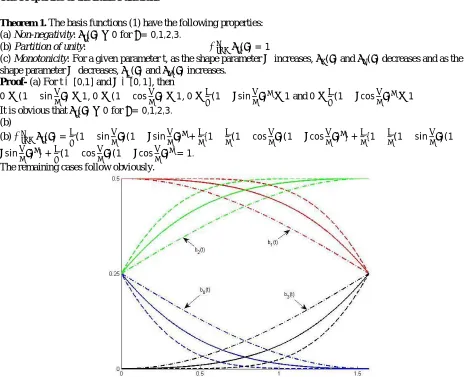
Fig. 1. Cubic Trigonometric BézierBasis Functions with different values of shape parameter.
Vol. 4, Issue 4, April 2016
0(dash-dotted lines), = 0.5(solid lines) and = 1(dashed lines) where ( ), ( ), ( ) and ( ) are denoted by blue lines, red lines, green lines and black lines respectively.
III.CUBIC TRIGONOMETRIC BÉZIER CURVE
Definition 2. Given points (i=0,1,2,3) in or , then
( ) =∑ ( ) , ∈[0,1], ∈[0,1] (2) is called a Cubic Trigonometric Bézier curve with a shape parameter .
3.1 Properties of Cubic Trigonometric Bézier Curve
Theorem 2. The Cubic Trigonometric Bézier curves (2) have the following properties:
(a) Terminal Properties:
(0) = [ + 2 + ] and (1) = [ + 2 + ], (3)
(b) Geometric invariance:
The shape of a cubic trigonometric Bézier curve is independent of the choice of coordinates, i.e. (2) satisfies the following two equations:
( ; ; + , + , + , + ) = ( ; ; , , , ) + ,
( ; ; ∗ , ∗ , ∗ , ∗ ) = ( ; ; , , , )∗ , (4)
∈[0,1], ∈[0,1]
where q is arbitrary vector in or , and T is an arbitrary × matrix, d=2 or 3.
(c) Convex hull property:
The entire cubic trigonometric Bézier curve segment lies inside its control polygon spanned by , , , .
(d) Symmetry:
, , , and , , , define the same cubic trigonometric Bézier curve in different parameterizations, i.e., r (t; ; , , , ) = r (1 − t; ; , , , )
IV.SHAPE CONTROL OF CUBIC TRIGONOMETRIC BÉZIER CURVE
For ∈[0,1], we can write (2) as follows:
( ) =∑ ( ) + sin 1−sin sin −2 ( − ) +
cos (1−cos )( cos −2)( − ) (5) where ( ) = (1−sin ), ( ) = {1− (1−cos )}, ( ) = {1− (1−sin )} and ( ) = (1−
cos ).
Obviously, shape parameter affect curves only on the control points ( − ) and ( − ) respectively. Also, change of one control point will alter at most four segments of the curve. So, local adjustment can be made without disturbing the rest of the curve.
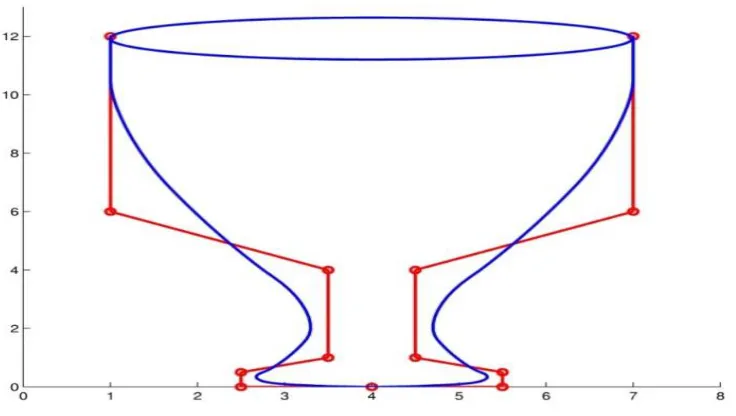
The shape parameter also serves to effect local control in the curves. As increases, the curve moves in the direction of the control points( − ) and ( − ) and as decreases the curve moves in the opposite direction to the control points ( − ) and( − ). In Fig. 2 the effect of shape parameter on the Cubic Trigonometric Bézier curve for = 1 (green lines), = 0.5 (red lines) = 0 (blue lines) is illustrated. Fig. 3 shows a computed example using the 17 control points. In order to construct a closed Cubic Trigonometric Bézier curve, we can set = , =
, = .
4.1 The Representation of Ellipse
Vol. 4, Issue 4, April 2016
corresponding Cubic Trigonometric Bézier curve with the shape parameter = 0 and local domain t ∈ [0, 1] represents an arc of an ellipse with ( ) = 7 + cos , ( ) = 7 + sin .
Proof- If we take =(8a, 4b) , =(8a, 8b) , =(8a, 8b) , =(4a, 8b) into (2), then the coordinates of Cubic Trigonometric Bézier curve are ( ) = 7 + cos , ( ) = 7 + sin .
This gives the intrinsic equation:
Fig. 2. Effect of shape parameter on the Cubic trigonometric Bézier curve
Vol. 4, Issue 4, April 2016
−7
+ −7 = 1
V. APPROXIMABILITY
Control polygon provides an important tool in geometric modeling. It is an advantage if the curve being modeled tends to preserve the shape of its control polygon. Here we show the relations of the Cubic Trigonometric Bézier curves and cubic Bézier curves corresponding to their control polygon.
Suppose , , and are not collinear; the relationship between Cubic Trigonometric Bézier curve r(t), and the cubic Bézier curve B(t) =∑ P (1−t) t with the same control points P (i = 0, 1, 2, 3)are as follows:
r(0) = [P + 2P + P ], r(1) = [P + 2P + P ],P = B(0), P = B(1)
and B −P∗= (P −P −P + P )
r 1
2 −P
∗= 1
8(√2−1)(√2− λ) (P −P ) + 1
8 √2−1 (√2− λ) (P −P )
where P∗= (P + P )
we have r −P∗= (√2−1)(√2− λ) (P −P −P +P )
Let B −P∗=r −P∗
1
8(P −P −P + P ) =
1
8(√2−1)(√2− λ) (P −P −P +P )
(√2−1)(√2− λ) = 1
λ=−1
From here we conclude that Cubic Trigonometric Bézier curves are closer to the control polygons than the Cubic Bézier curves when > 0. respectively.
VI.CONCLUSION
As mentioned above Cubic Trigonometric Bézier curves have all the properties that cubic Bézier curves have. However they can deal precisely with circular arcs, cylinders, cones etc., which can only be approximated by cubic curves. Also, because there is nearly no difference in structure between a Cubic Trigonometric Bézier curve and a cubic Bézier curve, it is not difficult to adapt a Cubic Trigonometric Bézier curve to a CAD/CAM system that already uses the cubic Bézier curves.
REFERENCES
1. I. J. Schoenberg, 1964, On Trigonometric Spline Interpolation, J. Math. Mech., Vol. 13, pp. 795-825.
2. T. Lyche, R. Winther, 1979, A Stable recurrence relation for trigonometric B-splines, J. Approx. Theory, Vol. 25, pp. 266-279. 3. X. Han, 2002, Quadratic Trigonometric Polynomial Curves with a Shape Parameter, Computer Aided Geometric Design, Vol. 19, pp.
479-502.
4. X. Han, 2003, Piecewise Quadratic Trigonometric Polynomial Curves, Mathematics of Computation, Vol. 72, pp. 1369-1377.
5. X. Han, 2004, Cubic Trigonometric Polynomial Curves with a Shape Parameter, Computer Aided Geometric Design, Vol. 21, pp. 535-548. 6. X. Han, 2006, Quadratic trigonometric polynomial curves concerning local control, Applied Numerical Mathematics, Vol. 56, pp.
105-115.
7. X. A. Han, Y. C. Ma, X. L. Huang,, 2009, The Cubic Trigonometric Bézier Curve with Two Shape Parameters, Applied Mathematical Letters, Vol. 22, pp. 226-231.
8. Xi-An Han, YiChen Ma, XiLi Huang, 2008, A novel generalization of Bézier curve and surface, Journal of Computational and Applied Mathematics, 217, pp. 180-193.
9. Cheng Wei Wang, Jul.2007, Cubic Trigonometric Polynomial Spline Curves with Shape Parameter, Journal of Beijing Institute of Clothing Technology, vol.28, pp. 50-55.
Vol. 4, Issue 4, April 2016
12. Lanlan Yan, Jiongfeng Liang, 2011, A Class of Algebraic-Trigonometric Blended Splines, Journal of Computational and Applied Mathematics, 235, pp. 1713-1729
13. Huayong Liu, Lu Li, Daming Zhang, 2011, Study on a Class of T-C Bézier Curve with Shape Parameters, Journal of Information and Computational Science, 8: 7, pp. 1217-1223.
14. Wei Xiang Xu, Liu Qiang Wang, Xu Min Liu, 2011, Quadratic TC-Bézier Curves with Shape Parameter, Advanced Materials Research, vols. 179-180, pp. 1187-1192.
15. L.L. Yan, X.B. Yang, L.Z. Song, 2008, Bézier Curves with Two Shape Parameters, Journal of Engineering Graphics, vol.29, pp. 88-92. 16. Xiaoqin Wu, Xuli Han, 2007, Cubic Trigonometric Polynomial Spline Curves with a Shape Parameter, Computer Applications and
Software, vol.24, pp.62-64.
17. XiaoqinWu, Xuli Han, Shanming Luo, 2008, Quadratic Trigonometric Polynomial Bézier Curves with a Shape Parameter, Journal of Engineering Graphics, vol.29, pp. 82-87.
18. Xi-An Han, XiLi Huang, YiChen Ma, 2010, Shape Analysis of Cubic Trigonometric Bézier Curves with a Shape Parameter, Applied Mathematics and Computation, 217, pp.2527-2533.
19. Mridula Dube, Reenu Sharma, 2013, Quartic Trigonometric Bézier Curve with a shape parameter, International Journal of Mathematics and Computer Applications Research (IJMCAR), Vol. 3, Issue 3, Aug 2013, pp. 89-96.
20. Mridula Dube, Reenu Sharma, 2015, Shape Features of Cubic Trigonometric Bézier Curve With Two Shape Parameters, Proceedings of National Conference in Pure and Applied Mathematics, 2015, pp. 13-17.
BIOGRAPHY