Galaxy Position based Solar Power Prediction
System using Neural Network
Saranya R, Ambili K
P.G Scholar, Department of Computer Science and Engineering, Cochin College of Engineering, Kerala, India Assistant Professor, Department of Computer Science and Engineering, Cochin College of Engineering, Kerala, India
ABSTRACT: Galaxy position based solar power prediction system is a prediction system used to aid the design of solar power systems more accurately irrespective of the climate conditions, geographical locations and availability of sun light. This ensures the design of solar power system which ensures the availability of minimum power requirements. The application aims to build a tool in designing the solar power systems irrespective of location and climate conditions. This basically calculates the availability of sun light of any location from the provided locations geographical coordinates and the time of installation provided. Calculates suns position at time and angle of incident of light on earths provided location. Based on this availability of sun light and climate conditions we calculate the no of cells required to cater the needs to our power consumption. Also this application gives expert opinion on the angle of installation of the solar panels. This also takes care of the climate conditions. The forecasts are based on previous power output and weather data, and weather prediction for the next day. We present a new approach that forecasts all the power outputs for the next day simultaneously. It builds separate prediction models for different types of days, where these types are determined using clustering of weather patterns. As prediction models it uses ensembles of neural networks, trained to predict the power output for a given day based on the weather data. This application has the following modules including location identifier, climate Fetcher, prediction Logic .Based on the information collected by the above modules the system gives the detailed deployment specifications to the user, using these technicians can design a solar system which satisfies the power requirements in all climate conditions
KEYWORDS: Solar tracking, PV, Machine Learning, GPS, ANN
I. INTRODUCTION
As part of an environmental approach, the world is moving towards the discovery of new clean (green) energy resources that are both renewable and have less negative impact on the environment. The solar energy is one among this green resource. Several techniques and systems had been developed to collect this energy on a higher scale by maximizing the concentration of the solar irradiance. One well-known type of solar tracker is the heliostat, a movable mirror that reflects the moving sun to a fixed location, but many other approaches are used as well. The project entitled “Galaxy position based solar power prediction system” is a system based project. The front end of this project is java language and back end is MS Sql server. This project can be used by everyone who aims to configure the solar panel to maximize its use. Solar technologies include solar heating, solar photovoltaic, solar thermal electricity and solar architecture, which can make considerable contributions to solving some of the most urgent energy problems the world now faces. But the main disadvantage with sort of natural energies is we can’t guarantee the consistent and continues availability, this changes with climate conditions. The application aims to build a tool in designing the solar power systems irrespective of location and climate conditions.
panel, the maximum energy can be absorbed, as the panel is operating at their greatest efficiency [4]. The large scale solar tracker that normally used is not suitable for the residential use.
The power generated from PV systems is highly variable as it depends on the solar irradiance and other meteorological conditions. The uncertainty in solar power generation may lead to unnecessary increase in the spinning reserve and operational costs. This motivates the need for accurate forecasting of the generated solar power at different time intervals to ensure the stability of the grid by balancing the demand and supply, while keeping the costs low. Different approaches for forecasting the power generated from PV systems have been proposed. They are based on statistical methods such as liner regression and autoregressive moving average , and machine learning methods such as Neural Networks (NNs) [2,8], nearest neighbor [5] and Support Vector Regression (SVR) . Most of the previous work focused on developing general prediction method for all types of weather conditions. The purpose of this document is to present a classification method for solar power prediction systems We wish to be able to use this method as a research and innovation tool, useful for selecting the optimal system during the stage of technological development of the new systems and during the stage of development of the opportunity and feasibility studies, and of the business plans on the development of new production capacities of solar energy.
II. RELATED WORK
A Design of Single Axis Sun Tracking System[1], main objective for this project is to develop the sun tracking solar system model which is a device that follow the movement of the Sun regardless of motor speed. Beside that, it is to improve the overall electricity generation using single axis sun tracking system and also to provide the design for residential use. LDR or light dependent resistor has been chosen as the sensor because LDR is commonly used in sun tracking system. This is because LDR is sensitive to the light.
The resistance of LDR will decreases with increasing incident light intensity [9]. For the controller, PIC18F877A had been chosen. This PIC programming will give the pulse to the driver to move the motor. For the driver, bidirectional DC motor control using relay has been used. The motor controller had been chosen because it can control the motor to rotate clockwise and counter-clockwise easily.
Solar tracking systems for solar concentrator field of heliostats - Innovation, performance and adaptation to small-scale applications[2] The choice of this system is based on several scientific studies and is focused on solar tracking with two-axis. Different mathematical models and simulations have been developed and used to determine: i) the position [1] of the sun relative to a geographic position of an observer, ii) the angular position of the heliostats, and iii) the set of equations modelling the geometry of shadows and the blocking effect between the heliostats. This allows to the geometry optimization of the field in order to obtain the best compromise between productivity heliostats and the land occupied by them, which aim to minimize the cost of energy.
This mechanical system is the medium carrying the heliostats that follow the sun throughout the day (rotational drive on two axes). The characterization of this system is summarized up in the fact that the design is simple as it is shown in the figure 2 below. In other words, it offers an easy rotational movement, a good stability; and an optimization in terms of weight and size; as it orientates the heliostats with accuracy. This latter characterization of the mechanical system is the most essential element for a better tracking. The rotation on two axes is carried out using two low-power motors.
Power Management Strategy Based on Weather Prediction for Hybrid Stand-alone System [3] is a Stand-alone hybrid generation system that is usually used to supply remote areas or locations interconnected to a weak grid. They combine several generation modules, typically assimilating different renewable energy sources. In this work, a wind-solar system is considered as main energy source. A lithium-ion battery bank is used to overcome the periods of poor production. In fact, the battery operates as secondary source for supplying the power deficit caused by the dynamic power balance [12]. In addition to these sources a DE is used as backup source.
Design of a Solar Power Management System for an Experimental UAV[4] is designed to obtain electric energy from the solar system and to make the required power available for the on-board computers and other electronic circuitries for an experimental UAV. The electric power generated from the solar cells depends on the temperature and the solar radiation conditions and the load electric characteristics.
small plants even if the technologies cannot participate in the market at competitive conditions yet. Obviously, performance of such plants are quite low.However, system reliability and maintainability have to be improved to make them more attractive for installation in rural areas.
Optical Performance of Horizontal Single-Axis Tracked Solar Panels[7] In a specific site, the annual collectible radiation on a full 2-axis tracked panel is largest as compared to fixed or single-axis tracked panels, and is a constant statistically over many years, but the annual solar gain on a traditional fixed south-facing panel, S0, is a function of its tilt-angle, and an optimal tiltangle, opt , 0 β , could be obtained by repeatedly calculating S0 for different tilt-angles until a maximum annual collectible radiation, S0,max, is found. Results obtained in this work indicated that the annual collectible radiation on HA-tracked solar panels was related to the orientation of the tracking axis, the EW-axis sun-tracking was worst to boost the energy collection of tracked panels and the SN-axis sun-sun-tracking was best.
III.PROPOSED ALGORITHM
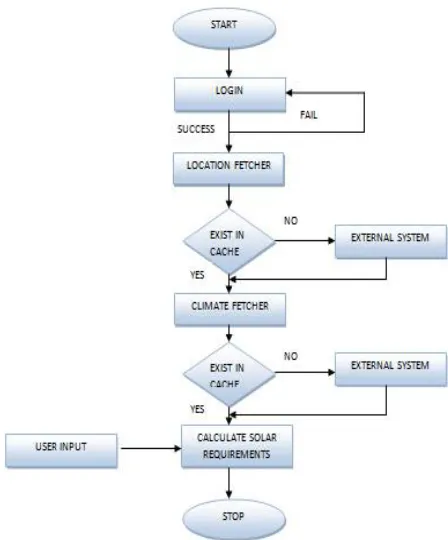
In the proposed system, the system will calculates the availability of sun light of any location from the provided locations geographical coordinates and the time of installation provided. It predicts the weather situation by checking the previous days weather data and Calculates sun’s position at time and angle of incident of light on earths provided location. Based on this availability of sun light and climate conditions we can calculate the number of cells required to cater the needs to our power consumption. Also this application gives expert opinion on the angle of installation of the solar panels. This also takes care of the climate conditions also. In this method we implement a neural network concept on historical data to fetch the climatic condition based on latitude and longitude and store that information in the knowledge base. Here we are predicting the weather data using the clustering and neural networks[1] and this gives a better results compared to other existing systems. It also has a better configuration system where we can simulate data based on given data.
Prediction Algorithm:
Given:
(1) a time series of previous solar power output up to the day d: P=[P1,P2,P3,….,Pd], where Pi=[pi1,pi2,pi3,…pin]represents the power profile for day i, i.e. n observations of the power output measured at half-hourly intervals.
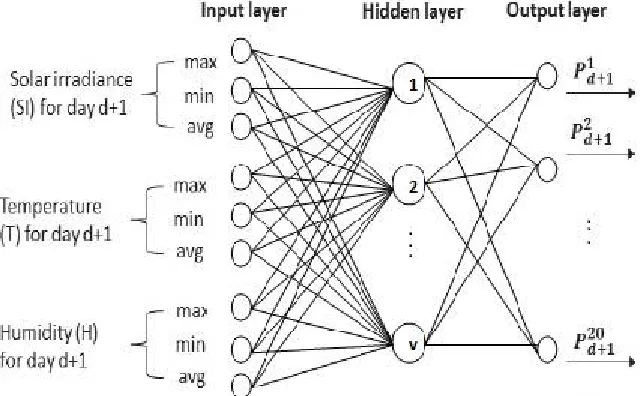
(2) A time series of previous weather data for the location of the PV plant up to day d: W=[W1, W2, W3,… Wd ] where Wi is the weather data for day i. Wi is a 12- dimensional vector of the maximum, minimum and average daily solar irradiance (SI), ambient temperature (T) and humidity (H) Wi= [SIimax, SIimin, Timax, Timin, Himax, Himin]
(3) Predicted weather data Wd+1 for day d+1 e.g. Obtained from the bureau of meteorology.
Fig 2: Ensemble neural network for climate fetching
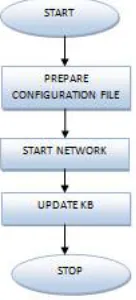
Fig 3 :Proposed Neural Network Flow diagram
To train the dataset we manually add data into a knowledge base which will contain the location’s geographic coordinates. Through clustering then we will select the correct data.
More specifically, the power output prediction by an ensemble for time h for the next day d+1 is:
Distance between the clusters is calculated using Euclidian distance formula
d=
√∑(
−
)2
IV.SIMULATION RESULTS
We divided the solar power and weather data into two non-overlapping subsets: training, used to build the prediction models, and testing, used to evaluate their performance. The testing set contained the last 200 days for the second year (approx. 30% of all data) and the training set contained the remaining 530 days (approx. 70% of all data). For the NN models we also used a validation set for early stopping of the training and parameter selection, so the 730 days were further split into 70% used for training and 30% used for validation.
Our results show that to better understand the performance of our best approach, the clustering based k-NN with clustering method 2 (that uses the half-hourly solar irradiance), We can see that the best accuracy was achieved for cluster C1, closely followed by clusters C3 and C2, and finally cluster C4, which has considerably lower accuracy.
In addition to accuracy, other important performance indicators are training and testing time. The training time for our prediction methods was less than 20 minutes. Since the training is done offline, this is an acceptable requirement. All prediction models were very fast at predicting new instances – the testing time was a few seconds.
The graph represents the relation between the input weather conditions with respect to the time.
V. CONCLUSION AND FUTURE WORK
The newly developed system consumes less time and output is efficient. All places in the galaxy were identified & their latitude and longitude is fetched easily. And according to the location the climate details are fetched from the climate fetcher module. Since the system provides help messages and it is very much user friendly, and any user gets familiarized with its usage. We proposed and evaluated clustering based approaches that utilize previous PV power and weather data. The forecasting is done (1) directly, without the need to firstly predict the solar irradiance and then convert it into PV output, and (2) simultaneously for all half hourly intervals, rather than incrementally using the forecasts for the previous times.The main idea behind our approaches is to cluster the days based on their weather characteristics and then build separate prediction models for each cluster using the PV data. We investigated if building such separate prediction models improves the accuracy, compared to building a single prediction model for all types of days.
The following future enhancements may be worthwhile to make the tool usable to a wider section of users:
Solar Energy can be calculated without the software by making into online.
New materials of solar panels can be added.
REFERENCES
1 Mashud Rana,Irene Koprinska ,Vassilios G Aglidis,Power forecasting using weather type clustering and ensembles of neural network,IEEE,2016
2 Guihua Li Runsheng Tang, Hao Zhong , International Conference on Future Energy, Environment, and Materials Optical Performance of Horizontal Single-Axis Tracked Solar Panels
3 Solar tracking systems for solar concentrator field of heliostats - Innovation, performance and adaptation to small-scale applications
4 Menad Dahmane, Jerome Bosche, Ahmed El-Hajjaji, Power Management Strategy Based on Weather Prediction for Hybrid Stand-alone System, 7th International Conference on Sustainability in Energy and Buildings.2009
5 Design of a Solar Power Management System for an Experimental UAV,Article in IEEE Transactions on Aerospace and Electronic Systems , November 2009.
6 George Sebastian Naghiua, Ioan Giurcaa, Ioan Achileanb, Gheorghe Badeaa ,Multicriteria Analysis on Selecting Solar Radiation Concentration Ration for Photovoltaic Panels Using Electre-Boldur Method , 9th International Conference Interdisciplinarity in Engineering, INTER-ENG 2015, 8-9 October,2015
7 A. Giovannelli ,State of the Art on Small-Scale Concentrated Solar Power Plants Optical Performance of Horizontal Single-Axis Tracked Solar Panels ATI, 70th Conference of the ATI Engineering Association,2015
8 Mashud Rana , Irena Koprinska , Vassilios G Agelidis Solar Power Forecasting Using Weather Type Clustering and Ensembles of Neural Networks, International Joint Conference on Neural Networks (IJCNN),2016
9 Tamara A. Papalias and Mike Wong, “Making Sense of Light Sensors”, Application notes, CA: Intersil Americas Inc. 2007.
10 Valenciaga, F., Puleston, P.F., Battaiotto, P.E.. Power control of a photovoltaic array in a hybrid electric generation system using sliding mode techniques. IEE ProcControl Theory Applications, 2001;148:448–455[11]
11 J´erˆome Bosche, Ahmed El-Hajja, Power Management Strategy Based on Weather Prediction for Hybrid Stand-alone System Menad Dahmane 12 Bizon, N. Load following mode control of stand-alone renewable/ fuel cell hybrid power source. Energy Conversion and Management
13 Haskew, T.A. Characteristic study of vector-controlled direct driven permanent magnet synchronous generator in wind power generation. In: Power and Energy Society General Meeting - Conversion and Delivery of Electrical Energy in the 21st Century. (2008)
14 "Global Market Outlook For Solar Power / 2015 - 2019," Solar Power Europe, 2015.
15 H. T. C. Pedro and C. F. M. Coimbra, "Assessment of forecasting techniques for solar power production with no exogenous inputs," Solar Energy, vol. 86, pp. 2017-2028, 2012.
16 D. Yang, Z. Ye, L. H. I. Lim, and Z. Dong, "Very short term irradiance forecasting using the lasso," Solar Energy, vol. 114, pp. 314-326, 2015. 17 Y. Chu, B. Urquhart, S. M. I. Gohari, H. T. C. Pedro, J. Kleissl, and C. F. M. Coimbra, "Short-term reforecasting of power output from a 48
MWe solar PV plant," Solar Energy, vol. 112, pp. 68-77, 2015.
18 H. Long, Z. Zhang, and Y. Su, "Analysis of daily solar power prediction with data-driven approaches," Applied Energy, vol. 128, pp. 29-37, 2014.
19 C. Chen, S. Duan, T. Cai, and B. Liu, "Online 24-h solar power forecasting based on weather type classification using artificial neural networks," Solar Energy, vol. 85, pp. 2856-2870, 2011.