University of Windsor University of Windsor
Scholarship at UWindsor
Scholarship at UWindsor
Electronic Theses and Dissertations Theses, Dissertations, and Major Papers
2015
Game Theoretic Energy Balanced Routing Protocols For Wireless
Game Theoretic Energy Balanced Routing Protocols For Wireless
Sensor Networks
Sensor Networks
Mehmmood Abd University of Windsor
Follow this and additional works at: https://scholar.uwindsor.ca/etd
Recommended Citation Recommended Citation
Abd, Mehmmood, "Game Theoretic Energy Balanced Routing Protocols For Wireless Sensor Networks" (2015). Electronic Theses and Dissertations. 5259.
https://scholar.uwindsor.ca/etd/5259
GAME THEORETIC ENERGY BALANCED ROUTING PROTOCOLS FOR
WIRELESS SENSOR NETWORKS
by
Mehmmood Abdulla Abd
A Dissertation
Submitted to the Faculty of Graduate Studies
through the Department of Electrical and Computer Engineering
in Partial Fulfillment of the Requirements for
the Degree of Doctor of Philosophy at the
University of Windsor
Windsor, Ontario, Canada
2015
Game Theoretic Energy Balanced Routing Protocols For Wireless Sensor Networks
by
Mehmmood Abdulla Abd
APPROVED BY:
Dr. A. Shami
University of Western Ontario, Canada
Dr. A. Azab
Industrial and Manufacturing Systems Engineering
Dr. M. Khalid
Department of Electrical and Computer Engineering
Dr. M. Mirhassani
Department of Electrical and Computer Engineering
Dr. R. Benlamri, Co-Advisor
Department of Electrical and Computer Engineering
Dr. Kemal E. Tepe, Advisor
Department of Electrical and Computer Engineering
DECLARATION OF CO-AUTHORSHIP / PREVIOUS
PUBLICATION
I. Co-Authorship Declaration
I hereby declare that this dissertation incorporates some materials part of which
are results of joint researches. The investigations and evaluations done
through-out this dissertation used some technologies that were developed in the WiCIP
research laboratory. The investigations were supported by collaborative help
from my colleagues in WiCIP LAB in the form of advice, critiques, and
mentor-ing. This dissertation also incorporates the outcome of joint research undertaken
in collaboration with Sarab F. Majed Alrubeaai and Brajendra K. Singh, under
the supervision of Professor Dr. Kemal E. Tepe and Rachid Benlamri. In all
cases, the key ideas, primary contributions, experimental designs, data
analy-sis and interpretation, were performed by the author, and the contribution of
co-authors was primarily through the provision of suggestions, comments,
cri-tiques, verification and other supports. I am aware of the University of Windsor
Senate Policy on Authorship and I certify that I have properly acknowledged the
contribution of other researchers to my dissertation, and have obtained written
permission from each of the co-author(s) to include the above material(s) in my
II. Declaration of Previous Publication
This dissertation includes three original papers that have been previously
pub-lished/submitted for publication in peer reviewed journals, as follows:
Dissertation chapter Publication title/full citation Status
Part of Chapter 3 and 5 Mehmmood A. Abd, Sarab F. Al
Rubeaai, Brajendra K. Singh, Kemal E.
Tepe, Rachid Benlamri, Global Game
Theoretic Energy Balance Approach For
Wireless Sensor Networks ,
Submitted
Part of Chapter 4 Mehmmood A. Abd, Sarab F. Al
Rubeaai, Kemal E. Tepe, Rachid
Ben-lamri, ”Game Theoretic Energy Balancing
Routing in Three Dimensional Wireless
Sensor Networks”, Accepted in
Wire-less Communications and Networking
Conference (WCNC), 2014 IEEE
Accepted
Part of Chapter 3 and 5 Mehmmood A. Abd, Brajendra K.
Singh, Sarab F. Al Rubeaai, Kemal
E. Tepe, Rachid Benlamri, “Game
Theoretic Energy Balanced (GTEB)
Routing Protocol for Wireless Sensor
Networks”, Wireless Communications
and Networking Conference (WCNC),
2014 IEEE , vol., no., pp.2564, 2569, 6-9
April 2014
Published
I certify that I have obtained a written permission from the copyright owner(s) to
material describes work completed during my registration as graduate student at the
University of Windsor.
I declare that, to the best of my knowledge, my dissertation does not infringe
upon anyones copyright nor violate any proprietary rights and that any ideas,
tech-niques, quotations, or any other material from the work of other people included in
my dissertation, published or otherwise, are fully acknowledged in accordance with
the standard referencing practices. Furthermore, to the extent that I have included
copyrighted material that surpasses the bounds of fair dealing within the meaning of
the Canada Copyright Act, I certify that I have obtained a written permission from
the copyright owner(s) to include such material(s) in my dissertation. I declare that
this is a true copy of my dissertation, including any final revisions, as approved by
my dissertation committee and the Graduate Studies office, and that this dissertation
ABSTRACT
A primary concern in the operation of Wireless Sensor Network (WSN) is the issue of
balancing energy consumption and lifetime maximization. This dissertation addresses
the problem of unbalanced energy consumption in WSNs by designing traffic load
balancing geographical routing protocols. In order to provide energy balance; two
decentralized, scalable and stable routing protocols are proposed: Game Theoretic
Energy Balanced (GTEB) routing protocol for WSNs and three dimensional (3D)
Game Theoretic Energy Balance (3D-GTEB) routing protocol for WSNs. GTEB
were designed to fit with WSNs deployed in 2D space, while 3D-GTEB designed to
work with WSNs deployed in 3D terrain.
Both protocols are built based on balancing energy consumption into region level
and node level using different game theory in each level. In the first level, evolutionary
game theory was used to balance the energy consumption in various packet forwarding
sub-regions, while in the second level classical game theory was used to balance the
energy consumption in forwarding sub-region nodes. 3D-GTEB benefits from utilizing
the third coordinate of nodes’ locations to achieve better and accurate routing decision
with low network overhead.
The protocols where evaluated analytically and experimentally under realistic
classical game theories are applicable to WSNs, but also they achieve significantly
better performance in terms of energy usage, load spreading, and packet delivery
ratio under different network scenarios when compared to the state-of-art protocols.
Moreover, further investigation is made to evaluate the effectiveness of using game
theories by comparing GTEB with three random test protocols. The results
demon-strated that the GTEB and 3D-GTEB are prolonged the network lifetime from 33%
to 85%, and provided better delivery ratio form 26% to 52% as compared with other
DEDICATION
to my
MOTHER and FATHER
ACKNOWLEDGEMENTS
I would like to thank my advisor Dr. Kemal E. Tepe for introducing me into the
research area of wireless sensor networks, for his help and support during all phases
of this dissertation and mainly for the many fruitful discussions, which always inspired
and motivated me. I am grateful for all the time he dedicated to me and my work
despite he has many other students they also need his support. He became a good
friend and I hope this relationship will last after the end of this study period too.
I would like to thanks my second advisor Dr. Rachid Benlamri and I feel a special
gratitude for all the time he dedicated to me and my work despite the long geographic
distance between us.
I had many helpful and interesting discussions with all the other research group at
WiCiP LAB for their advice and enlightening discussions. However, the most I am
grateful to my wife Sarab F. Majed: she supported me in all time and motivate me
TABLE OF CONTENTS
Page
Declaration of Co-Authorship / Previous Publication . . . iii
Abstract . . . vi
Dedication . . . viii
Acknowledgements . . . ix
List of Tables . . . xiv
List of Figures . . . xv
List of Abbreviations . . . xvi
1 Introduction . . . 1
1.1 Introduction . . . 1
1.1.1 Applications of wireless sensor networks (WSNs) . . . 2
1.1.2 Challenges in Wireless Sensor Network (WSNs) . . . 3
1.2 Problem Statement . . . 5
1.3 Contributions . . . 7
1.4 Research Objectives . . . 9
1.5 Dissertation Organization . . . 11
2 Background and Literature Review . . . 12
2.2 Wireless Sensor Network Routing Metrics . . . 13
2.3 Routing Protocol Classification . . . 14
2.4 Energy Balanced in WSN . . . 15
2.4.1 Route level energy balance . . . 15
2.4.2 Region level energy balance . . . 15
2.5 Game Theory An Overview . . . 16
2.5.1 Classical game theory . . . 16
2.5.2 Evolutionary game theory . . . 18
2.6 Literature Review . . . 21
2.6.1 Review of energy balance in 2D WSNs . . . 21
2.6.2 Review of energy balance in 3D WSNs . . . 22
2.6.3 Review of game theory in WSNs . . . 23
2.7 Summary . . . 24
3 Game Theoretic Energy Balanced (GTEB) Routing Protocol for Wireless Sensor Networks . . . 25
3.1 Introduction . . . 25
3.2 Protocol Description . . . 27
3.2.1 Region level energy balance (RLEB) . . . 30
3.2.2 Replicator Dynamics . . . 32
3.2.3 Evolutionary equilibrium . . . 35
3.2.4 Stability analysis . . . 38
3.2.5 Node level energy balance (NLEB) . . . 40
3.3 Results and Discussion . . . 47
3.3.1 Network lifetime . . . 49
3.3.2 Energy consumption per packet . . . 50
3.3.3 Packet delivery ratio . . . 51
4 Game Theoretic Energy Balancing Routing in Three Dimensional
Wireless Sensor Networks . . . 53
4.1 Introduction . . . 53
4.2 Protocol Description . . . 55
4.2.1 Wedge level energy balance (WLEB) . . . 58
4.2.2 Node level energy balance (NLEB) . . . 60
4.3 Results and Discussion . . . 61
4.3.1 Network lifetime . . . 63
4.3.2 Average energy consumption per packet . . . 64
4.3.3 Packet delivery ratio . . . 66
4.4 Summary . . . 67
5 Protocol Evaluation and Analysis . . . 69
5.1 Introduction . . . 69
5.2 Random Test Protocols . . . 70
5.2.1 Random-Random protocol . . . 70
5.2.2 Random-CGT protocol . . . 70
5.2.3 EGT-Random protocol . . . 71
5.3 Network Performance Analysis . . . 71
5.3.1 The effect of network density on network lifetime . . . 71
5.3.2 The effect of traffic load on network lifetime . . . 73
5.3.3 The effect of network density on average energy consumption per packet . . . 74
5.3.4 The effect of the traffic load on average energy consumption per packet . . . 75
5.3.5 The effect of the traffic load on packet delivery ratio . . . 76
5.4 The effect of Packet Forwarding Region’s Size on Network Lifetime . 77 5.5 Summary . . . 78
6.1 Contributions . . . 79
6.2 Future Research Directions . . . 81
References . . . 82
A Appendix A: Stability Analysis of RLEB . . . 93
A.1 Stability Analysis of RLEB Evolutionary Game Over K Regions . . . 93
B Appendix B: Copyright Permission . . . 96
LIST OF TABLES
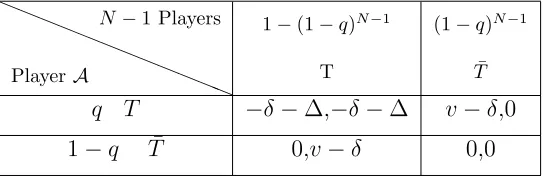
3.1 THE PAYOFF MATRIX OF N-PLAYER NON-COOPERATIVE GAME. 40
3.2 NASH EQUILIBRIUM WITH DIFFERENT REWARD VALUE AND
NUMBER OF NEIGHBORS . . . 44
LIST OF FIGURES
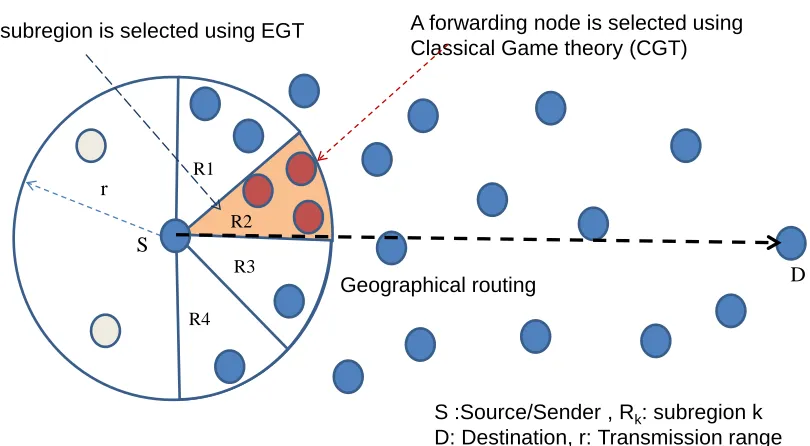
3.1 Subregion and node selection in the proposed protocol. . . 28
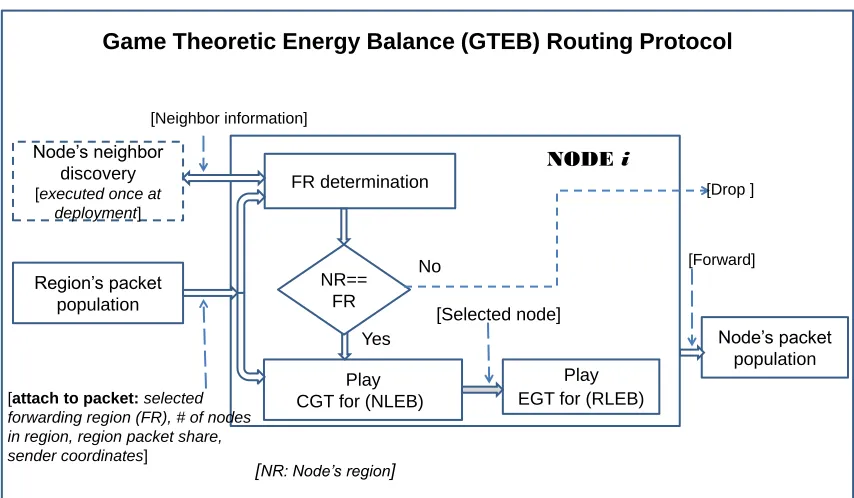
3.2 GTEB’s functional diagram. . . 29
3.3 Nash equilibrium q∗ versus changes in reward value v with different number of neighbors. . . 45
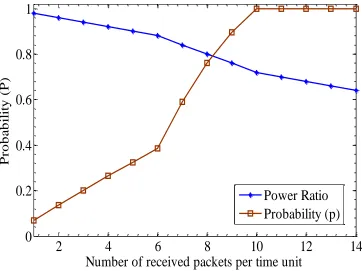
3.4 Forwarding probability versus number of forwarded packets and node’s residual energy. . . 46
3.5 Network lifetime with different packet generation rates. . . 49
3.6 Average energy consumption per packet with different packet genera-tion rates. . . 50
3.7 Packet delivery ratio with different packet generation rates. . . 51
4.1 Illustration of 3D-GTEB scenario. . . 56
4.2 Network lifetime versus different densities. . . 63
4.3 Network lifetime versus different packet generation rates. . . 64
4.4 Energy per packet versus different densities. . . 65
4.5 Energy per packet versus different packet generation rates. . . 66
5.1 The effect of network density on lifetime in GTEB and the three
pro-tocols. . . 72
5.2 The effect of traffic load on the network lifetime in GTEB and the
three protocols. . . 73
5.3 The effect of network density on energy per packet in GTEB and three
random protocols. . . 74
5.4 The effect of traffic load on energy per packet in GTEB and three
random protocols. . . 75
5.5 Packet delivery ratio in GTEB and three test cases. . . 76
5.6 GTEB lifetime evaluation using two, four and eight packet forwarding
LIST OF ABBREVIATIONS
N Number of sensor nodes (players) in region/wedge k
´
Ci Proportion of packet already forwarded by a node out of Ci
´
Ei Residual energy in node i
¯
T No Transmission strategy
β Normalization factor for the total energies in region/wedges
∆ Collision energy cost
δ Transmission energy cost
˙
X Replicator dynamics
˙
Xk Net change in the number of packets in region k
X∗ Equilibrium packet distribution vector
λ Packet population of a sensor node
λk Number of packets in region k
M Number of sensor nodes in WSN
N Set of players
S Set of strategies
Si Set of strategies of node i
S−i Set of strategies of opponent node −i
Ω Volume of deployment terrain
ρ Density of network
θ Angle of forwarding region/wedge
−→
SA Vector from sender S to the node A
−→
SD Vector from sender S to the destinationD
−→
S Sender sensor node
D Destination sensor node
A Sensor node A
O Polar point of a node’s transmission sphere
3D Three dimensions
GT EB Game theoretic energy balance
2D Two dimensions
Ci Ideal proportion of packet must be forwarded by node i
E[Ui] Expected payoff for node i
Etr Receiving energy cost in Joule
Etx Transmission energy cost in Joule
Ei Initial energy of node i in Joules
Ek Residential energy in region k
Fk(X) Fitness function of region k
GRP Geographical routing protocol
Hk Function of the number of players in region k
K Number of forwarding region/wedge
n Node n
O The polar transmission sphere
P Transition probability matrix
pi,k Node i forwarding probability in region k
q∗ Nash equilibrium strategy
R Forwarding region
T Transmission strategy
v Reward value
ui Payoff function of node i
si Strategy of node i
B Broadcasting strategy ¯
B No Broadcasting strategy
Bk Available resources in region k
BS Base station
C Proportion of packet in a region/wedge
CBR Constant bit rate
CGT Classical game theory
d Depth of deployment space
dB Decibel
EGT Evolutionary game theory
FW Forwarding wedge region
h Hight of deployment space
J Joule
kbps Kilo bit per second
MANET Mobile ad hoc networks
m Meter
mW milliwatt
NE Nash equilibrium strategy
NLEB Node level energy balance
PDR Packet delivery ratio
QoS Quality of service
RLEB Region Level Energy Balance
RTT Round trip time
RLEG Region level evolutionary game
s Any strategy
w Width of deployment space
WLEB Wedge level energy balance
WSN Wireless sensor network
CHAPTER
1INTRODUCTION
1.1
Introduction
Wireless Sensor Networks (WSNs) will be very prevalent technology in the near future
due to their unique characteristics and to their great number of applications. WSNs
consist of a large number of autonomous micro-sensors that are deployed in remote
and inaccessible areas to monitor physical or environmental conditions. Although the
sizes of sensors are very small, they have their own on-board processor, as well as
com-munication, mobilizing, position finding, and storage capabilities. Sensor nodes have
the ability to collect and route data, through one or multi hops, to other nodes, or
ex-ternal base stations. Coordination and cooperation among sensor nodes will provide
essential network information collected from monitored physical phenomena. Base
Station (BS) basically acts as a gateway between sensor network and end user by
re-ceiving the data from sensor nodes and forwarding it to the server hence, it is required
to have more computational, energy, and communication resources than sensor nodes.
Routing data in WSNs very challenging task due to infrastructure-less
communi-cations and frequent topology changes. The main drawbacks of the WSNs are the
This chapter presents examples of WSNs applications, challenges in WSNs, problem
statement, and contributions of this work.
1.1.1
Applications of wireless sensor networks (WSNs)
WSN applications can be classified into three categories based on sensing and
report-ing mechanisms [1, 2].
1. Periodic reporting applications: in these applications, the sensor nodes will
sample the collected data periodically, store and transmit collected data to the
base station. This type of scenario is commonly used in monitoring applications
such as automatic irrigation systems [3], habitat surveillance [4], and military
operations [5]. The main advantage of this category is that data generation rate
and traffic volume is predictable.
2. Event driven applications [6–8]: In these applications each sensor has the
abil-ity to sense and evaluate the usefulness of information. If the detected information
is useful the information will be transmitted to the base station for evaluation. The
main property of this type of application is the randomness of event occurrence,
which correlates with the time and place. Therefore, time and packet traffic load
is unpredicted. The surveillance applications, disaster relief applications, intrusion
detection applications, and patients monitoring applications are a few examples of
such event driven applications.
3. Query based applications [9]: In these applications, the sensory data are
regu-larly sampled and stored in senor nodes. The base station sends request messages
to the specific senors to fetch the data directly. The main challenge in this category
is that the data management process due to the limitation of the storage capacity
of the sensors.
1.1.2
Challenges in Wireless Sensor Network (WSNs)
The limitation in WSNs resources make it necessary to design new routing protocols
that differ from regular routing protocols designed for other wireless communication
systems. Some of the limitations in WSNs are as following:
1. Energy restriction: Wireless sensors are powered with a limited power supply
such as batteries and capacitors. These limited energy resources have a direct
impact on the network lifetime [10]. The network lifetime is the duration from
the deployment time until the time when the first sensor runs out of energy. In
unattended and remote environments, replacing or charging batteries is not cost
effective and practical. Hence, good utilization of the limited power resources is
important to prolong the network lifetime.
Geographical Routing Protocols (GRPs) due to their low network overhead can
increase energy utilization and improve network lifetime. In this dissertation, I
focused on energy balance challenge to prolong the network lifetime by evenly
distributing traffic load in the network using GRP.
2. Mobility: Due to the sensor node’s mobility, the topology of the network may
change frequently, which may cause route failure, high collision rate, blockage
rout-ing information, and increase energy consumption [11]. Thus, network mobility
must be addressed in a data propagation protocol design.
3. Network deployment: Network deployment is another challenge in WSNs,
spe-cially when a WSN deployed in remote or inaccessible areas. It is very difficult
or even impossible to determine their location in advance. For example, sensors
that are serving to monitor battlefields or disaster areas are usually randomly
thrown from airplanes over areas of interest and these sensors must be able to
determine their own locations, initiate their sensing, and communicate with their
random network deployment scenarios and various network densities.
4. Scalability [13]: Due to the increasing number of sensors in a network, the
mes-sages that must be routed to the base station increase. Therefore, data propagation
protocol must be able to scale with changes in a network; such as changes in
net-work density, netnet-work connectivity, and/or sensing operations. Decentralized and
localized algorithms, where sensor nodes usually employ, are often used to satisfy
the scalability requirements.
5. Fault tolerance [14]: WSNs are inherently prone to failure due to the low cost
hardware and limitation of the energy supplies. A failure of a sensor node should
not influence the overall functionality of the network. So in such cases, a network
must have the ability to accommodate a new route to the base station. This may
need actively rerouting packets through a more reliable part of the network that
has more resources (available energy).
6. Location dependent contention [15]: The traffic load on a wireless channel
varies with the number of sensor nodes that are present in a given region. The
contention over the usage of a channel will increase with the increase in the number
of sensor nodes. The high contention over the channel causes a large number of
collisions and consequently inefficient utilization of energy and bandwidth.
There-fore, any reliable data propagation protocol must have the property of preventing
or minimizing high channel contention.
7. Security [9, 16, 17]: Normally, the traffic routing in the sensor network is
con-nectionless, consequently making it highly susceptible to security threats. The
shared wireless medium makes the network subject to various attacks such as
de-nial service attacks. Therefore, WSNs require security solutions that fit with their
wireless communication and limited resources.
depend-ing on WSNs applications. For example, disaster field monitordepend-ing entails reliable
minimum delay delivery of sensory information for ensuring fast response by a
corresponding authority. In contrast, agricultural monitoring and animal-borne
applications require balancing energy consumption in sensor nodes and long
net-work lifetime to minimize maintenance effort and cost.
The main goal of this dissertation is to extend the network lifetime by distributing
traffic load in WSNs. This gaol is achieved by employing a decentralized, scalable and
energy-balanced geographical routing protocol called GTEB and three dimensional
routing protocol called 3D-GTEB. Both routing protocols utilize a combination of
evolutionary and classical game theories.
1.2
Problem Statement
This dissertation provides solution to problems associated with GRPs to achieve
global balanced energy consumption in order to extend the lifetime of network. These
problems are discussed hereunder:
Problem 1. Unbalanced energy consumption: uneven energy dissipation in the
Ge-ographical Routing Protocols (GRPs) can result in premature network failures,
which shorten the lifetime of the network, accelerate network partitioning, and
generate energy hole problem [19–23]. Therefore, utilizing routing protocol for
fair traffic load distribution among wide range of sensors is one of the key
meth-ods to prolong operations of the network.
Problem 2. Unbalanced traffic load and redundant transmission: GRPs forward the
packets toward the destination based on one of the following techniques:
A. Shortest path forwarding (SPF) approach [24–26]: Where, a packet travels
from source to destination through the shortest straight path. That leads to
energy faster than other nodes, which creates network partitions and failures.
Hence, the traffic load must be spread on large number of sensor nodes to
evenly deplete energy consumption and improve the network lifetime.
B. Region Based Forwarding (RBF) approach [27–29]: A packet is broadcasted
to a set of nodes located in the same region and all sensors transmit the
re-ceived packet toward the destination. That causes redundant transmissions.
These redundant transmissions can increase energy consumption. Therefore,
a new innovative routing protocol is required to improve energy utilization
to prolong the network lifetime.
Problem 3. 3D network deployment [30–32]: sensor networks are deployed in a 3D
space. Utilizing 2D geographical routing protocols for 3D wireless networks
may not provide an accurate solution and in some cases it is not possible such
as Unmanned Aerial Vehicles (UAV) communication. Thus, there is a strong
desire to use 3D GRP to improve accuracy and energy efficiency of the
net-work. Therefore, by including third coordinate of nodes’ position is decreased
the number of dropped packets, while energy efficiency and the lifetime of the
network is increased. For this reason, it is important to consider the third
coor-dinate of nodes’ location in order to avoid route description errors, transmission
redundancies, and high packet miss ratio.
Problem 4. Energy hole problem [22, 33]: Energy hole problem is associated with
GRPs due to over utilization of some nodes over other nodes. For instance, in
case of SPF the nodes that are located along the straight line between source
and destination will deplete their energy sooner than outer sub-regions nodes.
Moreover, nodes near the sink will suffer from high traffic load and deplete
their energy because these nodes send their own data as well as forwarding
other nodes’ data to the base station. This rapid energy depletion of some
span of the network.
In this work, GRPs will be used because they have lower network overhead than
topological routing protocols because they do not require route discovery and route
maintenance. Additionally, decentralized routing algorithms can be implemented
in GRP efficiently where, each node makes its forwarding decision based on its local
information only. These positive attributes of GRPs make them promising candidates
for WSNs. In this dissertation, GRPs are designed to enhance the network lifetime
by using game theory [26, 34].
In this dissertation, two novel decentralized, scalable and energy balanced routing
protocols are proposed:
A. Game theoretic energy balanced (GTEB) routing protocols for WSNs. GTEB is
designed and implemented in WSN deployed in 2D space.
B. Three dimensional game theoretic energy balanced (GTEB) for WSNs.
3D-GTEB is designed and implemented in WSN deployed in 3D space.
The protocol operations are verified via a combination of evolutionary game theory
(EGT) and classical game theory (CGT), an extensive simulation as well as analytical
evaluations which have been conducted to verify their validity.
1.3
Contributions
The primary contributions of this dissertation are:
1. A novel energy balanced geographical routing protocol is proposed and
exten-sively evaluated theoretically and in simulation, which is called: Game Theoretic
Energy Balanced Routing Protocol (GTEB). GTEB protocol was designed based
on a combination of evolutionary game theory (EGT) and classical game theory
(CGT). GTEB was compared to two competing GRPs and to a probabilistic
competing protocols in terms of prolonging network lifetime, packet delivery rate,
and energy consumption per packet. Moreover, GTEB is compared to three other
advised geographical routing protocols which are designed to evaluate the
reliabil-ity of GTEB in terms of region forwarding selection and forwarding node selection
techniques.
2. Energy balance is achieved in the region level by balancing the traffic load over a
set of packet forwarding regions around every sender and/or relay node between
the source and destinations. In order to minimize the energy consumption per
region and to delay the network partitioning at the region level, evolutionary game
theory (EGT) was applied to balance the traffic load among these forwarding
regions. Energy balance was achieved, in the node level, by distributing the traffic
load evenly among the nodes in the forwarding region in order to delay network
partitioning at the node level. The classical game theory (CGT) was used to
balance the traffic load among a number of nodes in the forwarding region to
minimizing the energy consumption per node. By combining region level energy
balanced (RLEB) with node level energy balance (NLEB) the ultimate objective
of this work, maximizing network lifetime, was achieved.
3. GTEB which is designed for 2D WSN was extended to 3D-GTEB to provide a
solution to 3D WSN. The network lifetime, packet delivery ratio, and average
energy consumption per packet were further improved by in-cooperating third
coordinate of node locations.
4. The energy hole problem was solved by reflecting dynamic changes in the network
by detecting the dynamic changes in the network conditions using evolutionary
game theory.
The results were promising and the protocols exhibited exactly the desired
optimal routing solution for minimizing energy consumption in sensor nodes, highly
reliable (delivery rate), highly scalable, fits with any network size, and significantly
extended network lifetime.
In RLEB, the analysis of the region level evolutionary game modeling has reached
stable traffic load distribution over a set of forwarding regions using the concept of
replicator dynamics. Such analysis was applied to 2D and 3D-forwarding regions.
This work shows that if the traffic load distribution was disturbed, the traffic
distri-bution would return to its original stable distridistri-bution. The analytical study in the
NLEB proves that the effectiveness of using classical game theory in NLEB problem
modeling and shows that all nodes play their role as a forwarder/or not at equilibrium
satisfactory point. In summary, the routing protocol frameworks designed in this
dis-sertation not only support the WSNs quality of services requirements, but also able
to minimize energy consumption in sensor nodes, provide high reliability (delivery
rate), and avoid energy hole problem.
1.4
Research Objectives
All problems that discussed in 1.2 are investigated and solved throughout this
dis-sertation. In this work, network conditions and sensor node behavior were studied
and it is found that designing a decentralized decision making routing algorithm can
extend the network lifetime. The use of the EGT to balance the energy dissipation
over the set of forwarding regions was proven, and also this study shows that the
CGT can be used to balance the energy consumption in senor nodes that are located
in the same forwarding region. Therefore, to achieve such wide energy balance both
EGT and CGT were combined in one protocol. The objectives of the research have
achieved throughout five steps as following:
Step 1. In this phase, a routing algorithm for 2D WSN was developed to balance
protocol was designed to make all forwarding regions consume their energy at
the same time. The routing protocol is investigated in OMNeT++, and it was
implemented using an evolutionary game.
Step 2. In this phase, the routing protocol in step 1 was enhanced by balancing the
traffic load among nodes that were located in the same forwarding regions. This
enhancement was investigated in OMNeT++, and it was implemented using a
classical game.
Step 3. Both phases were combined together to form one game theoretical energy
balance routing protocol; named GTEB. GTEB was evaluated based on an
analytical analysis and compared to three state-of-art geographical routing
pro-tocols: RTLD [29], RPAR [35], and probabilistic forwarding protocols. This
routing protocol was designed to fit with WSNs deployed in 2D space and is
applicable to any network topology with various traffic loads.
The proposed protocol also evaluated with the three advised random forwarding
protocols.
Step 4. In this step, a new 3D-GTEB routing protocol was designed by
enhanc-ing GTEB by includenhanc-ing the third coordinates of node locations in the routenhanc-ing
calculation. This protocol was investigated in OMNeT++, and evaluated by
comparing the network lifetime and the packet delivery ratio in 3D-GTEB to
GTEB.
Step 5. The stability in GTEB and 3D-GTEB was mathematically analyzed and
the results proved that the protocols reach a stable state and all sensor nodes
1.5
Dissertation Organization
A background and literature review is given in Chapter 2. Chapter 3 identifies the
solution for data propagation protocol and presents the results of Game Theoretic
Energy Balanced (GTEB) Routing Protocol for Wireless Sensor Networks.
Chap-ter 4 describes the design of Game Theoretic Energy Balancing Routing in Three
Dimensional (3D-GETB) for Wireless Sensor Networks. The evaluation details of the
proposed protocols are presented in Chapter 5. In Chapter 6, the conclusions of the
proposed research in this dissertation is summarized and some recommendations for
CHAPTER
2BACKGROUND AND LITERATURE REVIEW
2.1
Introduction
The process of establishing paths from a given sensor node to any base station through
a single or multiple hop is called routing. Routing establishment is the main
re-sponsibility of the network layer of the communication protocol stack. Finding and
maintaining routes in WSNs are not trivial tasks because energy restrictions and
unre-liability of the wireless medium cause unpredictable topological changes. Since WSNs
applications require a large number of sensor nodes to be deployed in large
geograph-ical areas, thus the multi-hop communication approach is necessary. In multi-hop
routing approach, nodes must not only generate and transmit the data which they
sense, but also act as relays and forward the data of other nodes. However, when
the nodes are deployed in harsh and inaccessible areas, usually they are deployed in
a randomized way and the resulting topologies are non-uniform and unpredictable.
In such case, it is important for the sensor nodes to have the ability to cooperate
in order to determine their positions, learn about their neighbors, and explore the
route to the base station. Thus, designing routing protocol that can adapt to
topo-logical changes and is able to fit to WSNs limited resources is essential to extend
packet delivery ratio (PDR), quality of service (QoS), fault resistance, and energy
dissipation fairness [26, 36, 37]. Therefore, WSNs require routing solutions that are
light weighted, adaptive, scalable, and flexible.
2.2
Wireless Sensor Network Routing Metrics
The routing protocol metrics are used to express various objectives of the routing
protocols with respect to the limited resources of WSNs. This section provides a
brief overview of the routing protocol metrics that are related to this study:
A. Network lifetime: The network lifetime is defined as the duration before any
sensor node in the network becomes inoperative due to energy depletion [24, 38].
Thus, it is important to balance energy dissipation in wide range of sensor nodes
to prevent premature network failure. In such balance, it has to ensure the average
energy usage per node is the same in all sensors to prolong the network lifetime.
B. Average energy consumption per packet: The average energy consumption
per packet refers to the average amount of energy spent by all nodes to successfully
deliver a packet to the destination [10, 39]. The goal of this metric is to minimize
the total amount of energy dissipation for broadcasting a packet from the source
node to the base station (sink). Average energy consumption per packet metric
is the basic concept to evaluate the energy efficiency in routing protocols.
C. Packet delivery ratio: The packet delivery ratio refers to the ratio of delivered
packets to the base station out of the total number of generated packets by the
sender node [40, 41]. The main objective of using this metric is to assess the
2.3
Routing Protocol Classification
In literatures, a wide range of routing protocols has been proposed to solve multi-hop
routing problem [36]. In general, the routing protocol algorithms can be classified into
two categories: topological routing protocols and geographical routing protocols.
A. Topological Routing Protocols:
Topological routing protocols (TRPs) were designed on the basis of routing
al-gorithms that engineered for mobile ad hoc networks (MANETs) [37, 42]. In the
topological routing approach, a route is usually pre-defined among nodes and
stored in a routing table before initiating a packet transmission, where every node
has its own routing table [43]. The main advantage of this approach is that a route
is readily available whenever a node requires sending a message to any other node.
On the other hand, it is not adaptable to the dynamic changes in the network
and has high network overhead due to the route discovery and route maintenance
procedures, which were very costly in the energy constrained WSNs networks.
In [37] a survey on multi-path routing and their challenges is presented.
B. Geographical Routing Protocols in WSNs:
Geographical routing protocols (GRPs) benefit from location knowledge of the
sensor nodes to send data from any given node to the destination. This is done
without the need to build up a routing table [26, 36]. Hence, the sender does
not need to check the route availability or breakage as the packets travel from the
sender to the destination they may take different routes depending on the network
status. Furthermore, eliminating the reliance on topological information makes
GRPs suitable to handle dynamic conditions that often present in WSNs. This
makes geographical routings a valuable option to devise decentralized and
scal-able routing protocols which can balance energy utilization in WSNs. However,
Positioning System (GPS) in outdoor deployments, and signal strength and time
of arrival based location estimation techniques in indoor deployments [27].
More-over, GRPs can be applied in WSNs deployed in two dimensional (2D) terrain or
deployed in three dimensional (3D) terrain [44].
2.4
Energy Balanced in WSN
The main goal of energy balance in WSNs is to prolong network lifetime. Energy
balance is commonly achieved through routing protocols by evenly distributing traffic
load among nodes to ensure that the average energy expenditure in all nodes is the
same [24, 45]. In GRP, there are two common energy balance routing techniques:
route level energy balance [46, 47] and region level energy balance [23, 28, 48].
2.4.1
Route level energy balance
Route level energy balance is aiming to prolong the network lifetime by optimizing
the energy usage in the senor nodes that belong to a set of pre-defined routes. In this
approach, a higher traffic load is observed around the line between the source and
destination node [49, 50]. Additionally, more traffic will be passing through one hop
nodes away from the destination causing quick energy depletion and early network
partitioning. That is why, considering balancing energy in route level is not enough
to achieve network wide energy balance.
2.4.2
Region level energy balance
In this approach, the energy balance can be achieved using region based forwarding
techniques [22,50]. The terrain of network is divided into a set of geographical regions
and all the nodes that are located in those regions will forward the received packets
exist in the region nodes in this approach. This imbalance can lead to premature
network partitioning as some nodes in a forwarding region are used for packet
for-warding more often.
Accordingly, both route level energy balance and region level energy were combined
in this dissertation to achieve an effective and wide energy balance routing protocols.
2.5
Game Theory An Overview
Game theory is the study of the conflict and cooperation among a set of players.
The players can be any kind of decision makers such as individuals, groups, firms, or
combination of these. The concepts of game theory provide a method to formulate,
analyze, and understand strategic interactions. In general, game theory can be
classi-fied into two classes of theories [51]. These classes are: classical game theory (CGT),
and evolutionary game theory (EGT).
2.5.1
Classical game theory
Classical game theory (CGT) is a part of applied mathematics that describes and
studies interactive decision making processes, this is where several players make their
decisions based on the potential effect of the interest of other players [52, 53]. Game
theory was firstly introduced by Von Neumann and Oskar Morgenstern in their work
“Theory of Games and Economic Behavior”, published in 1944 [54]. The classical
game theory comprises two types of games: cooperative and non-cooperative games.
In the cooperative game the player selects his/her strategies based on the coordination
along with other the players in the game, while in non-cooperative games each player
selects his/her strategies without any interference from other players. In this study,
I considered non-cooperative game of N players with mixed strategies.
1. Players: The decision makers in the modeled scenario are players and denoted
by a finite set, N = {1, ..., N}, where N ≥ 2. A player is said to be rational
when he/she can choose an action in a way to magnify his/her own payoff.
2. Strategies: A strategy is one of the given possible actions of a player and each
player has a finite set ofK strategies denoted by Si ={s1, s2, ..., sK}, where Si
represents the strategy space for player i.
The strategy is defined as pure strategy when the player plays one of his/her
strategies without any probability and has no uncertainty about the payoff that
result from playing any strategy. In contrast, when the player chooses one of
his/her strategies with certain probability without knowing exact payoff that
result from playing any strategy it is called mixed strategy. In this dissertation,
I considered N-player non-cooperative game with mixed strategies.
3. Payoff function: The function that quantifies a player’s preferences for a
given strategy is called payoff function and is denoted by Un(si, s−i), where si
represents the strategy that is selected by playeri and s−i represents strategies
that are selected by other opponents. The received payoff by any player depends
on the strategy he/she picked and the strategies which all the other players
picked.
In a game, every player tries to maximize his/her payoff by choosing his/her own
best response strategy to what other opponents choose. Such strategy is denoted by
s∗i ∈ Si and opponent strategies are denoted bys−i ∈ S−i. The best response strategy
is mathematically defined as follows,
(∀si ∈ Si) ui(s∗i, s−i)≥ui(si, s−i). (2.1)
When all players choose their best response strategies, the resulting strategy
solution that satisfies all the players in the game. When the game reaches Nash
equi-librium state no player can increase his/her payoff by deviating from current strategy
unilaterally. Nash equilibrium condition is expressed as:
∀i∈ N(∀si ∈ Si) ui(s∗i, s
∗
−i)≥ui(si, s∗−i) (2.2)
It is worth mentioning that the condition in (2.2) is held in every N-player
non-cooperative game whenever mixed strategies are allowed [52].
2.5.2
Evolutionary game theory
Evolutionary game theory (EGT) was originally developed by J. Maynard Smith
and G.R Price [56] to study the evolutionary and animals conflict in nature. In
particular, EGT is used to make reliable predications about population dynamics,
where individuals in the populations are repeatedly engaged in strategic interactions.
Evolutionary games are also useful to find the stable balance in the distribution of
the proportions of population competing for resources in absence of a global view
of the resources and the total size of population [56]. The proportion distribution
of population λ over a set of different geographical regions is called the population
state and denoted by, X = [X1, .., XK], where Xk = λλk and λk is the number of
individuals that uses regionk. A balance is achieved when an individual in a portion
of populationX receives the same fitness (payoff) in all geographical regionsK. This
balance evolves over time based on the resource consumption rate and the availability
of residual resources at various regions. An evolutionary game consists of five main
components:
1. Player: Any individual in the population is considered a player.
2. Population: The set of players that engage in strategic interactions are
3. Strategies: The variations of selections from a set of K geographical regions
by a player are considered as the set of strategies.
4. Fitness function: The function that quantifies the expected payoff that is
received by the player when he/she plays one of his elementary strategies against
the mean strategy of the population in the conflicting field is called fitness
function.
5. Replicator dynamics: The set of differential equations that captures the
in-flow and outin-flow of players from one region to other regions represents Replicator
dynamics.
In this study, the fitness function is defined as a decreasing function of population,
which depends on the players’ density that follows various strategies. On that account,
the fitness function is expressed as follows,
Fk(X) = Bk−Hk(Xkλ), (2.3)
where,Fk(X) represents the fitness function of the player when it uses regionk andB
represents the available resources for the player in regionRk, andHk is an increasing
function of players’ density in the conflict field.
The evolution of proportions of a population that adopt different strategies
(re-gions) over time can be modeled through the replicator dynamics [57], which can be
given as follows,
˙
where, ˙X = [ ˙X1, ..,X˙K] represents the vector of the players’ distribution over all
regions and ¯F(X) represents the mean fitness for the population and given by:
¯
F(X) =
K
X
k=1
XkFk(X). (2.5)
Ideally, such distribution would converge to a stable state, where the proportions do
not change with time and even if they change, they would return to the stable state
after a period of time. Such equilibrium proportion distribution is given by the
vec-tor, X∗ = [X1∗, ..., XK∗].
At this moment the strategies that are followed by the players are called
evolu-tionary stable strategies (ESSs), whenever the following conditions are hold:
A. The fitness function for a player must be the same in all regions.
B. The player cannot increase its fitness by moving to any other region.
These two conditions are robust and a refined version of the Nash equilibrium. The
mathematical expressions of ESS is given hereunder:
XF(X∗)≤X∗F(X∗) (2.6a)
XF(X)≤X∗F(X) (2.6b)
Equation (2.6a), represents the Nash equilibrium condition and (2.6b), represents the
2.6
Literature Review
The research work in this dissertation is related to the energy balance in WSNs. The
literatures reviewed throughout this dissertation is divided into the following three
sub-sections.
2.6.1
Review of energy balance in 2D WSNs
Maximizing network lifetime can be achieved using different methods such as altering
transmission power as in [23], designing power aware routing protocol as in [24], and
distributing traffic load among least power routes as in [49,50]. Although each of these
methods offers benefits, the most plausible is the load balancing. However, there is no
globally applicable load balancing solution for extending the network lifetime in GRPs
This dissertation provides a globally applicable solution to extend network lifetime by
balancing traffic load over regions and nodes, with scalable and distributed manner
using GT and GRP.
GRPs are gaining popularity and are being employed for industrial applications
such as advanced metering infrastructures for smart grids [26]. Geographical
forward-ing does not require routforward-ing overhead and every node is able to make its forwardforward-ing
decision distributively and locally. GRPs have also been proposed to balance
en-ergy in the WSNs to prolong the network lifetime. Ahmed and Fisal [29] proposed
a quadrant based directional forwarding scheme, called Real-time Load Balance
Dis-tribution protocol (RTLD), which limits the forwarding task to a quadrant of the
forwarding nodes. However, redundant transmissions in the selected quadrant may
occur and some quadrants could be utilized more than others, depending on the
loca-tion of the source. Jinnan et al. [23] presented heuristic routing scheme to solve the
problem of uneven energy consumption around energy hole in GRPs. This scheme
et. al [21] presented a solution to the problem of condensing a traffic load around the
base station (sink) by adjusting the transmission power of the nodes to by-pass these
vulnerable nodes around sinks, and transmitting directly to the sink with certain
probability. Although using a larger transmission power is more energy expensive, it
helps extending the lifetime of the network. Petrioli et. al [22] presented ALBA-R
localized and distributed GRP for balancing traffic load on nodes that are located
around energy holes so that those nodes do not run out of energy too early. In our
case, GTEB can detect the energy hole problem areas and does not forward any traffic
toward such areas. Chipara et. al [35], suggested a real-time power aware routing
protocol (RPAR) to find balance between end-to-end delay and energy consumption
using transmission power adjustment. RPAR is compared to the proposed protocol
in this dissertation.
2.6.2
Review of energy balance in 3D WSNs
As a part of this dissertation is related to the energy balance in 3D WSNs, therefore
some of the related papers are discussed in this subsection. In order to overcome
pre-mature energy depletions in 3D WSNs different methods have been proposed [58, 59].
For instance, proposals such as [30] and [31] offer to balance traffic load by mapping
2D network on a sphere and by routing packets on the surface of the sphere using
virtual spherical coordinates. Particularly in [30], Circular Sailing Routing (CSR) is
proposed to reduce congestion of the hot spots at the center of the network, which
extended the lifetime of the whole network. Balanced energy consumption in a set of
predefined routes was investigated in [60]. However, that approach requires a large
number of routes to achieve a global load balance in order to provide a feasible
solu-tion [19]. Nonetheless, most of the available literatures offer solusolu-tions to 2D networks
or assume the networks are 2D to reduce the complexity [60, 61]. Realizing
Ellipsoid geographical 3D greedy-face based routing protocol was proposed to extend
the network lifetime [44]. Greedy based routing algorithm, called ALFA+, was
pro-posed to balance traffic load in a 3D network by forwarding packets toward regions
that experience minimum traffic load [62].
2.6.3
Review of game theory in WSNs
A. Review of classical game theory in WSNs:
Game theory was proven to provide versatile solutions for dynamic and distributed
networking problems [63]. CGT is used in GRPs for various problems related to
the end-to-end delay optimization, task allocation, relay selection, and network
congestion [64, 65]. Tekinay [66] had presented a survey for game theory
applica-tions in security and energy efficiency with different formulaapplica-tions of these problem
based on the approach of game theory. Behzadan et al. [48] proposed a game
the-oretic heterogeneous balanced data routing (HBDR) algorithm for WSNs with
tree topology. In this protocol, a hierarchical network is constructed using CGT
to provide a load balanced tree that maximizes the lifetime of network.
Kamhoua et al. [67]proposed a GT based congestion avoidance mechanism for a
GRP around the line between the source and destination. Naserian and Tepe [68]
used game theoretic routing to reduce routing overhead by selecting forwarding
nodes to provide connection without network partitioning. Neda et al. [65] applied
forwarding task allocation problem to classical game in order to optimize energy
consumption among sensor nodes to extend network lifetime. Huang et al. [69]
proposed to use CGT in base stations for relay selection and transmission power
allocation for the network.
EGT is emerging as an important tool to solve dynamic networking problems due
to changes in energy state, channel state, and topology [70]. For example,
Niy-ato and Hossain [71] used EGT to allocate bandwidth for the users based on the
service cost of various wireless networks. Anastasopoulos et al. [72] employed an
evolutionary game to optimize traffic routing over multi-path wireless back-haul
networks experiencing rain attenuation. Khan et al. [63] applied EGT to fairly
distribute users to various wireless access network technologies for bandwidth
and cost. Altman et al. [70] designed EGT based routing protocol for WSNs to
control congestion and reliability influenced by the wireless channel’s
characteris-tics. In [73], EGT is implemented to solve the packet forwarding problem when
a network consists of heterogeneous nodes operated in networks with different
authorities. This shows that the forwarding cooperation among authorities can
evolve and provide stable communication. In this dissertation, load balancing
based on available energy levels in the surrounding nodes was performed using
EGT.
2.7
Summary
In this chapter the routing protocol definition, routing protocol metrics, routing
al-gorithms classification, and the related techniques that are used to balance energy
consumption in WSNs are discussed. It showed that geographical routing protocol
provides a better energy solution than topological protocols. Introductions to the
classical and evolutionary game theories were also provided. The literature review
of energy balanced in 2D WSN, 3D WSN, and game theory in WSNs are presented.
The combination of the two levels of game theories decision making will be presented
CHAPTER
3GAME THEORETIC ENERGY BALANCED (GTEB) ROUTING
PROTOCOL FOR WIRELESS SENSOR NETWORKS
3.1
Introduction
Extending network lifetime and sensor functionality is crucial for successful utilization
of wireless sensor networks (WSNs) in a number of challenging applications, where
replacing or charging energy storage units (i.e. batteries) in the sensor devices is
impractical or not cost effective. For example, ARGO project deploys thousands of
floating sensors to gather hydro-graphic data from oceans and their energy supply
cannot be replaced or recharged [74] after they are released to the environment.
Pro-longing sensors lifetime can significantly reduce the cost of ARGO project and help us
to understand health of the oceans better. There are many similar large data
gather-ing projects for which expansion of WSNs lifetime is extremely important. Different
approaches have been used to extend the lifetime of sensor nodes. One prominent
approach is to balance the WSN communication in the network in order to deplete
energy at similar time or rate [21,29,49]. In theses approaches, routing decisions play
an important role in selecting candidate paths for balancing energy [20, 33, 38, 50].
be-cause they do not need routing tables, and therefore, do not require route discovery
and route maintenance mechanisms which incur large overhead. However, GRPs
re-quire location information. This can be provided using Global Positioning System
(GPS) in outdoor deployments, and signal strength and time of arrival based
loca-tion estimaloca-tion techniques in indoor deployments. Although these may increase the
complexity of the GRPs for networks where nodes do not move, and data gathering
applications where location of sinks are fixed, the benefits of simplicity of GRPs
ex-ceeds this extra complexity of obtaining location information. For this reason routing
protocol for low power and lossy networks (RPL) as a GRP is adapted for smart grid
applications [75]. One problem with GRPs, is that they do not have a global view of
the network, including energy information at regions and nodes, and providing this
information can incur large overhead and increase complexity. This issue is addressed
by adopting distributed and relatively simple algorithms to balance energy in order
to extend WSN lifetime.
This dissertation uses a game theoretic (GT) approach to build a viable load
balancing solution to extend WSNs lifetime. GT offers interesting decision making
mechanism in distributed and dynamic environment in absence of global view and
certainty. For this reason GRP combined with GT was used in this work to take
advantage of inherent benefits of this combination. In this work, the energy balance
problem is solved at both region level and node level. In RLEB, the objective is to
balance the energy consumption around a sender such that all sub-regions around
the sender will participate fairly and deplete their energy approximately at the same
time. After selecting the participating region, NLEB is required to select the most
favorable forwarder node in this sub-region. Because of the objectives of RLEB and
NLEB are different, RLEB employs evolutionary game theory (EGT), and NLEB
employs classical game theory (CGT). EGT captures the dynamic energy changes in
energy in the selected sub-region.
The main contribution of this dissertation is twofold. First, a new method is
de-veloped for extending the network lifetime by balancing traffic load at two levels, over
regions and at the nodes in those regions. Second, the energy hole problem in WSN
geographical routing is mitigated using EGT [23]. The energy hole problem occurs
due to an uneven traffic load distribution. For instance nodes closer to the sink have
to take heavier traffic load leading to deplete of their energy faster and partitioning
of the network. In this dissertation, the energy hole problem is mitigated by using an
evolutionary game.
In this chapter a description of the protocol with is presented in Section 3.2.
Sub-section 3.2.1 provides a detailed region level energy balance while Sub-Sub-section 3.2.5
presents the detailed of node level energy balance of the proposed protocol.
Sec-tion 3.3 presents the results and discussion. Finally, conclusions are drawn and further
research is suggested in Section 3.4.
3.2
Protocol Description
The proposed game theoretic energy balanced (GTEB) routing protocol is designed
to provide energy balance to randomly deploy multi-hop WSNs withMhomogeneous
nodes with transmission range is r. Initial energy of a node is E Joules. The nodes
know their locations and the location of the destination node (base station). In the
network, any node can be a source and can report events periodically or when they
occur. The problem of achieving network wide energy balance is broken down into
the following two sub-problems:
R2 R1
R3
R4
S r
D Geographical routing
A subregion is selected using EGT A forwarding node is selected using Classical Game theory (CGT)
S :Source/Sender , Rk: subregion k D: Destination, r: Transmission range
Figure 3.1. Subregion and node selection in the proposed protocol.
B. NLEB within the sub-region.
The energy balance at region level is achieved using EGT and the energy balance at
node level will be achieved using CGT. The transmission range of a sender is divided
intoK forwarding sub-regions based on network density ρ. Figure 3.1 illustrates this
scenario. In the figure, the selected sub-region is shaded and the selected forwarding
node is shown.
Based on an EGT, a sender forwards a packet to one of its neighborhood with the
following information:
1. Angle, θ, which is bounding the selected forwarding sub-region.
2. Nk, number of neighbors in this sub-region.
3. Sender’s location (x, y).
Game Theoretic Energy Balance (GTEB) Routing Protocol
Node’s neighbor discovery
[executed once at deployment]
Region’s packet population
Play
CGT for (NLEB))
Play
EGT for (RLEB)
NODE i
[Neighbor information]
[attach to packet: selected forwarding region (FR), # of nodes in region, region packet share, sender coordinates]
Yes [Selected node] FR determination NR== FR [Forward] Node’s packet population
[NR: Node’s region]
No
[Drop ]
Figure 3.2. GTEB’s functional diagram.
This information, provided by the packet, will allow surrounding nodes to identify
whether they are in the forwarding region. Then the nodes in the selected
sub-region will play N-player non-cooperative classical game to identify which one will
be potential forwarding node (PFN). One of the PFNs, in that sub-region who wins
the game becomes a sender node, and its turn, plays it’s own evolutionary game to
select the next forwarding region in order to balance energy consumption in its own
surrounding.
Figure 3.2 shows a schematic functional diagram of the distributed decision making
processes in GTEB protocol. The node neighbor discovery function depicted in the
figure is executed once at the deployment time of the network in order to allow nodes
to learn the number of one hop neighbors. Other functions will be executed whenever
a node receives a new packet from one of its neighbors. The node drops a received
packet, if it is not located in the designated forwarding sub-region or if the packet
3.2.1
Region level energy balance (RLEB)
The objective of RLEB is to spread the forwarding task around the sender node fairly
such that surrounding nodes deplete their energy at the same time. EGT is employed
to achieve this objective. We assume total number of packets λ sent by a sender isS
or any relay, which represents the total population of region level evolutionary game
(RLEG). This population of packets is distributed to K sub-regions throughout the
operation. Hence a sub-region k will forward λk packets and, consequently the total
number of packets that are forwarded by all sub-regions is λ = PK
k=1λk. The task
of RLEG is to define the proportion of packets that can be forwarded by each
sub-region in every game interval. Senders play the RLEG on behalf of the packet, and
the set of strategies for the packet is the selection of sub-regions, which is denoted by
R = {R1, R2, ..., RK}. Every packet has set of K strategies to play. The proportion
of the packets forwarded throughk th sub-region is specified byXk, which is given by
λk
λ . Thus, the packet population distribution vector X over all sub-regions is given
by X = [X1, X2, ..., XK]. The goal of employing EGT is to find the stable packet
proportions distribution of population in all sub-regions in order to make all regions
consume their energy approximately at the same time. Such stable vector is called
equilibrium packet proportions distribution vector or stable state X∗.
This vector can be obtained by modeling the energy balance problem into a set of
differential equations, which will be the replicator dynamics of the RLEG. The most
important part of evolutionary game is to design a fitness function that captures
the energy consumption in the network. The fitness function will be used to identify
switching probability from one region to another region. Both of these will be utilized
to obtain replicator dynamics to find the equilibrium solution for the game. The
fitness functionFk(X) for a packet is expressed in term of gain and cost of utilizing a
region for forwarding. The gain,Ek, represents the available remaining energy in the
parameters:
1. Packet transmission and reception energies.
2. Number of nodes in that sub-region Nk.
3. Number of packets sent through this sub-region λk.
Consequently, the fitness function is given by
Fk(X) = Ek−[λ∗Xk∗(2∗Nk∗Etr+Etx)], (3.1)
whereEtrandEtxare the energy consumed by a node while receiving and transmitting
a packet respectively. Etr and Etxare both dependent on the packet length ofm bits,
the transmission radius of d meters, and few hardware parameters. Then, energy
consumption by a node for transmitting a packet can be expresses as
Etx(m, d) =m∗(etc+eta∗dα), (3.2)
where the energy spent by transmitter electronics is denoted by etc, and transmitter
amplifier byeta. These are hardware dependent parameters related to the processing,
sending the packets, and α is the path loss exponent whose value is larger than 2 in
sensor networking applications.
The energy consumption by a node for receiving a packet is given by
Etr(m) = m∗erc, (3.3)
where erc is the transceiver effeteness during the start-up time, which is ignored due
to its dependence on the type of MAC protocol used.
All nodes located in the same sub-region (in transmission range of forwarding/sender
node) will spend the receiving energy cost as they all receive the packets. After
game to forward the packet in NLEB, and the forwarding node will spend the
trans-mission cost. The values of transtrans-mission and receiving cost can be obtained from any
sensor node’s data-sheet. For example, the energy consumption for transmission and
reception of an IRIS sensor node is 51 and 24 milliwatts, respectively [76]. During
the protocol run time, packets forwarded in sub-region k will be further forwarding
by next hop neighbor in a given game interval.
The fitness function in (3.1) expresses that a packet will be forwarded to a sub-region
as long as the available energy in that sub-region Ek is more than energy threshold
value given by
Ek/(λ∗Xk)≥(Etx+Etr), (3.4)
which represents the required energy to receive and forward a packet. That is why the
packet’s share of energy will be decreased with the increase in the number of packets
in a forwarding sub-region. Hence, a sub-region is considered dead if its residual
energy drops below the energy threshold value.
3.2.2
Replicator Dynamics
The replicator dynamics provide packet population distribution over different
sub-regions. Selection of a sub-region is considered a strategy for a packet. In every game
interval, a sender decides the proportions of packets to be forwarded through various
forwarding sub-regions based on their residual energies. The switching probability
Pk,l(X), from sub-region l to sub-region k is associated with region fitness values