University of Windsor University of Windsor
Scholarship at UWindsor
Scholarship at UWindsor
Electronic Theses and Dissertations Theses, Dissertations, and Major Papers
2014
Microstructural Analysis and Micromechanical Modeling of Flow
Microstructural Analysis and Micromechanical Modeling of Flow
Behaviour of Dual Phase Steels Using a Representative Volume
Behaviour of Dual Phase Steels Using a Representative Volume
Element Method
Element Method
Maedeh Amirmaleki
University of Windsor
Follow this and additional works at: https://scholar.uwindsor.ca/etd
Recommended Citation Recommended Citation
Amirmaleki, Maedeh, "Microstructural Analysis and Micromechanical Modeling of Flow Behaviour of Dual Phase Steels Using a Representative Volume Element Method" (2014). Electronic Theses and
Dissertations. 5271.
https://scholar.uwindsor.ca/etd/5271
This online database contains the full-text of PhD dissertations and Masters’ theses of University of Windsor students from 1954 forward. These documents are made available for personal study and research purposes only, in accordance with the Canadian Copyright Act and the Creative Commons license—CC BY-NC-ND (Attribution, Non-Commercial, No Derivative Works). Under this license, works must always be attributed to the copyright holder (original author), cannot be used for any commercial purposes, and may not be altered. Any other use would require the permission of the copyright holder. Students may inquire about withdrawing their dissertation and/or thesis from this database. For additional inquiries, please contact the repository administrator via email
Microstructural Analysis and Micromechanical
Modeling of Flow Behaviour of Dual Phase Steels
Using a Representative Volume Element Method
By
Maedeh Amirmaleki
A Thesis
Submitted to the Faculty of Graduate Studies
through Mechanical, Automotive and Materials Engineering
in Partial Fulfillment of the Requirements for
the Degree of Master of Applied Science
at the University of Windsor
Windsor, Ontario, Canada
2014
Microstructural Analysis and Micromechanical Modeling of Flow Behaviour
of Dual Phase Steels Using a Representative Volume Element Method
By
Maedeh Amirmaleki
APPROVED BY:
__________________________________________________________
Dr. D.O. Northwood
Mechanical, Automotive, & Materials Engineering
___________________________________________________________
Dr. V. Stoilov
Mechanical, Automotive, & Materials Engineering
____________________________________________________________
Dr. D. Green
, Advisor
Mechanical, Automotive, & Materials Engineering
Author’s Declaration of Originality
I hereby certify that I am the sole author of this thesis and that no part of this thesis has
been published or submitted for publication.
I certify that, to the best of my knowledge, my thesis does not infringe upon anyone’s
copyright nor violate any proprietary rights and that any ideas, techniques, quotations,
or any other material from the work of other people included in my thesis, published or
otherwise, are fully acknowledged in accordance with the standard referencing
practices. Furthermore, to the extent that I have included copyrighted material that
surpasses the bounds of fair dealing within the meaning of the Canada Copyright Act, I
certify that I have obtained a written permission from the copyright owner(s) to include
such material(s) in my thesis and have included copies of such copyright clearances to
my appendix.
I declare that this is a true copy of my thesis, including any final revisions, as approved
by my thesis committee and the Graduate Studies office, and that this thesis has not
Abstract
Micromechanical modeling of flow curves of DP500 and DP600 steels in uniaxial tension
was carried out using the representative volume element (RVE) method. Digimat and
ABAQUS software were coupled and used to provide the required RVE model
parameters and to perform simulations. Modeling results were validated using the
experimental flow curves of the steels. It was found that the flow curve of DP500 steel
was accurately predicted from the onset of plastic deformation up to the onset of
necking. In case of DP600 steel, the numerical flow curve accurately predicted the
experimental flow curve of steel after 0.07 strain up to necking strain. The RVE size of
12.7x12.7x12.7 µm and 7.9x7.9x7.9 µm containing 26 martensite islands were found as
the optimum RVE sizes for DP500 and DP600 steel, respectively. A mesh of C3D4
elements having a size of 0.050 µm was found to be the optimum element type and
Table of Contents
Author’s Declaration of Originality ... ii
Abstract ... iii
List of Tables ... vi
List of Figures ... vii
List of Appendices ... xii
List of Symbols ... xiii
1 Introduction ... 1
1.1 Motivations for Dual Phase Steels ... 1
1.2 Micromechanical Modeling of Flow Behaviour ... 3
1.3 Objective of the Research ... 4
1.4 Structure of the Dissertation ... 4
2 Literature Survey ... 5
2.1 Introduction to Dual Phase Steels ... 5
2.2 Strengthening Mechanisms in Dual Phase Steels ... 6
2.2.1 Ferrite ... 7
2.2.2 Martensite ... 7
2.2.3 Bainite ... 9
2.3 Yielding and Work Hardening Behaviour of Dual Phase Steels ... 11
2.4 Micromechanical Modeling Using the Representative Volume Element Method ... 13
2.4.1 Definition of the RVE ... 14
2.4.2 Definition of Flow Behaviour of Each Phase ... 18
2.4.3 Application of Boundary Conditions and Solving the Problem ... 22
2.4.4 Homogenization ... 25
2.5 Key Points in RVE-based Modeling of Dual Phase Steels ... 29
3 Materials Characterization ... 35
3.1 Quantitative Metallography of As-received Dual Phase Steels ... 35
3.2 Distribution of Alloying Elements in the Microstructure ... 42
3.3 Distribution of Carbon in Ferrite, Bainite and Martensite ... 48
3.4 Strengthening Mechanisms and Flow Curves of DP500 and DP600 Steels ... 48
4 Modeling Procedure and Methodology ... 53
4.1 Calculation of Flow Behaviour of Constituents ... 54
4.2 Introducing the flow behaviour of constituents to Digimat-FE ... 58
4.3 RVE Generation in Digimat-FE... 59
4.4 Definition of Loadings and Boundary Conditions in the Digimat-FE ... 63
4.5 Solving the Problem in ABAQUS and Obtaining the Flow Curve of RVE in Digimat-FE . 64 4.6 Homogenization in Digimat-MF ... 65
5 Modeling Results and Discussion ... 67
5.1 Influence of RVE Size on Numerical Flow Curves ... 67
5.1.1 DP500 Dual Phase Steel ... 69
5.1.2 DP600 Dual Phase Steel ... 79
5.2 Influence of Mesh Size on Numerical Flow Curves ... 89
5.3 Influence of Element Type on Numerical Flow Curves ... 98
5.4 Numerical Flow Curves of Constituents ... 99
5.5 Distribution of Stress and Strain in the Microstructure ... 101
6 Conclusions and Recommendations for Future Work ... 107
References ... 110
Appendix A ... 116
A1. Flow Behaviour of Ferrite in DP500 Steel ... 116
A2. Flow Behaviour of Martensite in DP500 Steel ... 116
A3. Flow Behaviour of Ferrite in DP600 Steel ... 116
A4. Flow Behaviour of Martensite in DP600 Steel ... 117
A5. Flow Behaviour of Bainite in DP600 Steel ... 117
List of Tables
Table 2-1 The values of the parameters in the third term of Equation 2-10 ... 21 Table 3-1 Chemistry of DP500 and DP600 Steel ... 35 Table 3-2 Etchants used to etch DP600 steel ... 36 Table 3-3 Statistical results of quantitative metallography of through-thickness microstructures
List of Figures
Figure 1-1 Total elongation of different steels as a function of (a) yield strength and (b) ultimate tensile strength. HSS: high strength steel; AHSS: advanced high strength steel; IF:
interstitial free; BH: bake hardened; HSLA: high strength low alloy; TRIP: transformation-induced plasticity; DP: dual phase; MS: martensitic steel. [1] ... 2 Figure 1-2 Application of different types of steel in the 2015-2020 electric and hybrid vehicles as
indicated in the WorldAutoSteel’s FutureSteelVehicle (FSV) program *2+ ... 2 Figure 1-3 Different scales of characterization and modeling of materials [3] ... 3 Figure 2-1 Microstructure of (a) DP500, (b) DP780 and (c) DP980 steels including ferrite grains
(dark matrix) and martensite (bright phase). [5] ... 6 Figure 2-2 Hardness of martensitic steel as a function of carbon content [16] ... 8 Figure 2-3 Dependence of martensite yield strength on martensite carbon content [17] ... 8 Figure 2-4 Schematic temperature-time-transformation (TTT) diagram showing the different
domains of transformations in steel [29] ... 10 Figure 2-5 Schematic diagram of the formation of upper and lower bainite [30] ... 10 Figure 2-6 Schematic presentation of yield point phenomenon in low carbon steels ... 11 Figure 2-7 (a) Continuous yield behaviour in dual phase steels and (b) mobile dislocations at the
ferrite/martensite interface in dual phase steels [32] ... 12 Figure 2-8 True stress-strain curve of a ferrite-martensite steel with 1.5 wt% Mn and different
carbon contents annealed at 760 °C [34] ... 13 Figure 2-9 Four steps of micromechanical modeling of flow behaviour using the RVE method .. 13 Figure 2-10 Two-dimensional cell models: (a) square array, (b) stacked hexagonal array and (c)
three-dimensional array of stacked hexagonal cylinders [38]. ... 15 Figure 2-11 2D RVEs based on real microstructures generated by (a) Uthaisangsuk et al [35], (b)
Paul [39] and (c) Ramazani et al [40]. ... 16 Figure 2-12 3D RVEs based on real microstructures generated by (a) Uthaisangsuk et al [35], (b)
Paul [39] and (c) Ramazani et al [40] ... 17 Figure 2-13 3D reconstruction of (a) austenite phase in AL-6XN microstructure [42] and (b) dual
phase steel [43] using EBSD. ... 18 Figure 2-14 Schematic of a typical 2D RVE. ... 24 Figure 2-15 Schematic representation of a macrostructure with (a) a locally and (b) a globally
periodic microstructure [54]. ... 26 Figure 2-16 Schematic representation of first-order homogenization [54] ... 27 Figure 2-17 (a) Volume elements VE 1–VE9 in a DP600 with 35% martensite and (b) predicted
corresponding flow curves from numerical tensile tests [49] ... 31 Figure 2-18 Comparison between experimental and numerical flow curves of a dual phase steel
with fine and coarse distribution of martensite in the microstructure [36] ... 32 Figure 2-19 Influence of the mesh size on true stress-strain response of a 2D RVE for DP600 steel
Figure 2-21 True stress-strain curves of 2D and 3D RVE of two dual phase steels with 20 and 45
vol% of martensite [35] ... 34
Figure 3-1 The mounted through-thickness sample of as-received DP600 steel ... 36
Figure 3-2 Scanning electron microscope through-thickness microstructure of as-received DP500 etched by Nital 2%; ferrite is dark gray and martensite is light gray. ... 37
Figure 3-3 Optical through-thickness microstructure of as-received DP600 etched by Nital 2%; ferrite is etched in light gray and the other constituents are in dark gray/black. ... 37
Figure 3-4 Optical through-thickness microstructure of as-received DP600 etched by Picral 4%; bainite is etched in black and the other constituents are in gray. ... 38
Figure 3-5 Optical through-thickness microstructure of as-received DP600 etched by LePera; martensite is etched in white and the other constituents are in gray/black. ... 38
Figure 3-6 Analysis of a micrograph in image analysis software ... 39
Figure 3-7 Distribution of grain size for martensite islands in the DP500 steel ... 41
Figure 3-8 Distribution of grain size for martensite islands in the DP600 steel ... 41
Figure 3-9 EDS maps and distribution of Mn (red), Cr (turquoise) and Si (blue) in a through-thickness microstructure of DP500 steel. ... 43
Figure 3-10 EDS maps and distribution of Mn (red), Mo (yellow), Cr (turquoise) and Si (blue) in a through-thickness microstructure of DP600 steel near the surface of the sheet. ... 44
Figure 3-11 EDS maps and distribution of Mn (red), Mo (yellow), Cr (turquoise) and Si (blue) in a through-thickness microstructure of DP600 steel near the centre of the sheet. ... 45
Figure 3-12 EDS maps and distribution of Mn (red), Mo (yellow), Cr (turquoise) and Si (blue) in a through-thickness microstructure of DP600 steel near the centre of the sheet. ... 46
Figure 3-13 EDS maps and distribution of Mn (red), Mo (yellow), Cr (turquoise) and Si (blue) in a through-thickness microstructure of DP600 steel near the centre of the sheet. ... 47
Figure 3-14 The true flow curve of DP500 steel ... 49
Figure 3-15 The true flow curve of DP600 steel ... 49
Figure 3-16 Voids in the through-thickness microstructures of (a) DP500 and (b) DP600 steels close to the necking area deformed by the standard uniaxial tensile test. ... 52
Figure 4-1 Analytical flow curves of (a) ferrite and (b) martensite in DP500 steel... 56
Figure 4-2 Analytical flow curves of (a) ferrite, (b) martensite and (c) bainite in DP600 steel ... 57
Figure 4-3 Analytical flow curve of combination of ferrite and bainite ... 58
Figure 4-4 Digimat-FE analysis tree ... 59
Figure 4-5 Determination of morphological parameters of the inclusion phases in Digimat-FE. . 60
Figure 4-6 RVE generation in Digimat-FE: “RVE visualization” tab ... 61
Figure 4-7 RVE information in Digimat-FE: “RVE global data” tab ... 62
Figure 4-8 RVE information in Digimat-FE: “RVE phase data” tab ... 62
Figure 4-9 Definition of loading Digimat-FE loadings stage, a) definition of mechanical loading and boundary condition, b) definition of loading parameters. ... 63
Figure 4-10 Determination of solving parameters in Digimat-FE and exporting the finite element problem to ABAQUS ... 64
Figure 5-1 RVEs based on real microstructures generated by (a) Uthaisangsuk et al [35], (b) Paul [39], (c) Ramazani et al [40] and (d) Digimat for this research. ... 68 Figure 5-2 Size distribution of martensite in the RVE (Actual) and real microstructure (Reference)
... 68 Figure 5-3 Micromechanical modeling results for DP500 steel with 11 martensite islands inside
the RVE: (a) RVE, (b) distribution of martensite in the RVE, (c) distribution of von Mises stress in the RVE at ε≈0.12, (d) distribution of equivalent strain in the RVE at ε≈0.14, (e) flow curve of RVE and (f) numerical and experimental flow curves of DP500 steel. ... 71 Figure 5-4 Micromechanical modeling results for DP500 steel with 14 martensite islands inside
the RVE: (a) RVE, (b) distribution of martensite in the RVE, (c) distribution of von Mises stress in the RVE at ε≈0.12, (d) distribution of equivalent strain in the RVE at ε≈0.14, (e) flow curve of RVE and (f) numerical and experimental flow curves of DP500 steel. ... 72 Figure 5-5 Micromechanical modeling results for DP500 steel with 20 martensite islands inside
the RVE: (a) RVE, (b) distribution of martensite in the RVE, (c) distribution of von Mises stress in the RVE at ε≈0.12, (d) distribution of equivalent strain in the RVE at ε≈0.14, (e) flow curve of RVE and (f) numerical and experimental flow curves of DP500 steel. ... 73 Figure 5-6 Micromechanical modeling results for DP500 steel with 26 martensite islands inside
the RVE: (a) RVE, (b) distribution of martensite in the RVE, (c) distribution of von Mises stress in the RVE at ε≈0.12, (d) distribution of equivalent strain in the RVE at ε≈0.14, (e) flow curve of RVE and (f) numerical and experimental flow curves of DP500 steel. ... 74 Figure 5-7 Micromechanical modeling results for DP500 steel with 29 martensite islands inside
the RVE: (a) RVE, (b) distribution of martensite in the RVE, (c) distribution of von Mises stress in the RVE at ε≈0.12, (d) distribution of equivalent strain in the RVE at ε≈0.14, (e) flow curve of RVE and (f) numerical and experimental flow curves of DP500 steel. ... 75 Figure 5-8 Micromechanical modeling results for DP500 steel with 36 martensite islands inside
the RVE: (a) RVE, (b) distribution of martensite in the RVE, (c) distribution of von Mises stress in the RVE at ε≈0.12, (d) distribution of equivalent strain in the RVE at ε≈0.14, (e) flow curve of RVE and (f) numerical and experimental flow curves of DP500 steel. ... 76 Figure 5-9 (a) Tensile toughness of the DP500 steel as measured under the experimental flow
curve and predicted using RVEs of different sizes, and (b) with an enlarged scale. ... 78 Figure 5-10 Micromechanical modeling results for DP600 steel with 11 martensite islands inside
the RVE: (a) RVE, (b) distribution of martensite in the RVE, (c) distribution of von Mises stress in the RVE at ε≈0.125, (d) distribution of equivalent strain in the RVE at ε≈0.15, (e) flow curve of RVE and (f) numerical and experimental flow curves of DP600 steel. ... 81 Figure 5-11 Micromechanical modeling results for DP600 steel with 14 martensite islands inside
the RVE: (a) RVE, (b) distribution of martensite in the RVE, (c) distribution of von Mises stress in the RVE at ε≈0.125, (d) distribution of equivalent strain in the RVE at ε≈0.15, (e) flow curve of RVE and (f) numerical and experimental flow curves of DP600 steel. ... 82 Figure 5-12 Micromechanical modeling results for DP600 steel with 20 martensite islands inside
Figure 5-13 Micromechanical modeling results for DP600 steel with 26 martensite islands inside the RVE: (a) RVE, (b) distribution of martensite in the RVE, (c) distribution of von Mises stress in the RVE at ε≈0.125, (d) distribution of equivalent strain in the RVE at ε≈0.15, (e) flow curve of RVE and (f) numerical and experimental flow curves of DP600 steel. ... 84 Figure 5-14 Micromechanical modeling results for DP600 steel with 32 martensite islands inside
the RVE: (a) RVE, (b) distribution of martensite in the RVE, (c) distribution of von Mises stress in the RVE at ε≈0.125, (d) distribution of equivalent strain in the RVE at ε≈0.15, (e) flow curve of RVE and (f) numerical and experimental flow curves of DP600 steel. ... 85 Figure 5-15 Micromechanical modeling results for DP600 steel with 36 martensite islands inside
the RVE: (a) RVE, (b) distribution of martensite in the RVE, (c) distribution of von Mises stress in the RVE at ε≈0.125, (d) distribution of equivalent strain in the RVE at ε≈0.15, (e) flow curve of RVE and (f) numerical and experimental flow curves of DP600 steel. ... 86 Figure 5-16 (a) Tensile toughness of the DP600 steel as measured under the experimental flow
curve and predicted using RVEs of different sizes, and (b) with an enlarged scale. ... 87 Figure 5-17 Effect of mesh size on modeling results for DP500 steel with 26 martensite islands
inside the RVE: (a) flow curves of RVEs and (b) numerical and experimental flow curves of DP500 steel. ... 90 Figure 5-18 Effect of mesh size on modeling results for DP600 steel with 26 martensite islands
inside the RVE: (a) flow curves of RVEs and (b) numerical and experimental flow curves of DP600 steel. ... 91 Figure 5-19 (a) RVE of DP500 with 26 martensite islands, (b) distribution of equivalent strain
inside the RVE at ε=0.14 with mesh size of 0.025 µm, and (c-f) cross-sections of the RVE at different depths. The depths of sections are shown on the RVE. ... 92 Figure 5-20 (a) RVE of DP500 with 26 martensite islands, (b) distribution of equivalent strain
inside the RVE at ε=0.14 with mesh size of 0.05 µm, and (c-f) cross-sections of the RVE at different depths. The depths of sections are shown on the RVE. ... 93 Figure 5-21 (a) RVE of DP500 with 26 martensite islands, (b) distribution of equivalent strain
inside the RVE at ε=0.14 with mesh size of 0.075 µm, and (c-f) cross-sections of the RVE at different depths. The depths of sections are shown on the RVE. ... 94 Figure 5-22 (a) RVE of DP600 with 26 martensite islands, (b) distribution of equivalent strain
inside the RVE at ε=0.14 with mesh size of 0.025 µm, and (c-f) cross-sections of the RVE at different depths. The depths of sections are shown on the RVE. ... 95 Figure 5-23 (a) RVE of DP600 with 26 martensite islands, (b) distribution of equivalent strain
inside the RVE at ε=0.14 with mesh size of 0.05 µm, and (c-f) cross-sections of the RVE at different depths. The depths of sections are shown on the RVE. ... 96 Figure 5-24 (a) RVE of DP600 with 26 martensite islands, (b) distribution of equivalent strain
Figure 5-28 Flow curves of the matrix: ferrite in DP500 steel and ferrite+bainite in DP600 steel as predicted by Digimat software ... 101 Figure 5-29 (a) 2D RVE of DP500 steel with 42 martensite islands, and (b) size distribution of
martensite islands inside the RVE (Actual) and size distribution of martensite in the real microstructure (Reference) ... 101 Figure 5-31 Distribution of strain (left) and stress (right) in DP500 RVE presented in Figure 5-29 at true strains of (a) 0.05, (b) 0.09, and (c) 0.14. ... 104 Figure 5-32 Distribution of strain (left) and stress (right) in DP600 RVE presented in Figure 5-30 at strains of (a) 0.04, (b) 0.09, and (c) 0.16. ... 105 Figure 5-33 (a) Stress concentration in the RVE of DP500 steel where martensite islands lie close
List of Appendices
Appendix A
Calculation of the flow behaviour of ferrite, martensite and bainite in DP500 and DP600 steels is presented in the following. Results are used in Section 4.1.
List of Symbols
f ss
%C carbon content of ferrite that made solid solution
m ss
%C carbon content of martensite that made solid solution
%RA Relative Accuracy percent
b Burgers vector
C solute concentration in solid
d grain size
F Force
FM RVE deformation field
ky constant in the Hall-Petch equation
L dislocation mean free path
M Taylor factor
MS martensite start temperature
N number of measured grains
N normal to initial RVE boundaries
n normal to current RVE boundaries
PM Piola-Kirchhoff stress tensor
s standard deviation
V0 volume of undeformed RVE
Vf volume fraction of ferrite
Vm volume fraction of martensite
X initial position vector of RVE
x actual position vector of RVE
Γ current RVE boundaries
Γ0 initial RVE boundaries
γ shear strain
Δσc contribution of carbon solid solution hardening in flow stress
ε von Mises effective strain
µ shear modulus
ρ dislocation density
σ0 friction stress opposing the movement of dislocations
σf flow stress
σm Cauchy stress
σSSS flow stress associated with solid solution strengthening
σy yield strength
1
Introduction
1.1 Motivations for Dual Phase Steels
Most of the current passenger vehicles operate on fossil fuels which tend to create
economic and ecological challenges. One way to decrease fuel consumption is to reduce
vehicle weight and this can be done by using stronger and thinner sheets in the vehicle
body so as not to compromise passenger safety. Reducing the thickness of body parts and
simultaneously preserving occupant safety requires a grade of sheet metal with an
excellent combination of strength and formability such as dual phase steels.
As is shown in Figure 1-1, dual phase steels cover wide ranges of elongation and strength
which means that there are grades of dual phase steels with varying combinations of
strength and formability which can be used for different automotive body. The
designation of dual phase steels includes a prefix DP as an abbreviation for dual phase and
a number which represents the ultimate tensile strength of the steel. For instance, DP600
steel is a type of dual phase steel with an ultimate tensile strength that is at least 600
MPa. DP500, DP600, DP780 and DP980 are the more common industrial grades of dual
phase steels.
With their superior and wide range of combination of strength and ductility, dual phase
steels have gradually increased in market share. For instance, as is shown in Figure 1-2,
According to World Auto Steel’s Future Steel Vehicle (FSV) program, more than 30% of the
future electric and hybrid vehicle bodies is expected to be made from three grades of dual
phase steel.
In addition to a superior combination of strength and ductility, dual phase steels have
attracted attention in the sheet metal forming industry due to their specific characteristics
such as continuous yielding, low yield to tensile strength ratio, high initial work hardening
Figure 1-1 Total elongation of different steels as a function of (a) yield strength and (b)
ultimate tensile strength. HSS: high strength steel; AHSS: advanced high strength steel; IF:
interstitial free; BH: bake hardened; HSLA: high strength low alloy; TRIP: transformation-induced
plasticity; DP: dual phase; MS: martensitic steel. [1]
Figure 1-2 Application of different types of steel in the 2015-2020 electric and hybrid vehicles
1.2 Micromechanical Modeling of Flow Behaviour
Microstructural parameters have a significant influence on the flow behaviour of
materials; however, microstructural features are not considered in phenomenological
finite element (FE) modeling of materials. To investigate the influence of microstructural
features on flow behaviour, microstructure-based finite element models are developed.
These models are known as micromechanical models.
In all mechanical modeling, elastic and plastic parameters such as Young’s modulus,
Poisson’s ratio, yield stress, hardening modulus and hardening exponent are considered.
In micromechanical models, chemical composition and volume fraction of phases, grain
size and dislocation-based parameters are also taken into account. Hence,
micromechanical models are able to predict the effects of solid solution hardening, grain
size refinement and dislocations on the strength and ductility of sheet metal.
As it is shown in Figure 1-3, depending on the goal, modeling can be carried out at different scales. Micromechanical modeling of the flow curve can be carried both at a
micro and macro-scale. It means that in micromechanical modeling, there is a bridge to
relate the micro and macro scale flow behaviour of material. The micromechanical
modeling technique that is used in this research is based on the representative volume
element (RVE) method which is described in Section 2.4.
1.3 Objective of the Research
The objective of this research is to predict the flow behaviour of DP500 and DP600 dual
phase steels using a micromechanical model. The representative volume element (RVE)
method was used for micromechanical modeling. Microstructural materials parameters
such as chemical composition, volume fraction and morphology of phases as well as
effects of modeling parameters including RVE and mesh size and element type have been
investigated in this research.
1.4 Structure of the Dissertation
A brief description of the contents of each chapter is presented in the following:
Chapter 2 presents a literature review on the processing, strengthening mechanisms and
flow behaviour of dual phase steels. Also, fundamentals of micromechanical modeling
using the RVE method and the key points of micromechanical modeling of dual phase
steels are described in this chapter. Finally, there is a brief review of the Digimat software
which was used for micromechanical modeling.
Chapter 3 describes characterization of as-received DP500 and DP600 steel sheets
including quantitative metallography, chemical analysis, flow behaviour and analysis of
voids in the microstructure of deformed specimens.
Chapter 4 exhibits the general procedure that was used in this thesis for micromechanical
modeling of dual phase steels using the RVE method.
Chapter 5 includes the results of this research and discusses the merits of this work. The
numerical flow curves that were obtained for DP500 and DP600 steels are compared with
the corresponding experimental flow curves. Also, influences of the RVE size and mesh
size on the numerical results are discussed in this chapter.
2
Literature Survey
2.1 Introduction to Dual Phase Steels
Dual phase steels were introduced in the 1960s [4] and started to be used in the
manufacturing industry in the 1970s. Their greater combination of strength and ductility
compared to conventional steels encouraged the industries to support research on
processing and microstructure-properties relationship of dual phase steels. The
microstructure of dual phase steels consists of ferrite as the soft matrix and martensite as
the hard phase, and small amounts of bainite may also be present. Ferrite and martensite
are responsible for plastic deformation and strengthening of dual phase steels,
respectively.
Commercial dual phase steels are produced by an intercritical annealing heat treatment in
the (α + ϒ) region of the iron-cementite phase diagram followed by rapid quenching to
room temperature. Quenching must be sufficiently fast to avoid the diffusion and
formation of other structures such as pearlite and bainite. However, in bainite-assisted
dual phase steel, the steel is quenched to a certain temperature, an isothermal heat
treatment is carried out to form bainite and a second rapid quench cools the steel to room
temperature. The martensite volume fraction varies in different grades of dual phase
steel. For instance, as it is shown in Figure 2-1, the martensite fraction in a typical DP500
and DP780 steel is approximately 10 vol% and 20 vol%, respectively; however, in a DP980
steel, the volume fraction of martensite is more than 30 vol% in order to provide sufficient
strength to the steel. The martensite content in dual phase steels determines the
intercritical annealing temperature. According to the lever rule, greater amounts of
austenite are formed at higher intercritical annealing temperatures which transforms to
Figure 2-1 Microstructure of (a) DP500, (b) DP780 and (c) DP980 steels including ferrite grains
(dark matrix) and martensite (bright phase) [5].
During processing of dual phase steels, different alloying elements are used in solid
solution to increase the strength and hardness of the steel. Silicon, manganese,
chromium, and molybdenum are the typical alloying elements in dual phase steels. Silicon
affects the chemical composition of austenite by accelerating the migration of carbon
atoms from the ferrite to the austenite during intercritical annealing [6]. Manganese is
used to enhance hardenability of dual phase steels [7]. Chromium and molybdenum
reduce the critical cooling rate of austenite for martensitic transformation [8,9]. Other
elements such as vanadium and titanium may be added to form carbide and nitride
precipitates that can increase the strength of the steel by precipitation hardening [10].
These precipitates limit the movement of the ferrite-austenite interface during quenching
and enhance the martensite formation [11].
2.2 Strengthening Mechanisms in Dual Phase Steels
The microstructure of commercial dual phase steels includes ferrite and martensite.
Depending on the heat treatment cycle, it may also include same bainite. The influence of
strengthening mechanisms in ferrite, martensite and bainite on the flow stress of dual
2.2.1 Ferrite
Ferrite is the interstitial solid solution of carbon in body centered cubic (BCC) iron. It is the
predominant phase in most low carbon steels including high strength low alloy steels
(HSLA) and dual phase steels (DP). The ferrite grain size has a significant influence on the
yield strength of dual phase steels. The influence of grain size on yield strength is
described by the Hall-Petch relationship which was successively developed by Hall [12]
and then Petch [13]:
2 1 y 0 y =σ +k d
σ 2-1
where d is the grain diameter, σy is the yield stress, σ0 is the friction stress opposing the
movement of dislocations in the grains and ky is a constant. The mean ferrite grain size in
advanced dual phase steels is reduced to less than 10 µm which remarkably enhances the
flow stress.
Solid solution hardening is another strengthening mechanism that enhances the flow
stress of ferrite. In dual phase steels, manganese is the dominant alloying element which
has a notable influence on strengthening of the steel. Solid solution strengthening
depends on the solute concentration as follows [14]:
n SSS=kc
σ 2-2
where c is the solute concentration, k is a constant, and 0.5<n<0.67.
2.2.2 Martensite
During processing of dual phase steels, the steel is quenched from the intercritical
annealing temperature to room temperature. During this heat treatment, the intercritical
austenite transforms to martensite by a diffusionless phase transformation. The
mechanical strength of martensite primarily depends on its carbon content [14][15]. The
dependence of martensite hardness on the carbon content of the steel is shown in
Figure 2-2. Also, Figure 2-3 presents the yield strength of martensite as a function of martensite carbon content. Similar to ferrite, solid solution hardening is a strengthening
Figure 2-2 Hardness of martensitic steel as a function of carbon content [16]
Figure 2-3 Dependence of martensite yield strength on martensite carbon content [17]
The mechanical properties of dual phase steels significantly depend on the volume
ductility of dual phase steels improves with a finer dispersion of martensite islands rather
than a coarse, banded or laminated martensite in the microstructure [20,23].
Martensite strength has a crucial role in the strengthening of dual phase steels. Since the
martensite phase is a hard phase, the external loads are transferred to the martensite
from the soft ferrite matrix. Hence, by increasing the volume fraction of martensite the
yield and ultimate tensile strengths of dual phase steel increase [24]; however, it was
reported that 55 vol% of martensite resulted in the greatest strength but beyond that a
strength reduction was observed [20]. This behaviour is explained by the decreasing
carbon content of martensite when its volume fraction increases which leads to softening
of the martensite. Dependency of martensite strength on the martensite carbon content
was described by square-root [25] and cube-root [26] equations; however, it has also
been simply described by a linear equation by several authors [17,21,27]. In dual phase
steels with a high-carbon martensite phase, under external loading, the martensite
remains elastic and only the ferrite phase deforms plastically; therefore, the steel
deformation is more comparable to that of alloys that are hardened with ultra-high
strength particles [17].
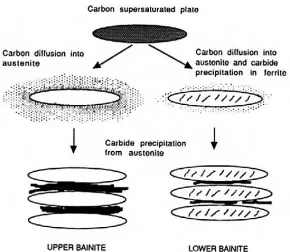
2.2.3 Bainite
As it is shown in Figure 2-4, bainite forms by decomposition of austenite at a temperature
above the martensite start temperature (Ms) and below the pearlite formation
temperature. As it is presented in Figure 2-5, bainite is a combination of plate-shaped ferrite and carbides. Bainite is presented in two forms: lower-bainite and upper-bainite.
Lower-bainite forms at temperatures closer to the Ms while upper-bainite forms at higher
temperatures. The difference between upper and lower bainite occurs due to the
dependence of the diffusion rate of carbon on the temperature at which bainite is
forming. At higher temperatures, carbon diffuses faster from the newly formed ferrite to
the residual austenite between the ferritic plates and forms large carbides. At low
temperatures, diffusion of carbon is slower; hence, carbides precipitate inside the ferrite
consists of cementite and dislocation-rich ferrite. The strength of this ferrite with high
concentration of dislocations is greater than that of ordinary ferrite. The hardness of
bainite is between that of pearlite and martensite [28].
Figure 2-4 Schematic temperature-time-transformation (TTT) diagram showing the different
domains of transformations in steel [29]
2.3 Yielding and Work Hardening Behaviour of Dual Phase Steels
The yield point is the stress at which a material begins to deform plastically. As is shown in
Figure 2-6, low carbon steels generally exhibit yield point elongation. The yield point
phenomenon includes upper and lower yield points in the tensile stress-strain curve
followed with oscillations of the flow stress. In low carbon steels, dislocations are locked
by the interstitial carbon atoms. The shear stress required to cause dislocation movement
inside the grain is less than the shear stress necessary to unlock them, and this causes a
sharp drop in stress at the yield point. The following oscillations, known as Lüders bands,
continue until there are sufficient mobile dislocations to start continuous work hardening.
Figure 2-6 Schematic presentation of yield point phenomenon in low carbon steels
As it is shown in Figure 2-7(a), the yield point phenomenon is not usually observed in dual
phase steels and the flow curves of dual phase steels exhibit continuous yielding due to
the processing of dual phase steels. Austenite and martensite have face centered cubic
(FCC) and body centered tetragonal (BCT) crystal structures, respectively. Hence, a volume
expansion occurs during the austenite to martensite phase transformation [31]. This
volume expansion introduces plastic deformation and therefore, as it is shown in
increasing the volume fraction of martensite the number of the newly generated
dislocations increases. These dislocations are not locked by the interstitial carbon atoms.
Hence, at the yield point, they can move immediately thus producing to make a smooth
flow curve.
Figure 2-7 (a) Continuous yield behaviour in dual phase steels and (b) mobile dislocations at the
ferrite/martensite interface in dual phase steels [32]
Work hardening, also known as strain hardening, is the strengthening of metals by plastic
deformation. This strengthening occurs due to the movement and generation of
dislocations within the crystal structure. Work hardening starts in materials after yielding
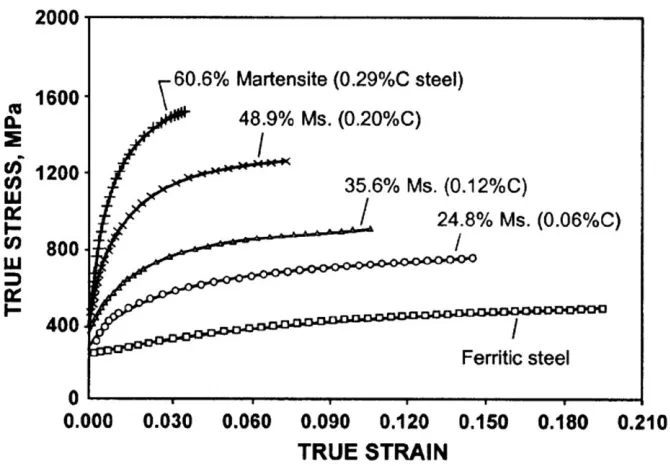
occurs. Figure 2-8 shows that work hardening in dual phase steels significantly depends on
the volume fraction of martensite. The work hardening rate is reported to be greater in
Figure 2-8 True stress-strain curve of a ferrite-martensite steel with 1.5 wt% Mn and different
carbon contents annealed at 760 °C [34]
2.4 Micromechanical Modeling Using the Representative Volume Element
Method
In the micromechanical modeling, the microstructural features of a material are
presented in a finite element (FE) model through a representative volume element (RVE).
An RVE is a small volume of microstructure that has the general characteristics of the
whole microstructure and over which modeling of specific characteristics is carried out.
The results of the RVE modeling investigations should properly describe the
characteristics of the whole microstructure. As presented in Figure 2-9, micromechanical modeling of flow behaviour of a material using the RVE method consists of four steps.
These steps are described in Sections 2.4.1 to 2.4.4.
Figure 2-9 Four steps of micromechanical modeling of flow behaviour using the RVE method
Definition of the RVE
Definition of flow behaviour
of each phase
Application of boundary conditions and
simulation of deformation
2.4.1 Definition of the RVE
The RVE-based micromechanical modeling technique is an approach to predict the
mechanical behaviour of materials using their microstructural features. An RVE is a small
volume of microstructure which is able to adequately represent the essential features of
the whole microstructure. It is expected that the RVE modeling method is able to
represent the overall macroscopic behaviour of the material which means that the RVE
acts as a bridge between the micro-scale and macro-scale properties of material.
A suitable RVE will have an average the same microstructural parameters as the overall
microstructure, such as volume fraction, morphology and randomness of the phases.
Hence, an RVE should be sufficiently large to include the essential microstructural
characteristics. On the other hand, the RVE size should be as small as possible so that the
states of stress and strain can be approximately considered as homogeneous in the whole
RVE. Also, a smaller RVE requires less computational resources such as computer memory
and calculation time to simulate the deformation. An advantage of micromechanical
modeling using the RVE method is that the RVE provides a detailed description of the
stress and strain distributions and their evolution in the microstructure during a metal
forming process [35–37].
A basic RVE can be defined using a simple cell model or it can be more complicated by
using a real microstructure. The RVE can also be defined in two dimensions (2D) or three
dimensions (3D). Al-Abbasi carried out micromechanical modeling of dual phase steels
using 2D and 3D cell models as the RVEs [38]. Figure 2-10 shows three cell models that were used by Al-Abbasi. He considered the martensite phase as circles and spheres in the
2D and 3D RVEs, respectively. The size of the circles and spheres in each cell was
Figure 2-10 Two-dimensional cell models: (a) square array, (b) stacked hexagonal array and
(c) three-dimensional array of stacked hexagonal cylinders [38].
2D and 3D RVEs can also be generated based on real microstructures. In the case of dual
phase steels, martensite and ferrite can be clearly distinguished due to the color contrast
between ferrite grains and martensite islands in a micrograph. The images from the actual
microstructure, with two different colors for ferrite and martensite, can be converted to a
2D RVE model using different digitizing techniques. The digitized image is then discretized
in preparation for the FE simulation of the deformation process. Some examples of 2D
RVEs based on real microstructures that were generated by Uthaisangsuk et al [35], Paul
[39] and Ramazani et al [40] are presented in Figure 2-11.
The simplest assumption for generating a 3D RVE of a two phase material is based on
Mori–Tanaka’s approach [41]. In this approach, the second phase particles are considered
as inclusions that are distributed in a matrix representing the first phase. As can be seen in
Figure 2-12, Uthaisangsuk et al [35], Paul [39] and Ramazani et al [40] generated cubic RVEs of dual phase steels. They considered ferrite as the matrix and martensite as
inclusions. The numbers of ferrite and martensite cubes were determined according to
Figure 2-11 2D RVEs based on real microstructures generated by (a) Uthaisangsuk et al [35],
Figure 2-12 3D RVEs based on real microstructures generated by (a) Uthaisangsuk et al [35],
(b) Paul [39] and (c) Ramazani et al [40]
The 3D RVEs that were just mentioned were generated by different researchers based on
simplified microstructural features; however, Lewis et al [42] and Brands et al [43] produced
3D RVEs using the real microstructures as shown in Figure 2-13. For this purpose the 3D image of the actual microstructure was obtained by assembling multiple 2D images of the
microstructure taken at different depths. This can be done by grinding and polishing the
sample over and over and taking an image at each step or by doing a 3D reconstruction of
microstructure using 3D electron backscatter diffraction (EBSD). Brands et al [43] used the
3D EBSD technique to produce a 3D RVE of a dual phase steel. They put the sample on a
tiltable holder inside of a field emission scanning electron microscope (FESEM) equipped
with a focused ion beam (FIB) cutting system. During the investigation the sample was
tilted between two positions: FIB-cutting and the EBSD positions. After taking the EBSD
image, the FIB system milled thin layers (10 nm - 1µm) from the investigated surface of
the sample. The 3D RVE of the dual phase steel was generated by assembling the EBSD
Figure 2-13 3D reconstruction of (a) austenite phase in AL-6XN microstructure [42] and (b)
dual phase steel [43] using EBSD.
There are some advantages and disadvantages for both 2D and 3D RVEs:
It is much easier to generate 2D RVEs from real microstructure than to produce 3D
RVEs, and they are able to take into account the microstructural morphology.
Calculation time for 2D RVEs is less than for 3D RVEs. Ramazani et al reported that
the calculation time for a 2D RVE based on a real microstructure took 30 min
whereas it took 240 min for a simple cubic 3D RVE [40].
2D modeling has less complexity and lower computational cost compared to 3D
modeling; however, comparing the experimental and predicted results has shown
that 2D modeling underestimates the flow behaviour of dual phase steels but 3D
modeling results correlated very well with experimental results [39][40].
2.4.2 Definition of Flow Behaviour of Each Phase
To determine the flow behaviour of ferrite, martensite and bainite in dual phase steels, a
dislocation based model was developed by Rodrigues and Gutierrez [44] which has been
used by many researchers [35–37,39,40,45–49]. The development of this model is
explained in the following.
As illustrated by Gil-Sevillano [50], the orientation factor, M, relates the macroscopic flow
stress, σ, and the critical resolved shear stress, τ, and the plastic strain, ε, to the amount of
dγ dε M Mτ σ
2-3
From Equation 2-3, the macroscopic work hardening rate relates to the microscopic material parameters by:
dε dM τ dγ dτ M dε
dσ 2 2-4
where dτdγ represents the microscopic hardening rate of the crystalline element. The
effect of strain on orientation variation is presented by the second term in Equation 2-4.
The classic relationship between the flow stress and dislocation density is:
p αMμb σ
Δσ σ
σf 0 0 2-5
where α is a constant, M is the Taylor factor, µ [MPa] is the shear modulus, b [m] is the
Burger’s vector, and p is the dislocation density.
The first term in Equation 2-5 takes into account the contribution of the lattice friction and
the elements in solid solution. For a series of different steels with microstructures
containing ferrite, pearlite, bainite and martensite with different levels of carbon content,
the following expression for σ0 was suggested by Buessler [51]:
ss 0=77+80%Mn+750%P+60%Si+80%Cu+45%Ni+60%Cr+11%Mo+5000N
σ 2-6
All the elements are assumed to be homogeneously distributed in each phase.
The second term in Equation 2-5 is expanded based on dislocation density. Evolution of the dislocation density with strain during the deformation can be expressed as [52]:
p k bL 1 dγ dp dγ dp dγ dp r recovery
stored
2-7
where kr is a constant and L is the dislocation mean free path. From Equation 2-7 and
considering p0 as the initial dislocation density and assuming that L is constant, the
1 exp( kM )
p exp( k M ) kk αMμb
Δσ r 0 r
r
with
bL 1
k 2-8
So the equation for Δσ can be written as:
L k ε) Mk exp( b αMμ Δσ r r -1
2-9
Since the two terms in the Equation 2-5 are defined, the total approach for determination
of the flow curve of each phase is [44]:
L × k ε) Mk exp( 1 × b × μ × M × α + Δσ + σ = σ r r c 0
-- 2-10
where σ is the true flow stress for a true strain of ε.
The first term σ0 takes care of the effects of substitutional alloying elements as presented
in Equation 2-6. The second term, Δσc, describes the strengthening due to interstitial
carbon; however the strengthening effect of carbon in ferrite is not the same as in
martensite. Therefore Δσc is calculated differently for ferrite and martensite [44]:
) (%C × 5000 = Δσ f SS f
c 2-11
161 ) (%C × 3065 = Δσ m SS m
c - 2-12
where f
SS
%C and m SS
%C are the carbon wt% in ferrite and martensite, respectively.
Table 2-1 The values of the parameters in the third term of Equation 2-10
M: Taylor Factor M=3
µ: Shear Modulus µ= 80000 MPa
b: Burger’s vector b=2.5×10⁻¹⁰m
α: constant α=0.33
Kr: Recovery Rate For ferrite (
dα 10 kr 5
), where dα is the
ferrite grain size [53] For martensite (kr=41) [53]
For bainite, (kr 10 5dγ
), where dϒ is the prior
austenite grain size [46]
L: dislocation mean free path
For ferrite (L= dα ) [53]
For martensite (L= 3.8×10⁻⁸ m) [53] For bainite (L= 2 × 10⁻⁷) [46]
For bainite the factor L is assumed to be the average distance between low angle grain
boundaries measured in random directions. Bainite laths are generally 0.2 µm wide and
therefore L is considered as the value presented in Table 2-1. Kr for bainite is considered to
relate to the prior austenite grain size as shown in Table 2-1. Using the prior austenite grain size seems to give a better estimation since using the bainitic ferrite lath width in the
Hall-Petch equation results in an excessively high strength contribution [46]. Hence, the
prior austenite grain size needs to be identified to determine the flow behaviour of
bainite.
For bainite, the effect of dislocation strengthening is more significant than the
strengthening effect by carbon solid solution [29]. Δσc for bainite is considered to be a
function of the prior austenite grain size and transformation temperature. The
transformation temperature dependency comes from the fact that Δσc depends on
amount of dislocation increases. Prior austenite grain size also affects the Δσc of bainite as
it can affect the bainitic transformation temperature and kinetics [29][46].
The hardness of bainite grains was reported to be equal to the hardness of ferrite and
martensite according to the mixture rule [37]:
m m c f f c b
c=Δσ V +Δσ V
Δσ 2-13
where V is the volume fraction of phases in the dual phase steel microstructure.
2.4.3 Application of Boundary Conditions and Solving the Problem
Kouznetsova [54] described the theory of boundary conditions for micromechanical
modeling of multi-phase materials in her PhD thesis. A summary of this theory is
presented in the following.
Appropriate boundary conditions such as loading and constraints should be applied to an
RVE to investigate the flow behaviour of RVE in a specific condition. This will define a
problem in continuum solid mechanics which will be solved by the finite element method.
The RVE deformation field in a point with initial position vector X (in the reference
domain of V0) and the actual position vector x
(in the current domain V) is described by
the deformation gradient tensor:
c 0m
m ( x)
F 2-14
where the gradient operator ∇0m is taken with respect to the reference microstructural
configuration. Also the RVE is in a state of equilibrium, which mathematically is reflected
by an equilibrium equation in terms of the Cauchy stress tensor σm. It can be described in
terms of the first Piola-Kirchhoff stress tensor of Pm which is presented below:
0 σm m
in V, or
0 Pc m 0m
in V0
2-15 1 c m m m
m det(F )σ (F )
where mis the gradient operator with respect to the current deformation of the
microstructure. By imposing the macroscopic deformation gradient tensor FM on the
microstructural RVE through a specific approach, the actual macro-to-micro transition is
possible. The simplest is to use the Taylor (or Voigt) assumption which assumes that all of
the microstructure constituents are subject to a constant deformation which is the same
as the macroscopic deformation. Another assumption is that of Sachs (or Russ) which
assumed that an identical constant stress is applied to all the components. These
simplified assumptions do not really reflect the actual deformation of the microstructure.
Many of the accurate averaging strategies require the solution of the detailed
microstructural boundary value problem to transfer the given macroscopic variables to
the microstructural RVE via the boundary conditions. Classically, three types of RVE
boundary conditions are used, i.e. prescribed displacements, prescribed forces and
prescribed periodicity.
In prescribing displacement boundary conditions, the position vector of a point on the RVE
boundary in the deformed state is defined as:
X F
x M
with X on Γ 0 2-17
where Γ denotes the undeformed boundary of the RVE and F0 M the macroscopic
deformation gradient tensor on the microstructural RVE. This kind of condition prescribes
a linear mapping of the RVE boundary.
The traction boundary conditions, are described as:
0 c M m Γ on .P N = p or Γ, on .σ n = t 2-18
Periodic boundary conditions were introduced based on the assumption of
microstructural periodicity [54]. The periodicity conditions of the RVE are presented in a
general form in Equation 2-19 which represents a periodic deformation:
) ( X X F x
x M 2-19
From Equation 2-19 and Figure 2-14, the parts of RVE boundary
Γ
0andΓ
0are defined insuch a way that NN at corresponding points on
Γ
0and
0
Γ
.The periodic boundary condition can be expressed as:
1
4 x
x x
xT B
1 2 x x x xR L
1 4 2
3 x x x
x
2-20
Where xT
, xB
, xL
, and xR
, are the position vector at the top, bottom, left, and right,
boundary of the RVE, respectively.
x
i (i= 1, 2, 3, 4) are position vectors of the cornerpoints 1, 2, 3, and 4, in the deformed state, respectively. These position vectors are
described according to:
i M i F X
x and i=1,2,3,4 2-21
It has been reported [55][56] that the periodic boundary condition provides a better
estimation of the overall properties of the microstructure compared to the prescribed
displacement and prescribed traction boundary conditions.
2.4.4 Homogenization
Kouznetsova [54] also described the theory of homogenization for micromechanical
modeling of multi-phase materials. A summary of this theory is provided in the following.
Homogenization is a technique that relates the micro-scale behaviour of a material to its
macroscopic behaviour. Computational homogenization technique has proven to be a
valuable tool to establish non-linear micro-macro structure-property relations. In
homogenization, the material is assumed to be sufficiently homogeneous at the
macro-scale, but heterogeneous at the micro-scale due to the existence of inclusions, grains,
interfaces, cavities, etc.
Two approaches are proposed to describe the periodicity of the inhomogeneity in the
microstructure: global periodicity and local periodicity which are schematically shown in
Figure 2-15. In the global periodicity approach, the same inhomogeneity is assumed to repeat itself throughout the whole microstructure. The local periodicity approach is
preferred since it allows a microstructure to include a variety of inhomogeneities with
different morphologies that are repeated at individual macroscopic points. Hence, it
allows the modeling of the effects of a non-uniform distribution of the microstructure on
Figure 2-15 Schematic representation of a macrostructure with (a) a locally and (b) a globally
periodic microstructure [54].
It has been reported that a first order computational homogenization technique can be
used for RVE problems [40][54][57]. In a homogenization procedure macroscopic and
microscopic quantities are shown by “M” and “m”, respectively. As it is designated in
Figure 2-16, the first-order homogenization is carried out in three steps:
The deformation tensor, FM, is calculated for every material point, i.e. the
integration points of the macroscopic mesh in a FE model.
FM of a macroscopic point is used to formulate the boundary conditions which are
imposed on the RVE located on that point which results in the deformation of the
RVE.
The stress tensor, PM, of the initial macroscopic point is obtained by averaging the
resulting RVE stress field over the volume of the RVE.
The numerical stress-deformation relationship at the macroscopic point is the result of
this procedure. Furthermore, the local macroscopic consistent tangent is obtained based
Figure 2-16 Schematic representation of first-order homogenization [54]
In first order homogenization, coupling of the macroscopic and microscopic deformation
and stress is carried out by application of integral averaging theorems. The integral
averaging expressions were first proposed by Hill (1963) [58] for small deformations and
developed for large deformation by Hill (1984) [59] and Nemat-Nasser (1999) [60] as
follows:
Deformation It is assumed that the macroscopic deformation gradient tensor FM is the
volume average of the microstructural deformation gradient tensor Fm:
0 0 0 0 0 0 1 1 d N x V dV F V F V m M 2-22
where V0 is the undeformed volume of the RVE. The divergence theorem is used to
transform the volume integral over V0 of the RVE to a surface integral. The validation of
M M M M F d N X F V d N X X F V d N x x V d N x d N x V F
0 0 0 0 0 0 0 0 0 0 0 0 0 0 0 1 ) ( 1 ) ( 1 1 2-23
where x is position vector of nodes in deformed state and X is position vector of nodes in undeformed state. n and N are the normal to the current (Γ) and initial (Γ0) RVE
boundaries, respectively.
Stress The averaging relation for the first Piola-Kirchhoff stress tensor is:
0 0 0 1 dV P V P V m M
2-24
The macroscopic Piola-Kirchhoff stress tensor PM in the microstructural quantities defined
on RVE surface is:
0 0 c m
m P for microscopic equilibrium
I X
m
0 for microstructure equality
) ( )
( )
( 0 P X P 0 X 0 P X
P c m m m m c m m m 2-25
By substitution of Equation 2-25 into Equation 2-24 and applying the divergence theorem and definition of the first Piola-Kirchhoff stress vector according to Equation 2.14, PM of
RVE is obtained over the surface:
c m P N
p 2-26
0 0 0 0 0 0 0 0 0 0 1 1 ) ( 1 d X p V d X P N V dV X P V P c m c m V m M 2-27
By considering the periodicity conditions (Equations 2-20 and 2-21) for the RVE shown in
i i
i
M fX
V
P
∑
4 , 2 , 1 0 1
2-28
where fi are the resulting external forces at the boundary nodes and Xi
are the position
vectors of these nodes in the undeformed state.
2.5 Key Points in RVE-based Modeling of Dual Phase Steels
Several researchers have developed RVE-based micromechanical models to predict the
flow behaviour of dual phase steels. In 1999, Huper et al [61] modeled the flow behaviour
of dual phase steel based using an FE model. They found that flow behaviour of dual
phase steels depended on volume fraction of phases and the shape of the grains. In 2000,
Ishikawa et al [62] used a body centered cubic (BCC) cell model to investigate the effects
of volume fraction and morphology of second-phase particles on deformation behaviour
of ferritic steels. The cell model proposed by Ishikawa et al accurately estimated the
tensile behaviour of ferrite-pearlite steels. In 2003, Al-Abbasi and Nemes [63,64] studied
the effects of martensite volume fraction and martensite size on strength and ductility of
dual phase steel using a cell model. After 2010, the number of publications on
micromechanical modeling of flow curves of dual phase steels notably increased.
Uthaisangsuk et al [35] suggested a 3D RVE-based micromechanical model of randomly
distributed martensite in a ferrite matrix to predict flow curves of a dual phase steel and a
TRIP steel. Marvi-Mashhadi et al [65] predicted flow curves of dual phase steels with
18-44 vol% of martensite by development of an RVE-based FE model using the actual
microstructure of dual phase steels. Sodjit et al [66] modeled the flow curves of dual
phase steel with 25-90 vol% of martensite by proposing a 2D RVE-based FE model using
actual microstructures. They also studied the effect of martensite volume fraction on the
behaviour of the flow curves of dual phase steels. Paul et al [45,67] developed 2D and 3D
RVE-based models to predict flow behaviour of a dual phase steel. Plastic strain
localization under tensile loading was studied as a pre-stage of failure. Finally, Ramazani
et al [40,49] studied the flow behaviour of dual phase steels using 2D and 3D RVE-based

![Figure 2-11 2D RVEs based on real microstructures generated by (a) Uthaisangsuk et al [35],](https://thumb-us.123doks.com/thumbv2/123dok_us/1404632.1173102/32.612.120.496.72.557/figure-d-rves-based-real-microstructures-generated-uthaisangsuk.webp)
![Figure 2-16 Schematic representation of first-order homogenization [54]](https://thumb-us.123doks.com/thumbv2/123dok_us/1404632.1173102/43.612.156.475.72.277/figure-schematic-representation-order-homogenization.webp)