ABSTRACT
SHAH, MIHIR ROHIT. Enabling Aggressive Voltage Scaling for Real-Time and Embedded System with Inexpensive and Efficient Power Conversion. (Under the direction of Dr. Subhashish Bhattacharya).
The thesis takes Electrical Power Subsystem (EPS) for CubeSats as a base and builds the concept of Aggressive Voltage Scaling with Real Time Implementation using it. EPS is flexible, scalable and reconfigurable for its use in wide range of small satellites with different power processing requirements. It consists of battery charging modules to store solar energy and point of load modules to use it to power other subsystems and payloads. The thesis discusses the requirements, specifications, architecture and implementation of EPS. It also discusses various protection and failure recovery features making the subsystem robust in the harsh space environment. Software implementation and RTOS based implementation are reported which apply algorithms like MPPT and PID to the converters of the subsystem. A prototype board is developed and results are presented. The effect of change in control loop frequency on load transients is discussed. This helps to lower the cost of system by relaxing the real-time requirements and enabling the use of low end micro controllers or designing multiple subsystems using a single micro controller. Aggressive Voltage Scaling method processes the power supplied to the loads and keeps it to a minimum by scaling the supply voltage based on the state of loads. These concepts can be applied to a variety of embedded system power supplies with wide range of power requirements.
© Copyright 2012 by Shah Mihir Rohit
by
Mihir Rohit Shah
A thesis submitted to the Graduate Faculty of North Carolina State University
in partial fulfillment of the requirements for the degree of
Master of Science
Computer Engineering
Raleigh, North Carolina
2012
APPROVED BY:
___________________________ Dr. Subhashish Bhattacharya
Chair of Advisory Committee
__________________________ __________________________
DEDICATION
TO
MY PARENTS
RASHMITA SHAH & ROHIT SHAH
MY SISTER
SWATI SHAH
AND MY FIANCÉE
BIOGRAPHY
Mihir Shah was born on April 20, 1986 in Ahmedabad (Gujarat), India. He did his schooling
from Shri C. C. Shah Sarvajanik English High School, Surat. He received the degree of Bachelor of
Technology in Electronics Engineering from National Institute of Technology, Surat, India in 2008.
He started pursuing his graduate studies in the field of Computer Engineering at North Carolina State
University in Spring 2011. He is associated as a student with Future Renewable Electrical Energy
Delivery and Management (FREEDM) Systems Center during his study at North Carolina State
University. He is engaged in research in application of embedded systems in the field of power
electronics. His interests span across a wide range of subjects – Embedded Systems, Digital Design,
Computer Architecture and Power Electronics.
Mihir has been an entrepreneur and has developed and marketed products and provided
consultancy in the field of embedded systems during his undergraduate program, from 2006 to 2008.
From 2008 to 2010, he worked as Design and Development Engineer at Tata Elxsi Ltd., India. He has
worked in the field of Digital TV and Multimedia Systems, Image Processing, Video Analytics and
Computer Architecture. He has developed Automated Testing Environment (ATE) for Multimedia
Home Platform on Sony Bravia, Ground Truth Video Analytics Tool for Canon cameras and
benchmarked Intel’s SandyBridge Processor against its predecessors. From May 2012, he has been
working as an Intern in IBM, where he is involved in the development of Hardware Acceleration for
ACKNOWLEDGEMENTS
I express my sincere gratitude and thank my advisor, Dr. Subhashish Bhattacharya for
the support and guidance he has provided during my graduate program at North Carolina
State University. His belief in me and constant encouragement made this Masters program a
fruitful experience. He has been a source of inspiration, in both personal and professional
domains. I thank my committee, Dr. Alexander G. Dean and Dr. Srdjan Lukic, for providing
valuable feedback and continuous support during this project. I thank FREEDM Systems
Center for sharing the resources and National Science Foundation for funding this project. I
thank Avik Juneja, Tharunachalam Pindicura and Michael Plautz, for working with me to
accomplish this project.
I am grateful to Shailesh Notani, for introducing me to Dr. Bhattacharya and this
project. I appreciate the valuable inputs and discussions by my seniors and friends, Kamalesh
Hatua, Arun Kadavelugu, Samir Hazra, FNU Sachin Madhusudan, Hesam Mirzaee, Awneesh
Tripathi and Sumit Datta at FREEDM Systems Center. I extend my gratitude towards the
staff members of the center, especially Karen Autry and Colleen Reid for the facilities and
support. I thank Hulgize Kassa for his supervision assuring my safety in the laboratory.
I would like to thank my friends Chintan Panirwala, Nikunj Bhansali, Aarohi Patel,
Milind Kulkarni, Komal & Jayesh Bhambhani, Amit Deshmukh, Sushant Sinha, Prathamesh
Save, Jaydip Solanki, Hemil Jariwala, Richa Asarawala, Nidhi Pandya, Shikhar Singh,
Bharat Balagopal, Bharath Balasubramanian and Abhinaya Nakka for being my family
Finally, I would like to thank my parents, Rashmita Shah and Rohit Shah and my
sister, Swati Shah for their care and constant support and my fiancée, Nidhi Joshi for her love
TABLE OF CONTENTS
LIST OF FIGURES ... viii
LIST OF TABLES ... x
CHAPTER 1 Introduction ... 1
CHAPTER 2 CubeSat ... 5
2.1. Introduction ... 5
2.2. CubeSat Specifications ... 9
2.3. CubeSat Subsystems: ... 10
2.3.1. Attitude Determination and Control Subsystem (ADCS) ... 11
2.3.2. Command and Data Handling (CDH) Subsystem ... 12
2.3.3. Communication (COM) ... 12
2.3.4. Electrical Power Subsystem (EPS)... 12
2.3.5. Structures (STR) ... 13
2.3.6. Payload (PLY) ... 13
2.3.7. Software ... 13
2.4. Electrical Power Subsystem ... 15
CHAPTER 3 Previous Work ... 18
3.1. Clyde Space EPS ... 18
3.2. CubeSat Kit EPS ... 20
3.3. CubeSat EPS ... 22
3.3.1. Design Specifications ... 22
3.3.2. Proposed Architecture ... 25
CHAPTER 4 Hardware Design and Modifications ... 28
4.1. Flexible Battery Charging Module ... 32
4.2. FDPOL ... 34
4.3. Path Selection ... 37
4.4. Power Failure & Recovery ... 38
4.5. Current & Voltage Measurement ... 39
4.7. Controller ... 43
4.8. TestBed ... 45
CHAPTER 5 Software Design ... 48
5.1. Controller Software Design ... 48
5.1.1. Board Driver ... 48
5.1.2. Control Loop ... 50
5.1.3. Debug Interface ... 52
5.2. RTOS based implementation ... 52
5.3. Communication and Configuration Design ... 55
5.4. MPPT Algorithm Implementation ... 56
5.5. PID Control of POL converters ... 59
CHAPTER 6 Aggressive Voltage Scaling ... 63
CHAPTER 7 Results ... 67
7.1. FBCM ... 67
7.1.1. Open Loop ... 67
7.1.2. Closed Loop ... 69
7.2. FDPOL ... 71
7.2.1. Open Loop ... 71
7.2.2. Closed Loop ... 73
CHAPTER 8 High Frequency GaN device based implementation ... 74
8.1. GaN based phase leg with indigenous driver circuit ... 77
8.1.1. Circuit... 77
8.1.2. Board Layout ... 79
8.1.3. Results ... 80
8.2. Development of GaN based circuit with LM5113 driver IC ... 84
8.2.1. Results ... 85
CHAPTER 9 Summary and Future Work ... 87
LIST OF FIGURES
Figure 1. SMART-1 Swedish Medium Sized Satellite ... 6
Figure 2. One mini satellite of RapidEye Constellation ... 7
Figure 3. AENEAS – A 3U CubeSat ... 8
Figure 4. P-POD Deployer ... 10
Figure 5. CubeSat Subsystems ... 11
Figure 6. Building blocks of EPS ... 15
Figure 7. Architecture of Clyde-Space EPS ... 18
Figure 8. Clyde Space EPS Hardware ... 19
Figure 9. Architecture of CubeSat Kit EPS ... 20
Figure 10. CubeSat Kit EPS Hardware ... 21
Figure 11. Proposed Architecture for CubeSat EPS ... 25
Figure 12. Hardware Implementation of EPS ... 28
Figure 13. EPS Prototype Board Sections ... 29
Figure 14. EPS Prototype Board ... 30
Figure 15. Current Sensing Board ... 30
Figure 16. EPS Board with Current Sensing Board ... 31
Figure 17. Flexible Battery Charging Module Schematic ... 33
Figure 18. Flexible Digital Point of Load – Buck Converter Schematic... 35
Figure 19. Flexible Digital Point of Load – Boost Converter Schematic ... 36
Figure 20. Path Selection Feature Schematic ... 37
Figure 21. Power Failure Recovery Circuit Schematic ... 38
Figure 22. Voltage Measurement Circuits - I ... 39
Figure 23. Voltage Measurement Circuits - II ... 40
Figure 24. Current Sensor Circuit Schematic ... 41
Figure 25. MPPT Circuit Schematic ... 42
Figure 26. Micro Controller Interface Schematic ... 43
Figure 27. Micro controller Kit interface circuit ... 44
Figure 28. Micro controller Kit interface board ... 45
Figure 29. TestBed ... 46
Figure 30. FBCM Over Current Situation ... 51
Figure 31. RTOS based implementation ... 53
Figure 32. Configuration and Debugging Interface... 55
Figure 33. V-I characteristics of Solar Panel ... 56
Figure 34. Power Curve for Solar Panel ... 57
Figure 35. Open loop response of servo motor ... 60
Figure 36. Closed loop response for interrupt driven implementation (Load: Servo Motor) ... 60
Figure 38. Response time based on control loop frequency ... 64
Figure 39. Selection of Control loop update rate based on Voltage Margin ... 65
Figure 40. FBCM – Boost Mode ... 68
Figure 41. FBCM – Buck Mode ... 68
Figure 42. FBCM – Closed Loop Control ... 69
Figure 43. FDPOL converters at 75% and 25% duty cycles ... 71
Figure 44. FDPOL converters at 50% duty cycle ... 72
Figure 45. FDPOL converters – varying duty cycle on the fly ... 72
Figure 46. FDPOL Closed Loop Control ... 73
Figure 47. Resistance vs Breakdown Voltage comparison ... 75
Figure 48. LGA Package for EPC eGaN devices ... 76
Figure 49. Digital and Power Section Schematic for GaN board ... 77
Figure 50. Isolated power supply circuit for gate driver ... 78
Figure 51. GaN device based Phase Leg - Board Layout ... 79
Figure 52. Low Power Buck Converter at 1.5MHz ... 80
Figure 53. High Power Buck Converter at 1MHz ... 81
Figure 54. Low Power Boost Converter at 1MHz ... 82
Figure 55. High Power Boost Converter at 1MHz ... 82
Figure 56. GaN based phase leg circuit using LM5113 ... 84
Figure 57. Board layout - GaN based phase leg using LM5113 ... 85
LIST OF TABLES
CHAPTER 1
Introduction
Embedded systems have become an integral part of our life. Right from an electronic
tooth brush to a mobile phone or an unmanned surveillance robot to a satellite, embedded
systems have played a crucial role in making tasks efficient and easy. Embedded systems are
developing at an unprecedented rate in terms of features, capability and power. With the cost
of high performance hardware going low and with the aid of easily available development
tools, the overall cost and development time of each system is decreasing.
An increasing number of devices are going portable these days. These devices operate
on battery power and are getting smaller in size. With increasing portability comes the
challenge of designing efficient battery systems. The devices are made up of multiple
subsystems designed to perform specific tasks. With more number of devices going portable
and complex, there is a need for efficient power subsystems that can be embedded in these
devices. The power subsystem should be able to provide power for the entire embedded
system which includes charging the batteries and using the energy stored in the batteries to
power the subsystems. The power subsystem should be low cost, efficient and easily
reconfigurable for various applications. It should generate multiple voltage domains so as to
eliminate the need for each subsystem to have its own power converter. Increasing the
devices go into a low power or standby mode when not in use to save power consumption.
Generally, the low power mode is achieved by reducing the frequency of operation of
subsystems. The system can operate at low voltage in standby mode. Power being directly
proportional to the square of voltage, scaling the supply voltage of the system saves a
significant amount of power. The motivation of the project is to develop a low cost, efficient
and scalable power subsystem which can aggressively and intelligently scale the output
voltage on multiple rails to reduce power consumption of the system.
CubeSat is a very good example of an embedded system with stringent voltage and
power limits of operations. It is a battery powered system which has communication
capabilities and high performance sensing equipment like earth imaging and weather
monitoring equipment. It has a dedicated Electrical Power Subsystem (EPS) which serves as
the power processing and regulating subsystem. The size and weight constraints of CubeSat
CHAPTER 2 describes CubeSat mission, satellite specifications and various
subsystems. It also discusses EPS in detail.
CHAPTER 3 discusses previous work in the field of development of CubeSat EPS. It
discusses the architecture, implementation, advantages and drawbacks of various CubeSat
Electrical Power Subsystems available in the market. It is followed by the work [1] by
Shailesh Notani. He gathered design specifications for EPS, proposed architecture which
caters the requirements and developed prototype board. He has reported preliminary test
results of the prototype board. Testing of high frequency GaN devices, development of phase
leg and its results are discussed in [1]. This thesis is based on his work. Enhancement of EPS
prototype board (CHAPTER 4), software design and implementation (CHAPTER 5),
communication and debugging interface (CHAPTER 5) and enhancement and redesign of
GaN devices based phase leg along with implementation of buck and boost converters using
the phase leg (CHAPTER 8) is discussed in as a part of the work in this thesis. Aggressive
Voltage Scaling, its requirements and advantages are discussed in CHAPTER 6.
Being a part of the project team, I was responsible for developing and implementing the
following mentioned segments.
• Testing the CubeSat EPS board
• Modifications in FBCM and FDPOL circuits
• Modifications in path selection feature circuit and power failure circuit
• Design of breakout board to interface EPS board with any micro controller development
• Design and development of Current Sensing circuit for EPS
• Software development – board driver and interrupt driven control implementation
• Communication and Debug Interface
• Plugging PID algorithm in interrupt driver control implementation for point of load
converters
• MPPT algorithm implementation
• Over-current and under-voltage protection implementation
• Enabling the EPS board for Aggressive Voltage Scaling implementation
• A part of Aggressive Voltage Scaling implementation
• Enhancement and re-design of GaN devices based phase leg
• Development and testing of buck and boost converters using the phase leg
The test bed discussed in Section 4.8., developed by Michael Plautz, an MS student
under Dr. Alexander Dean, is used to test the EPS and characterize various loads and their
transients. The CubeSat EPS board is used to test various implementations. RTOS based
implementation discussed in Section 5.2. and implementation of PID on RTOS discussed in
CHAPTER 2
CubeSat
2.1. Introduction
The term “CubeSat” is used for satellites that adhere to the standards described in
CubeSat design specification. The program is led by Professor Jordi Puig-Suari at California
Polytechnic State University, San Luis Obispo and Professor Bob Twiggs at Stanford
University’s Space System Development Laboratory with an aim to design a satellite with
capabilities that a graduate student could design, build, test and operate. Its primary purpose
was to reduce cost, decrease development time and increase number of experimental
launches. It also aimed to increase collaboration between universities and private companies
to build small satellites.
Satellites can be classified on the basis of their size/weight:
• Large Satellite: Wet Mass greater than 1000kg
• Medium Sized Satellite: Wet Mass between 500-1000kg
• Mini Satellite: Wet Mass between 100-500kg
• Micro Satellite: Wet Mass between 10-100kg
• Nano Satellite: Wet Mass between 1-10kg
• Pico Satellite: Wet Mass between 0.1-1kg
These definitions are not strict but are general. They are sometimes cross-referred
based on their size and weight. This thesis deals with power system design for CubeSats
which fall under the category of Pico Satellites and Nano Satellites.
Figure 1. SMART-1 Swedish Medium Sized Satellite
The satellite SMART-1 was a Swedish designed ESA mini satellite weighing 367kg
that orbited around the moon for three years after its launch in September, 2003 until it was
deliberately crashed into the Moon’s surface in September 2006 to study the effect of a
Figure 2. One mini satellite of RapidEye Constellation
RapidEye constellation is an example of distributed tasks mini satellites where a
group of 5 identical satellites weighing 150kg each is employed to perform imaging task on
the earth. These satellites have sensors that assist in monitoring vegetation health, improve
species separation and help in measuring protein and nitrogen content in biomass. These
satellites are to be replaced with a group of 6 micro satellites weighting 38kg to improve the
revisit time of 3.5 hours as compared to 24 hours.
On August 2, 2012 Atlas V rocket launched from Vandenberg Air Force Base in
California deployed 11 CubeSats for US Government and NASA ELaNa university program
[2]. These satellites are:
• CINEMA by University of California at Berkeley: A 3U cubesat to study Space
Weather effects in near-Earth Space.
• CSSWE by University of Colorado at Boulder: A 3U cubesat to study the relationship
• CP5 by California Polytechnic State University at San Luis Obispo: A 1U cubesat
De-Orbiting experiment using a Deployed Thin-Film Mechanism.
• CXBN by Morehead State University: A 2U cubesat Map the entire sky in X-ray
spectrum using energy cosmic background radiation measurements in the 30-50KeV
range.
• Aeneas by University of Southern California: A 3U cubesat to prove the concept of
wifi based tag tracking from low earth orbit to track cargos in the open ocean waters.
• ORSES by Operationally Responsive Space Office: A 3U cubesat for US Army
Space and Missile Defense Command.
• HORUS & RE by Lawrence Livermore National Laboratory: Both 3U CubeSat to
detect orbiting payloads and debris for orbital measurement
• Aerocube 4A, 4B, 4C by Aerospace Corporation: For technical research
Five CubeSat were deployed from the International Space Station on October 4, 2012.
These CubeSats were carried to ISS by a Japanese HTV cargo carrier and they have payloads
[4] - Morse code communication with the earth using LED – optical interface, a ham radio
transmitter, space photography, infrared photography and earth observation. This
demonstration proved the concept of deployment of cubesats from a bigger satellite like
International Space Station.
Looking at the current trends, it is seen that the shift to the CubeSat specification for
satellite development has increased the frequency of cubesats being deployed. More number
of missions is being planned as these are low-cost and fast to develop missions.
2.2. CubeSat Specifications
A CubeSat is a 10 cm cubed sized small satellite with maximum mass of 1.33kg.
These are known as 1U (one unit) CubeSats. They can be scaled in one axis in increments of
1U modules to make 2U CubeSats (20cm x 10cm x 10cm) and 3U CubeSats (30cm x 10cm x
10 cm). This standard 10cm x 10cm size enables the use of common deployment system thus
Figure 4. P-POD Deployer [5]
Cal Poly has developed Poly Picosatellite Orbital Deployer (P-Pod) [5] [6] which
carries the CubeSats into the orbit and deploys them. P-POD Mk III [7] has the capability to
deploy a 3U CubeSat or a combination of 1U and 2U CubeSats sizing up to 3U CubeSats.
Cal Poly has a CubeSat Acceptance Checklist [5] which needs to be fulfilled for a CubeSat to
be deployed by P-POD. P-PODs have been used to deploy all the CubeSats since 2006.
Along with the size constraints, a CubeSat is required to fulfill vibration standards, radiation
hardness standards, launch procedures and other design requirements like deployment
switches and launch pins.
2.3. CubeSat Subsystems:
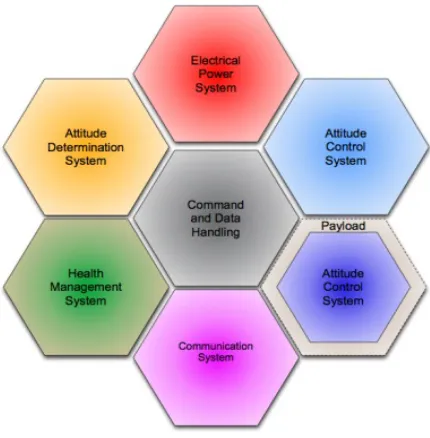
Figure 5. CubeSat Subsystems
2.3.1. Attitude Determination and Control Subsystem (ADCS)
The Attitude Determination and Control Subsystem (ADCS) [9] keeps the satellite in
proper orbit and orientation. It consists of a permanent magnet to stabilize the satellite about
earth’s magnetic field. It possesses sensors like magnetometer to determine the satellite’s
orientation and send it to Control and Data Handling subsystem, sun sensors to detect the
direction of sun and accelerometers to detect the motion of satellite. Actuators like Hysteresis
rods providing magnetic damping, momentum wheels, etc. are present in the subsystem to
prevent oscillation about the spinning axis and correct the attitude of satellite. The subsystem
is responsible to point the antenna in an orientation to establish a good communication with
the ground station, the solar panels towards the sun and the imaging camera towards the
2.3.2. Command and Data Handling (CDH) Subsystem
The Command and Data Handling (CDH) system is the brain of the satellite. It is
responsible to control all other subsystems, provide communication with ground station,
store and process data from sensors and detect and manage faults. This subsystem
communicates with all other subsystems and maintains their operation along with providing
communication interface between subsystems and ground station.
2.3.3. Communication (COM)
The Communication (COM) system is responsible for providing the data link between the Command and Data Handling (CDH) system and the ground station to communicate control commands as well as receive health and status data through a bi-directional, full duplex communication system. The COM system is made up of three main components: the antenna design, the terminal node controller (TNC), and the radio/transceiver. The communication functionalities like data rate control; flow control and standby/shutdown are controlled by Command and Data Handling (CDH) subsystem.
2.3.4. Electrical Power Subsystem (EPS)
2.3.5. Structures (STR)
All subsystems, circuits and payloads are safely housed in the CubeSat structure. It
provides mounts and supports so that all subsystems can be mounted. It is responsible to
provide protection from the space environment and radiation. The structure is the interface
between the CubeSat and deployer. It can slide on the rails to be easily deployed by the
springs mounted on the deployer. It has the deployment switches which senses separation
from the deployer.
2.3.6. Payload (PLY)
Payload consists of experiments, proof of concept designs, individual tasks like
imaging or distributed tasks like weather monitoring. With the continued advances in
miniaturization and capability increase of electronic technology, it is possible for small but
complicated tasks like imaging to be accomplished by a system as small as a CubeSat.
Payload and its application are used to create specifications for all the other subsystems of
the satellite.
2.3.7. Software
The software is divided into two categories. The ground station software is
responsible to communicate with the satellite and display status of the satellite along with
payload experimental data to ground crew. Flight software is responsible for the control and
operations of CubeSat. It should support various modes like communications mode, idle
mode and power save mode along with handling emergency conditions that arise during the
EPS should have algorithms for maximum power point tracking, battery health monitoring,
2.4. Electrical Power Subsystem
The EPS is responsible to generate and distribute electrical energy to various
subsystems in CubeSat. It interfaces with solar panels to extract solar power which is the
only source of energy during operation. This is used to charge energy storage devices like
batteries or super capacitors. The stored energy is used to provide power to various
subsystems. It runs various algorithms to maintain storage devices in healthy condition,
protect subsystems under electrical failures, extract peak power from PV arrays, etc. It is
directly responsible for efficient power distribution in the satellite.
Figure 6. Building blocks of EPS [1]
Regulated Power Bus
Solar Panel Panels
Storage-Lithium
Batteries Communication System
Flexible Battery Charging Module
(FBCM)
Point Of Load Module (FBCM)
Flexible Digital Point of Load DC/DC (FDPOL)
Command & Data Handling
Attitude Determination & Control System Payload
Figure 6 shows the general architecture of EPS with the essential blocks of the
subsystem. Here, Flexible Battery Charging Module (FBCM) derives energy from solar
panels and stores it in Li batteries. Flexible Digital Point of Load (FDPOL) Converter is
responsible to generate a regulated power bus which powers other subsystems and payloads.
In the absence of battery power, point of load converter can extract the power from the solar
panels as well. The Central Power Controller controls FBCM and FDPOL and runs various
health and protection algorithms. It communicates with Command and Data Handling (CDH)
Subsystem to receive commands regarding the system. It is to be noted that subsystems
possess power converters to convert power bus to their power requirements. As each
subsystem needs to have its own power converter, the electrical efficiency of the satellite
reduces.
This helps us to note the requirements of Electrical Power Subsystem:
• It should be low cost and efficient.
• It should have multiple point-of-load converters to generate various power rails to cater
power requirements of multiple payloads.
• It should be flexible to accommodate a variety of specifications and configurations of
solar panels as well as the batteries.
• It should be scalable to cater the needs of 1U to 12U CubeSats.
• It should be reconfigurable to eliminate the need for redesigning the power system for
• It should be able to handle various load transients generated by subsystems switching to
CHAPTER 3
Previous Work
The work done in development of CubeSat EPS by Shailesh Notani is reported in his
thesis [1]. First we will look at a few very well-known EPS providers and their architectures
followed by a discussion of the work by Shailesh Notani.
3.1. Clyde Space EPS
Clyde Space is the world leading supplier of power system components for CubeSats.
They have been designing, manufacturing, testing and supplying power system electronics,
solar panels and batteries for space programmes since 2006. Figure 7 shows architecture of
the second generation of Clyde Space CubeSat Electronic Power System [10] [11]. It
connects to solar panels via Battery Charge Regulators. Each BCR can be connected in
parallel to two solar panels on the opposite faces of the Cubesat. The BCRs have in built
Maximum Power Point Tracker (MPPT) to track the panel which is directly illuminated and
track its maximum power point. This energy from solar panel is used to charge batteries or
provide power to distribution modules via a switched network. The output of the distribution
modules is an unregulated Battery Voltage Bus, a regulated 5V supply Bus and a regulated
3.3V supply Bus. Protections features like Over-Current Bus Protection and Battery Under
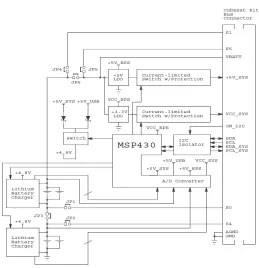
Voltage Protection are implemented. EPS communicates with other modules using I2C
telemetry.
Clyde Space EPS has the output voltage buses limited to 3.3V and 5V. These buses
are non configurable. Thus a subsystems needs to have its own converter if it operates at a
voltage level other than 3.3V or 5V. Also, as the buses are not configurable, they cannot be
switched to lower voltage levels when the subsystems enter low power modes.
3.2. CubeSat Kit EPS
CubeSat Kit EPS [12] is a product by Pumpkin © Inc. They have been designing the
kit since 2003 and they have the fourth generation of CubeSat EPS in market. CubeSat Kit
EPS uses linear voltage regulators to generate voltage rails of 3.3V and 5V along with
unregulated battery power rail. Use of linear regulators reduces switching noise but reduces
the efficiency of the converters.
Figure 10. CubeSat Kit EPS Hardware
The batteries are charged via USB connector. EPS boards can be stacked to increase
the output current. It has auto-resettable current fuse for over current protection. The kit
provides EPS telemetry via I2C interface. It uses iPod® batteries and there is no interface
3.3. CubeSat EPS
In his work [1], Shailesh Notani gathered requirements and design specifications. He
proposed a scalable architecture for EPS and modeled the system. He explored the use of
Rad-Hard GaN devices and discussed its use for CubeSat EPS. He developed a prototype, did
some preliminary tests and presented results for both boards. Here we discuss about his work
and proposed enhancements.
3.3.1. Design Specifications
The paper [1] gathers specifications for solar panels, payloads and various subsystems
of CubeSat to design requirements of EPS. The EPS prototype does not fulfill to all the
requirements as the primary motive is to enable its fast development. Due to rapid
technological advancements various new systems are being deployed in CubeSats along with
new experiments. Thus, EPS needs to be easily scalable and reconfigurable to accommodate
changes in configurations and designs.
Configuration of solar panels depends on batteries being used in the system which in
turn depends on payloads of system. Based on the specifications of battery, different
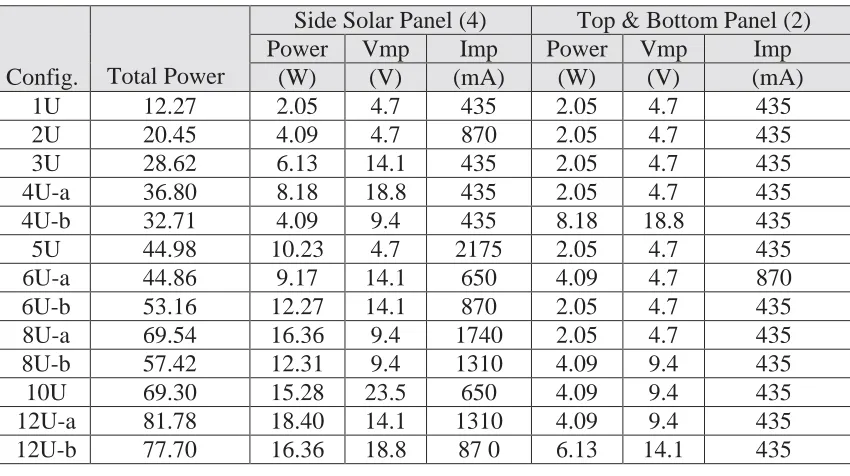
configurations of solar panels can be designed. The table shows various configurations of
solar panels for CubeSat and their power supply capabilities based on Spectrolab’s 28.3%
Table 1. Solar Cell Configurations
Config. Total Power
Side Solar Panel (4) Top & Bottom Panel (2)
Power Vmp Imp Power Vmp Imp
(W) (V) (mA) (W) (V) (mA)
1U 12.27 2.05 4.7 435 2.05 4.7 435
2U 20.45 4.09 4.7 870 2.05 4.7 435
3U 28.62 6.13 14.1 435 2.05 4.7 435
4U-a 36.80 8.18 18.8 435 2.05 4.7 435
4U-b 32.71 4.09 9.4 435 8.18 18.8 435
5U 44.98 10.23 4.7 2175 2.05 4.7 435
6U-a 44.86 9.17 14.1 650 4.09 4.7 870
6U-b 53.16 12.27 14.1 870 2.05 4.7 435
8U-a 69.54 16.36 9.4 1740 2.05 4.7 435
8U-b 57.42 12.31 9.4 1310 4.09 9.4 435
10U 69.30 15.28 23.5 650 4.09 9.4 435
12U-a 81.78 18.40 14.1 1310 4.09 9.4 435
12U-b 77.70 16.36 18.8 87 0 6.13 14.1 435
Subsystems and payload dictates the power requirements of a CubeSat. Batteries are
selected in accordance with the power requirements of these subsystems. Generally, there are
two batteries in a CubeSat – one being used as backup. These batteries are Li based batteries
as they are light in weight and compact in size. They can be of 3.7V, 7.4V, 14V, 20V or 30V
depending on the configuration of CubeSat. EPS should be able to charge one battery while
supplying power from the other one. Thus it should be capable of controlling the power flow
in the system.
Battery Charging Modules should be capable of interfacing with the different solar
should have battery over-charging protection and excess energy should be diverted to point
of load converters.
Point of Load converters should be able to interface with batteries with different
specifications. It should be capable of taking excess power input from battery charging
modules. Different voltage rails required by the system should be generated by multiple
point-of-load converters. The output voltage of point of load converters should be
configurable on the fly. Each one should be able to deliver current of 2A. It should also
provide battery under-voltage protection.
There should be various protection circuits and algorithms implemented in EPS.
Battery should be protected against over-charging and under-voltage operations. All the
stages should have over current protection implemented. In case of short circuit faults,
multiple attempts should be made to determine if the faults are temporary or permanent and
proper actions should be taken. Command and Data Handling subsystem should be informed
of any such faults occurring in the system.
The software should be able to control all the converters of the system along with
provision to change parameters or power flow by the user. It should be running multiple
algorithms like MPPT, battery state-of-charge and battery state of health, etc. It should also
implement protection algorithms by sensing currents and voltages at each stage of EPS. It
Lastly, EPS should use components which are least affected by radiation and comply
with Rad-Hard space requirements. It helps to minimize the use of aluminum for shielding
and reduce the weight of EPS. Maximum weight of EPS should be 200 grams along with
batteries. It should fit in a cube of 10 cms.
3.3.2. Proposed Architecture
Figure 11. Proposed Architecture for CubeSat EPS
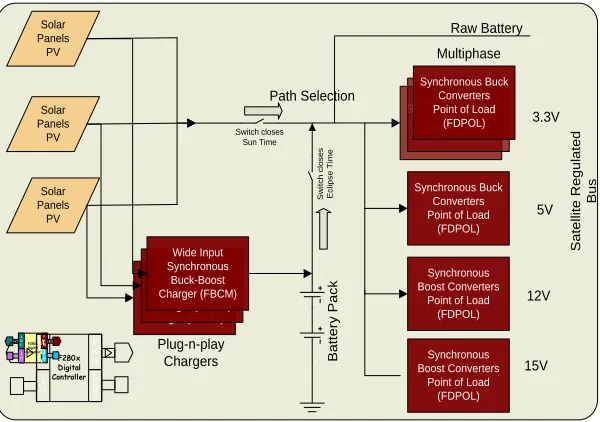
As shown in Figure 11 [1], a scalable modular architecture was proposed which can
generate multiple power rails with different voltage ratings. These rails can be reconfigured
as per requirement.
Synchronous Buck Converters Point of Load Synchronous Buck
Converters Point of Load
Wide Input Synchronous Buck-Boost Charger (FBCM) Solar Panels PV Wide Input Synchronous Buck-Boost Charger (FBCM) Solar Panels PV Wide Input Synchronous Buck-Boost Charger (FBCM) Solar Panels PV Synchronous Buck Converters Point of Load (FDPOL)
Synchronous Buck Converters Point of Load (FDPOL)
Path Selection
Battery Pack
Switch closes Sun Time
Switch closes Eclipse Time
Plug-n-play Chargers Multiphase 12V Synchronous Boost Converters
Point of Load (FDPOL) 5V 3.3V F F 280 280 x x Digital Digital Controller Controller P P W W M M C C O O M M M M S S A A D D C C I I O O Satellite Regulated Bus Synchronous Boost Converters
Point of Load (FDPOL)
It has multiple Flexible Battery Charging Modules (FBCMs) which can interface with
solar panels with different configurations and ratings. These converters can be connected in
parallel to scale the system to higher ratings. They extract power from solar panels and
deliver it to energy storage devices connected in the system. Each FBCM can be interfaced
with two strings of solar panels on opposite faces of the satellite. Two energy storage devices
can be connected to the system.
Multiple Flexible Digital Point of Load (FDPOL) converters convert power from
batteries and FBCM to regulated buses for various subsystems. Standard voltage levels are
regulated on these rails/buses like 3.3v, 5v, 12v, 15v, etc. These levels can are flexible and
can be reconfigured by giving appropriate command to the power controller.
EPS is controlled by a micro controller which controls all the converters of FBCM,
FDPOL, senses the state of battery and controls power flow in the system. It communicates
with other subsystems to know the state of other subsystems and with CDH to accept
commands and send status messages. It runs algorithms for Maximum Power Point Tracking,
Over Current protection, under voltage protection, etc.
Preliminary tests were carried on the prototype board and test results were reported.
Shailesh Notani proposed a GUI based interface to debug and test the hardware [1].
Development of a test bed was required to enable proper testing of the CubeSat EPS. We will
discuss hardware implementation of each stage of EPS along with modifications in the next
chapter. Test bed will be discussed in Section 4.8., followed by the concept of aggressive
In his work [1], Shailesh Notani reported the test results of EPC GaN devices on the
demo boards [13] and [14]. He designed a phase leg circuit using EPC1010 devices and
reported its results. The phase leg circuit is enhanced to handle higher power and a phase leg
with gate driver IC - LM5113 is developed. We will discuss these circuits and their results
CHAPTER 4
Hardware Design and Modifications
In this chapter, we will see the hardware implementation of EPS and discuss each
stage in detail.
Figure 12. Hardware Implementation of EPS
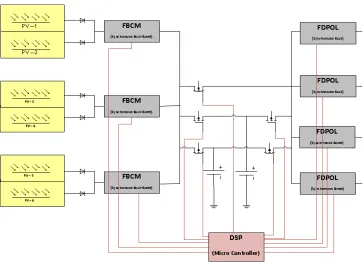
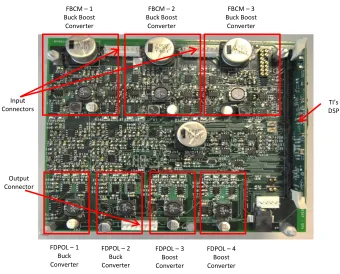
EPS prototype has three Flexible Battery Charging Modules (FBCMs) which
connected to the prototype. These storage devices can be Li-based batteries or super
capacitors depending on the requirement of the CubeSat. It has four Flexible Digital Point of
Load (FDPOL) converters. Two FDPOLs generate standard voltage rails of voltages below
the battery voltage whereas the other two FDPOLs generate voltage rails above the battery
voltage. These rails are user configurable on the fly. PMOS switches are present on the
prototype to control the power flow from Battery Charging Modules to batteries or Point of
Load converters and from Batteries to Point of load converters. The system is controlled by a
micro controller (currently TI’s DSP TMS320F28335).
Figure 13. EPS Prototype Board Sections
Input Connectors
FBCM – 1 Buck Boost
Converter
FBCM – 2 Buck Boost
Converter
FBCM – 3 Buck Boost
Converter
FDPOL – 1 Buck Converter
FDPOL – 2 Buck Converter
FDPOL – 3 Boost Converter
FDPOL – 4 Boost Converter
TI’s DSP
Figure 14. EPS Prototype Board
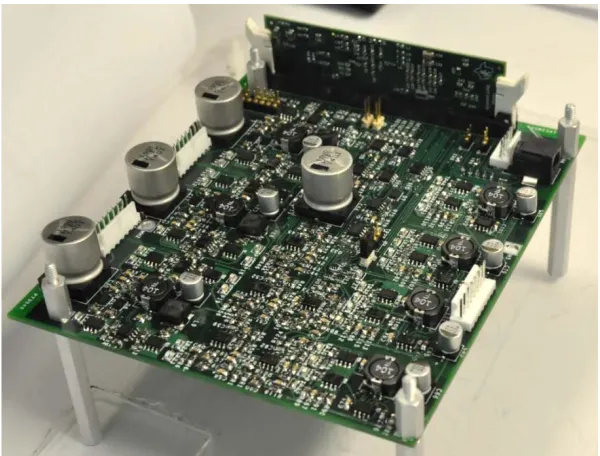
The current sensing implementation for each converter on the board is modified.
Another board is used to sense the current in each of the converters. The implementation on
the current sensor board can be accommodated on the prototype board by replacing the
existing sensing circuit.
Figure 16. EPS Board with Current Sensing Board
The size of the board is 5.9” x 5.05”. The parts count has changed to 500. The same
parts and devices have been used in designing all converters to keep the count of different
parts low. The total number of different parts used is 43. It is to be noted that all the parts on
the board are placed on the top layer of four layer board. Thus it gives a scope to reduce the
with six solar panels on the input side connector, two batteries on the connector and
generates four output voltage rails on the output connector. It is equipped with two
communication interface – I2C and RS232 on the respective connectors.
4.1. Flexible Battery Charging Module
Three Flexible Battery Charging Modules (FBCMs) are present on EPS prototype
board. Each module can be interfaced with two strings of solar panels, each on opposite face
of the CubeSat. Only one of the pair of solar panels faces the sun and thus produces more
power than the other which is exposed to reflection of solar rays from the earth. EPS can be
interfaced with all the six solar panels on a CubeSat. The strings of solar arrays are connected
to the input of Battery Charging Module through diodes. As CubeSat spins and revolves
around the earth, there is a large variation in the solar illumination of the panels. Also, there
can be various configurations of solar panels connected to the modules. Thus, the modules
should have a wide input range up to 30V. Also, different batteries (3.2V – 30V) can be
connected to the modules based on the requirements of CubeSat.
The implementation of Battery Charging Modules is a synchronous buck converter
followed by a synchronous boost converter to accommodate wide input and output voltage
ranges. The module switches to buck converter mode when input voltage is higher than the
battery voltage and to boost converter mode when input voltage is lower than the battery
Figure 17. Flexible Battery Charging Module Schematic
As shown in the schematic Figure 17, gate driver IC TPS28226 is used to drive
MOSFETs of buck/boost converter. Devices are rated for breakdown of 40V 8A. The
MOSFETs Q1 and Q2 along with inductor L2 form Buck Converter for FBCM. Similarly,
the MOSFETs Q3 and Q4 and inductor L2 form Boost Converter for FBCM. Only one of the
buck and boost converter is active at a time. Resistors R5 and R7 form the voltage divider to
sense solar panel output voltage. Input current and inductor current are sensed respectively
by resistors R1 and R2 and are amplified to ADC inputs of the microcontroller. Gate
terminals of devices are protected by back to back zener diodes rated at 5.4V. Capacitors -
Title
Size Document Number Rev
Date: Sheet of
A Cubesat - Electrical Power Sy stem
Custom
1 11
Thursday , Nov ember 17, 2011
R9 10 541-10.0TCT-ND R10 10 541-10.0TCT-ND R12 10k RMCF0805FT10K0CT-ND R11 10k RMCF0805FT10K0CT-ND X_EN C10 0.1u 478-1395-1-ND C12 0.1u 478-1395-1-ND C1 1000p 709-1288-1-ND PWM_X_1A R2 0.025 CSR0805FK25L0CT-ND C4 1000p 709-1288-1-ND PWM_X_1B X_CSP X_CSN Q1 DMN4027SSS-13CT-ND Q2 DMN4027SSS-13CT-ND Q4 DMN4027SSS-13CT-ND Q3 DMN4027SSS-13CT-ND L3 22u SRR6038-220Y CT-ND TP1 5015KCT-ND FBCM_OUT TP5 T POINT A TP3 T POINT A
TP2 T POINT A
TP4 T POINT A
TP8
T POINT A
TP7 T POINT A
TP9 T POINT A
R153 20k RNCP0805FTD20K0CT-ND R154 20k RNCP0805FTD20K0CT-ND R159 20k RNCP0805FTD20K0CT-ND R160 20k RNCP0805FTD20K0CT-ND C3 0.1u 478-1395-1-ND C5 1000u PCE4848CT-ND PWR_X PWM_X_2B PWM_X_2A R7 3k RMCF0805FT3K00CT-ND R5 30k RHM30.0KCRCT-ND X_INV_VI C8 0.01u 478-1383-1-ND C7 0.1u 478-1395-1-ND PANEL_X_1 PANEL_X_2 D1 568-6530-1-ND D2 568-6530-1-ND L2 100u MSS1048-104ML J3 CON3 1 2 3 C9 47u 565-2568-1-ND D11 KDZTR5.1BCT-ND 5.4V X_EN J4 CON3 1 2 3
FBCM - Panel_X_1 & Panel_X_2
C1 and C4 help in protection against ESD. Inductor L1 is a ferrite bead used to reduce the
input noise. The battery charging modules can be connected in parallel to increase the
amount of current to charge batteries and to provide current to point of load converters.
Additional FBCM modules can be connected to the board to scale up the input power of the
EPS.
4.2. FDPOL
Flexible Digital Point-of-Load converters generate standard voltages on output rails
from unregulated battery voltage as input. Prototype board has two synchronous buck point
of load converters and two synchronous boost point of load converters to generate the output
voltage ranges from less than battery voltage to higher than battery voltage. Battery voltage
can be from 3.2V to 30V and output voltage rails can be of any voltage, generally standard
voltages like 1.8V, 3.3V, 5V, 6V, 9V, 12V, 15V and 30V. These converters can handle
Figure 18. Flexible Digital Point of Load – Buck Converter Schematic TP29
T POINT A
TP30 T POINT A TP31
T POINT A
TP32 T POINT A D35 KDZTR5.1BCT-ND 5.4V D36 KDZTR5.1BCT-ND 5.4V D37 KDZTR5.1BCT-ND 5.4V D38 KDZTR5.1BCT-ND 5.4V POL1_OUT POL1_OUT_VI R9110k RMCF0805FT10K0CT-ND R90 43k RHM43.0KCRCT-ND C67 0.01u 478-1383-1-ND C66 47u 565-2568-1-ND R165 20k RNCP0805FTD20K0CT-ND R166 20k RNCP0805FTD20K0CT-ND FDPOL Circuits A. Synchronous Buck
POL Inductor current detection circuit
J9 CON3 1 2 3 POL1_EN C75 0.1u 478-1395-1-ND PWM_POL1A R85 0.025 CSR0805FK25L0CT-ND PWM_POL1B POL1_CSP POL1_CSN Q24 DMN4027SSS-13CT-ND Q25 DMN4027SSS-13CT-ND C65 0.1u 478-1395-1-ND L10 100u MSS1048-104ML U11 296-22853-1-ND UGATE 1 BOOT 2 PWM 3 GND 4 LGATE 5 VDD 6 EN/PG 7 PHASE 8 PWM_POL1A PWM_POL1B POL1_PWM C76 1u 490-4736-1-ND Vl PHASE_POL1 PHASE_POL1 R86 10
541-10.0TCT-ND R8710
Figure 19. Flexible Digital Point of Load – Boost Converter Schematic
Figure 18 and Figure 19 are schematics of Synchronous Buck POL and Synchronous
Boost POL converters. As mentioned before, same components as FBCM are used to reduce
the cost of the EPS. Gate driver TPS28226 drives the MOSFETs for the buck and the boost
converters. The voltage divider on the output side brings down the voltage to ADC input
range. Inductor current is sensed by the resistor and fed to the ADC for sensing by the
microcontroller. R104 10 541-10.0TCT-ND R103 10 541-10.0TCT-ND R105 10k RMCF0805FT10K0CT-ND R106 10k RMCF0805FT10K0CT-ND Q27 DMN4027SSS-13CT-ND Q26 DMN4027SSS-13CT-ND POL2_OUT PWM_POL2A PWM_POL2B C79 47u 565-2568-1-ND PHASE_POL2 TP33 T POINT A
TP34 T POINT A
TP35 T POINT A R102
0.025
CSR0805FK25L0CT-ND
TP36 T POINT A
POL2_CSP POL2_CSN L11 100u MSS1048-104ML SW_BATT C78 0.1u 478-1395-1-ND
SW_BATT over here has to be replaced by another power supply
POL2_EN C80 0.1u 478-1395-1-ND U12 296-22853-1-ND UGATE 1 BOOT 2 PWM 3 GND 4 LGATE 5 VDD 6 EN/PG 7 PHASE 8 PWM_POL2A PWM_POL2B POL2_PWM C81 1u 490-4736-1-ND PHASE_POL2 VL POL2_OUT POL2_OUT_VI R108 10k RMCF0805FT10K0CT-ND R107 43k RHM43.0KCRCT-ND C82 0.01u 478-1383-1-ND D39 KDZTR5.1BCT-ND 5.4V D40 KDZTR5.1BCT-ND 5.4V D41 KDZTR5.1BCT-ND 5.4V D42 KDZTR5.1BCT-ND 5.4V R167 20k RNCP0805FTD20K0CT-ND R168 20k RNCP0805FTD20K0CT-ND J10 CON3 1 2 3 Title
Size Document Number Rev
Date: Sheet of
<Doc> A
Cubesat - Electrical Power Sy stem
Custom
8 11
4.3. Path Selection
Path selection feature is implemented to control the flow of power in the system.
Figure 20. Path Selection Feature Schematic
As seen from schematic diagram in Figure 20, output of battery charging modules can
be connected to batteries (BATT1 or BATT2) or to the input rail of Point of Load converters
(SW_BATT) by Q13, Q14 and Q15 respectively. Also, power from Batteries can be
connected or disconnected to input of POLs by switches Q19 and Q20. These switches are
controlled by signals from microcontroller. Diodes D8, D9 and D10 are connected to block
reverse flow of power to Battery Charging Modules. Thus, power from the solar panels can
be diverted to the POLs instead of using them for charging, if batteries are fully charged or
there is more need of power at the loads. Also, batteries can be disconnected to prevent over
charging and in case of short circuit faults on the output side.
4.4. Power Failure & Recovery
Figure 21. Power Failure Recovery Circuit Schematic
When there is a condition of no power on satellite, the power controller cannot start.
All converters in the system cannot operate as they receive PWM signals from the controller.
This results in a deadlock situation as batteries cannot be charged. To overcome this
situation, power failure recovery circuit is implemented. PMOS switch Q34 is ON when
there is no signal (SOLAR_PWR) from micro controller. This switches on non-regulated
Q34
DMP4050SSS-13CT-ND
PWR_X
R134 10k
RMCF0805FT10K0CT-ND
Q35
BCR133INCT-ND
Q36
BCR133INCT-ND
R135 10k
RMCF0805FT10K0CT-ND
SOLAR_PWR
BATT1
D53
charging of the battery 1. When battery is charged enough to power the micro controller,
micro controller asserts SOLAR_PWR signal and turns off the switch. Battery charging is
performed by FBCMs controller by micro controller.
4.5. Current & Voltage Measurement
Figure 22. Voltage Measurement Circuits - I
C27 1000p 709-1288-1-ND C31 1000p 709-1288-1-ND R31 3k RMCF0805FT3K00CT-ND Z_INV_VI R29 30k RHM30.0KCRCT-ND C34 0.01u 478-1383-1-ND PANEL_Z_1 PANEL_Z_2 D5 568-6530-1-ND D6 568-6530-1-ND TP25 T POINT A
TP26 T POINT A
Figure 23. Voltage Measurement Circuits - II
Voltage divider circuits are implemented to bring the voltage at different stages down
to ADC input voltage range. The resistors can be selected based on the highest possible
voltage at the stage. Currently we are testing with batteries rated at 7.2V and thus buck
output resistor divider can be selected as 23k and 1k. Boost converters are rated at maximum
output voltage of 30V. Resistor divider for boost converter can be selected as 99k and1k.
This gives capacity of fine sensing on buck converter. To keep the design scalable and
accommodate batteries up to 30V, all resistor dividers are selected as 43k and 10k ohms.
POL1_OUT
POL1_OUT_VI
R91 10k
RMCF0805FT10K0CT-ND
R90 43k
RHM43.0KCRCT-ND
C67 0.01u
478-1383-1-ND
POL2_OUT
POL2_OUT_VI
R108 10k
RMCF0805FT10K0CT-ND
R107 43k
RHM43.0KCRCT-ND
C82 0.01u
Figure 24. Current Sensor Circuit Schematic
An external current sensing circuit is implemented to sense and amplify the voltages
sensed across sense resistors. The gain of this circuit can be set by the equation:
G = (1 + R1/R2)/4
Maximum current across any sense resistor (0.025 ohms) is rated to be 2A. Gain of
this circuit is currently set to 31, to accommodate any current overshoots up to 4A keeping
the output to the ADC to maximum of 3.1V.
4.6. MPPT Circuit design
Figure 25. MPPT Circuit Schematic
To track power extracted from a solar panel, there is a need to sense voltage and
current from the panel. The voltage measurement by voltage divider circuit and current
measurement by sense resistor is used to track the power transferred from solar panels to
battery charging circuit. MPPT algorithm uses these values to change the load current so as
4.7. Controller
Figure 26. Micro Controller Interface Schematic
Microcontroller is required to control all the converters and switches of EPS. EPS has
a pluggable micro controller interface which can interface with any micro controller.
Currently EPS is being tested using TI’s DSP TMS320F28335. It has a hardware floating
point unit (FPU), 256K x 16 Flash memory, 34K x 16 SARAM, 18 PWM outputs, 6
high-resolution PWM outputs, 16 channels of 12-bit ADC with 80ns conversion rate and other
high end features like 2 CAN modules, 3 UART modules, JTAG support, etc. It operates at a
X_PWM_1 X_PWM_2 Y _PWM_2 Y _PWM_1 Z_PWM_2 Z_PWM_1 POL1_3_OUT_VI POL1_3_CS_VI POL2_4_OUT_VI X_INV_VI POL2_4_CS_VI POL1_PWM Z_INV_VI Y _INV_VI FBCM_VI X_INC_VI Z_INC_VI Y _INC_VI POL1_EN
X_CS_VI Y _CS_VI
Z_CS_VI ANA1_3_SEL1 ANA1_3_SEL1 ANA1_3_SEL2 ANA2_4_SEL2 ANA2_4_SEL1 VCC_5V BATT1_CHRG VCC_5V BATT2_CHRG VCC_5V BATT2_SWB_EN VCC_5V BATT1_SWB_EN FBCM_SWB_EN VCC_5V SW_BATT_VI BATT_VI V33_ISO RX_ISO GND_ISO GPIO84 GPIO86 GPIO85 GPIO87 BATT_1_2_SEL J1 DIM100 V33-ISO51 51 ISO-TX 52 NC53 53 NC54 54 NC55 55 GND-ISO56 56 ADCA0 57 AGND58 58 ADCA1 59 AGND60 60 ADCA2 61 AGND62 62 ADCA3 63 AGND64 64 ADCA4 65 NC66 66 ADCA5 67 GPIO59 68 ADCA6 69 GPIO61 70 ADCA7 71 GPIO63 72 GPIO01 73 GPIO03 74 GPIO05 75 GPIO07 76 5V77 77 GPIO09 78 GPIO11 79 GPIO49 80 GPIO85 81 5V82 82 GPIO13 83 GPIO14 84 GPIO25 85 GPIO27 86 5V87 87 GPIO17 88 GPIO19 89 GPIO21 90 GPIO23 91 5V92 92 GPIO29 93 GPIO31 94 GPIO33 95 5V96 96 TDI 97 TDO 98 TRSTn 99 EMU0 100 V33-ISO1 1 ISO-RX 2 NC3 3 NC4 4 NC5 5 GND-ISO6 6 ADC-B0 7 AGND8 8 ADC-B1 9 AGND10 10 ADC-B2 11 AGND12 12 ADC-B3 13 AGND14 14 ADC-B4 15 NC16 16 ADC-B5 17 GPIO58 18 ADCB6 19 GPIO60 20 ADCB7 21 GPIO62 22 GPIO00 23 GPIO02 24 GPIO04 25 GPIO06 26 DGND27 27 GPIO08 28 GPIO10 29 GPIO48 30 GPIO84 31 GPIO86 32 GPIO12 33 GPIO15 34 GPIO24 35 GPIO26 36 DGND37 37 GPIO16 38 GPIO18 39 GPIO20 40 GPIO22 41 GPIO87 42 GPIO28 43 GPIO30 44 GPIO32 45 GPIO34 46 DGND47 47 TCK 48 TMS 49 EMU1 50 H ea d er 1 H1 H ea d er 2 H2 SOLAR_PWR BATT1_PWR EMU0 TRSTn TDI TDO TMS EMU1 TCK TX_ISO
Y _EN X_EN
frequency up to 150MHz. We can replace it by a low end micro controller as we will see in
the low cost aggressive voltage scaling CHAPTER 6.
Figure 27. Micro controller Kit interface circuit Analog Signals Digital Signals Power Supply Communication I2C JTAG UART J2 CON16A 1 2 3 4 5 6 7 8 9 10 11 12 13 14 15 16 J4 CON20A 1 2 3 4 5 6 7 8 9 10 11 12 13 14 15 16 17 18 19 20 J5 CON20A 1 2 3 4 5 6 7 8 9 10 11 12 13 14 15 16 17 18 19 20 J6 CON8A 1 2 3 4 5 6 7 8 J7 CON4 1 2 3 4 J8 CON4 1 2 3 4 J9 CON4 1 2 3 4 X_INV_VI Y _INV_VI Z_INV_VI FBCM_VI X_INC_VI Y _INC_VI Z_INC_VI X_CS_VI J3 CON16A 1 2 3 4 5 6 7 8 9 10 11 12 13 14 15 16 POL2_4_CS_VI POL2_4_OUT_VI POL1_3_OUT_VI POL1_3_CS_VI BATT_VI SW_BATT_VI Y _CS_VI Z_CS_VI
X_EN Y _EN
Figure 28. Micro controller Kit interface board
A general purpose interface board is designed to interface various micro controller
kits to the EPS board. This board plugs in the EPS in place of TI’s DSP daughter board. This
board provides connectors for analog signals, digital signals, communication signals, power
supply and JTAG interface as shown in Figure 27. As shown in Figure 28, layout for the
board is complete except for the mechanical cut out to make it compatible with DIMM-100
pin dimensions.
4.8. TestBed
Subsystems and Payloads contain mainly digital systems. These systems can be micro
controllers, imaging devices, memory devices, communication devices, etc. They generate
transients that must be handled by CubeSat EPS to meet the voltage regulation specifications.
A configurable testbed is prepared by Michael Plautz to emulate the load transients and to
The hardware components chosen are representatives of a wide range of embedded
applications. The diversity also accounts for a wide spectrum of operating voltages and
power requirements. At this stage, the application hardware is separate from the EPS board.
The behavior of embedded application is controlled using a different microcontroller than
that used on the EPS board. It should be noted that the power supply of the testbed is
provided by the EPS, whereas the behavior is embedded in a distinct microcontroller. Sample
loads include servomotors, LCD screens, Bluetooth radios, etc. [15]
Figure 29. TestBed
The testbed is developed using a Renesas RDK (Renesas Demonstration Kit) based
on a 32 MHz 16-bit microcontroller from the RL78 family. This specific board has several
wheel, and, a PWM (Pulse Width Modulation) port, making it easy to interface a
servomotor. Potentiometer wheel and switches are used to scroll through the menu and select
options. Test bed is also designed to run various peripherals periodically. [15]
NOTE: The development of testbed is done by Michael Plautz as a part of Aggressive
CHAPTER 5
Software Design
5.1. Controller Software Design
Controller software is designed in three parts: Board Driver, Control Loop and Debug
interface. The software is written in C language. Eclipse based Integrated Development
Environment provided by TI, Code Composer Studio, is used for development and testing of
software. The software is debugged by online emulation using JTAG interface.
5.1.1. Board Driver
Board driver is a set of functions that are used to configure the board giving an
abstraction layer for user to configure the board. These functions modify the state of I/O pins,
initialize PWM signals for converters, and initialize ADC channels and conversion rate.
Driver code is arranged in a file structure as below:
Table 2. File Structure for Driver Code
File Name File Contents
Adc.c
Adc.h
Table 2. Continued
BoardInit.c
BoardInit.h
Board initialization function
Debug.c
Debug.h
Initialization of Debug interface and transmit functions for
Debug Information
Gpio.c
Gpio.h
Configuration of General Purpose Inputs and Outputs to
control switches
ISRs.c
ISRs.h
Interrupt Service Routines for ADC, PWMs and
Communication
PWM.c
PWM.h
Configuration of PWM modules – switching period, initial
duty cycle, etc.
Serial.c
Serial.h
Initialization of Serial module to enable the command/debug
interface
Timers.c
Timers.h
Configuration of Timers to call user based algorithms
periodically
Variables.c Contains the global variable declarations and initializations
Extern.h Contains ‘extern’ declaration of global variables to be included
in various source files
The function Init_Board() resets EPS to initial settings, disables all PMOS switches
self-test. It calls initialization functions for System Control (InitSysCtrl()), General Purpose
I/Os (InitGpio()), Interrupt vectors (InitPieCtrl()), Interrupt Vector Table
(InitPieVectTable()), Analog to Digital Converters (InitADC()), PWM modules
(InitPWM()), Timers (InitTimers()), Serial Interface (InitSerial()) and voltage and current
levels for each stage (InitValues()).
Current implementation initializes the output of Battery Charging Modules to 7.2V,
Buck point of load converters to 3.3V and 5V whereas boost point of load converters to 12V
and 15V. Initially all switches are turned off, to disable power flow on the board. The power
flow on the board is started when the deployment switches separate. The control algorithm
turns off a converter with input voltage less than specified minimum input voltage. This
helps to protect boost converters running at very high duty cycles and the gate driver ICs
from locking down.
5.1.2. Control Loop
Present implementation of the control loop is as a part of the interrupt service routine
of ADC module whereas the main program idles in an infinite loop after triggering start of
conversion for ADC module. Initially, control loop runs with all the converters in off mode
with all switches turned off so that it can stabilize for the first 500 cycles. After the
stabilization routine, FBCMs and FDPOLs are turned on followed by the switches to enable
battery charging with MPPT and power supply to the loads. At the end of ADC interrupt
trigger for the start of ADC conversion can be placed in a timer interrupt service routine to
modify the control loop update rate.
Features for protection against overcharging, over-current, etc. conditions are
implemented as a part of control loop. Under the situation of over-current, particular stage is
shut down and restarted. As shown in Figure 30, a few attempts are made to restart the power
stage before raising a flag depicting a permanent fault. This flag can be used to signal DCH
regarding the fault. Restart attempts continue periodically until a command is received to turn
off the module. Under the situation of battery under-voltage, point-of-load converters are
disconnected from the battery to avoid further discharging. Battery voltage is continuously
monitored so as to look for an attempt to reconnect it to converters.
5.1.3. Debug Interface
A debug interface implementation is used to send sensed voltages and currents at all
stages of EPS via RS232 protocol. This interface runs in the main loop at the lowest priority
so that it does not hinder the functionality of critical control loop. It is a bi directional
interface and can be used to configure EPS externally as discussed in Section 5.3.
A light protocol is developed to use the debug interface. An enumeration eCommand
is transmitted which determines the type of message (stage and voltage/current). This is
followed by a space (0x20) character. The values are sent as strings followed by a new-line
(0x0a) character as the end of message.
For example,
0x01 0x20 0x49 0x50 0x49 0x0a is a message for “ADCVal00 = 121”.
5.2. RTOS based implementation
The RTOS based implementation [15], developed by Avik Juneja, is based on TI’s
advanced RTOS called SYS/BIOS. The features include preemptive, multitasking,
synchronization, instrumentation, hardware abstraction and memory management. The
software architecture is depicted in Figure 31.
NOTE: The RTOS based implementation is designed by Avik Juneja as a part of Aggressive
Figure 31. RTOS based implementation
A single task T0 is responsible for the control of voltage domains in the EPS. Within
the task, there are various functions which control separate voltage domains. A single task is
used to simplify interfacing with the single analog-to-digital converter (ADC). The ADC
performs sequential conversions using an analog input multiplexer and stores the results in
the respective result registers.
There are two hardware interrupts, HWIadc and HWIpwm, which are enabled once each
time T0 runs. The interrupt service routines (ISRs) for HWIadc and HWIpwm are responsible
for collecting the ADC samples and updating the PWM duty cycles, respectively. The
At the beginning of execution, task T0 collects the ADC samples from various power
domains (voltages from Buck, Boost and Buck-Boost, and currents from various parts of the
board), by enabling HWIadc. These samples are then used for control calculations and
updating the PWM duty cycles of their respective domains, by enabling the HWIpwm. The
HWIs are disabled within their respective ISRs to avoid further interruption until the next
occurrence of T0. This enables us to control the update frequency by controlling the task
frequency.
The control task’s execution time was measured to be Texec = 37 µs consistently with
the MCU running at a clock frequency of 150 MHz. This time can be used for real-time
schedulability analysis, such as processor utilization and worst-case task response time. After
adding scheduler overhead and timing resolution, the fastest task possible execution
frequency was measured to be ftask = 25 kHz. This task execution time can likely be reduced
5.3. Communication and Configuration Design
Figure 32. Configuration and Debugging Interface
As discussed before, EPS prototype is equipped with I2C and RS232 communication
protocols. I2C protocol can be configured as required by CubeSat. Present on the fly
configuration testing is done by RS232 protocol. Software is developed in Visual C++ to
communicate with the board over serial interface and provide a GUI to configure EPS stages.
As shown in the Figure 32, it displays currents and voltages at each stage of EPS and can be
used to reset/set the voltage at any stage. It follows the debug interface protocol defined for
5.4. MPPT Algorithm Implementation
As CubeSat spins on its axis along with its revolution around the earth, the
illumination condition on solar panels keeps on varying. The Battery Charging Module needs
to extract maximum power while the output power of solar panels varies. The EPS micro
controller runs the Maximum Power Point Tracking algorithm to track peak power point of
solar panel.
Figure 34. Power Curve for Solar Panel
Figure 34 shows the power curve of solar panels by varying the load on the output
side under sunlight inside laboratory. The solar panels are rated at Vmp of 7.8V and Imp
350mA. There are three main types of MPPT algorithms: perturb-and-observe, incremental
conductance and constant voltage. The first two methods are also known as hill-climbing
methods as these algorithms track local maximum of the power curve.
Perturb-and-Observe (P & O) algorithm is generally used in most of the systems. It
perturbs operating voltage in a direction and senses output power of solar panel. If the power
has increased as compared to previous iteration, it knows that the change in operating voltage
is beneficial. The operating voltage is continuously changed in the direction which increases
fast changing illumination conditions, this algorithm can track in a wrong direction. This
algorithm is easy to implement and the system is not facing rapidly changing illumination
conditions.
The Incremental Conductance method uses PV array’s incremental conductance
dI/dV to compute the sign of change in power dP/dV. It adapts to changing irradiance
conditions more accurately than P & O. However, the output oscillates about maximum
power point and can track in wrong directions under rapidly changing illumination
conditions. This method is more complex than P & O and requires more computational time.
The Constant Voltage method makes use of the fact that the ratio of Vmpp/Voc =
0.76. This method requires setting PV panel’s output current to zero for the time it senses
open circuit voltage. The operating voltage is then set to 76% of the measured value. Even
though 76% is a good approximation of maximum power point voltage, it might not coincide
with it.
Digital implementation of perturb-and-observe (P & O) method is applied to track
maximum power point of solar panels. This method is chosen for its easy and accurate
implementation. The output voltage and current of solar panel are sensed by the sense circuit
as discussed in Section 4.6. and fed to ADC module of micro controller. These values are
multiplied to get power. In next iteration, the output current of Battery Charging Module is
increased by a predefined step to increase the load on solar panel. The voltage and current are
sensed at this load and output power is compared to previous value. If output power is more
![Figure 3. AENEAS – A 3U CubeSat [3]](https://thumb-us.123doks.com/thumbv2/123dok_us/1405033.1173130/20.612.243.406.505.664/figure-aeneas-u-cubesat.webp)
![Figure 6. Building blocks of EPS [1]](https://thumb-us.123doks.com/thumbv2/123dok_us/1405033.1173130/27.612.107.518.393.662/figure-building-blocks-of-eps.webp)
![Figure 7. Architecture of Clyde-Space EPS [10]](https://thumb-us.123doks.com/thumbv2/123dok_us/1405033.1173130/30.612.151.472.383.614/figure-architecture-of-clyde-space-eps.webp)