University of Windsor University of Windsor
Scholarship at UWindsor
Scholarship at UWindsor
Electronic Theses and Dissertations Theses, Dissertations, and Major Papers
2013
Investigating Modern Cryptography
Investigating Modern Cryptography
Mike Lee
University of Windsor
Follow this and additional works at: https://scholar.uwindsor.ca/etd
Recommended Citation Recommended Citation
Lee, Mike, "Investigating Modern Cryptography" (2013). Electronic Theses and Dissertations. 4920. https://scholar.uwindsor.ca/etd/4920
This online database contains the full-text of PhD dissertations and Masters’ theses of University of Windsor students from 1954 forward. These documents are made available for personal study and research purposes only, in accordance with the Canadian Copyright Act and the Creative Commons license—CC BY-NC-ND (Attribution, Non-Commercial, No Derivative Works). Under this license, works must always be attributed to the copyright holder (original author), cannot be used for any commercial purposes, and may not be altered. Any other use would require the permission of the copyright holder. Students may inquire about withdrawing their dissertation and/or thesis from this database. For additional inquiries, please contact the repository administrator via email
Investigating Modern Cryptography
by
Michael Lee
A Thesis
Submitted to the Faculty of Graduate Studies through the Department of Mathematics and Statistics
in Partial Fulfillment of the Requirements for the Degree of Master of Science at the
University of Windsor
Windsor, Ontario, Canada 2013
c
Investigating Modern Cryptography
by
Michael Lee
APPROVED BY:
—————————————————————– M. Hlynka
Department of Mathematics and Statistics
—————————————————————– E. Selvarajah
Odette School of Business
—————————————————————– R. J. Caron, Supervisor
Department of Mathematics and Statistics
—————————————————————– Tim Traynor, Chair of Defence
Author’s Declaration of Originality
I hereby certify that I am the sole author of this thesis and that no part of this thesis has been published or submitted for publication.
I certify that, to the best of my knowledge, my thesis does not infringe upon any-ones copyright nor violate any proprietary rights and that any ideas, techniques, quotations, or any other material from the work of other people included in my the-sis, published or otherwise, are fully acknowledged in accordance with the standard referencing practices. Furthermore, to the extent that I have included copyrighted material that surpasses the bounds of fair dealing within the meaning of the Canada Copyright Act, I certify that I have obtained a written permission from the copyright owner(s) to include such material(s) in my thesis and have included copies of such copyright clearances to my appendix.
Abstract
Contents
Author’s Declaration of Originality iii
Abstract iv
List of Figures x
List of Tables xi
1 Introduction 1
2 Classical Cryptography 5
2.0.1 Transposition Cipher . . . 7
2.0.2 Caesar Shift Cipher . . . 8
2.0.3 Monoalphabetic Substitution Cipher . . . 9
2.0.4 Vigen`ere Cipher . . . 10
3 Mathematical Background: Part I 15 3.1 Number Theory . . . 15
3.2 Algebra . . . 32
4 Polynomial Arithmetic 43 4.1 Polynomial Representation with binary coefficients . . . 43
4.2 Addition and Subtraction . . . 44
4.3 Multiplication . . . 45
4.5 Modulo . . . 47
5 Modern Cryptography 49 5.1 Symmetric Cryptography . . . 49
5.1.1 Advanced Encryption Standard (AES) . . . 49
5.1.2 AES Algorithm . . . 51
5.2 Asymmetric Cryptography . . . 65
5.2.1 RSA Cipher . . . 68
5.3 ElGamal public-key encryption . . . 70
6 Mathematical Background: Part II 74 6.1 Elliptic Curves . . . 74
7 Modern Cryptography: Part II 93 7.1 Elliptic Curve Cryptography(ECC) . . . 93
7.2 The Elliptic Curve Diffie-Hellman Protocol(ECDH) for key exchange 94 7.3 Elliptic Curve El-Gamal . . . 95
8 Random Number Generator [RNG] 97 8.1 Random Numbers . . . 97
8.2 Desirable Property of a RNG . . . 97
8.3 Types of RNGs . . . 98
8.4 Categories of Pseudorandom Number Generators . . . 99
8.5 Difficulties with True Randomness . . . 101
8.7 Sources of Noise for randomness . . . 103
8.8 Types of physical noise . . . 103
8.9 Post Processing . . . 106
9 Testing randomness 110 9.1 Statistical randomness . . . 110
9.2 A Simple Test for Randomness . . . 111
9.3 Tools and Test Suites for testing Randomness . . . 112
9.4 NIST 800-22 Test Suite . . . 112
9.4.1 Assumptions . . . 112
9.4.2 The Tests . . . 113
9.4.3 Test Descriptions . . . 114
9.5 rngtest (Ver. 4) Test Suite (FIPS-140-2 Tests) . . . 119
9.5.1 rngtool suite . . . 119
9.5.2 The Tests . . . 119
9.5.3 Test Descriptions . . . 120
9.6 DIEHARDER (3.31.1) Test Suite . . . 122
9.6.1 The DIEHARDER Test Suite . . . 122
9.6.2 The Tests . . . 123
9.6.3 Test Descriptions . . . 123
9.7 ENT Test Suite . . . 140
9.7.1 ENT: A Pseudorandom Number Sequence Test Program . . . 140
9.7.3 Test Descriptions . . . 141
10 OptoRNG 144 10.1 Optoisolators . . . 144
10.2 OptoRNG . . . 148
10.3 Testing of OptoAESRNG . . . 154
10.3.1 Visual Random Test . . . 154
10.3.2 ENT Test Suite . . . 155
10.3.3 rng-tools (rngtest) . . . 159
10.3.4 NIST 800-22 Test Suite . . . 160
10.3.5 DIEHARDER Test Suite . . . 160
10.4 Conclusion . . . 161
11 Summary and Future Work 162 Appendix A: AES Implementations 163 AES C Source Code 128-bit . . . 163
AES 128-bit Input and Output verification . . . 175
AES Sketch Source Code 128-bit implemented in firmware (Arduino UNO) 179 AES 128-bit Input and Output verification (Arduino UNO) . . . 190
Appendix B: OptoRNG 192 OptoAESRNG Source Code . . . 192
OptoAESRNG.pde . . . 192
AESArd.cpp . . . 198
OptoAESRNG Testing . . . 205
ENT Sequence Test Program Output . . . 205
RNGTool rngtest 1GB Test File Output . . . 208
RNGTool rngtest 3GB Test File Output . . . 213
NIST Statistical Test Suite Output . . . 215
C code for substituting long Test Name to Short form Name . . . 216
NIST STS 1 000 000 bits at 10 runs . . . 221
NIST STS 1 000 000 bits at 100 runs . . . 251
NIST STS 1 000 000 bits at 1000 runs . . . 281
NIST STS 10 000 000 bits at 10 runs . . . 311
NIST STS 10 000 000 bits at 100 runs . . . 341
Dieharder 1GB Test File Output . . . 371
Dieharder 3GB Test File Output . . . 391
Dieharder 13GB Test File Output . . . 406
Dieharder AESOFB Output . . . 416
Dieharder mt19937 Output . . . 428
References 442
List of Figures
1 Elliptic curve P +Q, whereP 6=Q . . . 76
2 Elliptic curve P +Q, whereP =Q . . . 77
3 Associative property (P +Q) +R =P + (Q+R) = −T . . . 91
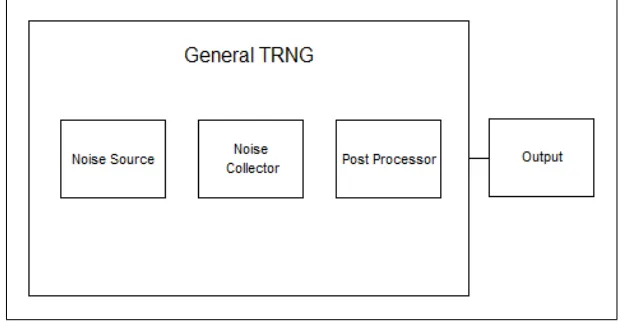
4 General TRNG Block Diagram . . . 102
5 Visual Random Bitmap Test . . . 111
6 Optocoupler VO617A picture. . . 145
7 Photodiode PN-junction showing Photoelectric Effect . . . 145
8 OptoRNG Block Diagram . . . 148
9 OptoRNG Prototype Circuit Diagram . . . 149
10 OptoRNG Prototype PCB . . . 149
11 Arduino Uno Microcontroller . . . 150
12 OptoAESRNG Block Diagram . . . 152
13 OptoAESRNG Post Processor Flowchart . . . 153
List of Tables
1 Statistical Letter Table [29]. . . 10
2 Vigen`ere Square used for cipher. . . 11
3 AES definitions, glossary of terms, and acronyms [19]. . . 50
4 Pseudo Code for AES algorithm [19]. . . 53
5 AES algorithm Substitution Box (S-Box) in hexadecimal [19]. . . 55
6 AES algorithm Inverse Substitution Box (Inverse S-Box) in hexadeci-mal [19]. . . 58
7 Pseudo Code for Inverse AES algorithm [19]. . . 66
8 Pseudo Code for AES Round Key algorithm [19]. . . 67
9 NIST 800-22 Tests. . . 114
10 rngtool Suite Tests. . . 119
11 Corresponding Interval specification for FIPS 140-2(2001-10-10) Runs Test. . . 121
Investigating Modern Cryptography
1
Introduction
Due to the technical complexities of modern cryptography it difficult to find a “one stop” resource that rigourously defines and illustrates the fundamentals of how and why cryptography works. The focus of this thesis is to uniquely compile and rigorously present the modern cryptographic algorithms AES, RSA, and ECC in a manner which is familiar to Mathematicians, Computer Scientists, and Engineers. Its purpose is to demystify the inner workings of modern cryptography and give a strong fundamental concrete understanding in the hopes that it will ease the burden of the transition from theory to practice.
An attempt was made to comprehensively cover the subject matter in such a way that the use of external material is a minimum. Although, it is assumed the reader under-stands how general logic and proofs work. And it is also helpful, but not necessary, if the reader has rudimentary knowledge in the following subjects: Linear Algebra, Calculus, Number Theory, Abstract Algebra, Algebraic Geometry, and Statistics.
Algebra instead of a more complicated approach. The proving of this theorem allows us to avoid a more difficult approach with Algebraic Geometry when showing the Elliptic Curve group (E,+) is associative. In addition, we facilitate the understanding of the material by following the proofs, in most cases, with concrete examples where possible.
The demand for higher information security, has caused an increase in key sizes, due to advancing technology such as processor speed. Random number generation is be-coming crucial for cryptographic applications, since their randomness is needed for aspects like key generation, authentication, and padding. The security of such systems are based on the quality of the random numbers generated. Many attacks on cryp-tographic systems are focused on their implementation rather than the system itself, since a poor implementation can result in a successful attack. This is the reason why it is desirable to produce quality unpredictable random numbers. It is an assumption that one can obtain and use high quality numbers for these processes. However, in many cases, their quality have been overlooked with detrimental consequences. An example of this would be the lack of randomness produced by the random number generator used with the digital signature algorithm for signing executable code on the Sony Playstation 3(PS3). This flaw allowed the private keys, used in the au-thentic code signing process, to be recovered. Knowledge of these keys would permit the execution of arbitrary code on the system and possibly allow individuals to copy games.
The random number generatorOptoRNGis hardware based and uses unpredictable physical noise produced by an optoisolator. Specifically, the noises resulting from Quantum Shot, Thermal, Flicker, and the Photoelectric effect. The design and con-struction of OptoRNG is simple and only requires a total of 11 components. The small bill of materials make for a cost effective and inexpensive true random number generator. Furthermore, the generator operates at the standard 5V CMOS/TTL level and can be powered from a standard USB port unlike other methods, such as those based on zener diodes, which require higher voltages.
A unique algorithm for extracting the random data from the generator was created to prevent problems such as under and over-sampling. The algorithm samples two rela-tive timing intervals between successive rising edges of the bitstream from OptoRNG with the output being determined by a size comparison of the intervals. To increase the performance of OptoRNG the block cipher AES was used to post process the out-put stream. This serves two purposes: to speed up the generator, and to whiten or remove any unwanted bias that may have resulted from the discrete transformation of the analog noise signal from the optoisolator. The combination of OptoRNG with the block cipher AES gives rise to an improved generator called OptoAESRNG. The output of this generator has been tested using a list of comprehensive, open source, test suites. These test suites have produced consistent results that have shown the output of the generator does not deviate from statistical randomness. This implies the output is of good quality.
2
Classical Cryptography
Cryptography is the science of secret messages. The idea is that messages can only be read by their intended recipients. “Crypto” comes from the Greek word “kryptos” which means “to hide”, “graphein” means “to write”, put these together and we get a rough translation of “secret writings”. Encrypting is the procedure for hiding mes-sages or “plaintext”. A message that is encrypted is called ciphertext. Decrypting is the procedure used to go from ciphertext to plaintext, usually by the usage of a key. A key is the unique element that allows the locking or unlocking of a message during the process of encryption or decryption. A desirable property of an encryption algo-rithm is that its strength rests solely on the strength of its key, that is the knowledge of the key is the only way to know the plaintext from ciphertext.
Herodotus wrote: As the danger of discovery was great, there was only
one way in which he could contrive to get the message through: this was by
scraping the wax off a pair of wooden folding tablets, writing on the wood
un-derneath what Xerxes intended to do, and then covering the message over with
wax again. In this way the tablets, being apparently blank, would cause no
trouble with the guards along the road. When the message reached its
destina-tion, no one was able to guess the secret, until, as I understand, Cleomenes’
daughter Gorgo, who was the wife of Leonides, divined and told the others
that if they scraped the wax off, they would find something written on the
wood underneath. This was done; the message was revealed and read, and
afterwards passed on to the other Greeks. [29]
2.0.1 Transposition Cipher
Plaintext:
THE CAT AND THE DOG WENT TO THE STORE. Encipherment:
T E A A D H D G E T O H S O E H C T N T E O W N T T E T R
Ciphertext:
TEAADHDGETOHSOEHCTNTEOWNTETR.
algorithm is too difficult then the user may encounter problems in the execution, due to human error, without the use of a computer (although this is not an issue today).
2.0.2 Caesar Shift Cipher
ABCDEFGHIJKLMNOPQRSTUVWXYZ XYZABCDEFGHIJKLMNOPQRSTUVW
Plaintext:
THE DOG IS CUTE.
Cipertext:
QEB ALD FP ZRQC.
2.0.3 Monoalphabetic Substitution Cipher
A B C D E F G H I J K L M N O P Q R S T U V W X Y Z H E L O M Y N A I S K B C D F G J P Q R T U V W X Z
Plaintext:
THE BIRD FLYS.
Ciphertext:
RAM EIPO YBXQ.
We observe that Monoalphabetic Substitution Ciphers have more security than Caesar Shifted ciphers since the number of possibilities for a substitution table is 26 for Caesar Shifted, as compared to 26! for Monoalphabetic Substitution. So, it follows that there are an astronomical number of possibilities for monoalphabetic plaintext encipherment. One may think that this system is incredibly strong but it has a weakness when it is subjected to statistical analysis on the frequency of each letter [29]. Due to the nature of the English language we know that certain letters appear more often then others. Because of this statistical information, we are able to reduce the number of possibilities for a substitution table.
Letter Table
Letter Percentage Letter Percentage
a 8.2 n 6.7
b 1.5 o 7.5
c 2.8 p 1.9
d 4.3 q 0.1
e 12.7 r 6.0
f 2.2 s 6.3
g 2.0 t 9.1
h 6.1 u 2.8
I 7.0 v 1.0
j 0.2 w 2.4
k 0.8 x 0.2
l 4.0 y 2.0
m 2.4 z 0.1
Table 1: Statistical Letter Table [29].
1) the number of permutations for a possible substitution table is reduced, 2) words start to form as each letter for the substitution table are solved. This allows letters of the substitution table to be solved from partially completed words.
2.0.4 Vigen`ere Cipher
Vigen`ere Square
ABCDEFGHIJKLMNOPQRSTUVWXYZ
1 BCDEFGHIJKLMNOPQRSTUVWXYZA
2 CDEFGHIJKLMNOPQRSTUVWXYZAB
3 DEFGHIJKLMNOPQRSTUVWXYZABC
4 EFGHIJKLMNOPQRSTUVWXYZABCD
5 FGHIJKLMNOPQRSTUVWXYZABCDE
6 GHIJKLMNOPQRSTUVWXYZABCDEF
7 HIJKLMNOPQRSTUVWXYZABCDEFG
8 IJKLMNOPQRSTUVWXYZABCDEFGH
9 JKLMNOPQRSTUVWXYZABCDEFGHI
10 KLMNOPQRSTUVWXYZABCDEFGHIJ
11 LMNOPQRSTUVWXYZABCDEFGHIJK
12 MNOPQRSTUVWXYZABCDEFGHIJKL
13 NOPQRSTUVWXYZABCDEFGHIJKLM
14 OPQRSTUVWXYZABCDEFGHIJKLMN
15 PQRSTUVWXYZABCDEFGHIJKLMNO
16 QRSTUVWXYZABCDEFGHIJKLMNOP
17 RSTUVWXYZABCDEFGHIJKLMNOPQ
18 STUVWXYZABCDEFGHIJKLMNOPQR
19 TUVWXYZABCDEFGHIJKLMNOPQRS
20 UVWXYZABCDEFGHIJKLMNOPQRST
21 VWXYZABCDEFGHIJKLMNOPQRSTU
22 WXYZABCDEFGHIJKLMNOPQRSTUV
23 XYZABCDEFGHIJKLMNOPQRSTUVW
24 YZABCDEFGHIJKLMNOPQRSTUVWX
25 ZABCDEFGHIJKLMNOPQRSTUVWXY
26 ABCDEFGHIJKLMNOPQRSTUVWXYZ
position in the Vigen`ere square which indicates a ’K’. So ’K’ is our first letter of the ciphertext. We then move to the second letter of the keyword and apply the same method as mentioned above. This procedure is repeated until the message is completely converted to ciphertext by cycling the letters of the keyword from start to finish and repeating it over and over. Such that after every five letters of encoding the key letter ’H’ is used, followed by the letter ’E’, then ’L’, then ’L’, then ’O’, and the cycle repeats until the end of the message. Also note that the cipher alphabet at row seven in the Vigen`ere square is a Caesar shifted substitution table of offset seven. One can view the Vigen`ere Cipher as many Caesar shifted substitution ciphers combined into one cipher. The combination gives greater complexity and increased security.
Key:
HELLOHELLOHELLO....
ABCDEFGHIJKLMNOPQRSTUVWXYZ
7 HIJKLMNOPQRSTUVWXYZABCDEFG
4 EFGHIJKLMNOPQRSTUVWXYZABCD
11 LMNOPQRSTUVWXYZABCDEFGHIJK
11 LMNOPQRSTUVWXYZABCDEFGHIJK
14 OPQRSTUVWXYZABCDEFGHIJKLMN
Plaintext:
Dogs are friendly. Ciphertext:
KSRD OYI QCWLROWM.
3
Mathematical Background: Part I
The purpose of this section is to review the mathematics required for some of the areas in modern cryptography. The definitions and proofs in this section are found in many textbooks and are considered common knowledge. (Please refer to [4, 9, 14, 17, 18, 29, 32, 38] for more details.)
3.1
Number Theory
Definition 3.1 If a, b ∈ Z we say that a divides b, denoted symbolically as a|b, if and only if there exists an integer q such that b = qa.
Definition 3.2 The Greatest Common Divisor of a, b ∈ Z is the integer d >
0, such that d|a and d|b; and whenever c ∈ Z, c|a and c|b then c|d; and is denoted by d = GCD(a, b). (Informally, the Greatest Common Divisorof a and b is the largest number that divides both a and b.)
Example 3.1 GCD(10,25) = 5 and GCD(18,30) = 6.
The Well Ordering Property: Let Z>0 denote the positive integers. Then every non-empty subset A ofZ>0 contains an element a∈ Asuch that a ≤k for all k ∈A, that is A contains a smallest element a.
unique integers q and r such that b=qa+r where 0≤r < a, and q, r ∈Z are called the quotient and remainder when b is divided bya, respectively.
Proof:
Let A={x=b−qa≥0|q∈Z}.
b > 0 =⇒b∈A
b = 0 =⇒a=b−(−1)a∈A
b < 0 =⇒b(1−a) +a=b−(b−1)a∈A
Therefore A is not empty.
By the Well Ordering Property Acontains a smallest element r =b−qa≤x
for all x∈A. If r= 0 then we are done, since b=qa. Also, if r < a then we are done since b=qa+r. We now assume thatr > a, so 0< r−a= (b−qa)−a=
b −(q+ 1)a ∈ A, but that would mean we have found a non-negative integer smaller than r, which contradicts the minimality condition.
Therefore integers q and r, with b=qa+r and 0≤r < a, exist.
0< r2−r1 < aand (q1−q2)a=r2−r1. It follows thata|(r2−r1), but this means that r2 −r1 ≥ a, since r2 −r1 = ka for some k ∈ Z, contradicting r2 −r1 < a. Thereforer1 =r2 and (q1−q2)a= 0, so q1 =q2 sincea >0. And so, the integers
q and r are unique, as required.
Proposition 3.1 If a, b ∈Z and r|a and r|b then r|(ax+by) for any x, y ∈ Z. In particular r|(a+b) and r|(a−b). (If r divides two numbers then r divides a linear combination of them.)
Proof:
If r|a and r|b then there exists s, t ∈ Z such that a = sr and b = tr. So, for some u, v ∈Z, (ua+vb) = (usr+vtr) = (us+vt)r. It follows that r|(ua+vb). Since, u and v were arbitrary then r|(ax+by) for any x, y ∈ Z. And, if x = 1 and y=±1 then r|(a+b) andr|(a−b).
Lemma 3.1 If b=qa+r then GCD(a, b) =GCD(r, a).
Proof:
Let d=GCD(a, b)
Suppose c|aand c|r then c|(qa+r), again by Proposition 3.1. So, it follows that
c|b.
Now, since c|aand c|bthenc|d, soc≤d. (c > dwould contradict the maximality condition on d.)
Therefore d=GCD(r, a). Sinced|a,d|r, and c≤d.
Theorem 3.2 The Euclidean Algorithm. Ifa,b∈Zwherea6= 0, thenGCD(a, b) is the last non-zero remainder, rn, in the following list of equations obtained from the
Division Algorithm.
b = q1a+r1 where 0< r1 <|a|
a = q2r1+r2 where 0< r2 < r1
r1 = q3r2+r3 where 0< r3 < r2 ..
.
rn−2 = qnrn−1+rn where 0< rn < rn−1
rn−1 = qn+1rn+ 0
Proof:
By repeated usage of Lemma 3.1 we obtain:
GCD(a, b) =GCD(r1, a) = GCD(r2, r1) =...=GCD(rn, rn−1) = GCd(0, rn) =
rn
If the remainder of the first application of the Division Algorithm is zero then
a|b and GCD(a, b) = |a|.
Example 3.2 GCD (160, 7) = 1
160 = 7(22) + 6
7 = 6(1) + 1
6 = 1(6) + 0
Theorem 3.3 Solutions to Diophantine Equations. If a, b ∈ Z then there exists x, y ∈Z, such that ax+by = GCD(a, b).
Proof:
Case a = 0; GCD(0, b) = b(1). Case b = 0; GCD(a,0) = a(1).
from the Euclidean Algorithm. Next, we generate an expression for rn in terms of rn−1 and rn−2.
GCD(a, b) = rn = rn−2 - qnrn−1
We then write rn−1 in terms ofrn−2 and rn−3.
GCD(a, b) = rn−2 - qnrn−1 = rn−2 - qn(rn−3 -qn−1rn−2)
Iteratively continuing with this process until we can write theGCD(a, b) in terms of r2 and r1, then r1 and a, and finally a and b, yields an expression containing a solution to the Diophantine Equation.
Example 3.3 Consider the Diophantine Equation 160y+ 7x= 1 from Example 3.2.
We have that GCD(160,7) = 1. Reversing the steps from the example we have: 1 = 7 - 6(1)
= 7 - (160 - 7(22))(1)
= 7(23) - 160(1)
= 7(23) + 160(-1)
so, x = 23 and y = -1.
Substituting x and y into 160y + 7x, we get:
160(-1) + 7(23) = -160 + 161 = 1
Definition 3.3 Two integers a andb are said to be congruent modulo m, or just
m|(b−a) ⇐⇒ m|(a−b)
⇐⇒ (b−a) = mq, for some q ∈Z ⇐⇒ b = a + mq, for some q ∈Z ⇐⇒ b ∈ a + mZ
⇐⇒ b ≡ a (modm)
Definition 3.4 A relationR on a setS is called anequivalence relation if for all
a, b, c ∈ S we have (1) aRa. (Reflexive)
(2) if aRb then bRa. (Symmetric)
(3) if aRb and bRc then aRc. (Transitive)
Proposition 3.2 Congruence modulo m forms an equivalence relation.
Let a, b, c∈Z
(1) a ≡ a (mod m) (Reflexive)
(2) if a ≡ b (mod m) then b ≡ a (mod m) (Symmetric)
(3) if a ≡ b (mod m) and b ≡ c (mod m) then a ≡ c (mod m) (Transitive)
Proof:
(1) We know that a - a = 0 and m|0. ∴ a ≡ a (mod m)
(2) If a ≡ b (mod m) then m|(a−b), so, m|(−b+a) = m|(−1)(b−a). And so,
(3) If a≡ b (mod m) andb ≡ c(mod m) thenm|(a−b) andm|(b−c), it follows that m|[(a−b) + (b−c)] (by Proposition 3.1). So, m|[a+ (−b+b)−c)] =
m|(a−c). ∴ a ≡ c(mod m).
Definition 3.5 If R is an equivalence relation on a set S and a ∈ S then [a] =
{x ∈ S|xRa} is called an equivalence class or residue class, which consists of all elements x ∈ S such that x is equivalent to a.
Remark 3.1 It is a common practice to notate an equivalence class [a] as a¯, or just a when it is known to be an equivalence class. Also, the element a is called a
representative of the equivalence class [a]. The collection of equivalence classes with respect to integers modulo m is denoted by Zm = {[0]m,[1]m,[2]m, ...,[m−1]m}.
Example 3.4 Z3 = {[0]3,[1]3,[2]3}
0 ≡ 3 ≡ 0 + 3k (mod 3) for all k ∈Z. 1 ≡ 4 ≡ 1 + 3k (mod 3) for all k ∈Z. 2 ≡ 5 ≡ 2 + 3k (mod 3) for all k ∈Z.
or equivalently,
[0] = {x|x≡0 (mod 3)} = {0 + 3k|k ∈Z}
[1] = {x|x≡1 (mod 3)} = {1 + 3k|k ∈Z}
Proposition 3.3 a ≡ b (mod m) if and only if a and b have the same remainders when divided by m.
Proof:
Using the Division Algorithm we obtain:
a =q1m + r1 where 0≤ r1 < m
b =q2m + r2 where 0≤ r2 < m
So, (a -b) = (q1−q2)m + (r1−r2) where -m < (r1−r2)< m
if a ≡ b (mod m) then m|(a−b) and so, m|(r1 −r2). But (r1 −r2) is strictly between -m and m, the only way this could happen is if (r1 −r2) = 0.
if aandbhave the same remainders when divided by mthen (a-b) = (q1−q2)m, so it follows that m|(a−b). ∴a ≡ b (mod m).
Remark 3.2 The above proposition shows the relationship between congruence
mod-ulo m and remainders, and as a consequence there is precisely one remainder for
every integer modulo m, namely one of {0,1,2, ...,m−1}.
Proposition 3.4 If ac ≡ bc (mod m) and GCD(c, m) = 1 then a ≡ b (mod m).
If ac ≡ bc (mod m) then m|c(a−b), but we are given that the GCD(c, m) = 1 (the greatest common divisor is 1), so it follows that m|(a−b). Therefore a ≡ b
(mod m), by Definition 3.3.
Definition 3.6 An integer p isprime provided that the only positive integers
divid-ing p are 1 and p.
Theorem 3.4 Fermat’s Little Theorem. Ifpis a prime number anda ∈Z, such that p-a then ap−1 ≡1 (mod p).
Proof:
We shall examine:
ra ≡ sa (mod p) where 0 ≤ s ≤ r ≤ p-1.
So, p|(r −s)a. This implies that p|(r −s), since p - a. It follows that r = s
(mod p), since r and s are inclusively between 0 and p−1. That is, the only way to write (r−s) =pkfor somek∈Z, having a zero remainder, is if (r−s) = 0
So,
a·2a·3a· ... ·(p−1)a ≡ 1·2·3·... ·(p−1) (mod p) (p−1)!ap−1 ≡ (p−1)! (mod p)
But, p-(p−1)!, sincepis prime and does not divide any of the factors of (p−1)! therefore GCD(p,(p−1)!) = 1. And so, by Proposition 3.4:
ap−1 ≡ 1 (mod p).
Definition 3.7 A Linear Congruence in the variable x is a relation of the form
ax ≡ c (mod m).
Proposition 3.5 Thelinear congruenceax ≡c(modm) has a solution x0 if and only if the linear Diophantine equation ax + my = c has a solution x0 for some
y0 ∈Z.
Proof:
Proposition 3.6 The linear congruence ax ≡ c (mod m) has a solution if and only if GCD(a, m)|c.
Proof:
We know from Proposition 3.5 that ax ≡ c (mod m) has a solution if and only if ax + my = c has a solution. We need to show that if and only if the linear Diophantine equation ax +my =chas a solution then GCD(a, m)|c.
Supposeax+my=chas integer solutions. We know by definition thatGCD(a, m)|a
andGCD(a, m)|m. So, theGCD(a, m) must divide a linear combination of them, that is GCD(a, m)|(ax +my). ∴ GCD(a, m)|c.
Now, suppose that GCD(a, m)|c, so c = dk where k ∈ Z and d = GCD(a, m). By Theorem 3.3, there exists s, t ∈Z such thatas +mt =d.
Multiplying as + mt= d through by k we get,
a(sk) + m(tk) = (dk)
ax +my = c, where x =sk and y = tk.
∴ ax + my = chas a solution.
Example 3.5 Considering the results from Example 3.3 we show a practical example
We have, 7x ≡ 1 (mod 160) ⇐⇒ 160y + 7x = 1
Which has a solution x = 23 and y = -1.
So, 7(23) = 161 (mod 160) ≡ 1 (mod 160)
Therefore 7(23) ≡ 1 (mod 160). So, x ≡ 23 (mod 160), and 7−1 = 23.
Theorem 3.5 TheSimple Chinese Remainder Theorem if GCD(m1, m2)= 1 then for any integers a1 anda2 then the simultaneous linear congruence relations:
x ≡ a1 (modm1)
x ≡ a2 (modm2)
have a solution. If x = x0 is one solution then the complete solution is x ≡ x0 (mod
m1m2).
Proof:
We have, x ≡ a1 (mod m1), so it follows that,
x = m1k +a1, for some k ∈Z.
m1k + a1 ≡ a2 (mod m2). So,
m1k ≡ (a2 - a1) (mod m2).
Since the GCD(m1, m2) = 1 then the linear congruence in k of m1k ≡ (a2
-a1) (mod m2) has a solution.
m−11m1k ≡ m1−1(a2 - a1) (mod m2)
k ≡ m−11(a2 - a1) (mod m2)
k ≡ b (mod m2), where b =m1−1(a2 - a1) So, k = m2l +b, for somel ∈Z
x = m1k + a1
= m1(m2l +b) + a1 = m1m2l + (m1b +a1) We get, x =m1m2l +x0, where x0 = (m1b +a1).
∴ x ≡ x0 (mod m1m2).
Example 3.6 This is an example of how to solve simultaneous linear congruence
relations.
x ≡ 1 (mod 3)
x ≡ 2 (mod 5)
3k1 + 1 ≡ 2 (mod 5). 3k1 ≡ 2 - 1 (mod 5) 3k1 ≡ 1 (mod 5)
Since the GCD(3,5) = 1 we can find a solution to 3k1 ≡ 1 (mod 5). (That is,
GCD(3,5)|1 [Proposition 3.6].)
Solving 3k1 + 5y = 1
Using technique from Example 3.3:
5 = 3(1) + 2
3 = 2(1) + 1
2 = 1(2) + 0
1 = 3 - 2(1)
= 3 - (5-3(1))(1)
= 3(2) - 5(1)
1 = 3(k1) + 5(y)
= 3(2) + 5(-1).
So, it follows that k1 ≡ 2 (mod 5). Since 2 = 3−1. 2(3)k1 (mod 5) ≡ 2(1) (mod 5)
k1(mod 5) ≡ 2 (mod 5)
k1 ≡ 2 (mod 5).
k1 = 5k2 + 2, for some k2 ∈Z
x = 3(5k2 + 2) + 1
= 15k2 + 7
∴ x ≡ 7 (mod 15).
The RSA Cryptosystem is the work of Ron Rivest, Adi Shamir, and Leonard Adleman. The name of the system comes from taking the first letter of each of their last names.
Theorem 3.6 (RSA Cryptosystem.) Let p and q be distinct primes, where n =
pq and e, d ∈Z>0 such that ed ≡ 1 (mod (p−1)(q−1)). If 0≤ M < n and Me ≡
C (mod n) and Cd ≡ R (mod n) where 0≤R < n then R = M.
Proof:
We are given that ed ≡ 1 (mod (p−1)(q−1)) this means that
ed = 1 +k(p−1)(q−1), for some k ∈Z. Using this we get,
R ≡ Cd (mod n)
≡ (Me)d (mod n)
≡ Med (mod n)
≡ M1+k(p−1)(q−1) (mod n)
So, if p-M then
R (mod p) ≡ M Mk(p−1)(q−1) (mod p)
≡ M(M(p−1))k(q−1) (mod p)
≡ M(1)k(q−1) (mod p), by Thm. 3.4 (Fermat’s Little Theorem)
≡ M (mod p).
But, if p|M then M (mod p) ≡ 0 (mod p), since M is a multiple of p. So, both sides of are 0, and satisfy the relation R (mod p) ≡ 0 (mod p)≡ M (mod p).
∴ R ≡M (mod p).
Using similar arguments one can show that R ≡ M (mod q).
Thus we have,
R ≡ M (mod p)
R ≡ M (mod q)
Since the GCD(p, q) = 1, we can use Theorem 3.5 to give
R ≡ M (mod n).
3.2
Algebra
The definitions and proofs in this section are found in many textbooks and are con-sidered common knowledge. Refer to the following references [8, 14, 24, 36] for more details.
Definition 3.8 AGroupGis a nonempty set with a binary operator normally called
multiplication, usually denoted as ab (or a· b) where a, b ∈ G, with the following properties for all a, b, c∈G:
1.) ab∈G (Closure)
2.) There exists e ∈G such that ae=a =ea (Identity)
3.) There exists a−1 ∈G such that aa−1 =a−1a=e (Existence of Inverse) 4.) a(bc) = (ab)c (Associativity)
If ab=ba for all a, b∈G then the Group is said to be Abelian or Commutative.
Definition 3.9 A Ring R is a nonempty set with two binary operators called
ad-dition and multiplication, usually denoted as a+b and ab (or a·b) where a, b∈ R, respectively. The Ring R has the following properties for all a, b, c∈R:
1.) a+b∈R (Additive Closure)
2.) a+b=b+a (Additive Commutativity)
4.) There exists 0 ∈R such that a+ 0 = 0 +a=a (Additive Identity) 5.) There exists −a∈R such that a+ (−a) = 0 (Additive Inverse) 6.) ab∈R (Multiplicative Closure)
7.) a(bc) = (ab)c (Multiplicative Associativity)
8.) a(b+c) =ab+ac and (b+c)a=ba+bc (Distributivity)
Definition 3.10 A FieldFis a ring with the additional properties that for all a, b∈
F:
1.) ab=ba (Multiplicative Commutativity)
2.) There exist 1 ∈F such that a·1 = a (Multiplicative Identity) 3.) For every a6= 0, there exists a−1 ∈
F such aa−1 = 1 (Multiplicative Inverse)
Definition 3.11 A Polynomial Ring, P[x], is the set of all polynomials whose coefficients come from P, where P is a ring.
Definition 3.12 If Fis a field with a(x), b(x)∈F[x] we say thata(x) divides b(x), denoted symbolically as a(x)|b(x), if and only if there exists a polynomial q(x)∈F[x] such that b(x) = q(x)a(x).
Definition 3.13 A monic polynomialin F[x], is a polynomial a(x) =anxn+...+
a0, such that an = 1; the multiplicative identity in F.
Definition 3.14 The Greatest Common Divisor for the polynomials f(x), g(x)
d(x)|g(x); and wheneverc(x)∈F[x], such that, c(x)|f(x)andc(x)|g(x)thenc(x)|d(x); and is denoted by d(x) = GCD (f(x), g(x)). (Informally, the Greatest Common Divisor for f(x)and g(x)is the largest polynomial that divides both f(x) andg(x).) (Note: A monic polynomial for the GCD of two polynomials is used by convention in
order to ensure uniqueness of d(x).)
Example 3.7 GCD(x2−1, x−1) = x−1 and GCD(x−1, x+ 1) = 1.
Theorem 3.7 The Division Algorithm for Polynomials. Let f(x), g(x) ∈
F[x]where g(x)6= 0, then there exists unique polynomials q(x), r(x)∈F[x]such that:
f(x) = g(x)q(x) +r(x), where 0≤ deg r(x) < deg g(x) or r(x) = 0.
Proof:
LetA ={h(x) = (f(x)−q(x)g(x)) | q(x)∈F[x]}.
Case 1: if deg f(x)<deg g(x) thenq(x) = 0 and r(x) = f(x), so r(x)∈A. Case 2: if f(x) = 0 then q(x) = 0 and r(x) = 0, so r(x)∈A.
Case 3: if deg f(x) ≥ deg g(x) then if deg f(x) = 0 then it follows from the assumption, deg f(x) ≥ deg g(x), that deg g(x) = 0. This means thatf(x) and
Since b ∈F and g(x) =b is non-zero, we can write:
a = (bb−1)a=b(b−1a).
And so, it follows from a=f(x) = g(x)q(x) +r(x) = (b)q(x) +r(x) that q(x) = (b−1a) and r(x) = 0.
Letf(x) =anxn+...+a0, wherean 6= 0. Letg(x) = bmxm+...+b0, wherebm6= 0.
Assume there exists unique polynomials q(x), r(x) ∈ F[x] such that f(x) =
g(x)q(x) +r(x), where 0≤ deg r(x) < deg g(x) or r(x) = 0, for all n such that deg f(x)< n.
We know, n≥m by case assumption.
And since bm ∈F, so does b−m1. We can multiply g(x),
(anb−m1xn
−m)g(x) = (a
nb−m1xn
−m)(b
mxm+...+b0)
= anxn+ (anbm−1)bm−1xm−1+...+ (anbm−1)b0xn−m. Letr1(x) = f(x)−(anb−m1xn
So, degr1(x)<degf(x), since the highest term (anxn) off(x) is cancelled when subtracted by (anb−m1xn−m)g(x).
By the induction hypothesis, we can writer1(x) in terms ofg(x). So, there exists
q1(x) andr(x) such that:
r1(x) = q1(x)g(x) +r(x), where r(x) = 0 or 0≤ deg r(x)< deg g(x)
And so, it follows that,
f(x) = (anb−m1xn
−m)g(x) +r 1(x) = (anb−m1xn
−m)g(x) +q
1(x)g(x) +r(x)
For uniqueness, suppose that:
f(x) = q1(x)g(x) +r1(x), where r1(x) = 0 or 0 ≤ deg r1(x)< deg g(x)
f(x) = q2(x)g(x) +r2(x), where r2(x) = 0 or 0 ≤ deg r2(x)< deg g(x). Subtracting the two equations we get,
0 = (q1(x)−q2(x))g(x) + (r1(x)−r2(x))
r2(x)−r1(x) = (q1(x)−q2(x))g(x). So,
r2(x)−r1(x) = 0 or deg (r2(x)−r1(x))< deg g(x).
Since, ifq1(x)6=q2(x) then deg (r2(x)−r1(x))≥deg g(x) but this can’t happen because both of the degrees of r1(x) and r2(x) are strictly less than that of g(x), and so the deg (r2(x)−r1(x)) must also be strictly less than the deg g(x).
We can now conclude that r1(x) =r2(x) and q1(x) =q2(x).
Therefore it follows from cases 1, 2, and 3 that there exists unique polynomials
q(x), r(x) ∈ F[x] such that f(x) = g(x)q(x) +r(x), where 0 ≤ deg r(x) < deg
g(x) or r(x) = 0.
Proposition 3.7 Ifa(x), b(x)∈F[x]andr(x)|a(x)andr(x)|b(x)thenr(x)|(a(x)s(x)+
b(x)). (If r(x) divides two polynomials then r(x) divides a linear combination of them.)
Proof:
If r(x)|a(x) andr(x)|b(x) then there exists p(x), q(x) ∈F[x] such that,
a(x) = p(x)r(x) andb(x) =q(x)r(x).
So, for some u(x),v(x) ∈F[x],
(u(x)a(x) +v(x)b(x)) = (u(x)p(x)r(x) +v(x)q(x)r(x)) = (u(x)p(x) +v(x)q(x))r(x).
It follows that r(x)|(u(x)a(x) +v(x)b(x)). Since, u(x) and v(x) were arbitrary then r(x)|(a(x)s(x) +b(x)t(x)) for any s(x), t(x) ∈ F[x]. And, if s(x) = 1 and
t(x) = ±1 thenr(x)|(a(x) +b(x)) andr|(a(x)−b(x)).
Lemma 3.2 If b(x) =q(x)a(x) +r(x) then GCD(a(x), b(x)) =GCD(r(x), a(x)).
Proof:
Since d(x)|a(x) and d(x)|b(x) then it follows from Proposition 3.7 that
d(x)|(b(x)−q(x)a(x)). And so, d(x)|r(x). Supposec(x)|a(x) andc(x)|r(x) then by Proposition 3.7c(x)|(q(x)a(x) +r(x). So, it follows thatc(x)|b(x). Now, since
c(x)|a(x) and c(x)|b(x) then c(x)|d(x), so deg c(x)≤ deg d(x). (deg c(x)> deg
d(x) would contradict the maximality condition on d(x).)
Therefored(x) = GCD(r(x), a(x)). Since d(x) divides both a(x) and r(x).
Theorem 3.8 The Euclidean Algorithm for polynomials states that ifa(x), b(x)
∈ F[x] where a(x) 6= 0, then GCD(a(x), b(x)) is the last non-zero remainder, rn(x), in the following list of equations obtained from the Division Algorithm.
b(x) = q1(x)a(x) +r1(x) where deg r1(x)< deg a(x)
a(x) = q2(x)r1(x) +r2(x) where deg r2(x)< deg r1(x)
r1(x) = q3(x)r2(x) +r3(x) where deg r3(x)< deg r2(x) ..
.
rn−2(x) = qn(x)rn−1(x) +rn(x) where deg rn(x)< deg rn−1(x)
rn−1(x) = qn+1(x)rn(x) + 0
The above algorithm terminates after a finite number of steps since the degree of the remainders generated by successive iterations of the Division Algorithm are strictly decreasing and non-negative.
By repeated usage of Lemma 3.2 we obtain:
GCD(a(x), b(x)) = GCD(r1(x), a(x)) = GCD(r2(x), r1(x)) = ... =
GCD(rn(x), rn−1(x)) =GCd(0, rn(x)) =rn
If the remainder of the first application of the Division Algorithm is the zero polynomial then a(x)|b(x) and GCD(a(x), b(x)) =a(x).
Example 3.8 GCD (x8+x4+x3+x+ 1, x3+ 1) = 1
x8+x4+x3+x+ 1 = (x3+ 1)(x5−x2+x+ 1) + x2 x3+ 1 = (x2)(x) + 1
x2 = (1)(x2)+ 0
The following theorem shows the existence of Solutions to Diophantine Equa-tions of polynomials.
Theorem 3.9 If a(x), b(x) ∈ F[x] then there exists s(x), t(x) ∈ F[x], such that
Proof:
Case a(x) = 0; GCD(0, b(x)) = b(x)(1). Case b(x) = 0; GCD(a(x),0) = a(x)(1).
If a(x) and b(x) are non-zero polynomials then GCD(a(x), b(x)) = rn(x), the last non-zero remainder of The Euclidean Algorithm. Next, we generate an expression forrn(x) in terms of rn−1(x) and rn−2(x).
GCD(a(x), b(x)) = rn(x) = rn−2(x) -qn(x)rn−1(x)
We then write rn−1(x) in terms of rn−2(x) and rn−3(x).
GCD(a(x), b(x)) = rn−2(x) - qn(x)rn−1(x) = rn−2(x) - qn(x)(rn−3(x)
-qn−1(x)rn−2(x))
Iteratively continuing with this process until we can write the GCD(a(x), b(x)) in terms ofr2(x) and r1(x), then r1(x) anda(x), and finallya(x) and b(x), yields an expression containing a solution to the Diophantine Equation.
1 = (x3+ 1) - (x2)(x)
= (x3+ 1) - (x8 +x4+x3+x+ 1 - (x3+ 1)(x5−x2+x+ 1))(x) = (x3+ 1)(x6−x3+x2+x+ 1) - (x8+x4+x3+x+ 1)(x) = (x3+ 1)(x6−x3+x2+x+ 1) + (x8+x4 +x3+x+ 1)(−x)
so, s(x) = −x and t(x) = x6−x3+x2+x+ 1.
Substituting s(x) and t(x) into (x8+x4+x3+x+ 1)s(x) + (x3+ 1)t(x), we get:
4
Polynomial Arithmetic
Since the use of polynomials in cryptography is a fundamental concept, and modern cryptography is primarily accomplished using a computer, it is natural to consider a binary representation for polynomials over F={0,1}.
4.1
Polynomial Representation with binary coefficients
Let b be a byte, such that b ={b7b6b5b4b3b2b1b0}wherebi is a binary digit, 0 or 1, for 0 ≤ i ≤ 7. We note that b7 is the most significant bit and b0 is the least significant bit. The byte b is a representation of the polynomial:
P7 i=0bix
i = b
7x7+b6x6 +b5x5+b4x4+b3x3+b2x2+b1x1+b0
Example 4.1 The byte b={10010011} has the following polynomial representation:
x7+x4+x+ 1.
Sometimes it is convenient to represent the binary digits as hexadecimal (base 16). In
this representation the digits are usually represented by{0,1,2,3,4,5,6,7,8,9, a, b, c, d, e, f}. Each digit has a length of 4-bits, so, a byte is 2 digits long since it has 8-bits.
{10011010} = {9a}.
4.2
Addition and Subtraction
The addition of polynomials with binary coefficients is performed by summing modulo 2 the coefficients of equivalent exponents onx. The result of this operation is a simple bitwise XOR (1 XOR 1 = 0, 1 XOR 0 = 1, 0 XOR 1 = 1, 0 XOR 0 = 0), also denoted using ⊕. Making the use of polynomials with binary coefficients very efficient and natural to implement on a computer.
Example 4.3 The following is an example to illustrate the addition of polynomials
and their different representations (polynomial, binary, and hexadecimal). It becomes
evident from the binary notation that the operation is an XOR, as can be seen with
the results of XOR’ing the corresponding bits in the binary notation.
(x6+x5+x) + (x6+x5+x+ 1) = 1
{01100010} ⊕ {01100011} = {00000001} {63} ⊕ {62} = {01}
Subtraction of polynomials with binary coefficients is equivalent to addition since the addition/subtraction of the coefficients are done modulo 2. So, 1 + 1 = 2 = 0 (mod 2) and 1−1 = 0 (mod 2).
(x2+ 1) + (x7+x3+x2+x) ≡ {00000101} ⊕ {10001110}
≡ {10001011} ≡ x7 +x3+x+ 1
(x7+x3+x+ 1) + (x7+x3 +x2+x) ≡ {10001011} ⊕ {10001110} ≡ {00000101}
≡ x2 + 1
4.3
Multiplication
Multiplication by x can be seen as a simple bitwise left shift operation. Since multi-plication of polynomials is associative, then multimulti-plication by {x, x2, x3, ... , xn} is a bitwise left shift of {one, two, three, ... , n}, respectively. Again, like addition this operation is very efficient to implement on a computer.
Example 4.5 If we take the polynomial x2+ 1and multiply it by x then it can easily been seen from the binary notation that the operation of multiplication byxis a bitwise
left shift operation.
(x2+ 1)x = x3 +x
{00000101} · {00000010} = {00001010}
Example 4.6 (x2+ 1)x3 = x5+x3.
(x2+ 1)x3 = x5 +x3
{00000101} · {00001000} = {00101000}
Example 4.7 If we take the polynomial x2 + 1 and multiply it by xn then it can easily been seen from the binary notation that the operation of multiplication by xn is
a bitwise left shift operation applied n times.
(x2+ 1)xn = xn+2+xn
{00000101} · {00001000} = {00000101< n zeros >}
Example 4.8 In this example we see that polynomial multiplication can be broken
down into bitwise left shifts and XORs. This operation is primarily due to the
dis-tributive property of polynomials.
(x2+ 1)(x4+x3+x+ 1) = (x2)(x4+x3+x+ 1) + (1)(x4+x3+x+ 1) = (x6+x5+x3+x2) + (x4 +x3+x+ 1) = x6+x5+x4+x2+x+ 1
(x2+ 1)(x4+x3+x+ 1) = (x2)(x4+x3+x+ 1) + (1)(x4+x3+x+ 1)
= {00000100} · {00011011} ⊕ {00000001} · {00011011}
= {01101100} ⊕ {00011011}
= {01110111}
4.4
Division
The division of polynomials is computationally more expensive to perform than either of addition or multiplication, since it requires a combination of those operations. Polynomial division is performed similarly to integer division.
Example 4.9 In this example we divide (x3+x2 +x+ 1) by (x2+ 1). (We know that: (x2+ 1)(x+ 1) = (x3+x2+x+ 1).)
x+ 1
x2+ 1
x3+x2+x+ 1
−x3 −x
x2 + 1
−x2 −1 0
4.5
Modulo
Modular arithmetic of polynomials is the remainder upon division of two polynomials. From Example 4.6 we observe that the result is larger than 8 bits. For our purposes we will use modular arithmetic to reduce polynomials which have representations of more than 8 bits.
shows the remainder of (x9+x5+x4+x2) when divided by (x8+x4+x3+x+ 1).
(x9+x5+x4+x2) mod (x8+x4+x3+x+ 1) = x
Since,
x
x8+x4+x3+x+ 1
x9+x5+x4+x2
−x9−x5−x4−x2−x
−x
5
Modern Cryptography
A symmetric key system is one which uses the same key to encrypt and decrypt. The Vigenre Cipher is an example of this. An asymmetric keyed system is one which uses different keys to encrypt and decrypt. The RSA (Rivest, Shamir, Adleman) cipher system is an example of an asymmetric system, and is one of the simplest private/public keyed systems ever created due to its easy implementation.
Authentic Keyed Systems are used to ensure the identity of a connecting user or participant in exchanging electronic data. It verifies the credentials of the connecting user or participant. An example would be when a user logs into a network, the user provides their credentials (ID and password). This information tells the server who is logging in and verifies the authenticity of the user by comparing the user ID and password stored on the server. Most often the password is not directly stored on the server but a hash of the password based on a one-way mathematical function applied to the original password.
5.1
Symmetric Cryptography
5.1.1 Advanced Encryption Standard (AES)
Affine Transformation A transformation consisting of multiplication by a matrix fol-lowed by the addition of a vector.
Array An enumerated collection of identical entities (e.g., an array of bytes).
Key Expansion Routine used to generate a series of Round Keys from the Cipher Key.
Round Key Round keys are values derived from the Cipher Key using the Key Expansion routine; they are applied to the State in the Cipher and Inverse Cipher.
State Intermediate Cipher result that can be pictured as a rectan-gular array of bytes, having four rows andN b columns. S-box Non-linear substitution table used in several byte substitution
transformations and in the Key Expansion routine to perform a one-for-one substitution of a byte value.
Word A group of 32 bits that is treated either as a single entity or as an array of 4 bytes.
N b Number of columns (32-bit words) comprising the State. For this standard,N b = 4.
N k Number of 32-bit words comprising the Cipher Key. For this standard, N k = 4, 6, or 8.
N r Number of rounds, which is a function of Nk and Nb (which is fixed). For this standard,N r = 10, 12, or 14.
Table 3: AES definitions, glossary of terms, and acronyms [19].
Information Processing Standards Publication 197 (FIPS PUB 197) by the National Institute of Standards and Technology (NIST). AES is a symmetric block cipher, using cryptographic key sizes of 128, 192, or 256 bits to encrypt and decrypt data blocks of a 128 bits. This cryptographic standard replaces the Data Encryption Standard (DES), a symmetric block cipher of key size 56 bits.
5.1.2 AES Algorithm
The AES algorithm utilizes 16 bytes (128 bits) for its Input, Output, and State
blocks. If we consider the Input and Output blocks as single dimensional arrays of 16 bytes with each element of the arrays representing a byte then the arrays for the
Input and Output blocks can be represented as:
Input = {in0, in1, in2, ... , in15} where ini is the ith input byte, for 0 ≤ i ≤ 15.
Output ={out0,out1, out2, ... ,out15}where outi is theith output byte, for 0≤ i≤ 15.
State = {st0, st1,st2, ... , st15} where sti is the ith state byte, for 0 ≤i ≤ 15.
However, the internal operations for AES are performed on the two dimensional byte array State containing 4 rows and 4 columns (N b = 4). Initially the Input array is copied directly to theStatearray then the operations of the algorithm are performed, with the results of those operations copied to the Output array. The following shows the corresponding positions of byte elements for the Input and Output arrays to the
Input
in0 in4 in8 in12
in1 in5 in9 in13
in2 in6 in10 in14
in3 in7 in11 in15
→
State
st0 st4 st8 st12
st1 st5 st9 st13
st2 st6 st10 st14
st3 st7 st11 st15
→
Output
out0 out4 out8 out12
out1 out5 out9 out13
out2 out6 out10 out14
out3 out7 out11 out15
So, the first byte of the Input or Output corresponds to the (0,0) position of the
State array labeled st0; the second byte of the Input or Output corresponds to the (1,0) position of the State array labeled st1; the third byte of the Input or Output corresponds to the (2,0) position of the State array labeled st2; so on and so forth until the last byte which corresponds to the (3,3) position of the Statearray labeled
st15.
The AES algorithm uses cipher key lengths of 128, 192, or 256 bits, that is N k = 4, 6, or 8 words, respectively. The size of the cipher key determines the number of rounds performed in the algorithm. If the size of the key, N k = 4, 6, or 8 then the number of rounds, N r = 10, 12, or 14, respectively. A round consists of four different byte-oriented transformations applied to the State. The transformations are as follows:
The algorithm for AES encryption which uses the above transformations is as follows:
Cipher(byte in[4*Nb], byte out[4*Nb], word w[Nb*(Nr+1)]) begin
byte state[4,Nb]
state = in
AddRoundKey(state, w[0, Nb-1]) for round = 1 step 1 to Nr1
SubBytes(state) ShiftRows(state) MixColumns(state)
AddRoundKey(state, w[round*Nb, (round+1)*Nb-1]) end for
SubBytes(state) ShiftRows(state)
AddRoundKey(state, w[Nr*Nb, (Nr+1)*Nb-1]) out = state
end
Table 4: Pseudo Code for AES algorithm [19].
b00
b01
b02
b03
b04
b05
b06
b07
=
1 0 0 0 1 1 1 1 1 1 0 0 0 1 1 1 1 1 1 0 0 0 1 1 1 1 1 1 0 0 0 1 1 1 1 1 1 0 0 0 0 1 1 1 1 1 0 0 0 0 1 1 1 1 1 0 0 0 0 1 1 1 1 1
b0 b1 b2 b3 b4 b5 b6 b7 + 1 1 0 0 0 1 1 0
Remark 5.1 Taking the inverse of the byte-represented-polynomial is what contributes
to the non linearity of the substitution process. Also, the inverse of the zero element
is zero by convention.
The calculation of the SubBytes process can be simplified by using a pre-calculated lookup table.
Example 5.1 The following example shows the usage of the substitution box (S-Box).
We demonstrate this on an arbitrary element of the state matrix whose value is in
hexadecimal. Suppose that st0 = 09, to substitute it with the corresponding element
in the S-Box, we take the entry at row 0 and column 9 of the S-box and see that it
contains the value 01, we denote this operation as S[09] = 01.
0 1 2 3 4 5 6 7 8 9 a b c d e f 0 63 7c 77 7b f2 6b 6f c5 30 1 67 2b fe d7 ab 76 1 ca 82 c9 7d fa 59 47 f0 ad d4 a2 af 9c a4 72 c0 2 b7 fd 93 26 36 3f f7 cc 34 a5 e5 f1 71 d8 31 15 3 4 c7 23 c3 18 96 5 9a 7 12 80 e2 eb 27 b2 75 4 9 83 2c 1a 1b 6e 5a a0 52 3b d6 b3 29 e3 2f 84 5 53 d1 0 ed 20 fc b1 5b 6a cb be 39 4a 4c 58 cf 6 d0 ef aa fb 43 4d 33 85 45 f9 2 7f 50 3c 9f a8 7 51 a3 40 8f 92 9d 38 f5 bc b6 da 21 10 ff f3 d2 8 cd c 13 ec 5f 97 44 17 c4 a7 7e 3d 64 5d 19 73 9 60 81 4f dc 22 2a 90 88 46 ee b8 14 de 5e b db a e0 32 3a a 49 6 24 5c c2 d3 ac 62 91 95 e4 79 b e7 c8 37 6d 8d d5 4e a9 6c 56 f4 ea 65 7a ae 8 c ba 78 25 2e 1c a6 b4 c6 e8 dd 74 1f 4b bd 8b 8a d 70 3e b5 66 48 3 f6 e 61 35 57 b9 86 c1 1d 9e e e1 f8 98 11 69 d9 8e 94 9b 1e 87 e9 ce 55 28 df f 8c a1 89 d bf e6 42 68 41 99 2d f b0 54 bb 16
Table 5: AES algorithm Substitution Box (S-Box) in hexadecimal [19].
We first calculate the gcd (x3+ 1, x8+x4+x3+x+ 1)
x8+x4+x3+x+ 1 = (x3+ 1)(x5+x2+x+ 1) + x2
x3+ 1 = (x2)(x) + 1
so,
gcd (x3+ 1, x8+x4+x3+x+ 1) = 1.
Using Theorem 3.9,
1 = x3+ 1 - (x2)(x)
we find that the inverse of x3+ 1 over x8+x4+x3+x+ 1 is x6+x3+x2+x+ 1.
Example 5.3 The following is an example of how to generate a value from the
sub-stitution box. In this example we choose the value 09 to be substituted. We first notice
that the value for S[09], using the table, is 01. The following is the process of finding
01 without the table.
We find the binary representation of 09 = 0000 1001.
From this we change it into its polynomial representation
0000 1001 = (0)x7+ (0)x6+ (0)x5+ (0)x4+ (1)x3+ (0)x2+ (0)x1+ (1)x0 = x3+ 1.
From example 5.2, we see that the inverse of the polynomial x3 + 1 over x8 +x4 +
x3+x+ 1 is
x6+x3+x2+x+ 1 = 0100 1111
b00
b01
b02
b03
b04
b05
b06
b07
=
1 0 0 0 1 1 1 1 1 1 0 0 0 1 1 1 1 1 1 0 0 0 1 1 1 1 1 1 0 0 0 1 1 1 1 1 1 0 0 0 0 1 1 1 1 1 0 0 0 0 1 1 1 1 1 0 0 0 0 1 1 1 1 1
1 1 1 1 0 0 1 0 + 1 1 0 0 0 1 1 0 = 0 1 0 0 0 1 1 0 + 1 1 0 0 0 1 1 0 = 1 0 0 0 0 0 0 0
And so, it follows that S[09] = 01.
0 1 2 3 4 5 6 7 8 9 a b c d e f 0 52 9 6a d5 30 36 a5 38 bf 40 a3 9e 81 f3 d7 fb 1 7c e3 39 82 9b 2f ff 87 34 8e 43 44 c4 de e9 cb 2 54 7b 94 32 a6 c2 23 3d ee 4c 95 b 42 fa c3 4e 3 8 2e a1 66 28 d9 24 b2 76 5b a2 49 6d 8b d1 25 4 72 f8 f6 64 86 68 98 16 d4 a4 5c cc 5d 65 b6 92 5 6c 70 48 50 fd ed b9 da 5e 15 46 57 a7 8d 9d 84 6 90 d8 ab 0 8c bc d3 a f7 e4 58 5 b8 b3 45 6 7 d0 2c 1e 8f ca 3f f 2 c1 af bd 3 1 13 8a 6b 8 3a 91 11 41 4f 67 dc ea 97 f2 cf ce f0 b4 e6 73 9 96 ac 74 22 e7 ad 35 85 e2 f9 37 e8 1c 75 df 6e a 47 f1 1a 71 1d 29 c5 89 6f b7 62 e aa 18 be 1b b fc 56 3e 4b c6 d2 79 20 9a db c0 fe 78 cd 5a f4 c 1f dd a8 33 88 7 c7 31 b1 12 10 59 27 80 ec 5f d 60 51 7f a9 19 b5 4a d 2d e5 7a 9f 93 c9 9c ef e a0 e0 3b 4d ae 2a f5 b0 c8 eb bb 3c 83 53 99 61
f 17 2b 4 7e ba 77 d6 26 e1 69 14 63 55 21 c 7d
Table 6: AES algorithm Inverse Substitution Box (Inverse S-Box) in hexadecimal [19].
ShiftRows operates on the State matrix by cylindrically shifting the rows to the left. During this operation the first row remains the same, the second row is shifted once, the third row is shifted twice, and the fourth row is shifted three times.
State
st0 st4 st8 st12
st1 st5 st9 st13
st2 st6 st10 st14
st3 st7 st11 st15
→ShiftRows →
State
st0 st4 st8 st12
st5 st9 st13 st1
st10 st14 st2 st6
st15 st3 st7 st11
MixColumnsis a transformation that operates on the columns of theStatematrix, where each column, represented by a polynomial whose byte coefficients come from column elements, is multiplied by a fixed polynomial a(x) over a field GF(28) modulo (x4+ 1).
a(x) = {03}x3+{01}x2+{01}x+{02}
Multiplication by a(x) modulo (x4+ 1) can be written in the form of a matrix.
a(x) 02 03 01 01 01 02 03 01 01 01 02 03 03 01 01 02
To see why this is true we will take a(x) and multiply by the first column of the state matrix, represented by s(x) = {st3}x3+{st2}x2+{st1}x+{st0}.
In the following we use ⊕ to denote bitwise XOR addition, ⊗ to denote modular multiplication of polynomials over (x4 + 1), and · to denote modular multiplication of polynomial coefficients of polynomials over (x8+x4+x3+x+ 1).
So,
where
k0 = {02} · {st0},
k1 = {01} · {st0} ⊕ {02} · {st1},
k2 = {01} · {st0} ⊕ {01} · {st1} ⊕ {02} · {st2},
k3 = {03} · {st0} ⊕ {01} · {st1} ⊕ {01} · {st2} ⊕ {02} · {st3}
k4 = {03} · {st1} ⊕ {01} · {st2} ⊕ {01} · {st3},
k5 = {03} · {st2} ⊕ {01} · {st3},
k6 = {03} · {st3}.
From this we can solve for the modular product a(x)⊗s(x). But first we notice that:
dxi mod (x4+ 1) = dxi mod 4.
This means we can reduce all of the exponents of x, i ≥ 4, to those which are < 4 and just “add” the corresponding coefficients.
So,
a(x)s(x) mod (x4+ 1) = a(x) ⊗s(x)
= c3x3 +c2x2+c1x+c0
c0 = {02} · {st0} ⊕ {03} · {st1} ⊕ {01} · {st2} ⊕ {01} · {st3},
c1 = {01} · {st0} ⊕ {02} · {st1} ⊕ {03} · {st2} ⊕ {01} · {st3},
c2 = {01} · {st0} ⊕ {01} · {st1} ⊕ {02} · {st2} ⊕ {03} · {st3},
c3 = {03} · {st0} ⊕ {01} · {st1} ⊕ {01} · {st2} ⊕ {02} · {st3}.
The coefficients can be rewritten in matrix form as:
c0 c1 c2 c3 =
02 03 01 01 01 02 03 01 01 01 02 03 03 01 01 02
st0 st1 st2 st3
which is the desired result. Apply this result to the rest of the columns of the State
matrix, it follows that
State
st0 st4 st8 st12
st1 st5 st9 st13
st2 st6 st10 st14
st3 st7 st11 st15
←
a(x) 02 03 01 01 01 02 03 01 01 01 02 03 03 01 01 02
⊗
State
st0 st4 st8 st12
st1 st5 st9 st13
st2 st6 st10 st14
st3 st7 st11 st15
Example 5.4 The following is an example that demonstrates theMixColumns
c0 c1 c2 c3 =
02 03 01 01 01 02 03 01 01 01 02 03 03 01 01 02
00 01 02 03 =
{02} · {00} ⊕ {03} · {01} ⊕ {01} · {02} ⊕ {01} · {03} {01} · {00} ⊕ {02} · {01} ⊕ {03} · {02} ⊕ {01} · {03} {01} · {00} ⊕ {01} · {01} ⊕ {02} · {02} ⊕ {03} · {03} {03} · {00} ⊕ {01} · {01} ⊕ {01} · {02} ⊕ {02} · {03}
=
{03} ⊕ {02} ⊕ {03} {02} ⊕ {03} · {02} ⊕ {03} {01} ⊕ {02} · {02} ⊕ {03} · {03} {01} ⊕ {02} ⊕ {02} · {03}
The first part of the calculation uses the fact that the zero element, ({00}), multiplied by any other element gives the zero element. And, the identity element, ({01}), multiplied by any other element gives the element which was multiplied by the identity.
We are now left with calculating: ({03} · {02}), ({02} · {03}), ({02} · {02}), and ({03} · {03}). Since, multiplication by polynomials is commutative, it follows that ({03} · {02}) = ({02} · {03}).
{03} · {02} = {02} · {03}
= {0000 0010} · {0000 0011}
= {x+ 1} · {x}={x} · {x+ 1}={x2+x} = {0000 0110}
= {06}
{02} · {02}
= {0000 0010} · {0000 0010}
= {x} · {x}={x2} = {0000 0100}
= {04}
{03} · {03}
= {0000 0011} · {0000 0011}
= {x+ 1} · {x+ 1}={x2+ 2x+ 1}={x2+ 1} = {0000 0101}
= {05}.
{03} ⊕ {02} ⊕ {03} {02} ⊕ {03} · {02} ⊕ {03} {01} ⊕ {02} · {02} ⊕ {03} · {03} {01} ⊕ {02} ⊕ {02} · {03}
=
{03} ⊕ {02} ⊕ {03} {02} ⊕ {06} ⊕ {03} {01} ⊕ {04} ⊕ {05} {01} ⊕ {02} ⊕ {06}
= 02 07 00 05
It follows that,
c0 c1 c2 c3 =
02 03 01 01 01 02 03 01 01 01 02 03 03 01 01 02
00 01 02 03 = 02 07 00 05
The calculation for InvMixColumns is similar, except one uses a−1(x) instead of
a(x). Where a−1(x) is:
![Table 1: Statistical Letter Table [29].](https://thumb-us.123doks.com/thumbv2/123dok_us/1421613.1174713/22.612.221.433.57.272/table-statistical-letter-table.webp)
![Table 4: Pseudo Code for AES algorithm [19].](https://thumb-us.123doks.com/thumbv2/123dok_us/1421613.1174713/65.612.146.506.94.382/table-pseudo-code-for-aes-algorithm.webp)
![Table 5: AES algorithm Substitution Box (S-Box) in hexadecimal [19].](https://thumb-us.123doks.com/thumbv2/123dok_us/1421613.1174713/67.612.113.551.59.323/table-aes-algorithm-substitution-box-s-box-hexadecimal.webp)
![Table 6: AES algorithm Inverse Substitution Box (Inverse S-Box) in hexadecimal [19].](https://thumb-us.123doks.com/thumbv2/123dok_us/1421613.1174713/70.612.147.507.482.625/table-aes-algorithm-inverse-substitution-box-inverse-hexadecimal.webp)
![Table 7: Pseudo Code for Inverse AES algorithm [19].](https://thumb-us.123doks.com/thumbv2/123dok_us/1421613.1174713/78.612.150.505.72.325/table-pseudo-code-for-inverse-aes-algorithm.webp)
![Table 8: Pseudo Code for AES Round Key algorithm [19].](https://thumb-us.123doks.com/thumbv2/123dok_us/1421613.1174713/79.612.149.505.66.385/table-pseudo-code-aes-round-key-algorithm.webp)