A Survey on Enhancing Lifetime of WSN
Using Cluster Size Solution
Sonal R. Kuche, Prof. R.H. Borhade
Student of M.E, Dept. of I.T., SKN College of Engineering, SPP University, Pune, India
Professor, Dept. of I.T., SKN College of Engineering, SPP University, Pune, India
ABSTRACT: Wireless sensor networks (WSN) or can be called as wireless sensor and actuator networks (WSAN), are
spatially distributed autonomous sensors to monitor physical or environmental conditions, like temperature, sound, pressure, etc. and to mutually pass their data through the network to the main location. WSN is formed by hundreds or thousands of nodes that communicate with each other and pass data along from one to another and compulsorily connected to at least one base station. Efficient energy consumption of nodes to extend network lifetime is a prime design issue for wireless sensor networks because a successful operation of wireless sensor network depends upon battery life of sensor nodes. Clustering is an important mechanism in large multi-hop wireless sensor networks to obtain scalability, to reduceenergy consumption and to achieve better network performance.
KEYWORD: Wireless sensor networks, energy efficiency, clustering, Cluster Heads, Network lifetime
I. INTRODUCTION
A.WSN
WSN is very evolving technology. There is wide range of applications in WSN like environmental monitoring, battlefield awareness, temperature sensing etc. there is need of increasing network lifetime in WSN as changing sensors frequently is not possible practically all the time. To overcome this challenge improvement in routing protocol is very necessary.
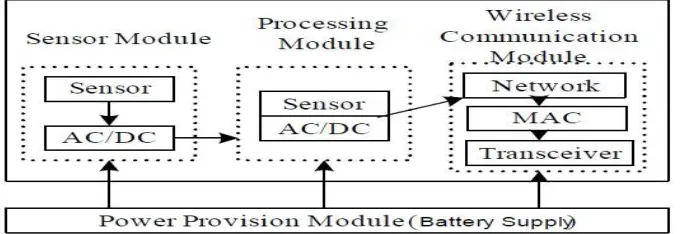
Wireless sensor networks (WSNs) are composed of a large number of affordable power-driven wireless sensor nodes, which detect and monitor physical parameters around them through self-organization. Efficient energy consumption of nodes to extend network lifetime is a prime design issue for wireless sensor networks because a successful operation of wireless sensor network depends upon battery life of sensor nodes. The Figure I shows the architecture of WSN node. It consist of four modules 1) Sensor Module 2) Processing Module 3) Wireless Communication Module and 4) Power Provision Module.
B. CLUSTERING
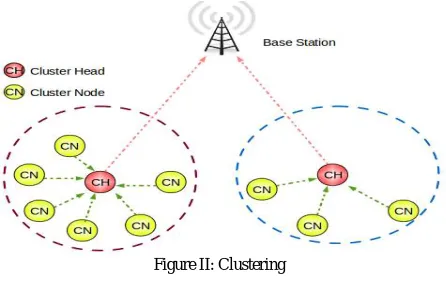
Clustering is an important technique in large multi-hop wireless sensor networks for obtaining scalability, reducing energy consumption and achieving better network performance. Clusters are grouping of sensor nodes and selection of cluster heads (CHs) for all the clusters. CHs collect the data from respective cluster’s nodes and forward the aggregated data to base station.
Once the WSN has been divided into clusters, the communication between nodes can be intra-cluster or intercluster. Intra-cluster communication comprises the message exchanges between the participating nodes and the CH. Intercluster communications include the transmission of messages between the CHs or between the CH and the BS. In all the cluster-based protocols we can locate three main stages during the clustering formation process: (a) cluster head election, (b) cluster formation (set-up phase), (c) data transmission phase (steady-state phase). Different perspectiveoccur to implement each one of these stages. For example, it is possible to use a fixed distribution of the SNs and the CH, or to use a dynamic algorithm for the location of the sensors and CH election. The Figure II shows clustering of nodes. Nodes select cluster head, cluster heads communicate with base station.
Figure II: Clustering
II. LITERATURE SURVEY
Vipin Pal and et al. have discussed the Clustering approach proposed in their paper has a threshold set on a number of cluster members and distance threshold for un-clustered nodes. The proposed method has balanced clusters and better cluster quality. Simulation results show that proposed solution outperform existing clustering algorithm and has extended network lifetime and low node death rate[1].
S SanthaMeena and et al. have discussed the clustering dimensions in Wireless Sensor Network balance the network energy by using the good clustering routing approaches. The modified architectures of LEACH, LEACH-Balanced, and Two-Level Hierarchy LEACH are analyzed and compared. This paper analysis the throughput, packet delivery ratio, residual energy and life-time of the all the three protocols LEACH, LEACH-Balanced and Two-Level Hierarchy LEACH. The TL-LEACH gives better performance compared to both LEACH and LEACH-B[2].
Mohamed Eshaftri and et al. have discussed the clustering scheme Load-balancing Cluster-Based Protocol (LCP) for wireless sensor networks was proposed as a more energy-efficient protocol. The main contribution of the LCP protocol is its ability to continue rotating the cluster head (CH) role between nodes within the same cluster, by selecting the node with the highest residual energy to become a CH for the next round. We compared and evaluated the LCP protocol performance with well-known Energy Efficient clustering protocols, which have the same aim increase the network lifetime. The simulation results showed that LCP protocol significant balance the energy consumption among the entire node and achieves an obvious improvement to the network’s lifetime by 15%[4].
Faisal Javeed and et al.The performance of BEENISH,TDEEC, DDEEC and DEEC for several networks withdifferent levels heterogeneity parameters.It is obvious from the above simulations that performance of every protocol differs while varying heterogeneity parameters. In real practical scenario heterogeneity parameters of WSN changes with passing rounds. From our work, we find BEENISH overall most efficient from all on metrics of stability period, network lifetime and throughput. TDEEC is also comparable in terms of network lifetime with BEENISH but on other hand stability period and throughput is much lower. DDEEC and DEEC are less efficient due to their two level heterogeneous probability functions and their performance is effected in high-level heterogeneous networks[5].
Kyung-Tae Kim and et al. An energy efficient clustering protocol for the self-organizing wireless sensor network. The proposed scheme introduces a new threshold value used in selecting the cluster heads in the network. We have also introduced a new tree construction approach inside each cluster to minimize the energy consumption of the sensor nodes. As a result, the proposed scheme can significantly reduce energy consumption and increase the lifetime of the network compared to the existing schemes[6].
Can Lv and et al. have discussed the clustering algorithm mainly takes into account reducing the total energy consumption through balancing the energy dissipated in each single node. By creating well-distributed clusters, not only the energy consumption of each cluster is balanced, but the data of each cluster can be routed to BS through inter-cluster multi-hop forwarding, which is an energy-saving method. With the evenly-distributed inter-clusters created by EDACH, the total energy consumption for inter-cluster and intra-cluster is reduced. The simulation results show that the lifetime of the network is extended effectively[7].
Pawan Singh Mehra and et al. a self-organising load balanced clustering protocol which increases the life span of the network effectively. Consideration of dominant factors like residual energy, proximity average, dissipation rate of the node, the number of times a node is chosen as CH and its distance to the base station during the selection of cluster head helps in selecting the best available node in the network for cluster head candidature. Incorporation of modified TDMA slot with sleeping mode makes the protocol more energy efficient. The overhead of reclustering in every round is removed by putting a threshold which determines reclustering requirement. Ensuring no two cluster heads within the same communication rangeRC contributes ineffectiveness of proposed work.Longerpersistentperiodof proposed work justifies the load balancing in the network[8].
Akshay S. Nagdive and et al. have discussed that to reduce the number of data transmission the hybrid compressive sensing CS is used in which the sensors are divided into clusters, each cluster contains a cluster head CH which is selected according to the maximum energy present in the batteries of sensor nodes and also the second maximum node is ready for further Cluster Head Selection. Here the sensed data is collected through the sensor nodes, each sensor sends the sensed data to the cluster head in the form of tree topology and gather all the data to the cluster Head[9].
also decreased significantly, for which the presence of active nodes in the area holds for a larger amount of time. The main target of our model is fulfilled by scattering the load among all nodes equally through multiple nested clustering. The sink node always dynamically selects the CCL by calculating the average residual energy by considering the initial energy of the node and strength of the network. Numerous experiments have been done by considering various parameters for different targeted sensors to find out the performance results. Also, the deployment area can be enhanced by the appropriate nomination of CCL considering the fact of load distributions among all nodes in the network. The future scope may be adopted with multiple mobile sensors and sink mobility where the dynamic behavior will play a vital role in energy efficiency[10].
Amit Sharma and et al. have discussed thatWSN’s are battery limited hence Network lifetime and energy saving is a major issue in this field, which leads us to work in this field. The examinations of routing protocols, especially clustering routing protocol i.e., LEACH and TEEN have been done. These protocols are applicable under specific constraints, i.e., LEACH works in a proactive homogeneous environment and TEEN works in a reactive homogeneous environment. These routing protocols have a common problem i.e., uneven load distribution and back transmission. In proposed scheme natural selection of CHs mechanism is used, which chooses the optimum number of cluster heads, each CH has residual energy more than average energy of network and distant to each other and also introduces modified free organization mechanism to form a cluster. From the simulation results, it concludes that for proactive homogeneous network proposed algorithm increase the network lifetime by 34.44% from LEACH, 33.24% from LEACH-ACH and 18.28% from LEACH-(ACH) 2 and for reactive homogeneous network the network lifetime increased by 70.32% from TEEN, 52.15% from TEEN-ACH and 26.03% from TEEN-(ACH) 2. Last node dead for different algorithms is shown in Table-2. Therefore, due to enhancing network lifetime of proposed algorithm, number of packets transmitted to sink node which increases the throughput of the network and also reduce the energy consumption of network[11].
Ming-Yu Tsai and et al. have discussed a Virtual Cluster Head Election Clustering Scheme, VCHEC, which achieved better cluster head distribution than LEACH. Unlike LEACH, VCHEC does not allow cluster heads locating too close to each other, it also promises that a cluster node can reach its cluster head within an appropriate range. Nodes do not need to transfer data to a faraway cluster head and leads to energy inefficiency. In VCHEC we also proposed an energy efficient cluster head election mechanism, which can select a node with higher residual energy[12].
III. CONCLUSION
Clustering of sensor nodes in wireless sensor networks is a good approach to minimize energy consumption of network. To design an optimum wireless sensor network we have to consider energy consumption and hence toextend the network lifetime are major challenges.The identified challenge of increasing lifetime of WSN network can be resolved in future using enhanced clustering method.
IV. ACKNOWLEDGMENTS
On the submission of this paper, I would like to extend my gratitude & sincere thanks to my project guide Prof. R. H. Borhade, HOD, Dept. of Information Technology for his constant motivation and support during the course of my work. I truly appreciate and value his guidance and encouragement. I would like to thank all faculty members of SKN College of Engineering and all who’s direct and indirect support helped me in my research work of paper.
REFERENCES
1. V. Pal, G. Singh and R. P. Yadav, "Balanced Cluster Size Solution to Extend Lifetime of Wireless Sensor Networks," in IEEE Internet of Things Journal, vol. 2, no. 5, pp. 399-401, Oct. 2015.
3. W. AbdEllatief, O. Younes, H. Ahmed and M. Hadhoud, "Energy efficient density-based clustering technique for wireless sensor network," 2016 8th International Conference on Knowledge and Smart Technology (KST), Chiangmai, 2016, pp. 196-200.
4. M. Eshaftri, A. Y. Al-Dubai, I. Romdhani and M. B. Yassien, "A new energy efficient Cluster-Based Protocol for Wireless Sensor Networks," 2015 Federated Conference on Computer Science and Information Systems (FedCSIS), Lodz, 2015, pp. 1209-1214.
5. F. Javeed, A. Naz, T. N. Qureshi, A. Basit and N. Iltaf, "A review on variant clustering designs in heterogeneous WSNs," 2015 National Software Engineering Conference (NSEC), Rawalpindi, 2015, pp. 48-54.
6. K. T. Kim, M. Y. Kim, J. H. Choi and H. Y. Youn, "An energy efficient and optimal randomized clustering for wireless sensor networks," 2015 IEEE/ACIS 16th International Conference on Software Engineering, Artificial Intelligence, Networking and Parallel/Distributed Computing (SNPD), Takamatsu, 2015, pp. 1-6.
7. C. Lv and L. Qiao, "Evenly-distributed clustering for wireless sensor network: A scalable, energy-efficient approach," 2016 IEEE International Conference of Online Analysis and Computing Science (ICOACS), Chongqing, 2016, pp. 229-234.
8. P. S. Mehra, M. N. Doja and B. Alam, "Energy efficient self organising load balanced clustering scheme for heterogeneous WSN," 2015 International Conference on Energy Economics and Environment (ICEEE), Noida, 2015, pp. 1-6.
9. A. S. Nagdive and P. K. Ingole, "An implementation of energy efficient data compression & security mechanism in clustered wireless sensor network," 2015 International Conference on Advances in Computer Engineering and Applications, Ghaziabad, 2015, pp. 375-380.
10. S. P. Nayak, S. C. Rai and S. K. Pradhan, "MERA: A Multi-clustered Energy Efficient Routing Algorithm in WSN," 2015 International Conference on Information Technology (ICIT), Bhubaneswar, 2015, pp. 37-42.
11. A. Sharma and P. Kansal, "Energy efficient load-balanced clustering algorithm for Wireless Sensor Network," 2015 Annual IEEE India Conference (INDICON), New Delhi, 2015, pp. 1-6.