Face Recognition System Using
Wavelet Normalization
R.Anitha
1, S.Ramila
2Assistant Professor, Dept. of CSE, Sri Krishna College of Technology, Coimbatore, India 1
Assistant Professor, Dept. of CSE, Sri Krishna College of Technology, Coimbatore, India 2
ABSTRACT: Facial recognition is an approach or a system to identify any individual. It can done by analysing and
pattern comparison. It is mainly used to provide the security for an individual. It faces some difficulty in case of different illumination. To overcome this, invariant illusion algorithm is used in this paper. Due to this,our system can work well under a different circumstances. It followed by three stages; preprocessing, a feature extraction, and recognition. Wavelet-based normalisation technique lightens the dark and highlight areas of the face image. To imitate the human visual system and examine a face image from the internal facial features to the external facial shapes, multiple face models along with complementary features are used. Features are extracted using Fourier transform. To classify the image, a simple metric Euclidean Distance is used.
KEYWORDS: Euclidean distance, Fourier feature, PCLDA, Single Scale Retinex, Wavelet-based normalisation
I. INTRODUCTION
Bio-metric system is a system that uses person’s identity as information (i.e., human characteristics, finger print, eye retinas and iris and facial patterns) .Face recognition is an application that capable of identifies the person from digital image or a video. Due to non-contact process, Face recognition has an advantage over the other Biometric systems like Finger print/palm print and iris. It doesn’t need the person to interact with the system.
Spoofing attack is a situation in which person’s identity is concealed by the third party. Many types of spoofing attacks are email spoofing, caller id spoofing, GPS spoofing etc. Falsifying face biometric samples are simple compared to other, because it doesn’t require any extra skills. Moreover, multimedia content are readily available in the internet social websites (such as facebook,T witter and you tube).To authenticate the user two types of methods are available, they are as follows 1.Knowledge based method-In this user-system interaction is present. 2.Token-Based methods-In this method user need to give some pass code by the way of smart card swiping or token code etc..The main drawbacks in this scheme are system will not authenticate the user who is responding and requesting. Face Recognition contains the following steps1.Enrollement, 2.Recognition and 3.Result.
This paper is organized as follows: In Section 2, various schemes are discussed. Pre processing steps are explained in section 3.In section 4, feature extraction method is discussed. Multiple face models and classifications are explained in section 5 and 6.Image results are discussed in section 7.Finally face recognition conclusion is depicted in section 8.
II. RELATEDWORK
A hierarchical framework approach was stated by Su et al.[1].It uses Fourier Transform and Gabor wavelets to to use both global and local features. In this framework, accuracy tends to high but
Endured heavy computational burden on target device which have low computational power. Global features are extracted.
make the system as more illumination tolerant and shift-invariant features of PCA and advanced correlation filters are combined. Since many correlation filter needed for the single person it makes more computation burden. To enforce the weak classifiers Wang and Tang[3] applied random sampling on training samples and feature vectors. It seems to very stable because it cover most of the face features, but do not deal with illumination variations.
Chang et al.[4]measures the normalized gradients of face contour locations. It measures each corresponding image. Computational cost is very low.It is permissible to illumination, but variations not allowed. Hwang et al. [5] used SSR normalization. Due to illuminations accuracy is too low. To overcome this, wavelet based normalized technique is used.
III.PREPROCESSING
Variance in illumination is the main obstacle for face recognition as face image of same person varies under different illuminations. This factor is serious, especially when appearance based methods are applied. A little illumination variation can significantly change the appearance based methods applied. There are numerous pre-processing algorithms to minimize the effect of illuminious change for face recognition.
In this paper, the illumination – insensitive integral gradient image method is proposed to overcome unexpected illumination changes in face recognition.
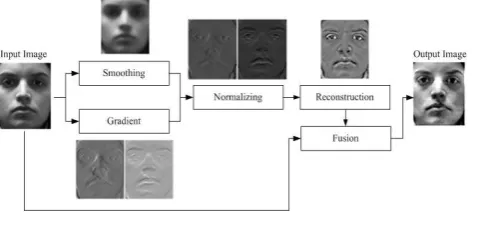
Fig 1. Pre-processing Stages
Figure (1) describes the processing stages of our work. In this, input image is taken into two processes. i) Smoothing and ii) gradient. From this process, features such as face, eyes, hairs etc.. are extracted. Noise can be removed from the resultant image under the normalization step. Original image is fused with the reconstructed image. On intrinsic and extrinsic factors we normalize the gradients and integrate the result with anisotropic diffusion method. Through this feature we compensate for unexpected artefacts and achieve smoother and natural output image for face recognition.
IV. FEATURE EXTRACTION
Features for a person classification are extracted to identify any invariance in face image against changes. Face recognition has been classified in to two different classes of approaches, the local-feature based method and the global feature based method. The local feature based analyses a various wavelet features extracted from high resolution image. They have low computational power due to heavy burden on target device. Global feature based approach extract features from low resolution image .they are better for good devices with low computational power in spite of limited accuracy compared with local feature based methods.
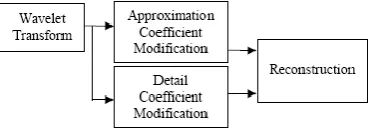
Fig 2. Wavelet-based normalisation
Wavelet-based normalisation [figure 2] is a combination of two approaches; histogram normalization and photometric normalization. 2D filter bank which contains low-pass and high pass filters is used to calculate the scaling factors and wavelet coefficient. Image is divided into four categories:
LL (Low-Low), LH (Low-High), HL(High-Low), and HH (High-High).
Above components are so called as approximation, horizontal, vertical and diagonal components. It must be calculated as individual to avoid correlation. Using different wavelet filter sets and/or different number of transform-levels will result in different decomposition results. Decomposition will result in some noise terms. Anisotropic diffusion method [7] is a kind of process to extract the original texture of an image and meanwhile it removes the noise. Images are taken into different hierarchical level. Images are divided into many segments as smooth regions. It can end when discontinuous rose. When we remove all the illumination variations it may induce to loss some needed information. To avoid this, original image is fused with reconstructed image. The fused image is obtained by:
χINGI = α χr + (1- α )χ
Where χr is the final reconstructed image and α is the weighting parameter, 0≤ α ≤ 1. Here, it is chosen as 0.5.
V.MULTIPLEFACEMODELSBASEDONHYBRIDFOURIERFEATURE
Multiple face models are constructed using graph method. It can attained by selective frequency bandwidth. To gain more specific extraction, we perform fourier features to all kind of images. Input images are divided into many blocks. In that Fourier filter is applied. By the usage of graph method, fourier features are fused. The Fourier transform is a complex function given as:
F(u,v) = R(u,v) + jI(u,v)
Where R(u,v) and I(u,v) are the real and imaginary components respectively. There are three different Fourier features i)the real and imaginary component domain, ii) Fourier spectrum domain, and iii)phase angle domain. To avoid the angular problem in phase angle the cosine values are used.
RI(u,v) = [R(u,v) I(u,v)]
⌠(u,v) = | F(u,v) = [R2(u,v)+ I2(u,v)]1/2 Φ(u,v) = cos(tan-1[I(u,v)/R(u,v)])
Fig 3. Multiple Face Models
In the above figure (3) The clear face model is formed to analyse the internal features of a face, such as the eyes, nose, and mouth, while the coarse face model includes the general structures of a face and the external components such as hair, ear, and jaw-line. Image should be prefect when it lies between the fine model and the coarse model. The clear face model is robust to background and hair style changes but sensitive to pose changes of the image. On the other hand, the coarse face model shows the opposite tendency.
VI. CLASSIFICATION
Now the test image subjected to recognition is also projected to the face space and then the weights corresponding to each eigenface [9] are found out. The weights of all the training images are found out and stored. Images are not directly stored as raw; it can stored by their weights. It can obtain by the way of eigen values. In order to obtain the best image, weights of the test images are concurrently compared with the trained image which is already stored in database. The comparison is done using the Euclidean distance nearest- neighbour classifier.
The easiest way to determine which face class /cluster provides the best description of an input face image is to find that class which minimizes the Euclidian distance [10]. Minimum the distance is the maximum is the match.
If the feature vector of the probe is x and that of a database face is y, where x=( x1, x2, x3,….xn) and y= (y1, y2,…...yn). The position of a point in a Euclidean n-space is a Euclidean vector. So, x and y are Euclidean vectors, starting from the origin of the space, and their tips indicate two points. The Euclidean norm, or Euclidean length, or magnitude of a vector measures the length of the vector as follows:
If the minimum value of the measured distance, € is below the threshold, then the recognition is successful and relevant information about the recognised face is provided from the database which contains information about the faces.
VII. RESULT ANALYSIS
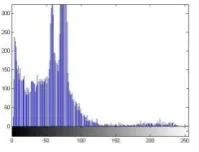
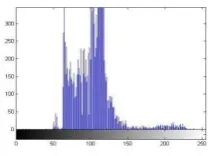
For performing the experiment, 100 images of 10 individuals with 10 images of each are taken. This recognition system tries to find the identity of a given face image according to its memory. The memory of a face recognizer is generally simulated by a training set.
Fig 5. After Wavelet-based Normalisation
The training set consists of the features extracted from known face images of different persons. As there are 10 images per individual in the ORL database, first 3 of them are used to train the system and the rest are used to test it. For testing the whole database, the faces used in training, testing and recognition are changed and the recognition performance is given for whole database. After the process output image is obtained(figure 5)
VIII.CONCLUSION
Ambient lighting changes greatly within and between days and among indoor and outdoor environments. Illumination variation is a major challenge which causes serious performance degradation for most practical face recognition systems.
To overcome the uncontrolled environmental problems, a novel illumination invariant pre-processing algorithm is used which includes the Wavelet-based normalization technique. This is a photometric normalization method based on human perception theory and illumination properties. It is a combination of two approaches, histogram normalization and photometric normalization. When compared to the single scale retinex method, the wavelet-based normalised image has not only enhanced contrast but also enhanced edges and details that will facilitate the further face recognition task. Thus, the result shows that the wavelet method can improve the face recognition rate.
REFERENCES
[1] Y. Su, S. Shan, X. Chen, and W. Gao, 2009, ―Hierarchical ensemble of global and local classifiers for face recognition,‖ IEEE Trans. Image Process
[2] M. Savvides, B. Kumar, and P. Khosla, 2004, ―Corefaces—Robust shift invariant PCA based correlation filter for illumination tolerant face recognition,‖ in Proc. IEEE, Comput. Vis. Pattern Recognition
[3] X. Wang and X. Tang,2004, ―Random sampling LDA for face recognition,‖ in Proc. IEEE. Comput. Vis. Pattern Recognition
[4] Chyuan-Huei Thomas Yang, Shang-Hang Lai, and Long Wen Chang,2003, ―A reliable face recognition algorithm based on matching normalized gradients in Proc. IEEE.
[5] Wonjun Hwang, Haitao Wang, Hyunwoo Kim, Seok-Cheol Kee, and Junmo Kim, 2011, ―Face Recognition System Using Multiple Face Model Of Hybrid Fourier Feature Under Uncontrolled Illumination Variation,‖ in Proc. IEEE
[6] S. Samsung,2005, ―Integral normalized gradient image —A novel illumination insensitive representation,‖ in Proc. IEEE Workshop Face Recognit. Grand Challenge Exper.,
[7] J. Malik and P. Perona, 1990, ―Scale-space and edge detection using anisotropic diffusion,‖ IEEE Trans.
[8] P. N. Belhumeur, J. P. Hespanha, and D. J. Kriegman, 1997, ―Eigenface vs. Fisherfaces: Recognition using class specific linear projection,‖ IEEE Trans. on Pattern Analysis and Machine Intelligence
[9] P. J. Phillips, H. Moon, S. A. Rizvi, and P. J. Rauss, ―The FERET evaluation methodology for face recognition algorithms,‖ IEEE Trans.Pattern Anal. Mach. Intell., vol. 22, no. 10, pp. 1090–1104, Oct. 2000.
[10] D. M. Blackburn, M. Bone, and P. J. Phillips, ―Facial recognition vendor test 2000 evaluation report,‖ Dec. 2000 [Online]. Available:
http://www.frvt.org/
[12] K. Messer, J. Kittler, M. Sadeghi, M. Hamouz, and A. Kostin et al.,―Face authentication test on the BANCA database,‖ in Proc. Int. Conf. Pattern Recognit., Aug. 2004, vol. 4, pp. 523–532.
[13] P. J. Phillips, P. J. Flynn, T. Scruggs, K. Bowyer, J. Chang, K. Hoffman, J. Marques, J. Min, and W. Worek, ―Overview of the face recognition grand challenge,‖ in Proc. IEEE. Comput. Vis. Pattern Recognit., Jun. 2005, vol. 1, pp. 947–954.