Horizontal Strut-Arm Optimization Effects on
Drag Coefficient
Rikhi Ramkissoon
1, Krishpersad Manohar
2, Anthony Adeyanju
3Ph.D. Candidate, Department of Mechanical and Manufacturing Engineering, The University of the West Indies,
St. Augustine, Trinidad, West Indies1
Senior Lecturer, Department of Mechanical and Manufacturing Engineering, The University of the West Indies,
St. Augustine, Trinidad, West Indies2
Senior Lecturer, Department of Mechanical Engineering, Ekiti State University, Ado-Ekiti, Nigeria3
ABSTRACT: Strut arms contribute significantly to the overall drag in VAWT and reduces the overall power output. Four low drag air foil cross section profiles suitable for strut arm construction were simulated and optimized using the XFOIL 1.0 program. The profile with the lowest simulated drag coefficient, UWI-1, was constructed and tested in an open-circuit suction type conventional non-return laboratory wind tunnel. The flow characteristic was examined experimentally using surface pressure measurements. The results showed that an increase in the Reynolds number from 3.32 x 10⁵ to 9.64 x 10⁵ resulted in a decrease in the drag coefficient from 0.01241 to 0.00984. This is a significantly lower drag coefficient when compared to the nominal value of about 0.4 for cylinders in cross flow within the Reynolds number range tested. The results obtained for the experimental drag coefficient values and the simulated XFOIL were within 10.7%.
KEYWORDS: Drag coefficient, Vertical axis wind turbine, Strut arm.
I. INTRODUCTION
Wind energy is one of the fastest growing alternative energy resources being tapped into as a viable nonpolluting renewable energy source. For centuries wind turbines has served as a practical way to capture and convert the kinetic energy of the wind to mechanical energy and in more recent times directly to electrical energy. The straight bladed Darrieus vertical axis wind turbine (VAWT) is very attractive for its low cost and simple design. The main advantages are the generator and gearbox can be placed on the ground facilitating easy maintenance, lower cost, and they accept wind from any direction eliminating the need for yaw mechanisms. However, the effective power conversion efficiency is lower than the popular horizontal axis wind turbine [1].
Research has shown that properly designed VAWT has the potential to compete with other renewable sources of energy and can be economically feasible. However, increasing the efficiency is critical in order to be an affordable alternative option in the increasingly competitive wind turbine market [1].
Struts gave rigidity to the blades and improved the turbine’s response to gravitational loads. However, struts have the aerodynamic disadvantage of disturbing flow and causing resistive torque. The struts can decrease potential output power by 26 %. Preliminary research indicated that strut modification increased the turbine output power up to 17% for wind speeds of 3.5 m/s to 5 m/s [1]. This effectively resulted in a 9% potential output power reduction compared to 26%. In this study, strut arm modifications were modeled and optimized to determine the design with the lowest drag.
II. VAWT SUPPORTING STRUTS
and strongly influence some natural frequencies of the rotor [2]. However, the strut add to the weight and cost and generate significant parasitic drag which reduces the net power output. Supporting struts must be strong enough to carry the weight of the blades, inertial and aerodynamic loads, and must also be stiff enough in both flexure and torsion to prevent excessive static and dynamic deflections. The design of supporting struts involves a trade-off between aerodynamic and structural requirements. The length of the supporting struts (i.e. the radius of the turbine) should be as low as possible to reduce the parasitic drag generated.
The blades of SB-VAWT can be supported with the horizontal struts in different orientations. The three main types of blades supports can be categorized as (i) cantilever support, (ii) simple support, and (iii) overhang support. To minimize the parasitic drag, cantilever or one horizontal supporting strut per blade is preferred. However, for smaller capacity SB-VAWT with high blade bending moments caused by centripetal acceleration, either simple or overhang supports (which utilize two struts per blade) are preferred [3].
III.SUPPORTING STRUT MODELLING
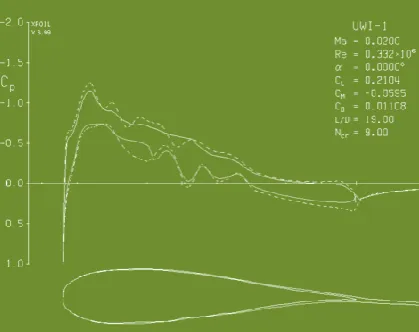
One of the main features and propose of struts is to provide structural stability for the turbine blades. Strength of the strut arms are of priority and the circular design is most common. The disadvantage is the large parasitic drag on the wind turbine during operation. The use of low drag airfoils attachments to the struts is not to act as blades or provide structural stability but to reduce drag. The desired characteristics of these strut modifiers was to get the lowest possible drag coefficient. Interest in the lift coefficient is not a requirement for the strut arm. Standard low drag airfoils was used as the starting point and then modified as an attachment to the round strut. The low drag airfoils selected as starting models were the AS 5045, GU 255118, Mersk 7 and the NACA 63-209. These base line airfoil models were changed and then modeled using the XFOIL modeling software until the drag was the lowest possible value. The resulting modified airfoil were named UWI-1, UWI-2, UWI-3 and UWI-4.
IV.XFOIL MODELING
Fig. 2: UWI-2 Strut modifier at a Reynolds number of 332000.
Fig. 3 UWI-3 Strut modifier at a Reynolds number of 332000.
Table 1. XFOIL Drag Coefficients for the different strut modifiers.
UWI 1 STRUT
UWI 2 STRUT
UWI 3 STRUT
UWI 4 STRUT
Re. No. Drag Coefficient
332000 0.01108 0.01897 0.01544 0.01455
532000 0.01022 0.01494 0.01359 0.01238
731000 0.00934 0.01307 0.01215 0.01113
964000 0.00922 0.01168 0.01105 0.01005
V. STRUT MODIFIER EXPERIMENTAL ANALYSIS
Based on the simulation with XFOIL the lowest drag strut modifier, UWI-1, was selected, built and was tested in the wind tunnel. The strut modifier model was fabricated with chord length, c = 0.16 m, Span, b = 0.24 m, and Chord-to-tunnel height, c/h = 0.26.
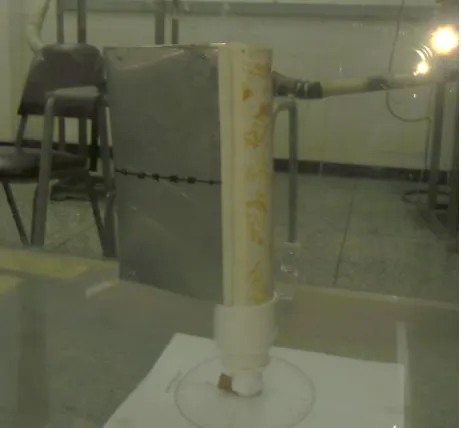
The model was mounted horizontally in the wind tunnel test section downstream of the contraction, spanning the entire width of the test section. The airfoil skin was fabricated with 16-gauge aluminum sheet metal and drilled to facilitate the installation of static pressure taps. There were a total of 4 tapped holes in the top and bottom surfaces of the airfoil skin. A 50.8 mm (2 inch) diameter PVC tubular axle was fitted unto the strut modifier plate was securely connected to an interface plate attached to the wind tunnel. The support plates were made of teak wood [7], making them easy for drilling but also strong and durable. The strut modifier model instrumented with static pressure taps is shown in Fig.5.
Figure 5. UWI-1 Strut modifier.
The calibrated wind tunnel was an open-circuit suction type conventional non-return design with one closed working section in which the airflow was completely contained within the laboratory. It was constructed with 9.49 mm thick plywood of dimensions 3.9116 m in overall length, 1.6256 m wide and 1.6256 m high at the mouth.
An automated system was used to acquire static surface pressure measurements sequentially from all the static pressure taps. LabVIEW software was used to acquire wall pressure measurements within the test section and for the airfoil and strut modifier static surface pressure measurements. All measurements made were at steady state conditions, atmospheric pressure and temperature variation under 2.0%.
Signals were acquired at a sampling rate of 5,000 Hz and with a sample size of 100,000 data points were discretized into 100 segments. The auto-spectral density was computed from the fast Fourier transform (FFT) of each signal segment, averaged over the number of segments and normalized by the variance of the signal so that the area under the curve was unity. Four test were carried out on the UWI-1 strut modifier, at each of the four Reynolds number modelled within the range 3.32 x 10⁵ to 9.64 x 10⁵ to determine the drag coefficient values. Steady state conditions existed for most of the testing periods and the variation between the sets of individual reading was within 3%. After each set of experiments, the testing equipment was inspected to ensure that they were functioning properly. The average was computed for each data set and the experimental results were compared to the software modeling results [8].
VI.RESULTS
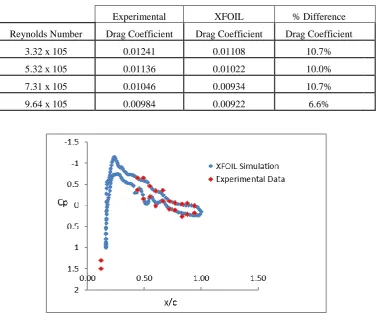
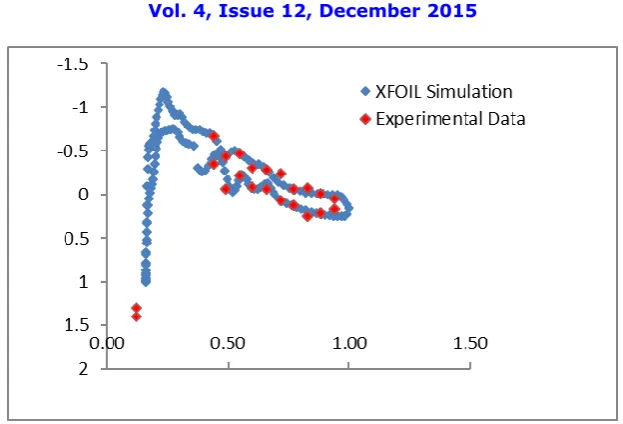
The experimental results and XFOIL simulated results for the UWI-1 are shown in Table 2 and graphically represented in Figs. 6 to 9.
Table 2. Drag coefficient variation with Reynolds number for Experimental versus Simulated.
Experimental XFOIL % Difference
Reynolds Number Drag Coefficient Drag Coefficient Drag Coefficient
3.32 x 10⁵ 0.01241 0.01108 10.7%
5.32 x 10⁵ 0.01136 0.01022 10.0%
7.31 x 10⁵ 0.01046 0.00934 10.7%
9.64 x 10⁵ 0.00984 0.00922 6.6%
Fig. 7. Analytical vs. Experimental data at a Reynolds number of 532,000.
Fig. 9. Analytical vs. Experimental data at a Reynolds number of 964,000.
VII. DISCUSSION AND CONCLUSION
The flow characteristic over the strut modifier was examined experimentally using mean surface pressure for a range of Reynolds numbers from 3.32 x 10⁵ to 9.64 x 10⁵. Steady state conditions existed for most of the testing periods and the variation between the sets of individual reading was within 3%. Drag coefficients were calculated from the lift coefficient data computed based on surface pressure distributions and presented in Table 2. The results showed that, on the average, an increase in the critical Reynolds number from 3.32 x 10⁵ to 9.64 x 10⁵ resulted in a decrease in the drag coefficient from 0.01241 to 0.00984. This is a significantly lower drag coefficient when compared to the nominal value of about 0.4 for cylinders in cross flow within the Reynolds number range tested [9]. The results obtained for the experimental drag coefficient values were in very close comparison with the simulated XFOIL values with 10.7% being the largest difference, 6.60 % the lowest.
REFERENCES
[1] Rikhi Ramkissoon and Krishpersad Manohar, “Increasing the Power Output of the Darrieus Vertical Axis Wind Turbine.” British Journal of Applied Science & Technology, Vol. 3, No.1, pp. 77-90, 2013.
[2] I. Paraschivoiu, “Wind Turbine Design: With Emphasis on Darrieus Concept”, Polytechnic International Press. Montreal, Canada, 2002. [3] B. K. Kirke, “Evaluation of Self-Starting Vertical Axis Wind Turbines for Stand-Alone Applications”, PhD Thesis, Griffith University,
Australia, 1998.
[4] M. Drela, “XFOIL: An Analysis and Design System for Low Reynolds Number Airfoils”, Conference on Low Reynolds Number Airfoil Aerodynamics. University of Notre Dame, Australia, 1989.
[5] M. Drela and M. B. Giles, “Viscous-Inviscid Analysis of Transonic and Low Reynolds Number Airfoils.” AIAA Journal Vol. 25, No. 10, pp. 1347-1355, 1987.
[6] Ryan J. Gerakopulos, “Investigating Flow over an Airfoil at Low Reynolds Numbers Using Novel Time-Resolved Surface Pressure Measurements”, Master’s thesis, University of Waterloo, Ontario, Canada, 2011.
[7] Krishpersad Manohar, David Yarbrough, Dale Ramlakhan and Gurmohan Kochhar, “Thermal Conductivity of Trinidad Wood,” Proc. International Conference on Thermal Insulation (volume 11), The Greenbrier, White Sulphur Springs, West Virginia, USA, January 12-14, pp.103-112, 2004.
[8] M. Islam, A. Fartaj and R. Carriveau, “Analysis of the Design Parameters Related to a Fixed-Pitched Straight-Bladed Vertical Axis Wind Turbine.” Wind Engineering, Vol. 32, No. 5, pp. 491–507, 2008.