ISSN(Online) : 2319 - 8753
ISSN (Print) : 2347 - 6710
I
nternational
J
ournal of
I
nnovative
R
esearch in
S
cience,
E
ngineering and
T
echnology
(An ISO 3297: 2007 Certified Organization)
Vol. 4, Issue 2, February 2015
Differentiation of Level Process Values for
Diverse PID Controller Techniques
G.Karpagam
1, M.Nalini
1, G.Savithri
3UGStudent, Department of Instrumentation &Control Engineering, Saranathan College of Engineering, Trichy, Tamil Nadu, India1,2,3
ABSTRACT: The main purport of this paper is to ascertain the best control action for a cylindrical tank level process using PID controllers. A PID controller is the combination of proportional, Integral and derivative control action which possess the ability to reduce the present, past and anticipation of errors. It has the optimal control dynamics of Zero steady state, quick response, no oscillation and higher stability. Initially, the FOPTD with dead time is identified from a real time process using the process modelling of SK method. Various controller tuning methods such as MZN (Modified Ziegler Nichol’s), IMC (Internal Model Control), CHR (Chien Hrones Reswick), ZN (Ziegler Nichol’s) and TL (Tyreus-Luyben)are implemented for this process and based on the examination of time domain specifications and performance error criteria ,the best control action is determined.
KEYWORDS: Cylindrical tank, Level, NI ELVIS, MATLAB, PID Controller I. INTRODUCTION
Controlling of Level process is considered as an important role in process industries. Therefore, to control such process PID controllers comes into picture. A PID control loop feedback mechanism is to control the error i.e. the deviation from the process variable and the required set point [2]. Manipulated variable is used to accomplish the process of reducing the errors to get the desired set point. A PID is also known as Three term controller due to the involvement of three separate constant parameters (Proportional, Integral, Derivative values).Response of the process can be examined by the degree of overshoot and oscillation.
The plant is controlled by a control input u(t), which can be expressed as
𝑢 𝑡 = 𝑘𝑝𝑒 𝑡 + 𝑘𝑖 𝑒(𝑡) 𝑑𝑡 + 𝑘𝑑
𝑑𝑒(𝑡) 𝑑𝑡
Where,
𝑘𝑝 Proportional gain
𝑘𝑖 Integral gain
𝑘𝑑 Derivative gain
The term 𝑘𝑝 has the adjustment of controlled output, 𝑘𝑖 produces the zero steady state and 𝑘𝑑 provides rapid system
response. Present error e(t), past error de(t)/dt and anticipated error ∫e(t) dt reduction makes the controller as “Bread and Butter” for control Engineers. Performance Specification like marginal stability, Transient response and bandwidth are enhanced using tuning of PID controller.
MATLAB is a matrix Laboratory which is used by all sorts of Engineers. It helps to research and visualize ideas and get together around different field .It provides ease to user by offering graphical representation in programming. NI ELVIS ( Educational Laboratory Virtual Instrumentation Suite) is a hands-on design and prototyping platform that integrating the 12 most commonly used instrument. It connects Pc through USB connection, provide quick and easy acquisition and display of measurement.
ISSN(Online) : 2319 - 8753
ISSN (Print) : 2347 - 6710
I
nternational
J
ournal of
I
nnovative
R
esearch in
S
cience,
E
ngineering and
T
echnology
(An ISO 3297: 2007 Certified Organization)
Vol. 4, Issue 2, February 2015
transfer function, the PID tuning parameters (Kp, Ki, Kd) are calculated and it is applied to various tuning methods. The closed loop response can be obtained by simulation process using calculated values. In the Simulation process, the values are passed to PID controller with the help of MATLAB software. Based on the process output, the time domain specifications (Rise time, Peak time, Peak overshoot and Settling time) and error criteria values (ITAE, IAE, ISE, MSE) are encountered. On comparing the above specified characteristics which is shown in the tabulations below, the best controller for the real time cylindrical tank level process is found.
II. RELATED WORK
The procedure of the work is analysed and documented below
Interfacing of real time cylindrical tank with PC and NI ELVIS
Observation of change in level value with respect to time
Analysis of readings and determination of the system function
Simulation of diverse tuning methods which is invoked in the MATLAB software
Analysis of the characteristics of process interms of time domain specifications and Performance error criteria
Conclusion of best suitable controller for the cylindrical level system.
III. EXPERIMENTAL SETUP
It consists of process tank, level transmitter, pump, I/P converter, Computer, Rotameter. The inlet range of the rotameter is (10-100) LPH which pass the flow to the storage tank with the help of centrifugal pump of 0.5HP causing the level to increase. The level of the tank is sensed by two wire sensor and transmitted to the controller (PC).The electronic range of the level transmitter is (0-90) cm and output is (4-20) mA. A control valve of pneumatic actuator with air to close type is used, which acts based on the I/P converter pressure value of (3-15) psi achieves the level control.
ISSN(Online) : 2319 - 8753
ISSN (Print) : 2347 - 6710
I
nternational
J
ournal of
I
nnovative
R
esearch in
S
cience,
E
ngineering and
T
echnology
(An ISO 3297: 2007 Certified Organization)
Vol. 4, Issue 2, February 2015
IV.PROCESS IDENTIFICATION
OPEN LOOP RESPONSE (TWO POINT METHOD):
In the level process to determine the transfer function the readings are taken between level and time and it is enforced in SK method. The SK method formula is
td=1.3t35.3-0.29t85.3
p=0.67(t85.3-t35.3)
REAL TIME READINGS FOR LEVEL PROCESS: TIME PROCESS
VARIABLE 0 0.92 5 1.27 10 1.3 15 1.35 20 1.38 25 1.38 30 1.41 35 1.45 40 1.49 45 1.52 50 1.55 55 1.58 60 1.61 65 1.66
70 1.71 75 1.74 80 1.77 85 1.81 95 1.87 105 1.9 205 2.46 305 2.87 405 3.17 505 3.38 605 3.54 705 3.64 805 3.72 905 3.77 1005 3.81 1100 3.81 V. DETERMINATION OF TRANSFER FUNCTION
Transfer function defines the relationship between input and output parameters of level process. Generally the transfer function is expressed as
G s =kpe
−τd(s)
τs + 1
Where
Kp is the gain of the process td is the dead time and
τis the time constant of the system
From the above readings and the graph plotted below, the parameters are calculated using SK method which provides the transfer function of
Level =0.09633e
−9.95s
268s + 1
VI.TUNING METHODS Ziegler Nichol’s Method:
ISSN(Online): 2319-8753
ISSN (Print): 2347-6710
I
nternational
J
ournal of
I
nnovative
R
esearch in
S
cience,
E
ngineering and
T
echnology
(An ISO 3297: 2007 Certified Organization)
Vol. 4, Issue 1, January 2015
requires Ku(ultimate gain) and Pu (ultimate time period). To find the values bode and root locus are needed, which can be found by coding in a M-File. It provides a table to find kp,ki and kd values by substituting the determined Ku and Pu values.
Modified Ziegler Nichol’s Method:
It is the upgraded version of Ziegler Nichol’s Method and it provides the better response with good stability. This provides the smaller overshoot and reduces the undesirable oscillation
Tyreus-Luyben Method:
It starts with a low value of Kp and perturb the system input to an oscillation in output. By increasing the Kp value, sustained oscillation is observed. Ku used is the smallest value of Kp, which achieves oscillation and Pu is the period of oscillation at Ku.
Chien Hrones Reswick Method:
It focuses on two factors Set point Tracking and Disturbance Rejection, which further has a division of No overshoot and some (20%) overshoot[1]. Based on the application, whether the desired level is to be reached or the noise to be eliminated, the factors are selected.
Internal Model Control:
IMC is developed by Garcia and Morari in the year 1980.The controller depends on two element and they are complexity of the model and performance requirements given by the designer.
VII. MINIMUM INTEGRAL ERROR CRITERIA
The criteria are used to figure out the best controller for various methods. They are i) ITAE : Integral Time Absolute Error
This error criterion produces a system based on the time .It has sluggish response in the initial stage and settle it quickly by avoiding oscillations.
ITAE = t e(t) dt
T
0
ii) IAE : Integral Absolute Error
It does not weight any errors but provides the less sustained oscillation.
IAE = e(t) dt
T
0
iii) ISE: Integral Square error
It provides the better response for larger errors because the square of larger error results in further larger value. So it responds quickly for larger errors and took larger time period for smaller errors.[3]
ISE = e2(t) dt T
0
iv) MSE: Mean Square Error:
It is mostly used for defining the natural energy of a signal and it’s popularity is due to simple usage even it can be used in signal processing.
ITAE = t e2(t) dt T
ISSN(Online): 2319-8753
ISSN (Print): 2347-6710
I
nternational
J
ournal of
I
nnovative
R
esearch in
S
cience,
E
ngineering and
T
echnology
(An ISO 3297: 2007 Certified Organization)
Vol. 4, Issue 1, January 2015
VIII. RESULTS & COMPARISON FIGURE 1
(A) PID values for different tuning methods
Using various controller tuning methods and with the help of their respective formula, the tuning parameters are found and tabulated below
TUNING METHODS KP KI KD
ZIEGLER NICHOL’S 341.4 22.176 1313.96
MODIFIED ZN 187.77 12.19 1927.14
CHIEN HRONES RESWICK
167.16 0.625 834.60
TYREUS- LUYBEN 177.81 4.887 869
INTERNAL MODEL CONTROL
10.97 0.040 0.499
( B) Time Domain Specifications
From the simulated response representing the real time level process, their characteristics are determined and listed out in a tabulation below
TUNING METHODS
SETTLING TIME RISE TIME PEAK TIME PEAK
OVERSHOOT ZIEGLER
NICHOL’S
196 39.825 15 27.2
MODIFIED ZN 450 40.13 63.5 28.3
CHIEN HRONES RESWICK
800 59.585 90 3
TYREUS- LUYBEN
225 39.95 64.05 39.7
INTERNAL MODEL CONTROL
700 75 0 0
(C) Performance Error Criteria
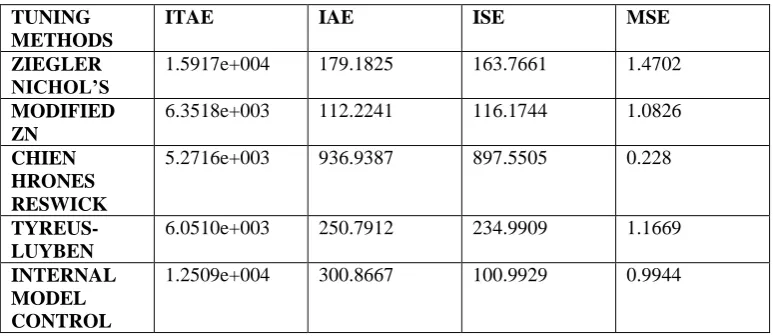
To find the best controller, the error reduction standards are necessary. Therefore, ITAE,IAE,ISE and MSE values are shown below in a tabulation
TUNING METHODS
ITAE IAE ISE MSE
ZIEGLER NICHOL’S
1.5917e+004 179.1825 163.7661 1.4702
MODIFIED ZN
6.3518e+003 112.2241 116.1744 1.0826
CHIEN HRONES RESWICK
5.2716e+003 936.9387 897.5505 0.228
TYREUS- LUYBEN
6.0510e+003 250.7912 234.9909 1.1669
ISSN(Online): 2319-8753
ISSN (Print): 2347-6710
I
nternational
J
ournal of
I
nnovative
R
esearch in
S
cience,
E
ngineering and
T
echnology
(An ISO 3297: 2007 Certified Organization)
Vol. 4, Issue 1, January 2015
In the above figure 1, (A) is the PID values for various tuning methods are calculated and the characteristics of the process when it is fed into the system are listed in (B) and (C) as time domain specifications and error criteria.
IX.GRAPHS FIGURE 2
(A) Open loop response
The response taken from the level transmitter between level and time is plotted below
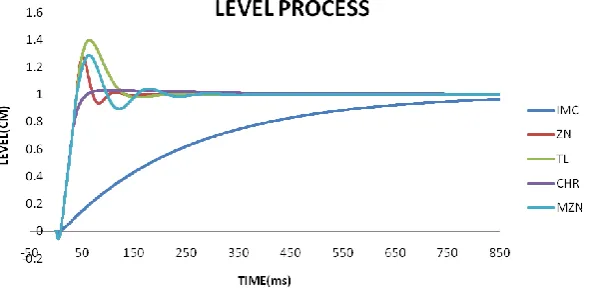
(B) Closed loop response of various tuning Methods
Closed loop response using different PID tuning methods are plotted in a single graph for the ease of comparison
ISSN(Online): 2319-8753
ISSN (Print): 2347-6710
I
nternational
J
ournal of
I
nnovative
R
esearch in
S
cience,
E
ngineering and
T
echnology
(An ISO 3297: 2007 Certified Organization)
Vol. 4, Issue 1, January 2015
X. CONCLUSION
From the above analysis of the real time cylindrical tank process, several criteria’s are established. Based on certain feature,the best controller has to be observed.
Depending on time domain specifications and minimum error integral criteria, the controller which possesses the best characteristic is ZIEGLER NICHOL’S METHOD. Therefore, ZN is suitable for the level process
G s =0.09633e
−9.95s
268s + 1
REFERENCES
[1] Mohammad Shahrokhi and Alireza Zomorrodi, “Comparison of PID Controller Tuning Methods “, 2012
[2] Tuning Of Controllers for Non Linear Process Using Intelligent Techniques D.Mercy1, September 2013 S.M.Girirajkumar IJAREEIE Vol. 2, Issue 9, September 2013