ISSN(Online) : 2319 - 8753
ISSN (Print) : 2347 - 6710
I
nternational
J
ournal of
I
nnovative
R
esearch in
S
cience,
E
ngineering and
T
echnology
(An ISO 3297: 2007 Certified Organization)
Vol. 4, Issue 2, February 2015
Synthesis, Characterization, Antimicrobial
Activity, Antifungal Activity and DNA
Cleavage Studies of Transition Metal
Complexes with Schiff Base Ligand
Anil Kumar M R
1, Shanmukhappa S
2*,Rangaswamy B E
3, Revanasiddappa M
4ResearchCandidate, Department of Chemistry, Bapuji Institute of Engineering and Technology, Davangere
Karnataka, India1.
Professor, Department of Chemistry, Bapuji Institute of Engineering and Technology, Davangere, Karnataka, India2.
Professor and Head, Department of Biotechnology, Bapuji Institute of Engineering and Technology,
Davangere, Karnataka, India3.
AssociateProfessor, Department of Engineering Chemistry, PESIT – Bangalore South Campus, Hosur Road,
Bangalore, Karnataka, India4.
ABSTRACT: Transition metal complexes of Cu(II), Co(II), Ni(II) and Zn(II) have been synthesized with the Schiff base ligand prepared by the condensation reaction between isooxazol-3-yl amine and salicylaldehyde. Elemental analysis of these complexes suggest that these metal ions forms complexes of type ML2(H2O)2 stoichiometry for Cu(II), Co(II), Ni(II) and Zn(II). The ligand behaves as bidentate and forms coordinate bonds through O and N atoms. Magnetic susceptibility, IR, UV – Visible, Mass and ESR spectral studies suggest that Cu(II), Co(II), Ni(II) and Zn(II) complexes posses octahedral geometry. The complexes were tested for their antimicrobial activity against the bacterial strains Staphylococcus aureus and Bacillus subtilis. The Schiff base metal complexes evaluated for their antifungal activity against the fungi Aspergillus niger and Cladosporium oxysporum. The DNA cleavage studies of Schiff base complexes were studied by agarose gel electrophoresis method using Calf – Thymus DNA.
KEY WORDS: Schiff base, metal complexes, antimicrobial activity, antifungal activity, DNA cleavage
I. INTRODUCTION
Schiff bases have often been used as chelating ligands in coordination chemistry[1]. These Schiff bases are biologically[2] as well as synthetically[3] important nitrogen containing compounds having azomethine group. Schiff bases can be synthesized from an aromatic amine and a carbonyl compound by nucleophilic addition forming an imine. Schiff bases of the general formula RR′C=NR{Prime} that are obtained typically by condensation of an aldehyde or ketone with a primary amine(as aniline) with elimination of water[4]. Metal complexes of Schiff bases containing nitrogen donor ligands have wide applications in dye industry, food industry, and biological activities[5-6]. A large number of Schiff bases and their complexes have been studied because of their interesting and important properties like catalytic property and transfer of amino group[7] and ability to form complexes with wide range of transition metals[8]. The interaction of schiff base metal complexes with DNA has gained much interest towards their applications as therapeutic agents[9-10].
ISSN(Online) : 2319 - 8753
ISSN (Print) : 2347 - 6710
I
nternational
J
ournal of
I
nnovative
R
esearch in
S
cience,
E
ngineering and
T
echnology
(An ISO 3297: 2007 Certified Organization)
Vol. 4, Issue 2, February 2015
OH N
O N
Figure 1: Proposed Structure of Ligand
II. MATERIALS AND METHODS
Analytical grade metal chloride salts, viz. NiCl2. CoCl2, CuCl2, and ZnCl2 are used. The chemicals used are of analytical grade and solvents are used after distillation. Molar conductivities of 10-3M solutions were carried out using EM 183 EC conductivity meter. Elemental analysis results for the prepared complexes are obtained from microanalysis of Carbon, Hydrogen, Nitrogen and Oxygen using Thermo Finnigan FLASH EA 1112 CHNS analyzer. Melting points for the prepared complexes are obtained from Electric melting point apparatus Tempo make. FT - IR spectra were recorded on a Thermo Nicolet Avatar FTIR-ATR spectrometer with 4 cm-1 resolution in the frequency range 400 – 4000 cm-1 and 1H NMR spectra of the was recorded in DMSO-d6 solvent and the spectrum were recorded on a DSX- 300/AV-III 400/DRX- 500/AV-III500/AV-700 NMR spectrometer at IISc, Bangalore. UV – Visible spectra was recorded on Ultraviolet – Visible spectrophotometer. The magnetic susceptibility was measured at room temperature using Gouy balance. ESR spectrum was recorded on a Varian USA E112 spectrophotometer. Mass spectra were recorded on a JEOL SX 102/DA 6000 Mass spectrophotometer using argon/xenon (6 kV, 10 mA) as the FAB gas. The DNA cleavage activity of Cu(II), Ni(II) and Ni(II) complexes were studied by agarose gel electrophoresis method using Calf-Thymus DNA. Antibacterial activity of the Schiff base and metal complexes against bacterial strains such as Staphylococcus aureu and Bacillus subtilis was studied by agar diffusion method. The antifungal activities of complexes have been studied by agar diffusion method against the fungi Aspergillus Niger and Cladosporium Oxysporum.
Synthesis of Schiff base ligand: 10 mL of isoxazol – 3 – yl amine is mixed with 10 ml of salicylaldehyde in a round bottom three necked flask and then ethanol is added as solvent and about two to three drops of concentrated hydrochloric acid is added. This mixture is refluxed on a water bath maintained at about 600C for about two hours. Then the contents of the flask are added to ice water. Then the obtained yellow solid is separated by filtration and dried in electric oven. Yield: 80%
Synthesis of metal complexes: The metal complexes were prepared by mixing of 50 mL of 2.5 mmol ethanolic solution of CoCl2.6H2O / NiCl2.6H2O / CuCl2.6H2O / ZnSO4.7H2O with 50 mL of 5 mmol ethanolic solution of the Schiff base ligands in 1:2 (metal: ligand) ratio. The resulting mixture was refluxed on water bath for about 4-5 hours. A coloured product appeared on standing and cooling the above solution. The precipitated complex was filtered and recrystallized with ethanol and then dried in an electric oven at 500 – 700 C [11-12]. Yield: 60-70%.
III. RESULTS AND DISCUSSION
The analytical data of complexes and their molar conductance values are given in table 1. All these complexes are analysed. The stoichiometry of the ratio 1:2 of the type ML2(H2O)2.
Compound
Molecular
formula Elemental analysis, found(calculated) Colour M.P (OC)
Molar conductivity (Scm2mol-1)
C H O N M
Ligand C10H8O2N2
63.78 (63.82)
4.18 (4.25)
16.94 (17.02)
14.73
(14.89) ---- Yellow 140 --- Co
complex CoL2(H2O)2
50.60 (50.96)
4.14 (4.24)
19.94 (20.38)
11.68 (11.89)
12.42
ISSN(Online) : 2319 - 8753
ISSN (Print) : 2347 - 6710
I
nternational
J
ournal of
I
nnovative
R
esearch in
S
cience,
E
ngineering and
T
echnology
(An ISO 3297: 2007 Certified Organization)
Vol. 4, Issue 2, February 2015
(50.98) (4.25) (20.39) (11.89) (12.46) Green Cu
complex CuL2(H2O)2
50.34 (50.46)
4.06 (4.20)
20.10 (20.18)
12.63 (12.68)
13.26
(13.36) Dark > 300 9.18 Zn
complex ZnL2(H2O)2
50.08 (50.24)
4.08 (4.18)
20.00 (20.09)
11.64 (11.72)
13.68
(13.75) Yellow > 300 8.44 Table 1. Elemental analysis, colour, melting point and conductance data of Ligand and metal complexes
1H NMR spectral data of ligand:
1HNMR spectra of the Ligand was recorded and the chemical shifts observed at 9.1 is assigned to the proton of the imine group (CH=N) as a singlet. The OH resonance in the 1H-NMR spectra appears as a singlet at 12.00 ppm. The aromatic protons of salicylaldehyde side of the ligand, appear as multiple peaks at 6.98-7.38 ppm.
IR spectral data:
The IR spectral data of Ligand and metal complexes are listed in table 2.
IR spectral data of the ligand the band seen at 3151.5 cm-1 is due to C – H streching of hydrogen attached to aromatic ring. The IR spectra of Ligand do not show bands at 1725 cm-1 and 3300 cm-1, which are due to C=O group and –NH2 group but in the spectrum of ligand there is a band present at 1613.6 cm-1 which is due to the streching frequeny of – C=N (azomethine) group[13]. This confirms the formation of –C=N (azomethine) group.
In the complexes band due to the streching frequeny of –C=N is shifted to lower frequency which indicates coordination of the nitrogen of azomethine group to the metal[14]. In the free ligand the band observed at 1206 cm-1 is due to the presence of –OH group attached to aromatic ring but in the complexes O atom coordinates through metal ion due to deprotonation of phenolic group. The metal complexes exhibit bands in the range(3650 – 3785 cm-1) shows the presence of water molecules coordinated to the metal[15].
Sl. No. Ligand / Complexes νN – H νC = N νC – O νM – O νM – N
1 C10H8O2N2 3151 1613.6 1409.6 -- --
2 Co(C10H8O2N2)2(H2O)2 3390.6 1520.6 1380.6 485.2 512.4
3 Ni(C10H8O2N2)2 (H2O)2 3402 1526 1380.5 500 520
4 Cu(C10H8O2N2)2 (H2O)2 3400 1602.2 1310.6 480 510
5 Zn(C10H8O2N2)2 (H2O)2 3350 1588.5 1386.4 476 494 Table 2. IR spectral data(cm-1) of ligand and its complexes
Electronic spectra:
In electronic spectra the band due to n → π* transition of azomethine group is expected at 325nm but in the complexes the bands of azomethine group are shifted to higher wavelengths which indicates that the nitrogen atom of imine group is involved in complexation with metal ion. In the spectra of complexes a very weak low intensity absorption band is observed viz. for Co(II) complex at 476.1 nm [4T1g (F) → 4T1g(P)], for Ni(II) complex(charge transfer) at 445.6 nm [3A2g (F) → 3T1g(P)], for Cu(II) complex(d–d transition) at 445 nm [2Eg → 2T2g] and this supports the octahedral geometry of metal complexes[16].
Magnetic Susceptibility data:
The spin free octahedral cobalt(II) complex was reported to exhibit magnetic moment in the range 4.46 to 5.53 BM. Our synthecised cobalt(II) complex exhibit magnetic moment of 4.92 BM. Hence the observed moment for the cobalt(II) complex indicates that it has an octahedral geometry.
The spin free octahedral nickel(II) complex was reported to exhibit magnetic moment in the range 2.82 to 3.4 BM. Our synthecised nickel(II) complex exhibit magnetic moment of 2.98 BM. Hence the observed moment for the nickel(II) complex indicates that it has an octahedral geometry.
ISSN(Online) : 2319 - 8753
ISSN (Print) : 2347 - 6710
I
nternational
J
ournal of
I
nnovative
R
esearch in
S
cience,
E
ngineering and
T
echnology
(An ISO 3297: 2007 Certified Organization)
Vol. 4, Issue 2, February 2015
ESR spectra:
The X – band ESR spectra of Cu(II) complex is recorded at room temperature. The ESR spectra of Cu(II) complex is shown in figure 2. The Cu(II) complex posses 𝑔║value of 2.094 and 𝑔┴ value of 2.066. The value of 𝑔║> 𝑔┴ and 𝑔║>
𝑔┴ > ge (2.0023) suggests the presence of unpaired electron predominantly in the 𝑑𝑥2− 𝑦2orbital. The deviation of calculated gav(2.0754) from that of the free electron(2.0023) is due to covalent character of metal – ligand bond. The 𝑔║ value less than 2.3 indicates covalent environment. Based on these observations copper(II) complex may have octahedral geometry[19-20].
Figure 2: ESR Spectrum of Cu(II) complex
Mass spectra:
The mass spectra of the complex shows a molecular ion peak at m/z 430.6 which corresponds to molecular weight of the complex (469) by the loss of water molecules due to fragmentation[21]. The mass spectra (figure No.3) of complex show multiple peaks representing successive degradation of complex molecule due to formation of different fragments. The fragments of species undergo demetallisation giving a peak at m/z 386.8. The peaks of appreciable intensity have been observed at m/z value 332.7 and 234.6 suggests the fragmentation pattern[22].
ISSN(Online) : 2319 - 8753
ISSN (Print) : 2347 - 6710
I
nternational
J
ournal of
I
nnovative
R
esearch in
S
cience,
E
ngineering and
T
echnology
(An ISO 3297: 2007 Certified Organization)
Vol. 4, Issue 2, February 2015
DNA Cleavage Studies:
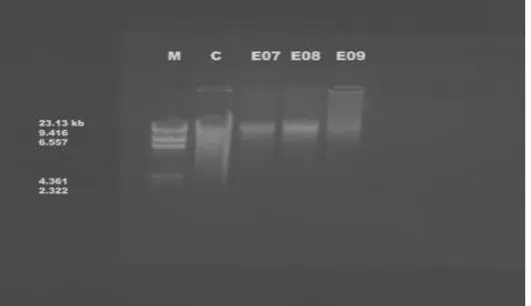
The DNA cleavage activity of Co(II), Ni(II) and Cu(II) complexes were studied by agarose gel electrophoresis method using Calf-Thymus DNA. The gel after electrophoresis reveal that the intensity of DNA is diminished which is due to cleavage of DNA by metal complexes and this indicates the role of metal ions in the cleavage reactions. The difference was observed in the bands of metal complexes compared to control DNA due to molecular weight difference. This shows control DNA did not alone show any apparent cleavage. Since the compounds were observed to cleave DNA, it can be concluded that the compounds inhibit the growth of pathogenic organism by cleaving the genome[23-24]. The DNA cleavage of metal complexes are shown in figure 4.
Figure 4: DNA cleavage analysis of metal complexes. [E07- Co(II), E-08- Ni(II), E-09- Cu(II)]
Antibacterial activity:
In this study we investigated antibacterial activity of the Schiff base and metal complexes against bacterial strains such as Staphylococcus aureu and Bacillus subtilis by agar diffusion method. The concentrations used for the bacterial stains are 25, 50, 100, 200, 400 and 800 μg/ml. Gentamycin is used as standard antibiotic and DMSO is used as solvent. All the compounds were inoculated using a loop onto plates containing Nutrient Agar (NA) media and incubated at 32oC for 24 hours. To carry out agar diffusion assay the bacterial suspensions were prepared in sterile distilled water[25-27]. The antibacterial activities of metal complexes against Staphylococcus aureus and Bacillus subtilis are shown in Table 3.
Table 3: Antimicrobial activity of compounds
The cobalt, nickel and copper metal complexes exhibited good antibacterial activity when compared to free Ligand against the bacterial strains Staphylococcus aureu and Bacillus subtilis. But the antibacterial activity shown by Schiff base ligand and complexes was less when compared to antibacterial activity of shown by standard antibiotic gentamycin.
Sl.No. Compound
Inhibition zone diameter in mm
Staphylococcus aureus Bacillus subtilis
25 µg
50 µg
100 µg
200 µg
400 µg
800 µg
25 µg
50 µg
100 µg
200 µg
400 µg
800 µg
1 C10H8O2N2 Ligand 0 0 2 6 10 14 0 0 1 5 9 11
2 Co(C10H8O2N2)2(H2O)2 0 0 4 8 11 19 0 0 5 8 11 18
3 Ni(C10H8O2N2)2 (H2O)2 0 0 6 9 12 18 0 0 5 8 10 16
4 Cu(C10H8O2N2)2 (H2O)2 0 1 5 9 12 17 0 1 4 7 10 17
5 Zn(C10H8O2N2)2 (H2O)2 0 0 6 10 11 15 0 0 5 9 11 14
6 Gentamycin
standard antibiotic
ISSN(Online) : 2319 - 8753
ISSN (Print) : 2347 - 6710
I
nternational
J
ournal of
I
nnovative
R
esearch in
S
cience,
E
ngineering and
T
echnology
(An ISO 3297: 2007 Certified Organization)
Vol. 4, Issue 2, February 2015
Antifungal Activity:
The antifungal activity of complexes have been studied by agar diffusion method against the fungi Aspergillus Niger and Cladosporium Oxysporum. Flucanozole is used as standard antibiotic and DMSO is used as solvent[28-29]. The antifungal activity of the Schiff base metal complexes against the fungi Aspergillus Niger and Cladosporium Oxysporum are shown in table 4.
Table 4: Antifungal activity of compounds
All the metal complexes exhibited better antifungal activity when compared to free Ligand against the fungi Aspergillus Niger and Cladosporium Oxysporum. But the antifungal activity shown by Schiff base ligand and complexes was slightly less when compared to antifungal activity of shown by standard antibiotic Flucanozole.
IV. CONCLUSION
In the above mentioned work we have synthesized new Schiff base Ligand and its metal complexes. The synthesized Ligand and its metal complexes were characterized by various methods. Based on these facts we propose the octahedral structure for Cu(II), Co(II), Ni(II) and Zn(II) complexes (Figure 5). The electrical conductivity data of complexes reveals that these complexes act as insulators at room temperature, however as the temperature increases the conductivity increases indicating a semiconducting behavior.
O N
O N
O
N
O N M
O
H2
O
H2
Figure 5: structures of complex Where M – Co (II), Ni (II), Cu (II), Zn(II)
REFERENCES
1. Poomalai Jayaseelan, Selladurai Prasad, Subramanian Vedanayaki and Rangappan Rajavel, “Synthesis, spectral characterization, electrochemical and anti-microbial activities of new binuclear Schiff base metal complexes derived from 3,3’ diaminobenzedine,” European Journal of Chemistry, Vol.2, No.4, pp 480-484, 2011.
2. A. Kaura, Lalit.Sharma and V.J.Dhar, “Synthesis, Spectral and Antimicrobial study of some novel Schiff bases and Beta-Lactum Derivatives,” International Journal of Chemical Sciences, Vol.9, No.4, pp 2009-2015, 2011.
Sl.No. Compound Inhibition zone diameter in mm
Aspergillus Niger Cladosporium Oxysporum
0.12 5 mg
0.25 mg
0.5 mg
1.0
mg 2 mg 0.12 5 mg
0.25 mg
0.5 mg
1.0
mg 2 mg
1 C10H8O2N2 Ligand 0 0 1 2 4 0 1 2 4 5
2 Co(C10H8O2N2)2(H2O)2 0 1 2 4 8 0 2 3 4 9
3 Ni(C10H8O2N2)2 (H2O)2 0 1 3 4 7 0 1 2 4 8
4 Cu(C10H8O2N2)2 (H2O)2 0 0 2 5 7 0 1 3 5 7
5 Zn(C10H8O2N2)2 (H2O)2 0 1 3 5 6 0 2 3 6 6
6 Flucanozole standard antibiotic
ISSN(Online) : 2319 - 8753
ISSN (Print) : 2347 - 6710
I
nternational
J
ournal of
I
nnovative
R
esearch in
S
cience,
E
ngineering and
T
echnology
(An ISO 3297: 2007 Certified Organization)
Vol. 4, Issue 2, February 2015
3. Ganesh Mhaske, PankajNilkanth, AvinashAuti, Sachin Davange and SharadShelke, “Aqua medicated, Microwave assisted, Synthesis of Schiff bases and their biological evaluation,” International Journal of Innovative Research in Science, Engineering and Technology, Vol.3, No.1, pp 8156-8161, 2014.
4. Navneet Kumar, Pratima Sharma, Aastha Pareek and Prasad AVGS, “Synthesis and characterization of some new Schiff bases,” International Journal of Chemical and Pharmaceutical Sciences, Vol.4, No.1, pp 12-18, 2013.
5. Mrs. Santwana Gaur, “Physico-chemical properties of Mn(II), Co(II), Ni(II) and Cu(II) Chelates of Schiff bases,” Asian Journal of Chemistry, Vol.15, No.1, pp 250-254, 2003.
6. Vivekananda Biradar, Mahendra raj Karekal and Mruthyunjayaswamy Bennikallu Hire mathada, “Synthesis Charecterization and Antimicrobial activity Studies of Some Transition Metal Complexes Derived from 5-bromo-3-Phenyl-N'-((2-Thioxo-1,2-Dihydroquinolin-3-yl)Methylene)-1H-Indole-2-Carbohydrazide,” Journal of Applicable Chemistry, Vol.3, No.1, pp 99-109, 2014.
7. A.P.Mishra and Annapoorna Tiwari, “Synthesis, Spectroscopic, Thermal and Antifungal Activity of Some Transition Metal Complexes involving 2-amino-4-hydroxy-6-methylpyrimidine Moiety,” Journal of Indian Council of Chemists, Vol. 28, No.1, pp 01-07, 2011.
8. Anita Sharma, Tushar Mehta and Manish K.Shah, “Synthesis and Spectral studies of Transition Metal Complexes supported by NO-bidentate Schiff Base Ligand,” Pelagia Research Library, Vol.4 No.1, pp 141-146, 2013.
9. Taghreed H. Al-Noor, Sajed. M Lateef and Mazin H. Rhayma, “Synthesis, Charecterization, Schiff Base Phenyl 2-(2-hydroxybenzylidenamine)benzoate and its complexes with LaIII, CrIII and PrIII,” Journal of Chemical and Pharmaceutical Research, Vol.4, No.9,
pp 4141-4148, 2012.
10. Priya Budhani, Sayed Aftab Iqbal, Suman Malik Mamta Bhattacharya, Liviu Mitu, “Synthesis, Characterization and spectroscopic studies of pyrazinamide metal complexes,” Journal of Saudi Chemical Society, Vol.14, pp 281-285, 2010.
11. A.P.Mishra, R.K.Mishra and S.P.Shrivastava, “ Structural and antimicrobial studies of coordination compounds of VO(II), Co(II), Ni(II) and Cu(II) with some Schiff bases involving 2-amino-4-chlorophenol,” Journal of Serbian Chemical Society, Vol.74, No.5, pp 523-535, 2009. 12. Razak Gafoor Sab, Fazlur Rahamann and B.H.M.Mrythyunjayaswamy, “Synthesis, spectral charecterization and Antimicrobial activity Studies
of Some Complexes of Schiff base Derived from (E)-3-chloro-N'-((2-oxoidolin-3-ylidene) benzo[b]thiophene-2-Carbohydrazide,” Journal of Applicable Chemistry, Vol.3, No.3, pp 1246-1259, 2014.
13. Vijaya Pawar, Sangeeta V.Chavan, Ramesh S.Yamgar, R,G.Atram, B,R.Thorat, Swati Bisht and Sudhir S. Sawant, “Synthesis and Characterization of Novel Transition Metal Complexes of 4-methyl-7-hydroxy-8-formyl Coumarin and their Biological Activities,” Asian Journal of Research in Chemistry, Vol.4, No.8, pp 1238-1242, 2011.
14. P.Muthuselvan, S.Theodore David, M.Sivasankaran Nair, “Transition Metal Schiff base complexes with N,S and O donors – Synthesis, Characterization and Antimicrobial Studies,” Asian Journal of Research in Chemistry, Vol.4, No.8, pp 1305-1310, 2011.
15. Gomathi, V and Selvameena R, “Synthesis, Characterization and Biological Studies of Complexes of 3D Transition metals with Schiff base Derived from Sulfadiazine and 2-acetylnaphthalene,” International Journal of Recent Scientific Research, Vol.4, No.1, pp 94-97, 2013. 16. A.H.Manikshete, S.K.Sarsamkar, S.A.Deodware, V.N.Kamble, M.R Asabe, “Synthesis, Characterization and Antimicrobial activity of new
cobalt(II), nickel(II) and copper(II) Complexes with 2-(2-hydroxy-1,2-diphenylethylideneamino)benzoic acid,” Inorganic Chemistry Communications, Vol.14, pp 618-621, 2011.
17. L. Mitu and A. Kriza, “Synthesis and Characterization of complexes of Mn(II), Co(II), Ni(II) and Cu(II) with an aroylhydrazone Ligand,”Asian Journal of Chemistry, Vol.19, No.1, pp 658-664, 2007.
18. Mithlesh Agrawal Gurjeet Kaur and Anshu khandelwal, “Synthesis and Studies of Mixed Ligand Complexes of Mn(II) with Salicylaldehyde and substituted salicylaldehydes, 2-hydroxyarylcarbonyl Compounds Or β-Diketones,” Journal of Applicable Chemistry, Vol.2, No.6, pp 1472-1483, 2013.
19. Tudor Rosu, Elena Pahontu, Calatin Maxim, Rodica Georgescu, Nicolae Stanica, Gabriela Laura Almajan, Aurelian Gulea, “Synthesis, Characterization and Antimicrobial activity of Some new Complexes of Cu(II), Ni(II), VO(II), Mn(II) with Schiff base Derived from 4-amino-2,3-dimethyl-1-phenyl-3-pyrazolin-5-one,” Polyhedron, Vol. 29, pp 757-766, 2010.
20. M.Revanasiddappa, C.Basavaraja, T.Suresh and S.D.Angadi, “Synthesis, spectral and Antimicrobial activity Studies of first row transition metal complexes derived from lansoprazole drug,” Journal of Indian Chemical Society, Vol.86, pp 127-132, 2009.
21. D Smita Revankar, Jyoti C Ajbani, M.Revanasiddappa, M Veerabhadra Swamy and S Shankar, “Synthesis, Characterization and Biological Studies on Riluzole Schiff base metal complexes,” Journal of Applicable Chemistry, Vol.3, No.4, pp 1447-1459, 2014.
22. Anupama B. And Gyana Kumari C, “Cobalt(II) complexes of ONO donor Ligands: Synthesis, Characterization, Antimicrobial and DNA binding study,” International Journal of Research in Chemistry and Environment, Vol.3, No.2, pp 172 – 180, 2013.
23. Sangamesh A. Patil, Shrishila N.Unki, Ajaykumar D.Kulkarni, Vinod H.Naik, Prema S.Badami, “Co(II), Ni(II) and Cu(II) complexes with Coumarin-8-yl Schiff bases: Spectroscopic, in vitro antimicrobial, DNA cleavage and fluorescent studies,” Spectrochimica Acta Part A: Molecular and Biomolecular Spectroscopy, Vol. 79, No.5, pp 1128-1136, 2011.
24. M.B.Halli, Naghma Shaishta, Sadu Suryakant.S and K.Mallikarjun, “Synthesis, Characterization and biological studies of metal complexes with 3-amino-5-bromobenzofuran-2-carboxamide Schiff base.” Journal of Applicable Chemistry, Vol.3, No.4, pp 1543-1551, 2014.
25. Samir Alghool, Hanan F.Abd El-Halim, A.Dahshan, “Synthesis, spectroscopic thermal and biological activity studies on azo-containing Schiff base dye and its cobalt(II), Chromoium(III) and Strontium(II) complexes,” Journal of Molecular Structure, Vol. 983, pp 32-38, 2010.
26. M.B.Fugu, N.P.Ndahi, B.B.Paul and A.N.Mustapha, “Synthesis, Characterization and Antimicrobial studies of vanillin Schiff base metal(II) complexes,” Journal of Chemical and Pharmaceutical Research, Vol.5, No.4, pp 22-28, 2013.
27. Eissa H H, “Synthesis, Characterization and Antibacterial activity of macrocyclic Schiff bases based on 1,3-Docarbonyl phenyl dihydrazide, 1,4- Docarbonyl phenyl dihydrazide,” Organic Chemistry Current Research, Vol.2, No.3, pp 1-8, 2013.
28. Vijay Kumar Tirlapur and Kashinath Noubade, “Synthesis, Characterization and biological activities of new Pyramidines and Pyrazole derivative.” Asian Journal of Research in Chemistry, Vol.3, No.3, pp 659-662, 2010.