HIGH NEGATIVE INTERFERENCE AT THE AM LOCUS IN NEUROSPORA CRASSAI
J. A. PATEMAN2
Botany School, Uniuersiiy of Melbourne, Parkuille, Victoria, Australia
Received January 18, 1960
NUMBER of independently induced alleles ( PATEMAN and FINCHAM
A
1958) are known at the “amination deficient,” am, locus in Neurospora crassa. In crosses between strains carrying different alleles, wild type ascospores were found in low frequency amongst the progeny. In an attempt to elucidate the mechanism of this wild type formation, marker genes on either side of the am locus were used in crosses between strains carrying the two alleles which gave the highest frequency of wild types among their progeny (PATEMAN and FINCHAM 1958). These alleles were previously referred to as am47 and ameg(PATEMAN 1957, 1958) where their origin is described, but are now designated ame and ams, respectively. The first series of marked wnp
x ams
crosses gave unexpected results which were briefly described by PATEMAN (1958). This present paper describes the results of a further series of marked crosses and the genetic analysis of a number of the wild type progeny.MATERIALS A N D METHODS
The mutant strains used for markers were 37401 (inositol-requiring)
,
inos, and a morphological mutant known as “spray”, sp. The mutant sp was kindly supplied by DR. R. W. BARRATT who also first located the am locus between sp and inos on the right arm of chromosome V. The order of markers with reference to the centromere is sp-am-inos. Random ascospore platings of the appropriate crosses (PATEMAN, unpublished) gave map distances of 5-8 cM for the s p Q m region and 2-3 cM for the am-inos region.All vegetative cultures were kept on Fries No. 3 medium supplemented with 10 pgm per ml of inositol where necessary. All crosses between strains were made on a medium favouring sexual reproduction ( WESTERGAARD and MITCHELL 1947) supplemented with 10 pgm per ml inositol.
EXPERIMENTAL RESULTS
First series of marked am2 x am3 crosses: I n the first series of experiments, briefly described by PATEMAN (1958), two types of cross were set up, sp ame inos+ x sp+ amy inos and sp ams inos+ x sp+ ame inos. Ascospores from these
‘This work was supported in part by a grant from the Anti-Cancer Council of Victoria, Australia.
840 J. A. P A T E M A N
crosses were spread on Fries No. 3 medium plus 1.5 percent agar, 1-5 percent sorbose, 0.75 percent sucrose, 10 pgm per ml inositol and 0.02 M glycine con- tained in Petri dishes. The glycine strongly inhibits the growth of a m ascospores with relatively little effect on am+ spores. The sorbose induces a colonial growth habit in any am+which develop and facilitates their isolation. The plates were kept at 60°C for 35 minutes immediately after spreading and then incubated at 25°C. The total number of live ascospores (after two days’ incubation) was estimated by counting the germinated ascospores in 20 sample fields of each plate, with a binocular dissecting microscope. The plates were searched after two days’ incubation; the majority of the am+ ascospores could be recognized at this stage by their vigorous growth, and they were isolated. Any am+ which were slow in developing, or had been missed in the first search, were picked up as barely visible colonies after a further one to two days’ incubation, and were isolated. The isolated am+ were then scored for spray and inositol requirement. In the case of those isolates where it was not certain that only the single am+
ascospore had been transferred, the a m + was crossed to an a m strain, and several single ascospore am+ progeny from this cross were also scored for spray and inositol requirement. This procedure ensured that the marker alleles associated with the a m + allele were accurately known in every case. The results obtained from these a m x a m crosses are given in lines 5 and 6 of Table 1, together with the results (lines 1, 2 and 4) from crosses between strains carrying the same allele at the a m locus. The latter crosses taken from the results given by PATEMAN
and FINCHAM (1958) are included to demonstrate that the am+ obtained from crosses between different a m alleles are not due to back mutation or contamina- tion.
The distribution of the marker alleles in the am+ strains from these a m x am crosses is remarkable, and does not correspond to that expected on the hypothesis that the a m + are produced by classical crossing over. There is a great excess of strains which are parental in type with respect to the markers s p and inos, and, consequently, would have to be regarded as double crossovers on the classical model. In the two types of cross, which are complementary with respect to the outside markers, the frequencies of the two crossover types and of the two pa- rental types should be reversed, but this is not so. Furthermore, whatever the assumed linear order of the two alleles within the a m locus, one of the two types of cross should give the genotype sp+ am+ inos+ as the most frequent kind of recombinant. This genotype would result from a crossover between the two a m
alleles with no other accompanying crossover between the markers s p and inos. I n fact, no strain with the genotype sp+ am+ inos+ was found in the sample of 47 wild types. Finally, although both the markers s p and inos would be expected to show a 1 : 1 segregation over-all, there is a signi€icant excess of sp in both types of cross.
R E C O M B I N A T I O N A T A M LOCUS 841
TABLE 1
Frequency of am+ from am x am crosses and the distribution of the marker alleles at the spray and inositol loci
No. of live Frequency
Cross sp+ inos+ s p inos sp+ inos sp inosl- Medium am+ in thousands ascospores Genotypes
No. of ascospores per 108 live
am* X am* . . . . . . . . Sorbose 0 465 . . . . am5 X am3 . . . . . . . . Sorbose 0 585 . . . . am" X am3 . . . . . . Sorbose 14 65 1 21.54
sp am* inos'
sp+ am$ inos
sp ams inos+
sp+ am8 inos
spf am0 inos
sp am3 inos+
x 0 0 0 0 Sorbose 0 209
X 0 6 0 1 7 Sorbose 23 1,549 14.85
X 0 8 7 9 Sorbose 24 1,214 19.77
sp amp inos 4 1 0 2 Sorbose 7 285 24.57
sp+ am8 inos' 2 8 6 3 No sorbose 19 596 31.88 X
sp+ am" inos' 4 2 1 4 Sorbose 1 1 624 17.63 X
sp am8 inos 3 2 1 0 Nosorbose 6 524 11.45
Total 104 5,443 19.11
~~
ams and the outside markers in the other two possible combinations, i.e., sp+ ame
inos+ X sp am3 inos and sp am* inos x sp+ am3 inos+. The results from these
crosses should show if there was always an excess of those marker alleles put into the cross with the am" allele.
842 J. A. PATEMAN
It can be seen from Table 1 (lines 7 to IO) that, unlike the first series of crosses, there is no excess of those marker alleles, which were put into the cross with the
am2 allele, in the am+ progeny. Thus, the possibility that the segment of genetic material carrying the am2 allele was preferentially included in the formation of the am+ recombinants in these crosses is discounted.
Inspection of the results, lines 7 to 10 in Table 1 , shows that there was little difference between the frequency of am+ carrying the sp allele on media with or without sorbose. In all four types of plating the ratio of s p to s p f is about one; the total nmnbers were nine s p to nine s p f on sorbose media, and 13 sp to 12 s p f on media without sorbose. Whatever the reason for the excess of the sp allele found in the first series of experiments, it seems clear from the later results that it was not due to a selective advantage of s p on sorbose medium.
The frequency of am+ formation varied considerably between replicate ex- periments and between experiments which differed in the type of parents or kind of media used. The mean frequency for each cross and the total mean frequency are given in Table 1. The total mean frequency, 19.11 per IOG ascospores, is the best estimate available of the frequency of am+ production. Using this estimate a
95 percent confidence interval was calculated for the sample obtained from each kind of cross. All of the mean frequencies given in Table 1 lie within their appro- priate 95 percent confidence interval. That is, no combination of genotypes or type of media tested resulted in a frequency of am+ production significantly dif- ferent, at the five percent level, from the total mean frequency.
Genetic analysis of am+ recombinants from marked am2 x am3 crosses: The phenotypes of all the am+ recombinants from these crosses were known accu- rately, and since Neurospora ascospores are normally haploid, the phenotypes should have been a direct reflection of the genotype. But it was considered pos- sible that the am+ were perhaps the result of rare meiotic abnormalities which gave rise to polyploidy, aneuploidy or some situation in which an extra piece of chromosome material carrying the am locus was present in the apparent am+
nucleus. It is known that disomics occur in N . crassa (PITTENGER 1954), and disomics carrying certain combinations of am alleles do, in fact, have a more or less normal phenotype. But it is established (PATEMAN and FINCHAM 1958) that
am2 and ams do not give rise to the usual kind of phenotypically wild type di- somic (pseudowild). The only practicable way of testing for some chromosomal abnormality in the am+ wild types from ams x ams crosses was to see if they were true breeding for am+, and whatever allele was apparently carried at the spray and inositol loci. Therefore, a number of am+ which had been first back- crossed to an am parent and reisolated, were crossed to appropriate tester strains and large numbers of ascospore progeny screened.
A total of 1 7 am+ strains derived from marked am2 x ams crosses were crossed to stock wild types. The resultant progeny were plated and screened for a m asco- spores. The number of ascospores screened from each cross ranged from 4,700 to
38,100, estimated by the sampling method previously described. There were no
RECOMBINATION AT A M LOCUS 843
tester strains. The progeny were plated and screened for sp+ ascospores. No sp+ were observed in a total of 132,800 ascospores from the eight crosses. Six am+
inos strains derived from marked amp x am3 crosses were crossed to inos tester
strains. The progeny were plated and screened for inos+ ascospores. No inos+ were observed in a total of 108,600 ascospores from the six crosses.
These results show that a sample of 17 out of the 90 am+ recombinants from marked crosses were true breeding for the am+ allele, eight were true breeding for the sp allele and six for the inos allele. It seems clear that the majority of the wild type recombinants must be truly haploid for both the am+ allele and those marker alleles which are expressed phenotypically. The data exclude at the 95
percent probability level that more than 16.25 percent of the am+ progeny from marked amz X am3 crosses could have been the result of chromosome abnormal- ities.
The distribution of the outside markers in the two series of experiments with marked am X am.crosses was very different (see Table l ) , and at present no
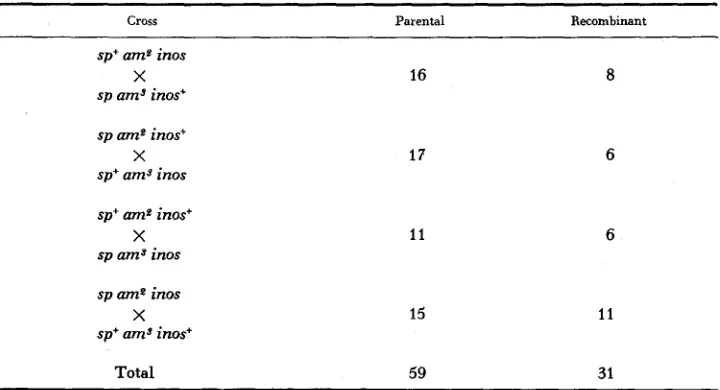
explanation can be suggested for this difference; but, in one important respect, all the experiments were similar. They all showed a great excess of strains which were parental in type with respect to the alleles at the sp and inos loci. In Table 2
the data are arranged to illustrate this. In each of the four possible kinds of marked am X am cross there were more parental types than those showing re- combination for the outside markers. The total for all the crosses is 59 parentals to 31 recombinants. On the classical model of crossing over, all the parental types represent double crossovers, and this is a case of extremely high negative inter- ference.
TABLE 2
Classification of am+ with respect to the distribution of the markers sp and inos
Cross Parental Recombinant
sp+ amp inos
X
sp am3 inos+
sp am* inos'
X
sp+ am3 inos
sp+ a m z inos+
X
sp am3 inos
sp a m p inos
X
sp+ am3 inos+
Total
16
17
1 1
15
59
8
6
6
1 1
844 J . A. P A T E M A N
DISCUSSION
The production of wild type recombinants in crosses between alleles at the am
locus is of particular interest since the wild types so formed regain the full normal ability to synthesize the enzyme glutamic dehydrogenase ( PATEMAN and FINCH- AM 1958). Preliminary work suggested that the origin of wild type recombinants
could not be satisfactorily explained on the basis of classical crossing over theory
(PATEMAN and FINCHAM 1958). Unfortunately, the frequency of such wild type production, about 19 per 106 live ascospores, is far too low for tetrad analysis. However, it was hoped that crosses between strains carrying marker alleles on either side of the am locus would help to elucidate the situation. The marked crosses established two main points.
If the am+ were the result of classical crossing over, then in each cross about 90 percent of the am+ progeny should have carried a particular combination of the outside markers. In the complementary cross, 90 percent of the am+ should have carried the complementary combination of markers. There was no such obvious complementary pattern of distributions of the marker alleles in the am+
progeny of complementary am2 x am3 crosses.
In the am+ progeny of all the four possible kinds of marked am2 X amJ crosses, there was a considerable excess of apparent double exchanges in the region be- tween the markers. If the 90 am+ were the result of a single exchange between
am2 and am’ then, assuming no interference, only seven to 11 percent of the am+
would be expected to carry a further exchange in the sp-inos region. In fact, about 65 percent of the am+ were apparent double exchanges with respect to the markers. It was not possible to estimate the excess of apparent exchanges on either side of the am locus, since the order of amz and am3 within the locus is not known. The data provide no information concerning the production of reciprocal recombinants, since these presumably would have been of the am phenotype if formed, and consequently not detected.
An excess of apparent double exchanges, usually called negative interference, is now a well-recognized phenomenon in a variety of organisms. It has been reported in bacteriophage ( STREISINGER and FRANKLIN 1956; CHASE and DOER-
MANN 1958); in Aspergillus (PRITCHARD 1955; CALEF 1957); in Neurospora
(FREESE 1957; DE SERRES 1958), to mention only some of the reported cases. It
is of interest that the intensity of negative interference, with apparent doubles more numerous than apparent singles, observed at the am locus is considerably greater than that usually observed in fungi. The results are not so easily compared with those obtained in bacteriophage, but the degree of negative i iiterference reported above is probably of the same magnitude if not higher than that found in bacteriophage (CHASE and DOERMANN 1958).
I n order to account for the many instances of high negative interference and of aberrant tetrad ratios in the literature, a “switch” hypothesis (FREESE 1957;
CHASE and DOERMANN 1958; DE SERRES 1958) has been proposed. It is suggested
R E C O M B I N A T I O N A T A M LOCUS 845
material using first one parental homologue as a template, then switching to the other, sometimes more than once. The average frequency of such “switches” is greater than one per effective pairing segment, and the process need not be reciprocal. This theory is sufficiently general to account for most of the known cases of recombination, and provides the most satisfactory explanation at the moment of this data concerning the am locus. In fact, the great excess of apparent double exchanges in crosses between a m alleles is in accord with one of the tenets of this theory. Namely, the closer the mutational sites, the more marked should be the clustering of exchanges and, of course, the a m alleles do show a very low frequency of recombination.
S U M MARY
1. I n crosses between strains carrying the alleles am2 and ams at the ‘‘amina- tion deficient” locus i n Neurospora crassa, am+ recombinants are found in the progeny with a frequency of about 19 per IO6 live ascospores.
2. The markers spray and inositol are adjacent to and on either side of the
a m locus. The four possible kinds of crosses between strains carrying different a m
alleles and the outside markers in different combinations were set up. Crosses which were complementary with respect to the markers carried by the parent strains did not show the expected complementary pattern of distribution of the markers in their progeny.
3 . In crosses between marked ama and amS crosses, there was a great excess of apparent double exchanges, i.e., very high negative interference. I n a total of 90 am+ progeny from marked amz x am3 crosses, 59 possessed a parental combi- nation of outside markers and 31 were recombinant. The expected number in the parental class, from a total of 90, was about nine.
4. It was shown that 17 am+ strains from marked ama X a m s crosses were true breeding for the am+ allele, eight were true breeding for the spray marker and six were true breeding for the inositol marker. The data exclude at the 95
percent probability level that more than 16.25 percent of the am+ progeny from marked ama x ams crosses could have been the result of chromosome abnormali- ties.
5 . The results described are not explicable on the classical theory of crossing over, but are in reasonable accord with the “switch” theory of recombination.
L I T E R A T U R E C I T E D
CALEF, E., 1957
Heredity 11 : 265-279.
CHASE, M., and A. H. DOERMANN, 1958
genetic structure of bacteriophage T4. Genetics 43: 332-353. DE SERRES, F. J., 1958
Cold Spring Harbor Symposia Quant. Biol. 23 : 11 1-1 18. FREESE, E., 1957
671 -684.
Effect on linkage maps of selection of crossovers between closely linked markers. High negative interference over short segments of the Recombination and interference in the ad-3 region of Neurospora crassa.
846 J. A. PATEMAN
PATEMAN, J. A., 1957
5 5 : 444-455.
Back mutation stud:es at the am locus in Neurospora crassa. J. Genet.
Aberrant recombination at the am locus in Neurospora crassa. Nature 181: 1605-1605. PATEMAN, J. A., and J. R. S. FINCEIAM, 1958 Gene-enzyme relationships at the am locus in
Neurospora crassa. Heredity 12 : 31 7-332.
PITTENGER, T. H., 1954 The general incidence of pseudowild types in Ncurospora crassa.
Genetics 39: 386-342.
PRITCHARD, R. H., 1955 T h e linear arrangement of a series of alleles of Aspergillus nidulans.
STREISINGER, G., and N. C. FRANKLIN, 1956 Mutation and recombination at the host range
WESTERGAARD, M., and H. K. MITCHELL, 1947 Neurospora. V. A synthetic medium favoring 1958
Heredity 9: 343-371.