Copyright 0 1989 by the Genetics Society of America
The Multivulva Phenotype of Certain Caenorhabditis elegans Mutants
Results From Defects in Two Functionally Redundant Pathways
Edwin
L.
Ferguson’ and H. Robert HorvitzHoward Hughes Medical Institute, Department of Biology, Massachusetts Institute of Technology, Cambridge, Massachusetts 0 2 1 3 9 Manuscript received February 13, 1989
Accepted for publication May 1 1, 1989
ABSTRACT
We previously identified Caenorhabditis elegans mutants in which certain of the six vulval precursor cells adopt fates normally expressed by other vulval precursor cells. These mutants define genes that appear to function in the response to an intercellular signal that induces vulval development. T h e multivulva (Muv) phenotype of one such mutant, CB1322, results from an interaction between two unlinked mutations, l i n - 8 ( n l l l ) II and lin-9(n112) III. In this paper, we identify 18 new mutations, which are alleles of eight genes, that interact with either l i n - 8 ( n l l l ) or lin-9(nI 12) to generate a M u v phenotype. None of these 20 mutations alone causes any vulval cell lineage defects. T h e “silent Muv” mutations fall into two classes; hermaphrodites carrying a mutation of each class are Muv, while hermaphrodites carrying two mutations of the same class have a wild-type vulval phenotype. Our results indicate that the Muv phenotype of these mutants results from defects in t w o functionally- redundant pathways, thereby demonstrating that redundancy can occur at the level of gene pathways as well as at the level of gene families.
T
HE cellular anatomy and the developmental pat- terns of cell divisions and cell fates of the ne- matode Caenorhabditis elegans are essentially invariant (SULSTON and HORVITZ 1977; DEPPE et al. 1978; KIMBLE and HIRSH 1979; SULSTON, ALBERTSON and THOMSON 1980; SULSTON et al. 1983). We are at- tempting to understand the genetic specification of a particular aspect of C . elegans development, the cell lineages that generate the vulva of the hermaphrodite. T h e vulva is formed by the descendants of three of six tripotent hypodermal cells. Previous studies have indicated that the fate of each of these six precursor cells is determined at least in part in response to an intercellular signal generated by the anchor cell of the somatic gonad (SULSTON and HORVITZ 1977; SULSTON and WHITE 1980; KIMBLE 198 1 ; STERNBERG and HORVITZ 1986; STERNBERG 1988). The three precur- sor cells that are near the anchor cell are induced to generate the vulva. T h e precursor cell nearest the anchor cell adopts the 1”
vulval fate, whereas the two adjacent precursor cells adopt a 2 ” vulval fate. T h e remaining three precursor cells adopt a 3 ” nonvulval fate.We have previously identified eleven genes that by the criteria of mutant phenotype, site of action, and time of action appear to act within the vulval precur- sor cells in the determination of the fates of these cells
of California. Berkeley, California 94720.
’ Present address: Department of Molecular and Cell Biology, University o f p a g e charges. This article must therefore be hereby marked “aduertisernent”
T h e publication costs of this article were partly defrayed by the payment in accordance with 18 U.S.C. 51734 solely t o indicate this fact.
Genetics 123: 109- 12 1 (September, 1989)
in response to the anchor cell signal (FERGUSON and HORVITZ 1985; FERGUSON, STERNBERG and HORVITZ 1987). Mutations in these genes cause certain of the vulval precursor cells to adopt fates normally ex- pressed by other precursor cells. In vulvaless (Vul) mutants, all six precursor cells express the nonvulval fate. In multivulva (Muv) mutants, all six precursor cells express vulval (1
”
or 2”) fates, dividing to gen- erate multiple vulval-like protrusions along the ventral side of the animal.Based on differences in cell lineage and morphol- ogy, the Muv strains can be divided into groups. In one group of Muv mutants, comprising mutants de- fective in any of three genes-lin-15, lin-34 and lin- 13-the six vulval precursor cells generally express an alternating pattern of 1 ” and
2 ”
vulval fates (FER- GUSON, STERNBERG and HORVITZ, 1987; STERNBERG,1988). A fourth Muv strain, CB1322, has a phenotype similar to that of mutants defective in any of these three genes. However, the Muv defect in this strain results from an interaction between two unlinked
mutations, lin-8(nlll)
ZZ
and lin-9(nl12)ZZZ,
neither of which alone results in any vulval cell lineage abnor- malities (SULSTON and HORVITZ 198 1 ; FERGUSON, STERNBERG and HORVITZ 1987).110 E. L. Ferguson and H. R. Horvitz
as the phenotypes of the other members of this group of Muv mutants, result from defects in two function- ally redundant pathways.
MATERIALS AND METHODS
Strains and genetic nomenclature: Caenorhabditis elegans
var. Bristol strain N2 and most of the mutant strains used for mapping and strain construction were obtained from BRENNER (1 974) or from the Caenorhabditis Genetics Cen- ter, which is supported by contract number NOl-AG-9- 21 13 between the National Institutes of Health and the Curators of the University of Missouri. Except where noted, these genes have been described by BRENNER (1974) and SWANSON, EDCLEY and RIDDLE (1984). T h e alleles used are either the reference alleles listed in the above publications or alleles that result in similar phenotypes. N2 is the wild- type parent of all nematode strains used in this work.
LGI: unc-1 l(e47); dpy-5(e61); dpy-l4(e188); unc-l?(el091).
LGII: bli-2(e768); dpy-lO(e128); rol-l(e91); unc-52(e444); mnCl dpy-lO(e128) unc-52(e444). mnCl dpy-10 unc-S5 is an LGII chromosomal abnormality that balances the right half of the chromosome (HERMAN 1978).
LGIII: dpy-l7(e164); lon-l(e185); sma-?(e491); lin- 16(e174?); daf4(e1?64); unc-?6(e251); unc-86(el507); dpy-
19(e1259); sup-5(e1464); sma-2(e502); unc-?2(e189).
LGIV: unc-5(e5?); unc-Z2(e66).
LGV: dpy-1 l(e224).
LGX: lon-2(e678); sup-7(st5); dpy-7(e1324); unc-?(e151); mnDp1; mnDf4?; mnDf4.
This paper follows the standardized C . elegans genetic nomenclature (HORVITZ et al. 1979). T h e genes identified by silent M u v mutations were assigned lin, for lineage ab- normal, gene names.
General techniques: Methods for the culturing, handling and genetic manipulation of C. elegans have been described (BRENNER 1974).
Mutagenesis of hermaphrodites of genotypes Zin-
8 ( n l l l ) and Zin-9(nl12): Phenotypically wild-type L4 her-
maphrodites homozygous for either l i n - 8 ( n l I I ) o r lin- Y(n112) were mutagenized with ethyl methanesulfonate (EMS) as described by BRENNER (1974). Individual muta- genized hermaphrodites were put on separate 100 mm NGM plates (BRENNER 1974) and allowed to produce 20- 40 progeny. T h e progeny of 3000 F, hermaphrodites from mutagenized l i n - 8 ( n l l l ) animals and 4000 F, hermaphrod- ites from mutagenized lin-9(nl12) animals were screened for M u v animals, each of which was a candidate for carrying a mutation that interacted with either l i n - 8 ( n l l l ) o r lin- Y ( n l l 2 ) to produce a Muv phenotype. Muv hermaphrodites were picked onto separate plates and allowed to self-fertilize. If a Muv animal appeared to be self sterile, it was mated with wild-type males and, if progeny were produced, Muv hermaphrodites were reisolated from the FP progeny. Only one Muv strain from each parental plate was characterized to ensure that each isolate carried an independently derived mutation.
T h e Muv phenotypes of 12 of the 17 strains that were isolated during these mutageneses were shown to be de- pendent on the presence of two mutations, the parental mutation and a newly induced mutation (see RESULTS). We will refer to these newly isolated mutations (as well as the preexisting lin-8 and lin-9 mutations) as “silent Muv” muta- tions, as they result in a Muv phenotype only in certain pairwise combinations (see RESULTS). T h e remaining five strains carried mutations that result in a M u v phenotype
independent of the silent mutation in the parental strain. Specifically, these strains defined three alleles of lin-1- 12753, n757, and an allele that was subsequently lost-and one allele of lin-15-n765ts; studies of these strains have been described elsewhere (FERGUSON and HORVITZ 1985). T h e mutation responsible for the Muv phenotype of the remaining strain, MT665, which was isolated after muta- genesis of lin-8(n111) hermaphrodites, displayed linkage to
unc-? X but not to bli-2 11, which is linked to lin-8, suggesting that the Muv phenotype of this strain may result from a lin- 15 mutation.
Isolation and characterization of Muv strains after mu- tagenesis of the strain MT1312: Five silent Muv strains were isolated after mutagenesis of the strain M T I 3 12. This strain displays a highly penetrant vulvaless (Vul) phenotype. Neither hermaphrodites nor males of this strain can mate. T o characterize the mutation that caused the Vu1 phenotype of M T 13 12, we attempted to isolate extragenic suppressors that would allow hermaphrodites of this strain to mate. We mutagenized M T l 3 1 2 hermaphrodites with EMS and ex- amined the F2 progeny of these animals for egg-laying- competent individuals. Although no phenotypically wild- type hermaphrodites were found among the progeny of approximately 12,500 F1 progeny of mutagenized herma- phrodites, 16 fertile Muv strains were isolated. Five of these 16 Muv strains were further characterized; the remaining 11 strains were lost. These five Muv strains had multiple ventral pseudovulvae, but were not egg-laying competent. However, occasional Muv hermaphrodites ruptured at the vulva, and although dying, could be fertilized by wild-type males. These matings enabled the isolation and subsequent characterization both of the mutation responsible for the Vu1 phenotype of MT1312, lin-l2(n676), and of the muta- tions that resulted in the Muv phenotypes of these strains. Studies of lin-I2(n676) have been described elsewhere (GREENWALD, STERNBERC and HORVITZ 1983; FERCUSON and HORVITZ 1985).
When the mutations responsible for the Muv phenotypes of these strains were mapped, they were found to display linkage to two linkage groups (see RESULTS). As one of the mutations responsible for the Muv phenotype of each strain displayed linkage to unc-? X , it is likely that the same X- linked mutation is present in all five of these strains and was present in the original strain, MT1312, prior to the rever- sion experiments. We isolated this mutation, n767, from the Muv strain MT1643.
Construction of strains homozygous for a single silent Muv mutation: A recessive marker in trans was used to identify the chromosome carrying the silent Muv mutation to be isolated. From hermaphrodites of genotype b/+; a+/
+
r , where a is the silent Muv mutation to be separated from the parental silent M u v mutation b and r is a recessive marker (or a number of closely linked recessive markers), wild-type hermaphrodites were picked. Those that segre- gated R animals but no Muv animals were of putative genotype+/+;
a + / + r . Progeny hermaphrodites of geno- type a l a were obtained by picking wild-type hermaphrodites that did not segregate any R animals. These genotypes were confirmed by mating b males with hermaphrodites of puta- tive genotypes a l a , picking at least eight F I progeny, and observing the presence of Muv hermaphrodites among the progeny of each F, hermaphrodite. In these experiments,dpy-5 unc-l? was used in trans to lin-?5(n745); lon-1 unc-86 dpy-19 was used in trans to lin-?6(n766); Lon-1 was used in
trans to lin-37; unc-52 was used in trans to lin-38(n751); and
unc-3 was used in trans to lin-l5(n767).
Redundant pathways in C. elegans 111
by mating males of genotype b/+; a/O, where a is the X- linked silent Muv mutation and b is the second silent MUV mutation in the strain, with hermaphrodites of genotype b; a. The non-Muv progeny of genotype b/+; ala segregated hermaphrodites of genotype ala.
Construction of class Aclass A double mutants: T o construct double mutants between lin-l5(n767) X and either Lin-8(nI I I )
zz
or Lin-38(n751) ZZ, males of genotypes a r / + +were mated with lin-15 hermaphrodites ( a r was either lin- 8 dpy-10 or rol-1 lin-38 unc-52). T h e resulting males were mated with lin-15 hermaphrodites and the Fl progeny of putative genotype a r / + + ; lin-15 were identified on the basis of segregation of R progeny. Most R progeny of herma- phrodites of genotype a r / + + ; lin-15 were of the desired genotype. The genotype of the lin-8 dpy-10; lin-15 strain was confirmed by mating males of genotype lin-35 unc-13/
++
with these hermaphrodites and observing that the great majority of the FP Dpy Unc progeny were Muv.A strain carrying the linked mutations lin-a(nll1) and lin-38(n751) was constructed as follows. Three of the 39 Dpy segregants from hermaphrodites of genotype lin-8 dpy- 10
+++/++
rol-1 lin-38 unc-52; lin-9/+ were of putative genotype lin-8 dpy-10 +++/lin-8 dpy-10 rol-1 lin-38 unc-52; lin-9/+, as 1/4 of both classes of progeny (Dpy hermaphrod- ites and Dpy Rol Unc hermaphrodites) were Muv. Dpy non- Rol non-Unc non-Muv progeny from each of the three hermaphrodites were mated with lin-8 males. Cross-progeny hermaphrodites that did not segregate any Muv animals were of genotype lin-8 dpy-10 rol-1 lin-38 unc-52/lin-8++++ From their progeny, the non-Dpy Rol Unc animals that did not segregate any Dpy animals were of the desired genotype lin-8+
rol-1 lin-38 unc-52.Construction of class B-class B double mutants: Strains containing two class B mutations were obtained by con- structing hermaphrodites that were heterozygous for both of the class B mutations and linked markers either in cis or in trans to each of the class B mutations. In some construc- tions, these hermaphrodites were also heterozygous for a class A mutation, which was removed by segregation in the next generation. Animals were obtained that were homo- zygous for each of the chromosomes carrying a class B mutation. In these experiments, for lin-35(n745); lin- 9(n112), unc-13 was in cis to lin-35, and dpy-17 was in cis to lin-9; for lin-35(n745); lin-36(n766), unc-13 was in cis to lin- 35, and dpy-19 sma-2 was in trans to lin-36; for lin-35(n745); lin-37(n758), unc-13 was in cis to lin-35, and Lon-1 was in cis to lin-37.
T o construct double mutants between lin-l5(n744) and other class B mutations, lin-15 progeny were picked from among the segregants of hermaphrodites of genotype r b/
++;
lin-15/+ grown at 25", where r is a marker in cis to the second class B mutation, b. (At 25", lin-l5(n744) animals are thinner and less fertile than the wild type.) The R segregants of these animals were of the desired genotypes. dpy-17 was in cis to lin-9, unc-13 was in cis to lin-35, unc-32 was in cis to lin-36, and Lon-1 was in cis to lin-37.lin-15 intragenic recombination: T o determine the fre- quency of recombination between the X-linked class B silent M u v mutation n744 and the lin-15 M u v allele n309, Muv hermaphrodites of genotype l i n - 8 ( n l l l ) ; unc-3 Zin- Z5(n309)/n744 were constructed. The progeny of these animals were examined for rare non-Muv animals: one such animal was obtained among 3,168 progeny. This herma- phrodite segregated 1/4 Muv animals, 1/2 phenotypically wild-type animals and 1/4 Unc non-Muv animals, indicating that n744 maps about 0.03% to the left of n309.
TO determine the frequency of recombination between the X-linked class A silent M u v mutation n767 and n309,
the progeny of M u v hermaphrodites of genotype lin- 9(n112); unc-3 lin-l5(n309)/n767 were examined. N o non- Muv hermaphrodites were found among 11 1'7 progeny, indicating that n767 maps within 0.09% of n309.
Construction of hermaphrodites of genotypes lin-8; Zin- 34; sup-7 and lin-9; lin-34; sup-7: To construct a strain of genotype l i n - 8 ( n l l l ) ; lin-34(n1046) unc-22; SUP-7 dpy-7, wild-type males were mated with hermaphrodites of geno- type Lin-8(n111); +lin-9(n942) unc-32/sma-2++. Progeny males were of two genotypes, lin-8(n111)/+; lin-9(n942) unc-32/++ and lin-a(nlll)/+; sma-2/+, and were mated with hermaphrodites of genotype lin-34(n1046) unc-22; sup- 7 dpy-7. Forty-five cross-progeny hermaphrodites were picked; nine were of genotype lin-9(n942) unc-32/++; lin- 34(n1046) unc-22/++; sup7 dpy-7/++ and were used to obtain hermaphrodites of genotype lin-9(n942) unc-32; lin- 34(n1046) unc-22; sup-7 dpy-7 (see below). One of the other 36 hermaphrodites was of genotype lin-8(nll l ) / + ; lin- 9(n942) unc-32/++; lin-34(n1046) unc-22/++; sup-7 dpy-7/
++.
From the progeny of that hermaphrodite, two of 55 phenotypically wild-type hermaphrodites picked were of genotype lin-a(nll1); lin-9(n942) unc-32/++; lin-34(n1046) unc-22/++; sup-7 dpy-7/++, as they segregated Dpy prog- eny, Muv Unc-22 progeny, Muv Unc-32 progeny but no non-Muv Unc-32 progeny. From the progeny of these two animals, seven of 44 phenotypically wild-type hermaphrod- ites picked were of the genotype lin-a(n111); lin-34(n1046) unc-22/++; sup-7 dpy-7/++. From the progeny of these hermaphrodites, three isolates of genotype l i n - 8 ( n l l l ) ; lin- 34(n1046) unc-22; sup-7 dpy-7 were established and were tested at 15 O to confirm the presence of sup-7. [sup7 results in sterility at 15 O (WATERSTON 198 l).]To obtain hermaphrodites of genotype lin-9(n942) unc- 32; lin-34(n1046) unc-22; sup-7 dpy-7, Dpy non-Unc her- maphrodites were picked from the progeny of the herma- phrodites of genotype lin-9(n942) unc-32/++; lin-34(nZ046) unc-22/++; sup-7 dpy-7/++. From the four Dpy herma- phrodites that were heterozygous for both lin-9(n942) unc- 32 and lin-34(n1046) unc-22, the phenotypes of the progeny hermaphrodites of genotype lin-9(n942) unc-32; lin- 34(n1046) unc-22; sup-7 dpy-7 were examined.
112 E. L. Ferguson and H. R. Horvitz
ried silent Muv mutations that were not alleles of lin-9. One
of these mutations, n1138, is linked to unc-3 X and may be an allele of lin-15; the other mutation, n1137, has not been characterized further.
RESULTS
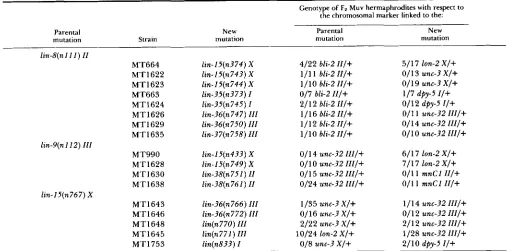
Identification of additional Muv strains that have phenotypes dependent on two mutations: T h e phe- notype of the Muv strain CB1322 is synthetic, as it depends on the presence of two mutations, Zin-8(nI 11) 11 and lin-9( n I 12) III; hermaphrodites homozygous for either of these two mutations have wild-type vulval cell lineages (SULSTON and HORVITZ 198 1 ; FERGUSON, STERNBERG and HORVITZ 1987). We sought to iden- tify other mutations that would interact with either lin-B(nlI1) or lin-9(n112) to generate a Muv pheno- type. As described in MATERIALS AND METHODS, we mutagenized hermaphrodites homozygous for either Zin-8(nl I I ) or lin-9(nI 12), obtaining twelve Muv strains from the mutagenesis of Zin-8(nI 1 I ) herma- phrodites and five Muv strains from the mutagenesis of lin-9(nl12) hermaphrodites. For 12 of these 17 strains, the Muv phenotype displayed linkage both to the linkage group of the mutation present in the parental strain, Zin-8(nl I I ) or Zin-9(nI 12), and to a second linkage group, indicating that the Muv phe- notype of the strain was caused by two unlinked mutations, one of which was the mutation in the parental strain (Table 1). T h e remaining five Muv strains contained mutations that resulted in a Muv phenotype whether or not the mutation in the paren- tal strain was present (see MATERIALS AND METHODS).
In addition, as described in MATERIALS AND METH-
ODS, five other Muv strains were fortuitously isolated after mutagenesis of the strain M T 13 12. As the Muv phenotype of each of these strains displayed linkage both to the X chromosome and to a marker on another chromosome (Table l ) , it is likely that a single X - linked mutation, which we call n767, was present in the strain M T 13 12 prior to the mutagenesis.
In the rest of this paper, we refer to the mutations in these Muv strains as “silent Muv” mutations, and the Muv phenotype that results from the presence of two silent Muv mutations as a “synthetic Muv” phe- notype.
Complementation and mapping: Two silent Muv mutations, a1 and a2, that mapped to the same chro- mosome were considered to be allelic if and only if hermaphrodites of genotype aI/a2; b (where 6 is a third silent M u v mutation with which both a1 and a2 interact to give a Muv phenotype) were Muv and produced all Muv progeny. It proved necessary to examine the progeny of Muv hermaphrodites of pu- tative genotype aI/a2; b for two reasons: (1) at ele- vated temperatures (22.5’ o r 2 5 ” ) certain of these mutations display partially dominant phenotypes, ie.,
some hermaphrodites of genotype a l l + ; b are Muv; and (2) certain pairs of nonallelic recessive mutations partially fail to complement, i.e., some hermaphrod- ites of genotype a l l + ; a2/+; b display a Muv pheno- type of reduced expressivity compared to the Muv phenotypes of the strains a l ; b and a2; b (E. FERGUSON, unpublished observations). Using the criteria de-
scribed above, it was possible to assign each silent Muv mutation unambiguously to a single complementation group.
As described below, six silent Muv mutations were shown to be alleles of lin-15, a gene previously defined by five visible Muv mutations (FERGUSON and HORV-
ITZ 1985). Nine other silent Muv mutations defined
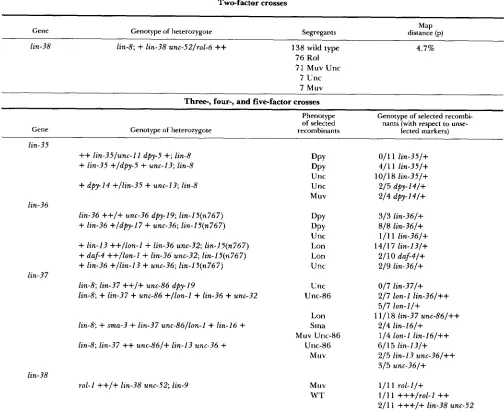
four new genes involved in vulval development-lin- 35, lin-36, lin-37 and Zin-38. Multiple-factor crosses (Table 2) were performed to position each of these four genes on its linkage group (Figure 1). Three additional silent Muv mutations (n770, n771 and n833) were each mapped to a linkage group and shown to complement all previously characterized si- lent Muv mutations on that linkage group. However, we have not positioned the genes defined by these three mutations on their linkage groups, and since these mutations could be alleles of previously defined genes, they have not been assigned separate gene names.
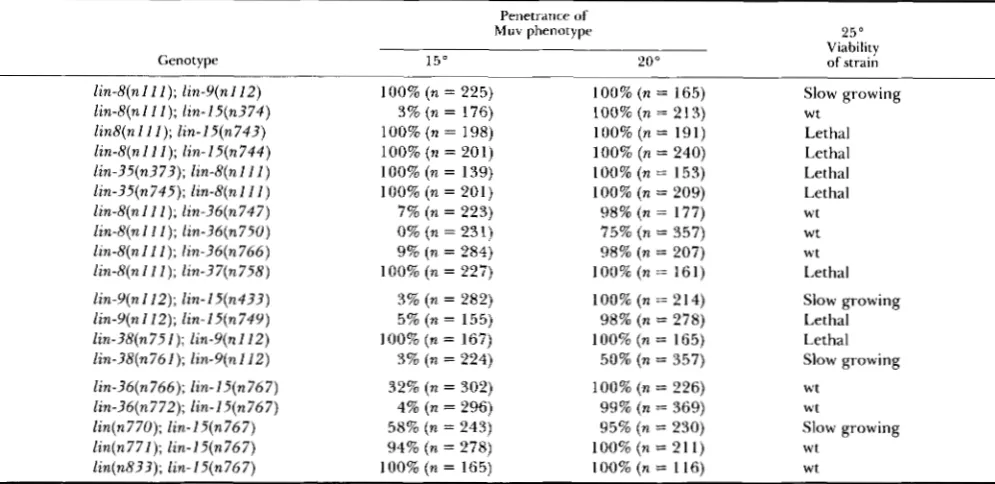
General characteristics of the newly isolated Muv strains: T h e Muv strains share two characteristics. First, some aspect of the phenotype of each strain is heat sensitive (Table 3). (The one strain that does not display an obvious heat-sensitive phenotype, lin(n833); lin-l5(n767), has a heat-sensitive maternal effect phenotype; see below.) At 15”, most strains display incompletely penetrant Muv phenotypes; at 20°, most strains have a completely penetrant Muv phenotype; and at 25
”
, all strains have a completely penetrant Muv phenotype (Table 3 and legend). In addition, most Muv strains display a heat-sensitive decrease in viability. Such Muv strains display three common phenotypes when grown at high tempera- ture: a generation time that is longer than that of the wild type; a decrease in the size of the adult herma- phrodites compared to the wild type; and a high incidence of sterility. This heat-sensitivity most likely reflects a heat-sensitive process revealed or induced by a reduction or loss of function of the silent Muv genes. (Similar genetic analyses indicate that certain other C . elegans processes are also heat sensitive; GOLDEN and RIDDLE 1984; FIXSEN 1985.)Redundant pathways in C. elegans
TABLE 1
113
Origins and chromosomal linkages of silent M u v strains
Genotype of Fz Muv hermaphrodites with respect to the chromosomal marker linked to the:
Parental New Parental New
mutation Strain mutation mutation mutation
lin-8(n I I 1 ) II
MT664 lin-IJ(n374) X 4/22 bli-2 I I / + 511 7 lon-2 X / +
MT1622 lin-l5(n743) X 1 111 bli-2 I I / + O/ 1 3 unc-3 X / +
MT1623 lin-l5(n744) X 111 0 bli-2 I l l + 011 9 unc-3 X/+
MT663 lin-35(n373) I 017 bli-2 I I / + 117 dpy-5 I / +
MT1624 lin-?5(n745) I 2/12 bli-2 I l l + 011 2 dpy-5 I / +
MT1626 lin-36(n747) III 1/16 bli-2 I I / + O/ 1 1 unc-32 I U / +
MT1629 lin-36(n750) III 111 2 bli-2 I I / + 011 4 unc-32 III/+
M T 1635 lin-?7(n758) III 1/10 bli-2 I I / + O/ 10 unc-32 HI/+
lin-9(n I 12) I I I
lin-I5(n767) X
MT990 lin-I5(n4?3) X 011 4 unc-32 I I I / + 611 7 lon-2 X / +
MT1628 lin-l5(n749) X 011 0 unc-32 III/+ 7 / 17 lon-2 X / +
MT1630 lin-?8(n751) I1 011 5 unc-32 III/+ 011 1 mnC1 I I / +
MT1638 lin-38(n761) II 0124 unc-32 I l I / + 011 1 mnC1 I I / +
M T 1643 lin-36(n766) III 1/35 unc-3 X / + 111 4 unc-32 III/+
MTl646 lin-36(n772) 111 O/ 16 unc-3 X / + 011 2 unc-32 III/+
M T 1648 lin(n770) III 2/22 unc-3 X/+ 211 2 unc-32 l I I / +
M T 1645 lin(n771) I l l 10124 ton-2 X/+ 1/28 unc-32 H I / +
MT1753 lin(n833) I 018 unc-? X / + 211 0 dpy-5 I / +
The mutations responsible for the Muv phenotypes of each strain were mapped to linkage groups by mating males carrying these mutations with hermaphrodites of genotypes dpy-5 I; bli-2 II; unc-?2 III or unc-5 IV; dpy-I 1 V; lon-2 X (TRENT, TSUNG and HORVITZ 1983), picking Muv animals from the F2 progeny, and noting the frequency of segregation of each of the chromosomal markers. If the chromosomal marker is linked to the mutation(s) responsible for the Muv phenotype, 2p of the Muv hermaphrodites should segregate the marker (where p is the recombination frequency between the marker and the Muv mutation). Conversely, if the chromosomal marker is unlinked to the mutation@) responsible for the Muv phenotype, 213 of the Muv hermaphrodites should segregate the marker. Only those markers listed displayed linkage to the mutations in the Muv strains. Mutations in two genes-lin-38 II and lin-15 X-did not display tight linkage to any of the above six markers. Using the protocol described above, some lin-I5 mutations were confirmed to map to LGX by establishing linkage to unc-3 X . Similarly, mutations in lin-38 were confirmed to map to LC11 by establishing linkage to mnCl dpy-IO unc-52.
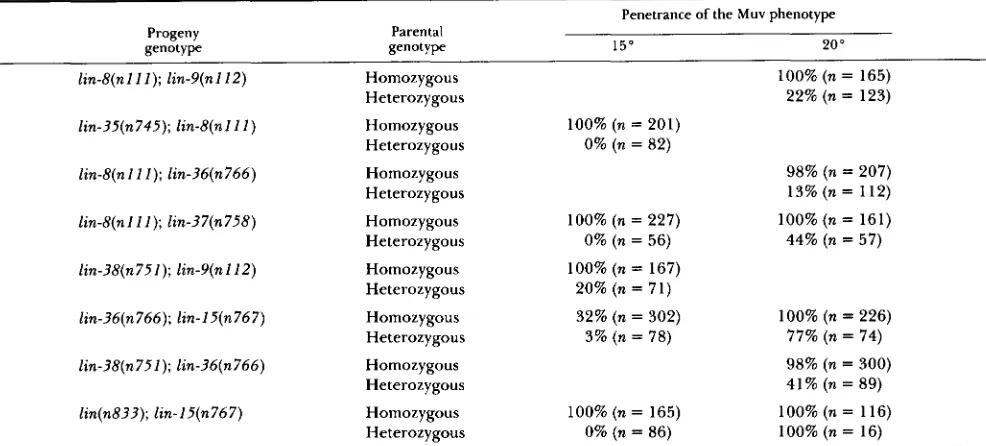
Muv phenotype in hermaphrodites of genotype a; b that are the progeny of a; b homozygous parents. This maternal effect was observed during the initial char- acterization of many of these strains, and subsequently was quantified for eight strains (Table
4).
For the three strains for which it was tested, the degree of maternal rescue was also temperature-sensitive. For example, although the strain lin8(nIII);
lin-37(n758)displays a completely penetrant Muv phenotype at both 1 5 " and 20", the penetrance of the Muv phe- notype of lin-8; lin-37 animals derived from hetero- zygous parents is higher at 20", 44% Muv, than at
15", 0% Muv.
We have not determined whether these maternal effects are the result of a synthetic interaction between the two silent mutations in the strain or whether this characteristic results from one of the two mutations in the strain. However, there are some results that suggest that the heat-sensitive decrease in viability observed in the synthetic Muv strains may not be caused by an interaction between the two mutations in the strain, as some silent Muv mutations have a heat-sensitive effect on viability independent of a sec- ond such mutation (see below).
Phenotypes resulting from isolated silent Muv
mutations: To determine the phenotype of herma- phrodites carrying a silent Muv mutation in only one gene, we constructed six strains each homozygous for
one of the mutations lin-Z5(n744), lin-I5(n767), lin- 35(n745), lin-36(n766), lin-37(n758), and lin- 38(n751) (see MATERIALS AND METHODS). At 20", hermaphrodites of all six strains (as well as lin-8(nIl
I )
and lin-9(nII2) hermaphrodites) have a wild-type phenotype as viewed with the dissecting microscope. However, at 2 5 " , hermaphrodites of genotypes lin- 9(n112), lin-I5(n744), lin-35(n745), or lin-37(n755)are thinner and less fertile than the wild type but are not Muv.
There are two classes of silent Muv mutations: To
114 E. L. Ferguson and H. R. Horvitz
TABLE 2
Two-factor crosses
Gene Genotype of heterozygote Segregants distance (p) Map
lin-38 lin-8;
+
lin-38 unc-52/rol-6++
138 wild type 4.7% 76 Rol 71 Muv Unc7 Unc
7 Muv
Three-, four-, and fivefactor crosses
Phenotype Genotype of selected recombi- of selected nants (with respect to unse- Gene
lin-35
Genotype of heterozygote recombinants lected markers)
++
lin-35/unc-I 1 dpy-5+;
lin-8 DPY 011 1 lin-35/++
lin-35 +/dpy-5+
unc-13; lin-8 DPY 411 1 lin-35/+Unc 1011 8 lin-35/+
+
dpy-14 +/lin-35+
unc-13; lin-8 Unc 215 dpy-l4/+Muv 214 dfy-I4/+
lin-36
++/+
unc-36 dpy-19; lin-IZ(n767) DPY 313 lin-36/++
lin-36 +/dpy-17+
unc-36; lin-I5(n767) DPY 818 lin-36/+Unc 111 1 lin-36/+
+
lin-I3 ++/ion-1+
lin-36 unc-32; lin-I5(n767) Lon 141 1 7 lin-I 3/++
daf-4 ++/ion-I+
lin-36 unc-32; lin-I5(n767) Lon 2/ 10 daf-4/++
lin-36 +/lin-13+
unc-36; lin-I5(n767) Unc 219 lin-36/+lin-8; lin-37
++/+
unc-86 dpy-19 Unc 017 lin-37/+lin-8;
+
lin-37+
unc-86 +/lon-I+
lin-36+
unc-32 Unc-86 217 lon-1 lin-36/++ lin-36lin-37
517 lon-I/+
Lon 11/18 lin-37 unc-86/++
lin-8;
+
sma-3+
lin-37 unc-86/lon-l+
lin-16+
Sma 214 lin-16/+lin-8; lin-37
++
unc-86/+ lin-13 unc-36+
Unc-86 6/ 1 5 lin-I 3/+315 unc-36/+
rol-I
++/+
lin-38 unc-52; lin-9 Muv 111 1 r o l - l / +Muv Unc-86 114 lon-1 lin-16/++
Muv 215 lin-13 unc-36/++
lin-38
W T 111 1 +++/rol-I
++
211 1 +++I+ lin-38 unc-52
Two-, three-, four-, and five-factor crosses were performed essentially as described by BRENNER (1974). Because the silent Muv mutations result in a wild-type phenotype, these mutations were scored in the presence of a second silent Muv mutation. For example, from heterozygotes of genotype r1
+
r2/+ a+;
b (where r l and r2 are chromosomal markers, a is the silent Muv mutation to be mapped with respect to those markers, and b is a second silent Muv mutation with which a interacts to generate a Muv phenotype), R1 non-R2 and R2 non-R1hermaphrodites were picked. The progeny of each recombinant hermaphrodite were examined for the presence of Muv animals. In one cross involving the mapping of lin-38, wild-type hermaphrodites were picked and scored for the segregation of the cis markers. The silent Muv genes lin-36 and lin-37 map adjacent to lin-13, which results in a sterile Muv phenotype. T h e segregation of lin-I3 from recombinant Muv hermaphrodites homozygous for either lin-36 or lin-37 was scored by determining whether progeny homozygous for the recombinant chromosome were sterile.
however, almost all animals of genotype lin-35; Ein-9 were sterile.) Mutations in lin-8 and lin-38 are class A
mutations, while mutations in lin-9, lin-35, lin-36 and lin-37 are class B mutations; as described below, some of the lin-15 mutations are class A mutations, while others are class B mutations.
Zin-15 is a complex locus with two independently
mutable activities: Six silent Muv mutations displayed linkage to the right arm of LGX (Table 1). Comple- mentation tests established that the three X-linked class B mutations isolated after mutagenesis of lin- 8(nlZZ) hermaphrodites, n744, n374 and n743, were allelic. Similarly, complementation tests established
that n767, the class A mutation present in MT13 12, was allelic with two X-linked class A mutations, n433 and n749, isolated after mutagenesis of lin-9(n112) hermaphrodites.
A series of deficiencies of the right arm of LGX (MENEELY and HERMAN 1979; 198 1) were used to map further n744 and n767 (Figure 1). mnDf4 failed to complement both n767 and n744, as hermaphrod- ites of genotypes lin-8; n744/mnDf4 and lin-36; n767/ mnDf4 were Muv. Conversely, mnDf43 complemented both mutations, as hermaphrodites of genotypes lin- 8 ; n744/mnDf43 and lin-36; n767/mnDf43 had a wild-
Redundant pathways in C. elegans 115
T
$ 2
5
/
i7.7
' " I-0 5 10
w
map units
0 0.1 0.2
map units u
(Table 6). T h e canonical Muv allele of lin-15, n309, failed to complement the silent alleles of both classes, as hermaphrodites of genotypes lin-8; n744/lin- 15(n309) and lin-36; n767/lin-l5(n309) had Muv phe- notypes. In addition, S. KIM (personal communica- tion) mapped n744 about 0.03 map unit left of Zin- 15(n309) and mapped n767 to within 0.09 map unit
of lin-l5(n309) (see MATERIALS AND METHODS). These map distances are similar to intragenic distances re- ported for other C . elegans genes (MOERMAN and
BAILLIE 1979; ROSE and BAILLIE 1980; WATERSTON,
SMITH and MOERMAN 1982; ROCALSKI and BAILLIE
1985; BULLERJAHN and RIDDLE 1988). Taken to- gether, these results lead us to conclude that n767 and n744 are alleles of lin-15.
T h e two classes of lin-15 silent Muv mutations com- plement, as hermaphrodites of genotypes lin-8; lin- 15(n744)/lin-I5(n767) and lin-36; lin-l5(n744)/lin- 15(n767) have a wild-type phenotype (Table 6). Thus, these experiments indicate that lin-15 is a complex locus with two activities, which can be mutated either independently or coordinately, and that mutations
that affect the second activity.
One of the Muv alleles of Zin-15, n765, results in a heat-sensitive Muv phenotype (FERGUSON and HORV-
ITZ 1985). To determine whether lin-l5(n765) re- stores both class A and class B aspects of lin-15 activity at 15", a series of double mutants was constructed between lin-l5(n765) and various class A and class B mutations. At 15', the double mutants containing lin- 15(n765) and a class A allele-lin-8(nI 1
I ) or lin-
?8(n751)-were Muv, while the double mutants con- taining lin-l5(n765) and a class B allele-lin-9(nl12), lin-?5(n745) or lin-36(n766)-had a wild-type phe- notype. These observations indicate that at 15', lin- 15(n765) results in a class B phenotype and that Zin- 15(n765) is temperature-sensitive for class A activity.All other visible Muv mutants that have a pheno- type similar to Zin-8; Zin-9 hermaphrodites also have
defects in both class A and class B functions: Her-
5
*> that affect one lin-15 activity complement mutations
FIGURE 1.-a, Partial genetic map of C. elegans indicating the markers used in this study. Genes with silent Muv alleles or with alleles that confer Muv phenotypes similar to those of the synthetic Muv strains are drawn above the lines representing the C. elegans linkage groups. The extents of a duplication (mnDpl) and of two deficiencies (mnDf4 and mnDf43) are indicated below these lines. The region of LGllI indicated by the rectangle is shown in more detail in b. b, Expanded genetic map showing the region of LGIlI extending from lon-1 to unc-32.
to the same region of LGX as lin-15, a gene previously defined by mutations that result in a Muv phenotype
(FERGUSON and HORVITZ 1985).
Complementation tests and mapping experiments were performed to determine whether the X-linked class A and class B mutations were alleles of lin-15
maphrodites carrying either the recessive mutation lin-Z3(n387) or the partially dominant mutation lin- 34(n1046) have a Muv phenotype that reflects abnor- malities in the vulval cell lineages that are similar to those of tin-8; lin-9 hermaphrodites (FERGUSON, STERNBERC and HORVITZ 1987). However, under cer- tain conditions, both lin-l3(n387) and lin-34(n1046) result in nearly wild-type phenotypes (FERGUSON and
116 E. L. Ferguson and H. R. Horvitz
TABLE 3
Temperature-sensitivity of silent Muv strains
Muv phenotype Penetrar~ce of
25"
Genotype 15" 20" Viability of strain
lin-8(nl ZZ); lin-Y(n112) lin-8(nZ 1 I ) ; lin-I5(n374) lin8(nlI I ) ; lin-l5(n743) lin-8(nZ11); lin-l5(n744) lin-?5(n373); lin-t?(nIlZ) lin-35(n745); lin-8(nlZl) l i n 4 n l l Z ) ; lin-36(n747) lin-8(nZl Z); lin-?6(~750) lin-8(nZ Z1); lin-36(%766) lin-8(n11 I ) ; lin-37(n758)
100% (n = 225) 3% (n = 176) 100% (n = 198) 100% (n = 201)
100% (n = 201) 100% (n = 139)
7% ( n = 223) 0% (n = 231) 9% ( n = 284) 100% ( n = 227)
100% ( n = 165) 100% (n = 213) 100% (n = 191)
100% (n = 153) 100% (n = 209)
75% (n = 357) 100% (n = 240)
98% (n = 177)
98% (n = 207) 100% (n = 161)
Slow growing
Lethal Lethal Lethal Lethal wt
wt wt wt Lethal
lin-Y(n112); lin-I5(n433) 3% (n = 282) 100% (n = 214) Slow growing
lin-Y(n112); lin-l5(n74Y) 5% ( n = 155) 98% ( n = 278) Lethal
lin-38(n761); lin-Y(nZZ2) 3% (n = 224) 50% (n = 357) Slow growing
lin-?6(n766); lin-l5(n767) 32% (n = 302) 100% ( n = 226) wt
lin-?8(n751); lin-Y(n112) 100% (n = 167) 100% (n = 165) Lethal
lin-36(~~772); lin-15(n767) 4% (n = 296) 99% (n = 369) wt
lin(n770); lin-l5(%767) 58% (n = 243) 95% (n = 230) Slow growing
lin(n771); lin-l5(n767) 94% ( n = 278) 100% ( n = 211) wt
lin(n833); lin-l5(n767) 100% (n = 165) 100% (n = 116) Wt
T h e penetrance of the M u v phenotype in each strain was determined after growing that strain at the indicated temperature for at least two generations. At 25". all animals from all strains were Muv, and many strains were less viable than the wild type. To quantitate this reduction in viability, we measured the amount of time in which a strain consumed a given amount of bacteria. T w o fertile hermaphrodites of each strain were grown at 20" and allowed to lay eggs for four hours o n each of four plates. Each plate contained a bacterial lawn of roughly equivalent size (approximately 2 cm in diameter) and density. T h e plates were put at 25" and were checked at intervals to determine when all the bacteria on the plate had been consumed. Wild type, the strain consumed the bacterial lawn as rapidly as the wild type (5 days); slow growing, the strain consumed the bacterial lawn in 10-20 days; lethal, the strain did not grow at 25" or took at least 30 days to consume the L;acteriai'lawn.
lin-13 mutations cause reduction of gene function, it is likely that the wild-type lin-13 gene product has both class A and class B activity; however, because the lin-34 mutation is semidominant, we cannot be certain whether the wild-type product of lin-34 normally has either activity.
Mutations in lin-13 result in a heat-sensitive Muv phenotype (FERGUSON and HORVITZ 1985): at 25" lin- I3 hermaphrodites that segregate from a heterozy- gous parent are sterile and Muv, whereas at 15 O such
lin-13 hermaphrodites are phenotypically wild type but generate progeny that are sterile and not Muv. We constructed a double mutant between lin- I3(n387) and a class A lin-15 allele, n767. At 15", the double mutant hermaphrodites of genotype unc-36 lin-I3(n387); lin-15(n767) that were the progeny of hermaphrodites of genotype unc-36 lin-I3(n387)
+/
++
unc-32; lin-I5(n767) were fertile and Muv, dem- onstrating that at 15" lin-l3(n387) behaves as a class B silent Muv mutation.The mutation lin-34(n1046) causes a partially dom- inant, incompletely penetrant Muv phenotype. T h e penetrance of the Muv phenotype of lin-34 is reduced from 56% to 13% by the amber suppressor tRNA mutation sup-7 (WATERSTON 1981; WILLS et al. 1983), indicating that n1046 is an amber mutation (FERGU-
SON and HORVITZ 1985). T o determine whether the lin-34; sup-7 double mutant could have defects in either class A or class B function, we constructed triple mutants carrying lin-34, sup-7 and either a class A or a class B silent Muv mutation (see MATERIALS AND MErHODS). At 20", the penetrance of the Muv phe- notype in hermaphrodites of genotype lin-8(nl
I I
);lin-34; sup-7 (59%, n = 224) was greater than the penetrance of the Muv phenotype in lin-34; sup-7 hermaphrodites (1 3%). In contrast, the penetrance of the M u v phenotype in hermaphrodites of genotype lin-9(n942); lin-34(n1046); sup-7 was low (16%, n = 25). Because the penetrance of the Muv defect of the lin-34; sup-7 hermaphrodites was increased in the presence of a class A mutation, but not in the presence of a class B mutation, hermaphrodites of genotype lin- 34; sup-7 are preferentially defective in class B func- tion.
Redundant pathways in C. elegans
TABLE 4
117
Rescue of the Muv phenotype by maternal activity
Penetrance of the Muv phenotype Progeny
genotype
Parental
genotype 15" 20"
lin-8(nZIZ); lin-9(n112) Homozygous 100% (n = 165)
Heterozygous 22% (n = 123)
lin-35(n745); lin-d(nl1 I ) Homozygous 100% (n = 201)
Heterozygous 0% (n = 82)
lin-d(nI 1 I ) ; lin-36(n766) Homozygous 98% (n = 207)
Heterozygous 13% (n = 112)
lin-8(nI 1 1 ); lin-37(n758) Homozygous 100% (n = 227) 100% (n = 161)
Heterozygous 0% (n = 56) 44% (n = 57)
lin-38(n751); lin-9(n112) Homozygous 100% (n = 167)
Heterozygous 20% (n = 71)
lin-36(n766); lin-I5(n767) Homozygous 32% (n = 302) 100% (n = 226)
Heterozygous 3% (n = 78) 77% (n = 74)
lin-38(n751); lin-36(n766) Homozygous 98% (n = 300)
Heterozygous 41% (n = 89)
lin(n833); lin-l5(n767) Homozygous 100% (n = 165) 100% (n = 116)
Heterozygous 0% (n = 86) 100% (n = 16)
T o quantitate the degree of maternal rescue of the Muv phenotype, hermaphrodites of genotype a/+; b r / + + (a and b are silent Muv mutations and r is a recessive marker closely linked to b ) were transferred daily to separate plates. The penetrance of the Muv phenotype in progeny of genotype a; br was determined by multiplying the percentage of phenotypically R progeny that were Muv by four. dpy-17 was used to mark lin-8; lin-9 segregants. unc-13 was used to mark lin-37; lin-8 segregants. unc-32 was used to mark lin-8; lin-36 segregants. lon-1 was used to mark lin-8; lin-37 segregants. rol-I unc-52 was used to mark lin-38; lin-9 segregants. unc-84 unc-3 was used to mark lin(n833); lin-15 segregants. lon-1 unc-32 was used to mark lin-36; lin-15 segregants. unc-32 was used to mark lin-38; lin-36 segregants. The penetrance
of the Muv phenotypes in hermaphrodites that were the progeny of homozygous a; b parents was measured in strains without cis markers. n,
for the progeny of homozygous parents, n equals the number of animals observed; for the progeny of heterozygous parents, n is estimated as
1/4 of the number of phenotypically R progeny.
TABLE 5
Phenotypes of double mutants carrying two silent Muv mutations
Class A Class B
lin-38 lin-I5 lin-9 lin-35 lin-36 lin-37 (n751) (n767) (n J 12) (n745) (n766) (n758) (n744)
lin-15
Class A lin-d(nll1) WT WT Muv Muv Muv Muv Muv
lin-38(n751) WT Muv Muv Muv M uv M u v
lin-I5(n767) Muv Muv M u v Muv N D
Class B lin-9(nI 1 2 ) lin-35(n745) lin-36(n766) lin-37(n758)
ST ND ND WT
WT WT W T
ND WT
W T
Double mutants were constructed as described in MATERIALS AND METHODS. On the basis of the phenotypes of the double mutant strains at 20", these mutations are of two classes, A and B. WT, phenotypically wild type; Muv, multivulva; ST, sterile not multivulva; ND, not determined because of close linkage between the two mutations.
notype. [The remaining allele, which was subse- quently lost, had a phenotype similar to that of Zin- 9(n112).] As the mutations that cause both the silent Muv phenotype and the sterility of the Zin-9(n942) and lin-9(n943) strains fail to complement, it is likely that both defects (sterility and the class B phenotype) are caused by mutations in lin-9. T h e frequency with which these three EMS-induced lin-9 mutations were obtained, 3 . 3 X per mutagenized F1 haploid genome, is comparable to the frequency, 5 X per
118 E. L. Ferguson and H. R. Horvitz
TABLE 6
Interactions among lin-15 alleles
Genotype Phenotype Genotype Phenotype
a; lin-l5(b)/+ W T b; lin-l5(a)/+ W T
a; lin-l5(Muu)/+ W T 6; lin-l5(Muv)/+ W T
a; lin-l5(b)/lin-l5(b) Muv b; lin-15(a)/lin-l5(a) Muv a; lin-l5(b)/lin-l5(Muu) Muv b; lin-l5(a)/lin-I5(Muv) M u v a; lin-l5(b)/lin-l5(a) W T b; lin-15(a)/lin-l5(b) W T
Hermaphrodites homozygous for a silent Muv mutation of either class and heterozygous for different lin-15 alleles.
a , the class A silent mutation LZn-8(nlll); b, the class B silent mutation lin-36(n766); lin-l5(Muu), lin-l5(n309); lin-I5(a), lin- 15(n767); Lin-l5(b), Lin-l5(n744). W T , wild-type. Animals of the different genotypes were obtained as described below. lin-t?(nllI); lin-l5(n744)/+: Males of genotype in lin-d(nll1) were mated at 25" with hermaphrodites of genotype l i n - 8 ( n l l l ) ; unc-32; lin- 15(n744). lin-d(nl11); lin-l5(n309)/+: Males of genotype lin- 8 ( n l l l ) were mated at 25" with hermaphrodites of genotype dpy- 10 l i n - 8 ( n l l l ) ; unc-3 lin-l5(n309). fin-d(nll1); lin-l5(n744)/lin- lZ(n309): Males of genotype lin-8(nlll); lin-l5(n744)/0 were mated at 25" with hermaphrodites of genotype lin-d(nll1) dpy-10; unc-3 lin-l5(n309). lin-8(nll I); lin-15(n744)/lin-l5(n767): Males of genotype lin-d(n1 I I ) + / l i n - d ( n l l l ) dpy-10; lin-l5(n767)/0 were mated at 25" with hermaphrodites of genotype h 8 ( n l l l ) ; unc- 32; lin-lZ(n744). lin-36(n766); Lin-l5(n767)/+: Males of genotype lin-36(n766); him-5 were mated at 25" with hermaphrodites of genotype lin-36(n766) dpy-19; lin-I5(n767). lin-36(n766); lin-
15(n309)/+: Males of genotype lin-36(n766); him-5 were mated at 20" with hermaphrodites of genotype Lon-1 lin-36(n766) unc-32; unc-3 lin-15(n309). lin-36(n766); lin-15(n767)/lin-l5(n309): Males of genotype lin-36(n766); him-5/+; lin-I5(n767)/0 were mated at 20" with hermaphrodites of genotype lon-1 lin-36(n766) unc-32; unc-3 lin-lZ(n309). lin-36(n766); Ein-l5(n767)/tin-l5(n744): Males of genotype lin-36(n766); him-5/+; lin-l5(n767)/0 were mated at 20" with hermaphrodites of genotype lin-36(n766) unc-32; lin- 15(n744).
DISCUSSION
In our effort to understand the complete genetic hierarchy that promotes vulval development, we in- vestigated the basis for the synthetic nature of the Muv phenotype of the strain CB1322 lin-8(nlll); lin- 9(n112). We obtained 18 additional mutations that
alone result in a wild-type vulval phenotype but inter- act with either lin-8 or lin-9 to generate a Muv phe- notype. Twelve of these "silent Muv" mutations were obtained by mutagenizing hermaphrodites homozy-
gous for either lin-8 or lin-9; the remaining mutations were isolated by mutagenizing a strain that carried the silent Muv mutation lin-I5(n767). We examined the pattern of interactions among the silent Muv mutations by constructing double mutants. Our analy- sis indicated that these mutations fall into two classes,
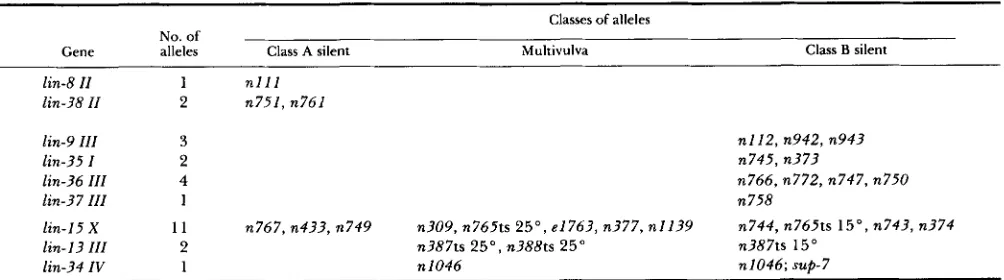
A and B. Strains containing a mutation of each class are Muv, while strains containing two mutations of the same class have a wild-type vulval phenotype. Two genes-lin-8 and lin-38"are defined by class A mu- tations, four genes-lin-9, lis-35, lin-36 and lin-37- are defined by class B mutations, and one gene-lin- 15--has both class A and class B mutations. In addi- tion, we demonstrated that the visible Muv mutants defective in the genes lin-13, lin-15 or lin-34, which have phenotypes similar to those of lin-8; lin-9 her- maphrodites, also have defects in both class A and class B activity.
Our findings suggest that the phenotypes of this group of Muv mutants are caused by defects in two functionally redundant sets of genes, each of which has multiple nonredundant components. Each such set could either encode products that act in a sequen- tial pathway or encode products that form a multi protein complex. T h e activity of one pathway (or complex) is disrupted by class A mutations, while the activity of the second pathway is disrupted by class B mutations. T h e pathways are functionally redundant because the activities of both pathways must be dis- rupted for a Muv phenotype to be manifest. T h e activity of each gene within the two pathways is unique because in the background of a class A or class B mutation the presence of any mutation of the opposite
TABLE 7
Genes with silent Muv alleles
No. of
Classes of alleles
Gene alleles Class A silent Multivulva Class B silent
lin-8 11 1 n l l l
lin-38 I I 2 n751, n761
lin-9 111 3
lin-35 I 2
lin-36 111 4
lin-37 I l I 1
n112, n942, n943 n745, n373
n766, n772, n747, n750 n758
lin-15 X 11 n767, n433, n749 n309, n765ts 25", e1763, n377, n1139 n744, n765ts 15", n743, n374
lin- 13 I11 2 n387ts 25", n388ts 25" n387ts 15"
lin-34 1V 1 n 1046 n1046; sup-7
Mutations in each gene result in one of three phenotypes: a defect in class A activity with no resulting Muv phenotype (Class A silent), a defect in class B activity with no resulting Muv phenotype (Class B silent); or a defect in class A and class B activity with a resulting M u v
Redundant pathways in C . elegans 119
class will result in a Muv phenotype. We cannot de-
termine whether these pathways specify a similar func- tion (e.g., alternate biochemical pathways leading to the production of a single end product) or specify different functions, the presence of either one of which is sufficient to generate a wild-type phenotype
(e.g., two intracellular signaling systems that have dif-
ferent second messengers).
These observations extend the concept of genetic redundancy from redundancy at the level of gene families to redundancy at the level of gene pathways. Previous reports have demonstrated that for certain gene families mutant phenotypes can be generated by null mutations only when all members of the gene family have been mutated. For example, strains car- rying a null mutation in either of the two yeast histone H2B genes are viable, while the elimination of the activities of both genes is lethal (RYKOWSKI et al. 1981). Similarly, the elimination of the activities of either of the two members of the family of yeast ras
genes results in viability, while the double mutant is lethal (TATCHELL et al. 1984; KATAOKA et al. 1984). This report demonstrates that although the activity of each gene in the class A and class B pathways is unique, the pathways specified by these two sets of genes are functionally redundant. Because genes that function in redundant pathways are not likely to mutate to generate a visible phenotype, such genes, and by in- ference, the existence of such pathways, are not likely to be identified in genetic screens that saturate for mutations of a given phenotype.
Because we do not know the null phenotypes of any of the genes specified by these mutations, we cannot unambiguously define which genes are active in both pathways and whether some genes are specific to a single pathway. Two genes, lin-13 and lin-15, are likely to act in both pathways. T h e cell lineage abnor- malities associated with reduction-of-function Muv al- leles in these genes are similar to those observed in Muv hermaphrodites of genotype lin-8; lin-9. In this paper, we demonstrate that the temperature-sensitive Muv phenotype of Zin-l3(n387) results from a tem- perature-sensitive defect in the class A pathway and a
non-temperature-sensitive defect in the class B path- way, indicating that the Zin-l3(n387) mutant is defec- tive in both pathways. For lin-15, we show that the Muv alleles of lin-15 fail to complement both the class
A and class B alleles of the gene, demonstrating di- rectly that the lin-I5 Muv mutants are defective in both pathways. T h e Zin-15 class A and class B alleles fully complement, which indicates that each ofthe Zin- 15 activities is separately mutable; perhaps Zin-15 en- codes multiple protein products, e.g., by alternative splicing of the lin-15 mRNA.
It is likely that some of the six genes defined solely by class A or class B mutations function in only one
of the two pathways. We have the most information about lin-9. We attempted to determine the null phe- notype of this gene by identifying new mutations that failed to complement the silent Muv phenotype of the class B allele lin-9(n112). Two of the three lin-9 alleles we obtained conferred a sterile, class B phenotype, while the third allele conferred a fertile class B phe- notype. T h e fact that we obtained three additional lin-9 mutations that resulted in a class B phenotype but did not obtain any lin-9 alleles that alone resulted in a Muv phenotype, suggests (but does not prove; see
RESULTS) that Zin-9 encodes an activity specific to the class B pathway. A second argument suggests that the remaining five genes-Zin-8, Zin-35, lin-36, lin-37 and lin-38”may encode activities specific to only one of the two pathways. If the product of any of these genes functioned in both pathways, and if the gene, like lin- 15, could mutate to a Muv phenotype without result- ant lethality, it is likely that we would have isolated Muv alleles of at least some of these genes during our previous screen for vulval cell lineage mutations (FER- GUSON and HORVITZ 1985). In that screen, we isolated
95 mutants, defining 22 genes, with either a Muv or Vu1 phenotype. We isolated multiple alleles of all the genes with activities that appear to be specific to these lineages, as well as multiple alleles of many genes with null phenotypes that are likely to be lethal (including five alleles of lin-15 and two alleles of lin-13). Thus, our data suggest that we have identified most genes for which either reduction or loss of gene activity results in a Muv or Vu1 phenotype. Our failure to identify Muv mutants defective in any of the five genes above suggests that these genes are not able to mutate to a Muv phenotype, either because the genes function in only one of the two pathways or because they function in both pathways but cannot mutate to a Muv phenotype without resultant lethality.
Although the class A and class B pathways are functionally redundant in the vulval tissues, mutations in the class B pathway can affect viability and/or fertility in the presence of a functional class A path- way, suggesting that the genes encoding the class B pathway may have a unique function in certain non- vulval tissues. Specifically, in a noncomplementation screen, we isolated new alleles of lin-9 that confer a sterile phenotype. In addition, strains carrying any of three class B mutations-lin-9(nl12), lin-35(n745) and Zin-37(n758)-are less fertile and have a smaller body size than the wild type at 25”. Last, a double mutant carrying the two class B mutations lin-9(nZZ2) and Zin-35(n745) is sterile. In contrast, class A muta- tions do not have any effect on viability or fertility even at high temperatures or in any pairwise combi- nations. However, because w e do not know the null phenotypes of any of the genes specified by class A