Copyright1999 by the Genetics Society of America
Maize
R2R3 Myb
Genes: Sequence Analysis Reveals Amplification
in the Higher Plants
Pablo D. Rabinowicz,*
,1Edward L. Braun,
†,1Andrea D. Wolfe,
‡Ben Bowen
§and Erich Grotewold*
,†*Cold Spring Harbor Laboratory, Cold Spring Harbor, New York 11724,†Department of Plant Biology and‡Department of Evolution, Ecology and Organismal Biology, Ohio State University, Columbus, Ohio 43210 and§Pioneer Hi-Bred International, Inc., Johnston, Iowa 50131
Manuscript received January 28, 1999 Accepted for publication May 26, 1999
ABSTRACT
Transcription factors containing the Myb-homologous DNA-binding domain are widely found in eukary-otes. In plants, R2R3 Myb-domain proteins are involved in the control of form and metabolism. The Arabidopsis genome harbors.100 R2R3 Myb genes, but few have been found in monocots, animals, and fungi. Using RT-PCR from different maize organs, we cloned 480 fragments corresponding to a 42–44 residue-long sequence spanning the region between the conserved DNA-recognition helices (MybBRH) of R2R3 Myb domains. We determined that maize expresses.80 different R2R3 Myb genes, and evolutionary distances among maize MybBRHsequences indicate that most of the amplification of the R2R3 Myb gene family occurred after the origin of land plants but prior to the separation of monocots and dicots. In addition, evidence is provided for the very recent duplication of particular classes of R2R3 Myb genes in the grasses. Together, these findings render a novel line of evidence for the amplification of the R2R3
Myb gene family in the early history of land plants and suggest that maize provides a possible model system
to examine the hypothesis that the expansion of Myb genes is associated with the regulation of novel plant cellular functions.
T
HE regulation of gene expression is a fundamental tinct family of DNA-recognition motifs with sequence similarity to the Myb repeats. For this reason, only Myb-process in all living organisms. Transcription factorsdomain proteins containing multiple Myb repeats were are classified in structural families according to the
pres-considered in this study. ence of specific DNA-recognition motifs (Pabo and
According to this criterion,z10 Myb-domain proteins
Sauer1992). One such family is constituted of proteins
have been identified to date in vertebrates, including containing the Myb-homologous DNA-binding domain
c-Myb, A-Myb, and B-Myb (e.g., Lipsick 1996). c-Myb (Myb-domain), originally identified in the v-myb
onco-plays an essential role in controlling the proliferation gene found in the avian myeloblastosis virus (
Klemp-and differentiation of hemopoietic cells. The cellular
naueret al. 1982). Proteins containing the Myb
DNA-functions of A-Myb and B-Myb are less well understood. binding domain have since been found in all eukaryotes
A single c-myb-like gene has been reported to date in in which they have been sought (reviewed in Lipsick
Drosophila, and the fungi and slime molds express only 1996). Myb domains are usually formed by two or three
a handful of Myb-like sequences (reviewed in Lipsick
imperfect 51- or 52-residue repeats (R1, R2, and R3).
1996). Each repeat encodes three a-helices, with the second
In sharp contrast, dicotyledonous plants express a and third helices forming a helix-turn-helix (HTH)
large number of Myb-homologous proteins (reviewed structure when bound to DNA, which is similar to motifs
inMartinandPaz-Ares1997). The number of R2R3 found in the l repressor and homeodomain proteins
Myb genes has been estimated to be at least 40 in Petunia
(Gabrielsenet al. 1991;Ogataet al. 1994). R2 and R3
hybrida (Avila et al. 1993) and .100 in Arabidopsis are usually sufficient for sequence-specific DNA
bind-(Romeroet al. 1998). Plant Myb domains usually have
ing. A growing class of proteins that contain a single
two Myb repeats most similar to the R2 and R3 repeats of Myb repeat has been identified. From an evolutionary
their animal homologs, defining the R2R3 Myb-domain point of view, these proteins are distantly related to
proteins family (Lipsick 1996;Martin and Paz-Ares
Myb domains containing the R2 and R3 Myb repeats
1997). Evolutionary studies based on the sequences of (RosinskiandAtchley1998), probably forming a
dis-Myb domains from several organisms indicate that plant Myb ancestors may have had three Myb repeats and that the first repeat was lost (Lipsick 1996; Rosinski and
Corresponding author: Erich Grotewold, Department of Plant Biology, Atchley1998). While these studies did provide some
Plant Biotechnology Center, 206 Rightmire Hall, 1060 Carmack Rd.,
clues on how vertebrate Myb genes evolved from a single Ohio State University, Columbus, OH 43210.
ancestor, little information was obtained regarding the E-mail: [email protected]
1These authors contributed equally to this work. expansion of the plant R2R3 Myb gene family or about
the evolution of the large number of plant Myb-domain Arabidopsis. The recent duplications of maize Myb genes suggest that the expansion of this family of tran-proteins. The recent analysis of the sequence of .80
R2R3 Myb genes from Arabidopsis thaliana added impor- scription factors could be directly related to plant evolu-tion and diversity. Maize and other grasses may provide tant data on the functional and structural relationships
among members of this family of transcription factors excellent model systems for understanding the evolu-tion of novel funcevolu-tions after Myb gene duplicaevolu-tion. in dicots (Romero et al. 1998), but the details of the
early evolution of plant Myb-domain proteins remain obscure. It is clear that sequence similarity downstream
MATERIALS AND METHODS of the R2R3 region of Arabidopsis Myb proteins is very
low with the exception of a small number of residues Materials:The B73 maize inbred line was used for these studies. Maize tissues included the following: 18 days after conserved within specific groups of Myb sequences,
pollination (dap) ears, including pericarp, cob glumes, aleu-which may be functionally related (Kranzet al. 1998).
rone, endosperm, and embryo tissues; roots from z 15-day-Plant Myb-domain proteins have some of the expected
old seedlings grown in sterile soil; 15-day-old seedlings; whole characteristics of regulators that play an important role tassels 2–4 days prior to anthesis; and nonpollinated silks im-in the evolution of plant form (DoebleyandLukens mediately after emergence from husks.
The primers used for PCR amplification corresponding to 1998). Plant Myb proteins regulate the differentiation
the sequences encoding the DNA-recognition helices of R2R3 of epidermal cells to trichomes (Oppenheimer et al.
Myb domains (Figure 1) were: 1991), the determination of cell shape (Noda et al.
pMyb59, 59-AARWSNTGYMGNYTNMGNTGG-39 1994), and the development of leaf form (Waiteset al.
pMyb39, 59-CCARTARTTYTTNAYNTSRTTRTC-39 1998). The complex control of phenylpropanoid
vMyb59, 59-TGYMGNGARMGNTGGCAYAAYCAY-39 (Sablowskiet al. 1994;Moyanoet al. 1996) and
flavo-vMyb39, 59-CCARTGRTTYTTNAYNSHRTTRTCNGT-39 noid biosynthesis (reviewed inMolet al. 1998) by Myb
with R5A/G, W5A/T, M5A/C, H5A/T/C, Y5C/T,
proteins indicates a key function played by this family
S5G/C, and N any base.
of regulatory factors in the evolution of plant metabolic
RNA isolation and cDNA synthesis:Total RNA was isolated diversity. The role of plant Myb proteins in mediating by pulverizing frozen maize tissue in liquid nitrogen and ex-the response to viral infection (YangandKlessig1996), tracting total RNA using the Trizol reagent (GIBCO, Grand Island, NY) according to the manufacturer’s instructions. Mes-hormones (Gubleret al. 1995), and drought (Uraoet
senger RNA was isolated using streptavidin-coated
paramag-al. 1993) suggests that they play important roles in the
netic beads (PolyATract mRNA isolation system III; Promega, interaction of plants with the environment. Together,
Madison, WI). First-strand cDNA synthesis was done by incu-these findings have led to the suggestion that the expan- bating 1–3mg of poly(A)1RNA with 0.25mg of random hexa-sion of the Myb gene family occurred in conjunction deoxynucleotides (Promega) in 12ml of water at 708for 10 min, chilling in ice, and carrying out reverse transcription with the development of new cellular functions (
Mar-using SuperscriptII (GIBCO-BRL, Gaithersburg, MD),
follow-tinandPaz-Ares1997) and that the role of Myb
pro-ing the manufacturer’s instructions, in a 20-ml reaction. teins is to provide plasticity for plant metabolism and
Amplification and cloning of PCR products:PCR was carried
development (Romeroet al. 1998). out using 0.5–1 ml of cDNA and 125 pmol of degenerate
Although few genes encoding R2R3 Myb-domain pro- primers in a 25-ml reaction volume containing 200mmof the four dNTPs, 3 mmMgCl2, 1 unit of Taq polymerase (Perkin
teins have so far been identified in monocots, there is
Elmer-Cetus, Norwalk, CT) in the manufacturer-provided little reason to believe that there are significantly fewer
buffer. Thermocycling conditions were 5 min at 958, then 40
Myb genes in monocots than in dicots. However,
se-cycles of 1 min at 958, 1 min at 628, and 30 sec at 728, and a quence data on monocot Myb genes should provide key final extension of 20 min at 728. Using this approach, 50–250 information on the patterns of evolution in the Myb ng of a single band ofz180-bp PCR product was obtained, which was separated on 1.5% agarose gels. Negative controls gene family. We investigated the phylogenetic
relation-with only the primers were always included to ensure that no ships among expressed R2R3 Myb genes in the model
contamination with other Myb genes frequently used in the monocot Zea mays. Sequence analyses of the region
be-lab had occurred. No PCR products were detected when the tween the conserved DNA-recognition helices of Myb mRNA was amplified prior to reverse transcription indicating domains (MybBRH) revealed that maize expresses .82
minor, if any, DNA contamination. The 180-bp band was cut off the gel together with a small agarose region (2–4 mm)
R2R3 Myb genes. The alignment of the corresponding
surrounding the band and extracted using a QIAquick (QIA-amino acid sequences provides novel insights into plant
GEN, Chatsworth, CA) spin column. Bands were cloned into Myb-domain sequence conservation and confirms that
the pT-Adv vector (CLONTECH, Palo Alto, CA), and QIAprep maize and animal Myb domains have substantial differ- plasmid DNA samples were sequenced using the ABI PRISM ences. Based upon the accumulation of synonymous dye terminator system (dRhodamine; Perkin Elmer) and an
ABI automated sequencer. and nonsynonymous substitutions in the maize MybBRH
Sequence analysis:Sequences obtained were analyzed using sequences, we found that the dramatic expansion of the
the IntelliGenetics GeneWorks 2.5 and Oxford Molecular
R2R3 Myb gene family in higher plants occurred within
MacVector 6.0 programs. Homology searches with databases the past 500 million years. Surprisingly, our data suggest were done using Blast 2.0 searches of the “nr” database at that there has also been a very recent expansion of the NCBI (http://www.ncbi.nlm.nih.gov). Nucleotide sequences
were translated into inferred amino acid sequences.
Phylogenetic analysis: The amino acid sequences were exhibit extremely similar compositions (data not shown), so they were not separated for this analysis.
aligned using Clustal V (Higginset al. 1992). The results were
adjusted to obtain the best alignment for each region based Synonymous and nonsynonymous p-distances were cor-rected for multiple substitutions when used to compute the on conserved sequences. For the large-scale analysis of Myb
evolution based upon amino acid sequences, PAUP* 4.0b1 ratio of nonsynonymous to synonymous mutations (KA/KS), and the models of sequence evolution used to correct p-dis-(Swofford1998) was used for maximum-parsimony analysis,
and PAUP* 4.0b1, PHYLIP 3.57 (Felsenstein1993), and PUZ- tances for multiple substitutions were used to generate satura-tion plots. The KA/KSratio can also be used to compute the ZLE 4.0 (Strimmerandvon Haeseler1998) were used for
distance analyses. The maximum-parsimony bootstrap analysis mean rate of nonsynonymous substitutions, which is calculated as the product of the KA/KSratio and the rate of synonymous used 2000 bootstrap replicates. Each bootstrap replicate used
100 random addition sequence replicates with no branch swap- mutations. Nonsynonymous distances were corrected for mul-ping, although this strategy (bootstrapping without branch tiple substitutions based upon Jukes-Cantor (JC) distances with swapping) may underestimate the actual relative nodal sup- ag-distribution to accommodate among-site rate variation (Jin
port of a clade (Wolfe and dePamphilis 1998). Distance andNei1990). Saturation for nonsynonymous mutations was analyses of amino acid sequences were conducted using 2000 calculated independently of the JC1 gmodel of sequence bootstrap replicates, using PAUP* 4.0b1 to perform neighbor evolution, using an empirical estimate based upon the sum joining of p-distances (mean character differences) or compo- of three-quarters of the proportion of nonsynonymous sites nents of PHYLIP 3.57 to generate the bootstrap datasets and exhibiting fourfold variation, two-thirds of the proportion of perform neighbor joining of distances estimated using the nonsynonymous sites exhibiting threefold variation, and one-PAM, JTT, and JTT 1 g models of amino acid evolution half of the proportion of nonsynonymous sites exhibiting two-(Dayhoffet al. 1978;Joneset al. 1992). JTT distance estimates fold variation. The variation of nondegenerate codon posi-were obtained using PUZZLE 4.0. Exact ties in neighbor-join- tions was determined using MybBRHsequences from both maize ing trees were broken randomly in both PAUP* 4.0b1 or and A. thaliana. Synonymous distances were assumed to accu-the neighbor-joining program from PHYLIP 3.57. The shape mulate according to the F81 model of sequence evolution parameter of theg-distribution (designateda, estimated to (Swofford et al. 1996), which is appropriate for sequences
be 0.62) used to describe site-to-site rate variation in these with biased nucleotide composition that do not exhibit a amino acid sequences was estimated using maximum likeli- highly biased transition/transversion ratio (Muse1996). The hood in PUZZLE 4.0, using a four-category discrete approxi- expected saturation for synonymous mutations corresponds mation to a continuousg-distribution (Yang1994). Model fit to one minus the sum of the squares of the proportion of each was examined using the likelihood-ratio test, with likelihoods nucleotide (Swoffordet al. 1996). Unsaturated comparisons calculated using PUZZLE 4.0, by computing a test statistic were considered to be those with synonymous p-distances#0.3 (d 52[ln L12ln L0]) that can be compared to ax2distribution and nonsynonymous p-distances#0.1. This corresponds to a (the degrees of freedom correspond to the number of addi- corrected synonymous distance of 0.4210 substitutions per tional free parameters in the model; seeHuelsenbecket al. synonymous site and a corrected nonsynonymous distance of 1996). Although models that are not nested (such as the JTT 0.1193 substitutions per nonsynonymous site.
and PAM models of amino acid evolution) cannot be tested in this manner, the model that has the highest likelihood is preferred.
RESULTS Phylogenetic analyses of nucleotide sequences using a more
limited set of aligned sequences employed PAUP 4.0b1 (Swof- Identification ofR2R3 Mybgenes expressed in maize: ford 1998) to identify phylogenetic trees, using the
un-To estimate the number of R2R3 Myb genes expressed weighted maximum-parsimony as well as the
minimum-evolu-in maize, we made use of the very high conservation of tion criteria using F811 gdistance estimates (Swoffordet al.
1996). Maximum-parsimony bootstrap analyses used branch- the two DNA-recognition helices of R2R3 Myb domains. and-bound searches while the distance bootstrap analyses used DNA fragments encoding regions of Myb domains neighbor-joining trees estimated from F811 gdistances (us- flanked by the two DNA recognition helices of R2 and inga 50.67, calculated from the nucleotide alignment). The
R3 (MybBRH, see Figure 1) were amplified by PCR,
a-parameter of theg-distribution was estimated using the F81
cloned, and sequenced. RT-PCR was carried out on model with a four-category discrete approximation to a
contin-uousg-distribution in PAUP 4.0b1. Molecular clock analyses mRNA extracted from several maize organs (see
mate-with complete MybBRHnucleotide sequences were conducted
rials and methods) using the degenerate primers as described (Kimballet al. 1997), except PUZZLE 4.0 was pMyb59and pMyb39that correspond to the
DNA-recog-used for the likelihood calculations. To “linearize” this tree
nition helices of all plant Myb-domain proteins aligned (Takezakiet al. 1995), four rapidly evolving MybBRHsequences
by Avila and coworkers (Avilaet al. 1993). When
prim-(1C47, IM44, IF25, and IF35) were removed.
Synonymous and nonsynonymous distances (KSand KA, re- ers corresponding to the DNA-recognition helices of spectively) were calculated using MEGA 1.01 (Kumar et al. animal Myb-domain proteins were used (vMyb59 and
1993) based upon the method proposed previously (Neiand vMyb39), no detectable PCR product was obtained (not
Gojobori1986). Because of the extreme codon bias in maize
shown). The 180-bp PCR products were extracted from MybBRH sequences, we report synonymous and
nonsynony-agarose gels, making sure to include potentially less-mous p-distances. An additional benefit of using p-distances
is the low variance of this measure, which is important when represented fragments of slightly larger or smaller sizes. comparing relatively short sequences. The codon bias of the After cloning of the PCR products, the sequences were MybBRHsequences was examined by extracting codon positions
determined. To decide if any given clone corresponded expected to be degenerate and nondegenerate based upon
to a possible Myb domain, we translated the coding the genetic code and evaluating the composition of these
strand (determined by the primers) in three frames and positions using MacDNAsis version 2.0 (Hitachi Ltd., San
ity between the R2 and R3 Myb repeats (van Aalten
et al. 1998). The limited sequence conservation in the
region between the linker and the R3 DNA-recognition helix makes this part of the R2R3 Myb domain ideal for evolutionary studies. The proteins encoded by the C1 and Pl genes, which arose by a duplication event associ-Figure 1.—Myb-domain structure indicating the region
ated with the allotetraploidization of maize (Gautand from which the MybBRHsequences are derived. Arrows indicate
Doebley1997), play identical functions in the control the primers used for MybBRHsequence amplification. R1, R2,
and R3 indicate each of the three Myb repeats. Helices forming of maize flavonoid biosynthesis (Coneet al. 1993). Yet,
the double helix-turn-helix motif characteristic of R2R3 Myb the MybBRH region of C1 and Pl have two amino acid domains are shown shadowed with the DNA-recognition
heli-differences (Figure 2). ces in black. The numbers correspond to the residues of the
In our analysis we identified five pairs of MybBRH se-P gene (Grotewold et al. 1991), used as a reference here.
quences with identical amino acid sequences but en-The Myb-domain region represented by the MybBRHsegment
corresponds to the last five residues (approximately residues coded by different genes as deduced from the corre-58–62) of the R2 DNA-recognition helix, the flexible linker sponding nucleotide sequences. These correspond to region that joins the R2 and R3 Myb repeats (approximately
ZmMYB-IP20, which has an identical nucleotide se-residues 63–71), and the first and second helices of the R3
quence as the MybBRHregion of the maize P gene ( Cho-Myb repeat.
praet al. 1996) and is identical at the amino acid level
to IF8, IF50 is identical to ZmMYB-IP26, ZmMYB-1C18 is identical to ZmMYB-IF55, in all Myb-domain proteins identified to date. Less than
2% of all the sequences obtained showed no homology IM65 is identical to IP47, and ZmMYB-IP71 is identical to ZmMYB-IP45 (Figure 2).
to Myb in any of the three possible reading frames and
were discarded. From a total of 480 Myb sequences As expected from previous studies (Williams and
Grotewold1997), the residues corresponding to the analyzed, 71 clones representing 30 different sequences
were obtained from 18 dap ears, 120 clones representing R2 DNA-recognition helix (Figure 1) are very highly conserved in the 82 sequences analyzed here (Figure 36 different sequences were obtained from roots, 131
clones representing 32 different sequences were ob- 2). The maize sequences show most often a Tyr residue at position 60 similar to Arabidopsis but different from tained from seedlings, 85 clones representing 21
differ-ent sequences were obtained from silks, and 73 clones the characteristic His residue present in animal Myb domains. Three maize Myb sequences (ZmMYB-IM31, representing 28 different sequences were obtained from
immature tassels (Table 1). We are confident that most, ZmMYB-IP102, and ZmMYB-IP124) have His or Lys resi-dues at this position. The conserved Arg residue at posi-if not all, of these sequences are derived from RNA and
not from contaminant genomic DNA. First, no amplifi- tion 62 is replaced in a few maize R2R3 Myb domains by a His residue, but never by Asn as in animal Myb cation was obtained in control RNA not treated with
reverse transcriptase (see materials and methods). domains. However, some Arabidopsis sequences have Asn residues at this position (Romeroet al. 1998). None
And second, the primers used for RT-PCR in this study
flank the position of a conserved intron found in all of the maize sequences characterized shows at this posi-tion the Ser residue found in the Arabidopsis GL1 pro-maize Myb genes characterized to date. Indeed,,10%
of the 801 Arabidopsis Myb sequences characterized tein, which is required for normal trichome formation (Oppenheimeret al. 1991), or in several other
Arabi-lack an intron in the MybBRH region (Romero et al.
1998). The lack of introns in all of the sequences charac- dopsis Myb domains phylogenetically unrelated to GL1 (Romeroet al. 1998).
terized here suggests that they are derived from RNA
and not from DNA. Little is known about sequence conservation or
re-quirements for the flexible linker. A conserved Pro resi-Analysis of the MybBRH
region encoded by maizeR2R3
Myb genes: The MybBRH region is formed by the last due is found at position 63 in both animal and plant
Myb domains (WilliamsandGrotewold1997). The
five residues (residues 58–62, using the maize P gene
sequence as a reference; see Figure 1) of the R2 DNA- change of Pro63 to Ala produced a dramatic reduction in the DNA-binding activity of animal Myb domains recognition helix, the flexible linker region
(approxi-mately residues 63–71) that joins the R2 and R3 Myb (HegvoldandGabrielsen1996), and this position was implicated in controlling the fluctuations of the Myb repeats, and the first and second helices of the R3 Myb
repeat (Figure 1). The sequence of the DNA-recogni- repeats with respect to each other (van Aalten et al.
1998). Consistently, the change of Pro63 to Ala would tion helices of Myb domains is highly conserved, and
residue changes in this region often impair DNA-bind- increase the flexibility of the linker. However, a subset of maize Myb domains, including that of the P protein, ing activity (Gabrielsenet al. 1991;Williamsand
Grote-wold 1997). The linker plays a fundamental role in have Ala instead of Pro at that position (Figure 2). Despite this change, the P protein binds DNA with high positioning the DNA-recognition helices on the DNA
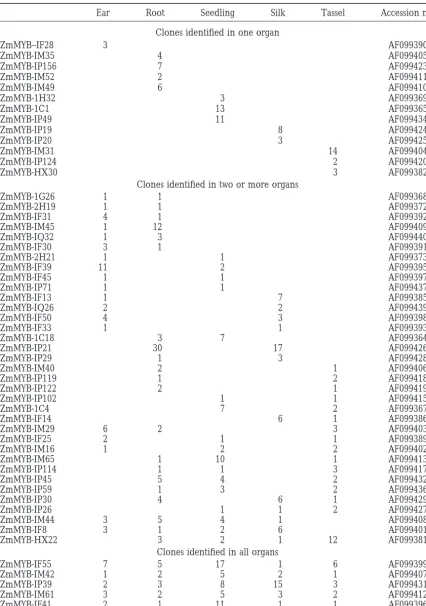
TABLE 1
Distribution of maize MybBRHsequences in different parts of the maize plant
Ear Root Seedling Silk Tassel Accession no.
Clones identified in one organ
ZmMYB--IF28 3 AF099390
ZmMYB-IM35 4 AF099405
ZmMYB-IP156 7 AF099423
ZmMYB-IM52 2 AF099411
ZmMYB-IM49 6 AF099410
ZmMYB-1H32 3 AF099369
ZmMYB-1C1 13 AF099365
ZmMYB-IP49 11 AF099434
ZmMYB-IP19 8 AF099424
ZmMYB-IP20 3 AF099425
ZmMYB-IM31 14 AF099404
ZmMYB-IP124 2 AF099420
ZmMYB-HX30 3 AF099382
Clones identified in two or more organs
ZmMYB-1G26 1 1 AF099368
ZmMYB-2H19 1 1 AF099372
ZmMYB-IF31 4 1 AF099392
ZmMYB-IM45 1 12 AF099409
ZmMYB-IQ32 1 3 AF099440
ZmMYB-IF30 3 1 AF099391
ZmMYB-2H21 1 1 AF099373
ZmMYB-IF39 11 2 AF099395
ZmMYB-IF45 1 1 AF099397
ZmMYB-IP71 1 1 AF099437
ZmMYB-IF13 1 7 AF099385
ZmMYB-IQ26 2 2 AF099439
ZmMYB-IF50 4 3 AF099398
ZmMYB-IF33 1 1 AF099393
ZmMYB-1C18 3 7 AF099364
ZmMYB-IP21 30 17 AF099426
ZmMYB-IP29 1 3 AF099428
ZmMYB-IM40 2 1 AF099406
ZmMYB-IP119 1 2 AF099418
ZmMYB-IP122 2 1 AF099419
ZmMYB-IP102 1 1 AF099415
ZmMYB-1C4 7 2 AF099367
ZmMYB-IF14 6 1 AF099386
ZmMYB-IM29 6 2 3 AF099403
ZmMYB-IF25 2 1 1 AF099389
ZmMYB-IM16 1 2 2 AF099402
ZmMYB-IM65 1 10 1 AF099413
ZmMYB-IP114 1 1 3 AF099417
ZmMYB-IP45 5 4 2 AF099432
ZmMYB-IP59 1 3 2 AF099436
ZmMYB-IP30 4 6 1 AF099429
ZmMYB-IP26 1 1 2 AF099427
ZmMYB-IM44 3 5 4 1 AF099408
ZmMYB-IF8 3 1 2 6 AF099401
ZmMYB-HX22 3 2 1 12 AF099381
Clones identified in all organs
ZmMYB-IF55 7 5 17 1 6 AF099399
ZmMYB-IM42 1 2 5 2 1 AF099407
ZmMYB-IP39 2 3 8 15 3 AF099431
ZmMYB-IM61 3 2 5 3 2 AF099412
ZmMYB-IF41 2 1 11 1 1 AF099396
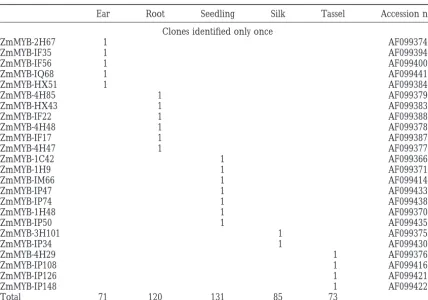
TABLE 1
(Continued)
Ear Root Seedling Silk Tassel Accession no.
Clones identified only once
ZmMYB-2H67 1 AF099374
ZmMYB-IF35 1 AF099394
ZmMYB-IF56 1 AF099400
ZmMYB-IQ68 1 AF099441
ZmMYB-HX51 1 AF099384
ZmMYB-4H85 1 AF099379
ZmMYB-HX43 1 AF099383
ZmMYB-IF22 1 AF099388
ZmMYB-4H48 1 AF099378
ZmMYB-IF17 1 AF099387
ZmMYB-4H47 1 AF099377
ZmMYB-1C42 1 AF099366
ZmMYB-1H9 1 AF099371
ZmMYB-IM66 1 AF099414
ZmMYB-IP47 1 AF099433
ZmMYB-IP74 1 AF099438
ZmMYB-1H48 1 AF099370
ZmMYB-IP50 1 AF099435
ZmMYB-3H101 1 AF099375
ZmMYB-IP34 1 AF099430
ZmMYB-4H29 1 AF099376
ZmMYB-IP108 1 AF099416
ZmMYB-IP126 1 AF099421
ZmMYB-IP148 1 AF099422
Total 71 120 131 85 73
Numbers indicate how many times each sequence was identified by RT-PCR in each maize organ. The column on the right provides the accession numbers of the MybBRHsequences obtained in this study.
residues besides Pro and Ala are found at position 63 the cotton Myb, the residue corresponding to position 84 is also a Thr.
among the maize R2R3 Myb domains identified in this
study. In 9 of the 10 R2R3 Myb domains where Pro63 A landmark of Myb domains is the presence of three periodic Trp residues in each Myb repeat (Saikumar
is changed to Ala, there is also a Thr residue at position
84, which is very rarely found in other maize R2R3 Myb et al. 1990). All plant R2R3 Myb domains analyzed to
date have the first Trp residue of the second Myb repeat domains (Figure 2). Whether Thr84 helps to stabilize
the interaction between the two Myb repeats in the replaced by a hydrophobic amino acid (Romeroet al.
1998). Our analysis of the 82 maize Myb domains con-presence of Ala63 remains to be determined, although
it is unlikely given the distant positions of the residues firms this difference between plant and animal Myb domains, because most of the sequences analyzed here corresponding to Pro63 and Thr84 in the deduced
structure of the R2R3 Myb domain of c-Myb (Ogataet have either Phe, Ile, Leu, or Met residues at position 70. Exceptions are ZmMYB-HX22, ZmMYB-IF45, and
al. 1994). All the maize Myb domains with an alanine
residue at position 63 form a gene clade (Figure 3), ZmMYB-IP119, which have a Tyr residue instead. The change of the conserved Trp residue to either Phe, Val, and ZmMYB-2H67, which has only the proline 63 to
alanine change, but not the Thr84 residue, is the most or Leu has little effect on the DNA-binding activity of animal Myb domains (Kanei-Ishiiet al. 1990). However,
basal one, suggesting a two-step appearance of Ala63
and Thr84. Consistently, no Myb sequence was found the effect of changing the Trp residue to Tyr has not been reported. Even more dramatic is the presence of in Arabidopsis containing this Ala63, although AtMYB11
and AtMYB12 have a serine residue at this position, Lys residues at position 70 in ZmMYB-IP102 and
ZmMYB-IP124. The effect of this nonconservative resi-being among a few Arabidopsis sequences with a Thr
residue at position 84 (Romeroet al. 1998). From.200 due change on the overall structure and DNA-binding activity of Myb domains remains to be determined. plant R2R3 Myb sequences present in the database, a
cotton gene encoding an R2R3 Myb protein (Cmy-J, Pro97 is highly conserved in both animal as well as
plant Myb domains (Figure 2). However, two maize se-accession no. AF034132) provides the only other
Figure 2.—Alignment of the deduced maize MybBRHamino acid sequences. The names of the maize Myb sequences charac-terized here are according to the criteria adopted previously (MartinandPaz-Ares
1997), with the exception of the genes named prior to year 1997. The sequence of ZmMYB-IF8 is not shown because it is identical to the sequence of P. The numbers on top of the alignment correspond to the sequence of P (Grotewold et al. 1991),
and the asterisks are spaced every five resi-dues. The alignment graphic was generated using BOXSHADE 3.2.1 (http://ulrec3. unil.ch/software/BOX_form.html). Iden-tical residues are shown in black, while con-servative changes are indicated in gray. Dashes indicate gaps in the alignment.
in which this conserved Pro residue was replaced by in the hinge region of v-Myb completely abolishes DNA binding (E. Grotewold,unpublished results), and all either Glu or Ser, respectively. The effect of this
differ-ence on Myb-domain structure or function is not yet R2R3 Myb domains characterized to date (Romeroet al. 1998) have the same distance between the
DNA-known.
We expected that the MybBRHregion would be highly recognition helices. Therefore, it was surprising to
in the first helix of R3 (between residues 77 and 78). (Chopraet al. 1996), the allele of the P gene expressed
in the B73 line used for these studies. The expression ZmMYB-IP102 and ZmMYB-IP124 have an additional
Val at this position, whereas ZmMYB-IP50 has a Met pattern of ZmMYB-IF8 coincides with the expression of
P in pericarp and silk tissues, although at lower levels
residue inserted. Because at least one of these sequences
appeared in multiple PCR reactions and all of these we also found sequences identical to ZmMYB-IF8 in the roots and seedling tissues (Table 1). The seedlings sequences have an insertion corresponding to exactly
three nucleotides (Table 1), they are unlikely to repre- include the coleoptile, where P-regulated 3-deoxy fla-vonoids have been reported (StylesandCeska1981). sent PCR artifacts. ZmMYB-IP50 is identical at the
nucle-otide level with the MybBRHregion of C1, with the excep- To our knowledge, P expression in roots has never been
rigorously examined. tion of the ATG insertion that adds an additional Met
residue. The B73 inbred line used for these studies has ZmMYB-IP20 and ZmMYB-1H48 encode products
identical to P at the amino acid level but with one and no C1 function, and the lesion in C1 in B73 has not
been identified, raising the question of the relationship two differences, respectively, at the nucleotide level (not shown). While ZmMYB-1H48 was isolated just once, between C1 and ZmMYB-IP50. ZmMYB-IP50 was found
once in seedlings, a tissue where C1 is normally not ZmMYB-IP20 was found three times in different PCR reactions, making the possibility of repeated errors in-expected to be expressed, suggesting that ZmMYB-IP50
may correspond to a C1-related R2R3 Myb-domain pro- troduced by the Taq polymerase highly unlikely.
ZmMYB-IP20 was found only in silks, one of the tissues tein, but probably not to C1 itself. The effect of a residue
insertion between residues 77 and 78 on Myb-domain where P is also expressed. ZmMYB-IP20 could corre-spond to a gene encoding a protein highly similar to structure or DNA-binding activity is not known.
ZmMYB-IF35 and ZmMYB-IQ68 have one residue less in the P, or alternatively, it could derive from one of the several
repeated P copies that form the P-wr allele (Chopraet
MybBRHregion (position 72). Both sequences were
iden-tified once in tassels (Table 1), and they are different al. 1998) that is present in the B73 line.
ZmMYB-IM49 is identical at the amino acid level with from each other at several positions (Figure 2); thus it is
unlikely that these differences are due to PCR or cloning the maize Myb-domain protein Zm38, but these two sequences have three silent nucleotide differences. Al-artifacts. Vertebrate R2 Myb repeats have a residue less
than plant R2 repeats, and this difference in length is though Zm38 was cloned from a leaf-specific cDNA li-brary (Maroccoet al. 1989), its expression pattern was
essential for DNA binding (WilliamsandGrotewold
1997). Perhaps small variations in the length of Myb never investigated. Thus, we cannot rule out the possibil-ity that ZmMYB-IM49 corresponds to Zm38 and that the repeats change the properties of the corresponding Myb
domains, contributing to their biological specificity. nucleotide differences correspond to polymorphisms. ZmMYB-IF33 shows a very high sequence similarity Whether the Myb-domain proteins corresponding to
ZmMYB-IP102, ZmMYB-IP124, ZmMYB-IP50, ZmMYB- with the genes encoding the Mixta proteins from
Petu-nia (myb.Ph3;Mur1995) and snapdragon (Mixta;Noda
IF35, and ZmMYB-IQ68 have unique DNA-binding
activ-ities or have lost their DNA-binding activity because of et al. 1994). Mixta proteins were shown to control petal
cell shape (reviewed inMartin and Paz-Ares1997). the length difference between the corresponding
DNA-recognition helices remains to be determined. The stud- A gene encoding a product very similar to the Mixta proteins from Arabidopsis (A.t. Mixta) was reported ies shown here strongly support the notion that plant
and animal Myb domains have extensive differences (Rabinowiczet al. 1996), and an alignment of the
Petu-nia, snapdragon, Arabidopsis, and maize homologous within the conserved Myb-homologous DNA-binding
domain. sequences shows that in the MybBRH region,
ZmMYB-IF33 has an identical amino acid sequence to Myb.Ph3 Sequence similarity of MybBRHsequences with other
plant Myb genes:We investigated the sequence similar- and has only one amino acid difference with A.t. Mixta (not shown). ZmMYB-IF33 was identified once in silks ity of the maize MybBRHsequences to other Myb-domain
proteins in the nr database available from the National and in immature ears, consistent with the reported ex-pression of Mixta in snapdragon flowers (Noda et al.
Center for Biotechnology Information. ZmMYB-IF8
showed 100% identity at the nucleotide level with P-wr 1994).
Figure3.—Phylogenetic relationships among maize R2R3 Myb genes. This cladogram presents the relationships among MybBRH sequences from maize with selected MybBRHsequences from the dicot A. thaliana and the bryophyte P. patens (dicot and bryophyte MybBRHsequences are presented in boldface) as inferred by neighbor joining of JTT1 gdistance estimates. The MybBRHsequence of c-Myb (Klempnaueret al. 1982) was used as the outgroup. Bootstrap proportions from 2000 replicates using neighbor joining
Phylogenetic analysis of maize R2R3 Myb proteins: has been used in some analyses of Myb evolution (Kranz
et al. 1998), the JTT model of amino acid evolution
Phylogenetic analysis of the sequence between the
DNA-recognition helices, equivalent to the MybBRHsequences (Jones et al. 1992) exhibits a slightly better fit to the
data [ln L5 23049.13 ( JTT); ln L5 23068.34 (PAM)]. used in this study and using.80 Arabidopsis R2R3 Myb
genes (Romeroet al. 1998), identified a tree topology Although the modest differences between these models suggest that both will provide similar estimates of Myb consistent with the presence of subgroups identified
by the presence of sequences in the carboxyl-terminal phylogeny, incorporation of among-site rate variation to the JTT model using a discrete approximation to a regions of R2R3 Myb proteins (Kranzet al. 1998). This
suggests that the phylogenetic information content of g-distribution resulted in a significant improvement to the model [ln L5 22814.96 ( JTT 1 g,a 50.62); ln the 44 amino acids in the MybBRHsequences used in this
study is sufficiently strong to reveal historical patterns L5 23049.13 ( JTT, no rate heterogeneity);d 5468.34, significant at P, 0.001], suggesting that the JTT1 g in the evolution of R2R3 Myb proteins.
To reconstruct the phylogenetic history of maize Myb model represents the best available model of amino acid sequence evolution for the MybBRH region. When this
genes, the MybBRHsequences obtained from maize as a
part of this study were combined with a set of 18 MybBRH model of sequence evolution is used to estimate genetic
distances, there is bootstrap support for a branch at sequences from A. thaliana and a single MybBRHsequence
from the moss Physcomitrella patens. Phylogenetic analy- the base of the phylogenetic tree (Figure 3, brancha). Surprisingly, this branch does not separate higher plant ses of these sequences, using the animal c-MybBRH
se-quence (Klempnauer et al. 1982) as an outgroup, re- MybBRHsequences from the bryophyte (P. patens) MybBRH
sequence, suggesting that at least one gene duplication sulted in the identification of a phylogenetic tree
topology that strongly supports the hypothesis that some in this set of sequences occurred prior to the divergence of vascular plants from bryophytes,z450 mya (Kenrick
diversification of the R2R3 Myb gene family occurred
prior to the divergence of monocots and dicots (Figure andCrane1997). Taken as a whole, we conclude that the phylogenetic information content of the MybBRH
re-3). The bootstrap consensus trees estimated using
un-weighted maximum-parsimony analysis of MybBRH se- gion of R2R3 Myb-domain sequences used in this study
is sufficiently strong to resolve some relatively ancient quences or neighbor joining of several different
dis-tance measures (see materials and methods) relationships within the Myb gene family (Figure 3).
Substitution rates and codon bias of maize R2R3 Myb contained at least two gene clades containing both
mo-nocot and dicot sequences that are well supported genes:To determine whether the MybBRHregion could
provide a convenient sequence to evaluate the diver-(bootstrap proportions$70% in all analyses), and seven
gene clades containing both monocot and dicot se- gence between specific plant R2R3 Myb sequences, the limitations inherent to evolutionary studies using this quences supported by some analyses (bootstrap
propor-tions$50%). The results of a large-scale analysis of Myb- region were assessed. A major feature of the maize MybBRH sequences was their nucleotide composition,
domain sequences from higher plants (P. D.
Rabino-wicz, E. L. Braun, R. T. Kimball, E. Grotewoldand which exhibited extreme bias in the degenerate codon positions (8.4% A, 5.1% T, 56.0% C, 30.5% G), which
A. D. Wolfe,unpublished results) also support the
nest-ing of monocot and dicot sequences in specific gene is similar to the bias found in other genes from monocot-yledonous plants (Murrayet al. 1989). The rapid
evolu-clades, strongly supporting the hypothesis that the
am-plification of the R2R3 Myb gene family began prior to tion of synonymous sites in plant nuclear genes, esti-mated to occur with an average rate of 6.5 3 1029
the divergence of monocots and dicots,z160 mya (see
Goremykinet al. 1997). substitutions per synonymous site per year (Gautet al.
1996), suggests that synonymous differences within the The major gene clades containing both monocot and
dicot sequences that are suggested by the phylogeny of MybBRH region became saturated rapidly (Figure 4A).
Given the high sampling variance resulting from the MybBRH sequences are poorly supported by bootstrap
analyses in many cases (bootstrap proportions,50%), limited length of the MybBRH region examined in this
study, the extreme codon bias of these sequences should suggesting either that sufficient information is not
pres-ent in the limited number of informative characters limit the usefulness of synonymous distances to relatively recent gene duplications, such as those that occurred present in the MybBRH sequences or that the internal
branches defining major gene clades are relatively short. within the past 65 million years (Figure 4A).
Nonsynonymous changes may provide substantial in-The second possibility could reflect a period of rapid
amplification of plant Myb genes (seeBraunet al. 1998 formation regarding ancient Myb gene duplications, be-cause they are expected to accumulate at a much slower for a similar example in the annexin gene family of
animals). To further explore this issue, specific models rate than synonymous differences. The composition of nondegenerate codon positions in the MybBRH region
of amino acid evolution that differentially weigh
differ-ent types of substitutions were examined, because they was found to be relatively unbiased (29.0% A, 19.7% T, 22.8% C, 28.5% G). However, using nonsynonymous may provide a better estimate of Myb evolution when
paralo-gous Myb genes presents the challenges of accommodat- The mean ratio of nonsynonymous to synonymous mu-tations (KA/KS) within the MybBRHregion was estimated
ing the functional constraints present in the MybBRH
region and the variation in the overall rate in which the to be 0.2780, suggesting that nonsynonymous substitu-tions in this region accumulate at a mean rate of 1.83 MybBRH region evolved in distinct Myb paralogs.
Esti-mates of evolutionary distances were obtained in a man- 1029substitutions per nonsynonymous site per year,
as-suming that the rate of synonymous evolution for these ner that accommodates among-site differences in
evolu-tionary rates resulting from functional constraints (the Myb genes is similar to that for other genes in the maize
J-C model of nucleotide substitution with rates at differ- genome (Gautet al. 1996).
ent sites distributed according to a g-distribution with The mean ratio of nonsynonymous and synonymous a shape parameter a 5 0.62; see Jin and Nei 1990). distances (KA/KS) was calculated based upon a subset
of pairwise comparisons that exhibit unsaturated synon-ymous distances. The unsaturated comparisons corre-spond to a total of 67 pairwise comparisons among 51 maize MybBRHsequences, representing genes that arose
by duplication in the past 35 million years. In striking contrast, similar analyses using a set of 84 A. thaliana MybBRHsequences revealed only 6 pairwise comparisons
that reflect gene duplications that occurred during a similar time frame (data not shown). These results sug-gest that many of the maize MybBRHsequences analyzed
are closely related to at least one other maize sequence obtained as a part of this study and indicate that the smaller number of recent Myb gene duplications that occurred in A. thaliana will not allow a similar calibration of the rate of nonsynonymous mutations based upon sequences from this organism. The mean KA/KS ratio
Figure 4.—Predicted accumulation of synonymous and nonsynonymous differences in the MybBRH region. (A) Pre-dicted accumulation of synonymous differences over time, assuming that synonymous mutations occurred at a rate of 6.531029mutations per synonymous site per year (Gautet al. 1996). The synonymous p-distance (observed proportion
of synonymous differences) was assumed to increase according to the F81 model of sequence evolution (Swofford et al.
estimated from maize sequences has a high variance brated using the divergence of C1 and Pl, two paralogous
Myb genes that were duplicated as a result of the
allotet-(5.812 31022), probably reflecting both the sampling
variance of individual distance estimates and differences raploid origin of the maize genome that diverged after the reversion of maize to disomic inheritance z11.4 in the rates at which nonsynonymous mutations
accu-mulate in specific Myb genes (see Li 1985). Although mya (Gaut and Doebley 1997), it is clear that the expansion of the maize proline-to-alanine gene clade the range of estimated KA/KSratios is large, the majority
(z60%) of KA/KS estimates are ,0.3, and almost all began within the grasses (Figure 5C). Because all the
members of this gene clade show some rate acceleration (.90%) of the KA/KSestimates are,0.6. This indicates
that the estimated rate of nonsynonymous mutation in relative to C1 and Pl, the divergence time estimates reported here probably represent overestimates of the the MybBRHsequences is likely to provide useful estimates
of divergence times for most Myb genes. actual duplication times.
The average rate of nonsynonymous mutation in the MybBRHregion suggests that these mutations are unlikely
DISCUSSION to exhibit saturation within the land plants (Figure 4B)
and further suggests that direct comparisons of synony- In this study, we demonstrated that the maize genome harbors .80 genes encoding R2R3 Myb-domain pro-mous and nonsynonypro-mous changes should reveal a
rapid accumulation of synonymous differences followed teins with distinct patterns of organ-specific expression. The number of maize R2R3 Myb genes identified here by continued accumulation of nonsynonymous
differ-ences (Figure 4C). In fact, direct comparisons of synony- is similar to that found in dicots, providing an indication that the radiation of the R2R3 Myb gene family hap-mous and nonsynonyhap-mous mutations in the MybBRH
re-gion reveal the expected pattern of saturation for pened prior to the split between the two major groups of flowering plants. Synonymous and nonsynonymous synonymous substitutions (Figure 5A). In contrast,
non-synonymous substitutions cluster between values of 0.2 substitution analyses support this notion and indicate that the major expansion of this family of regulatory and 0.35, much lower than expected for saturation.
Based upon the predicted accumulation of nonsynony- proteins occurred after the origin of the land plants. Additional amplification of this gene family occurred mous mutations (Figure 4B), we conclude that many of
the duplications within the maize R2R3 Myb gene family fairly recently during plant evolution, clearly after the monocot-dicot separation, and probably prior to the appear to have occurred between 200 and 550 mya.
These results are consistent with the results of phyloge- allotetraploid origin of the maize genome. Together with the cellular functions known to be controlled by netic analyses, which suggest substantial diversification
of the Myb gene family prior to the divergence of mono- plant Myb genes, these findings suggest a fundamental role played by R2R3 Myb genes in the evolution of plant cots and dicots as well as some amplification of the Myb
gene family early in the history of land plants (Figure 3). form and metabolic plasticity.
Maize expresses.82R2R3 Mybgenes:Only five genes To further explore possible recent duplications of
Myb transcription factors, additional analyses were con- encoding R2R3 Myb-domain proteins have been identi-fied in maize to date, corresponding to P, C1, Pl, Zm1, ducted using the members of the gene clade that
con-tain the proline 63 to alanine substitution (Figures 2 and Zm38 (Paz-Areset al. 1987;Maroccoet al. 1989;
Grotewoldet al. 1991;Coneet al. 1993). All of these
and 3), which includes the well-characterized P gene.
Comparisons within this gene clade show substantial gene products have been implicated directly or indi-rectly in the control of flavonoid biosynthesis. To date, variation in the numbers of both synonymous and
non-synonymous divergence (Figure 5A). Surprisingly, the z20 genes potentially encoding rice R2R3 Myb-domain proteins have been deposited in the database (Figure 6), most divergent comparisons within this group do not
involve the basal members of the proline-to-alanine despite the large amount of DNA sequence information available for this monocot. No candidate genes for func-gene clade. Instead, they involve a set of func-genes that
appear to show accelerated evolution in the MybBRHre- tions controlled by Myb-domain proteins in other
plants, such as cell fate or cell shape determination, gion relative to other Myb genes (Figure 5B). These
rapidly evolving R2R3 Myb genes are unlikely to repre- have been yet identified in monocots (Martinand Paz-Ares1997). This could reflect that monocots have sig-sent pseudogenes, because they are expressed (Table
1) and they show accelerated evolution at both synony- nificantly fewer R2R3 Myb genes than dicots or that monocot Myb genes have not been actively searched for. mous and nonsynonymous sites (Figure 5A).
To confirm the recent diversification of the proline- Using RT-PCR from RNA extracted from various plant organs, we demonstrated that maize expresses at least to-alanine gene clade, divergence times for the
mem-bers of this group were calculated by combining a maxi- 82 genes encoding R2R3 Myb proteins. While this num-ber is in the same order as reported for Arabidopsis mum-likelihood approach (Kimball et al. 1997) with
the use of “linearized” trees, which were produced by (Romero et al. 1998), maize probably encodes many
more than 82 R2R3 Myb genes. First, in this study we removing rapidly evolving taxa (Takezakiet al. 1995).
Figure 5.—Observed accumulation of synonymous and nonsynonymous differ-ences and evolutionary rate variation in the MybBRH region. (A) The accumulation of synonymous differences measured relative to the accumulation of nonsynonymous dif-ferences. Comparisons involving the mem-bers of the proline-to-alanine gene clade, hypothesized to represent a recently ex-panded group of genes, are presented in large black dots. For comparison, the value obtained by comparing the MybBRHregions of C1 and Pl is indicated with an arrow. C1 and Pl are paralogous Myb genes generated by a gene duplication that occurred during the allotetraploid origin of the maize ge-nome (GautandDoebley1997). (B) Phy-logeny of the proline-to-alanine gene clade, inferred using the minimum evolution method with F811 g distance estimates. Bootstrap supports for specific groupings are presented above (distance) and below (parsimony) specific branches. For pur-poses of clarity, the ZmMYB prefix was omit-ted from the sequences analyzed here. (C) Estimates of divergence time for specific groupings within the proline-to-alanine gene clade are given, using the divergence between C1 and Pl for calibration.
1), suggesting that the screen for expressed R2R3 Myb pressed in the number of developmental and environ-mental conditions tested (Kranzet al. 1998). If a similar
genes was not carried out to saturation. Second, while
the degenerate primers used here recognize most R2R3 situation is true in maize, we expect that maize encodes many more than 200 R2R3 Myb genes, in agreement with
Myb genes characterized to date, the Antirrhinum
PHANTASTICA gene, which has a highly unusual R3 the number of Myb-homologous sequences identified in a preliminary analysis of the Pioneer Hi-Bred Interna-DNA-recognition helix (Waites et al. 1998), provides
an example of a Myb gene that would not have been tional EST database (not shown). Nevertheless, the
identification of.80 R2R3 Myb genes in maize makes amplified by these primers. Third, Mutator insertions
in three Myb genes not represented in the sequences this the largest family of expressed regulatory proteins identified in any given organism to date.
reported here were characterized (P. D. Rabinowicz
andE. Grotewold,unpublished results). And last, con- While the RT-PCR method used in this study does not provide an accurate estimate of tissue specificity or ditions reported as inducers of Myb gene expression,
including dehydration (Urao et al. 1993), hormones expression levels between different Myb genes, it does render evidence of whether a particular Myb gene is (Gubler et al. 1995), and virus infection (Yang and
Klessig1996) were not tested here. From 100 or more expressed in any given organ. A subset of the identified
Myb genes was detected in just one organ (Table 1). R2R3 Myb genes proposed to be present in the
Figure 6.—Distribution of Myb homologs in eukary-otes. The relationships be-tween eukaryotic groups in which Myb homologs have been reported are based upon current estimates of eukaryotic phylogeny (see
Braunet al. 1998 for a
de-tailed discussion). Diver-gence time estimates were taken from the literature (BerbeeandTaylor1993;
Feng et al. 1997; Gore-mykinet al. 1997;Conway Morris1998). The number of Myb homologs was estab-lished by finding the num-ber of distinct proteins from the nr database at the Na-tional Center for Biotech-nology Information that have at least two regions ho-mologous to the Myb re-peats, based upon searches with a profile-hidden Mar-kov model obtained from the PFAM database ( Bate-manet al. 1999). It is likely that additional Myb homologs will be identified in many of these organisms, although the complete
genome sequence is available for S. cerevisiae and C. elegans, indicating that additional Myb homologs will not be identified in these organisms using this method. We did not attempt to group the Myb proteins identified using this criterion into clusters of orthologous genes, so it remains possible that the evolutionary history of eukaryotic Myb homologs is even more complex than suggested by this figure.
organs, and just a few were present in all organs studied. the maize R2R3 Myb genes, which is similar to the results found for Arabidopsis Myb genes (Kranz et al. 1998).
The frequencies at which MybBRHsequences were found
in our analysis extend over a wide range (Table 1). This could be either because each of the plant parts used in these studies is constituted by a number of These differences could illustrate genuine contrasts in
the levels of Myb mRNA accumulation, suggesting that different tissues or because expression patterns and phy-logenetic relationships are not associated for Myb-domain
Myb genes can be expressed at levels over two orders of
magnitude different. However, the frequency at which proteins.
The MybBRH region as a probe to assess R2R3 Myb
different MybBRH sequences were identified could
re-flect, in part, the dissimilar annealing rates of the degen- gene evolution:The ability to easily amplify and clone the MybBRHregion by RT-PCR provides a singular
advan-erate population of primers used for the PCR
amplifica-tion. Sequences corresponding to ubiquitously found tage to the R2R3 Myb family of regulatory genes to inves-tigate their number, expression, and evolution, as was
Myb genes were not amplified from each organ at levels
higher than organ-specific ones. For example, ZmMYB- previously demonstrated for the Arabidopsis R2R3 Myb genes (Romeroet al. 1998). Although the MybBRHregion
IM61 was found at similar low levels in all five organs
studied, whereas ZmMYB-IP21, found only in roots and consists of only 42–44 amino acids (126–132 nucleo-tides), the phylogenetic signal in this region is suffi-silks, is represented in both tissues at very high levels
(Table 1). While these results provide preliminary evi- ciently strong to resolve evolutionary relationships among a large number of different Myb genes (Figure dence on the expression patterns of the maize R2R3
Myb genes, they should facilitate the isolation of cDNA 3;Romeroet al. 1998). The variation at the amino acid
level is high enough that even the C1 and Pl genes, clones and the investigation of the cellular effects
caused by Mutator insertions in maize Myb genes (P. D. which have a very recent common evolutionary origin (Gautand Doebley 1997) with duplicated functions
RabinowiczandE. Grotewold,unpublished results).
Our results on the expression of maize Myb genes are in the control of anthocyanin biosynthesis (Coneet al.
1993), encode proteins with two amino acid differences consistent with previous findings in Arabidopsis, where
Myb genes show a wide range of expression patterns within this region (Figure 2), indicating that the MybBRH
sequence may provide a convenient “fingerprint” of (Kranzet al. 1998).
There was no apparent correlation between gene ex- R2R3 Myb gene identity. Consistent with this, only five
ent nucleotide sequences were found among the 82 duplication associated with the allotetraploid origin of the maize genome (GautandDoebley1997). Several
R2R3 Myb sequences described here (Figure 2 and
Table 1). groups of maize R2R3 Myb genes appear to have
origi-nated recently, around the time at which several other Synonymous and nonsynonymous substitution rates
furnish powerful tools to investigate the evolutionary grasses diverged (Figure 6) or close to the time at which
the maize genome duplicated (Gaut and Doebley
history of gene families. While synonymous substitution
rates are expected to provide the best correlation with 1997). Among 44 recently duplicated Myb genes (Braun
and Grotewold 1999), we found 10 groups of Myb time, the extreme codon bias present in maize and the
high sampling variance of synonymous p-distances for sequences that are likely to have undergone duplication during the allotetraploid origin of the maize genome. MybBRH sequences limit their use to relatively recent
divergences, such as those that occurred during the Five of these groups have three or more member se-quences, indicating the existence of recent Myb gene last 65 million years (Figure 4A). Furthermore, as we
demonstrated for a subset of the proline-to-alanine Myb amplifications that do not reflect the maize genome duplication. The clade containing the proline-to-ala-proteins (Figure 5B), there may be currently
unappreci-ated sources of rate variation at synonymous sites. In nine change (P-to-A clade, Figure 2) particularly at-tracted our attention, because this residue change was contrast to synonymous sites, nonsynonymous sites are
not predicted to exhibit saturation within the land not found in any of the 100 Arabidopsis Myb genes reported, although an equivalent change is present in plants (Figure 4B), which have an evolutionary origin
z450 mya (Kenrick and Crane 1997). However, the a cotton R2R3 Myb gene (GhMyb-J). Moreover, this clade contains the P gene, which activates a subset of maize use of nonsynonymous mutations as a measure of time
for gene families must be taken with care, because the flavonoid biosynthetic genes and controls the accumula-tion of 3-deoxy flavonoids and the phlobaphene pig-rates at which nonsynonymous sites of specific paralogs
evolve may differ in response to changes in the func- ments. P was recently shown to be sufficient for the biosynthesis of C-glycosyl flavones, important com-tional constraints (Li1985). In fact, a large variance for
the ratio of nonsynonymous to synonymous substitu- pounds with insecticidal activity in maize silks (Byrne
et al. 1996;Grotewoldet al. 1998). While the
evolution-tions was noted for the set of comparisons involving
unsaturated synonymous distances (seeresults), sug- ary origin of P is unknown, its role as a regulator of a branch of flavonoid biosynthesis appears to be novel gesting that there is some variation in the rate at which
nonsynonymous mutations occur in different Myb para- and probably restricted to the grasses. According to our studies, the P-to-A clade has at least 10 members (Figures logs. Despite this rate variation, the clustering of the
nonsynonymous p-distances for most comparisons does 2 and 3). The first duplication within this clade occurred
z30–40 mya (Figure 5C), earlier than the reported du-suggest that these values reflect the duplication of many
Myb genes during a specific period of land plant evolu- plication of C1 and Pl. Subsequent duplications within this clade appear to have occurred in much more recent tion prior to the radiation of the flowering plants.
Amplification of the plantMybgene family:The ob- times, and it is possible that one or more of the duplica-tions present in this clade were associated with the dupli-servation that maize encodes a number of R2R3 Myb
genes in the same order of magnitude as found in the cation of the maize genome (GautandDoebley1997). Differences in the rates at which some of the sequences Arabidopsis genome (Romeroet al. 1998) suggests that
amplification of this gene family occurred prior to the in this clade are evolving make the estimation of duplica-tion times difficult, but our results suggest that they split between monocots and dicots, the two major
groups of flowering plants thought to have separated must have occurred within the past 20 million years. The mechanisms by which R2R3 Myb genes amplified 160 mya (Goremykinet al. 1997). Indeed, this is
consis-tent with the observed nonsynonymous p-distances are not known nor can they be deduced from our stud-ies. Local gene duplications followed by dispersion of among the maize MybBRHsequences (Figure 5A), which
center the majority of values at a time somewhere be- similar genes is one possible mechanism. In Arabidopsis,
R2R3 Myb genes are spread throughout the genome,
tween 250 mya and 550 mya (Figure 4B). This supports
the idea that the amplification of R2R3 Myb genes is a not forming evident clusters (Kranzet al. 1998),
consis-tent with synonymous and nonsynonymous substitution phenomenon unique to the plant kingdom. Based on
the observation that only two R2R3 Myb genes were rates among Arabidopsis sequences that indicate that most Myb gene duplications in Arabidopsis are relatively found in the moss P. patens (Leechet al. 1993), the time
of the major amplification of this family is likely to have ancient (E. L. BraunandE. Grotewold,unpublished results). Little information is available on the map posi-happened within the past 400 million years, after the
divergence of vascular plants from the bryophytes (Fig- tion of maize Myb genes. P maps to chromosome 1S,
C1 to 9S, and Pl to 6L. Two additional maize Myb genes
ure 6).
Based on the now well-substantiated hypothesis that that carry Mutator insertions have been mapped to 2L and 5L, respectively (P. D. RabinowiczandE.
Grote-the major amplification of Myb genes happened a long
An interesting case that may help to understand the The functions of a small subset of higher plant R2R3
Myb genes have been elucidated. These functions
in-processes associated with R2R3 Myb gene amplification
is provided by the P-wr allele of the P gene. The P-wr clude the control of cell shape (Nodaet al. 1994), cell
fate (Oppenheimer et al. 1991), and cell identity
allele is composed of six gene copies arranged in a
tandem head-to-tail array, and the amplification may (Waiteset al. 1998); the regulation of phenylpropanoid
(Sablowskiet al. 1994;Moyanoet al. 1996), flavonoid
have occurred very recently, probably even after the
domestication of modern maize (Chopraet al. 1998). (Paz-Ares et al. 1987; Grotewold et al. 1991), and
tryptophan biosynthesis (BenderandFink1998); and The P-wr allele may constitute an early intermediate in
the amplification of R2R3 Myb genes. Dispersion caused the response to hormones (Gubleret al. 1995),
patho-gens (YangandKlessig1996), or adverse environmen-by transposable element insertions and recombination
events would be followed by functional divergence, cre- tal conditions (Uraoet al. 1993). Mutations in all plant R2R3 Myb genes investigated to date have narrow
pleio-ating additional R2R3 Myb genes with, at some point,
novel regulatory roles. tropic effects, affecting functions not essential for plant
survival or reproduction (Paz-Areset al. 1987;
Grote-Several lines of evidence indicate that members of
the P-to-A clade are not derived from the tandemly woldet al. 1991;Oppenheimeret al. 1991;Nodaet al.
1994;Bender andFink 1998;Waiteset al. 1998), yet
repeated copies of the P gene found in the P-wr allele
present in the B73 inbred line used in this study. First, they provide clear selective advantages, e.g., by provid-ing protection against pathogens or increasprovid-ing repro-the analysis of a longer cDNA sequence corresponding
to ZmMYB-IM44 shows very limited homology to P out- ductive fecundity. Thus, genes encoding R2R3 Myb-domain proteins have several characteristics that make side of the Myb domain (not shown). Second, members
of the P-to-A clade have very distinct expression patterns, them ideal candidates to be key players in the evolution of plant form (DoebleyandLukens1998) and meta-as deduced from the RT-PCR analyses shown in Table
1, which would not be expected if they derived from bolic plasticity. The elucidation of the structure-func-tion relastructure-func-tionships among members of this family of regu-the highly conserved repeats present in regu-the P-wr allele
(Chopraet al. 1998). And last, the level of divergence latory genes between related grasses should provide important information on the overall mechanisms by among the members of the P-to-A clade is inconsistent
with previous findings that suggest that this amplifica- which R2R3 Myb genes contributed to plant evolution and biodiversity.
tion of P-wr may have occurred within the past 200 years
(Chopraet al. 1998). We thank Yuling Sun for excellent technical assistance. We also
Myb-domain proteins and plant evolution:Our find- appreciate the technical help provided by Kathy Tworkoski and Greg Moriates. We are thankful to David Swofford for allowing access to ing that maize expresses a large number of R2R3
Myb-a test version of PAUP*. E.G. thMyb-anks JeMyb-an-Philippe Vielle Myb-and Ueli domain proteins, similar to Arabidopsis and other dicots
Grossniklaus for helpful discussions during joint group meetings and (Romeroet al. 1998), demonstrates that R2R3 Myb genes
Winship Herr for continuous support. This project was funded in constitute a very large gene family in higher plants. This part by a National Science Foundation grant (no. MCB-9896111) and is in sharp contrast to what has been found in animals, a seed grant from the Ohio State University Office of Research to E.G. P.D.R. was supported by a postdoctoral fellowship from the Consejo fungi, or slime molds (Figure 6), which appear to harbor
Nacional de Investigaciones Cientificas y Tecnicas, Argentina. only a handful of R2R3-related Myb-domain proteins
(reviewed inLipsick1996). Only two Myb-homologous
Note added in proof: A paper detailing the identification of cotton
sequences were identified in the moss P. patens (Leech Myb Cmy-J, the dicot Myb with a proline 63 to alanine change, has
et al. 1993). While this low number of Myb genes in been published asL. L. Loguercio,J. Q. ZhangandT. A. Wilkins, 1999, Differential regulation of six novel MYB-domain genes defines simpler plant forms could be due, at least in part, to
two distinct expression patterns in allotetraploid cotton (Gossypium incomplete sampling, the picture that emerges is that
hirsutum L.). Mol. Gen. Genet. 261: 660–671.
the R2R3 Myb gene family has expanded during the evolutionary process of plants (Figure 6). Our studies indicate that, while most of the amplification occurred
LITERATURE CITED prior to the separation between monocots and dicots,
significant expansion of the family happened within the Avila, J., C. Nieto, L. Can˜ as, M. J. BenitoandJ. Paz-Ares,1993
Petunia hybrida genes related to the maize regulatory C1 gene
monocots after the split between these two major groups
and to animal myb-oncogenes. Plant J. 3: 553–562. of flowering plants. The radiation of the R2R3 Myb
fam-Bateman, A., E. Birney, R. Durbin, S. R. Eddy, R. D. Finnet al., 1999
ily may have occurred in conjunction with the develop- Pfam 3.1: 1313 multiple alignments and profile HMMs match the majority of proteins. Nucleic Acids Res. 27: 260–262.
ment of new plant cellular functions (Martinand
Paz-Bender, J.,andG. R. Fink,1998 A Myb homologue, ATR1, activates
Ares 1997). The independent regulation of branched
tryptophan gene expression in Arabidopsis. Proc. Natl. Acad. Sci. flavonoid biosynthetic pathways by the two related maize USA 95: 5655–5660.
Berbee, M. L., and J. W. Taylor,1993 Dating the evolutionary
Myb-domain proteins P and C1 illustrates how
transcrip-radiations of the true fungi. Can. J. Bot. 71: 1114–1127. tion factors of this large family are utilized to promote
Braun, E. L.,andE. Grotewold,1999 Diversification of the R2R3
diversity in plant metabolic pathways (Grotewold et Myb gene family and the segmental allotetraploid origin of the
maize genome. Maize Genet. Coop. Newslett. 73: 26–27.