ABSTRACT
SUVARNA, SUSHIL SHEENA. Reconstruction of Ground Penetrating Radar Images Using
Techniques based on Optimization. (Under the guidance of Dr Wesley Snyder and Dr
Leonhard Bernold)
Ground Penetrating Radar (GPR) is an instrument used in semi-automated construction
systems. In principal, images of subsurface objects such as pipes and mines may be detected
and potentially measured. The detection of utilities is complicated by a combination of the
complexity involved in the data collection technique of the GPR and the irregularities present
beneath the surface. This thesis provides the initial results in the development of an algorithm
to invert the effects of these corruptions and return images, which are exact in the placement
and conformation of subterranean objects. The technique employed is a deconvolution-like
method that utilizes a maximum a posteriori (MAP) based optimization method to estimate
the best reconstruction. Mean field annealing (MFA) using gradient descent is the
optimization method used. Using this technique, single objects in the field of observation
were reconstructed to within an acceptable percentage of their original shape. Further work
would involve reconstructing multiple objects in the field of observation as well as
R
ECONSTRUCTIONO
FG
ROUNDP
ENETRATINGR
ADARI
MAGESU
SINGT
ECHNIQUESB
ASEDO
NO
PTIMIZATIONby
SUSHIL SHEENA SUVARNA
A thesis submitted to the Graduate Faculty of North Carolina State University
in partial fulfillment of the requirements for the Degree of
Master of Science
COMPUTER SCIENCE
Raleigh
2004
APPROVED BY:
________________________ ________________________ Dr Douglas Reeves Dr Mladen Vouk
BIOGRAPHY
Sushil S. Suvarna was born on December 24, 1979 in the city of Bombay, India. He
completed his Bachelors Degree in Electronics Engineering from Padmabhushan Vasantdada
Patil Pratishthan College of Engineering, Bombay, in May 2001. He then joined North
Carolina State University in Aug 2001, to further a Masters Degree in Computer Science.
During his time at NCSU, he worked on research projects along with Dr L. Bernold and Dr
W. Snyder.
TABLE OF CONTENTS
LIST OF FIGURES ...iv
1. PROBLEM DESCRIPTION...1
1.1 INTRODUCTION……… ...1
1.2 WHAT IS A GPR? ...1
1.3 MATERIAL CONDUCTIVITY ...2
1.4 DATA MIGRATION ...4
1.4.1 Data misrepresentation caused by the transmitted signal (direct wave) ………...4
1.4.2 Data misrepresentation caused by the signal spread……….6
2. LITERATURE REVIEW ... 9
2.1 GPR ANTENNA CHARACTERIZATION... 9
2.2 CATEGORIZATION OF OBJECT RECONSTRUCTION TECHNIQUES ...12
2.3 GPRS USED IN MINE DETECTION...14
2.4 RECONSTRUCTIONS BASED ON OPTIMIZATION...15
2.5 ALGORITHMS FOR THE INVERSION OF THE TRANSMITTED WAVE ... 16
2.6 MIGRATION ALGORITHMS ... 18
3. OPTIMIZATION ALGORITHM ...21
3.1 CONSTRUCTING THE OBJECTIVE FUNCTION ...21
3.2 GRADIENT DESCENT...24
3.3 MEAN FIELD ANNEALING...26
4. PRIMARY PROCESSING OF THE RECEIVED GPR SIGNAL...28
4.1 BACKGROUND REMOVAL USING “SUBTRACT TRANSMITTED PULSE” ....29
4.2 BACKGROUND REMOVAL USING “SUBTRACT MEAN TRACE”... 30
5. DATA MIGRATION...33
5.1 CORRELATION OF THE TRANSMITTED SIGNAL ...33
5.1.1 Signal Description and Simulation………...33
5.1.2 Linear Correlation Coefficient (LCC) ……….35
5.2 ANTENNA SIGNAL SPREAD...41
5.2.1 Incorporating the Prior and Noise Terms……….41
5.2.2 Gradient Descent and the MFA Algorithm………..46
6. CONCLUSION ...52
7. FUTURE WORK... 54
BIBLIOGRAPHY ... 56
LIST OF FIGURES
FIGURE 1-1 SAMPLE IMAGE OF THE GPR...07
FIGURE 1-2 ADDIITION OF THE TRANSMITTED SIGNAL OF THE GPR...09
FIGURE 1-3. SAMPLE TRANSMITTED WAVE OF THE GPR...10
FIGURE 1-4. SIGNAL SPREAD OF THE GPR REPRESENTED AS A CONE...11
FIGURE 1-5. EFFECTS OF THE SIGNAL SPREAD...13
FIGURE 1-4. HYPERBOLIC REPRESENTATIONS OF OBJECTS...13
FIGURE 2-1. ELECTRIC AND MAGNETIC PATTERNS FOR A GPR ANTENNA (FROM [26]) ...16
FIGURE 2-2. “THE RICKER WAVELET”(FROM [34])...21
FIGURE 2-3. “THE GPR WAVELET”(FROM [34]) ...21
FIGURE 2-4. COHERENT SUMMATION (FROM [18]) ...24
FIGURE 3-1. FLOW DIAGRAM OF THE SYSTEM...27
FIGURE 4-1. RAW DATA FROM THE GPR ...33
FIGURE 4-2-1. INITIAL UNFILTERED GPR DATA...35
FIGURE 4-2-2. FILTERED DATA (SUBTRACT TRANSMITTED PULSE)...35
FIGURE 4-3-1. INITIAL UNFILTERED GPR DATA...36
FIGURE 4-3-2. FILTERED DATA (SUBTRACT MEAN TRACE) ...36
FIGURE 4-4-1. SUBTRACT MEAN TRACE – WINDOW SIZE 30 ...36
FIGURE 4-4-2. SUBTRACT MEAN TRACE – WINDOW SIZE 200 ...36
FIGURE 5.1. GAUSSIAN MODULATED SINE WAVE MODEL OF THE GPR SIGNAL...39
FIGURE 5.2. SIMULATED DISK PLACED UNDER THE SOIL SURFACE...40
FIGURE 5.3. RECEIVED GPR IMAGE (SIMULATED) ...41
FIGURE 5.4. COLUMN (1-D) REPRESENTATION OF THE DISK...43
FIGURE 5.5. RESULT OF THE CORRELATION (1-D) ...44
FIGURE 5.7. FILTERED GPR IMAGE...46
FIGURE 5.8. RESULT OF THE LCC TECHNIQUE ON REAL DATA...46
FIGURE 5.9. SIGNAL SPREAD OF THE GPR ...48
FIGURE 5.10. SIMULATED DISK PLACED BENEATH THE SURFACE...54
FIGURE 5.11. HYPERBOLIC REPRESENTATION OF TE DISK (SIMULATED) ...54
FIGURE 5.12. RECONSTRUCTION OF THE DISK USING MFA...55
FIGURE 5.13. WHAT THE COMPLETE DISK WOULD LOOK LIKE...55
FIGURE 5.14. ENERGY CURVE OF THE MFA ALGORITHM...56
FIGURE 5.15. GRAPH OF SIGNAL TO NOISE RATIO VS ERROR...57
FIGURE 7.1. TWO DISKS PLACED SIDE BY SIDE (SIMULATED)...60
FIGURE 7.2. HYPERBOLIC REPRESENTATION OF THE TWO DISKS (SIMULATED) ...60
FIGURE 7.3. ATTEMPTED RECONSTRUCTION OF THE TWO DISKS (SIMULATED) ...61
1. PROBLEM
DESCRIPTION
1.1 INTRODUCTION
Ground Penetrating Radar (GPR) is an instrument that is used for subsurface mapping using
high-frequency electromagnetic waves. We attempt to use this instrument to detect, locate
and measureburied utilities, primarily pipes, both metallic and non-metallic. The first part of
the thesis explains the complex transmitted wave, constructs a model that best represents this
wave, and presents a method based on correlation and thresholding that locates the pipes. The
second half focuses on the signal-spread of the transmitted wave of the GPR, which appears
more as a cone than a single vertical pulse. This spread causes migration of the object, and
we propose a method based on optimization to invert this distortion. Finally, a common
algorithm comprised of the above methods is applied to actual GPR data in real time to
extract all the possible object locations with minimum false positives.
1.2 WHAT IS A GPR?
GPR transmits short pulses of high frequency electromagnetic energy into the ground from a
transmitting antenna. These waves propagate into the ground with a velocity that depends on
the dielectric property of the medium. If the waves encounter an interface between two
materials with different refractive indices, some of the wave energy is reflected back and the
rest continues to propagate to create further reflections. A receiver picks up these reflections
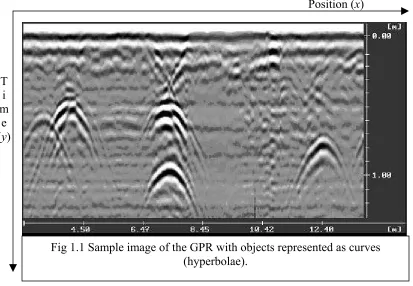
T i m
e (y)
Position (x)
Fig 1.1 Sample image of the GPR with objects represented as curves (hyperbolae).
In order to create an image, the GPR sends out pulses at a certain frequency and samples the
responses for a certain time slot before recording them as a single column corresponding to a
single position of the GPR. A collection of these columns, representing different positions
recorded in continuance make up an image.
1.3 MATERIAL
CONDUCTIVITY
The type of material in which the waves of the GPR propagate has a strong effect on the
signal penetration and the clarity of the received wave. The different material interfaces that
in reflection strength, b) changes in arrival time of specific reflections, c) source wavelet
distortion, and d) signal attenuation.
The GPR data consists of a continuous graphic display of reflected energy over a set time
interval. This set time interval is the two-way travel time, measured in nanoseconds. The
depth of the material the wave penetrates can be determined if the velocity of the
electromagnetic energy (νm) through the material is known. Using the dielectric constant of
the material, the velocity of the wave can be calculated using the formula
,
r m
c
ε
ν =
where c is the speed of light in vacuum and εr is the dielectric constant of the medium.
Once the speed is known, the depth of a particular object in the image can be calculated by
using the formula
. 2
r m r
t d =ν
dr is the depth, νm is the velocity in the medium and tr is the two way travel time from the
GPR to the object.
The penetration depths achieved using the GPR depend on the signal frequency and on the
nature of the material in which it travels. Higher frequency electromagnetic waves give better
resolution, but cannot penetrate to a great depth. Lower frequencies on the other hand
penetrate much deeper but provide poorer resolution. The wave will easily penetrate resistive
materials and will not heavily penetrate conductive materials. Because of their higher
the technique ineffective. Electromagnetic energy, in these frequency ranges, seldom
penetrates more that 30m into the surface and, in highly conductive material, may only
penetrate a few meters.
1.4 DATA
MIGRATION
Migration is a technique that is used to relocate objects in a GPR image from where they
appear to be, to where they are actually located.
GPR data is misrepresented in two ways, a) due to the structure of the transmitted pulse and
b) due to the spread of the signal of the GPR.
1.4.1 Data misrepresentation caused by the transmitted signal (direct wave)
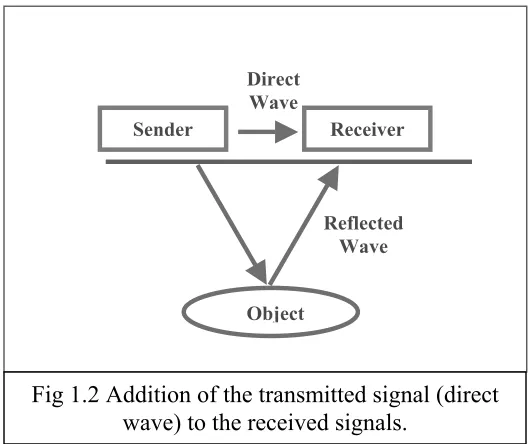
Fig 1.2 Addition of the transmitted signal (direct wave) to the received signals.
Reflected Wave Direct
Wave
Object
The receiver of the GPR not only picks up the signals returned by the different objects but
also the direct wave sent out by the transmitter (as shown in Fig 1.2).
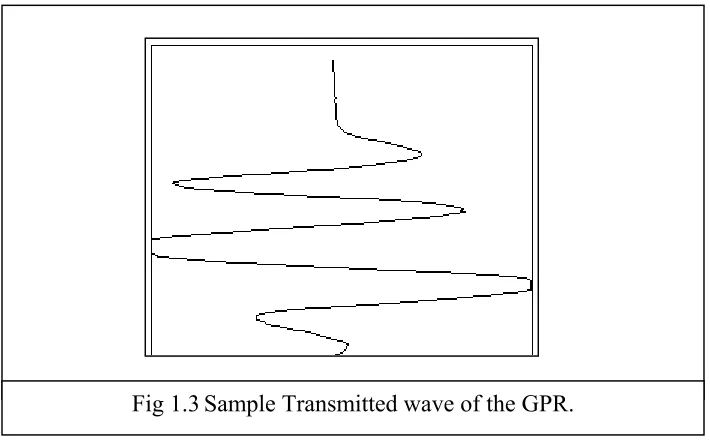
The signal of the GPR (direct wave) is not a simple impulse. It appears similar to a Gaussian
modulated sine wave. The reflections returned from different objects are proportional to
transmitted wave. As the receiver adds the transmitted wave to the returned signals,
understanding the structure of the input wave and its behavior is very important. A sample
transmitted wave is shown in Fig 1.3.
Fig 1.3 Sample Transmitted wave of the GPR.
The alternate positive and negative (left and right) peaks correspond to different intensities of
The deeper the object, higher the attenuation and lesser the energy that returns. The amount
of energy returning mainly depends on the difference in refractive indices at the material
boundary.
As the observed image g is the result of a convolution between the actual image f and the
input signal s, the relationship is given as
∑
− ×=
i
i s i y x f y
x
g( , ) ( , ) ( )
where i denotes the number of elements in the input signal s. The x-axis denotes the position
of the GPR and the y-axis denotes time. This convolution is reversed by a technique that uses
the linear correlation coefficient, explained in detail in section 5.1.
1.4.2 Data misrepresentation caused by the signal spread
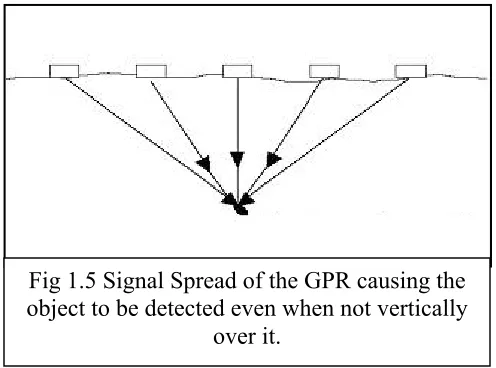
The GPR transmission is not comprised only of signals transmitted vertically, but rather the
signal spreads out as a cone emanating from the base of the GPR as shown in Fig 1.4.
L
t
Fig 1.4 Signal Spread of the GPR represented as a cone. GPR at (xo,0)
x
The x-axis represents the movement of the GPR (from the left to the right) along the surface
and the y-axis represents time. The y-axis increases in the downward direction. The same
definition of the x and y axes are maintained for all the images of the GPR.
At a particular position, the intensity of wave reflections from the different objects are
plotted against the distances of the GPR from these objects. Hence the value of a pixel along
the vertical depends on the convolution carried out along the curve of the cone that passes
through this pixel.
∑
+−
−
= θ
θ
) , ( ) , ( )
,
(x t f x y h x x t
g o o
f is the original image, g is the measured image and h is the kernel The GPR is located at
(xo,0) and remains fixed for one measurement. t denotes time and θ is the angle of spread.
The form of h depends on t, as h is the curve corresponding to a particular value of t. h is
time-variant. Depth (y) and time (t) are interrelated. We measure both of them in the same
units, pixels. For the arc L, all the points lying on the arc are equidistant from the source in
terms of time, but not in terms of depth. Hence during our measurements we need to convert
time into depth. For a fixed position of the GPR (xo,0), the x and y coordinates of the
different points on the arc are given in terms of time t as
. cos
0 t θ
x x= +
. sinθ t y=
where θ is the angle of the signal spread. The model shown in Fig 1.4 is explained in detail in
Fig 1.5 Signal Spread of the GPR causing the object to be detected even when not vertically
over it.
Due to the signal spread of the GPR as shown in Fig 1.5, a single object appears as a curve
(hyperbola) as shown in Fig 1.6.
T i m
e (ms)
Position (cm)
Fig 1.6 Hyperbolic representation of an object caused by the signal spread of the GPR.
The shape and size of the hyperbolae created by objects differ based on the location of the
objects. The primary technique used to reconstruct the hyperbolic representations to
2. LITERATURE
REVIEW
GPRs have been used in a variety of applications including mine detection, utility detection
and mapping, concrete inspection [11] [19] [21] [23], archaeology [12] [20] [24] [33],
structural inspection [2] [6] [10] [15] , geology [1] [16] [17] and mineral detection [8] [9]
[28]. Of these, mine detection has been the most popular topic for GPR research. See [5] [27]
[35] [36] for some recent survey methods. The main advantage of the GPR over other
detectors such as the Electromagnetic Inductor (EMI) is its two dimensional data
representation. In addition to the position of the object, this instrument helps determine its
depth as well.
2.1 GPR ANTENNA CHARACTERIZATION
According to Radzevicius [26], polarization in wave theory describes the magnitude and
direction of electric and magnetic fields with respect to space and time. Two main types of
polarization are linear polarization and circular polarization. If waves are linearly polarized,
the electric field is directed in a straight line from the transmitter (parallel to each other),
whereas in circular polarization the electric vectors emanating from the transmitter are not
parallel to each other.
Radzevicius [26] further states that for spherical targets and most linear targets that include
pipes and cables, the polarization of the reflected field is independent of the transmitted
antenna and those scattering from the targets. Most modern GPRs use dipole or bow tie
antennas in which the majority of the electric field is incident (moves along) along the long
axis of the bow-tie.
Radzevicius [26] explains that the waves that leave the antenna are called lateral waves and
those already present in the area surrounding the GPR are called space waves. The antenna
patterns observed are considered to be a result of the interference between these lateral and
space waves. However the main factor that defines the antenna pattern is the interaction
between the antenna and the lossy dielectric halfspace that is often very close to the GPR. He
further suggests that the best method to understand the pattern caused by a short dipole
antenna placed near a lossy halfspace is to study the Finite Difference Time Domain (FDTD)
model of the signal spread. Maxwell’s equations are used to model the electric and magnetic
fields of the antenna. FDTD is a method that is used to simulate electromagnetic propagation
[32]. As the electric and magnetic fields can be calculated throughout a discretized volume at
increasing steps of time, the distribution of the electromagnetic fields can be observed as a
function of time. In this case, FDTD was used to replace the spatial and time derivatives in
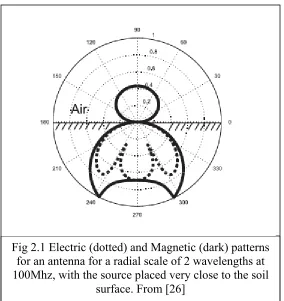
the Maxwell equations with finite difference approximations. His results showed the electric
Fig 2.1 Electric (dotted) and Magnetic (dark) patterns for an antenna for a radial scale of 2 wavelengths at 100Mhz, with the source placed very close to the soil
surface. From [26]
These lobes, as they are called, caused by the wave interference are heavily dependent on the
frequency of the incident wave. Ideally for most applications the radiation pattern should
contain a single lobe with most of its energy focused in the downward direction. However in
practice, many lobes are created which result in the misrepresentation of data that we
observe. Large numbers of lobes are created at higher frequencies, due to rapid interference
between lateral and space waves, making data interpretation even more difficult.
Daniels [7] also describes antenna characteristics and the various parameters that are
associated with antenna selection. He explains that the major consideration in antenna
selection is the target type and that for most common applications the cross-coupled dipole is
2.2 CATEGORIZATION OF OBJECT RECONSTRUCTION
TECHNIQUES
Cardimona [4] categorizes the object reconstruction process from raw GPR data into two
parts: “normal processing” and “advanced processing”. Zero time adjust, subtract mean trace
and gain adjustment are included in normal processing. Associating zero time with zero
depth is called zero time adjust. Superposition of the transmitted wave (direct wave) with the
signals received from the ground produces “ringing” or “banding”. A method known a
“subtract mean trace”, which is also a high pass filter, is one way of removing this ringing.
This method takes the average of a window of pixels and subtracts that average from the
value of the pixel that lies in the center of the window. The method is described by the
equation shown below
, ) , ( 1 ) , ( ) , ( 2 2
∑
= − = + −= i m
m i y i x f m y x f y x g
where m is the window size. This method and the parameters considered in selecting the
window size are described in detail in section 4.2.
Signals that travel less distance and time have greater intensities than the signals that arrive
later. Attenuation of these signals is proportional to the time taken for them to propagate.
This attenuation is caused due to geometric spreading as well as the absorption of energy by
the medium in which the signal propagates. Gain adjustment is required to compensate for
After the normal or primary processing, advanced techniques can be applied to better
interpret the data, most common of which is “migration”. Migration is one term that is used
to describe the technique of reconstructing the distorted representation of objects in GPR data
(also known as hyperbolae).
The GPR pulse (direct wave) enters the surface and intercepts various irregularities and
convolution is the technique that best describes the interaction of this pulse with these
irregularities. Deconvolution can be used to remove the effects of the direct wave (shaped
like a Gaussian modulated sine wave) to better interpret the GPR image. Inverse filtering is a
kind of deconvolution that is commonly used. Inverse filtering involves taking the Fourier
transform of the distorted signal and removing the distortion using the frequency domain
representation. However, this technique is helpful only when the structure of the source wave
is known. The basic approach to inverse filtering using Fourier transforms is shown below.
), ( * ) ( )
(t f t h t
g =
where g is the observed distortion of a kernel h over the original image f
In the frequency domain this would be represented as (using discrete time Fourier
Transforms)
). ( ) ( )
(k F k H k
G = ×
Deconvolution (inverse filtering) of the original image f in the frequency domain is given as
. ) (
) ( ) (
k H
k G k
F can be converted back into the time domain using the inverse discrete time Fourier
transform. As the discrete time Fourier Transform (DTFT) is used to represent a
discrete-time non-periodic signal as a superposition of complex sinusoids, the inverse DTFT
representation of a time domain signal involves an integral over frequency namely
ω
π ω
π
π
d e k F t
f i k
∫
+
−
= ( )
2 1 ) (
2.3 GPRS USED IN MINE DETECTION
Gestel [14], Gader [13] and others have worked extensively in the field of mine detection
using GPRs. Gestel [14] implemented migration using a method called “Alford rotation” that
analyzes “multi-configurational” data to detect the main orientation of the target. By
arranging the receiver and the transmitter in different orientations, data can be recorded in
four configurations and hence the term “multi-configurational data”. Problems with this
method include the requirement to collect data from four angles and the susceptibility of the
algorithm to noise. The noise present in real data causes enough disturbance to make the
algorithm unstable. Also for accurate location using this method, the radiation patterns of the
vertical and horizontal dipoles must be the same, which occurs only in air or extremely
homogenous environments.
In [13], Gader uses Hidden Markov Models (HMMs), stochastic models that produce time
comprised of landmine signatures derived from multiple sources. This library is the main
platform for the development of the HMM detection algorithm. Using the proposed HMM
technique the algorithm compares a hyperbola with the digital signatures that are present in
the library and generates a probability that’s associated with the best match for that curve.
The HMM technique breaks down the curve into states. Based on the Markov theory that the
probability at each state is only dependent on the previous state, a probability is associated
with each state. This probability attains an acceptable value only if there is a curve,
corresponding to one of the predefined curves, present in the image. The primary
disadvantage of this method is the creation of the signature library. In order to achieve a high
level of accuracy this library must be continually updated with all the possible signatures
from the different objects of interest. Also the various soil types must be taken into
consideration.
2.4 RECONSTRUCTIONS BASED ON OPTIMIZATION
Minimization is a technique used very commonly in image restoration algorithms. Hsiao [30]
presents a method to determine the ultrasonic reflectivity function resulting from density
changes in a medium, which is very similar to the reconstruction of reflections of the
electromagnetic waves in GPR systems. Similar to the problem presented in this thesis, this
paper estimates the reflected wave as a convolution of the input wave and the reflectivity
function of the material. The problem is then reduced to the maximization of a probability
that depends on the variation of the measured image from the unknown, and the prior
technique called “mean field annealing”, that is a type of optimization that attempts to avoid
local minima. The technique works well for detecting defects in metallic surfaces, however
non-linear reconstructions depend heavily on the prior knowledge of the statistics of the
unknown image.
2.5 ALGORITHMS FOR THE INVERSION OF THE TRANSMITTED
WAVE
In order to reconstruct the received signals that have been distorted due to the convolution
caused by the input wave of the GPR, some models for the transmitted wave have to be
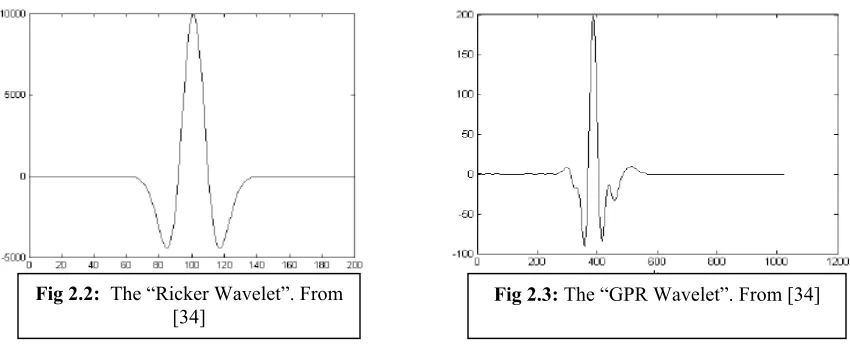
constructed. Van der Lijn [34] has presented models for the input wave and analyzed many
algorithms to generate the impulse response of targets that would make them easier to
classify.
Fig 2.3: The “GPR Wavelet”. From [34]
Fig 2.2: The “Ricker Wavelet”. From [34]
The impulse response of targets gives information about the size, internal structure and
material properties of those targets. In order to obtain the impulse response, many
wavelet”, shown in figure 2.2, which we observe looks a lot like a Gaussian modulated sine
wave. The second model called the “GPR wavelet”, figure 2.3, was extracted from an actual
GPR signal.
Some of the deconvolution methods employed along with their results are mentioned below.
Deconvolution based on linear least squares uses an error function that is shown below.
2
|| ||
min Xg y
g −
g is an estimate of the impulse response, y is the received signal and the input wave is
represented by X.
After experimentation, Van der Lijn [34], showed that this method worked fine for the “GPR
wavelet” but not for the “Ricker wavelet”. This occurred as to the structure of the “Ricker
wavelet” was smooth with most values being neighbor-dependent unlike the “GPR wavelet”
which had values are independent of its neighbors. The least squares method seems to work
better for waves that had values independent of each other.
A variant of the above method called “ridge regression” is shown below.
) || || || (||
min 2
2 2
2 g
y Xg
g − +λ
The second term calculates the squared second norm of g. This term helps improve the noise
sensitivity during the inversion. The sensitivity to noise is determined by the choice of λ,
reconstruction. Hence a λ must be selected that provides effective noise reduction and
acceptable errors in the reconstruction.
Van der Lijn [34] also states that by exploiting the structure of the impulse response of the
target, the sensitivity of the deconvolution algorithm to external disturbances could be
reduced. Also only part of the input wave (depending on the type of the wave to decide
which part) plays an important role in the calculation of the output. Hence Van der Lijn [34]
has presented a method called “subset selection using single columns” (SSUSC), which only
tries to use the relevant parts of the input and output waves to help in the reconstruction. The
main advantage of this method is its speed of execution. However, it does require prior
knowledge of the exact shape of the impulse response. Van der Lijn concludes that this is one
of the best deconvolution algorithms and improves on this by presenting variants that help
better determine or select the portions of the wave that need to be dropped.
2.6 MIGRATION
ALGORITHMS
Herman [18] presents an approach that is quite similar to the one we use based on our Ramac
GPR. After eliminating the transmitted wave using a background removal scheme, a
migration technique called “coherent summation migration” is used to relocate the actual
data. This method called volume based processing, uses a summation technique about the
Fig 2.4: Coherent Summation. From [18]
The principle states that the summation would result in a constructive interference only at the
real locations of the objects and destructive interference elsewhere. An appropriate threshold
decides the presence or absence of an object. The major advantage of this method is that it
can begin even before the data collection is complete.
Herman [18] also describes an alternate method called “surface based GPR processing”
based on template matching that reduces 3D data into 2.5 D. 3D data contains a lot of
information about the soil and the object, some of which might not be required to detect
objects. The transmitted signal of the GPR is structured such that most of the information
from the returned waves is contained at those points of the wave that correspond to large
amplitude or phase changes. Herman states that most of the information in a single received
the wave through a peak detector, only the peaks remain and the rest of the data is neglected.
This could possibly reduce the number of data points to be observed by a scale of 200. This
new grid of data that only has values at the peaks of the signal is called “2.5 D” data or a
“range image”. By observing the amplitudes of the peaks for the various objects at the
different depths, Herman [18] used template matching and thresholding to detect objects.
Volume based processing is generally poor at handling soil heterogeneities, and requires an
accurate estimate of the velocity in the medium. Surface based processing, on the other hand,
3. OPTIMIZATION
ALGORITHM
The common algorithm used to invert the distortions produced by the transmitted signal of
the GPR is a technique based on the optimization of an objective function. This objective
function is created by a combination of the data present in the received signal and the known
characteristics of the actual undistorted signal. This function is optimized using a technique
called mean field annealing which uses gradient descent.
3.1 CONSTRUCTING THE OBJECTIVE FUNCTION
In this section I follow the terminology used in [30]. For ease of understanding, we initially
represent the two-dimensional reflectivity function f(x,y) as if it were a one-dimensional
signal f(t). The transformation to two-dimensions is straightforward.
For a linear, time invariant system, we model the generation of the measured signal by the
convolution of an unknown reflectivity function f(t) with a kernel h(t) and the result, g(t) is
given as,
g(t) = f (t)⊗ h(t). 3.1
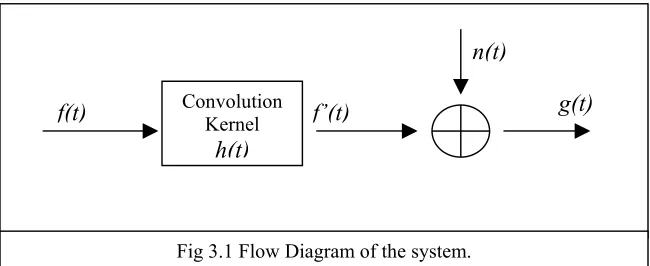
The above equation, however does not consider noise. Assuming that the noise is additive,
Fig 3.1 Flow Diagram of the system. n(t)
g(t) f’(t)
f(t) Convolution Kernel h(t)
f’(t) is the result of the initial distortion and n(t) is the noise.
f '(t) = f (t) ⊗ h(t) , 3.2
where denotes convolution. ⊗
Hence the noise n is given as
n(t) = g(t) − f '(t). 3.3
As the noise is assumed additive and the probability of noise is assumed Gaussian, then
denoting probability density by p,
. 2 1 ) ( 2 2 2σ σ π n e n p −
= 3.4
From the above equation we extend the formulation to the two-dimensional case, where we
consider the received signal as a two-dimensional array of pixels. We enumerate a single
pixel (i) as a lexicographic representation such that each pixel has a unique index i(x,y). In
terms of pixel i,the above equation is given as
. 2 1 ) ( 2 2 2 )' ( ' σ σ π i i f g i
i f e
g p
− − =
− 3.5
The above equation defines a probability specific to the value of a pixel in the image. As the
– f’ ) and thus is also the conditional probability density that the observed image g
was generated by f. Hence
) | (g f p . 2 1 ) | ( 2 2 2 )' ( σ σ π i i f g i
i f e
g p
− −
= 3.6
Noise is assumed to be an independent random process and thus the probability density of
generating the entire image f give the probability density of image g is given as
. ) | ( ) | ( =
∏
i i i f g p f gp 3.7
∏
− −=
i
g fi i
e f g p 2 2 2 ) ' ( 2 1 ) | ( σ σ
π 3.8
In order to convert this probability into one that denotes the probability density of f, given the
measured image g, we use Bayes’ rule p(f |g)
( | ) ( | ) ( ). Z f p f g p g f
p = ∗ 3.9
Where Z is simply a normalization constant that does not depend on the estimated image f.
constitutes a term called the “prior” that contains features and properties of the original
image. ) (f p
Hence in order to reconstruct the image, we find the image f such that is
maximized. This approach is called the maximum a posteriori (MAP) approach. By taking
the logarithm and changing the signs from equation 3.9 we convert the problem from a
maximization to the minimization of an objective function.
) | (f g p
( ) ( ' 2 ) ( ( )).
2
∑
∑
− + Λ = i i i ii g f
f F
H
∑
− = i i i n g f H 2 2 ) ' (σ is called the “noise” term and =
∑
i Λ ip f
H ( ( ))is called the “prior” term.
The “prior” term denotes the features in the image that need to be enhanced. Properties of an
image such as edginess, blur and brightness can be components of the prior. Based on
numerous experiments [3, 30, 31], it was discovered that an appropriate prior would be
. 2 1 2 2 2 ) (
∑
− ⊗ − = i r f p i e H τ τπ 3.11
where r is a kernel which estimates the first derivative. Such a kernel finds solution images
that are smooth, but which retain sharp edges.
3.2 GRADIENT
DESCENT
“Gradient Descent” is a minimization scheme uses and objective function and attempts to
find its solution by moving in the direction opposite to the slope of that function given by the
equation below. 1 , l k k l k l f H f f ∂ ∂ − = + α 3.12
where H is the objective function (in our case either Hn or Hp), k is the iteration number, fl is
one element of the vector representation of the image f and α , the “step size”, is a constant
to ensure that only small steps are taken in the direction of the minima.
In order to apply gradient descent, the energy function must be differentiated. After
i i rev
i
n f h g h
f H ⊗ − ⊗ = ∂ ∂ ] ) [( 1 2
σ 3.13
where hrev is the reverse of the original kernel h. In order to explain the differentiation of a
convolution we use a 1-D model in which f i is a pixel from the original image, g i is a pixel
from the measured image and h is a kernel with three elements in it (h-1h0h+1). Hence we
write out the terms involving a pixel f3at which a measurement g3 was made in the noise
term from Eq 3.10.
2 4 4 2 3 3 2 2
2 ) (( ) ) (( ) )
)
((f h g f h g f h g
Hn = ⊗ − + ⊗ − + ⊗ −
2 2 1 3 0 2 1 1 )
(f h + f h + f h −g
= − + 2 3 1 4 0 3 1 2 )
(f h + f h + f h −g
+ − +
2 3.14 4 1 5 0 4 1 3 )
(f h + f h + f h −g
+ − +
When Hn from the equation above is differentiated with respect to pixel f3 all the terms that
don’t contain that pixel reduce to zero and the result looks something like this
1 4 4 0 3 3 1 2 2 3 ) ) (( 2 ) ) (( 2 ) ) ((
2 ⊗ − + + ⊗ − + ⊗ − −
= ∂ ∂ h g h f h g h f h g h f f Hn
=2(((f ⊗h)−g)⊗hrev)3 3.15
where hrev =h+1h0h−1and (f ⊗h)−g) is computed at all points where g3 is measured. Hence
is just the kernel h reversed.
rev h
Similarly differentiating the prior term from Eq. 3.11 we get,
[( ) ] . 2 2 1 2 2 2 ) ( 3 rev r f i i p r e r f f H i ⊗ ⋅ ⊗ = ∂ ∂ − ⊗ τ τ
where rrev is the reverse of the kernel r and follows the same explanation as hrev. The
combined minimization function becomes
.
f H f
H f
H n p
∂ ∂ + ∂ ∂ = ∂ ∂
3.15
3.3 MEAN FIELD ANNEALING
A very common method of optimization is simulated annealing (SA). Simulated annealing is
a global optimization technique that primarily attempts to distinguish between different local
minima. The algorithm starts from an initial point, takes a step and evaluates the function.
Normally, during a minimization most downhill steps are accepted and the process continues
from the new point. The main characteristic of this algorithm is that in an attempt to avoid
local minima it might accept an uphill step. As the number of iterations of the algorithm
increase, the length of the steps taken tend to decline and the algorithm begins to converge on
a global optimum. This algorithm is considered to be robust as it makes very few
assumptions about the function to be optimized. This method however could take 10 to 1000
times the computing time compared to simpler optimization techniques.
To improve the search we introduced “mean field annealing” (MFA), which retains some of
the potency of the simulated annealing (SA) algorithm, but replaces random searches by a
series of deterministic gradient descents. It avoids most local minima and provides solutions
In MFA [3], [29] the τ in the prior term is initially set to a very high value such that the prior
term is zero at the start of the gradient descent algorithm. τ is then decreased gradually
making the prior term more and more significant. This approach runs dramatically faster than
4. PRIMARY PROCESSING OF THE RECEIVED GPR
SIGNAL
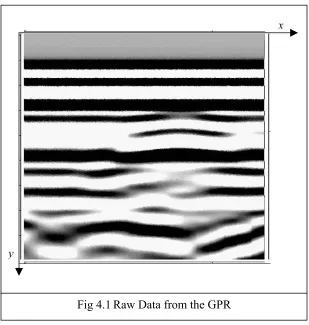
The raw data from the GPR is illustrated in Fig 4.1. The x-axis represents the motion of the
GPR along the surface and the y-axis (increasing downwards) indicates time.
y
x
Fig 4.1 Raw Data from the GPR
From this initial GPR image the reconstruction or object extraction process constitutes two
main steps.
a) Background Removal.
b) Data Migration.
i) Correlation of the transmitted signal
After these two steps, post-processing includes steps such as thresholding and object
extraction.
4.1 BACKGROUND REMOVAL BASED ON “SUBTRACT
TRANSMITTED PULSE”
The received data contains the “direct wave”, the reflected waves and external noise. The
instrument is designed such that the receiver continues to listen even as the transmitter sends
out the pulses. This effect is primarily due to the close proximity of the transmitting and
receiving antennae. As a result, the receiver picks up the transmitted wave and superimposes
it on the reflected signals. Since the transmitted signal is strong due to the close proximity of
the antenna to the receiver, it is very bright and thus it is difficult to identify gradients in the
image. The transmitted wave must be removed. There are two methods that were used to do
this, a) using a sample transmitted pulse and b) subtracting the mean trace.
In the “Subtract Transmitted Pulse” method, a sample pulse is subtracted from the entire
image. This sample pulse is extracted from GPR data recorded in an empty environment. The
running time of this algorithm is θ(n), where n is the number of pixels. Though quick, this
algorithm does not consider the dynamic nature of the working environment, and hence at
times the sample input wave does not exactly coincide with the actual wave used in practice.
This method leaves heavy traces of the input signal that are considered as anomalies by the
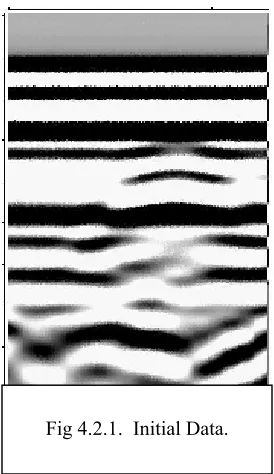
migration algorithm. A sample input image and its filtered output are shown in Fig 4.2.1 and
Fig 4.2.2. Filtered Result from the “Subtract Transmitted Pulse” method. Fig 4.2.1. Initial Data.
This technique only considers the transmitted signal and does not eliminate any external
noise.
4.2 BACKGROUND REMOVAL BASED ON “SUBTRACT MEAN
TRACE”
In this method we define a window of around 30 – 40 pixels and subtract from all the pixels
in this window the mean of the pixels in it. The window is moved along and the procedure is
repeated until the entire image is covered, as given in Equation 4.1.
∑
= − = + − = 2 2 ) , ( 1 ) , ( ) , ( m i m i y i x f m y x f y xg 4.1
Fig 4.3.2. Filtered Result using the “Subtract Mean
Trace” method. Fig 4.3.1. Initial Data.
This method does not require any prior knowledge of the GPR signal. The running time of
this algorithm is the window size multiplied by the previous method. As a result, selection of
a large window requires more processing time, which is critical in real time applications. A
sample input image and its filtered output are shown in Fig 4.4.1 and Fig 4.4.2.
Running time (Subtract Mean Trace) = m * Running time (Subtract transmitted pulse)
Sample filtered images for window sizes 30 and 200 pixels are shown in Fig 4.4.1 and Fig
4.4.2 respectively. After experimentation, the optimum window size was found to be between
5. DATA MIGRATION
5.1 CORRELATION OF THE TRANSMITTED SIGNAL
5.1.1 Signal Description and Simulation
The transmitted pulse (direct wave) of the GPR is not an impulse. It rather resembles a
Gaussian modulated sine wave (as shown in Fig 5.1). As a result, the reflections returning
from different objects are varying magnitudes of this wave.
Amplitude
Fig 5.1 Transmitted signal modeled by a Gaussian modulated sine wave
(Signal S) T
i m
e
As the observed image g is the result of a convolution between the actual image f and the
∑
− × =i
i s i y x f y
x
g( , ) ( , ) ( )
where i denotes the number of elements in the input signal s. The x-axis denotes the position
of the GPR and the y-axis denotes time.
In order to obtain an optimum algorithm for the reconstruction, we initially simulate a GPR
image in order to have a better control over the algorithm development. Once an algorithm is
designed, the method is extended to actual data from the GPR.
The simulation of a disc placed under the ground surface is shown in Fig 5.2. The horizontal
axis represents the line along which the GPR moves and the vertical axis denotes the depth of
the object. Only the upper half of the disc is considered.
Single Column X
When the transmitted wave (S) as modeled in Fig 5.1 is reflected in part from the circular
disk as shown in Fig 5.2, the signals received by the GPR appear as shown in Fig 5.3. Each
part of the disk reflects a certain amplitude of the direct wave.
Single Column X
Fig 5.3 Received image from the GPR (Simulated).
5.1.2 Linear Correlation Coefficient (LCC)
The linear correlation coefficient (r) is a quantity that determines the relationship between
two functions. Its value ranges from –1 to +1. +1 indicates a direct relationship between the
two functions, 0 indicates no relationship and –1 indicates an inverse relationship. The square
of this coefficient, r2, also known as the coefficient of determination, determines the variance
∑
∑
∑
= = = − − − − ≡ n i i n i i n i i i xy y y x x y y x x r 1 2 1 2 1 ) ( ) ( ) )( ( 5.1where x and y are the two functions with n values each.
x is the mean value of x defined as
∑
= n i i x n 1 1
and y is the mean value of y defined as
∑
= n i i y n 1 1 .In order to reverse the correlation caused by the transmitted wave, we isolate the returned
image (Fig 5.3) into individual columns. This can be done assuming that the result of the
correlation in a single column (one particular position of the GPR) is independent of the data
present in the remainder of the image. Hence we have now reduced the problem to a
reconstruction in one dimension.
If we consider the column corresponding to the center of the circular disc (Column X) in Fig
Amplitude
Fig 5.4 Column representation of the center of the disk. (Column X) T
i m
e
The impulse in the above figure corresponds to the bright spot on the disc, which was
roughly at a depth (position) of 300 pixels. In order to avoid the unreasonable case of a
homogenous background, we added Gaussian noise with a standard deviation of 0.1 to all the
remaining pixels that comprised the soil beneath the surface. The result of the correlation
Amplitude
Fig 5.5 Result of the Correlation. (Column Y)
T i m
e
In order to invert the correlation we use the linear correlation coefficient (r) from Eq. 5.1.
The pseudocode for the calculation of r is shown below.
for j = 51 to (1000 – 51) do (no of elements in a single column)
R[j] = 0.0;
for n = -50 to +50 do (101 elements in the input signal S)
R[j] += Y[j + n] x S[50 + n].
As the input signal S contains 101 elements, n in this equation is set to 101. To calculate r at
a particular pixel (i) from Column Y, we need to select 101 elements including pixel i. We do
this by selecting i as the 51st element and completing the array of 101 by taking 50
continuous elements from either side of i. This process has to be repeated 1000 times to
101 elements, there are 50 pixels at the beginning and 50 pixels at the end of Column Y that
do not have a value.
The linear correlation coefficient for the elements in Column Y with the input signal S is
shown below.
SY r
Amplitude
T i m
e
SY r
Fig 5.6 Reconstructed image - Linear Correlation Coefficient (Column
F).
As negative values of r indicates inverse relationships, we ignore all negative values of r.
Our simulation assumes that there can only be one object in a particular column, i.e. there
cannot be two objects one below the other. Hence there can only be one bright spot in one
column. In the above image (Column F), this maximum value (1.0 in this case, which
where we had the bright spot originally (Column X). Consequentially, the maximum value of
each column should correspond to an object. This however is not the case, as only the
maximum value of each column that is greater than a particular threshold value represents an
object.
In practice it was observed that even though the filtered images of actual GPR data (Fig 4.4)
do not have perfect discs or features as shown in Fig 5.2, but rather hyperbolic
representations of these objects, the correlation of the input signal results in an image which
contains columns that are independent of each other. Hence the linear correlation coefficient
method can be applied successfully without any modifications.
In order to implement the above algorithm to real data, an iron pipe 25 inches in length and 7
inches in diameter was placed 15 inches deep in a sandbox. The pipe was kept perpendicular
to the line of motion of the GPR. The soil used in this experiment was dry sand.
Fig 5.8 Result of the LCC technique applied to Fig 5.7.
Fig 5.7 shows the filtered result of the measurement. When the LCC technique is applied to
this image, the result after thresholding is shown in Fig 5.8. The input signal S used in this
case is the actual wave of the GPR, which is shown in Fig 1.2. The original image comprised
of 923 columns and 1024 rows. The algorithm took approximately18 seconds to run on a
Pentium 4 2000. Hence, as the reconstruction resembles a hyperbola with a dark background,
it can be reduced to its original form using the technique presented in Section 5.2.
5.2 ANTENNA SIGNAL SPREAD
In order to reconstruct the hyperbolae caused due to the signal spread of the GPR, we
construct an objective function as explained in Chapter 3 and attempt to optimize it such that
it converges to one particular solution based on certain parameters of the original image that
we shall define. As explained the objective function comprises of two terms, the noise term
and the prior term. The parameters of the original image are incorporated in the prior term.
5.2.1 Incorporating the Prior and Noise Terms
A model was created to simulate the signal spread of the antenna. A circular disc was used as
the object of choice.
Noise term
Originally the noise term Hn (from Eq 3.10) looks like
=
∑
i − i ng f H
2
) ' (
This equation was differentiated to be included in the minimization of the objective function.
It then takes the form (from Eq. 3.13)
12[( )i i] rev.
i
n f h g h
f H
⊗ − ⊗ =
∂ ∂
σ 5.3
where h represents the kernel to be applied and hrevrepresents the reverse of this kernel.
We have to construct the kernel (h) that models the antenna spread. The model of the signal
spread is shown in Fig 5.9. From experimental observations we have concluded that the
spread angle of the GPR is modeled (as best described by literature and experimentation) to
be around 45 degrees. Also, the wave front is assumed to be circular. We model the signal
spread in two dimensions and hence the wave appears as a sector subtended at an angle of 45
degrees on either side of the normal to the GPR. Effectively we get a sector with a radius
corresponding to the depth and a total angle of 90 degrees. The kernel (h) is effectively the
outer arc of this sector, the arc length of which is calculated from the parameters discussed
above.
L
t
Fig 5.9 GPR Signal Spread with the sensor at xo. GPR at (xo,0)
x
The position of the GPR is given by (xo,0). y signifies depth and increases in the downward
direction.
In the 2-dimensional – x,y - case we model the signal generation process as
∑
+−
−
= θ
θ
) , ( ) , ( )
,
(x t f x y h x x t
g o o
f is the original image, g is the measured image and h is the kernel The GPR is located at
(xo,0) and remains fixed for one measurement. t denotes time and θ is the angle of spread.
The form of h depends on t, as h is the curve corresponding to a particular value of t. h is
time-variant. Depth (y) and time (t) are interrelated. We measure both of them in the same
units, pixels. For the arc L, all the points lying on the arc are equidistant from the source in
terms of time, but not in terms of depth. Hence during our measurements we need to convert
time into depth. For a fixed position of the GPR (xo,0), the x and y coordinates of the
different points on the arc are given in terms of time t as
. cos
0 t θ
x x= +
. sinθ t y=
where θ is the angle of the signal spread.
The simulation moves the signal source from one end of the image to another. At each
position of the signal source, for different times (pixels), we calculate the arc length and
apply that as a kernel to the image at that pixel (same as equation 5.4). We store the result for
each pixel in an array (another image). This process is repeated for the next position of the
The signal is considered to be at its strongest down the center of the cone and attenuates
gradually away from the center. The signal of the GPR attenuates heavily as it propagates
deeper into the surface. The simulation incorporates this using an attenuation parameter that
moderately models that of the GPR. Experimentation with objects placed at different depths
the yielded the following results.
Original Strength of the signal / Response from an object 100 pixels deep = 113.
Original Strength of the signal / Response from an object 500 pixels deep = 527.
These responses however were from objects placed in dry sand. For wet clay the signal
strengths drop down by a further one third due to the refractive index of wet clay. Since the
medium of observation for all the experiments was chosen as dry sand we choose an
approximate attenuation parameter of 1/t where, where t≠ 0, corresponds to the object depth
in pixels.
In order to reverse of the kernel (outer kernel in Eq 5.3), the same process is repeated with an
inverted kernel. The kernel is inverted about the y-axis, i.e. we take a mirror image of the arc
that we used before and apply it to the result of the above operation.
Prior term
In Eq 3.11 we defined the prior term Hpas
.
2
1 2
2
2 ) (
∑
− ⊗− =
i
r f
p
i e
H τ
τ
π 5.5
[( ) ] .. 2 2 1 2 2 2 ) ( 3 rev r f i i p r e r f f H i ⊗ ⋅ ⊗ = ∂ ∂ − ⊗ τ τ
π 5.6
In order to incorporate a prior term we need to possess some knowledge of the original image
before it was distorted. In this case we know that the original image comprises a bright disc
kept in a dark background. In case of actual GPR data, the filtered and reconstructed image
(from section 5.1) is supposed to have bright curves corresponding to the edges of the
different objects against a dark background. Hence the prior term we selected smoothes the
image (in order to eliminate noise) while preserving the strong edges (which correspond to
the outline of the disc). We model the prior term as piecewise linear, which means that we
assume that the model consists of segments that are planar (considering that the intensity as a
function of x and y is a plane). This model has been used effectively in [3], [31]. A planar
form results if one chooses to minimize the effects of the second derivatives. Thus following
[3] [31] we define the prior with the help of three kernels.
− = ∆ 0 0 0 1 2 1 0 0 0 6 1
xx ,
− = ∆ 0 1 0 0 2 0 0 1 0 6 1
yy ,
− − = ∆ 25 . 0 0 25 . 0 0 0 0 25 . 0 0 25 . 0 2 xy xx
∆ is a kernel which when applied to image f approximates 2 .
2
x f
∂ ∂
Similarly ∆yy
approximates 2
2
y f
∂ ∂
and ∆xy approximates .
2
xy f
∂ ∂
In order to identify edges about a particular pixel we place the kernel over it. As a result the
neighbors are multiplied by the respective values in the matrix. The magnitude of this result
is proportional to the edge strength of that pixel.
As shown in Eq 3.14 and Eq 3.15, after the prior term is differentiated, the result of the first
convolution (with r) is further convolved with the reverse of the kernel (rrev) used for the first
convolution. Before we apply the reverse kernel we take the results of the three kernels
applied to the image (f⊗r) and use them in the exponential in equation 5.5. These values are
stored separately. Next, we perform the second convolution (with rrev) using the three results.
The kernels for rrev are shown below. Notice that due to their symmetry only the form of ∆xy
changes. − = ∆ 0 0 0 1 2 1 0 0 0 6 1
xx ,
− = ∆ 0 1 0 0 2 0 0 1 0 6 1
yy ,
− − = ∆ 25 . 0 0 25 . 0 0 0 0 25 . 0 0 25 . 0 2 xy
These values are then used to create the prior term that is added with the noise term to
give us the derivative of the objective (H) function.
5.2.2 Gradient Descent and the MFA Algorithm
The gradient descent equation is given as
1 , l k k l k l f H f f ∂ ∂ − = + α 5.7
where H is the objective function (in our case either Hn or Hp), k is the iteration number, fl is
one element of the vector representation of the image f and α , the “step size”, is a constant
The image obtained after the filtering and the reconstruction from section 5.1 is used as the
initial estimate in equation 5.7. This image is used in the noise and the prior terms to get the
difference f H
∂ ∂
. This difference is multiplied by α and subtracted from the initial estimate.
This becomes the input image for the next iteration of the gradient descent and so on till we
arrive at an estimate that does not produce a sizeable change in the term f H
∂ ∂
.
MFA is incorporated by setting the τ in the prior term to a very large value initially. This
makes the prior term zero to begin with and as the algorithm progresses τ is decreased by a
factor of 0.99 at each iteration to make the prior term more and more comparable in
magnitude to the noise term. As explained in section 3.3 this approach tends to avoid most
local minima and converges at solutions that are nearly global.
Results
Fig 5.10 shows the simulated representation of a disk placed beneath the soil surface. The
horizontal axis represents the line along which the GPR moves (assumed from left to right)
and the vertical axis denotes the depth of the object. As most of the waves from the
transmitter bounce off the top of the object, only the upper half of the disk is used in the
Fig 5.10 Simulated image of the upper half of a disk placed under a soil surface.
The result of the convolution from can be seen in Fig 5.11. The disk now looks like a
hyperbola, which has its center coinciding with the center of the disk. As explained, this
occurs due to the breadth of the signal spread of the GPR. The signals get attenuated as the
distance traveled increases and hence pixels at a greater depth are relatively dimmer than the
ones higher up.
Figure 5.11. Hyperbolic Representation (convolution) of the disk caused by the signal of the GPR.
The MFA algorithm is applied to the image in Fig 5.11. After using the measured image (Fig
5.11) as the initial estimate for the MFA algorithm, the algorithm converges to the image in
Figure 5.13. What the complete disk would have looked like Figure 5.12. Reconstruction of the disk
using the MFA algorithm.
It can be seen that most only the area corresponding to the top of the disk is bright. Fig 5.13
illustrates what the complete reconstruction would have looked like. A possible explanation
as to why only part of the disk is visible in Fig 5.12 is that only the top of the disk remains
intact after the initial convolution (Fig 5.11). The hyperbolae resulting from the surface of
the disk mixes up with the area corresponding to the remaining portions of the disk, which
get obscured and appear as part of the spread caused by the surface pixels. The reconstruction
is unable to differentiate between the original portion and the spread. This causes the
algorithm to eliminate the original area along with most of the spread during the
reconstruction. As a result only the original part of the disk that wasn’t corrupted by the
The energy curve for successive iterations of the MFA algorithm is shown in Fig 5.14. The
energy term indicates the difference in images in consecutive iterations, also considered as an
error. The algorithm converges to a solution when this error is minimized. In the case above,
this happens at the 92nd iteration after which the algorithm moves away from the solution.
Energy vs Iterations
0 5 10 15 20 25 30 35 40
0 10 20 30 40 50 60 70 80 90 100 110 120 130 140 150
Iterations
Energy
Figure 5.14. Energy Curve of the MFA algorithm.
Minimum at the 92nd
iteration.
Fig 5.15 shows the effect of noise on the reconstruction. The error is close to 0 when minimal
increases steeply for lower SNR values. Error values greater than 75 units create a difficulty
in object detection.
Signal to Noise vs Error
0 50 100 150 200 250 300
1.33 2 2.5 3.33 4 5 6.66 10 16.66 33.33 100 No
Error Signal to Noise Ratio
Error
6. CONCLUSION
The process of reconstruction of images from the GPR is broken down into various parts due
to the complex nature of the data recording process of the RAMAC GPR. Many papers have
presented techniques to reconstruct part of the data, but very few have addressed the
reconstruction in its entirety.
Due to the proximity of the antenna to the receiver, the instrument records and superimposes
the transmitted wave over the received signals. The process of utility detection is complicated
due to the strength of the transmitted signal. We propose two methods to remove the
transmitted signal. The “Subtract Transmitted Pulse” method subtracts a sample-transmitted
pulse from the entire image. This algorithm runs fast but tends to leave behind heavy traces
of the input signal. The “Subtract Mean Trace” method takes the average of all pixels within
a horizontal window and subtracts this average from all the elements in that window. The
running time of this algorithm is slower as compared to the previous technique but it removes
the transmitted wave almost completely. The ideal window size was found to be between 30
and 40 pixels.
As a single pulse of the GPR is not an impulse but rather a wave that looks similar to a
Gaussian Modulated Sine Wave (GMSW), the reflections from the utilities are magnitudes of
this wave. Hence any object in the image appears as a collection of black and white bands.
We used a technique based on the linear correlation coefficient (LCC) to reconstruct the
pulses. However, we assume that there would not be a case where two objects would be
![Fig 2.4: Coherent Summation. From [18]](https://thumb-us.123doks.com/thumbv2/123dok_us/1669844.1210033/25.612.143.440.140.344/fig-coherent-summation-from.webp)