E-Waste Management by Utilization of
E-Plastics in Concrete Mixture as Coarse
Aggregate Replacement
Amiya Akram
1, C. Sasidhar
2, K. Mehraj Pasha
3Associate Professor, Department of Civil Engineering, Kuppam Engineering College, Kuppam, India1 Professor, Department of Civil Engineering, JNTUA College of Engineering, JNTUA, Ananthapur, India2 Assistant Professor, Department of Humanities and Sciences, Kuppam Engineering College, Kuppam, India 3
ABSTRACT: Utilization of waste materials and industrial by-products is a sustainable solution to environmental
and ecological problems. Use of such materials makes their reutilization in cement, concrete and other construction materials, and also reduces the cost of cement and concrete manufacturing. Other indirect benefits include reduction in landfill cost, energy saving and reduction in solid waste. Electronic waste (e-waste) consists of discarded refrigerators, radios, TVs, Air conditioners, Mobile phones, computers and several other electronic gadgets that have reached their end of life or become obsolete. Efforts are being made in the construction industry to use non-biodegradable components of e-waste as a partial replacement of the coarse or fine aggregates in concrete. This study focuses on the utilization of e-waste plastic particles in concrete and tests the feasibility of utilizing shredded e-plastic particles as partial replacement of coarse aggregate. It was observed that when e-plastic alone was used, there was a decrease in strength but when 10% fly ash was added results comparable to control specimen were obtained. It is thereby suggested that utilization of this e-waste in concrete will reduce the requirement for conventional coarse aggregates thereby resulting in conservation of natural resources.
KEYWORDS: Coarse aggregate replacement, Durability, E-waste, management, Strength.
I. INTRODUCTION
Latest innovations in the field of science and technology have changed the very lifestyle of common man. Much electronic equipment that was beyond reach earlier is now available at affordable prices. On one hand this development has made life easy for all but on the other hand it has encouraged use and throws mentality. Nowadays people prefer to buy a new appliance rather than taking the pains to get the older one repaired. Such a trend not only leads to increase in volume of electrical and electronic waste but also poses serious threat to public health and environment. E-waste is growing exponentially in recent years because the markets for these products are also growing rapidly. The US-EPA has estimated an increase of 5 to 10% in the generation of e-waste each year globally of which only 5% is being recovered [1]. Thereby the amount of e-waste that needs to be disposed off in an environmental friendly manner is increasing day by day.The fraction including iron, copper, aluminium, gold and other metals in e-waste is over 60%, while plastics account for about 30% and the hazardous pollutants comprise only about 2.70% [2].
II. RELATED WORK
unprocessed. As Tirupati is a tourist place many people come here daily, government has to take necessary steps to dispose solid waste. E-waste now constitutes a major portion of solid waste stream therefore its well managed treatment and disposal becomes a major concern.Recycling of e-waste includes disassembling and destroying the individual parts to retrieve several materials [4].It has been reported that 95% of a computer’s useful materials and 45% of a cathode ray tubes materials can be retrieved through recycling [5].In case of developed countries possessing appropriate technology Recycling methods have minimum environmental impact [6], whereas in developing countries the final environmental benefit-impact balance for e-waste recycling is not always positive [4]. recycling, in any case, has smaller ecological footprint than e-waste dumping and burning [7] but the adverse environmental impact due to energy consumed for transportation of the waste to be recycled reduces its environmental benefit [8].The Government of India has drafted E-waste (Management & Handling) Rules 2011and these rules have come into effect from 1st May 2012.This makes sustainable management of e- waste mandatory for all polluters. Acute shortage of construction materials on one hand and increasing volume of e-waste on the other has led to researchers to take up experimentations related to reutilization of recoverable waste materials like plastics and glass from the e-waste stream in concrete mix design. Segregation of recoverable materials and reusing them is a good management option.
III. SCOPE OF RESEARCH
Researchers working with the electronic plastics supply chain have identified more than 30 products that are now considered viable end markets for e-plastics wastes. These include parts and products in market sectors such as telecommunications, automotive, electrical, construction, shipping, traffic control, computers, and household appliances. Recent studies have shown that reuse of very finely grounded plastic e-waste in concrete has economical and technical advantage for solving the disposal of large amount of e-waste [9]. The use of recycled aggregates saves natural resources and dumping spaces, and helps to maintain a clean environment [10].
The work focused upon finding physical properties of shredded e-plastic waste and investigates efficient use of this material by checking its suitability for reuse as coarse aggregate replacement in M 20 concrete mix. The optimum e-plastic waste content to be added as a partial replacement of coarse aggregate was determined and compressive and split tensile strength of mix with % variation (5,10,15%) of E-waste with conventional concrete with and without addition of 10% fly ash were compared. The work focused on possible conservation of natural resources by substituting with waste material by suggesting a possible reuse option for e-plastic waste.
II. METHODOLOGY
All materials used in this study were locally available. Portland cement was used in this investigation with the fine aggregate of 4.75 mm maximum particle diameter. The sand used for the experimental programme was locally procured and conformed to Indian Standard Specifications IS: 383-1970. E-plastic waste was collected from electronic shops in Tirupati and Nellore. This waste was shredded in a plastic processing factory in Nellore. Fly ash was procured from Lanco thermal plant, Srikalahasti. Slump flow test for each case sample was also done. Strength criteria of Grade M 20 concrete mix and for water/cement ratio of 0.5 was analyzed.
IV. EXPERIMENTAL RESULTS
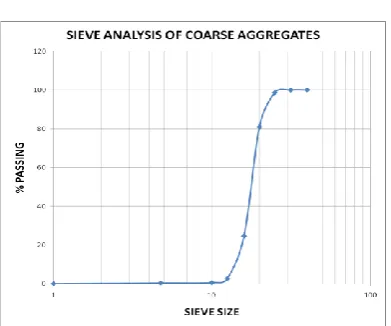
FIGURE 1: Sieve Analysis of Coarse Aggregates
Sieve analyses of representative samples for the naturally originated coarse aggregates to be used in the concrete mix are governed by the ASTM standards and the sieves used were the standard I.S. sieves. , and the grain size distribution curves for the tests is shown in Figure1.The aggregate materials showed S-shaped curves indicating well graded materials.
TABLE 1: Properties of coarse aggregates:
Specific Gravity 2.65 Water absorption 0.265%
Colour Light Shape Angular Crushing value 26.5%
Impact value 20.11%
Aggregate size maximum size of 20 mm
Properties of the coarse aggregate used in the experimental work are tabulated in Table 1.
FIGURE 2: Sieve Analysis of Fine Aggregates
2. In addition to the natural crushed stone aggregate with a maximum size of 20 mm, coarse crushed electronic plastic waste was used in this work as a partial replacement for naturally occurring coarse aggregate as 5%, 10%, and 15% of the coarse aggregates. The concrete mixes were to be cured for 7 days, 14 days and 28 days testing.
TABLE 2: Properties of Fine Aggregates
Characteristic Value
Type Uncrushed(natural) Specific Gravity 2.68 Total Water Absorption 1.02%
Fineness Modulus 2.507 Grading Zone III
Properties of the fine aggregate used in the experimental work are tabulated in Table 2.
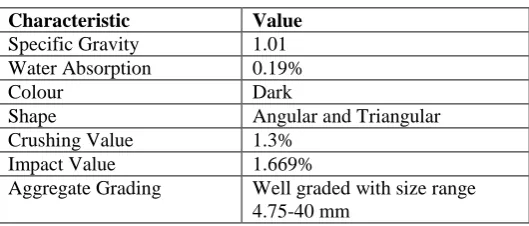
TABLE 3: Properties of E-plastic Waste
Characteristic Value
Specific Gravity 1.01 Water Absorption 0.19% Colour Dark
Shape Angular and Triangular Crushing Value 1.3%
Impact Value 1.669%
Aggregate Grading Well graded with size range 4.75-40 mm
The size of this shredded electronic waste was in the range of 4.75-40mm other properties of e-plastic waste are given in Table 3.This e-plastic waste was sieved and e-plastic waste of size 20 mm was collected and was used to replace coarse aggregate with 5, 10 and 15 percentages. The calculated amount of e-plastic waste was mixed with all other constituents of concrete in concrete mixer and different tests were carried out on the concrete prepared by above process.
Testing Program:
For the testing program, a series of 72 standard compressive tests and 72 standard split tensile tests were conducted with variable controlling factors: coarse electronic plastic waste content and fly ash amount.
TABLE 4: Mix proportion of concrete for E series (containing only e-plastic waste)
Mix Proportion Control
Mix E
E1 E2 E3
Proportion of E-Plastic Waste 0% 5% 10% 15% Proportion of Fly Ash 0% 0% 0% 0%
The reference testing samples for comparison purposes were casted with no electronic plastic waste content, and all the tests were done for 7,14 and 28 days compressive ( as per IS 516:1959 ) and split-tensile strength (as per IS 5816:1999).
TABLE 5:Mix proportion of concrete for F series (containing e-plastic waste and 10% Fly ash)
Mix Proportion Mix F F1 F2 F3
Proportion of E-Plastic Waste
0% 5% 10% 15%
Mix proportions used in this study are shown in Table 4 and 5. The test results obtained for cement were as follows:
Fineness of cement - 8% Normal consistency - 32% Initial setting time - 42min. Final setting time - 450min Compressive strength of cement For 3 days-31.2 N/mm2 For 7 days-50.3 N/mm2
V. DISCUSSION
An analysis was made on the strength characteristics by conducting the tests on e-plastic waste incorporated concrete and comparing the same with concrete containing e-plastic aggregate as well as fly ash(10%).The compressive strength for different % of e-plastic waste added to concrete with and without 10% fly ash and control specimen of concrete were tested at the end of 7,14 and 28 days using compressive strength testing machine . The water cement ratio was taken as 0.50 and mix was designed as M 20. Three cubes of each were casted and the average of three test results was taken for the accuracy of the results. The concrete cubes were cured at room temperature.
GRAPH 4.1: 7 days compressive strength for E & F series
The comparative 7 days compressive strength for series E and F is shown in Graph 4.1
The comparative 14 days compressive strength for series E and F is shown in Graph 4.2
GRAPH 4.3: 28 days compressive strength for E & F series
The comparative 28 days compressive strength for series E and F is shown in Graph 4.3 It is clear from the Graph that with the addition of e-plastic waste alone, the compressive strength of concrete reduces. However, the addition of fly ash helped in attaining enough compressive strength for all cases. The average reduction in compressive strength is about 34% for 15% e-plastic waste substitution. This reduction in compressive strength is attributed to the decrease in adhesive strength between the plastic aggregates and the cement paste. It is consistent with the observation made by other researchers [11, 12].
GRAPH 4.4: 7 days split tensile strength for E & F series
GRAPH 4.5: 14 days split tensile strength for E & F series
The comparative14 days split tensile strength for series E and F is shown in Graph 4.5
GRAPH 4.6: 28 days split tensile strength for E & F series
0 1 2 3 4 5 6
0 5 10 15 20
WITHOUT FLYASH WITH FLYASH P O R O S ITY
% E-PLASTIC WASTE
GRAPH 4.7: Porosity Test Results
The porosity test was carried out as per IS 3085:1965 procedures (Graph 4.7).
0 1 2 3 4 5 6
0 5 10 15 20
WITHOUT FLYASH WITH FLYASH W A T E R AB S OR P T ION
% E-PLASTIC WASTE
GRAPH 4.8: Water Absorption Test Results
The permeability tests for porosity and Saturated water absorption tests were carried out (as per IS 3085:1965 procedures). From Graphs 4.7 and4.8, it was found that, E mix exhibits slightly higher values than F mix for porosity. This can be explained by the E-plastic aggregates dispersed in concrete may be comprised of inter particle voids which may have contributed to an increase in Saturated water absorption and Porosity as both these factors are directly linked to voids in the structure. However, with proper vibration mechanism the possibility of voids can be minimized.
VI. CONCLUSIONS
contraction, or freeze and thaw.
The best way to manage increasing amount of e-plastic waste is integration of multiple options for handling plastics from end-of-life electronics. This approach includes varying combinations of mechanical recycling, feedstock (or chemical) recycling, reuse, energy recovery, and when necessary, the safe landfilling of plastics. All these options can be viable for managing e-plastic. However, the optimal combination of management options in any particular region depends on the resources, technologies and availability of materials.
The use of e-plastics in concrete is relatively a new development in the world of concrete technology and lot of research is required before this material is actively used in concrete construction. The use of e-plastics in concrete lowered the strength of resultant concrete, therefore, the research must be oriented towards overcoming this drawback in use of e-plastics in concrete.
REFERENCES
1. Pramila S., Fulekar M.H., Bhawana P., E-Waste- A Challenge for Tomorrow Research Journal of Recent Sciences ,1(3), 86-93, 2012.
2. Widmer R., Global perspectives on e-waste, Environmental Impact Assessment Review, 25, 436– 458, 2005.
3. Borthakur A., Singh P., Electronic waste in India: Problems and policies, International Journal of Environmental Sciences , 3(1), 353-362, 2012.
4. Gaidajis G., Angelakoglou K., Aktsoglou D., E-waste: Environmental Problems and Current Management, Journal of Engineering Science and
Technology Review , 3 (1) , 193-199, 2010.
5. Ladou J. , Lovegrove S., Export of electronics equipment waste, Int J Occup Environ Health. ,14, 1-10, 2008.
6. Aizawa H., Yoshida H. and Sakai S. I., Current results and future perspectives for Japanese recycling of home electrical appliances, Res Conserv
Recycl., 52, 1399-1410, 2008.
7. Hischier R., Wäger P and Gauglhofer J., Does WEEE Recycling make sense from an environmental perspective? The environmental impacts of
the Swiss take-back and recycling systems for waste electrical and electronic equipment (WEEE), Environ Impact Assess Rev. ,25, 525-539,2005.
8. Barba-Gutierrez Y., Adenso-Diaz B. and Hopp M., An analysis of some environmental consequences of European electrical and electronic
waste regulation, Res Conserv Recycl. 52, 481–495, 2008.
9. Lakshmi R., Nagan S., (2011), Investigations on durability characteristics of e-plastic waste incorporated concrete, Asian Journal of Civil Engineering (Building and Housing) ,12(6),773-787,2011.
10. Batayneh M. , Marie I., Asi I.(2007), Use of selected waste materials in concrete mixes, Waste Management ,27,1870–1876.
11. Choi, Y.W., Moon, D.J., Chung, J.S., Cho, S.K., (2005), Effects of waste PET bottles aggregate on properties of concrete, Cement and Concrete
Research ,35, 776–781.
12. Marzouk, O. Y., Dheilly R.M., Queneudec, M., (2007),Valorization of post-consumer waste plastic in cementitious concrete composites, Waste