Dynamic Ball Tracking and Hitting Robot
Using Vision System
Manikandan G, Dhanasekar. J, Sridevi. S, Sengottuvel P
Assistant Professor, Department of Mechatronics Engineering, Bharath Institute of Science and Technology Chennai,
Tamil Nadu, India
Assistant Professor, Department of Mechatronics Engineering, Bharath Institute of Science and Technology Chennai,
Tamil Nadu, India
Assistant Professor, Department of Mechatronics Engineering, Bharath Institute of Science and Technology Chennai,
Tamil Nadu, India
Professor, Bharath Institute of Science and Technology Chennai, Tamil Nadu, India
ABSTRACT: A ball tracking and hitting robot is designed by using the stereo vision system and Cartesian robot setup. The setup is done to identify a moving ball in space and then hit it by using the Cartesian robot. The vision system is used to identify the object and track its projected path from the initial frame rates of the vision and then find the destination of the ball trajectory. For the ball trajectory a suitable algorithm is developed based on the image frames and the spatial geometric location. The captured images are processed and analyzed for the destination location. The destination geometry detail is calculated and the signals are given for the servo motor which drives the robot to the desired location.
I.INTRODUCTION
Many applications require tracking of 3D objects in space or in surface moving with a velocity. The object has to be tracked and some application has to be done with input from the object. This project is aimed at tracking of a ball and hit it using the robotic assembly that can move in a specified work volume area. Visual Servoing is the technique used to capture the ball in 3D and 2D space. Ball tracking can be done through algorithm. For implementing the concept the video frames of the ball has to be captured. By using the first few frames, the velocity and trajectory at which the ball travels can be determined. The sensor system must provide estimates of the object trajectory as early as possible. High accuracy must be obtained, so that the best possible hitting position can be computed and signals can be sent to the actuator for a faster response time. Inverse kinematics is used for the robot control. Two cameras are used to track the ball one from the side and other from the top which is the input for the digital image analysis. After analyzing the images, the control algorithm sends the directions for the motor which does the robot operations. The robot can be used for entertainment purpose. But the technique behind the project can be used in industrial needs.[1]
X axis can be traversed for 52cm. The encoder has 500CPR (counts per revolution), so a resolution of approximately 1mm can be achieved for the setup. The encoder is used to control the DC Motor which is used for the linear movement of the X axis of the Cartesian robot. A pull type solenoid is placed over the X axis which is used for the ball hitting operation.[2]
II.NEED FOR THE PAPER
The computer vision technique is cheaper compared to special image processing processors. The image analysis technique is effective in identifying the ball in the 3D as well as 2D space which is moving with a velocity. Here the robot works based on the image sequence. Overall it must have a faster response time. If this is achievable then this concept can be implemented in industrial applications where more precise control movement is required.[3]
III.OBJECTIVE OF THE PAPER
Many applications require tracking of 3D objects in space or in surface moving with a velocity. These objects have to be tracked and some application is done with input from the object. This project is aimed at tracking of a ball and hitting it using the robotic assembly that can move in a specified work area. This technique can be used in industrial applications, automobiles and in hawk-eye prediction of ball trajectory in cricket and tennis.[4]
IV.OUTLINE
VIDEO INPUT
BALL TRACKING
DESTINATION LOCATION
MOTOR ACTUATIONS
BALL HITTING
The outline of the project is depicted in the Figure1.1. The first few frames of the video input are used for the analysis part. By using the images from the video input the ball tracking is done through the RLS algorithm which has been discussed later. By implementing this algorithm the destination location can be predicted and the controller sends the desired signal for the actuators which direct the solenoid to move to the predicted location and hit the ball.[5]
V.HARDWARE SETUP AND TESTING
The robot used is the single axis Cartesian robot with X coordinate. The motor interfacing is used to control the movement of the robot axis. The required linear position can be achieved through the movement and it can be stopped accurately using the encoder (positioning) and the end limits can be controlled by the proximity limit switches. The encoder used has a CPR of 500 which can be used for the precise movement.[6]
By using the encoder the X-axis can be moved with a resolution of 1mm per count. The fabrication of the Cartesian robot . The hardware setup works to hit the ball, for this the ball has to be tracked and inputs have to be given to the hardware.
VI.BALL TRACKING
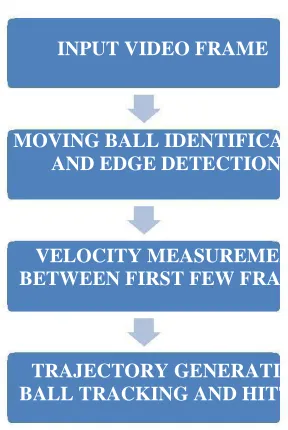
INPUT VIDEO FRAME
MOVING BALL IDENTIFICATION AND EDGE DETECTION
VELOCITY MEASUREMENT BETWEEN FIRST FEW FRAMES
TRAJECTORY GENERATION, BALL TRACKING AND HITTING
Figure 1.2 Ball Tracking Method
ball or not. Using the data from the video input the edge can be detected. Next parameter to be identified is the velocity of the ball, this can be done through the first few frames of the ball image. The time between the frames have to be measured, for the first three to five frames and with corresponding to time and distance travelled. The velocity of the ball can be determined. The flow control for the ball tracking algorithm is implemented, where the trajectory generation, ball tracking and caputre is done through Recursive Least Square (RLS) algorithm. The target trajectectory estimate is discused in section 8 of this paper.[8][13]
VII.VISUAL SERVOING
3D visual tracking and catching of a flying object can be done using the visual servoing technique. There are two basic approaches to visual servo control: Position-Based Visual Servoing (PBVS), where computer techniques are used to reconstruct a representation of the 3D workspace of the robot, and actuator commands are computed with respect to the 3D workspace and Image- Based Visual Servoing (IBVS), where an error signal measured directly in the image is mapped to actuator commands.
In most of the research done in robotic catching using PBVS, the trajectory of the object is predicted with data obtained with a stereo vision system and the catching is achieved using a combination of light weight robots with fast grasping actuators. A major difference exists between motion and structure estimation from binocular image sequences and that from monocular image sequences. With binocular image sequences, once the baseline is calibrated, the 3-D position of the object with reference with the cameras can be obtained.[9][12]
VIII.TARGET TRAJECTORY ESTIMATE
Taking 3D points to a 2D plane is the objective of projective geometry. The approach to determine motion consists of two steps: 1) Extract, match and determine the location of corresponding features, 2) Determine motion parameters from the feature correspondences.
8.1 RLS Algorithm
Figure 1.3 RLS adaptive filter
• selecting the filter coefficients
• Wn updating the filter as new data arrives
• e(n) error signal
• d(n) desired signal
IX.SOME APPLICATION
• Table tennis playing robot.
• hawk-eye prediction of ball trajectory in cricket and tennis.
• Used as a safety feature in automobiles Lane departure system and Vision system
X.CONCLUSION
This project implementation of a ball catching task using Cartesian robot has been carried out. The robot can catch an object flying in three-dimensional space using Recursive Least Squares (RLS) algorithm to extract and predict the position of the object from one feature correspondence from only vision system. A complete literature survey has been carried out for the dynamic tracking of ball. The object trajectory path can be obtained successfully even under high noise images. The recursive estimation technique has numerous advantages over other methods currently in use. First, using only one feature point, the issue of feature point’s correspondence is simplified. Another advantage is the recursive nature of the computations makes it suitable for real-time applications. Current research is directed towards the study of different control approaches to increase the catching range of the manipulator under noisy images.
REFERENCES
1. Ahmad Ali, et al. “Automatic Visual Tracking and Firing System for Anti Aircraft Machine Gun”.
Proceedings of International Bhurban Conference on Applied Sciences & Technology, IEEE, Islamabad, Pakistan, PP. 253 – 257, 2009.
2. Babu T.A., Sharmila V., "Cefotaxime-induced near-fatal anaphylaxis in a neonate: A case report and review of literature", Indian Journal of Pharmacology, ISSN : 0253-7613, 43(5) (2011) pp.611-612.
Valiathan G.M., Thenumgal S.J., Jayaraman B., Palaniyandi A., Ramkumar H., Jayakumar K., Bhaskaran S., Ramanathan A., "Common docking domain mutation e322k of the erk2 gene is infrequent in oral squamous cell carcinomas", Asian Pacific Journal of Cancer Prevention, ISSN : 1513-7368, 13(12) (2012) pp.6155-6157.
4.Bodhisattwa Chakraborty & Sukadev Meher. “Real-Time Position Estimation and Tracking of a Basketball”. Digital Image and Speech Processing Lab, National Institute of Technology, Rourkela, INDIA, 2012.
Mani Sundar N., Krishnan V., Krishnaraj S., Hemalatha V.T., Alam M.N., 'Comparison of the salivary and the serum nitric oxide levels in chronic and aggressive periodontitis: A biochemical study", Journal of Clinical and Diagnostic Research, ISSN : 0973 - 709X, 7(6) (2013) pp.1223-1227. 5.Fumio Miyazaki, et al. “Realization of Ball Catching Task using a Mobile Robot”. Proceedings of the IEEE International Conference on Networking, Sensing and Control, Taiwan, PP. 58 -63, 2004.
Thirunavukkarasu A.B., Chandrasekaran V., 'Efficacy of anti-scorpion venom serum over prazosin in severe scorpion envenomation: Is the current evidence enough", Journal of Postgraduate Medicine, ISSN : 0022-3859, 57(1) (2011) pp.83-84.
6.Gopal Pingali, et al. “Ball Tracking and Virtual Replays for Innovative Tennis Broadcasts”. IEEE, Visual Communications Research Bell Laboratories, Murray Hill, NJ, PP. 152 - 156, 2000.
Subbaraj G.K., Kulanthaivel L., Rajendran R., Veerabathiran R., "Ethanolic extract of Carum carvi (EECC) prevents N-nitrosodiethylamine induced phenobarbital promoted hepatocarcinogenesis by modulating antioxidant enzymes", International Journal of Pharmacy and Pharmaceutical Sciences, ISSN : 0975 - 1491, 5(S1) (2013) pp.195-199.
7.Guodong Chen , et al. “High Precision Pose Measurement for Humanoid Robot Based on PnP and OI Algorithms”. Proceedings of the IEEE International Conference on Robotics and Biomimetics, China, PP. 620 – 624, 2010.
8.Herrejon. R, et al. “Position Based Visual Servoing for Catching a 3-D Flying Object Using RLS Trajectory Estimation from a Monocular Image Sequence”. Proceedings of the 2009 IEEE, International Conference on Robotics and Biomimetics, China, PP. 665 - 670, 2009.
9.Jens Kober, et al. “Movement Templates for Learning of Hitting and Batting”. IEEE International Conference on Robotics and Automation Anchorage Convention District, Anchorage, Alaska, USA,PP. 853 - 858, 2010.
10.Justin A. Borgstadt et al. “Interception of a Projectile Using a Human Vision-Based Strategy”. Proceedings of the IEEE International Conference on Robotics & Automation, San Francisco, PP. 3189 – 3196, 2000.
11. Katharina Muelling, et al. “Learning Table Tennis with a Mixture Motor Primitives”. IEEE-RAS International Conference on Humanoid Robots, Nashville, TN, USA, PP. 411 -416, 2010.
12.Ping Yang, et al. “Control System Design for a 5-DOF Table Tennis Robot”. 11th Int. Conf. Control, Automation, Robotics and Vision Singapore, PP. 1731 – 1735, 2010.
13.Zhengtao Zhang, et al. “Visual Measurement and Prediction of Ball Trajectory for Table Tennis Robot”. IEEE Transactions on instrumentation and measurement, vol. 59, no. 12, PP. 3195 – 3205, December 2010.
14. B Karthik, TVUK Kumar, Noise Removal Using Mixtures of Projected Gaussian Scale Mixtures, World Applied Sciences Journal, 29(8), pp 1039-1045, 2014.
15. Vijayan T ,Cooperative Communication over Rayleigh Fading Channel,International Journal of Advanced Research in Electrical, Electronics and Instrumentation Engineering , ISSN: 2278 – 8875 , pp 2702-2708,Vol. 2, Issue 6, June 2013.
16. E.Kanniga, Dr.M.Sundararajan , Design and Architecture of Bio Signal Amplifier for Signal Extractor Neuro feedback Interface Machine ,International Journal of Advanced Research in Electrical, Electronics and Instrumentation Engineering ,ISSN: 2278 – 8875 , pp 792-780 ,Vol. 2, Issue 3, March 2013
17. S. RAJESWARI1, S.JASMINE2, Industrial Manifold Control Systems Using High Speed Networks, International Journal of Advanced Research in Electrical, Electronics and Instrumentation Engineering, ISSN: 2249-2615,pp 17-23, Volume2 issue-4 No1 July 2012
18. G.TAMIZHARASI & S.KATHIRESAN, Four Stroke Diesel Engine’s Surface Ignition using Ethanol, International Journal of Computer Trends and Technology(IJCTT) , ISSN (Print) : 2320 – 3765 , pp 3639-3646 ,Vol. 2, Issue 8, August 2013.