F. A. HAYS AND D . W. TALMADGE
Department of Podtry Husbandry, University of Massachusetts, Amherst, Mass.
Received September 15, 1948
INTRODUCTION
ONSIDERABLE interest is now centered on the question of inbreeding
C
as applied to poultry flocks bred for high fecundity. Very recentlySHOFPNER (1948) has presented data on several lines of birds some inbred as much as 60 percent and others approaching zero. SHOFFNER’S data support the general thesis that close inbreeding tends to reduce hatchability, decrease egg production and to retard sexual maturity. He found no effect on body weight or egg size.
Among other things, LERNER and HAZEL (1947) made a study of the amount of inbreeding that occurred in a flock of White Leghorns over a 12-year period. Matings had been planned to avoid inbreeding and some outside stock was brought in during the first nine years of the experiment. The flock of 1935 had an average coefficient of inbreeding of 1.5 percent. There was an increase in the average coefficient on successive years up t o a mean of 8.1 percent in 1941. The actual increase in the inbreeding coefficient amounted to about 2.1 percent for each generation. I n this flock inbreeding was somewhat higher in the lower producing birds.
Information is desirable concerning the amount of inbreeding that actually occurs in a closed flock where selection is based on fecundity characters and where matings of closely related birds are constantly avoided.
MATERIALS A N D METHODS
Rhode Island Reds bred for high fecundity since 1916 were used for study. The last five generations have been considered and pullet year performance records were used exclusively. The character and extent of the data are recorded in table 1. All stock was pedigreed.
Table 1 shows that 57 sires mated to 200 dams gave 1874 daughters for the laying houses. From the total of 1874 daughters only 1293 gave normal 365- day egg records. The rest either died or had egg records that were considered to be abnormal. The table also shows that the mean egg production of survivors did not change in five generations and that a modified type of selection of breeders may be necessary to raise the production level.
The mean degree of inbreeding in each generation was calculated by multi- plying WRIGHT’S inbreeding coefficient for each family through five ancestral generations by the number of daughters housed, adding these together and dividing by the total number of daughters concerned. Tracing the pedigrees back further would have been wasted time because the inbreeding coefficient
Contribution No. 686 from the MASSACHCTSETTS AGRICULTURAL EXPERIMENT STATION.
INBREEDING I N A CLOSED FLOCK
TABLE 1 Data on inbreeding
391
EXPECTED
DAUGH- INBREED-
DAUGU- DEAD OR COEFFI- MEAN
TERS 1NG
COM- COEFF1-
PERCENT
PLETING CIENT
ClENT PRODUC- GENERA- N O . O F N 0 , O F
TERS ABNORMAL
llANDOM TION MATING
TION SIRES DAMS
UOUSED
1942 6 24 201 146 27 5.33 2.60 233
1943 10 27 265 162 39 2.85 4.31 232
1944 1 2 39 386 286 26 3.73 5.67 230
1945 14 56 515 ' 365 29 4.37 6.78 224
1946 15 54 507 334 34 4.07 7.84 232
Totals 57 200 1874 1293
would have increased insignificantly. Table 1 records the inbreeding coeffi-
cients of each generation, the number of daughters housed, number completing the year, percent dying or giving abnormal records and mean production.
Table 1 indicates that there was a low degree of inbreeding in each genera- tion and that there was no tendency for the amount of inbreeding to increase in successive generations. The percentage of pullets dying or showing abnormal egg records was not consistent with the degree of inbreeding in the flock as a whole.
The calculated coefficients of inbreeding by WRIGHT'S (1931) formula for a reasonably large population mated at random were. higher than the actual
TABLE 2
Degree of inbreeding and egg production
INBREEDING COEFFICIENT
TOTAL AVG. FAMILY MEAN NO. OF
FAMILIES NUMBER SIZE BIRDS WEIGHTED
COMPLETING COMPLETING PRODUCTION 0
.01- 3 3- 5 5- 7 7- 9
9-1 1 11-13 13-15 1.5-17 17-19 19-21 21-23 23-25 25-27
___-_
10 101 42 15 13 3 1 5 2 1 1 1 0 5___
64 701 255 93
85
17 4 30 10 1 2
5
26
- -
6.4 239
6.9 232
6.1 235
6.2 222
7.1 217
5.7 212
4.0 195
6.0 219
5.0 223
1
.o
1322.0 190
5
.o
2285.2 209
~ _ _ ~ _ ~
coefficients in the last two generations. This fact indicates that by careful selection of breeders on the pedigree basis, inbreeding may be held a t a low level without introducing new stock.
I N B R E E D I N G AND E G G PRODUCTION
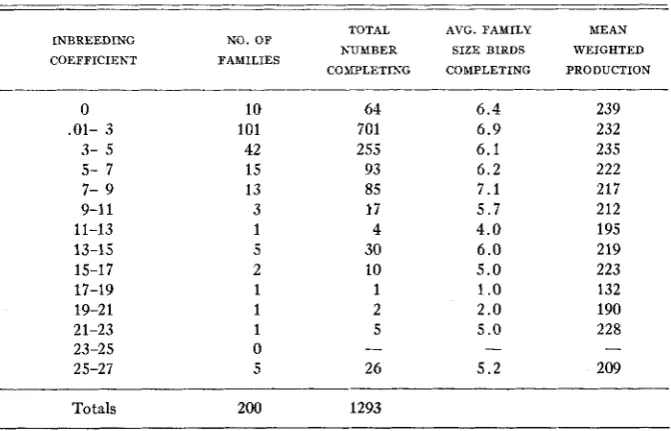
Inbreeding ranged from zero t o slightly over 25 percent in the different families. I n table 2 the total population in five generations is classified with respect to degree of inbreeding.
Table 2 indicates that mean annual egg production was highest in the families with no inbreeding. When the inbreeding coefficient was below five percent, the decline in egg production was not very great. When the inbreeding coefficient was above five percent there was a significant decline in mean egg production. I n general, there is some evidence of declining production with higher degrees of inbreeding, but there are exceptions.
E F F E C T S O F I N B R E E D I N G O N FECUNDITY CHARACTERS
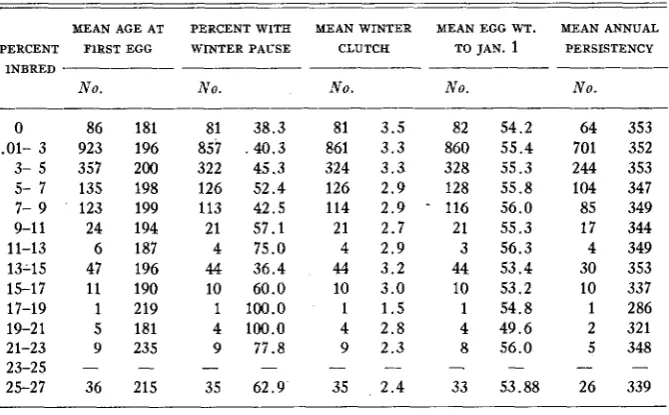
Such fecundity traits as age a t sexual maturity, incidence of winter pause, winter intensity, egg weight to January 1 and persistency'have an important relation t o the number of eggs laid. I n table 3 the possible effect of degree for inbreeding on these traits is considered.
TABLE 3
Effects of inbreeding on fecundity characters i n daughters
MEAN AGE AT PERCENT WITH MEAN WINTER MEAN EGG WT. MEAN ANNUAL PERCENT FlRST EGG WINTER PAUSE CLUTCH TO JAN. 1 PERSISTENCY
_______
-______
_ __-__
No. No. N o . N o . No.
0 .01- 3
3- 5 5- 7
7- 9 9-1 1 11-13 13215 15-17 17-19 19-21 21-23 23-25 25-27 86 923 357 135 123 24 6 47 11 1 5 9 36 - 181 196 200 198 199 194 187 196 190 219 181 235 215 -
81 38.3 857 .40.3 322 45.3
126 52.4 113 42.5 21 57.1 4 75.0 44 36.4 10 60.0 1 100.0 4 100.0 9 77.8
35 62.9
- _ 81 861 324 126 114 21 4 44 10 1 4 9 35 - 3.5 3.3 3 . 3 2.9 2.9 2.7 2.9 3.2 3.0 1.5 2.8 2.3 2.4 -
82 54.2 860 55.4 328 55.3 128 55.8 116 56.0 21 55.3 3 56.3 44 53.4 10 53.2 1 54.8
4 49.6 8 56.0
33 53.88
-
-64 353 701 352 244 353 104 347 85 349 17 344 4 349 30 353 10 337 1 286 2 321 5 348
26 339
- -
INBREEDING I N A CLOSED FLOCK 393 of inbreeding concerned in this flock were not as great as the effects of recessive genes e and e’ (HAYS 1945).
The incidence of winter pause was lowest in the non-inbred pullets and there was a significant increase in pause incidence as inbreeding became more intense. Winter intensity measured by the mean winter clutch size was definitely affected by inbreeding. Here the regression approached linearity. From the data available, there appears to be a consistent decline in clutch size as the inbreeding coefficient increased. I n view of this fact, it would appear that in- bred birds are likely to lay fewer eggs because of lower intensity.
TABLE 4
Degree of inbreeding and laying house mortality
DEGREE OF DAUGHTERS DAUGHTERS
yo MORTALITY
INBREEDING HOUSED COMPLETI~G
0 88 64
.01- 3 978 701
3- 5 382 255
5- 7 134 93
7- 9 132 85
9-1 1 24 17
11-13 6 4
13-15 47 30
15-17 12 10
17-19 1 1
19-21 5 2
21-23 10 5
23-25
25-27 40 26
1859* 1293
- -
___--
27.2 28.3 33.2 30.6 35.6 29.2 33.3 36.2 16.7
0
60. 0 50.0
35.0
-
* This total includes only families in which some daughters completed normal egg records.
Our data furnish no evidence that inbreeding affects egg size adversely. This is in agreement with the observations of SHOFFNER (1948) and many other in- vestigators.
Degree of inbreeding appeared to have no effect on persistency of laying. Since persistency or length of the laying year has been shown to be the most important single character affecting annual egg production, it is evident that inbreeding does not reduce egg production by shortening the laying year.
I n general, the data in table 3 appear to indicate that the decline in egg production associated with inbreeding is attributable largely to lowered in- tensity of laying and t o a 1e;ser extent to a higher incidence of winter pause.
INBREEDING AND MORTALITY
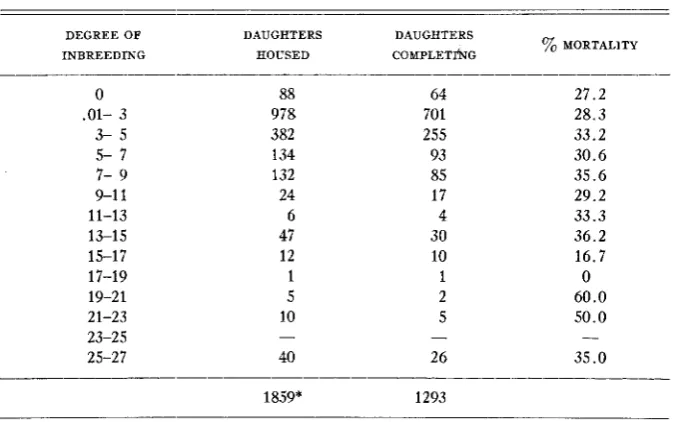
With few exceptions mortality tends to increase a s inbreeding increases. Unfortunately the number of daughters in the higher inbred groups from 10 percent upward is too small for statistical reliability. With adequate numbers of daughters ranging from 0 t o 10 percent inbred, there appears to be a slow but consistent increase in mortality as the degree of inbreeding increased.
DISCUSSION AND SUMMARY
I n a completely closed flock of Rhode Island Reds a very low degree of in- breeding appeared in five generations. The maximum occurred in the first generation a t 5.33 percent inbreeding and there was something of a decrease in degree of inbreeding through the period. These data do furnish evidence that a flock of from 200 to 500 pullets may be produced in a closed flock over a period of time without close inbreeding provided the stock is pedigreed so that close matings may be avoided. I n fact the maximum degree of inbreeding was 5.33 percent while 6.1 percent inbreeding results from single first cousin mat- ings.
Our data suggest that there is likely to be a decline in egg production when matings equivalent to single first cousin matings are made. Matings as close as a single generation of half-brother sister matings (12.5 percent inbreeding) may affect egg production adversely. Only five families showed a degree of inbreeding comparable with a single generation of full brother sister matings (25 percent inbreeding). The mean egg production of these daughters was 209.
As far as fecundity traits are concerned, the degree of inbreeding has some effects. Age a t sexual maturity is slightly increased by closer inbreeding. The incidence of winter pause rises with increased inbreeding. Winter intensity ap- pears to be very significantly reduced by inbreeding. Egg size is not affected but persistency may be very slightly reduced by inbreeding.
A gradual decline in viability accompanies an increased degree of inbreeding. Mean mortality was about 27 percent in the non-inbred group compared with a value of 35 percent when the inbreeding coefficient rose to 12 percent or higher.
HAYS, F. A., 1945
LERNER, I. M. and L. N. HAZEL, 1947 selection. Genetics 32: 325-339. SHOFFNER, R. N., 1948
WRIGHT, S., 1931
LITERATURE CITED
Isolating gene E' for early sexual maturity. Amer. Nat. 79: 372-377. Population genetics of a poultry flock under artificial