ISSN(Online): 2319-8753
ISSN (Print): 2347-6710
I
nternational
J
ournal of
I
nnovative
R
esearch in
S
cience,
E
ngineering and
T
echnology
(An ISO 3297: 2007 Certified Organization)
Vol. 4, Issue 11, November 2015
Ensemble Models Using Logical Bayesian
Decision Tree For Stream Classification And
Indexing Data
1
S.Mohanapriya,
2Dr.M.Rathamani
1Research Scholar, Department of Computer Science, NGM College, Pollachi, India
2Assistant Professor, PG Department of Computer Application, NGM College, Pollachi, India
ABSTRACT: Data Mining is the practice of automatically searching large stores of data to discover patterns and trends that go beyond simple analysis. Data Mining involves the use of sophisticated data analysis tools to discover previously unknown, valid patterns and relationships in large data sets. Data mining, the extraction of hidden predictive information from large databases, is a powerful new technology with great potential to help companies focus on the most important information in their data warehouses. Data mining techniques can be implemented rapidly on existing software and hardware platforms to enhance the value of existing information resources, and can be integrated with new products and systems as they are brought on-line. When implemented on high performance client/server or parallel processing computers, data mining tools can analyse massive databases.
KEYWORDS:Stream classification, VFDT,K-d trees, SVM Models.
I. INTRODUCTION
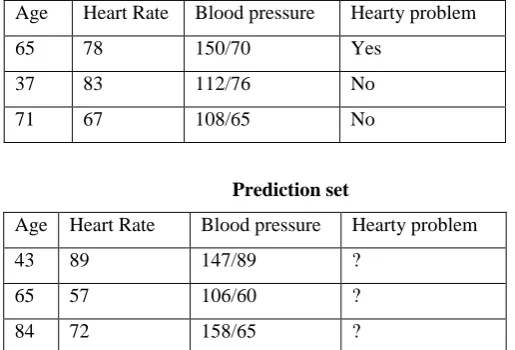
Classification consists of predicting a certain outcome based on a given input. In order to predict the outcome, the algorithm processes a training set containing a set of attributes and the respective outcome, usually called goal or prediction attribute. The algorithm tries to discover relationships between the attributes that would make it possible to predict the outcome. Among several types of knowledge representation present in the literature, classification normally uses prediction rules to express knowledge. Prediction rules are expressed in the form of IF-THEN rules, where the antecedent (IF part) consists of a conjunction of conditions and the rule consequent (THEN part) predicts a certain predictions attribute value for an item that satisfies the antecedent
Training set
Age Heart Rate Blood pressure Hearty problem
65 78 150/70 Yes
37 83 112/76 No
71 67 108/65 No
Prediction set
Age Heart Rate Blood pressure Hearty problem
43 89 147/89 ?
65 57 106/60 ?
84 72 158/65 ?
ISSN(Online): 2319-8753
ISSN (Print): 2347-6710
I
nternational
J
ournal of
I
nnovative
R
esearch in
S
cience,
E
ngineering and
T
echnology
(An ISO 3297: 2007 Certified Organization)
Vol. 4, Issue 11, November 2015
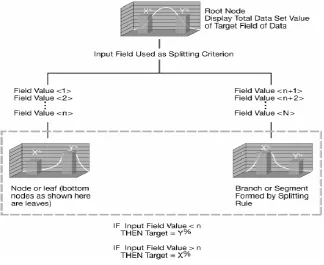
Using the example above, a rule predicting the first row in the training set may be represented as following: IF (Age=65 AND Heart rate>70) OR (Age>60 AND Blood pressure>140/70) THEN Heart problem=yes In most cases the prediction rule is immensely larger than the example above. Conjunction has a nice property for classification; each condition separated by OR’s defines smaller rules that captures relations between attributes. The decision tree learning method is one of the methods that are used for classification or diagnosis. Decision tree learning has several advantages. One of the advantages is that it gives a graphical representation of the classifiers which makes it easier to understand.
The decision tree algorithm
There are several procedures and methods for building decision trees, such as ID3, C4.5 and CART. ID3 is a simple decision tree learning algorithm developed by Ross Quinlan (1983). The basic idea of ID3 algorithm is to construct the decision tree by employing a top-down, greedy search through the given sets to test each attribute at every tree node. Advantages of Decision Tree Classifications
• Decision Trees able to generate understandable rules,
• They are able to handle both numerical and the categorical attributes,
• They provide a clear indication of which fields are most important for prediction
Figure 1: Illustration of the Decision Tree
II. RELATEDWORK
Stream classification: Existing data stream classification models can be roughly categorized into two groups: online/incremental models and ensemble learning.
ISSN(Online): 2319-8753
ISSN (Print): 2347-6710
I
nternational
J
ournal of
I
nnovative
R
esearch in
S
cience,
E
ngineering and
T
echnology
(An ISO 3297: 2007 Certified Organization)
Vol. 4, Issue 11, November 2015
that aims to obtain statistical results from data streams, and Boolean expression query where queries appear as DNF or CNF expressions .
K-d trees and M-trees: K-d trees, M-trees and R-trees are popularly used space-partitioning structures for query high dimensional data. The major difference is that K-d trees and M-trees are designed for organizing points, while R-tree is designed for organizing rectangles.
Ensemble pruning: For the purpose of reducing computational and memory costs, ensemble pruning searches for a good subset of all ensemble members that perform as good as the original ensemble.
Random Subspace sampling method
The Random Sampling is a popular methodology to counter the problem of class imbalance. However sampling methods, especially SMOTE (Synthetic Minority Oversampling Technique), work with the entire set of features or dimensions and may not be as effective in reducing the scarcity of the data.
Decision tree
The decision tree induction presented in Algorithm 1 results in decision-Tree. Consider a data set with features {X’i}ji=1 and an imbalanced binary target class Y . To keep the notation simple, to transform the features {X’i}ji=1into binary features{Xi}ni=1, i.e., {Xi}ni=1Binarize({X’i}ji=1). The inputs to the α -Tree algorithm are the binarized features {Xi}ni=1, the corresponding class labels Y , and a pre-specified α.
III.
IV.
V.
VI.
VII.
VIII.
III.PROPOSEDALGORITHM
Data Pre-processing Methods The data pre-processing techniques can be easily embedded in ensemble learning algorithms. A re-sampling techniques that study the effect of changing class distribution to deal with imbalanced data-sets, where it has been empirically proved that the application of a pre-processing step in order to balance the class distribution is usually a positive solution. Random under sampling: It is a non-heuristic method that aims to balance class distribution through the random elimination of majority class examples. Random oversampling:
In the same way as random under sampling, it tries to balance class distribution, but in this case, randomly replicating minority class instances. Selective pre-processing of imbalanced data (SPIDER): It combines local oversampling of
Algorithm 1. Grow a single Decision -Tree.
Input: training_data (features X1, X2,… Xn and label Y ), α
Select the best feature X*, which gives the maximum α -divergence criterion
if (number_of_data_points < cut_off_size) or
(best_feature = None) then
Stop growing
else
partition the training data into two subsets,
based on the value of X*
left child ← Grow a single α -Tree (data with (X* = 1), α)
right child ← Grow a single α -Tree (data with (X* = 0), α)
ISSN(Online): 2319-8753
ISSN (Print): 2347-6710
I
nternational
J
ournal of
I
nnovative
R
esearch in
S
cience,
E
ngineering and
T
echnology
(An ISO 3297: 2007 Certified Organization)
Vol. 4, Issue 11, November 2015
the minority class with filtering difficult examples from the majority class. It consists in two phases, identification and pre-processing.
Ensemble-Tree Spatial Indexing Structure
The Ensemble-tree spatial indexing structure consists in training the different classifiers with bootstrapped duplications of the original training data-set. An indexing algorithm does not require re-computing any kind of weights; therefore, neither is necessary to adjust the weight update formula nor to change computations in the algorithm.
Ensemble-Tree Spatial Indexing Structure
The Ensemble-tree spatial indexing structure consists in training the different classifiers with bootstrapped duplications of the original training data-set. An indexing algorithm does not require re-computing any kind of weights; therefore, neither is necessary to adjust the weight update formula nor to change computations in the algorithm.
IV. PERFORMANCE ANALYSIS
The research study performs three real-world streams [25] and one synthetic steam from the UCI repository was used [25]. Table 1 lists these streams after using the F-Score feature selection [26]. The synthetic stream is similar to Example 1. It was generated as follows. First, we randomly generated a collection of stream data {…, (xi, yi),…}, where xiR
d
is a d-dimensional vector with the jth element xij [0, 1], and yi {normal, abnormal} is the class label. Thus the decision space is a d-dimensional hyper-cube. The class of each stream record is defined by the rule that if a xib, where a [0, 1]d, b [0, 1]d, ai < bi for each i [1, d], then “abnormal”; otherwise, “normal”.
Measures: Three measures are used for online query evaluation. 1) Time cost.2)memory cost, 3)Accuracy. E-trees are expected to consume a larger but affordable size of memory space.Proposed systems are expected to achieve the same prediction accuracy as original ensemble models.
Table 1: Real-World Data Streams
Name Instances Attributes Areas
Intrusion Detection 4000000 11 Security
Spam Detection 460001 15 Security
Malicious URL Detection 488420 14 Security
Table 1 show the real-world streams and one synthetic steam from the UCI repository were used in this research.
Algorithm 3: procedure Logical classify (s : sample) returns class: C := true
N := root
while N ≠ leaf(c) do
let N = inode(conj, left, right) if C ^ conj succeeds in LDT ^ s then C := C ^ conj
ISSN(Online): 2319-8753
ISSN (Print): 2347-6710
I
nternational
J
ournal of
I
nnovative
R
esearch in
S
cience,
E
ngineering and
T
echnology
(An ISO 3297: 2007 Certified Organization)
Vol. 4, Issue 11, November 2015
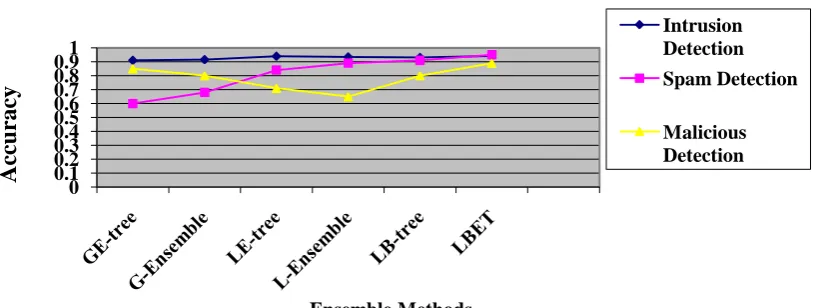
Table 2: Comparison Methods of imbalance classification of Accuracy values Methods GE-tree G-Ensemble LE-tree L-Ensemble LB-tree LBET
Intrusion Detection
0.91 0.915 0.939 0.934 0.93 0.9412
Spam Detection
0.6 0.68 0.84 0.89 0.91 0.95
Malicious Detection
0.85 0.80 0.71 0.65 0.80 0.89
In Table 2 describes the classification accuracy of proposed LBET method is produce better accuracy with existing
ensemble methods.
Table 3: Time Cost Comparisons with Benchmark Methods
Methods GE-tree G-Ensemble LE-tree L-Ensemble LB-tree LBET
Intrusion Detection
444.5 169 62 337 61.5 58
Spam Detection
5933 368969 3484 47406 3207 3155
Malicious Detection
1153 133600 782 12348 765 68
In Table 3 describes the Time cost comparison measures of proposed LBET method is produce better time cost with existing ensemble methods.
0 0.1 0.2 0.3 0.4 0.5 0.6 0.7 0.8 0.91
Ac
cu
rac
y
Ensemble Methods
Comparison Methods of imbalance classification of Accuracy values
Intrusion Detection Spam Detection
ISSN(Online): 2319-8753
ISSN (Print): 2347-6710
I
nternational
J
ournal of
I
nnovative
R
esearch in
S
cience,
E
ngineering and
T
echnology
(An ISO 3297: 2007 Certified Organization)
Vol. 4, Issue 11, November 2015
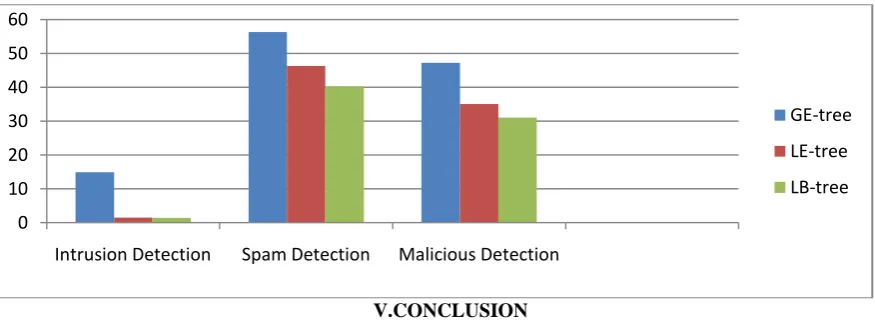
Table 4: Memory size Comparisons with Benchmark Methods GE-tree LE-tree LB-tree
Intrusion Detection 14.90 1.50 1.45
Spam Detection 56.29 46.29 40.27
Malicious Detection 47.26 35.04 31.04
In Table 4 describes the memory size comparisons of proposed LBET method is produce better memory consumption over the existing ensemble methods.
V.CONCLUSION
The research presents a new approach which combines techniques from various fields and adapts to solve the problem of data streaming, decision tree and indexing. The results show that the proposals generated the extremely relevant. It has been observed that as the Area under curve (i.e., Accuracy) and Time cost prevents the quality of proposed system. The classification technique is developed on the basis of logical Bayesian DT methodology has revealed promising results in our experiments on predicting the occurrences of uncertainty. Both the standard and suggested Bayesian DT techniques provide a high performance in terms of predictive accuracy
0 50000 100000 150000 200000 250000 300000 350000 400000
T
im
e (
se
con
d
s)
Ensemble Methods Time Cost Comparisons with Benchmark Methods
Intrusion Detection Spam Detection
Malicious Detection
0 10 20 30 40 50 60
Intrusion Detection Spam Detection Malicious Detection
ISSN(Online): 2319-8753
ISSN (Print): 2347-6710
I
nternational
J
ournal of
I
nnovative
R
esearch in
S
cience,
E
ngineering and
T
echnology
(An ISO 3297: 2007 Certified Organization)
Vol. 4, Issue 11, November 2015
REFERENCES
[1]P. Zhang, J. Li, P. Wang, B. Gao, X. Zhu, and L. Guo, “Enabling Fast Prediction for Ensemble Models on Data Streams,” Proc. 17th ACM SIGKDD Int’l Conf. Knowledge Discovery and Data Mining (KDD), 2011.
[2] M. Masud, J. Gao, L. Khan, J. Han, and B. Thuraisingham,“Classification and Novel Class Detection in Concept-Drifting Data Streams under Time Constraints,” IEEE Trans. Knowledge and Data Eng., vol. 23, no. 6, pp. 859-874, June 2011.
[3] J. Gao, R. Sebastiao, and P. Rodrigues, “Issues in Evaluation of Stream Learning Algorithms,” Proc. 15th ACM SIGKDD Int’l Conf. Knowledge Discovery and Data Mining (KDD), 2009.
[4] A. Bifet, G. Holmes, B. Pfahringer, R. Kirkby, and R. Gavalda, “New Ensemble Methods for Evolving Data Streams,” Proc. 15th ACM SIGKDD Int’l Conf. Knowledge Discovery and Data Mining(KDD), 2009.
[5] X. Zhu, P. Zhang, X. Lin, and Y. Shi, “Active Learning from Stream Data Using Optimal Weight Classifier Ensemble,” IEEE Trans. System, Man, Cybernetics, Part B: Cybernetics, vol. 40, no. 4, pp. 1-15, Dec. 2010.
[6] J. Quinlan, C4.5:” Programs for Machine Learning”. Morgan Kaufmann Publishers, 1993.
[7] J. Ma, L. Saul, S. Savage, and G. Voelker, “Identifying Suspicious URLs: An Application of Large-Scale Online Learning,” Proc. 26th Ann. Int’l Conf. Machine Learning (ICML), 2009.
[8] R. Guting, “An Introduction to Spatial Database Systems,” VLDB J., vol. 3, no. 4, pp. 357-399, 1994.
[9] A. Guttman, “R-Trees: A Dynamic Index Structure for Spatial Searching,” Proc. ACM SIGMOD Int’l Conf. Management of Data (SIGMOD), 1984.
[10] T. Sellis, N. Roussopoulos, and C. Faloutsos, “The R-Tree: An Efficient and Robust Access Method for Points and Rectangles,” Proc. ACMSIGMOD Int’l Conf. Management of Data (SIGMOD), 1990.
[11] T. Sellis, N. Roussopoulos, and C. Faloutsos, “The Rþ-tree: A Dynamic Index for Multi-Dimensional Objects,” Proc. 13th Int’l Conf. Very Large Data Bases (VLDB), 1987.
[12] P. Ciaccia, M. Patella, and P. Zezula, “M-Tree: An Efficient Access Method for Similarity Search in Metric Spaces,” Proc. 23rd Int’l Conf. Very Large Data Bases (VLDB), 1997.