ABSTRACT
MATTHIS, JOHN STEVEN. Selected Employee Attributes And Perceptions Regarding Methods And Animal Welfare Concerns Associated With Swine Euthanasia. (Under the direction of Dr. Richard T. Liles.)
The purpose of this study is to determine selected employee attributes on their perceptions regarding swine euthanasia and to explore their animal welfare concerns
associated with swine euthanasia. This study establishes the most prevalent personality types among swine employees in
Eastern North Carolina. The following independent factors will be used to determine an employee’s willingness to perform
euthanasia and attitude toward euthanasia. These factors include socio-demographic factors, socio-psychological
factors, farm factors, and euthanasia methods. The information was obtained by visiting 47 swine farms in eastern North
Carolina where a total of 388 surveys were administered with a 100% return rate.
The objectives of the study were developed from the
analysis of focus group participation and scrutinized by peer review. The selected objects for this research project
include:
important factor when choosing a euthanasia method? 3. Do employees perceive safety as an important factor
in performing euthanasia?
4. Which method of euthanasia, blunt trauma or carbon dioxide gas do employees perceive as being the fastest method of euthanasia for the pig?
5. What method of euthanasia training do employees prefer?
6. Do employees perceive the the time it takes to
complete the euthanasia process an important factor in choosing a method?
7. Do employees perceive the euthanasia as being a stressful part of the job?
8. Is there a correlation between a employee’s
temperament and his or her willingness to euthanize pigs and his or her attitude toward euthanizing? 9. Do selected socio-demographic factors influence an
employee’s attitude toward euthanasia and/or willingness to euthanize pigs?
10. Selected socio-psychological factors do have an
effect on an employee’s attitude and/or willingness
to euthanize.
11. Do selected farm factors influence an employee’s
attitude toward euthanasia and/or willingness to
employee’s attitude toward euthanasia and/or
willingness to euthanize pigs?
13. Does a combination of independent variables in the
multivariate model influence an employee’s attitude
toward euthanasia and/or willingness to euthanize
pigs?
The results of the survey concluded that regardless of their age, gender, or ethnic background, employees preferred a method of euthanasia that was perceived as less painful to the pig. The majority of the respondents have a personality type of ESTJ based on the Keirsey Temperament Sorter II. The swine employees in this study did not represent the INTP personality type.
Most of the employees did not feel stressed by having to perform euthanasia as long as the animal appeared sick. Most of the employees viewed euthanasia of a sick pig as a humane alternative to letting the animal die naturally. A majority of employees prefer to use a process that is less painful to the pig even though it may take longer. Most of the employees prefer to be trained on the farm. A majority of employees perceive blunt trauma to be the safest method for the 1 to 12 pound pig. A majority of employees perceive carbon dioxide gas to be safer than blunt trauma or the bolt gun method.
Selected Employee Attributes And Perceptions
Regarding Methods And Animal Welfare Concerns
Associated
With Swine Euthanasia
Steven Matthis
A dissertation submitted to the Graduate Faculty of North Carolina State University
In partial fulfillment of the Requirements for the Degree of
Doctoral of Education
OCCUPATIONAL EDUCATION
Raleigh 2004
APPROVED BY:
________________
______________
Richard T. Liles David M. Jenkins
Chair of Advisory Committee
___________________ _________________ Robert D. Mustian M. Todd See
DEDICATION
To my wife, Paula, whose love and encouragement helped me complete one step at a time.
To my daughter, Marie, whose laughter and humor helped me through the tough times.
To my mother and father, who taught me the value of hard work and determination.
BIOGRAPHY
Steven Matthis was born April 22, 1952, in Clinton, North Carolina. He is the only son of Oscar Lee and Martha Annette Matthis. He worked and lived on a livestock and crop farm throughout his high school years, and graduated from Union High School in 1970. He attended North Carolina State
University and graduated in 1975 with a Masters in
Agricultural Education. He started his teaching career in Transylvania County, North Carolina, at Brevard High School. After two years in the mountains, he moved back to Sampson County and started an Agriculture Science Curriculum at
Sampson Community College. In 1980, Steve decided to return to the farm full-time and raise swine, cattle and sheep. In 1993, Steve returned to the community college to start a new
Livestock and Poultry Technology Curriculum. While in this capacity, he has been actively involved with the National Pork Board and serves on the National Pork Board’s Education
Committee.
Steve is currently the Division Chairman of the
Agriculture and Industrial Departments at Sampson Community College, and works closely with livestock companies in the area by offering employee training. He is often sought to
ACKNOWLEDGEMENTS
It has been said that all things are possible with hard work and determination. That should be amended to “hard work, determination, and help from friends.” This spring a lifelong dream has become a reality for me thanks to the many people who have helped me on the way.
This process was truly a test of endurance. I started my education at North Carolina State University in 1970, and will complete the final leg of my educational journey 34 years
later. I can honestly say this phase of my education has been the hardest and most time consuming, but at the same time it has been one of the most rewarding and enjoyable segments of my educational process. Even though the last six years have been seemingly endless at times, the process has given me a greater appreciation of the research process, the doctoral degree, and higher education in general.
The achievement would not have been possible without the guidance of the following members of my graduate committee: Dr. Richard Liles, Dr. Jerry Gibson, Dr. David Jenkins, Dr. David Mustian, Dr. Morgan Morrow and Dr. Todd See.
First, I would like to thank Dr. Jerry Gibson for
encouraging me to take the first step on that long road to the doctoral degree. Everyone needs a push to get started; he gave me the initial encouragement and followed up with continued support.
solutions to every difficulty I encountered along the way. As the going got tough, his advice was the stepping-stone that helped me to make it through to the next level.
A positive word of encouragement and support when it sometimes seemed that there was no light at the tunnel’s end was a definite blessing. I could always count on Dr. David Jenkins’s positive attitude and inspirational comments to lighten the load.
A research project is not complete without an excellent statistician. Dr. David Mustian provided the expertise to accurately process and analyze the data. Without his help the project would fail to meet the expectation of industry and the scientific community.
Thanks to the guidance and wisdom of Dr. Morgan Morrow and Dr. Todd See, I was able to produce information with
practical relevance to North Carolina’s swine industry. Their dedication was critical in helping to guide the project in a path that developed knowledge that can be used on the farm to improve the welfare of both swine workers and the animals they care for.
Also, thanks go to Dr. Laurie Hamilton, a friend and colleague, who was always there when I needed help to get through the rough spots.
I will never be able to sufficiently show my appreciation to my immediate and extended family for the support they have given me through this process. My wife, Paula, and my
during the last six years. I couldn’t have done it without you!
So you see, hard work and determination are necessary, but not sufficient. I could not have completed this process
TABLE OF CONTENTS
Page
LIST OF CHARTS ...x
LIST OF TABLES ...xi
CHAPTER 1. INTRODUCTION ...1
Significance of Euthanasia in the Swine Industry ...3
Current Farm Euthanasia Situation ...9
Current Euthanasia Policies ...11
Background Information ...12
Gaps in the Research ...16
Statement of the Problem ...20
Purpose and Objectives of the Study ...23
Research Questions ...25
Assumptions and Limitations of the Study ...27
Definition of Terms ...29
Organization of the Study ...32
Summary ...32
CHAPTER 2. CONCEPTUAL FOUNDATIONS AND LITERATURE REVIEW ...35
History of Euthanasia ...35
Literature Review of Psychological Types ...38
2000 Report of the AVMA Panel On Euthanasia ...46
Emotional Responses of Animal Shelter Workers to Euthanasia ...50
Euthanasia of Rats With Carbon Dioxide—Animal Welfare Aspects ...53
Psychodemographic Profile of Stockpeople Working On Independent and Integrated Swine Breeding Farms in Quebec...55
Observations of the Trajectory of the Bullet in Fifteen Horses ...59
Personality Types, Attitude Towards Pigs, and Herd Productivity ...61
An Assessment of Carbon Dioxide Stunning in Pigs ...63
Clinical Recognition and Anticipation of Situations Likely to Induce Suffering in Animals ...64
Laboratory Technician Uneasiness and Guilt Toward Euthanasia ...65
Conceptual/Theoretical Framework ...67
TABLE OF CONTENTS (Continued)
Page
CHAPTER 3. METHODOLOGY ...73
Research Design ...75
Population and Sample ...76
Needs Assessment (Focus Group) ...77
Instrumentation ...77
Data Collection Procedure ...78
Notification and Information Phase ...78
Administering the Surveys ...79
Explaining the Importance of the Survey ...79
Viewing the Euthanasia Video ...80
Administering the Euthanasia Survey ...80
Administering the Keirsey Temperament Sorter II ...81
Analysis of the Data ...81
CHAPTER 4. RESULTS ...84
Demographic Data ...85
Preferred Method ...103
Perceived Level of Pain ...105
Perceived Level of Safety ...106
Speed of Euthanasia ...107
Preferred Training Method ...108
Time/Method of Euthanasia ...109
Perceived Stress Level ...110
Employees’ Temperament ...118
Socio-demographic Factors ...119
Socio-psychological Factors ...120
Farm Factors ...122
Euthanasia Methods ...123
Interaction of Independent ...124
Multivariate Model ...153
CHAPTER 5. CONCLUSIONS, IMPLICATIONS AND RECOMMENDATIONS ...157
Purpose and Review ...157
Major Findings and Conclusions ...159
Recommendations to the Swine Industry ...173
Future Research ...178
TABLE OF CONTENTS (Continued)
Page
LIST OF APPENDIX ...186
Appendix A. Focus Group Survey ...186
Appendix B. Focus Group Survey Results ...187
Appendix C. Focus Group Questions ...191
Appendix D. Euthanasia Survey (English) ...194
Appendix E. Keirsey Temperament Sorter II ...198
Appendix F. Euthanasia Decision Tree ...205
Appendix G. Company Protocol for Sow Euthanasia ...206
Appendix H. Company Protocol for Finish Pig Euthanasia ...207
Appendix I. Company Protocol for 1-12 lb Pig Euthanasia ...209
Appendix J. Company Protocol for Nursery Pig CO2 Euthanasia ...210
Appendix K. Company Animal Euthanasia Guidelines ...211
Appendix L. Farm Gun Protocol ...212
LIST OF CHARTS
Page Chart A: Myers-Briggs Type Indicator and The General
Population...41
Chart B: Myers-Briggs Temperament Group General Population
Distribution ...41 Chart C: Abstract/Concrete Word Usage ...43 Chart D: Keirsey's Four-cell Matrix ...44
LIST OF TABLES
Page Table 1. Distribution of Respondents by Ethnic Background ..87 Table 2. Distribution of Respondents by Gender ...87 Table 3. Distribution of Respondents by Educational Level ...88 Table 4. Distribution of Respondents by Age ...89 Table 5. Swine Producers That Currently Euthanize or Have ...90 Table 6. Number of Years Employees Have Been Working On
Farms Where They Had to Euthanize Pigs ...91 Table 7. Who Administered the Euthanasia Training ...92 Table 8. Swine Departments that Employees Have Worked One
Week or More ...93 Table 9. Methods Of Coping With The Stress Of Euthanasia
On Swine Farms ...94 Table 10. Method of Euthanasia Used on Farm to Euthanize
Pigs 1-12 lb. ...95 Table 11. Methods Used to Euthanize Nursery Pigs on Swine
Farms ...96 Table 12. Safety Level of Euthanasia Methods ...97 Table 13. What is the Heaviest Pigs Killed With Blunt
Trauma ...98 Table 14. Training Method Preferred by Swine Production
Employees ... 99 Table 15. Employees Feelings After Performing Euthanasia .. 100 Table 16. Religious Denomination ... 101 Table 17. Language ... 102 Table 18. Attitudes of Respondents Toward Euthanasia ... 115 Table 19. Employees Responses and Perceptions Regarding
Swine Euthanasia ...117 Table 20. Distribution of Respondents by Psychological
Type ...125 Table 21. Distribution of Respondents by Temperament ...126 Table 22. Distribution of Respondents by Their Attitudes
Toward Euthanasia ...127 Table 23. Relationship Between the Willingness of An
Employee to Euthanize and the Number of Years the
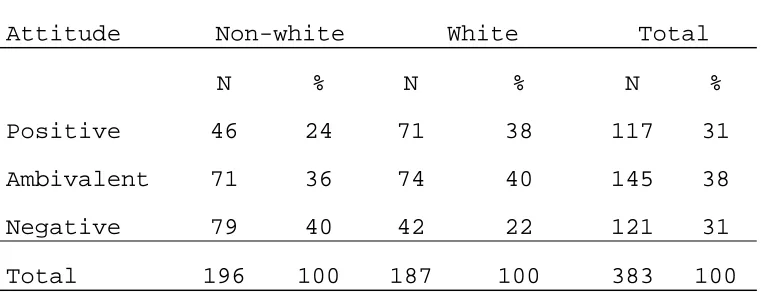
Employee has been Euthanizing Pigs ...128 Table 24. Relationship Between the White and Non-white Employees and Their Attitude Toward Euthanasia ...129 Table 25. Relationship Between the Attitude Toward
Euthanasia and the Employees Language Preference ...130 Table 26. Relationship Between the Willingness of An
Employee to Euthanize and the Level of Education ...131 Table 27. Relationship Between the Education Level of
the Employee and the Euthanasia of a Pig the Did Not
Table 28. Relationship Between the Gender of the
Employee and Their Attitude Toward Euthanasia ...133 Table 29. Relationship Between Gender and the
Willingness to Perform Euthanasia ...134 Table 30. Relationship Between the Age of the Employee
and Their Attitude Toward Euthanasia ...135 Table 31. Relationship Between Gender and Completing
Swine Euthanasia Using a Less Painful Method Even
if the Process Took Longer ...136 Table 32. Relationship Between the Level of Education
and the Willingness to Use a Less Painful Method Even Though the Method May Take Longer ... 137 Table 33. Relationship Between an Employee's Willingness
to Euthanize and Their Language Preference Either
English or Spanish ...138 Table 34. Relationship Between the Attitude to an
Employee Toward and Their Years Euthanizing Pigs ...139 Table 35. Relationship Between an Employee's Education
Level and Their Willingness to Euthanize Pigs ...140 Table 36. Relationship Between Attitude of the
Employee Toward Euthanasia and the Employee's Level
of Education ...141 Table 37. Relationship Between the Willingness of an
Employee to Perform Euthanasia and the Age of the
Employee ...142 Table 38. Relationship Between the Willingness of an
Employee to Use a Less Painful Method if it Took
Longer to Perform ...143 Table 39. Relationship Between the Willingness of
an Employee to Euthanize a Pig That Does Not
Appear to be Sick ...144 Table 40. Relationship Between an Employee's Attitude and
Euthanizing a Pig That Does Not Appear to be Sick ...145 Table 41. Relationship Between the Gender of the
Employee and Euthanizing a Pig That Does Not Appear
to be Sick ...146 Table 42. Relationship Between the Employee
Psychological Types and Their Attitude Toward
Euthanasia ...147 Table 43. Relationship Between the Willingness
of an Employee to Perform Euthanasia and Their
Personality Type ...148 Table 44. Relationship Between the Attitude of
an Employee to Perform Euthanasia and Their
Personality Type ...149 Table 45. Relationship Between the Willingness
of the Employee to Perform Euthanasia and Their
Table 46. Relationship Between the Willingness of the
Employee to Euthanize and the Area They Work ...151 Table 47. Relationship Between the Area the Employee
Works and the Employee's Attitude Toward
Euthanasia ...152 Table 48. Relationship Between the Method of
Euthanasia Training and the Willingness of
the Employee to Euthanize Pigs ...155 Table 49. Relationship Between the Age of the
Employee and the Willingness of the Employee to
Euthanize Pigs ...155 Table 50. The Relationship Between the Area of
Employment and the Willingness to Euthanize Pigs ...156 Table 51. Relationship Between Gender and the Attitude
CHAPTER 1.
INTRODUCTION
The overall purpose of this study was to determine the influence of selected employee attributes on their perceptions regarding methods of on-farm euthanasia in swine and on their concerns associated with the animal welfare aspects of these methods. Animal welfare and euthanasia are sensitive issues in the animal industry today. According to the National Pork Board’s new Swine Welfare Assurance Program booklet (2003), a pork producer's livelihood depends on the welfare and
performance of the livestock. The National Pork Board (2003) states, “if an animal is mistreated or under stress, it will need to eat more feed to grow, will be more susceptible to disease and will generally not thrive” (p.3). This
mistreatment could result in euthanasia by the employee, as most farm euthanasia is due to an untreatable illness or extremely “poor doing” pigs. An understanding of these
procedures by the general public and the swine farm worker is of utmost importance to insure an acceptance and balance from the farm to the consumer. McGlone and Pond (2003) state, “The pig industry must address issues of ethical values and
determine if the euthanasia methods currently used are the preferred methods, or if there are other procedures that are better for the animal and for the employee performing the procedure. The variables researched include socio-demographic factors, socio-psychological factors, farm factors and
euthanasia methods in order to determine the preferred on-farm euthanasia method. The study examines the personality types and demographics of swine farm employees, and how these relate to euthanasia and their willingness to euthanize pigs. The attitude and willingness of different ethnic groups toward farm euthanasia practices are also researched. Euthanasia methods are examined with regard to better meeting the animal welfare demands of swine employees and consumers.
In summary, the increased emphasis on animal welfare issues by consumers, the National Pork Board, the United States Department of Agriculture and individual swine
companies shows the need for more research in animal welfare related to swine euthanasia. The swine companies' concern towards sensitive consumer and employee issues is evident by their participation in this research project. The swine industry must embrace these changes and be proactive to meet these demands in order to satisfy both consumers and
employees. Thompson (2003) states, “We are entering a time when the public’s demand for ethical treatment of farm animals is starting to register in the form of price premiums and
that although the ethical responsibilities of the individual husbandry man are still important, there is a growing need to examine the ethics of animal care on an industry-wide basis.” (p.1) Euthanasia is just one area that deserves immediate attention and assessment to reflect positive producer attitudes.
Significance of Euthanasia in the Swine Industry
The research could have a significant impact on animal welfare issues associated with on-farm euthanasia throughout the United States’ swine industry.
Changing or modifying an existing production procedure or task is difficult, even on a small scale; however, economic factors could compel the swine industry to change an existing method or procedure to comply with consumer demands (Thompson, 2002). Many animal rights groups are steadily influencing public opinion on sensitive issues. McGlone and Pond (2003) list the Internet sites that are pro-commercial pig production and anti-commercial pig production. An examination of these sites confirms that the swine industry is at a crossroads in relation to sensitive issues such as euthanasia and animal welfare. Fast-food chains are demanding adherence to specified animal welfare standards before they agree to buy from a
demonstrated by Florida’s recently passed laws banning gestation crates (Burgdorfer, 2002). Tokach (2001) states, “move to outlaw gestation crates and/or farrowing crates could greatly reduce potential for future profit in industry”
(p.88). Hartsock (2002) agrees, “this state-by-state approach is particularly devastating because if a banned management practice significantly reduces the efficiency of production, and therefore profits, producers in the targeted states will not be able to compete and will go out of business” (p.1). North Carolina could be next on the list of targeted states on animal welfare issues. Many critical issues deal with public perception, not sound research. Barnett and co-author’s study (as cited in Harper, A 2002) states, “the issue of public
perception should not be confused with animal welfare” (p.1). A proactive approach based on theory and research is the best way to address consumer concerns regarding animal welfare and euthanasia. The swine industry realizes the importance of dealing with these sensitive issues quickly and thoroughly. Involvement in animal welfare research demonstrates the swine industry’s commitment to developing euthanasia methods that provide for adequate pig and employee welfare and satisfy consumer demands. An example of this is the Swine Welfare Assurance Program produced by the National Pork Board, which program provides a standard for proper animal welfare
practices.
the swine industry. Appendix F illustrates the protocol used by employees of two major Southeastern swine companies for determining which pig to euthanize. The high profile of this topic is evident by the number of newspaper and magazine
articles being published. Euthanasia, a topic that at one time was not talked about, is now making headlines (PETA, 2004). The animal cruelty charges of a Seaboard Farms employee
illustrates the urgency of research in this area (Kletecka, 2001).
Many avenues could be explored following the completion of this research project. Some of these topics include:
Fine tuning the prescribed method of euthanasia, including new machinery, technology and technique. Public awareness and acceptance of prescribed
procedures.
Advanced studies on employee satisfaction on the job when dealing with sensitive issues.
Job placement; can the employee perform the task outlined in the job description?
How to approach sensitive issues in the animal industry in a proactive manner to avoid public outcry.
Linking theory and practice is an integral part of this research project. The prescribed methods of euthanasia
are stated in appendices G,H,I,J and K. This research determines the practical application of these methods as determined by the employees who work in the industry and
complete the task on a daily basis. The swine industry must use research to determine which euthanasia method to implement, and how to train employees on techniques and procedures. Proper techniques and training are important for all employees, including new trainees and veteran swine herdsmen. This
research project explores the need for euthanasia training in the industry and the method of euthanasia training perceived as best by the employees.
Brewer (1982) states, although the actual process of animal euthanasia was documented as early as the sixteenth century, the lack of literature and research in the specific area of swine euthanasia indicates that swine euthanasia could be considered an emerging or under-researched area.
According to Arluke (1992), euthanasia is a topic that people do not want to discuss. Euthanasia has been documented as a production practice, but not highly publicized due to the sensitive nature of the subject. Recent interviews with
company representatives, coupled with media coverage reaffirms the idea that on-farm swine euthanasia is receiving
recognition as a sensitive animal welfare issue and needs to be dealt with in a timely manner.
the AVMA (2000), ”Whenever possible, a veterinarian
experienced with the species in question should be consulted when selecting the method of euthanasia, particularly when little species-specific euthanasia research has been done” (p.672). Additionally, there is a lack of research on how the swine caretaker feels about the euthanasia process. Arluke (1992) completed studies involving laboratory technicians and their feelings about euthanasia. Arluke (1992) found
uneasiness and a feeling of guilt among laboratory workers. Other emotional reactions of laboratory technicians include grief, anger and frustration (Walshaw, 1994). Shapiro (2000) states, “they show this dedication by doctoring these animals when they are injured or ill and by crying for them when they accidentally die or are shipped to market at the end of their productive lives . . . they are farmer’s friends” (p.152). Swine employees could presumably have emotional reactions to euthanasia that resemble the reactions of laboratory
technicians.
The news media and consumer perception have a defining role in how companies produce their product. Kaufman (2000) states, “McDonald’s restaurant chain yesterday launched a major effort to improve the way egg farmers care for their hens – a move that reflects rising scientific and public concern over how farm animals are treated” (p.1). For example, current trends in the meat export market are
Policy (2002) states, “we will comply with all laws and
regulations applicable to the animals’ health and welfare and we strive to enhance our animals’ well being and value”
(p.18). Smithfield Foods sets standards to meet consumers’ expectation for quality and safe pork products. The Food Marketing Institute in the June 2002 report states,
“retailers, animal welfare experts, animal welfare advocates, producers, processors and the public share the common goal that all animals used in agricultural production be cared for in a manner that takes into account their daily well-being and health” (p.1). Another example of animal welfare standards and consumer acceptance is the British “farm assured” red tractor logo. Lawrence (2002) states, “the red tractor is promoted as a ‘promise to consumers that food has been produced to meet exacting food safety, environmental and
welfare standards” (p.1). These practices are evidence of how seemingly small, insignificant issues have a large economic impact on an industry. The livestock industry cannot allow a sensitive topic like euthanasia to become a media issue
similar to the recent environmental publicity related to hog lagoons. Due to increased public pressure and negative press, The Environmental Defense Fund (1999) issued a report citing the “severe threat” to public health and the environment associated with hog waste lagoons. This report calls for the adoption of a solution package in 1999. The impact of the environmental report could have widespread economic
not directly related, they illustrate the need to deal with sensitive issues before the media adopts them. McGlone (2001) states, “it is possible for the industry to be forced or
encouraged to change based on the following forces on the industry: economic pressures on the pork industry, direct legislation, international trade requirements, and direct market forces” (p.1). The industry must be looking for all possible problems in advance to avoid bad publicity and possible economic loss.
Current Farm Euthanasia Situation
A lack of scientific research on specific farm animal euthanasia practices and failure of farms to accept a
designated euthanasia method have led to a variety of methods being administered by farm employees. The American
Association of Swine Veterinarians and the National Pork board published “On Farm Euthanasia of Swine-Options for the
Producer.” This booklet lists the various acceptable methods that producers use to euthanize pigs. In the absence of a designated farm protocol, euthanasia could vary from farm to farm. The farm manager chooses the euthanasia method that he or she prefers, with no thought given to the process, safety, pig pain or employee distress. According to D. Bishop
company farms for swine weighting more than 12 pounds to market was the gunshot.
New production protocols (Appendix L) reveal the rifle or gunshot is no longer used as the primary source of euthanasia on company farms due to employee safety issues. The rifle has been replaced on many company farms with the bolt gun. The bolt gun has been determined to be a safer method of
euthanasia by most companies. The bolt gun method of euthanasia conforms to the companies' policy of "no guns allowed on farm premises." According to Dennis (1988), the rifle is considered dangerous due to the possibility of
ricochet when used inside the facility. Company representative M. Daughtry (personal communication, December 2003) confirms the rifle is still used by many independent swine farmers and contract growers to euthanize pigs. Company farm polices do not govern independent farms and contract growers. The gunshot is an approved method of euthanasia by the American
Association of Swine Veterinarians (NPB, 2003).
Several swine companies that utilize employee handbooks have incorporated a section in the handbook that describes the company's prescribed euthanasia methods. Appendices G, H, I, J and K exhibit company euthanasia polices. Even though many companies have existing euthanasia polices, they do not have enough information concerning the human perception of
euthanasia from a farm employee performing the process or the consumer that purchases the final products. The animal
the Queensland government of Australia has also developed “Animal Welfare Standards.” The article “Animal Welfare
Standards: An Introduction to codes of Practice” (DPI.GLD.GOV. 2004) states, “consumers want assurances that animals used for production are raised in a way that safeguards their welfare” (p.2). The marketing experts in Queensland state, “to be
competitive, animal product exporters like Australia will need to match international standards on food safety, animal
welfare, and traceability”. McGlone and Pond (2003) state, “Pig farmers and students should be fully aware of societal concerns and be able to discuss them in a logical and rational manner to work toward solutions that are compatible to the producer and the consumer” (p.32). Marketing a farm commodity begins at the farm level and carries through to the retail consumer and must address emotional issues that affect not only producers, but also the animals in their care and the consumers who utilize the final product.
Current Euthanasia Policies
Contact with all companies involved in the survey process reveals a variety of company policies dealing with swine
euthanasia (Appendix G,H,I,J and K). Many of the companies describe the company's euthanasia procedures in the personnel handbook (Appendix G). Several of the companies describe the euthanasia process by referring to the swine euthanasia
Pork Board (2003). According to J.Latham (personal communication, March 29, 2004), who participated in
implementing the animal welfare management system in one of the companies participating in this survey, during the pre-employment interview, the types of daily tasks an employee is expected to perform on the farm are discussed by the
Employment Manager. Any prospective employee who has no previous experience working with swine is given an on-farm tour. The tour is done to ensure the prospective employee is aware of the environment on the farm. The tour also includes expectations regarding animal welfare. The farm manager with whom the new employee will be working usually completes the on-farm tour. If the new employee objects to the expected daily tasks, the employee can discuss the problem with the manager.
Background Information
Euthanasia is defined as a humane death occurring without pain or distress (NPB 2003). The AVMA (2000) suggests the
All creatures born on earth have an estimated life expectancy. Workers in the field of animal research, veterinary medicine and commercial animal production are required from time to time to euthanize animals before they reach their full life expectancy. In the commercial swine
industry in North Carolina, some of the reasons for euthanasia include potential disease risk to other animals and relief of suffering for animals too sick to recover.
As documented earlier, euthanasia is quickly becoming a sensitive and highly political issue in the area of animal welfare. Two areas that continue to be a problem in the swine industry are the perception of animal welfare from a public perspective and the perception of animal welfare from an employee view. Grandin (1987) suggests, “rotating the euthanasia responsibility among employees prevents a
mechanistic approach to the animals” (p.206). The Arluke study (as cited in AVMA, 1991) states, ”Constant exposure to, or participation in, euthanasia procedures can cause a
psychologic state characterized by a strong sense of work dissatisfaction or alienation, which may be expressed by
absenteeism, belligerence, or careless and callous handling on animals” (p.675).
from producers (McDonalds, 2003). One of the concerns associated with animal welfare is the euthanasia methods currently used in the swine industry. These companies,
encouraged by special interest groups like PETA, want to make changes in methods of animal handling associated with animal welfare issues. An article in Business Ethics magazine quotes the CEO of McDonald’s, Jack Greenberg, saying, “McDonald’s wants to take industry leadership in animal welfare” (Kaufman, 2000,p.7). Kaufman (2000) states, “If Mcdonald’s required
changes, suppliers will comply" (p.7). If the food industry rejects the swine industry’s methods of animal welfare, a serious economic impact could occur. McGlone (2001) suggests, that science should be used to make animal welfare decisions. McGlone suggests, that if animal welfare changes are made by animal rights activists instead of by using research and science, then farmers could be penalized for providing
improved animal welfare. An example of economic loss could be the need to retrofit gestation crates to open pens to conform to Florida’s new law banning gestation crates. McGlone (2001) states, “When the science is laid-out before reasonable
people, there is not much scientific justification to ban the crate—maybe we have not done enough studies, but even still, the science is not there today to ban the crate” (p.2). Using direct legislation and economic pressures could become a
This research looks at euthanasia from a farm employee’s perspective. The research explores the evolving issues and challenges, including animal rights issues, employee emotions, and employer job requirements, using the best euthanasia
procedures available and matching the employee with the job. If these sensitive issues are not handled properly, the result is high employee dissatisfaction resulting in high turnover (AVMA 2000). Employee turnover results in higher company
expense and lower productivity (McGlone, Pond 2003). There are many other related issues that intensify this critical area of human/animal relationship. The following list gives a glimpse into the background and complexity of the euthanasia issue:
01. Human animal bond (White,1996)
02. Grief issues associated with euthanasia White,1996; Walshaw (1994)
03. Strategies for coping in the workplace (Arluke, 1992)
04. Training of employees on coping techniques (Arluke,1992)
05. USDA regulations on animal welfare (Code of Federal Regulations, 1992)
06. Animal welfare regulations (Aphis.usda.gov) 07. Age related issues (Walshaw, 1994)
08. Compassionate care of animals (Walshaw, 1994) 09. Public opinion (White, 1996; AVMA, 2000)
The magnitude of this problem mandates that the swine industry be proactive in their pursuit of a solution to the problem of animal welfare, specifically with regards
euthanasia practices.
Gaps In The Research
The National Pork Board reports a steady growth in the pork industry since 1970. Rapid growth creates production problems in many segments of an industry when areas of
production are overlooked from a research perspective. Most of the previous euthanasia research involves laboratory
animals and technicians, because the research laboratory has the most concentrated number of animals that need to be
euthanized at one time. Other research involves dog pound or animal shelter workers. According to the Humane Society of the United States (1992), animal shelters in the United States euthanize approximately eight million unwanted dogs and cats every year. Animal pain and employee emotions can be more easily measured in a laboratory setting than on the farm.
According to the Pork Facts (2000), the number of swine production units has decreased, but the size of the farms has increased, resulting in fewer farms owned and operated solely by family members. Formerly, animal euthanasia was considered a part of farm life, and little need was perceived for
extensive research in this area. Armstrong (2004), at the
“how public perception of the meat industry has changed as society has evolved from its agricultural roots and as activist organizations affect public opinion, both in the
United States and world wide”(p.1). Armstrong (2004) cautions, ”noting the relatively small numbers of researchers working on animal welfare issues and the need for greater focus and
funding . . . the meat industry and the research community must be part of the solution by working together and by implementing science-based guidelines focusing on welfare, economics, food safety and consumer concerns” (p.2).
United States Senator Elizabeth Dole (Friends of Agriculture Seminar 2004) states that the farm family
population has decreased drastically in the past 100 years to approximately 2 percent of the population. Thus a conclusion could be made that many of the workers currently working on company farms did not grow up on a farm or have previous farm experiences. This lack of experience, training, and
professional support in reference to repeated animal euthanasia could result in a failure to comprehend the
realities of animal production and lead to misunderstanding or unpleasant experiences on the job, with concomitant high
employee turnover (AVMA, 2000).
caregivers and at the same time performed euthanasia on the animals they were caring for (Walshaw, 2002). Shapiro (2000) states, “the strong attachment or feelings the farmer has towards his or her stock can best be demonstrated by the dedication he or she has in delivering young calves, foals, lambs, and piglets by breathing into their mouths and giving them the first breath of life” (p.152). All methods of
euthanasia that are used on swine farms are approved methods of euthanasia by the AASV (National Pork Board, 2003). That a method is prescribed as a correct method for performing a task does not mean it is the only method that can be used
effectively. A gap in the research is present in the area of swine piglet euthanasia and human emotion. Most of the current research deals with laboratory technicians and animal
shelters, but by extension a presumption could be made that hog farm workers might have similar emotional reactions.
Research reveals that animal shelter workers have
emotional problems dealing with euthanasia (White, 1996). If emotional problems described by White (1996) are consistent among animal shelter workers who have to euthanize large numbers of animals, then possibly the same problems could exist in the swine industry. This factor alone could cause serious employee distress. Development of alternative methods could possibly decrease the emotional anxiety associated with the process.
accuracy. Human error and placement of the shot created a less than perfect means of death. The inconsistency of the bolt gun and other means of blunt trauma associated with human error could allow for unnecessary pig pain during the process. This research project will explore the idea that the blunt trauma method requires a forceful physical act that is considered distasteful by many employees. Performing
euthanasia on baby piglets using carbon dioxide gas, similar to the process used in the euthanasia of laboratory rats researched by Hackbarth (2000), could result in a more
consistent euthanasia process with less physical action by the employee. The piglet welfare could possibly be improved by using carbon dioxide gas euthanasia. The carbon dioxide process eliminates the need for a majority of the physical activity by the employee. During the survey process, many of the employees had questions about pig pain and suffering
during the euthanasia process.
Gaps in the research exist in the use of personality profiles on swine farms. Ravel (1996) states the literature reveals that swine farm workers tend to have personality profiles that are different from the typical population. A better understanding of farm employee personality types could play an important role in emotional reaction to euthanasia and resulting employee job satisfaction.
Further personality profiling could yield helpful
basis on a modern swine facility. Some of these tasks could be stressful to employees. Possibly new employees could be pre-tested and screened for a particular placement. Correct
placement could be improved by understanding an employee's personality and his or her willingness to perform certain tasks. Farm managers need to be sensitive toward employee
feelings about animal welfare and euthanasia issues. According to White (1996), animal shelter workers may experience
considerable emotional anguish from participation in animal euthanasia. There is very little research in the area of swine euthanasia, but farm workers could experience the same emotions of sadness and unresolved grief. Matching
personality types to performance tasks, specifically euthanasia, could benefit both employers and employee.
Statement of the Problem
company policy, employee training or employee attitude? These concerns range from the methods used to euthanize the pigs to the emotions of the farm employees completing this task. Companies are hiring specialists in the field of animal
husbandry such as Temple Grandin to help solve problems from production to slaughter. One example is the euthanasia audits performed by Grandin (2002) at an Excel meat packing plant to see if the plant meets McDonalds animal welfare standards.
In the swine industry, the largest number of pigs being euthanized occurs in the pre-weaned baby piglet stage. McGlone et al. (2003) states, “preweaning mortality is 20% on average in the United States, but under 15% on well-managed farms” (p.277). Farm employees must euthanize a percentage of these pigs to reduce pain and suffering of pigs too ill to recover. These piglets require the most care and nurturing by the
farrowing house workers. According to Walshaw (1994), there are advantages to the human-animal bond in the laboratory; kindness and concern for animals are very desirable
characteristics in animal care. The emotional conflict occurs somewhere between an employee being able to nurture an animal and being able to euthanize them when necessary to reduce pain and suffering. Another concern is the method used to
euthanize. This research addresses euthanasia methods currently used on the farms and methods considered by the employee as being the preferred method for reducing pig pain and employee discomfort. The methods currently used to
approved by the American Veterinary Medical Association and the National Pork Board (Appendix M). Initial focus group analysis and a review of company protocols reveal the farms participating in the research use the blunt trauma method of euthanasia for piglets one to ten pounds. This method involves a quick blow to the head causing instant unconsciousness. The blunt trauma method is considered fast, safe for employees and economical to perform (National Pork Board, 2003). This
research attempts to determine whether the employees
performing the task perceive blunt trauma as the preferred method, or whether a carbon dioxide gas protocol is preferred.
The main focus of this research is related to the methods of euthanasia currently being used in eastern North Carolina to euthanize baby piglets. This research focuses on
alternative methods of euthanasia that are less painful for the piglet, easier and safer for employees to perform without presenting emotional problems, and more aesthetically pleasing and acceptable from the public viewpoint. The research
evaluates the employees’ attitudes and willingness to perform euthanasia.
Four concepts are used in the theoretical framework of the project. The four factors include:
Socio-demographic Factors Socio-psychological Factors Farm Factors
Purpose and Objectives of the Study
There are many areas that could be researched dealing with animal welfare and swine euthanasia. As discussed earlier, there are rapid changes taking place in the livestock
industry, especially in the size and socio-demographic makeup of the employees. Livestock producers are steadily looking for accepted and improved methods of animal handling and
husbandry. Continual changes in the industry are forcing industry to look at scientific research to support accurate decision-making in all areas of animal production and welfare (Thompson, 2002). To reemphasize this point, the National Pork Board has developed a new certification program focused on animal welfare. The program is named the Swine Welfare Assurance Program (SWAP). According to local industry representative M.Daughtry (personal communication), this certification will be an integral part of their employee training program.
Temple Grandin’s (2002) animal welfare audits confirm that consumers prefer a proactive response to sensitive issues rather than a reactive approach. Consumers want to know the food they eat is being handled humanely, from birth to
harvest. Current information on various euthanasia techniques and their effects on animals are publicized in the 2000 Report of the AVMA Panel on euthanasia.
with animal shelter workers and research laboratory
technicians is used in the literature review section of this euthanasia study. Arluke (1992) states that many research and animal shelter workers have serious problems with caring and nurturing animals, knowing that the final destination of the animals is death by their hands. This project attempts to determine whether swine industry employees have the same problems associated with euthanasia as the shelter employees cited in Arluke’s study.
The AVMA (2000) and the National Pork Board (2003) defines euthanasia as a quick and painless death. One of the goals of this research is to determine if employees working in the field of swine production believe euthanasia is being
accomplished in the most humane way possible. If the research concludes a negative response, which of the euthanasia methods prescribed by existing research completes the task most
humanely?
The temperaments of the employees working in the swine industry are ascertained by using the Keirsey Temperament Sorter II. The temperaments of the employees are compared to the overall population and other farm employees' populations. Ravel, Allaire, Bigras-Poulin, and Ward (1995) state, “the parallel description of the independent stockpersons and of those working for organizations tends to show a common
psychological profile that may be related to the type of work” (p.247). Evaluations of the data are done to determine if
and animal welfare concerns associated with swine euthanasia are important to future decision making in the swine industry. The perceived attitudes and willingness of the employees to perform euthanasia are explored as this could have an effect on job satisfaction and decreasing employee turnover.
Listed below are the objectives of this euthanasia study.
Research Questions
Specific research questions addressed by the euthanasia study include:
1. Which method of euthanasia, blunt trauma,
electrocution, lethal injection, bolt gun, rifle or carbon dioxide gas, do employees prefer?
2. Does the employee perceive the pain of the pig an important factor when choosing a euthanasia method? 3. Do employees perceive safety as an important factor
in performing euthanasia?
4. Which method of euthanasia, blunt trauma or carbon dioxide gas, do employees perceive as being the fastest method of euthanasia for the pig?
5. What method of euthanasia training do employees prefer?
7. Do employees perceive the euthanasia of pigs as a stressful part of the job?
8. Is there a correlation between employees’
temperament and his or her willingness to euthanize pigs and his or her attitude toward euthanizing? 9. Do selected socio-demographic factors influence an
employee’s attitude toward euthanasia and/or willingness to euthanize pigs?
10. Selected socio-psychological factors do have an
effect on an employee’s attitude and/or willingness
to euthanize.
11. Do selected farm factors influence an employee’s
attitude toward euthanasia and/or willingness to
euthanize pigs?
12. Do selected euthanasia methods influence an
employee’s attitude toward euthanasia and/or
willingness to euthanize pigs?
13. Does a combination of independent variables in the
multivariate model influence an employee’s attitude
toward euthanasia and/or willingness to euthanize
Assumptions and Limitations of the Study
According to swine industry human relations personnel, the swine industry employee population in North Carolina
encompasses a broad range of cultural and ethnic backgrounds. The largest group of non-English speaking employees is of
Spanish descent. Industry representatives estimate between 40 and 50 percent of the farm employees speak Spanish (L. Torrez, personal communication, March 11, 2004). Several of the
company farms are staffed totally by Spanish speaking
employees. Steps have been taken in the research process to help eliminate possible population bias; a translator was
available when needed to interpret materials or videotape. The majority of the employees surveyed are Black, White or
The sampling procedure used in the study may create a limitation. The project’s sampling procedure was a stratified random sampling technique. All of the farms in the population were eligible for consideration. Due to biosecurity measures placed on certain farms after the selection process was
completed, two farms were eliminated, keeping them from completing the research. There is a chance that farm
elimination could cause an uncontrollable selection bias. Arluke (1992) explores the sensitive nature of
euthanasia among laboratory research employees. The
sensitivity of the subject could cause farm employees to be reluctant in answering the questions, or to answer them according to company policy. The participants in the survey understood that their employers supported the euthanasia
project and that their responses to the survey questions were a true and accurate response of their feelings on the swine euthanasia issue. All employees felt free to express
themselves through the survey, and did not feel encumbered by farm managers, fellow workers or past experiences. All
employees were notified prior to the survey as to the importance and accuracy of their responses.
The total length of the survey could create a limitation to the accuracy of the study. The euthanasia survey has
approximately 50 short, easy-to-read questions. The estimated time to complete this portion of the euthanasia survey is approximately ten minutes. The Personality Profile has 70
ten minutes to complete. Both of the surveys were translated for the Spanish-speaking employees. Incentives were given to encourage all participants to take their time and complete the survey as accurately as possible.
Human perception and understanding of euthanasia
practices described in the video could play an important role in the outcome of the survey. The author of the study
performed the video viewing and survey procedures. This helped eliminate any bias associated with these procedures.
Definition of Terms
The terms used in this euthanasia study are common to euthanasia literature, farm workers, animal researchers, and educators in the livestock industry. The terms defined below help develop a better understanding of this euthanasia
research.
AASV – The AASV is an acronym for the American Association of
Swine Veterinarians.
Animal Distress – Animal distress is created when an animal is
placed in an unfamiliar environment or the animal is subjected to excessive pain.
Animal Welfare – Animal welfare is the act of doing what is
best for the animal.
AVMA – The AVMA is an acronym for American Veterinary Medical
Biosecurity – Biosecurity is the processes used
to limit disease entry into a herd. Companies have different policies regarding biosecurity.
Blunt Trauma – Blunt trauma is the euthanasia procedure used
on animals to obtain a fatal head injury by striking with a blunt object.
Captive Bolt – A captive bolt is a gun-like piece of equipment
that projects a 4" metal rod into the skull of an animal. The animal is incapacitated from the action of the metal rod.
CO2 – CO2 is a natural gas found in the atmosphere in small
amounts.
Dyspnea – Dyspnea is the term used to describe animals that
have difficult or painful breathing.
Euthanasia – Euthanasia is the act of killing, for reasons of
mercy, individuals that are hopelessly sick or injured. Farrowing – In the swine industry, farrowing is the term used
to explain the process of giving birth.
Free Bullet – A free bullet is a projectile shot from a
handgun.
Homeostasis – Homeostasis is a relatively stable state of
equilibrium or a tendency toward such a state between the different but inter-dependent elements or groups of
elements of an organism or group.
Hypoxia – Hypoxia is a loss or displacement of oxygen to the
Independent Farmer – An independent farm is a family owned
farm unit.
Pre-weaning – Pre-weaning refers to baby pigs before they are
weaned from their mother.
Sedated – A sedative is a drug to lessen the pain of an
animal. Some animals must be sedated before euthanasia. Service Person – Service Person is a company employee that
visits farms on a routine basis and makes suggestions to Improve production and helps train employees.
Stock Person – A stock person is an employees that feeds,
medicates, and controls the pigs’ environment.
Vertically–Integrated – Vertically-integrated refers to the
Organization of the Study
Chapter 1 includes a statement about the significance of the project, current farm situation, background information, gaps in the research, statement of the problem, purpose of the study, research questions, assumptions, definitions,
organization, and summary statement. Chapter 2 includes the literature review and conceptual framework related to the
study. The research design, the description of the population, the survey instrument and the analysis of the data are
discussed in Chapter 3. Chapter 4 explains the results of the data. Demographic information of the respondents is also
discussed in Chapter 4. Chapter 5 yields the conclusion, implications and recommendations of the study.
Summary
The swine industry is steadily trying to improve the processes related to pig production as well as to satisfy
consumer demands for animal welfare. The industry's goal is to furnish a high-quality product that is as economical as
possible and does not jeopardize the emotional well-being of the employees or the welfare of the animals. Like any other industry, the swine industry is slow to spend money on areas that have not been proven through appropriate research.
being more proactive. Because of past experiences, the swine industry is ready to participate in research to help resolve animal welfare issues before they become items of contention.
The swine industry is in tune with the perceptions of special interest groups and employees. The industry is increasingly aware that an educated employee is a better employee and will save the company money, but an educated
employee is also an inquisitive employee. An educated employee wants the company to supply reasons for the methods used in various areas of production. If employees read or hear about a better way of performing a task, they ask questions and want realistic answers. Further research on euthanasia methods facilitates change and improves employee/public perception of a necessary process. Employer and employee must be satisfied that the method of euthanasia used is safe, accepted,
economical, and humane.
The American Veterinary Medical Association and the American Association Of Swine Veterinarians are continually updating methods of euthanasia for all species of animals (AASV, 2003). History reveals that industry as a whole tends to choose the least-cost method to produce a product. The swine industry has adhered to this in the past, but today is realizing that animal welfare and employee satisfaction can have a positive economic benefit.
CHAPTER 2.
CONCEPTUAL FOUNDATIONS AND LITERATURE REVIEW
Chapter 2 consists of the conceptual framework and the literature review. The first segment of this chapter reviews the literature related to the subject areas. The second
segment discusses the conceptual framework of the study. The conceptual framework consists of two main areas. The first area deals with socio-demographic factors, socio-psychological factors, farm factors and euthanasia methods. The second area of the framework is associated with how the socio-demographic factors, socio-psychological factors, farm factors, and
euthanasia methods relate to the attitudes of the workers toward euthanasia and their willingness to euthanize pigs.
History of Euthanasia Brewer (1982)
The history of an issue is important when evaluating current processes and procedures. Brewer (1982) presented the following information at the 32nd annual meeting of the
the first person to experiment with ether as a pain reliever. Brewer (1982) quotes Paracelsus in the early 16th century: "the use of ether in diseases which need to be treated with
analyses…quiets all suffering without any harm, and relieves all pains" (p.18). The first recorded use of nitrous oxide as a euthanizing agent was recorded by Humphrey Davy in 1800
(Davy, 1800). Research completed by Barton (1808) suggests that James Woodhouse, a professor of chemistry at the
University of Pennsylvania, completed experiments using nitrous oxide and carbon dioxide as euthanizing agents. Woodhouse concluded that carbon dioxide could be used as an anesthetic.
Brewer (1982) stated that the first report of animal euthanasia or humane killing without relation to anesthetic overdosage or chemical toxicity was published in 1933. Brewer could find only 12 references to animal euthanasia between 1933 to 1949 dealing with other euthanasia techniques.
The use of hypoxia as a euthanasia method dates back to the early 1800's, when Woodhouse conducted his experiments. Haldane study (as cited in Brewer, 1982, p.1) states, "that there was no essential differences between carbon monoxide poisoning and oxygen removal in 1895.” Brewer (1982) suggests that this opinion still lingers, but the experimental
community realizes there is a distinct and important
The perceived pain level of animals has been of interest to animal handlers for years. Brewer (1982) concluded that Claude Bernard in 1875 was the first person to recognize how an anesthetic affects an animal during the euthanasia process. Braezile (as cited in Brewer, 1982, p.1) stated, “there is evidence of differences in pain perception between humans and animals, but the known differences are primarily in conduction pathways, not in sensitivity to pain/pain receptors.”
This brief history of animal euthanasia raises several issues that will be discussed in greater detail in this research project.
The facts established by the history summary include the following: Brewer (1982)
1) There was not much research completed in the area of animal euthanasia before 1945.
2) There are many different views on the amount of pain felt by different species of animals during euthanasia.
Literature Review of Psychological Types Keirsey (1998)
The idea of determining a person’s psychological type has been around for many years. Finding the correct instrument to determine a person’s psychological type is a difficult task.
The validity and reliability of an instrument is
important. Keirsey makes several statements in his book Please Understand Me II about validity and reliability.
According to Keirsey (2003), validity is a problem to establish with any psychological instrument, and he goes so far as to say that “statistical validation for personality instruments are virtually meaningless” (p.1). Keirsey emphasizes that all sorters are not “tests” per se, so a validity statistic would not make much sense.
Keirsey (2003) states, “In terms of reliability, sorters are as ‘reliable’ as the MBTI, which is pretty good for a self-assessed personality questionnaire. They are pretty
reliable. Reliability and validity are partially a function of temperament, which is predicted by the theory” (p.2).
Harbour (1997) recognized that the Myers-Briggs Type
Indicator and the Keirsey Temperament Sorter were reliable in predicting a person’s behavior. Keirsey (2003) suggests the Keirsey Temperament Sorter yields similar results to the
Myers-Briggs Type Indicator. Keirsey indicates the correlation between the two indicators, the MBTI and the Keirsey
The backbone of the Myers-Briggs Type Indicator is
ultimately Carl Jung’s theory of personality types. Jung felt that his personality theory described general personality features rather than individuals as a whole (Kroeger, 1992). This understanding of personality typing helps clarify the lack of instrument validity.
Jung’s four psychological functions include thinking, feeling, sensation, and intuition. The Myers-Briggs Indicator emerged from Jung’s theory. Since the development of the
Myers-Briggs Indicator, millions of people have taken the instrument (Keirsey 1998).
The Myer-Briggs Type Indicator is designed to identify sixteen patterns of action and attitude (Keirsey 1998). The table below lists the meaning of the sixteen letters.
What the Myers-Briggs letters mean (Keirsey, 1998, p.12): E = Extraverted / Expressive
S = Sensory / Observant T = Thinking / Tough-minded J = Judging / Scheduling
I = Introverted / Reserved
N = Intuitive / Introspective F = Feeling / Friendly
From the letter combinations, Myers developed the 16 personality types. The sixteen types are divided into four separate personality groups. The four groups include (Keirsey, 1998, p.11):
SP’s SJ’s NF’s NT’s ESTP ESTJ ENFJ ENTJ ISTP ISTJ INFJ INTJ ESFP ESFJ ENFP ENTP ISFP ISFJ INFP INTP
The percentage of each of the personality types in the general population is demonstrated in Chart A (Moreira, 2003,p.2).
Introvert
ISTJ 6% ISFJ 6% INFJ 1% INTJ 1%
ISTP 6% ISFP 6% INFP 1% INTP 1%
ESTP 13% ESFP 13% ENFP 5% ENTP 5% Sensing
ESTJ 13% ESFJ 13% ENFJ 5% ENTJ 5%
Intuition
Extrovert
Chart A: Myers-Briggs Type Indicator and The General Population
The following Chart B is a combination of the 16 Myers-Briggs personality types into the four temperament groups.
Sensing / Perceiving SP 38% Sensing / Judging SJ 38% Intuition / Feeling NF 12% Intuition / Thinking NT 12%
According to the Myers-Briggs Type Indicator (chart B), there are equal amounts of people in the general population that represent the two groups sensing / perceiving (38%) and sensing / judging (38%).
The next two groups, intuition / feeling and intuition / thinking, are equally represented with 12% of the general population in each of these groups.
Keirsey (1998) defines temperament as a configuration of inclinations and makes the analogy that “our brain is a sort of computer which has temperament for its hardware and
character for its software” (p.20). Keirsey (1998) states, “temperament is a configuration of inclinations, while
character is a configuration of habits” (p.20).
Keirsey (1998) concludes that the characteristics of the four temperaments are consistent over time; he believes the four types are most likely derived from a combination of life’s two most basic human actions, how people communicate with each other and how people use tools to accomplish their goals. Humans are set apart from other animals by the way humans use words and tools (Keirsey, 1998).
Keirsey suggests that the great majority of the population is predominantly “concrete” in our word usage and the rest of the population is divided in their use of tools. Keirsey
Chart C illustrates Keirsey’s abstract and concrete word usage combinations. By observing a person’s word usage, they can be categorized as abstract or concrete.
Chart C: Abstract / Concrete Word Usage (Keirsey,1998,p.27)
The next area that Keirsey considers important in
The four-cell matrix (Chart D) illustrates the tool and word usage to explain the four temperaments.
Words
Abstract Concrete
Cooperative
Tools
Abstract NF Cooperator
Concrete SJ Cooperator
Utilitarian
Abstract NT Utilitarian
Concrete SP Utilitarian
Chart D: Keirsey’s Four-cell Matrix
Keirsey uses what can be observed, words and tools, to define different temperaments. Keirsey (1998) examines the differences between the Myers-Briggs Type Indicator and the Keirsey Temperament Sorter. The Myers-Briggs instrument is influenced by the purely hypothetical notion that there are four “psychological functions”: “sensation,” “intuition,” “feeling,” and “thinking.” Keirsey (1998) states, “I have never found a use for Jung’s scheme of psychological
heads—something which is not observable, and which is thus unavailable, subjective, a matter of speculation and
occasionally of projection” (p.30).
Keirsey (1998) states, “to take some of the guesswork out of temperament theory, I base my type definitions on what people do well, their skilled actions—what I call their
‘intelligent roles’—which are observable, and which thus can be defined more objectively” (p.30).
Keirsey (2003) suggests even though his methods of
obtaining temperaments are different than Myers’ methods, the correlation factor is .75 (p.1).
Information supplied by Keirsey on the website
www.keirsey.com implies the temperaments, SJ, SP, NF, and NT
are represented by the following percentages in the general U.S. population. The percentages can also be compared to the Myers-Briggs general population percentage presented earlier in the document. (p.2)
Groups Percentages
Artisans SP 35-40%
Guardians SJ 40-45%
Idealists NF 5-10%
Rationales NT 5-10%